
 Tiếng Việt

XM market hours run 24 hours/day from Monday to Friday, allowing continuous forex trading based on global market activity across different time zones.
Additionally, XM trading sessions include Asian, European, and US sessions, each with different liquidity levels and volatility affecting trading opportunities.
Therefore, XM trading time varies by asset type, with forex available 24/5, while stocks and commodities follow specific exchange hours.
Official forex trading hours operate continuously across global markets from Sydney to New York, and XM aligns fully with this schedule to ensure real-time execution.
In Forex trading, XM market hours directly impact liquidity, volatility, and overall trading performance. Understanding trading sessions, trading time, and global forex market hours will help you choose the right entry points and optimize your strategy. For better results, you should also combine this knowledge with proven approaches to Forex Trading Strategy.
XM market hours and how trading time works?
XM market hours follow a continuous 24-hour cycle, opening at 22:05 GMT on Sunday and closing at 21:50 GMT on Friday, providing 5 full days of uninterrupted trading every week.

During this weekly operating window, the platform connects retail investors directly to the global interbank network, allowing for instantaneous execution across major, minor, and exotic currency pairs. Understanding how this operational timeline works is critical for traders because liquidity, trading volumes, and typical bid-ask spreads fluctuate dramatically depending on the specific hour of the day.
What are XM market hours in forex trading?
In forex trading, XM market hours represent the official period during which the platform accepts, processes, and executes currency orders. While the internal platform servers remain online 24/5, individual currency pairs may experience brief daily maintenance pauses or varying liquidity conditions based on global banking schedules. For the vast majority of standard currency instruments, the trading desk remains completely open and active from Sunday evening through Friday afternoon without any mid-day interruptions.
However, moving away from standard currencies reveals that global exchange hours are far from uniform.
Do XM trading hours differ by asset type?
Yes, XM trading hours differ significantly depending on the specific asset class or underlying global exchange you are trading:
- Forex: Operates continuously 24/5 from Sunday 22:05 GMT to Friday 21:50 GMT.
- Precious Metals: Gold and Silver are open 23 hours a day, closing daily for a brief 60-minute break between 21:00 GMT and 22:00 GMT.
- Equity Indices & Shares: These instruments strictly mirror the local operating hours of their corresponding physical stock exchanges (e.g., US stocks open from 13:30 to 20:00 GMT).
- Cryptocurrencies: Available for execution 24 hours a day, 7 days a week, meaning crypto trading remains active through the weekend even when traditional financial markets are closed.
Recognizing these structural differences allows you to properly align your specific asset selections with official global banking operations.
Official forex trading hours on XM platform
The official forex trading hours on the XM platform are strictly engineered to bridge the gaps between the world’s primary international financial hubs.

Because the closing of one major geographical banking center immediately triggers the opening of another, the XM network maintains constant synchronization with global interbank liquidity pools. This precise alignment ensures that retail clients can execute orders with ultra-low latency and competitive market pricing regardless of whether they are trading at midday or in the middle of the night.
What are global forex trading hours?
Global forex trading hours are structured around the operational timelines of the world’s four primary financial centers: Sydney, Tokyo, London, and New York. Technically, the international market week begins when the Sydney banks open on Monday morning local time (Sunday evening GMT) and concludes when the New York exchanges close on Friday evening local time. This rotating relay race among global central banks ensures that there is always an active institutional market maker available somewhere in the world to quote currency prices.
To make this global network accessible to retail clients, the platform maps its internal systems to a uniform regional timezone standard.
How does XM align with official forex market hours?
XM aligns its system architecture directly with the Eastern European Time zone (EET, which is GMT+2, or GMT+3 during Daylight Saving Time), meaning the platform clock perfectly matches the traditional financial closing times of the New York market. By setting the server time to midnight EET precisely when New York banks close on Friday, XM ensures that daily chart candles represent a clean, standardized 5-day trading week. This standard alignment is highly beneficial for clients tracking technical data on the MBroker, as it completely eliminates erratic “weekend candles” that often skew moving averages and technical indicators on poorly optimized platforms.
Once you understand the overarching server time, you can begin tracking the distinct trading sessions that dictate market volatility.
XM trading sessions and market activity
The XM trading calendar is divided into four major trading sessions—the Sydney Session, Tokyo Session, London Session, and New York Session—each characterized by entirely different levels of market activity, volume, and volatility.
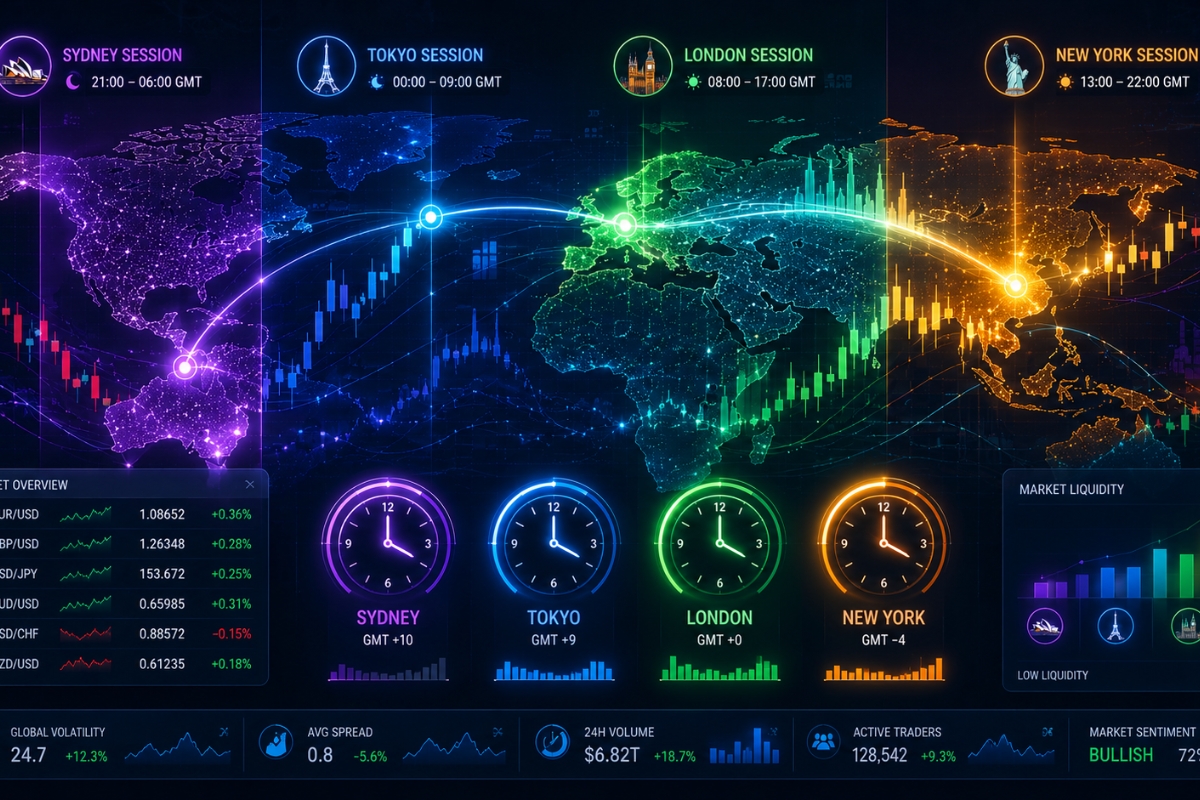
Statistical data proves that over 65% of all daily global forex turnover occurs when these regional blocks are highly active, directly affecting how aggressively a currency pair moves. Recognizing which specific regional session is driving the order book helps traders apply the appropriate strategies for maximum efficiency.
What are the main trading sessions on XM?
The global forex market on XM transitions smoothly through four major geographic operational blocks:
- The Sydney (Asian) Session: Opens at 22:00 GMT, marking the initial opening of the market week, characterized by lower relative volatility.
- The Tokyo (Asian) Session: Runs from 00:00 GMT to 09:00 GMT, dictating the momentum for major Asian and Pacific currencies like JPY, AUD, and NZD.
- The London (European) Session: Opens at 08:00 GMT and closes at 16:00 GMT, injecting massive institutional volume and driving trends for EUR, GBP, and CHF.
- The New York (American) Session: Operates from 13:00 GMT to 21:00 GMT, bringing extreme liquidity as US corporate data and dollar-denominated assets take center stage.
While all four windows present valid setups, professional day traders generally focus their capital deployment on one specific high-volume period.
Which session is best for trading forex on XM?
The London Session is historically the absolute best window for trading forex on XM due to its massive concentration of institutional liquidity, accounting for approximately 35% to 40% of total daily transaction volume. During this session, the major European currency pairs exhibit clean, sustainable directional trends and minimal market noise, allowing for high-probability technical breakouts. Furthermore, transaction costs reach their lowest daily levels during this period because heavy bank participation naturally compresses bid-ask spreads to near-zero levels on competitive accounts.
Understanding when these macro forces are active allows you to strategically schedule your entries around optimized timeframe combinations. After learning about XM’s trading hours, you can also refer to our Fractal Trading Strategy.
Best trading time on XM for different strategies
The best trading time on XM occurs during the London-New York overlap (13:00 GMT to 16:00 GMT), where both major financial centers are simultaneously open, creating the absolute highest volume and volatility of the day.

This critical 3-hour window represents the peak of global liquidity, making it the ideal environment for trend-following and breakout strategies. Conversely, different trading methodologies, such as range-bound scalping, thrive in lower-velocity environments, meaning your ideal trading schedule must be directly matched to your personal technical approach.
When is the best time to place trades on XM?
The optimal time to place trades depends entirely on the design of your underlying system:
- For Trend-Following & Breakouts: Execute positions during the London/New York Overlap (13:00 – 16:00 GMT), when volume spikes ensure that breakouts have genuine institutional follow-through.
- For Range Trading & Mean Reversion: Deploy capital during the late Asian Session (02:00 – 06:00 GMT), when pairs like EUR/USD stabilize within predictable horizontal support and resistance boundaries.
- For Major News Exploitation: Monitor the initial 30 minutes of the New York session open, when high-impact US macroeconomic reports (like Non-Farm Payrolls) are officially released.
While finding the correct entry window is vital, knowing when to completely walk away from your charts is equally important for long-term capital preservation.
When should traders avoid trading on XM?
Traders should actively avoid placing orders during the Sunday market open (22:00 – 23:00 GMT) and the Friday market close (20:00 – 21:50 GMT), as well as the daily rollover period (22:00 EET). During these specific micro-windows, global institutional liquidity drops to near-zero levels, causing typical bid-ask spreads to widen significantly. Executing positions during these low-volume periods exposes your account to unnecessary slippage and premature stop-loss stopouts, making it much safer to remain flat in cash.
To keep these exact operational hours perfectly accurate throughout the year, you must adjust your daily calculations for seasonal calendar changes.
Time zone, daylight saving and XM trading schedule
Time zones and daylight saving time (DST) adjustments directly alter the real-world XM trading schedule twice a year, shifting the relative local opening and closing times for traders worldwide.

Because XM synchronizes its platform infrastructure with Eastern European Time (EET), the server automatically transitions between GMT+2 in the winter and GMT+3 in the summer. Failing to track these seasonal time shifts can lead to costly operational mistakes, such as missing major economic data releases or miscalculating session overlaps.
How does time zone affect XM market hours?
Your geographical time zone does not alter the absolute operational hours of the global interbank network, but it completely changes when those hours appear on your local clock. For example, a trader based in Vietnam (ICT, GMT+7) will experience the weekly market opening at 05:05 AM on Monday morning, whereas a trader based in London (GMT) will see that exact same opening tick at 10:05 PM on Sunday evening. Properly calculating this regional offset ensures you are awake and alert exactly when your preferred session liquidity arrives.
Beyond simple geographic differences, you must also account for seasonal changes implemented by global governments.
Does daylight saving time change XM trading hours?
Yes, Daylight Saving Time (DST) shifts XM trading hours by exactly one hour twice a year, automatically adjusting the platform server between standard winter time and daylight summer time. In March, when Europe and the US shift their clocks forward, the XM server transitions to GMT+3, causing the local opening time for Asian-based traders to shift one hour earlier.
In conclusion, mastering XM market hours helps you trade at optimal times, reduce costs, and improve entry accuracy. Stay updated with market timing and tools on the MBroker homepage to enhance your trading performance.

Thoren Vextal is a specialist in XM trading guides, offering practical insights and real-market experience to help traders improve their strategies and trading performance. Email: [email protected]