
 Tiếng Việt
XM offers commodity trading through CFDs (Contracts for Difference) on instruments such as agricultural products, energies and metals, allowing traders to speculate on price movements without owning the underlying asset. These positions are opened and closed through XM’s supported trading platforms using a live trading account.
XM commodity CFDs sit alongside separate asset classes such as precious metals, energy products and stock indices, each with distinct contract specifications. Gold and oil, for example, are often categorized separately from soft commodities like coffee or sugar within XM’s product range.
Trading hours for XM commodity CFDs follow the underlying futures market sessions, generally active on weekdays, with each instrument having its own specific opening and closing times that traders can review in their account platform. Holiday schedules and session breaks vary by product and require verification before placing trades.
XM’s commodity CFD conditions include variable spreads and platform access through MT4 and MT5, with leverage that generally varies according to account type and client classification, as outlined on XM’s Trading Conditions page. This description is a general illustration of how leverage conditions are structured rather than a confirmed set of figures, and the specific tiering, ratios and thresholds tied to account equity are subject to confirmation on XM’s official page. Exact leverage figures, costs and margin requirements are confirmed directly on the trading platform, since these details change over time and the official page reflects the most current values.
This guide from Mbroker breaks down the commodity instruments available through XM, their contract specifications and how these products function within a CFD trading structure. The next section explains what commodities trading through XM actually involves.
What Is Commodities Trading Through XM?
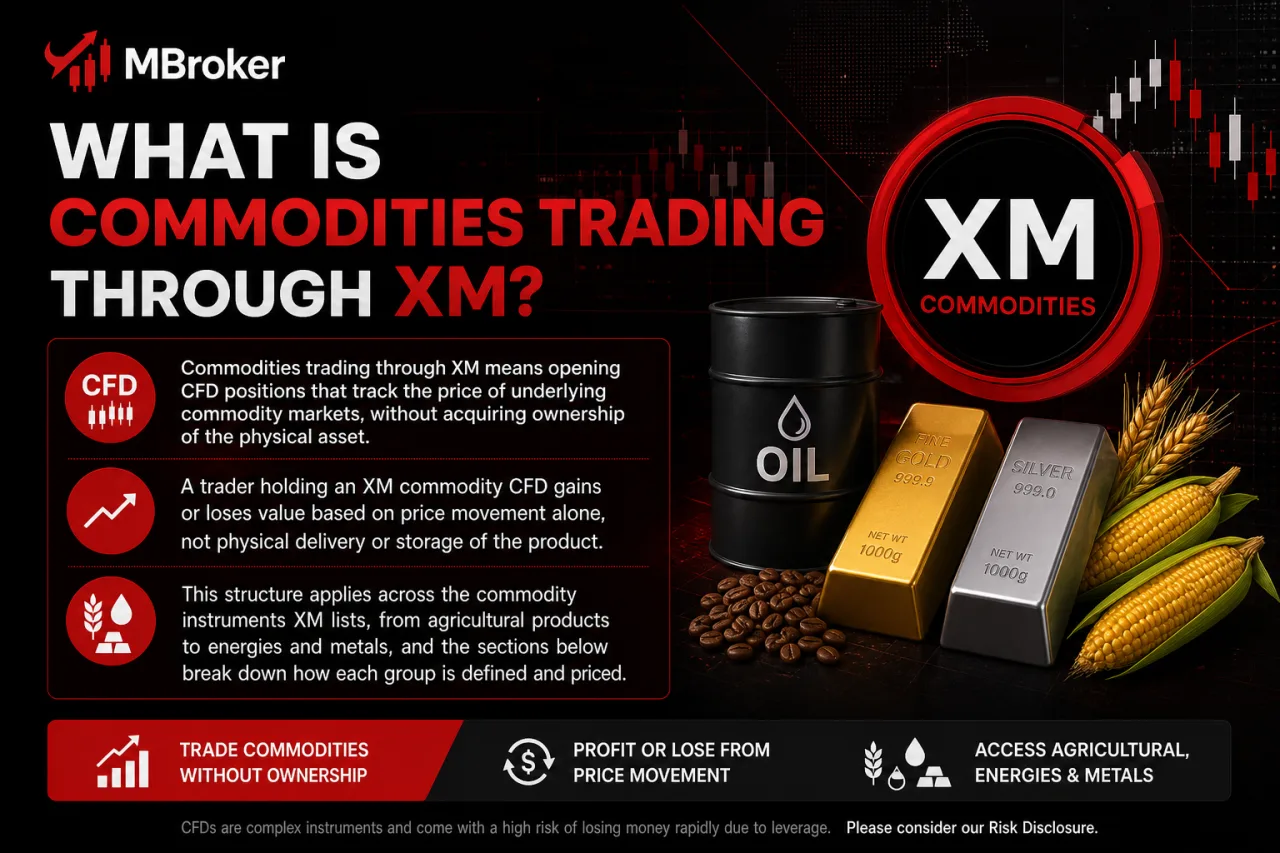
Commodities trading through XM means opening CFD positions that track the price of underlying commodity markets, without acquiring ownership of the physical asset. A trader holding an XM commodity CFD gains or loses value based on price movement alone, not physical delivery or storage of the product.
This structure applies across the commodity instruments XM lists, from agricultural products to energies and metals, and the sections below break down how each group is defined and priced.
The underlying reference for these CFDs is typically a futures market, meaning XM’s quoted price mirrors the relevant futures contract rather than a spot physical market. No certificate of ownership, warehouse receipt or physical settlement is involved at any point in the trade lifecycle.
Availability of specific commodity CFDs, along with the XM legal entity offering them, differs by region and regulatory jurisdiction. XM operates through multiple regulated entities, and the exact list of tradable commodity instruments may vary depending on which entity services a given client.
Traders confirm which commodity CFDs their account can access directly within the XM trading platform before placing any order.
What Asset Class and Underlying Markets Do XM Commodities Belong To?
XM commodities fall under a single asset class with three underlying market groups: agricultural products, energies and metals. Each group tracks a different physical market through CFD pricing, and the sections below break down what defines each grouping within XM’s product range.
Agricultural commodity CFDs reference crops such as coffee, sugar or wheat, priced off the corresponding futures market. Energy commodity CFDs track fuels including crude oil variants and natural gas, distinct from the metals grouping covered separately in this guide. Metals-linked commodity CFDs at XM cover industrial metals such as copper, while precious metals like gold typically sit in their own dedicated category rather than the general commodities group.
This distinction matters for traders reviewing contract specifications, since margin requirements, tick values and trading hours differ between agricultural, energy and metals instruments even within the same broad commodities asset class. Account platforms display each instrument’s specific classification before an order is placed.
Are XM Commodities CFDs or Futures-Based Contracts?
XM commodity CFDs are cash-settled contracts referencing underlying futures prices, not exchange-traded futures contracts themselves, as confirmed in XM’s official contract specifications. Traders never take delivery of the futures contract or the physical commodity; the CFD simply tracks the futures price movement.
This structure carries direct implications for how positions behave over time, since the reference market itself expires periodically even though the CFD wraps around it.
- Cash CFD structure means the position settles in cash based on price difference, not physical or futures delivery.
- Futures-referenced pricing means the CFD quote follows the nearest active futures contract for that commodity.
- Expiration handling applies because the underlying futures contract periodically expires, requiring the CFD to roll to the next contract month.
- Rollover adjustment occurs on the platform when this transition happens, which can affect open position pricing depending on the instrument.
Traders confirm each commodity’s specific rollover schedule and any related price adjustment directly within their XM trading platform before holding positions across a rollover date, since this timing differs by product and is not standardized across the entire commodities range.
What Commodity Instruments Does XM Offer?
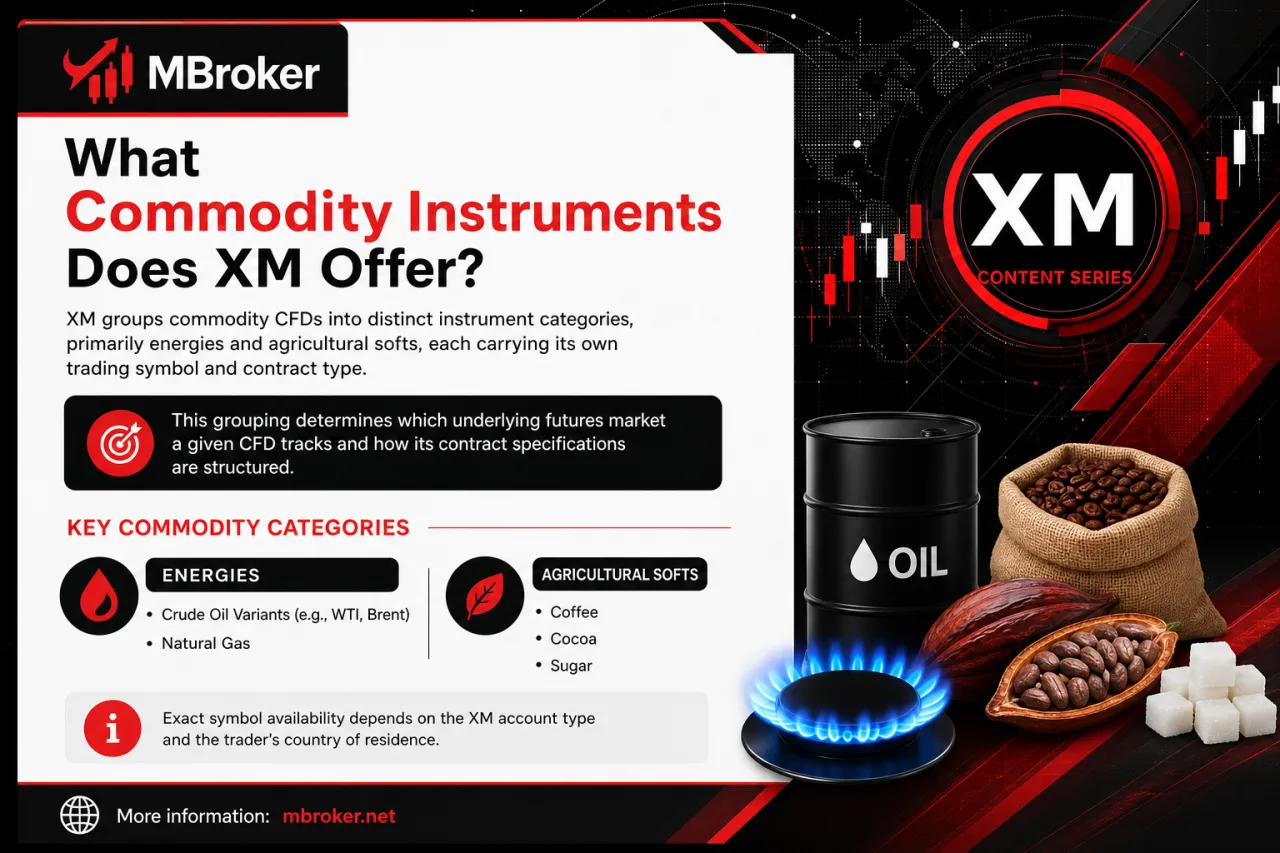
XM groups commodity CFDs into distinct instrument categories, primarily energies and agricultural softs, each carrying its own trading symbol and contract type. This grouping determines which underlying futures market a given CFD tracks and how its contract specifications are structured.
The sections below break down each category, starting with energy instruments such as crude oil variants and natural gas, followed by agricultural softs where offered. Exact symbol availability depends on the XM legal entity servicing a given account, so traders confirm the active instrument list directly within their trading platform before opening a position.
What Are the XM Trading Symbols for Each Commodity Instrument?
Each XM commodity CFD carries a distinct ticker symbol that identifies the underlying futures market on the trading platform, separate from precious metals or index symbols. These symbols appear directly in the MT4 or MT5 Market Watch window once an account has access to the corresponding instrument group.
The table below shows illustrative examples of commonly listed XM commodity instruments and their typical platform tickers. This list is not an official or complete directory of symbols, and exact availability depends on the servicing legal entity and account type.
| Commodity Instrument | Underlying Market | XM Symbol (illustrative example) |
|---|---|---|
| Crude Oil (WTI) | Crude oil futures | USOIL / OIL.WTI |
| Brent Crude Oil | Brent futures | UKOIL |
| Natural Gas | Natural gas futures | NATGAS |
| Coffee | Coffee futures | COFFEE |
| Sugar | Sugar futures | SUGAR |
| Cocoa | Cocoa futures | COCOA |
| Wheat | Wheat futures | WHEAT |
| Copper | Copper futures | COPPER |
Symbol naming conventions can differ slightly between MT4 and MT5, and between XM’s regulated entities, so the exact ticker string traders see in their account may not match the labels above.
Traders confirm the precise symbol, contract specifications and availability for their account directly within the Market Watch panel or contract specification sheet before placing an order. The table serves only as a general reference point for understanding how XM organizes commodity tickers, not as a source for order entry.
What Are the Contract Specifications for XM Commodity CFDs?
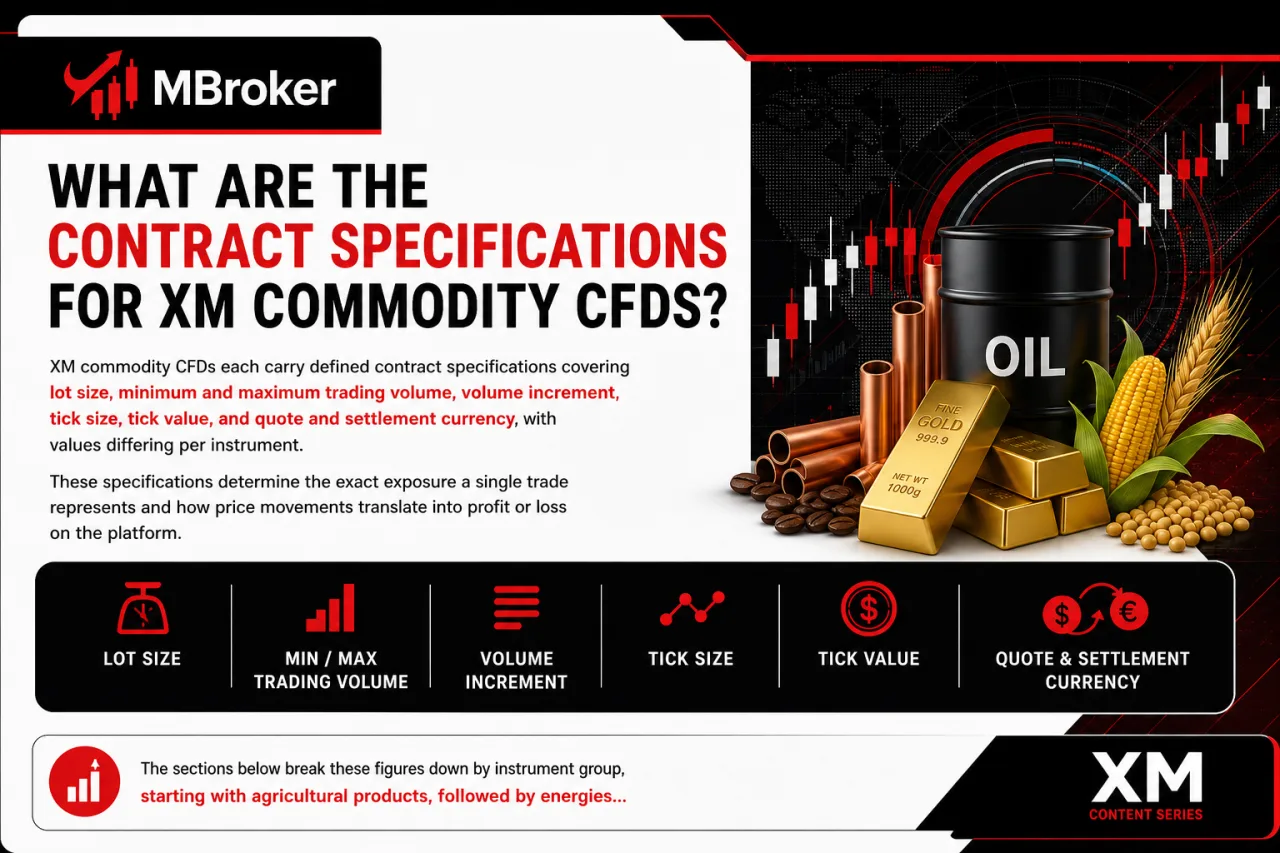
XM commodity CFDs each carry defined contract specifications covering lot size, minimum and maximum trading volume, volume increment, tick size, tick value, and quote and settlement currency, with values differing per instrument. These specifications determine the exact exposure a single trade represents and how price movements translate into profit or loss on the platform.
The table below summarizes typical contract specification categories that traders review before opening a commodity position, organized by instrument group, with illustrative examples included for reference only.
| Instrument Group | Contract/Lot Size | Min/Max Volume | Tick Size | Tick Value | Quote Currency |
|---|---|---|---|---|---|
| Agricultural products | Example: 1 lot may represent a set quantity of the underlying crop | Example: minimum volume often starts near 0.01 lots | Example: price moves in small fractional increments | Example: tick value scales with lot size and tick increment | USD (typical) |
| Energies | Example: 1 lot may represent a set number of barrels | Example: minimum volume often starts near 0.01 lots | Example: price moves in small fractional increments | Example: tick value scales with lot size and tick increment | USD (typical) |
| Metals | Example: 1 lot may represent a set number of ounces | Example: minimum volume often starts near 0.01 lots | Example: price moves in small fractional increments | Example: tick value scales with lot size and tick increment | USD (typical) |
The examples above illustrate the type of detail found on a specification sheet and do not represent official figures. Actual lot sizing, volume limits, tick size, and tick value differ from one instrument group to another and even between instruments within the same group.
Traders confirm the current specification sheet directly within their XM account before sizing any position, as these figures are subject to change without prior notice on this page. This table reflects a general structure only and does not substitute for the exact values published on the official XM platform (reviewed as of the article’s last update date).
What Leverage and Margin Requirements Apply to XM Commodities?
Leverage on XM commodity CFDs follows tiered ratios that decrease as account equity rises, starting at higher ratios for lower equity brackets and stepping down at defined thresholds. This tiering structure directly determines the margin required to open and maintain a commodity position.
Margin requirements scale inversely with leverage, meaning a lower leverage tier locks up proportionally more account equity per lot traded. Several factors shift these figures for a given trader:
- Account type selected influences the base leverage tier applied to commodity instruments.
- Client classification, such as retail or professional status, changes maximum leverage limits under the servicing entity’s regulatory framework.
- Legal entity servicing the account determines which leverage cap and margin schedule apply, since regulatory rules differ by jurisdiction.
- Instrument-specific margin rate adds a further variable on top of the general leverage tier, since each commodity carries its own base margin percentage.
Leveraged commodity trading amplifies both gains and losses relative to the capital deposited, and a position can incur losses exceeding the initial margin under adverse price moves. Traders confirm the exact leverage tier, margin percentage and classification status applicable to their account directly within the XM platform or account dashboard before opening a commodity CFD position, as these figures are reviewed as of the current date and subject to change.
Can You Go Long and Short on XM Commodity CFDs?
Yes, XM commodity CFDs support both long and short positions, letting traders speculate on rising or falling prices without holding the underlying futures contract. This bidirectional structure applies uniformly across agricultural, energy and metals CFDs covered earlier in this guide.
A long position profits when the commodity’s underlying futures price rises above the entry level, while a short position profits when that price falls below entry. Three factors define this availability on XM’s platforms:
- Order type selection on MT4 or MT5 determines whether a trader opens a buy (long) or sell (short) position at the point of execution.
- Margin requirement applies equally to long and short positions, since both directions lock up account equity based on the same leverage tier discussed previously.
- Overnight financing charges accrue on either direction depending on the instrument and position size, differing between long and short holdings for some commodities.
No directional restriction limits commodity CFDs to buying only, since the CFD structure itself is designed to track price difference rather than physical ownership. Traders confirm any temporary short-selling limitation, margin change or instrument-specific condition directly within their XM account before opening a position in either direction.
How Do XM Commodities Compare to Precious Metals, Energies and Indices?
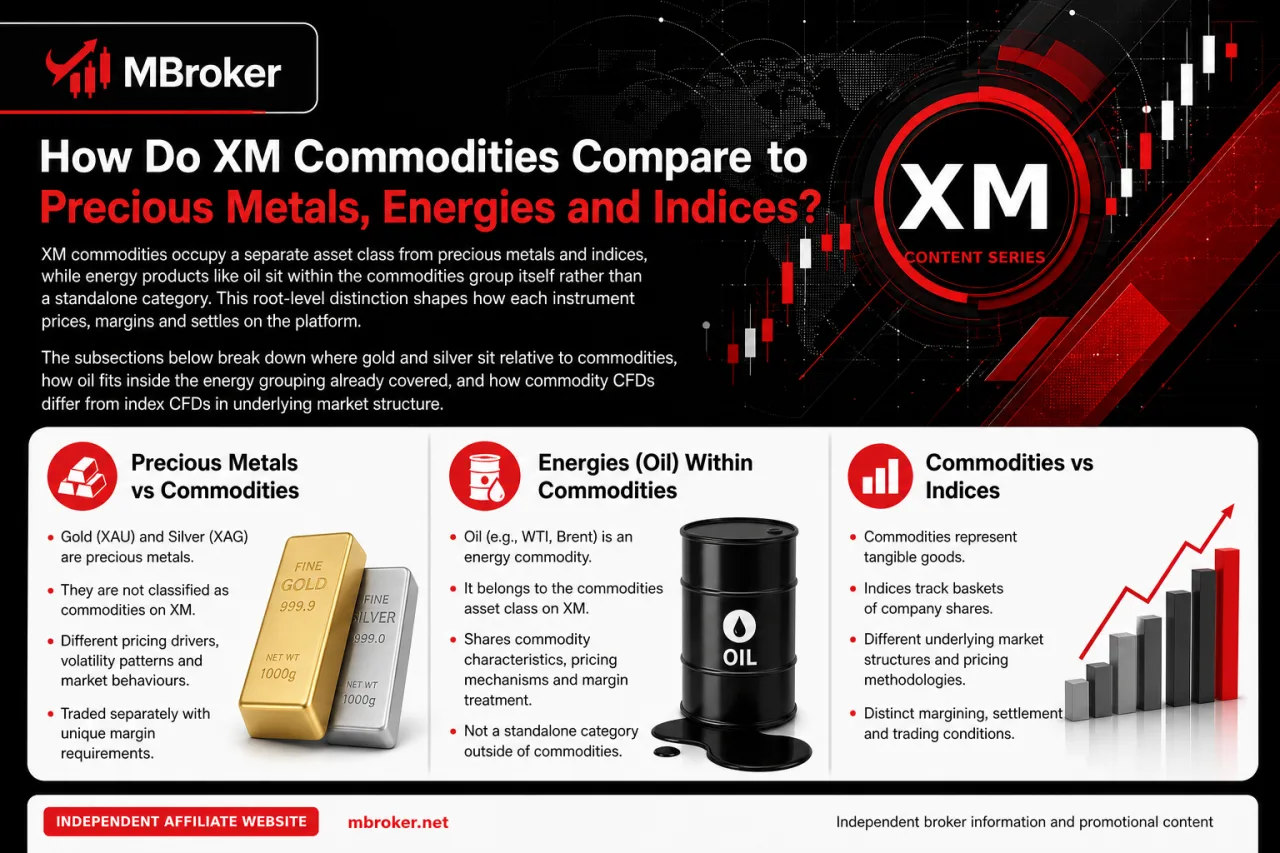
XM commodities occupy a separate asset class from precious metals and indices, while energy products like oil sit within the commodities group itself rather than a standalone category. This root-level distinction shapes how each instrument prices, margins and settles on the platform.
The subsections below break down where gold and silver sit relative to commodities, how oil fits inside the energy grouping already covered, and how commodity CFDs differ from index CFDs in underlying market structure.
Are XM Precious Metals Considered Part of Commodities Trading?
No, XM precious metals such as gold and silver sit in a separate asset category from commodities, distinct from the agricultural and energy groupings covered earlier in this guide. This classification question comes up often since gold and oil sometimes appear together on other platforms, so clarifying XM’s own structure matters here.
Three points explain this separation on XM’s platform:
- Category placement lists gold and silver under a dedicated metals or precious metals tab rather than inside the general commodities group.
- Contract specifications for precious metals, including tick value and margin rate, follow their own schedule separate from agricultural or energy instruments.
- Underlying market reference for gold and silver tracks spot or futures pricing distinct from the futures curves used for oil, natural gas or soft commodities.
Industrial metals like copper remain grouped with commodities, while gold and silver do not, so traders check the platform’s category label before assuming a shared classification. Confirming this placement directly within the XM account avoids confusion when comparing margin requirements or contract specifications across instrument groups.
How Do XM Energy Products Differ from Other Commodity CFDs?
XM energy products differ from other commodity CFDs mainly through faster rollover frequency, since crude oil and natural gas track fast-rolling futures curves while agricultural softs follow slower delivery cycles. This is the core distinction that separates energy instruments from metals and softs on the platform.
Energy CFDs such as crude oil variants reference futures contracts with shorter time-to-expiry windows compared to metals like copper. Agricultural instruments including coffee, sugar or wheat follow harvest-linked futures calendars, which produces a slower rollover rhythm than energies.
Beyond this timing difference, tick value and margin rate also vary by instrument group, since oil and natural gas carry separate contract specifications from softs and metals.
The detailed mechanics of how rollover and price adjustments apply to open positions are covered separately below. Traders confirm each instrument’s specific rollover schedule directly within their XM trading platform before holding a position across an expiration date.
What Are the Trading Hours and Market Sessions for XM Commodities?
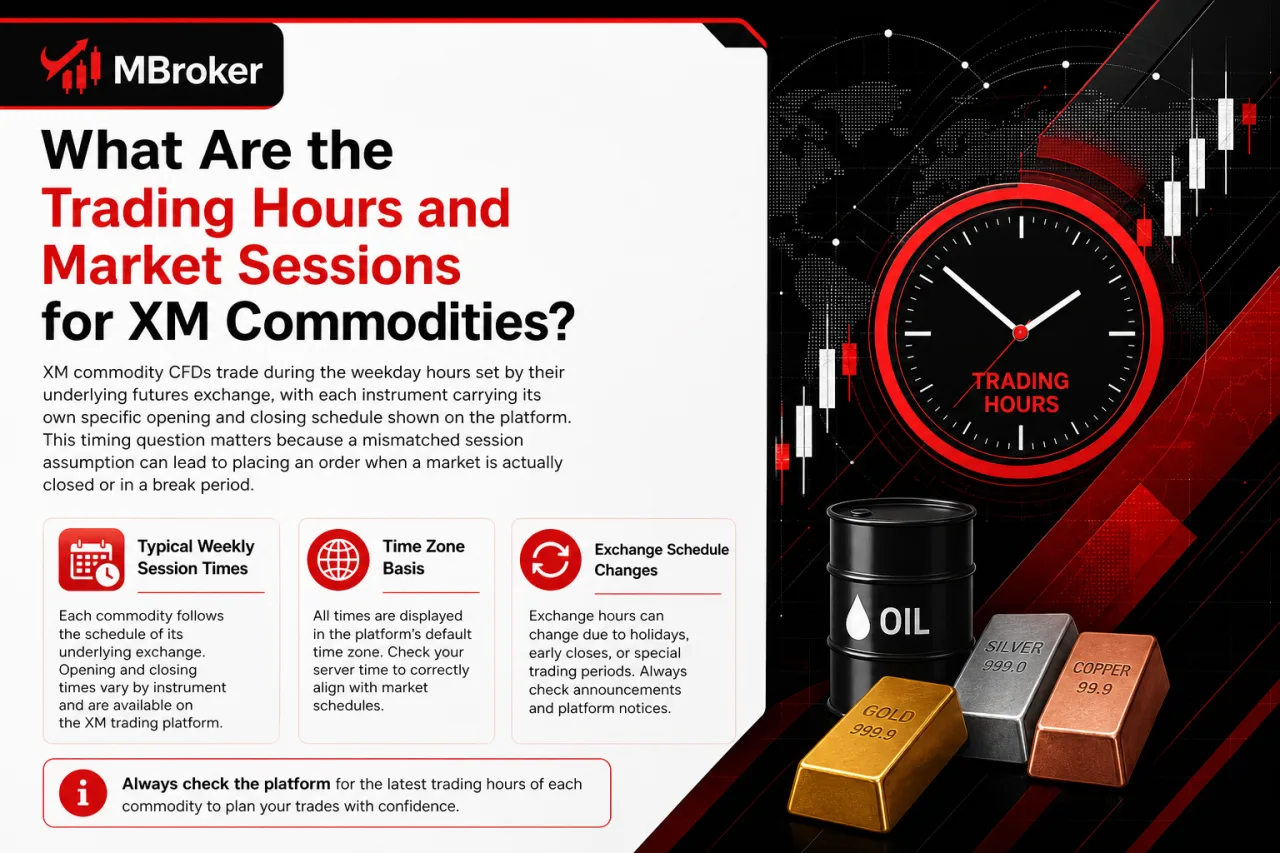
XM commodity CFDs trade during the weekday hours set by their underlying futures exchange, with each instrument carrying its own specific opening and closing schedule shown on the platform. This timing question matters because a mismatched session assumption can lead to placing an order when a market is actually closed or in a break period.
The subsections below break down typical weekly session times per instrument group, the time zone basis used for these hours, and how exchange schedule changes can shift trading windows on short notice.
What Is the Market Holiday Schedule for XM Commodities?
XM publishes a dedicated holiday trading schedule listing adjusted hours or closures for commodity CFDs around public holidays observed by the underlying futures exchanges. This schedule sits separate from the standard weekly session times covered earlier in this guide.
Holiday closures typically shorten trading hours, delay session opens or suspend trading entirely for a given instrument, depending on which exchange holiday applies to that commodity’s futures market. Energy, agricultural and metals instruments do not necessarily share the same holiday calendar, since each tracks a different underlying futures exchange with its own regional holiday observances.
Three points matter here:
- Notification method for holiday adjustments appears through XM’s official announcements or a dedicated holiday calendar page.
- Instrument-specific impact varies, since one commodity may close early while another trades normally on the same date.
- Update frequency for this schedule changes periodically as exchanges revise their own holiday calendars year to year.
Traders check XM’s official holiday trading schedule directly before placing or holding a commodity CFD position around a public holiday, since closures and adjusted hours differ by instrument and are subject to change without prior notice on this page.
What Are XM’s Trading Conditions for Commodity CFDs?
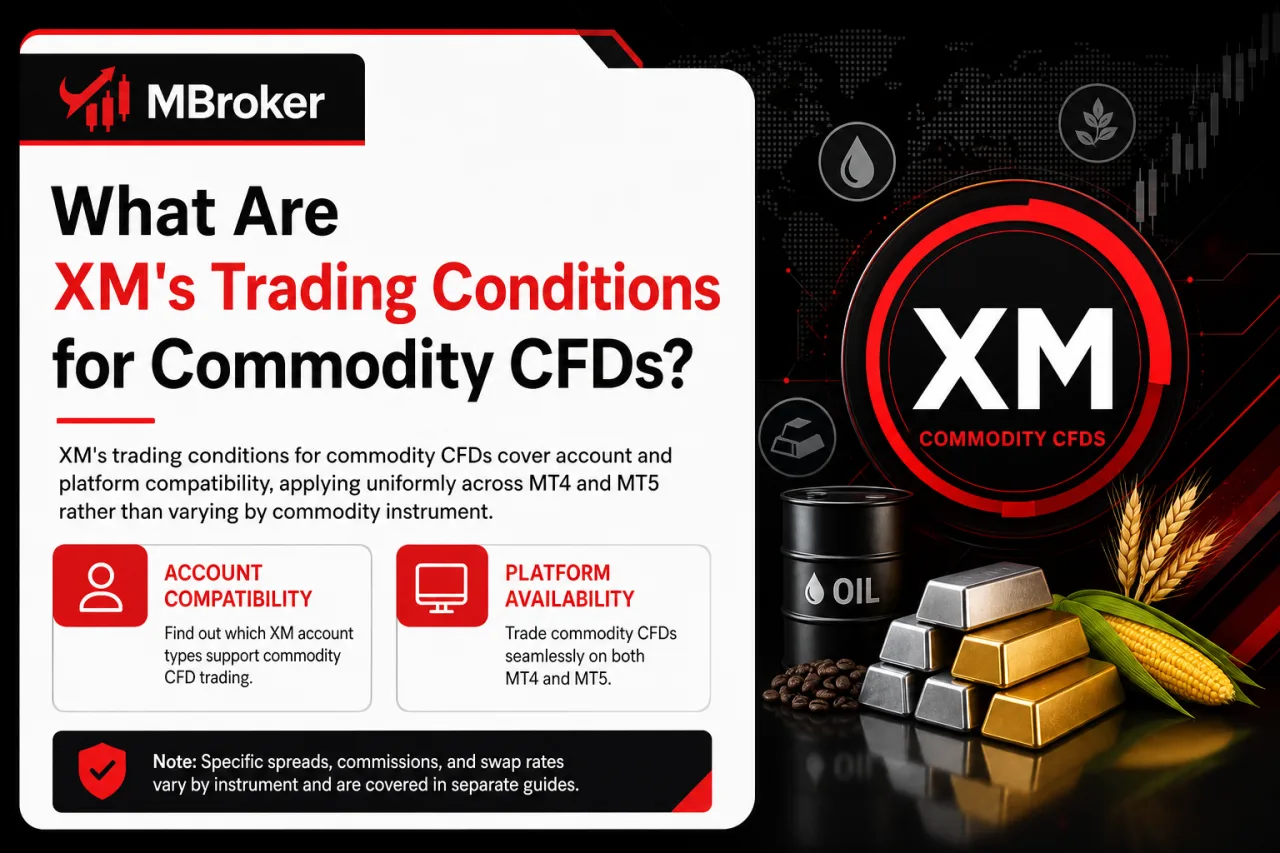
XM’s trading conditions for commodity CFDs cover account and platform compatibility, applying uniformly across MT4 and MT5 rather than varying by commodity instrument. This compatibility question sits separate from the detailed spread, commission and swap figures, which fall under a different content scope entirely.
The subsections below break down which XM account types support commodity CFD trading, followed by platform availability across MT4 and MT5, since these two factors together determine whether a given account actually accesses the instruments covered earlier in this guide. Exact cost figures such as spreads, commissions and overnight swap rates are not detailed here, since those variable trading costs belong to a separate fees-focused resource.
Traders confirm both account eligibility and platform access directly within their XM account dashboard before attempting to open a commodity CFD position, as availability differs depending on the servicing legal entity and account classification.
Which XM Account Types and Platforms Support Commodity CFD Trading?
All standard XM account types available for CFD trading grant access to commodity instruments, provided the servicing legal entity lists that specific commodity for the account’s region. This root-level compatibility question sits apart from the platform question, since account eligibility and platform support work as two separate checks before a commodity CFD order goes through.
Account eligibility typically follows a straightforward pattern across XM’s live account offerings:
- Standard live accounts access the full commodity instrument list available under the servicing entity, subject to regional restrictions.
- Micro or smaller-denomination account variants trade the same commodity instruments, often at reduced minimum volume increments.
- Demo accounts mirror live commodity instrument access for practice purposes, without real capital at risk.
Platform compatibility runs consistently across both MT4 and MT5, since XM lists commodity CFDs on each platform’s Market Watch panel rather than restricting instruments to one platform only. Mobile and web-based versions of both platforms carry the same instrument access as their desktop counterparts.
Traders confirm exact account-type eligibility and platform-specific symbol availability directly within their XM account dashboard before opening a commodity CFD position, since this compatibility differs by servicing legal entity and account classification.
Are There Regional or Entity-Specific Restrictions on XM Commodities?
Yes, XM commodity CFDs carry regional and entity-specific restrictions, since product availability and leverage caps differ depending on which XM legal entity services a given account. This restriction question connects directly to the leverage tiering and account eligibility points covered earlier in this guide.
Three factors drive this variation across XM’s structure:
- Regulatory framework applied by each servicing entity sets its own maximum leverage cap and margin schedule for commodity CFDs.
- Instrument list offered under one entity may exclude certain commodities available under another entity’s regulatory jurisdiction.
- Client classification status, such as retail or professional, shifts available leverage and instrument access within the same entity.
No single global product list or leverage schedule applies uniformly to every XM client, since the servicing entity determines both. Traders confirm the applicable legal entity, available commodity instruments and leverage tier directly within their account dashboard or contract specification sheet before opening a position, as these conditions are subject to change without prior notice on this page.
What Are Some Unique Considerations for Trading XM Commodities?
Some unique considerations for XM commodity CFDs center on futures-based expiration, rollover timing and settlement adjustments rather than the standard lot-size or leverage figures covered earlier. These technical points apply across agricultural, energy and metals CFDs, though the exact mechanics differ per instrument.
The subsections below break down how expiration and rollover work day-to-day, followed by whether any dividend-like adjustment applies to commodity positions, since these two areas raise the most account-specific questions once a trader has already reviewed the core contract specifications.
How Does Contract Expiration and Rollover Work for XM Commodity CFDs?
Contract expiration and rollover for XM commodity CFDs work through an automatic transition from the expiring futures contract to the next active contract month, applied directly on the platform without manual trader action. This process ties back to the futures-referenced pricing structure explained earlier in this guide.
Three elements define this mechanic:
- Expiry date approaching triggers the platform to prepare a shift from the current contract month to the next listed month.
- Position transfer moves the open trade to the new contract at a price reflecting the difference between the expiring and incoming futures quotes.
- Adjustment application credits or debits the account to offset any gap between the two contract prices, keeping the position’s economic value roughly consistent through the roll.
Rollover timing and adjustment size differ by instrument, since energy contracts often roll more frequently than agricultural softs, as covered earlier. Traders confirm the exact rollover date and adjustment method for a specific commodity directly within their XM trading platform before holding a position across an expiration window.
What Risks Are Unique to Leveraged Commodity CFD Trading?
Risks unique to leveraged commodity CFD trading center on geopolitical supply shocks and elevated volatility in energy and agricultural markets, amplified further by the leverage tiers described earlier in this guide. These factors sit apart from standard CFD risks like spread cost or margin calls, since they stem from the underlying physical market itself.
Three factors define this exposure:
- Geopolitical events affecting producing regions trigger sudden price gaps in oil, natural gas or agricultural futures, moving faster than a trader’s stop-loss order executes.
- Weather and harvest disruptions shift agricultural futures prices sharply around planting or harvest windows, unrelated to broader financial market sentiment.
- Leverage amplification magnifies both gains and losses from these price swings, since a small underlying move produces a proportionally larger account impact.
Energy markets in particular tend to show sharp volatility around supply announcements from major producing nations or organizations such as OPEC.
No guarantee exists that these risk factors produce a specific trading outcome. Traders review each commodity’s historical volatility pattern and confirm current margin requirements directly within their XM account before opening a leveraged position.
Conclusion
XM commodity CFDs give traders access to agricultural products, energy markets and industrial metals without owning or taking delivery of the underlying assets. Through MT4 and MT5, traders can open long or short positions, while prices generally track the relevant futures markets. Contract size, tick value, leverage, margin requirements, trading hours and symbol availability vary by instrument, account type and XM legal entity.
Before placing a trade, traders should verify the latest contract specifications, holiday schedule and rollover dates directly on the XM platform. Commodity prices can move sharply because of geopolitical events, supply disruptions, weather conditions and changes in global demand, while leverage can magnify both gains and losses. Beginners should practise with a demo account, use conservative position sizes and apply disciplined risk management before trading XM commodity CFDs with real funds.

Sylas Trenven is a forex strategist who helps traders master risk and timing. His work focuses on behavior-driven market entries and portfolio optimization for XM users looking to trade with precision and discipline. Email: [email protected]