
 Tiếng Việt

Bid ask spread is the difference between the Bid price (sell) and the Ask price (buy), which represents the fundamental trading cost every trader pays when opening a position.
In forex, spread typically ranges from 0.6 to 1.5 pips depending on the currency pair and market conditions. However, it can fluctuate based on liquidity and trading sessions.
An effective strategy is to trade during low-spread periods and use XM accounts with tighter spreads, helping reduce costs and maximize profitability.
The Bid price is where you sell and the Ask price is where you buy, and this difference determines the break-even point of every trade.
Reading and using the spread correctly helps traders optimize entry points and manage risk effectively, especially when trading on MT4 or MT5 platforms.
Bid ask spread is a core factor that directly impacts trading costs and overall profitability. Understanding what spread is, how it works, and how to optimize it can significantly improve your performance when trading on XM.
What is Bid Ask Spread in trading and how it works?
The Bid Ask Spread is the absolute numerical difference between the highest price a buyer is willing to pay for an asset (the Bid) and the lowest price a seller is willing to accept for that same asset (the Ask).

Statistically, this spread represents the primary transactional friction in modern electronic markets, functioning as a real-time gauge of market liquidity and order book depth. A highly liquid asset like the EUR/USD currency pair typically maintains an ultra-narrow spread of just 0.1 to 1.5 pips, whereas exotic currency pairs or illiquid equities can see spreads widen beyond 20 to 50 pips, making it a mandatory metric to calculate before deploying capital.
What is Bid and Ask price in forex?
In the foreign exchange market, currency pairs are always quoted in tandem, consisting of two separate prices updated simultaneously in milliseconds. The Bid price represents the immediate market rate at which a trader can sell the base currency, while the Ask price (often referred to as the offer price) represents the precise market rate at which a trader can buy the base currency. Because financial institutions demand a premium to facilitate immediate transaction fills, the Ask price is mathematically fixed at a higher value than the Bid price, ensuring that the market maker always buffers risk.
Understanding this dual-price quotation directly explains the existence of the overarching broker pricing structure.
What is spread in finance and why it exists?
The spread exists in finance primarily as a natural compensation fee for market makers, liquidity providers, and electronic communication networks (ECNs) that take on risk to maintain continuous market order flow. Without this structural pricing gap, financial institutions would have zero economic incentive to commit massive capital pools to guarantee immediate trade executions. The spread effectively bridges the structural imbalance between uncoordinated buyers and sellers, absorbing the instantaneous risk of market volatility while serving as the foundational revenue model for global brokerage clearers.
Once you comprehend why this structural fee exists, you must analyze the exact pricing mechanism that drives execution speed and order fills.
Bid vs Ask difference and pricing mechanism
The underlying pricing mechanism behind the bid vs ask difference is governed strictly by the real-time supply and demand forces shifting within a broker’s electronic order book.
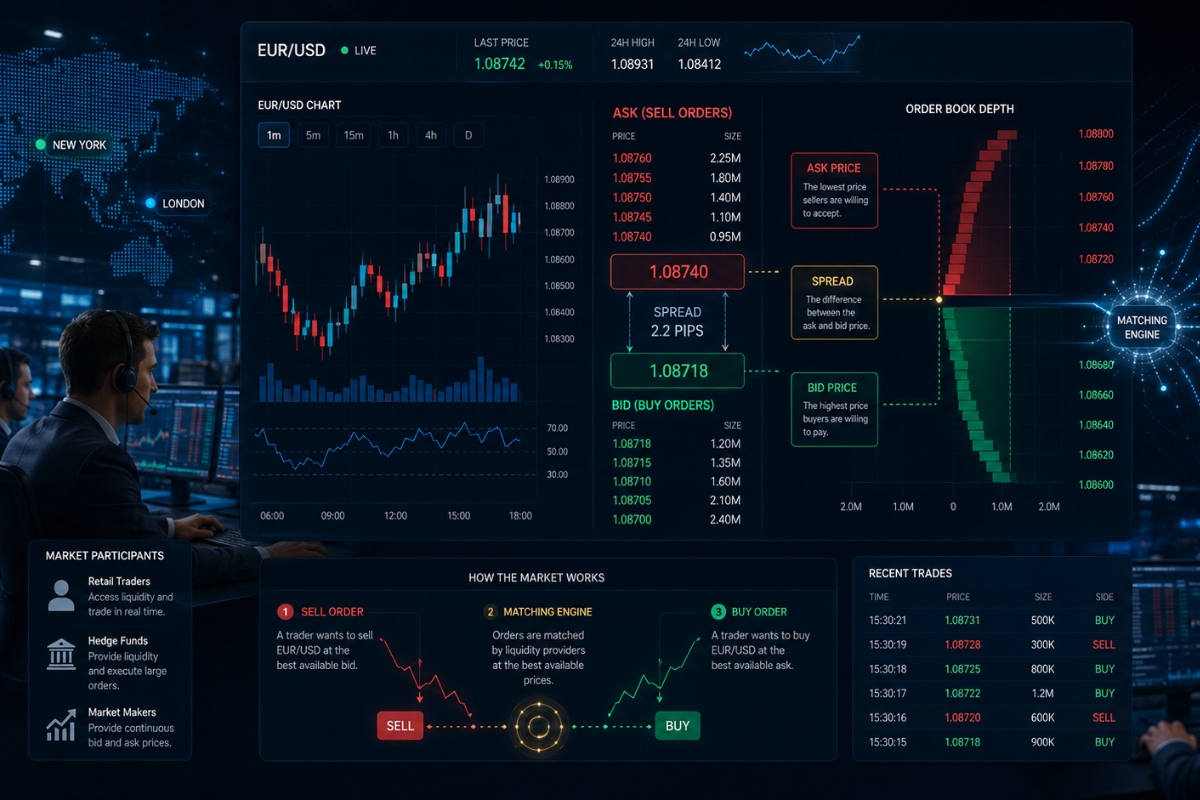
When a retail trade order is submitted, it does not execute in an abstract vacuum; instead, it is matched directly against the resting limit orders provided by major tier-1 investment banks and liquidity aggregators. The absolute size of this structural price gap expands or contracts dynamically based on total transaction volume, systemic risk parameters, and the immediate processing speed of the underlying exchange engine.
How does bid vs ask affect trade execution?
The operational gap between the bid and ask prices introduces an instantaneous, minor negative floating balance the exact microsecond a trade is executed. For example, if you open a long (buy) position, your trade is automatically filled at the higher Ask price, but the market terminal evaluates your position’s liquidation value using the lower Bid price. Consequently, the underlying asset’s market price must move upward by a distance equal to the initial spread just for the position to reach a 0.00 break-even threshold, making tight execution metrics absolutely vital for short-term scalpers.
This execution dynamic is never fixed, as it adapts rapidly to the broader health of global financial liquidity networks.
Why does spread change in different market conditions?
Spreads fluctuate dynamically because liquidity providers modify their risk premiums based on real-time market stability and order book volume. During periods of low market activity or high macroeconomic uncertainty, tier-1 banks withdraw their resting limit orders from the book, causing market depth to collapse and the spread to widen dramatically to protect their capital from toxic order flows. Conversely, during high-volume overlapping trading sessions, hundreds of competitive institutions pour capital into the book, narrowing the spread to microscopic levels due to intense pricing competition.
To witness this dynamic in a highly optimized retail setting, we can analyze how major international multi-regulated brokers manage these exact quotation flows.
Bid ask spread in forex trading on XM
XM applies the bid ask spread in forex trading by functioning as a massive liquidity aggregator, sourcing real-time price feeds from top-tier international banking institutions to deliver highly competitive, fractional pip pricing.
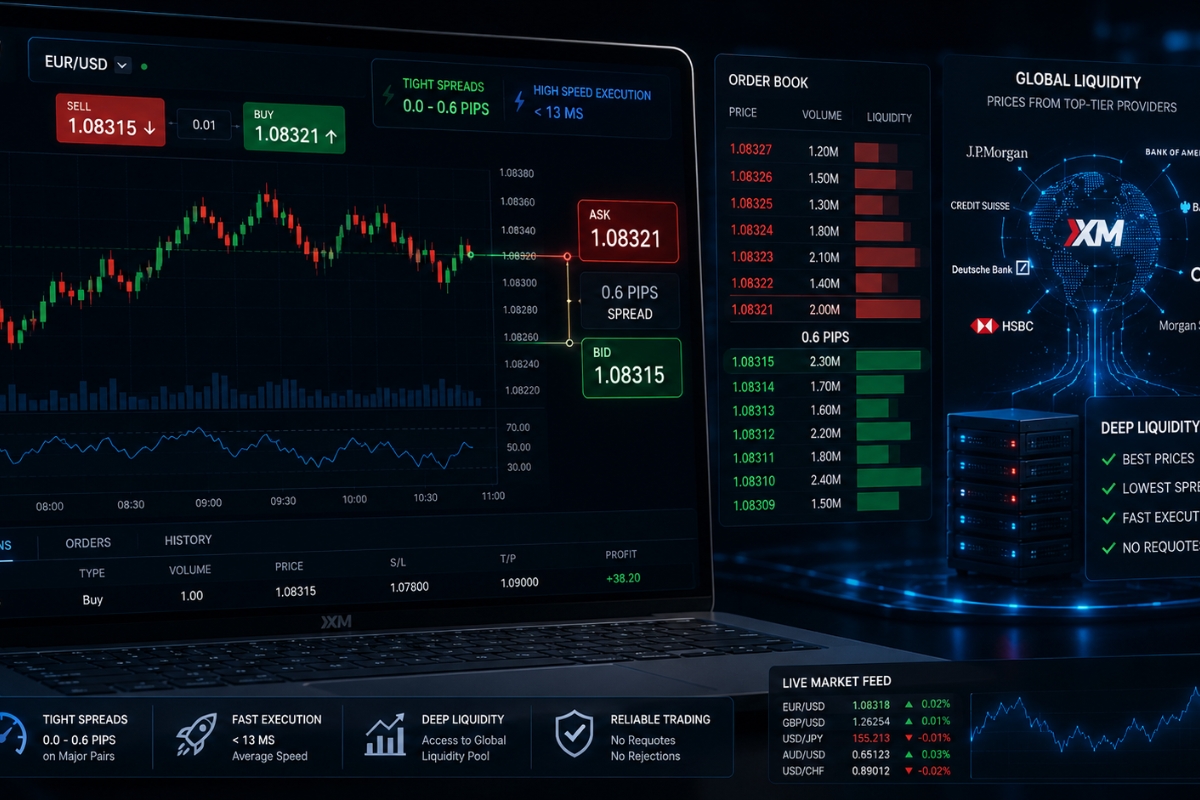
Across its various account types, XM utilizes a dynamic, variable spread model that actively compresses during peak market hours, with spreads on major pairs dropping as low as 0.6 pips on Standard accounts and an absolute 0.0 pips on specialized Ultra-Low infrastructure configurations. This transparent pricing architecture ensures that retail traders can execute high-frequency strategies without their profit margins being eroded by hidden markup fees. Additionally, you can also check out the XM Fees Deposit/Withdrawal transactions.
How does XM apply spread in forex trading?
XM processes spreads by utilizing automated smart order routing systems that instantly scan available liquidity pools to present the tightest possible Bid and Ask lines to your terminal. On standard account profiles, the broker combines the raw institutional spread with a minor, transparent internal markup that covers clearing costs and automated risk management. For high-volume traders who prefer zero markups, the broker routes orders directly to ECN pools via specialized low-spread accounts, substituting standard markups with a fixed, transparent commission fee per lot traded.
While this system guarantees superior execution speeds, market hours still play an external role in defining your transactional costs.
When is spread highest in forex markets?
Spreads hit their highest absolute levels during periods of severe structural liquidity gaps, most notably during the daily New York to Sydney session rollover (5:00 PM to 6:00 PM EST).
During this specific one-hour micro-window, the world’s largest financial institutions temporarily shut down their primary pricing desks to settle daily balances, causing the available market depth to drop by over 80%. Additionally, spreads experience massive, instantaneous spikes lasting several seconds during high-impact economic data releases, such as the US Non-Farm Payrolls (NFP) or Consumer Price Index (CPI) announcements.
Understanding when these cost expansions occur allows you to adjust your charting terminal to read and visually track these lines in real-time.
How to read and use bid ask spread in trading?
Learning how to read and use the bid ask spread in trading is a mandatory technical skill required to avoid entering high-probability setups at highly inefficient price levels.

In modern electronic charting, failing to visually map both sides of the quotation pair means you are trading half-blind, often leading to unexpected stop-loss liquidations or missed profit targets. By configuring your trading software to display real-time transaction costs, you convert an abstract numerical gap into a highly visual, defensive parameter that refines your trade timing.
How to read bid ask spread on MT4 or MT5?
To successfully view and analyze real-time spreads on the MetaTrader 4 (MT4) or MetaTrader 5 (MT5) platforms, execute these precise structural adjustments:
- Activate the Ask Line: Right-click anywhere on your active price chart, select Properties (F8), navigate to the Common or Show tab, and check the box labeled “Show Ask price line.” This displays a secondary horizontal line moving right above the standard price tracking line.
- Monitor the Market Watch: Press Ctrl + M to open the Market Watch window on the left side of your monitor, right-click inside the asset list, and select “Spread.” This adds a dedicated column showing the exact pip gap in real-time.
- Utilize Crosshair Metrics: Press the middle mouse button to activate the Crosshair tool, click and drag between the two horizontal lines to instantly calculate the precise distance in points or fractional pips.
- Consult Educational Hubs: Utilizing the technical configuration guides and real-time spread monitors featured on the MBroker homepage allows retail traders to audit their platform configurations to ensure accurate, delay-free visual tracking.
Once your platform is correctly calibrated to display these live transactional frictions, you can confidently integrate advanced cost-mitigation trading strategies into your daily portfolio routine.
Bid ask spread strategy for XM traders
A professional bid ask spread strategy for XM traders focuses on executing rules that maximize structural cost-efficiency, minimize slippage, and completely eliminate emotional execution errors.
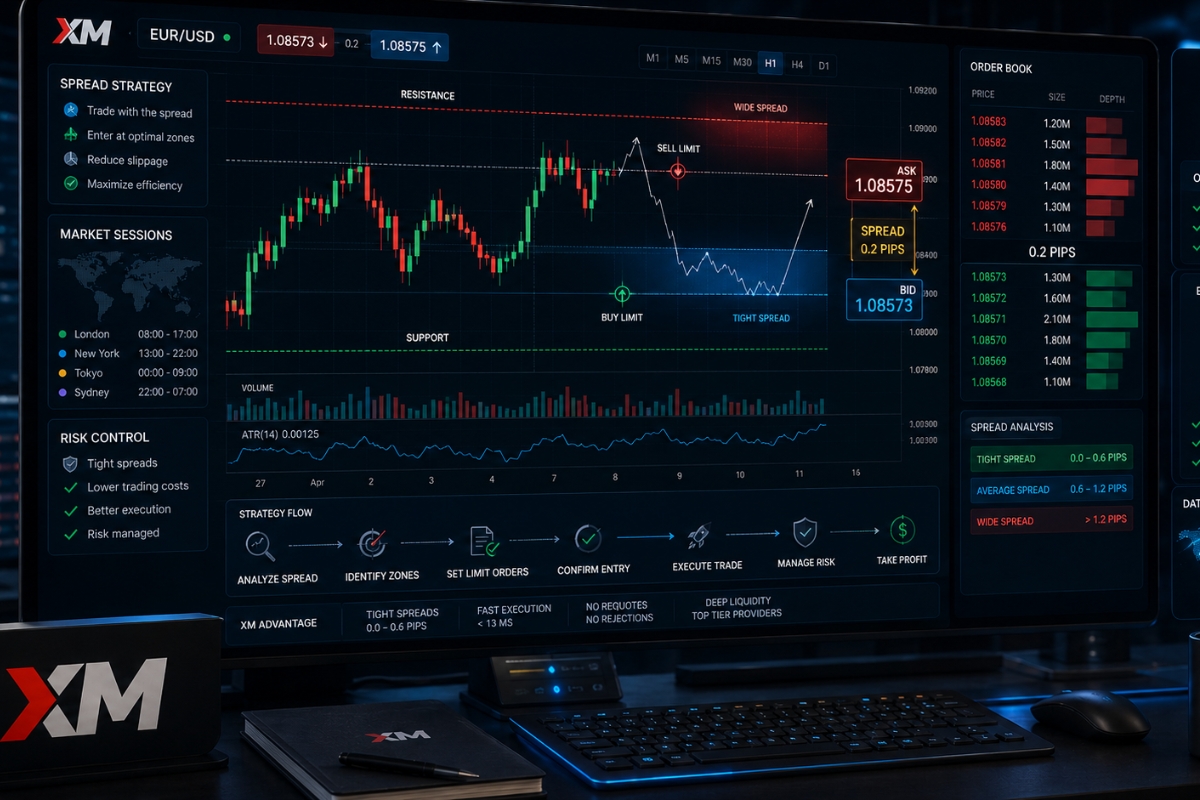
Because every pip paid to the spread represents a direct deduction from your strategy’s gross return, optimizing your trade entries around cost behaviors is just as important as reading price charts. By treating transactional costs as a flexible variable rather than a fixed necessity, you can deliberately structure your entry timings and account choices to secure a permanent mathematical edge.
What is the best trading strategy based on spread?
The most reliable trading strategy engineered around spread dynamics is the Liquidity-Confluence Breakout Strategy, which avoids market order execution during volatile periods and prioritizes limit order placements during high-volume sessions.
- Step 1: Filter Core Trading Hours: Exclusively restrict your live market entries to the peak overlapping hours of the London and New York sessions (8:00 AM to 12:00 PM EST), when global transaction volume peaks and spreads contract to their lowest daily averages.
- Step 2: Avoid Market Order Slippage: Never utilize market orders during major economic news releases or session rollovers. Instead, deploy passive Buy Limit or Sell Limit orders at key structural support and resistance levels.
- Step 3: Buffer Stop-Loss Placement: When setting a defensive Stop Loss for a short position, always add the current spread value plus a 0.5-pip buffer above the structural swing high to prevent your trade from being prematurely stopped out by a minor spread expansion.
- Step 4: Verify Volume Confluence: Before entering a breakout trade, cross-reference the live chart with a volume indicator to ensure that institutional buying pressure is expanding alongside the tight spread, confirming genuine trend momentum.
While executing setups during optimal hours is highly effective, permanently lowering your overhead expenses requires structural account optimization.
How to reduce spread cost in XM trading?
To permanently reduce your overall transactional expenses by up to 60% to 80%, transition your portfolio execution from standard retail structures to professional, low-overhead environments.
- First, migrate your capital into an XM Ultra Low Account, which completely strips away standard retail markups on major pairs, replacing them with raw institutional pricing.
- Second, utilize limit orders instead of stop orders to guarantee that you capture optimal fills without suffering from negative slippage during high-velocity price moves.
- Finally, by managing your broker configurations through the specialized cashbacks, rebates, and optimization frameworks hosted on the XM trading fees, you can rebate a significant portion of your paid spreads directly back into your liquid capital account, maximizing long-term strategic compounding.
In conclusion, the Bid Ask Spread is a fundamental technical pillar of financial markets that directly governs execution profitability and transaction efficiency. By mastering the core difference between Bid and Ask quotation mechanics, avoiding execution during high-spread rollover windows, and applying a disciplined, liquidity-focused strategy, you can insulate your capital from unnecessary costs.

Neria Solven is a financial analyst specializing in XM trading fees and account types, known for her clear and practical insights. Email: [email protected]