
 Tiếng Việt
XM offers equity indices as CFD instruments, allowing traders to speculate on the price movement of major stock market benchmarks without owning the underlying shares. These instruments are available across multiple XM account types and platforms, giving traders exposure to global equity markets through a single position.
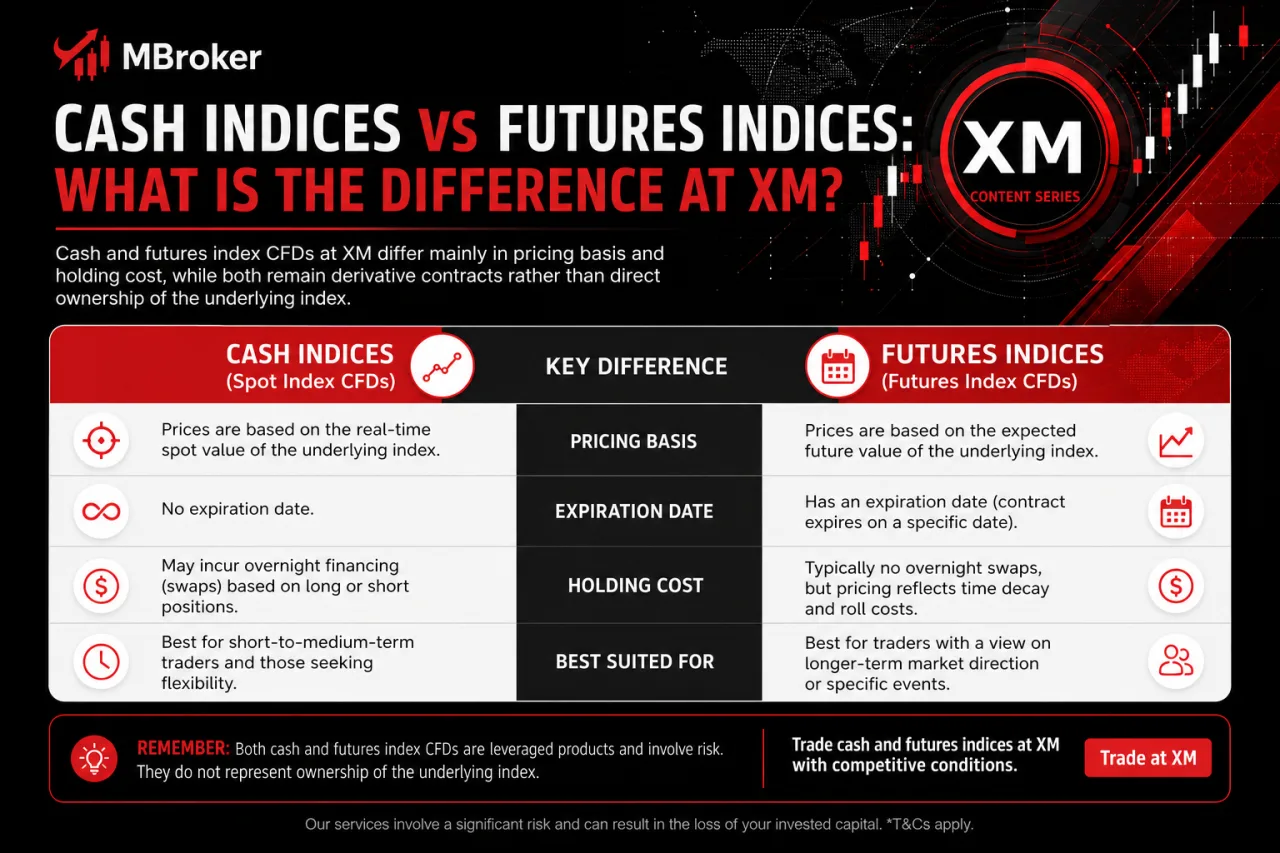
Cash and futures-based index instruments differ mainly in pricing structure and holding cost: cash indices track the real-time spot value of the underlying shares and typically carry an overnight swap charge, while index futures are priced off the index’s expected future value with financing effectively built into the contract price, resulting in little to no separate swap fee. Futures-based indices also come with set expiration dates, unlike cash indices which remain open-ended for continuous trading.
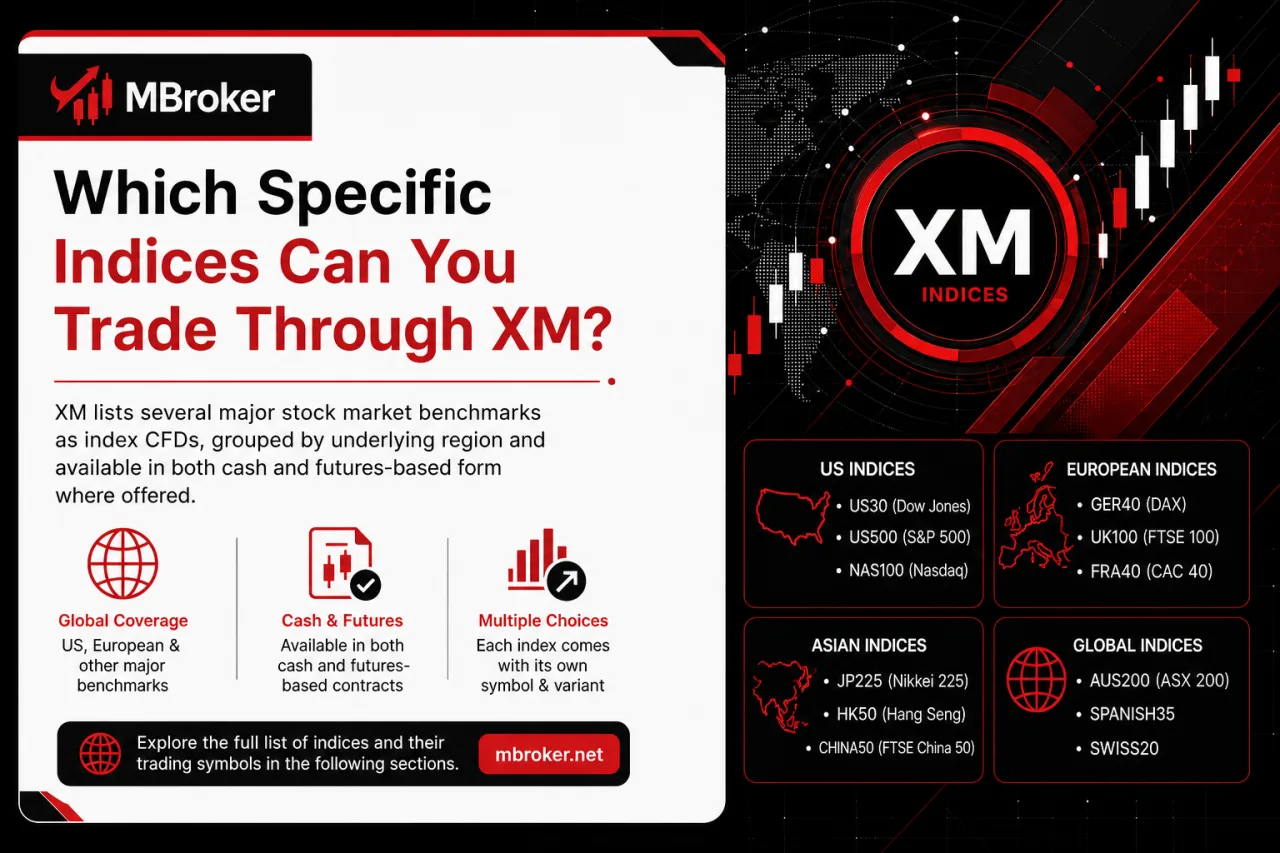
XM offers derivatives on some of the world’s most actively traded stock indices, including the Dow Jones, NASDAQ 100 and S&P 500, alongside other major global cash indices. Each instrument carries its own trading symbol, contract size and margin requirement, which vary by underlying market and product type.
XM’s equity indices selection covers many of the world’s most actively traded stock indices, providing a range of global index exposure comparable to what other major CFD brokers typically offer. However, exact contract specifications, leverage limits and thematic index availability differ depending on the broker and legal entity.
Mbroker breaks down these details further below, starting with how XM indices actually work and what defines this asset class.
What Are XM Indices and How Do They Work?
What Are XM Indices and How Do They Work
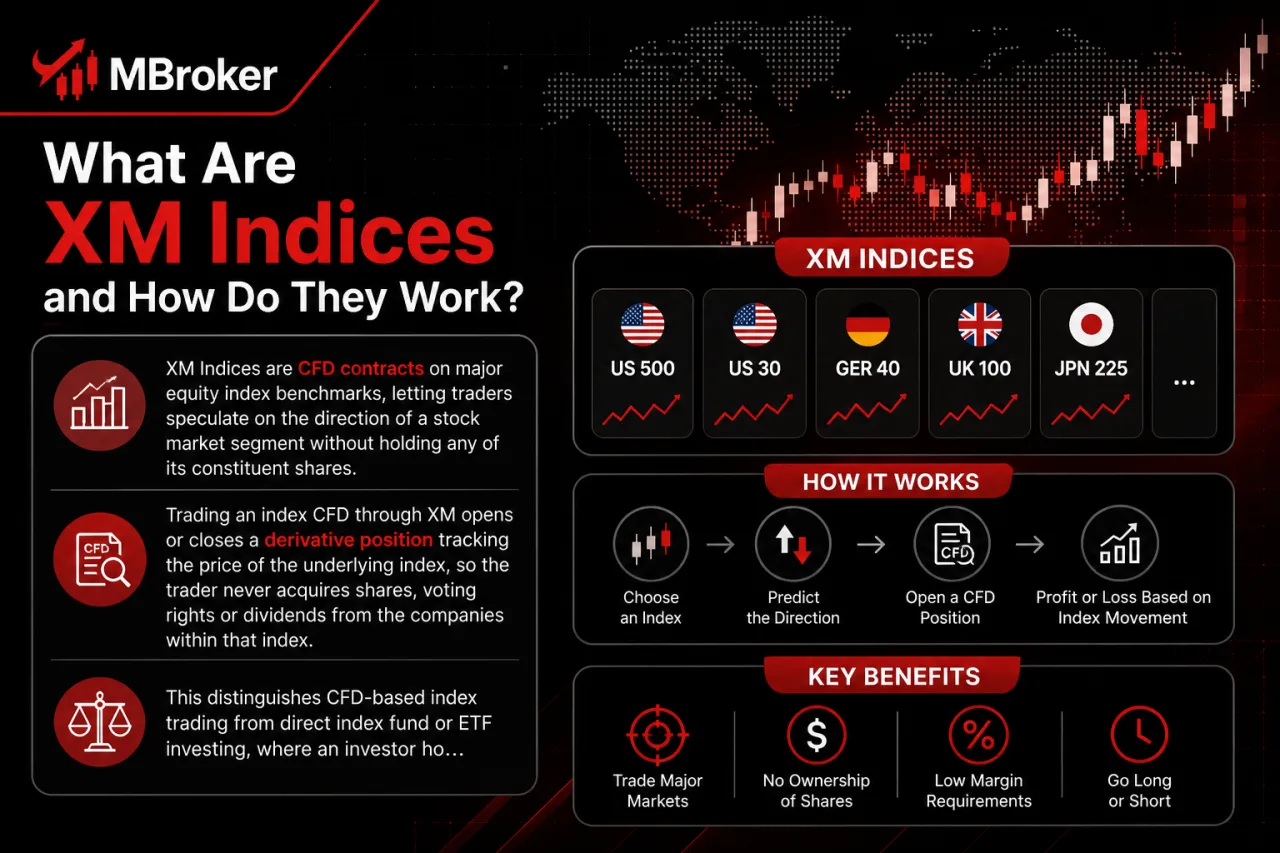
XM Indices are CFD contracts on major equity index benchmarks, letting traders speculate on the direction of a stock market segment without holding any of its constituent shares. Trading an index CFD through XM opens or closes a derivative position tracking the price of the underlying index, so the trader never acquires shares, voting rights or dividends from the companies within that index.
This distinguishes CFD-based index trading from direct index fund or ETF investing, where an investor holds an actual claim on the underlying assets. Within XM’s product range, indices fall under the derivative or CFD asset class, alongside forex, commodities and stock CFDs, a category that is distinct from ownership-based instruments such as shares or fund units and is linked to broad stock market performance rather than a single company.
The general purpose of these instruments is to provide exposure to overall market direction, sector trends or economic sentiment through one position instead of managing a basket of individual stocks. The following sections break down how the cash and futures variants of these index CFDs differ in structure and cost.
What Underlying Markets Do XM Index CFDs Track?
Each XM index CFD mirrors the performance of a stock market benchmark composed of multiple listed companies, without granting direct ownership of any shares. This underlying market question follows naturally from how these instruments track broad segments of the equity market rather than a single company’s stock price.
The underlying benchmark itself is calculated by a third-party index provider based on the combined share prices of its constituent companies, weighted according to market capitalization or another defined methodology. XM’s CFD then references that calculated value, so the position rises or falls in line with the aggregate movement of those listed companies.
Underlying markets covered by XM’s index CFDs include broad national or regional stock market benchmarks, such as US large-cap indices, European equity benchmarks and other major global markets. Each index reflects a specific exchange, country or economic region rather than an individual sector, and the trader’s exposure remains tied to that benchmark’s overall direction, not to any single constituent stock.
Cash Indices vs Futures Indices: What Is the Difference at XM?
Cash Indices vs Futures Indices: What Is the Difference at XM
Cash and futures index CFDs at XM differ mainly in pricing basis and holding cost, while both remain derivative contracts rather than direct ownership of the underlying index. Cash indices track the live spot price of the benchmark. Futures indices price in the market’s expectation of where the benchmark sits at contract expiry. This distinction also affects holding costs and expiration handling, and it shapes which trading style each instrument suits.
The practical distinction becomes clearer when looking at how each instrument behaves during an actual trade:
- A trader watching a cash index sees the price track the benchmark tick by tick throughout the session, closely mirroring the live market as it moves. A futures index trader, by contrast, watches a price that already factors in where the market expects the benchmark to sit at contract expiry, so the number on screen often sits at a premium or discount to the live spot value.
- Someone holding a cash index CFD overnight notices a swap charge added to or deducted from the account each day the position stays open. A futures trader holding through the same stretch generally sees no separate daily charge, since the financing cost sits baked into the contract price from the start.
- A day trader opening and closing a position within the same session rarely worries about contract expiry and simply relies on the continuous cash price. Someone planning to hold a position for weeks or months, on the other hand, picks the futures contract to avoid daily swap charges piling up, accepting the need to roll the position forward before the expiry date arrives.
Neither cash nor futures index CFDs grant ownership of the underlying shares or the index itself; both remain leveraged derivative products tracking index performance through XM’s trading platforms.
How Does Contract Expiration and Rollover Work for Futures-Based Index CFDs?
Futures-based index CFDs at XM expire on a set date, so an open position closes automatically or rolls to the next contract period as expiration approaches. This expiration and rollover mechanism follows directly from the futures pricing structure covered above, since a fixed date sits at the core of how these instruments differ from cash indices.
The rollover process generally works through these steps:
- Approaching expiration: the current futures contract nears its set expiration date while the position remains open.
- Adjusting the position: XM closes the expiring contract and opens an equivalent position in the next available contract period.
- Reflecting the price difference: the transition may create a price adjustment between the old and new contract, reflecting the shift in the futures curve.
- Continuing exposure: the trader’s exposure to the underlying index continues uninterrupted under the new contract terms.
Cash indices, by contrast, carry no expiration date and require no rollover, since they track the spot value of the underlying benchmark on a continuous basis. Exact rollover schedules, adjustment methods and contract periods vary by instrument and by XM legal entity. Traders confirm current rollover schedules and contract details on the official XM contract specifications page before holding a futures-based index position through an expiration date.
Are Dividend Adjustments Applied to XM Cash and Futures Indices?
Cash index CFDs at XM typically receive dividend adjustments, while futures-based index CFDs generally do not, since dividends are already priced into the futures contract. This dividend adjustment question ties directly into how the two contract types build in the cost of holding a position over time.
A cash index position open through the underlying company’s ex-dividend date usually triggers a balance adjustment reflecting that dividend payout, similar to how the spot value of the benchmark itself would move. A futures index, by contrast, prices expected dividends into the contract from the outset, so the futures value already accounts for anticipated payouts across the contract period, leaving little need for a separate adjustment entry.
This distinction sits alongside the swap and rollover differences covered earlier: cash indices carry ongoing overnight charges and dividend-related adjustments, while futures indices consolidate financing and dividend expectations into the contract’s futures price. Exact dividend adjustment methods, timing and whether an adjustment applies as a credit or a charge depend on the specific index and the underlying constituent companies involved. Traders should confirm current dividend adjustment policies on the official XM contract specifications page for the applicable legal entity before holding a cash index position through an ex-dividend date.
Which Specific Indices Can You Trade Through XM?
Which Specific Indices Can You Trade Through XM
XM lists several major stock market benchmarks as index CFDs, grouped by underlying region and available in both cash and futures-based form where offered. This grouping question follows the cash-versus-futures distinction covered above, since each benchmark below typically comes with its own contract variant and trading symbol.
Coverage spans US, European and other global benchmarks, with each index carrying a distinct trading symbol depending on contract type. The subsections that follow list specific benchmarks such as the Dow Jones, NASDAQ 100, S&P 500, DAX and FTSE 100, alongside their corresponding XM trading symbols and contract details.
What Are the Contract Specifications for Major XM Indices?
Major XM index CFDs carry distinct contract specifications, including contract size, minimum and maximum volume, tick size, quote currency and leverage, all of which vary by instrument and account type. The table below summarizes these core specifications for reference; the numbers cited here follow XM’s own contract specification pages and are subject to change.
| Specification | Typical Detail |
|---|---|
| Contract size | Set per index, varies by instrument (cash vs futures) |
| Minimum volume | Defined per instrument, typically a small fraction of a standard lot |
| Maximum volume | Defined per instrument, varies by account type |
| Volume increment | Smallest tradable step between minimum and maximum volume |
| Tick size | Smallest price movement allowed for the instrument |
| Tick value | Monetary value of one tick, dependent on quote currency and lot size |
| Quote/settlement currency | Typically USD or EUR, depending on the index |
| Leverage | Varies by instrument, account type and applicable XM legal entity |
These figures change periodically and differ across XM entities and account types, so traders should always verify the exact contract specifications directly on the XM trading platform before opening a position.
Traders should verify current contract specifications directly on the official XM website before opening a position, since values shown here serve only as a general reference structure. Information reviewed as of the article’s publication date may not reflect the latest updates from XM.
What Are the Trading Hours and Market Holiday Schedule for XM Indices?
XM index CFDs generally follow the trading hours of their underlying stock exchange, with each instrument carrying its own defined session window and holiday-adjusted schedule. This trading hours question connects directly to the contract specifications covered above, since session timing forms another core parameter for each instrument.
Major indices such as US, European and other global benchmarks each open and close according to their respective exchange calendars, meaning a US-linked index and a European-linked index rarely share identical session windows. Futures-based index CFDs may extend beyond standard cash market hours, reflecting the broader trading window typical of futures contracts, while cash indices generally track closer to the underlying exchange’s official session.
National and religious holidays in the relevant market often trigger adjusted hours, early closes or full trading suspensions on the affected instrument. XM publishes trading hours information covering schedule changes across its index CFD offering, so traders should check the broker’s platform directly for the most current holiday and session adjustments.
Traders should check this official XM calendar before placing or holding an index position around a known market holiday, since exact hours and holiday adjustments vary by instrument, region and applicable XM legal entity. Information reviewed as of the article’s publication date may not reflect the latest schedule updates from XM.
How Do You Start Trading Indices via XM?
How Do You Start Trading Indices via XM
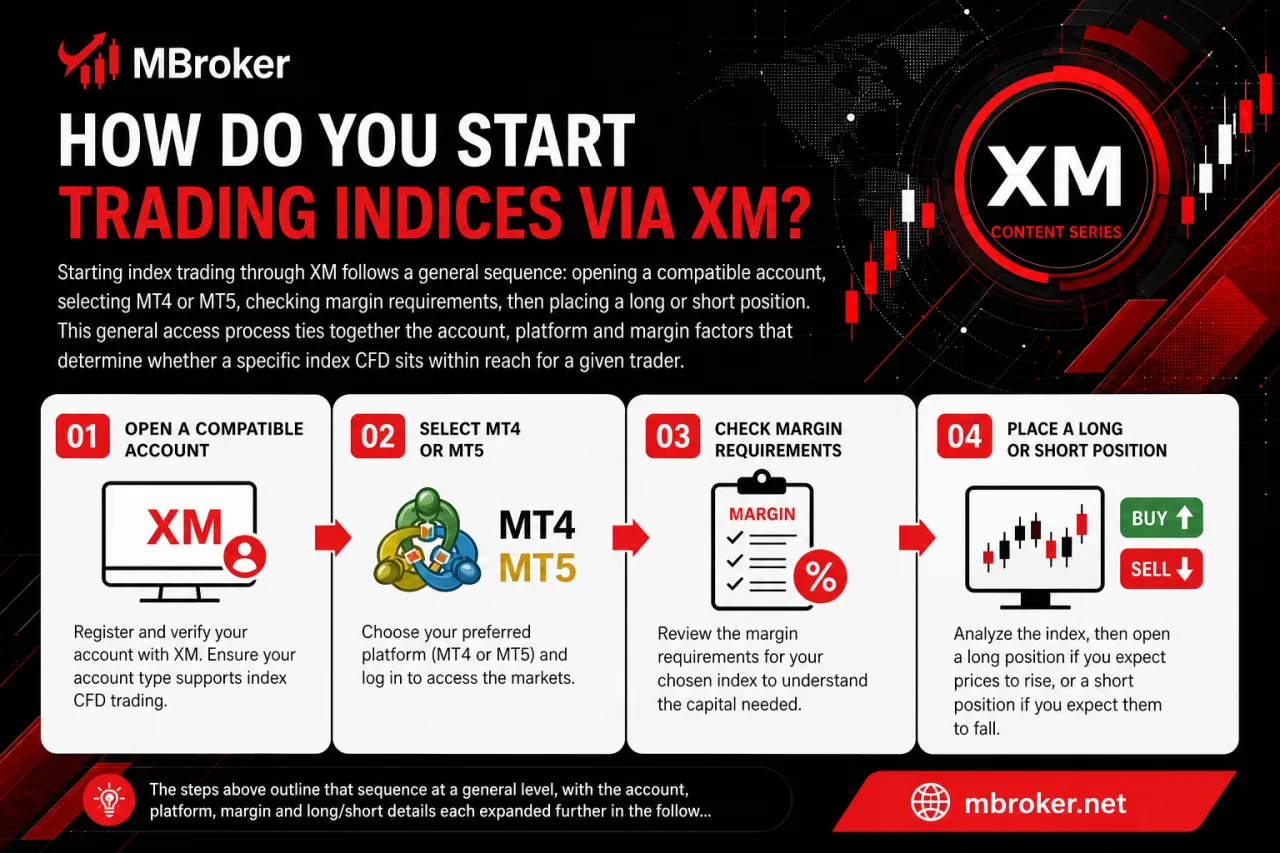
Trading indices via XM requires opening a compatible account, choosing MT4 or MT5, checking margin, then placing a position. This general access process ties together the account, platform and margin factors that determine whether a specific index CFD sits within reach for a given trader.
The steps below outline that sequence at a general level, with the account, platform, margin and long/short details each expanded further in the following subsections.
- Opening an account type that supports index CFD trading under the applicable XM legal entity.
- Selecting a supported trading platform, either MT4 or MT5, compatible with the account opened.
- Checking margin requirements for the specific index instrument before sizing a position.
- Placing either a long or short position depending on the trader’s directional view.
Exact account eligibility, platform availability and regional restrictions vary by XM legal entity, so traders should confirm current conditions directly on the official XM website before opening an index position.
Which XM Account Types and Platforms Support Index CFD Trading?
XM supports index CFD trading through standard live account types on both MT4 and MT5, with exact eligibility depending on the applicable XM legal entity and client region. This account and platform question ties directly into the access sequence outlined above, since compatibility determines whether a trader reaches a given index instrument in the first place.
Both MT4 and MT5 carry the full index CFD symbol list under a compatible live account, though demo accounts on either platform also allow index trading in a risk-free simulated environment. MT5 typically offers a broader range of order types and technical tools compared to MT4, though both platforms execute index CFD trades against the same underlying contract specifications.
Entity-specific and regional differences affect account availability more than platform functionality itself. Some XM entities restrict certain account types, leverage tiers or specific index symbols depending on local regulatory requirements, so a trader in one region may see a different subset of tradable indices than a trader registered under another XM entity.
Traders should confirm current account eligibility, platform support and regional index availability directly on the official XM website before applying for an account, since these conditions vary by legal entity and remain subject to change.
How Does XM’s Indices Offering Compare With Other Brokers?
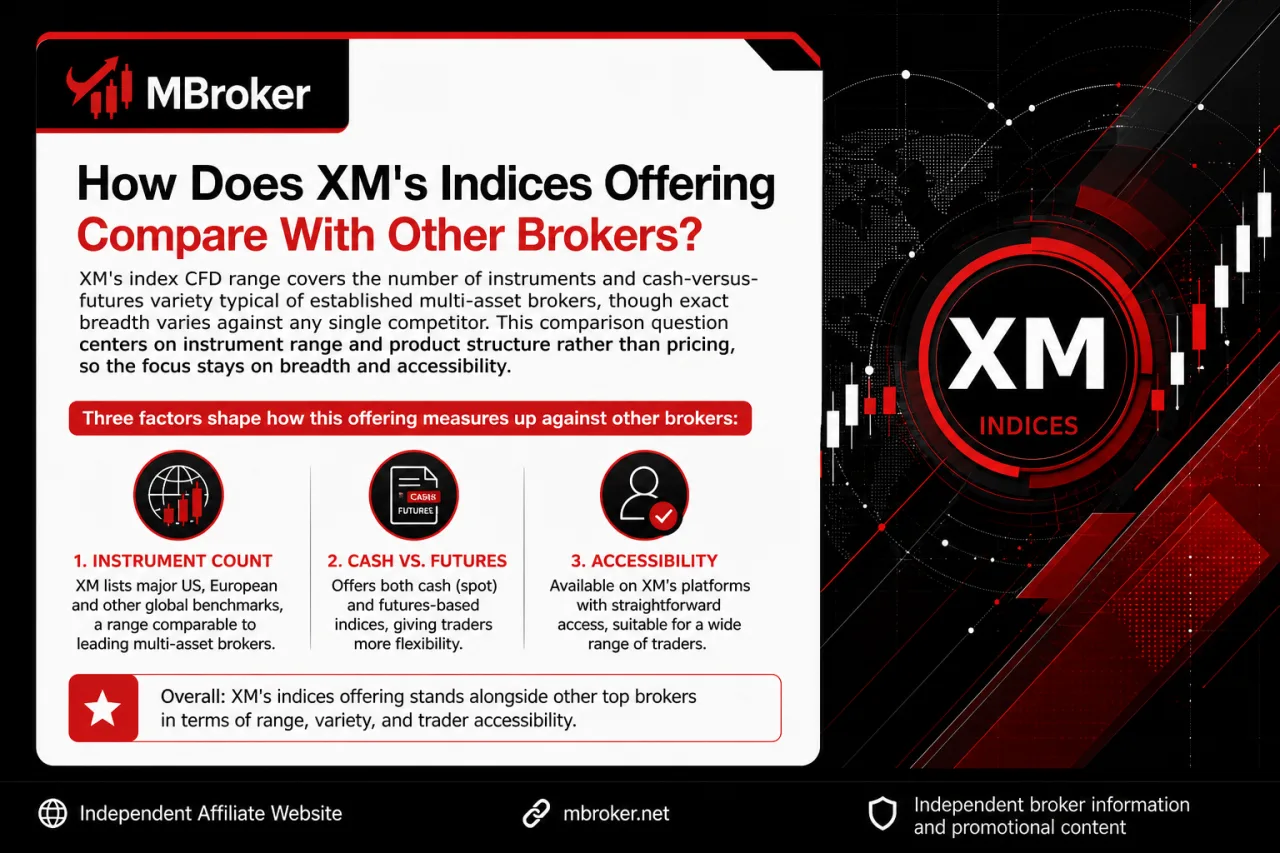
How Does XM’s Indices Offering Compare With Other Brokers
XM’s index CFD range covers the number of instruments and cash-versus-futures variety typical of established multi-asset brokers, though exact breadth varies against any single competitor. This comparison question centers on instrument range and product structure rather than pricing, so the focus stays on breadth and accessibility.
Three factors shape how this offering measures up against other brokers:
- Instrument count: XM lists major US, European and other global benchmarks, a range comparable to what other established CFD brokers typically list, though some competitors extend coverage into additional regional or thematic indices.
- Cash and futures availability: XM offers both cash and futures-based variants on several benchmarks, a dual structure not every broker provides across its full index list.
- Platform accessibility: XM’s indices trade through both MT4 and MT5 under standard live accounts, matching the platform accessibility most competing brokers offer through the same software.
Exact instrument counts, regional index coverage and cash/futures pairing differ by broker and by XM legal entity, so traders should compare current index lists directly on each broker’s official contract specifications page before assuming equivalent coverage.
What Thematic and Niche Index CFDs Does XM Offer Beyond Major Benchmarks?
XM does not publicly list dedicated thematic or niche index CFDs separate from its major benchmarks. This grouping question follows the specific-index list covered above, since any additional coverage would sit alongside those major benchmarks rather than replace them.
Where such instruments exist, thematic or sector-specific indices typically track a narrower segment of the market, such as a single industry group or a smaller regional exchange, differing from major benchmarks in composition and purpose. A benchmark like the Dow Jones or FTSE 100 aggregates a broad cross-section of listed companies across sectors, while a thematic or niche index generally isolates one industry or one smaller market instead; traders should check XM’s official platform directly to confirm the specific range of thematic or niche index instruments available, if any, beyond the major benchmarks.
Traders should confirm current thematic or niche index availability directly on the official XM contract specifications page before assuming any such instrument sits alongside the major benchmarks under their specific account and legal entity.
How Do Thematic Indices Differ From Standard Equity Indices at XM?
Thematic index CFDs differ from standard equity indices at XM through narrower composition, isolating a single sector or smaller market instead of aggregating a broad cross-section of listed companies. This composition question builds directly on the thematic and niche availability point raised above, since structure marks the main distinction between these two index groups where thematic instruments exist.
A standard benchmark such as a major US or European index weights its constituents across multiple sectors and industries, spreading exposure across a wide swath of the economy. A thematic or niche index instead concentrates on one narrower segment, such as a single industry group or a smaller regional exchange, which typically produces a more concentrated exposure profile tied to that segment’s specific drivers rather than broad economic sentiment.
Both structures remain CFD products at XM, meaning neither grants ownership of the underlying shares or index itself, regardless of how narrow or broad the composition runs. Weighting methodology, sector concentration and constituent count vary by specific instrument, so traders should confirm current thematic index composition directly on the official XM contract specifications page where such instruments are offered.
Conclusion
XM index CFDs provide a practical way to gain exposure to major global equity benchmarks through a single leveraged position without owning the underlying shares. Cash indices generally track spot prices and may involve overnight swaps and dividend adjustments, while futures-based indices incorporate financing expectations into their prices and carry defined expiration dates. Both variants allow traders to take long or short positions through supported XM accounts and platforms.
Before opening a trade, investors should verify the latest contract size, leverage, margin requirement, trading hours, holiday schedule, swap conditions, dividend treatment and expiration or rollover rules directly on the XM platform. Because index prices can react quickly to economic data, interest-rate decisions and broader market sentiment, traders should use conservative position sizes, maintain sufficient free margin and practise on a demo account before risking real funds.

Sylas Trenven is a forex strategist who helps traders master risk and timing. His work focuses on behavior-driven market entries and portfolio optimization for XM users looking to trade with precision and discipline. Email: [email protected]