
 Tiếng Việt
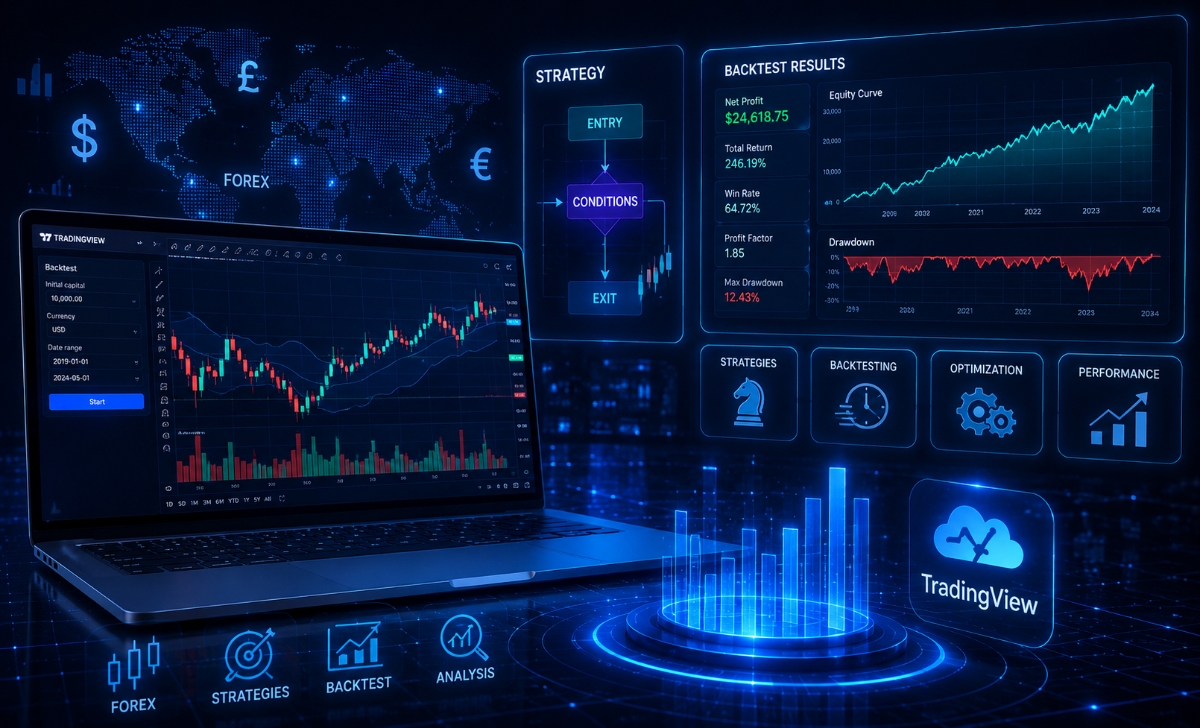
Backtesting trading is the process of testing a strategy on historical data to evaluate its performance before live trading, helping traders reduce risk and validate ideas.
Moreover, backtesting strategies allow traders to optimize entry, exit, and risk management rules, improving consistency and decision-making.
Additionally, backtesting platforms like MT4, MT5, and specialized tools provide automated testing environments, enabling accurate simulation of trading conditions.
In forex trading, backtesting helps analyze currency pair behavior under different market conditions, allowing traders to refine strategies based on real historical price data.
Furthermore, TradingView offers built-in backtesting via Pine Script and visual charting tools, making it one of the most popular platforms for strategy testing.
Mastering backtesting trading is essential to building profitable strategies and avoiding costly mistakes. At XM Guide, traders gain practical knowledge and tools to test, optimize, and apply strategies effectively in real markets.
Backtesting trading in financial markets
Backtesting trading is the quantitative process of running a structured trading strategy through historical market data to determine how accurately and profitably its rules would have performed in the past.

Executing a historical simulation allows you to gather vital baseline performance metrics—such as win rates and maximum drawdowns—across thousands of past candles before risking any real capital. Utilizing this empirical method transforms speculative trading ideas into mathematically verified systems, establishing a solid risk-management framework that is universally required by institutional funds and retail algorithmic traders alike.
What is backtesting trading and why is it important?
Backtesting trading is a rigorous technical simulation that applies objective entry, exit, and risk-management rules to past market data to evaluate a system’s long-term mathematical expectancy. It is highly important because it completely removes human emotional bias from strategy evaluation, providing empirical proof of whether a methodology possesses a genuine edge. Furthermore, running these simulations builds the psychological discipline required to stick to a strategy during natural periods of temporary account drawdown, as you possess historical proof of the system’s ultimate recovery capacity.
Achieving this high level of psychological certainty, however, depends entirely on the quality of the historical records you feed into your software.
What data is required for accurate backtesting?
Accurate backtesting requires high-fidelity, unmanipulated historical price data that includes the open, high, low, and close (OHLC) metrics for every specific candle interval. For advanced scalping strategies, you must secure precise tick data—which captures every microscopic price movement and spread fluctuation—spanning at least a 5 to 10-year market cycle to account for varying volatility environments. If your underlying data lacks accuracy or suffers from missing gaps, your backtesting simulations will produce highly distorted outcomes that fail to mirror live market conditions.
Once you have secured high-quality data feeds, you can proceed to structure your strategy rules and define your core performance evaluation metrics.
Backtesting strategies and performance evaluation
Backtesting strategies require a non-negotiable matrix of objective execution rules alongside strict mathematical performance evaluation metrics to separate profitable systems from random variations.

Statistically, a robust historical evaluation must span a sample size of at least 100 to 200 consecutive trades across multiple market cycles to prove its statistical validity. By thoroughly auditing your performance parameters against standardized institutional benchmarks, you can easily identify structural flaws in your risk design and optimize your capital allocation models before launching a live account.
How to build a trading strategy for backtesting?
To build an institutional-grade trading strategy ready for historical simulation, you must define five absolute structural parameters within your system rules:
- The Market Filter: Explicit conditions that define when to trade, such as executing long positions only when price resides completely above the 200-period moving average.
- The Entry Trigger: A precise technical event, such as a MACD line crossover or a verified chart pattern breakout, that opens the position instantly.
- The Initial Stop-Loss: A structural price coordinate or volatility-based boundary (e.g., Average True Range multiple) that defines your maximum risk per trade.
- The Profit Target: A mathematical exit rule that ensures your average winning trade is significantly larger than your average losing trade.
- The Position Sizing Protocol: A strict risk-management rule dictates that you never risk more than 1% to 2% of your total account equity on any single execution.
With these five structural rules permanently coded or recorded, you can run your simulation and evaluate the resulting data matrix.
What metrics should be used to evaluate backtesting results?
To accurately audit the viability of your trading strategy, you must evaluate these five key performance ratios:
| Performance Metric | Institutional Baseline Target | Core Definition & Analytical Purpose |
| Win Rate | $40\% – 60\%$ | The percentage of total executed trades that result in a net financial profit. |
| Profit Factor | $> 1.5$ | Gross profits divided by gross losses; measures structural strategy efficiency. |
| Max Drawdown | $< 15\%$ | The largest peak-to-trough decline in your equity curve; measures capital risk. |
| Risk-Reward Ratio | $1:2 \text{ or higher}$ | The average size of your winning trades relative to the size of your losing trades. |
| Sharpe Ratio | $> 1.0$ | Measures your risk-adjusted return relative to an underlying risk-free asset benchmark. |
Isolating these performance ratios allows you to identify your system’s limits, preparing you to transition to selecting the best software tools for execution.
Backtesting platforms and tools for traders
Backtesting platforms and tools provide the computational infrastructure, data storage, and visual chart rendering engines required to execute historical strategy simulations with speed and precision.

Modern backtesting applications automate data collation, enabling retail clients to test complex indicator combinations across decades of historical market ticks in under a minute. Utilizing these professional engines allows you to instantly verify your strategic ideas, provided you select an infrastructure that matches your programming background and analytical requirements.
What platforms are commonly used for backtesting?
The modern technical analysis landscape features four primary platforms optimized for historical simulation:
- TradingView: The industry leader for cloud-based visual backtesting, offering an intuitive environment through its proprietary Pine Script programming language.
- MetaTrader 4 / 5 (MT4/MT5): The traditional retail standard, heavily relied upon for algorithmic optimization via the Strategy Tester engine and MQL coding environments.
- NinjaTrader: An advanced terminal favored by futures and forex day traders, providing deep historical market replay functions and C#-based optimization.
- Python (Pandas/Backtrader): The institutional quantitative standard, utilized by data scientists to run complex statistical scripts on massive multi-gigabyte tick data arrays.
While these automated platforms offer immense computing power, you must manage their technical limitations to protect your live capital.
What are the limitations of backtesting tools?
The fundamental limitation of all backtesting software tools is their inability to perfectly replicate live human psychology, unexpected broker execution delays, and real-time spread widening. Automated simulations assume that every order is filled instantly at the exact requested price, completely ignoring the real-world effects of negative market slippage and broker execution latency. For clients reviewing advanced liquidity guides and setting up optimization frameworks on the MBroker, recognizing these software limitations is vital for adding a realistic safety margin to your theoretical backtesting metrics.
To see these platform dynamics in action, let us examine how historical simulations are applied specifically within the global currency market.
Backtesting trading in forex market
Backtesting trading in the forex market requires adjusting your simulation parameters to account for the decentralized nature, floating leverage caps, and daily rollover costs characteristic of global currency trading.

Because the currency market operates continuously 24 hours a day across 5 full business days, a historical test must evaluate how your strategy performs across different geographical session overlaps. Applying a systematic backtesting protocol to your preferred currency pairs ensures you identify which specific market hours yield the highest probability configurations for your portfolio.
How is backtesting applied in forex trading?
In forex trading, backtesting is applied by running your technical strategy across historical currency data blocks to track how your rules handle various macroeconomic shifts. For example, a trader testing a trend-following system on the EUR/USD pair will run a historical simulation spanning the last 10 years to see how the system performs during prolonged central bank interest rate trends versus tight range-bound consolidations. This systematic evaluation allows you to isolate your pair’s specific behavioral tendencies, ensuring your stop-loss and take-profit parameters are tailored to the asset’s true historical volatility.
However, if you do not filter your currency simulations correctly, you risk falling victim to severe mathematical errors.
What are common mistakes in forex backtesting?
The most destructive mistake in forex simulation is Curve Fitting (over-optimization), which occurs when a trader modifies their technical rules endlessly to make the historical equity curve look absolutely perfect. This error results in a highly rigid system that excels on past data but fails immediately in live, unpredictable market conditions because it lacks natural statistical flexibility. Additionally, many retail traders forget to include real-world transaction costs, such as floating bid-ask spreads and overnight swap fees, which can quickly turn a theoretically profitable backtest into a net-losing live system.
To avoid these costly programming errors, many professional day traders utilize user-friendly visual simulation interfaces to run their tests.
Backtesting trading on TradingView platform
Backtesting trading on the TradingView platform provides an ultra-modern, cloud-based visual infrastructure to build, optimize, and execute historical strategy simulations with maximum ease.

By utilizing its integrated Strategy Tester panel alongside the Pine Script programming language, you can convert manual chart layouts into fully automated testing scripts that provide instantaneous statistical output. This powerful interface makes it simple to test any rule-based system across global forex pairs, indices, or crypto assets without needing a complex programming background.
How to backtest a strategy on TradingView?
To backtest a strategy on TradingView accurately, follow this definitive 5-step operational framework:
- Step 1: Open Your Target Chart and Timeframe: Select your preferred financial asset (e.g., GBP/USD) and choose a clean charting interval (such as the 1-hour or 4-hour timeframe) to load your historical price feed.
- Step 2: Load Your Strategy Script: Click on the “Indicators” tab at the top of the screen, navigate to the “Strategies” sub-section, and select a pre-built strategy layout or load your customized Pine Script via the “Pine Editor” panel.
- Step 3: Configure Your Properties and Capital Settings: Open the strategy settings menu and input your specific simulation rules, including your starting capital (e.g., $10,000), your standard order size (e.g., 1 Lot), and a realistic percentage for base broker commissions and slippage.
- Step 4: Analyze the Strategy Tester Performance Data: Navigate to the “Strategy Tester” tab at the bottom of the screen to review your automated performance summary, checking your net profit factor, total completed trades, and maximum equity drawdown curve.
- Step 5: Audit Individual Fills in the List of Trades: Open the “List of Trades” submenu to manually inspect every historical entry and exit marker printed on your chart, verifying that the execution engine perfectly matches your intended technical rules.
Mastering this straightforward setup sequence allows you to quickly audit any technical concept and join the ranks of professional system operators.
Why do traders prefer TradingView for backtesting?
Global chartists prefer TradingView for historical simulations because of its superior cloud computing speeds, highly intuitive user interface, and immense open-source community library. The platform eliminates the need to manually download massive multi-gigabyte data files, as its internal servers host pristine, real-time historical records for thousands of global financial instruments. Furthermore, by cross-referencing your TradingView strategy results with the verified broker reviews and technical optimization resources found on the MBroker, you can easily select a high-speed execution engine that matches your backtested performance parameters perfectly.
In short, Backtesting Trading is a mandatory technical discipline required to remove emotion, verify system edges, and protect your capital from unforced market errors. By defining objective strategy rules, utilizing reliable testing software, and strictly avoiding the traps of curve-fitting, you can easily ensure your live execution is backed by robust quantitative data.

Thoren Vextal is a specialist in XM trading guides, offering practical insights and real-market experience to help traders improve their strategies and trading performance. Email: [email protected]