
 Tiếng Việt

Momentum trading is a strategy that focuses on trading assets moving strongly in one direction, allowing traders to capture profits by following price momentum instead of predicting reversals.
Additionally, momentum trading relies on indicators like RSI, MACD, and Momentum Oscillator, which help measure trend strength and identify potential entry or exit points.
Therefore, an effective momentum trading strategy involves entering trades during strong trends and exiting before momentum weakens, often based on breakout signals or continuation patterns.
Moreover, momentum trading is widely used across forex, stocks, and crypto markets, where high volatility and liquidity create ideal conditions for capturing price acceleration.
However, traders often fail in momentum trading due to poor timing, lack of discipline, and ignoring market conditions, making risk management and consistency key to long-term success.
Momentum trading is a strategy that leverages the power of price trends to maximize profits in the short term. However, to apply it effectively, traders need a thorough understanding of how the market operates, the appropriate indicators, and the correct execution strategy.
Momentum trading overview
Momentum trading is a systematic financial approach centered on buying assets that exhibit strong upward price trends or short-selling assets displaying aggressive downward trajectories.

Statistically, this methodology relies on the asset’s underlying velocity—the speed at which price changes occur—under the quantitative premise that existing trends are highly likely to persist for a distinct period before exhausting. Unlike value investing, which seeks undervalued assets, momentum practitioners focus entirely on high-velocity trends, capitalizing on the persistent market behavior where assets showing strong performance continue to outperform over a 3-to-12-month horizon.
What is momentum trading in financial markets?
In global financial markets, momentum trading is the practice of capitalizing on existing market trends by entering positions in the direction of the strongest price acceleration. The core thesis operates on an adaptation of Newton’s First Law of Motion: an asset moving aggressively in a specific direction will maintain that trajectory until it encounters a massive zone of opposing liquidity or structural macroeconomic intervention. Traders do not look for market bottoms or absolute tops; instead, they seek to capture the highly profitable middle section of a macro trend where institutional money is actively driving the price.
While the definition is straightforward, understanding why these trends persist in highly efficient markets requires looking at collective investor psychology.
Why does momentum trading work in real markets?
Momentum trading works consistently across real financial markets due to documented behavioral biases and institutional execution constraints.
- The Bandwagon Effect: As a specific asset breaks out into a new high, financial media coverage and retail FOMO (Fear Of Missing Out) accelerate, attracting a massive wave of secondary buyers who drive the price even higher.
- Institutional Order Splitting: Large mutual funds and investment banks cannot deploy hundreds of millions of dollars in a single order without crashing the market. Instead, they use algorithmic systems to distribute their buying over days or weeks, creating a persistent upward lift.
- Analyst Underreaction: Financial analysts often adjust their corporate earnings estimates too slowly when a sector booms, leading to a series of positive earnings surprises that fuel a multi-month trend.
Once you understand why price velocity occurs, the next logical step is learning how to quantify this force using specialized technical tools.
Indicators used to measure momentum strength
Indicators used to measure momentum strength are mathematical algorithms that analyze the rate of change of an asset’s price over a specific rolling period.

Rather than simply tracking absolute price levels, these tools calculate the internal acceleration of a trend, providing quantitative data that alerts a trader when a move is gaining strength or rolling over. Utilizing a combination of bounded oscillators and trend-following indicators allows professional traders to filter out random market noise and focus entirely on high-probability setups that possess genuine institutional backing.
What are the most effective momentum trading indicators?
To isolate high-probability trend velocity, professional asset managers rely on three primary technical indicators:
- Relative Strength Index (RSI): A bounded momentum oscillator that measures the speed and change of price movements between a scale of 0 and 100, tracking whether bulls or bears dominate the tape.
- Moving Average Convergence Divergence (MACD): A trend-following momentum indicator that illustrates the relationship between two moving averages of an asset’s price, highlighting shifts in directional velocity via its histogram.
- Average Directional Index (ADX): A non-directional indicator that measures the absolute strength of a trend on a scale of 0 to 100, where readings above 25 confirm that a strong, tradable trend is active.
Selecting these indicators is only half the battle; long-term profitability requires an advanced understanding of how to read their real-time signals.
How to interpret momentum indicators in trading?
Interpreting these indicators requires looking past basic retail overbought or oversold definitions and focusing on structural health. For instance, when an asset’s price hits a new high while the RSI moves firmly above 70, it signals an exceptionally strong, healthy momentum phase that warrants buying, rather than shorting. However, if the price prints a new high but the MACD histogram or RSI creates a lower peak, it warns of a bearish divergence, indicating that the trend’s underlying velocity is dying out despite the higher price print.
With your analytical tools calibrated, you can integrate these indicators into a rigorous, rule-based execution framework.
Momentum trading strategy and execution logic
A momentum trading strategy and execution logic provides an objective, systematic framework that dictates exactly when to buy a breakout, how long to hold the asset, and where to cut losses if the trend fails.
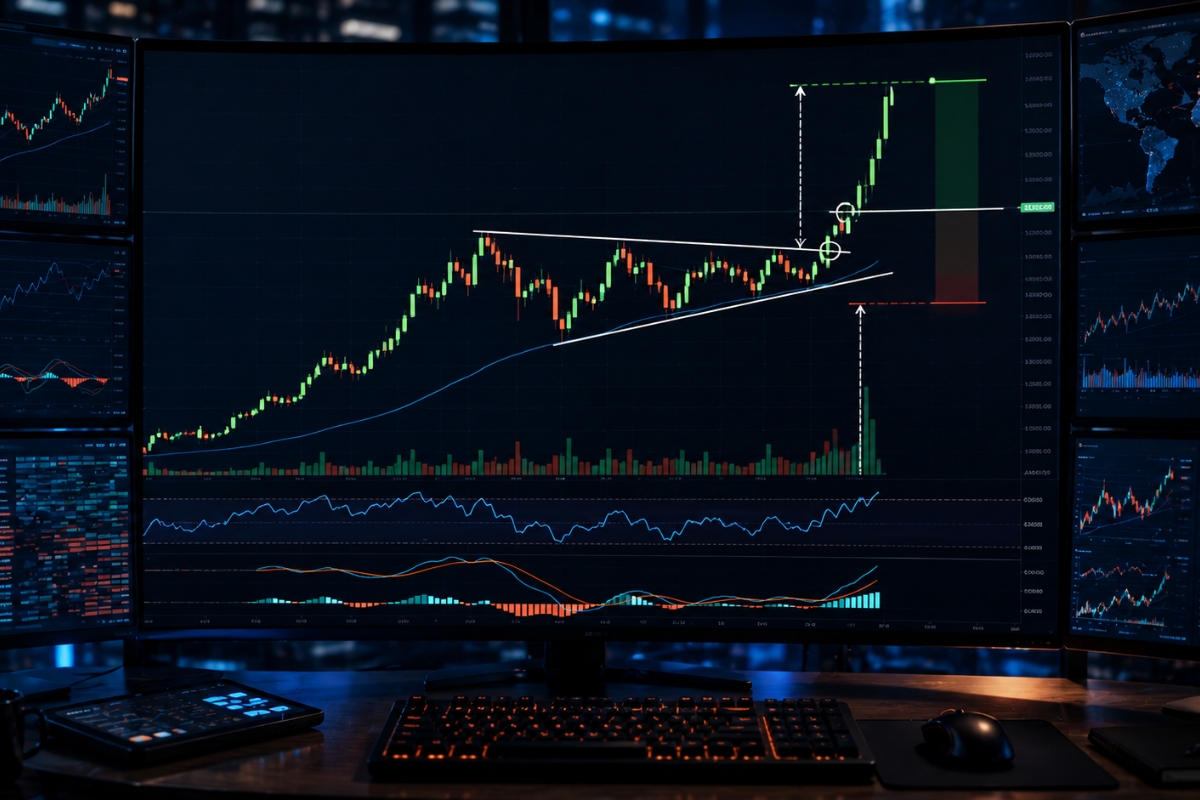
Because momentum setups occur during highly volatile market phases, executing trades based on raw gut feeling will quickly lead to severe account drawdowns. Professional traders use precise technical rules to manage their risk-to-reward ratios, ensuring that their average winning trades are significantly larger than their controlled losses.
What is a practical momentum trading strategy?
The most reliable momentum strategy follows a strict 5-step structural sequence:
- Step 1: Identify wedge structure: Scan your watchlists for assets consolidating within a tight horizontal range or a geometric chart pattern (like a wedge or rectangle) while the ADX sits below 20, indicating compressed volatility.
- Step 2: Wait for breakout confirmation: Patience is mandatory; wait for a strong daily candlestick to break and close completely outside the resistance barrier, backed by a volume spike that is 2 times higher than the 20-day average.
- Step 3: Enter trade in breakout direction: Execute a long entry immediately upon the close of the breakout candle, or place a buy stop order just above the breakout high to ensure the market’s velocity carries you into the position.
- Step 4: Set stop loss outside wedge: Position your defensive Stop Loss safely outside the breakout zone, typically right below the 20-day Exponential Moving Average (EMA) or the intermediate swing low of the previous consolidation.
- Step 5: Set take profit based on pattern size: Measure the vertical height of the consolidation range and project it outward from the breakout point, or employ a trailing stop based on the Chandelier Exit to ride the trend until it officially reverses.
While having a mechanical strategy is critical, your win rate will improve dramatically if you align your entry timing with specific institutional market windows.
When is the best time to enter momentum trade?
The absolute best time to enter momentum trade is during the first two hours of the major global trading sessions—specifically the London open and the New York open. During these intervals, major institutions rebalance their portfolios, unleashing massive blocks of capital that spark clean, sustainable breakouts. For retail traders aligning their executions with professional infrastructure, using the educational guides and premium feeds found on Forex Technical Analysis helps ensure that you are entering trades when global liquidity is at its absolute peak, reducing the risk of false breaks.
Once execution timing is mastered, you must learn how the performance of this strategy shifts across different global asset classes.
Market use of momentum trading across asset classes
The market use of momentum trading across asset classes varies dramatically based on localized liquidity distribution, structural regulations, and the trading hours of each specific financial instrument.

A strategy that performs flawlessly on a liquid blue-chip stock index may require specific filtering adjustments when applied to decentralized currency pairs or highly volatile cryptocurrency networks. To maintain a steady equity curve, multi-asset managers must modify their holding periods and indicator sensitivities to match the specific characteristics of the asset class they are actively trading.
How is momentum trading applied in forex and stocks?
In traditional financial markets, momentum trading follows distinct structural pathways:
- In Corporate Stocks: Momentum is exceptionally reliable and long-lasting. Equities are heavily influenced by macro sector rotations and corporate earnings trends, allowing stock traders to buy top-performing companies and hold them for weeks or months as institutional capital continuously floods into the stock.
- In Foreign Exchange (Forex): Currencies are inherently mean-reverting because they are controlled by central bank interest rate policies. Therefore, forex momentum strategies are typically shorter-term, focusing on aggressive breakouts from major macroeconomic support and resistance levels during high-impact news events like Non-Farm Payrolls (NFP).
While traditional markets follow strict institutional guidelines, emerging decentralized asset classes offer an entirely different level of velocity.
How does momentum trading perform in crypto markets?
Momentum trading achieves its highest absolute returns—and highest structural volatility—within the cryptocurrency sector. Because crypto markets operate 24/7, possess high retail participation, and utilize substantial leverage, trends tend to overextend far past rational valuation levels, creating massive parabolic runs. However, these trends are prone to sudden, violent liquidations; traders using platforms like MBroker are strongly advised to pair their momentum oscillators with real-time volume profiles to verify that a crypto breakout has genuine whale backing before chasing the move.
Acknowledging the extreme volatility of crypto highlights the final, most critical component of this discipline: managing your psychological blind spots.
Execution challenges and trader mindset in momentum trading
Execution challenges and trader mindset in momentum trading represent the psychological hurdles that prevent most retail participants from achieving long-term consistency.

Because this style requires buying assets that have already increased significantly in price, it runs completely counter to the basic human instinct of “buying low and selling high.” Surviving as a professional momentum trader requires transitioning from an emotional mindset to a purely probability-based business model, where preserving your capital is always prioritized over being right.
Why do traders fail with momentum strategies?
The vast majority of retail traders fail with momentum strategies due to distinct behavioral traps:
- Chasing Overextended Trends: Entering a long position after an asset has already gone parabolic and reached extreme overbought territory on the weekly chart, making them easy targets for institutional distribution.
- Hesitation at Breakouts: Failing to pull the trigger when a valid breakout occurs, and then buying much higher out of pure frustration once the asset has already moved.
- Moving Stop Losses: Widening their defensive risk parameters during a trend reversal because they are emotionally attached to a position, turning a small controlled loss into an account-destroying drawdown.
Overcoming these psychological roadblocks requires a systematic approach to risk control and platform optimization.
How to improve consistency in momentum trading?
To drastically improve your consistency and protect your trading capital, enforce three non-negotiable professional rules:
- Enforce Fixed Capital Risk: Never risk more than 1% to 1.5% of your absolute account equity on any individual breakout trade.
- Utilize Trailing Stops: Once a position moves to a 1:1 risk-to-reward ratio, immediately move your stop loss to break-even, and use a rolling moving average to capture the trend risk-free.
- Leverage Institutional Infrastructure: Executing your trades via the advanced order routing tools and premium educational ecosystems championed on the MBroker homepage ensures minimal execution slippage and keeps your technical skills aligned with institutional standards.
By systematically identifying high-velocity breakouts, utilizing multi-layered indicator confirmation, and maintaining an ironclad risk-management mindset, you can safely turn market volatility into a scalable commercial edge.

Thoren Vextal is a specialist in XM trading guides, offering practical insights and real-market experience to help traders improve their strategies and trading performance. Email: [email protected]