
 Tiếng Việt
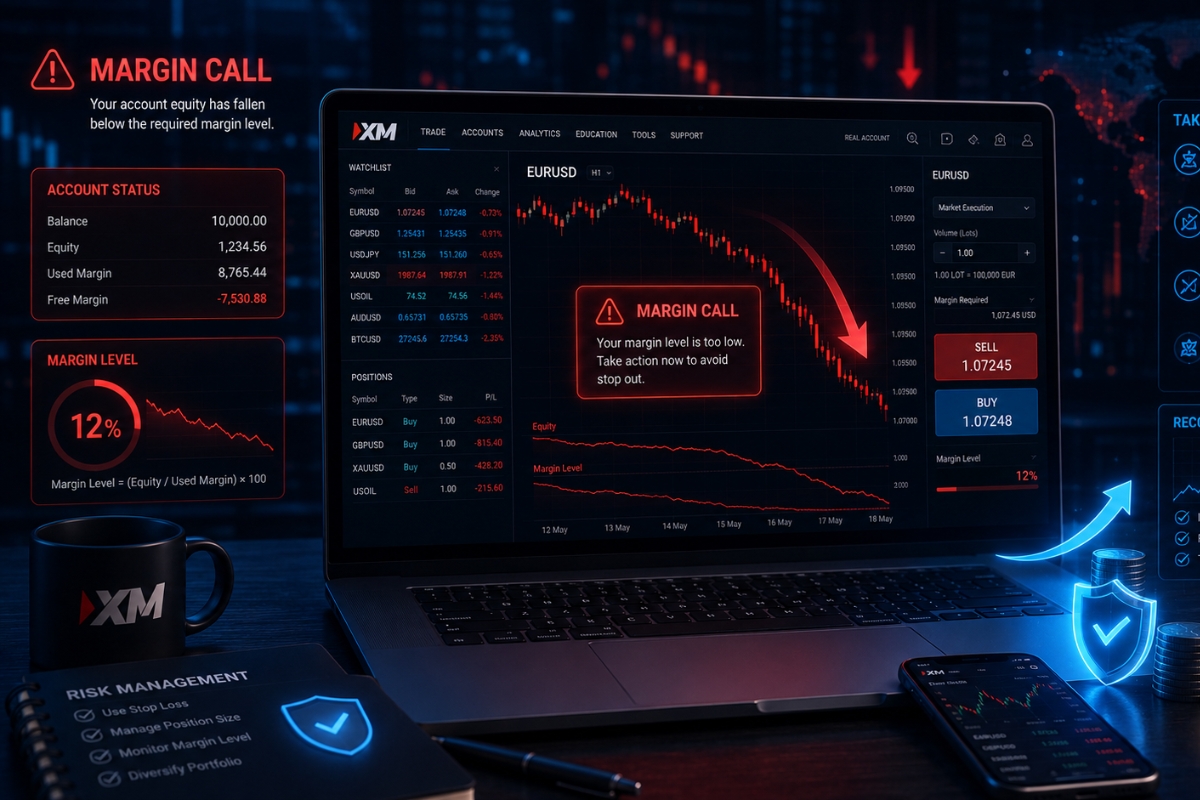
Margin call is a warning from the broker when your margin level falls below the required threshold, usually around 50–100%, indicating that your account is at risk and needs additional funds or position reduction.
However, a margin call is triggered when losses reduce your equity below the required margin level, often caused by high leverage, large position sizes, or strong market movements against your trade.
For example, if your account balance drops to the margin call level due to a losing trade, the broker will alert you to deposit more funds or close positions, your trades may be at risk of automatic liquidation.
Therefore, proper risk management such as using stop loss, low leverage, and position sizing can effectively prevent margin calls, helping traders maintain stable account performance.
Additionally, repeated margin calls indicate poor trading discipline and can severely impact long-term profitability, making it essential to control risk rather than chasing high returns.
In Forex trading, margin calls are a major risk that can quickly reduce your account balance. Understanding what it is and how to manage it helps protect your capital. Learn more in the Forex Technical Analysis category to improve your strategy and risk control.
Margin call meaning in trading
A margin call is a formal broker notification requiring an investor to deposit additional funds or liquidate open positions immediately because the account equity has fallen below the required maintenance margin level.
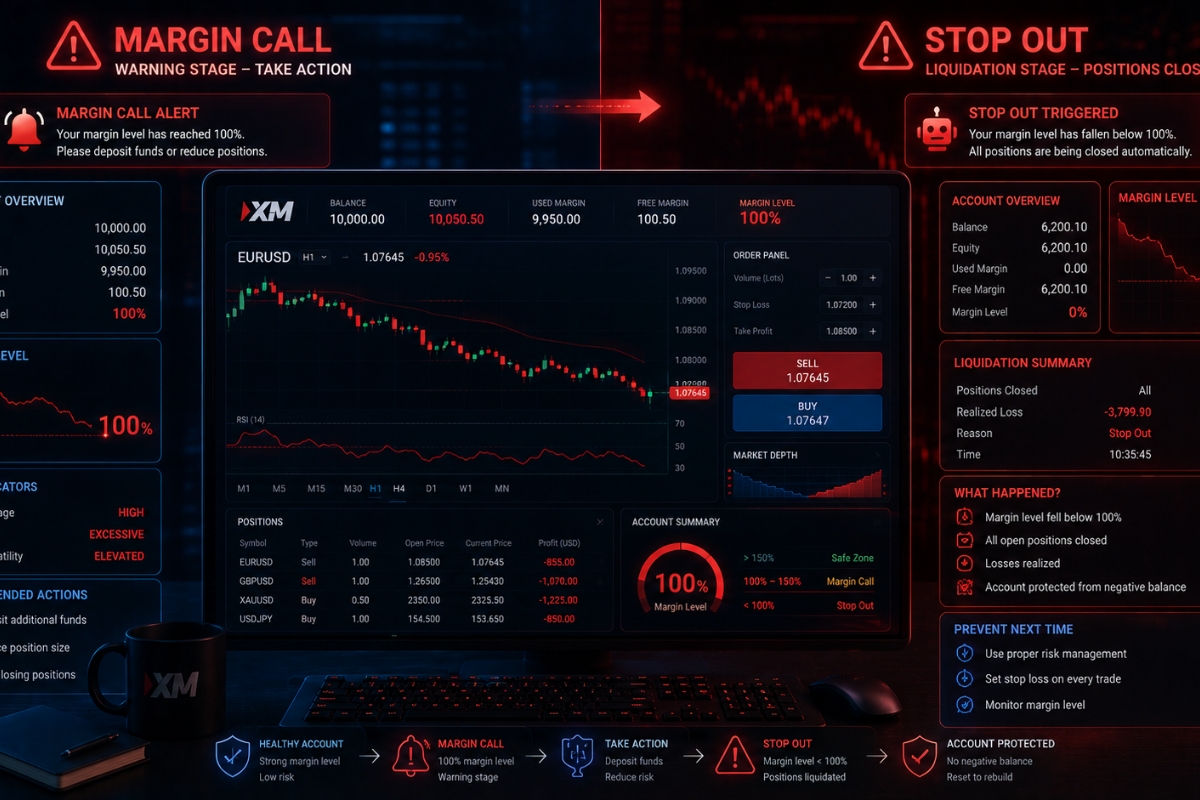
Statistically, in retail forex and CFD accounts, a margin call typically triggers when your Margin Level calculated as + ( Equity / Used Margin ) x 100 drops down to exactly 100%. This protective mechanism is legally enforced by financial regulators to ensure that your open floating losses do not exhaust your remaining balance, thereby preventing your account from sliding into a negative equity status.
What is a margin call and how does it work?
In institutional brokerage architecture, a margin call works as an automated safety firewall that monitors your account metrics in real time. When you open a leveraged position, the broker locks up a specific portion of your capital as collateral, known as the “Used Margin.” If the market moves against your trades, your “Floating Loss” increases, which directly causes your “Equity” to decline. The moment your equity equals your used margin, your usable margin hits exactly $0, immediately triggering the margin call warning system on your platform.
Understanding this initial warning threshold allows us to contrast it with the secondary, more severe execution tier.
What is the difference between margin call and stop out?
The critical difference between a margin call and a stop out lies in the execution mechanism and the urgency of the account status:
- Margin Call Threshold: Operates as a primary warning level, usually occurring at a 100% Margin Level. At this stage, your platform turns red, your ability to open new trades is restricted, but your existing positions remain open.
- Stop Out Threshold: Operates at an automated execution level, typically set between 20% and 50% Margin Level. On this secondary floor, the broker’s server bypasses your input and automatically liquidates your active positions starting from the biggest losing trade to instantly free up equity.
Once you can distinguish the warning signs from forced closure, you must pinpoint the exact market variables that accelerate these triggers.
Margin call trigger and when will it happen?
A margin call trigger happens the exact moment your floating losses deplete your free margin to zero, leaving your account balance completely incapable of sustaining your active exposure.
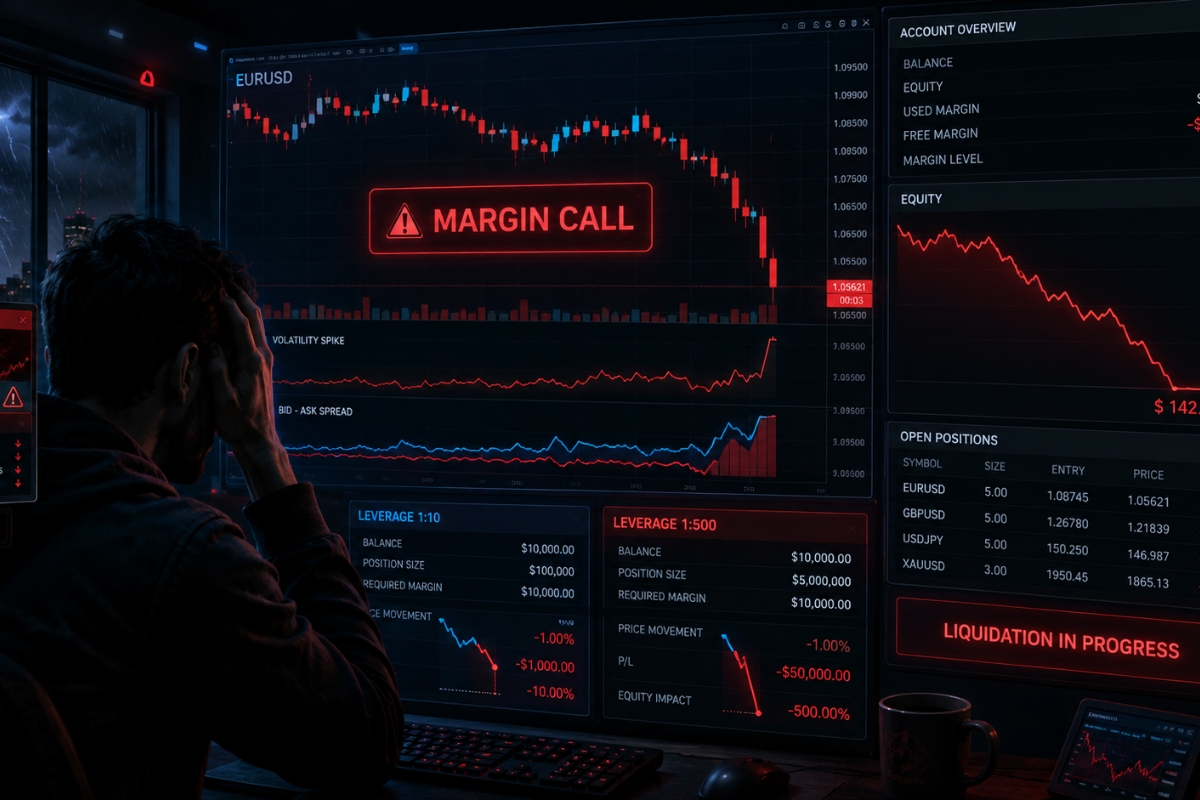
In active financial markets, this trigger is primarily caused by two overlapping factors: an adverse price move against an over-leveraged position or a sudden, unexpected expansion in broker bid-ask spreads. When market volatility increases rapidly, these metric boundaries compress within seconds, making it mandatory to understand the exact mathematical relationship between leverage sizes and account vulnerability.
What triggers a margin call in forex trading?
In the foreign exchange market, a margin call is triggered by specific operational catalysts:
- Over-Trading: Opening too many positions simultaneously, which locks up an unsustainably high percentage of your account capital as used margin.
- Holding Through High-Impact News: Leaving large trades exposed during events like Non-Farm Payrolls (NFP) or interest rate decisions, when sudden 100-pip adverse price spikes immediately erase equity.
- Spread Widening: During the daily rollover window (22:00 EET), global bank liquidity drops, causing spreads to temporarily widen by 5 to 10 times their normal size, which can instantly trigger a margin call even if the market price has not moved.
While basic price movement is the underlying cause, the speed of the trigger is entirely dictated by your chosen account leverage.
How does leverage increase margin call risk?
Leverage increases your risk by functioning as a financial amplifier that exponentially reduces the amount of structural price movement required to wipe out your capital. For example, if you trade using a conservative 1:10 leverage, the market must move a massive 10% against your position to threaten your account margin. However, if you utilize an aggressive retail leverage of 1:500, your position size is so disproportionate to your equity that a minor, fractional market move of just 0.2% will completely exhaust your margin level, triggering an immediate platform warning.
To clarify this mathematical relationship, let’s evaluate a precise, step-by-step mathematical example in a real trading scenario.
Margin call example in real trading scenarios
A margin call example in real trading scenarios illustrates how a series of small, undisciplined technical decisions can quickly culminate in a major account crisis.
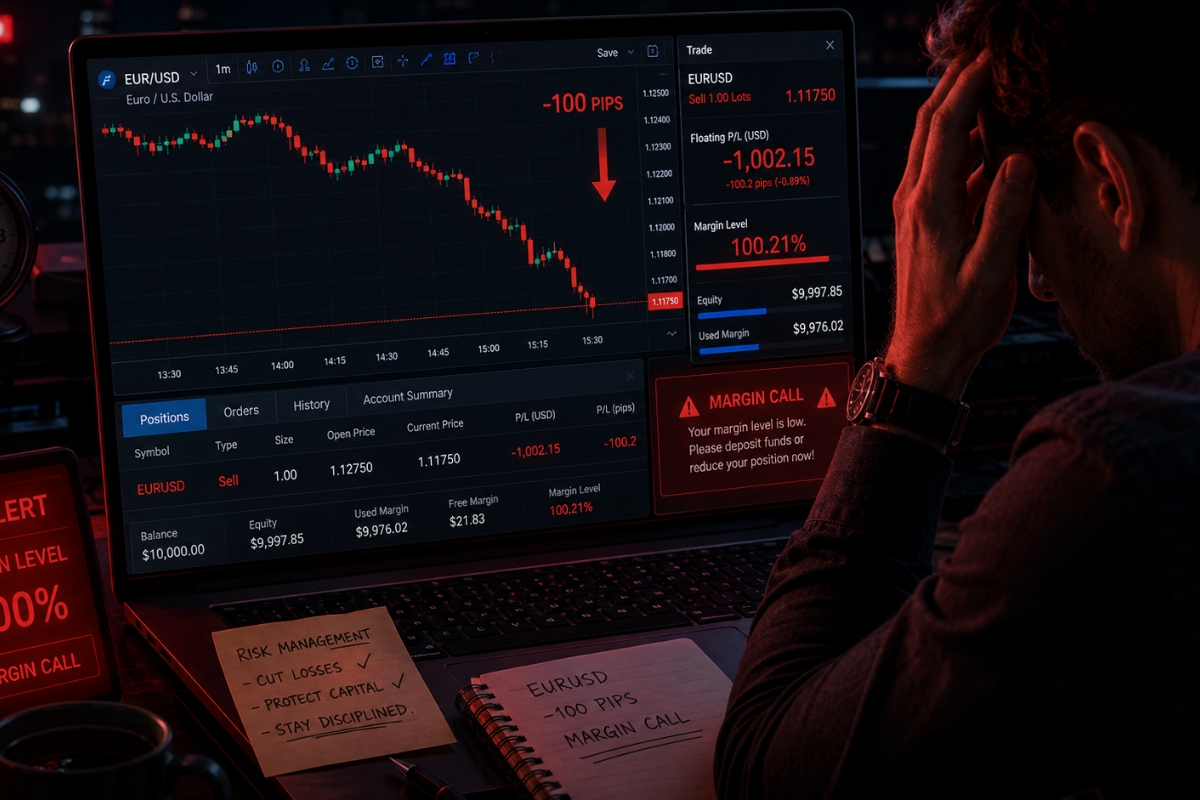
When calculating margin parameters, a professional specialist does not think of abstract percentages; they look at the exact dollar amounts assigned to lot sizes, pip values, and maintenance margins. Reviewing a standard retail trading miscalculation highlights how quickly leverage can turn a manageable market correction into a devastating forced liquidation event.
Example of a margin call in forex trading
Let’s construct a live trading scenario using standard institutional metrics:
- Account Balance: $1,000 USD
- Account Leverage: 1:100
- Trade Executed: Buy 1.0 Standard Lot of EUR/USD at 1.10000
- Used Margin Requirement: To open 100,000 Euros at 1:100 leverage requires exactly $1,100 USD of notionally calculated margin (assuming base currency adjustments). Let’s adjust our position to 0.5 lots to fit our capital, meaning the broker locks up $500 USD as Used Margin, leaving you with $500 USD of Free Margin.
If the EUR/USD declines by 100 pips down to 1.09000, each pip loss on a 0.5 lot trade equals $5 USD, resulting in an active floating loss of $500 USD. Your remaining account equity drops to exactly $500 USD ($1,000 balance minus $500 floating loss). Because your Equity ($500) now perfectly equals your Used Margin ($500), your Margin Level hits 100%, and the platform immediately executes an automated Margin Call warning.
Understanding this precise mathematical threshold brings us to the operational decisions you must make once the warning arrives.
What happens after a margin call is triggered?
The moment the margin call is officially triggered on your terminal, the platform limits your control and introduces a strict protocol:
- Platform Color Shift: The entire terminal dashboard changes to a flashing red color, signaling an extreme capital emergency.
- Order Restriction: The broker’s server blocks your ability to open any new positions or add to your current trades, as your free margin is currently below zero.
- Funding Window: You are given a brief, volatile window to manually deposit additional cash to boost your equity or voluntarily close down your biggest losing positions. If the market continues to drop and you take no defensive action, the server will aggressively advance to the automated stop-out liquidation phase.
Beyond immediate financial damage, this process leaves a deep scar on your performance history and mental focus.
Margin call impact on trading performance
A margin call’s impact on trading performance goes far beyond a simple deduction from your account balance; it acts as a structural indicator of systemic trading failure.
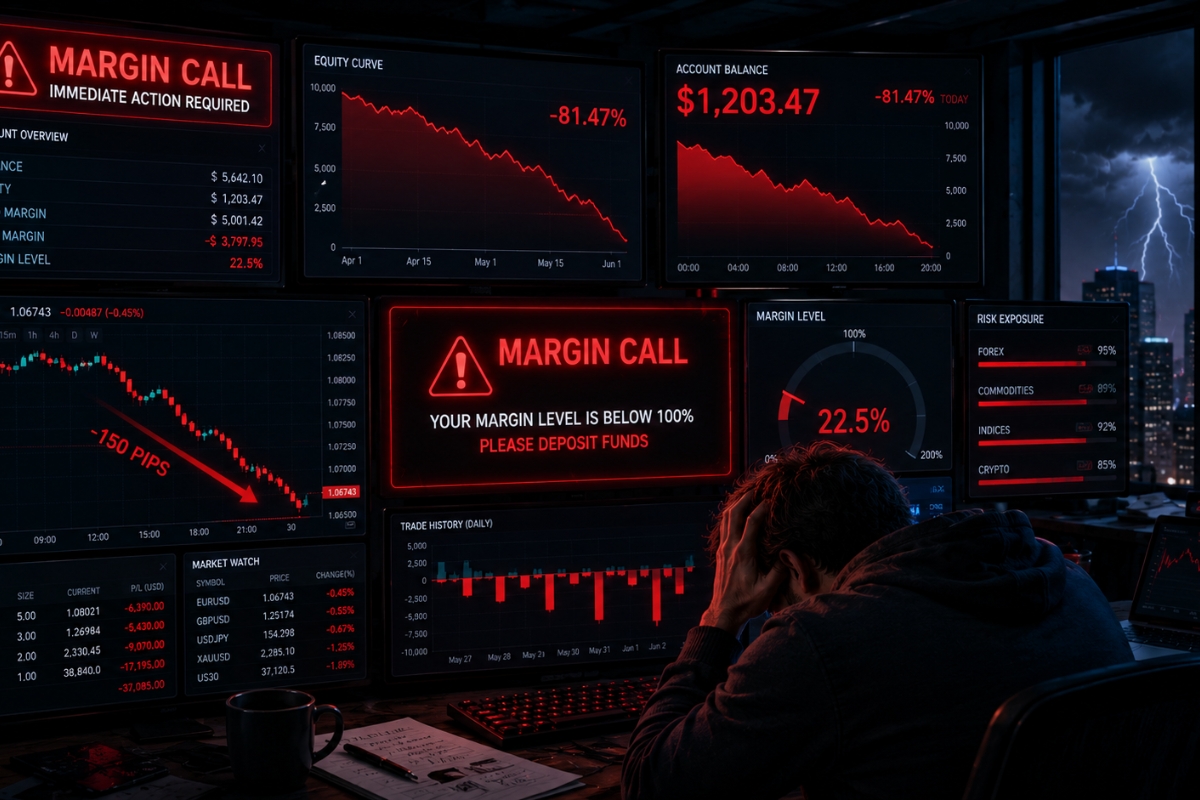
In institutional asset management, a single margin call event is treated as a major compliance breach that immediately disqualifies a trader from managing corporate funds. Maintaining an equity curve that experiences margin distress proves that your underlying allocation rules are mathematically flawed, leading to severe behavioral deterioration.
How does a margin call affect trader psychology?
Experiencing a margin call triggers a highly destructive psychological phenomenon known as “Revenge Trading.” When a retail trader watches their account flash red, the sudden shock activates emotional panic and cognitive bias, causing them to completely abandon their trading plan. Instead of taking a calculated loss, they frequently experience denial, leading them to add more capital into a losing position or double their lot sizes in a desperate attempt to win back their losses quickly, which usually accelerates the ultimate stop-out execution.
This psychological breakdown is a symptom of a much larger structural error in your overall strategy.
Why do repeated margin calls indicate poor risk management?
Repeated margin call events are undeniable proof of poor risk management because they demonstrate a complete failure to respect the laws of probability and capital allocation. If your account enters margin distress multiple times, it confirms that you are actively committing critical trading errors: running positions without protective stop-loss orders, risking an unsustainable percentage of capital per trade, or using excessive leverage. For professional networks aligning their accounts through platforms like MBroker, repeated margin warnings highlight an urgent need to stop active execution and rebuild your core risk metrics from scratch.
To permanently break this cycle of account destruction, you must implement a robust defensive framework.
Risk management to avoid margin call
Risk management to avoid a margin call requires deploying a systematic, rule-based approach that guarantees your account equity can easily withstand even the most extreme market anomalies.
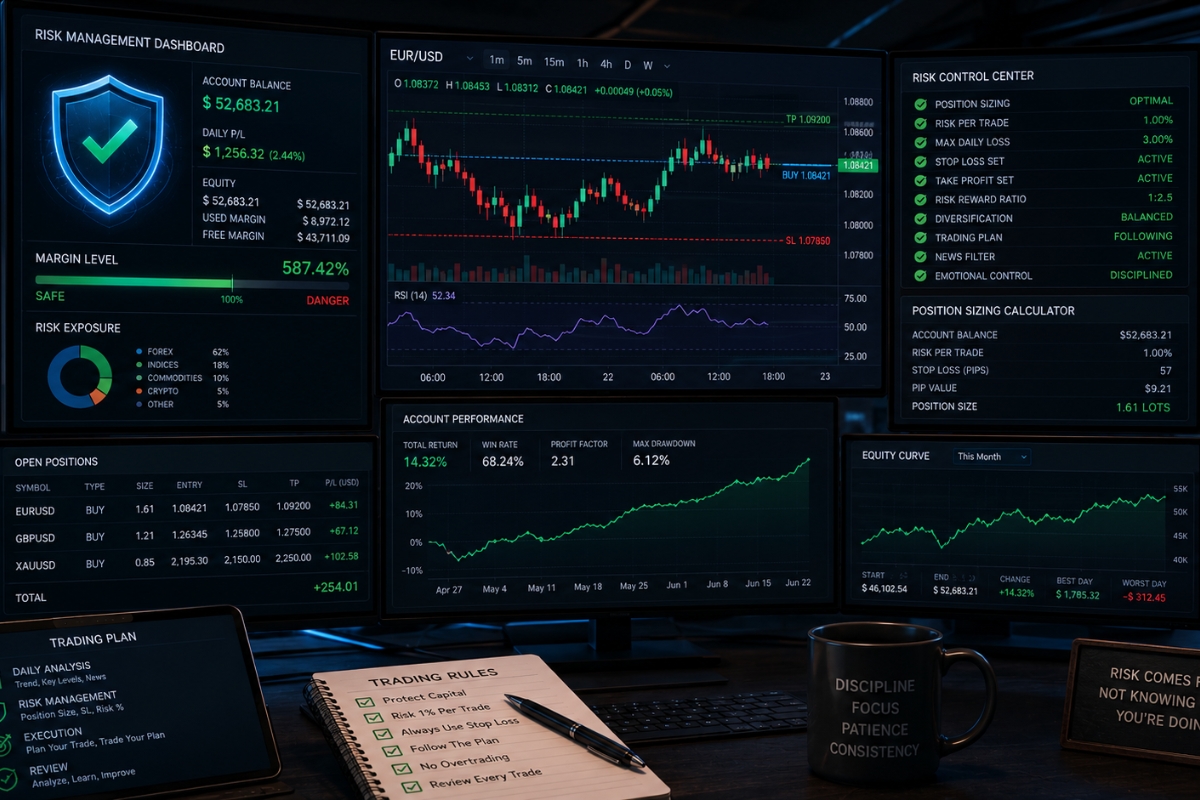
Professional market operators do not rely on hope or luck; they construct an airtight operational blueprint that caps potential losses long before a trade ever reaches a broker’s warning threshold. By treating capital preservation as your primary metric, you ensure that your account remains highly liquid, stable, and perfectly positioned for long-term compounding growth.
How to prevent margin calls in trading?
To permanently eliminate the threat of a margin call from your trading business, strictly enforce these three institutional rules:
- Mandatory Hard Stop-Loss: Every trade must have an automated stop-loss order sent to the broker server immediately at entry, positioned well above your platform’s 100% margin call zone.
- Maintain High Free Margin: Keep at least 70% to 80% of your total account capital completely free and unused, providing a massive buffer to absorb normal intraday price fluctuations.
- Utilize Premium Execution Infrastructure: Executing your technical setups through the institutional routing systems, ultra-tight spreads, and transparent leverage controls recommended on the MBroker ensures that your margin levels are never artificially threatened by predatory spread spikes or execution slippage.
While these core rules apply to all market participants, novice traders require a more restrictive framework during their initial learning curve.
What is the best risk strategy for beginners?
The absolute best risk strategy for beginners is the strict enforcement of the 1% Rule combined with conservative leverage restrictions. Under this protocol, a novice trader must size their positions so that the maximum potential loss on any single trade represents exactly 1% of their total liquid balance. Furthermore, beginners should cap their account leverage at a maximum of 1:30, ensuring that price movements remain slow, manageable, and completely decoupled from the catastrophic margin call thresholds that routinely wipe out uneducated retail participants.
By understanding the 100% margin call threshold, calculating your required used margin before entering the market, and utilizing the advanced capital protection calculators championed on the MBroker, you can easily ensure your account remains completely safe from forced liquidation.

Thoren Vextal is a specialist in XM trading guides, offering practical insights and real-market experience to help traders improve their strategies and trading performance. Email: [email protected]