
 Tiếng Việt
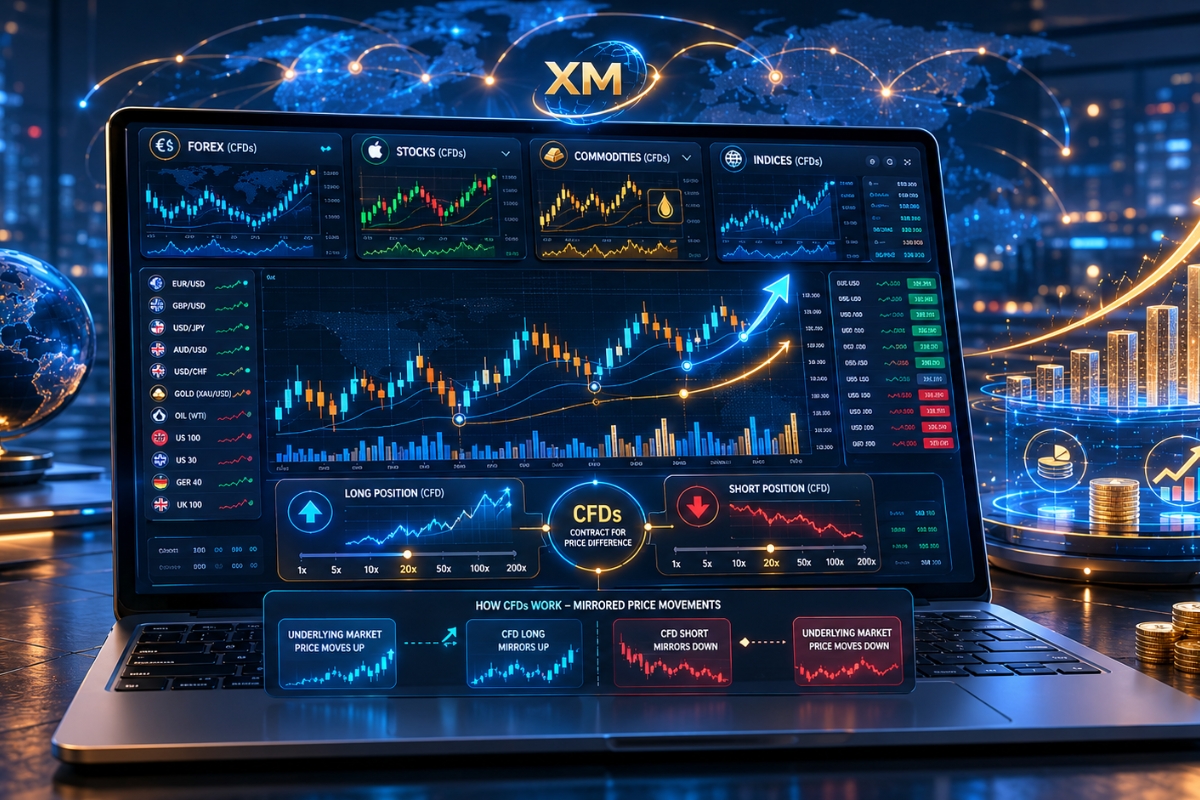
CFDs XM are derivative products that allow traders to speculate on price movements without owning the underlying asset, enabling both Buy and Sell positions with flexible leverage.
In other words, CFDs (Contract for Difference) represent the price difference between entry and exit points, where profit or loss is calculated based on market movement instead of asset ownership.
Additionally, XM offers CFDs across multiple markets including Forex, stocks, indices, commodities, and cryptocurrencies, providing diversified trading opportunities on one platform.
Therefore, CFDs XM can be highly profitable but also carry significant risk due to leverage, with returns depending on market direction, volatility, and risk management.
In practice, CFDs XM work through margin trading, where traders use leverage to control larger positions with smaller capital, amplifying both potential profits and losses.
CFDs XM have become a preferred choice thanks to their flexibility, multi-market access, and ability to profit in both directions. To trade effectively, you must understand how CFDs work, their definition, and real profitability potential, especially when combined with skills from the Forex Technical Analysis category to improve entry and exit decisions in this high-risk, high-reward environment.
What are CFDs XM and how do they work overall?
CFDs XM are financial derivative contracts that allow traders to speculate on the rising or falling prices of global assets—such as forex, stocks, indices, and commodities—without taking physical ownership of the underlying instrument.
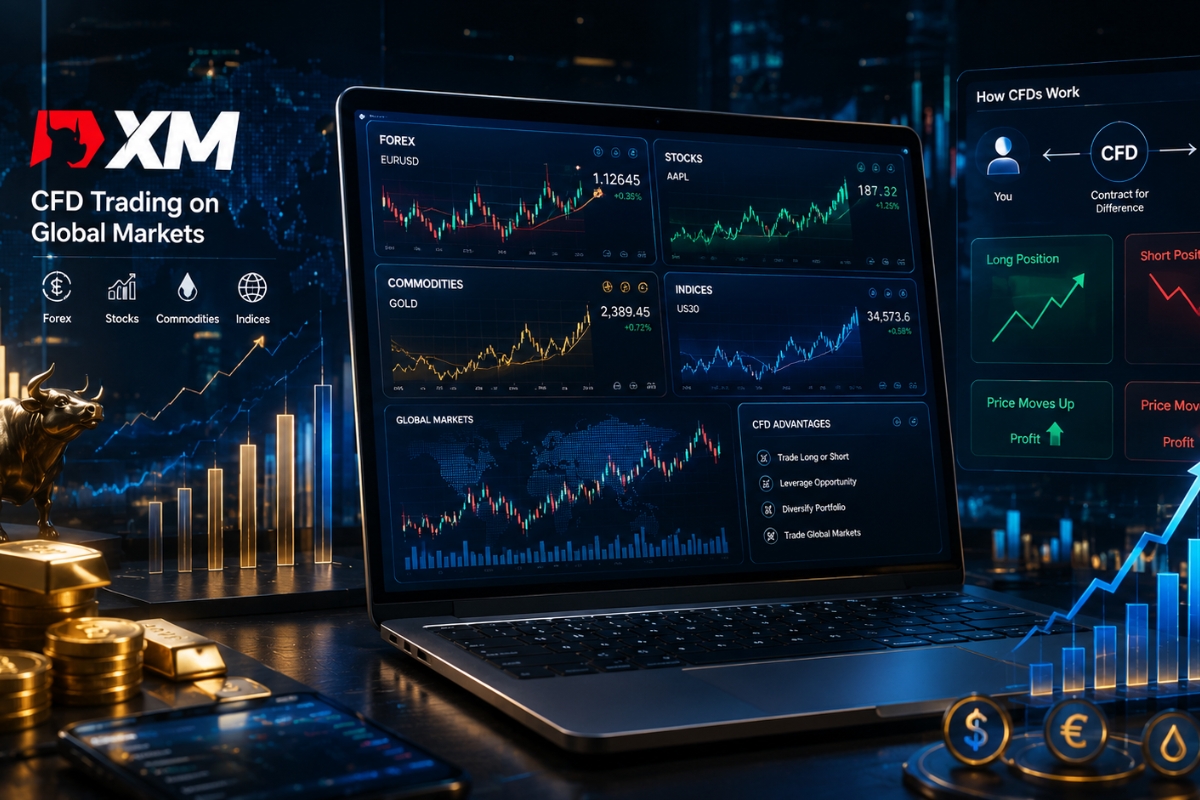
They work through an over-the-counter (OTC) agreement between the trader and the broker, where the two parties agree to exchange the price difference of an asset between the contract’s opening and closing times. Mechanically, if you buy a contract and the market gains value, you pocket the absolute dollar difference; conversely, if the market drops, your account balance is deducted.
What are CFDs XM in trading?
In active trading, CFDs XM represent a standardized digital bridge to over 1,000 global financial instruments hosted on the MetaTrader 4 and MetaTrader 5 platforms. Instead of purchasing physical gold bars or corporate stock certificates, you trade a digital contract that mirrors the real-time cash price feed of the global exchange. This structure enables instantaneous trade execution speeds, under 1 millisecond, and eliminates traditional administrative headaches like asset storage fees, brokerage stamp duties, and settlement delays.
Understanding this operational infrastructure makes it easier to identify the specific investor profiles that this product family targets.
Who should trade CFDs XM?
This specific leveraged asset class is explicitly engineered for a distinct category of financial market participants:
- Short-Term Speculators: Day traders and swing traders who want to capitalize on daily micro-movements within global trends.
- Hedgers: Portfolio managers who use short CFD contracts to protect their physical equity holdings against temporary macro market downturns.
- Capital-Constrained Investors: Traders at MBroker who wish to gain large market exposure using small initial deposits via leverage.
- Bi-Directional Operators: Strategic thinkers who want the equal ability to profit from falling bear markets (shorting) as easily as rising bull markets (longing).
Once your investor profile is verified, you must master the fundamental legal and academic definitions that govern contracts for difference.
Definition of CFDs and contract for difference explained
The contract for difference (CFD) is defined as a binding bilateral financial derivative where the buyer pays the seller (or vice versa) the exact difference between the current value of an asset and its value at contract closure.
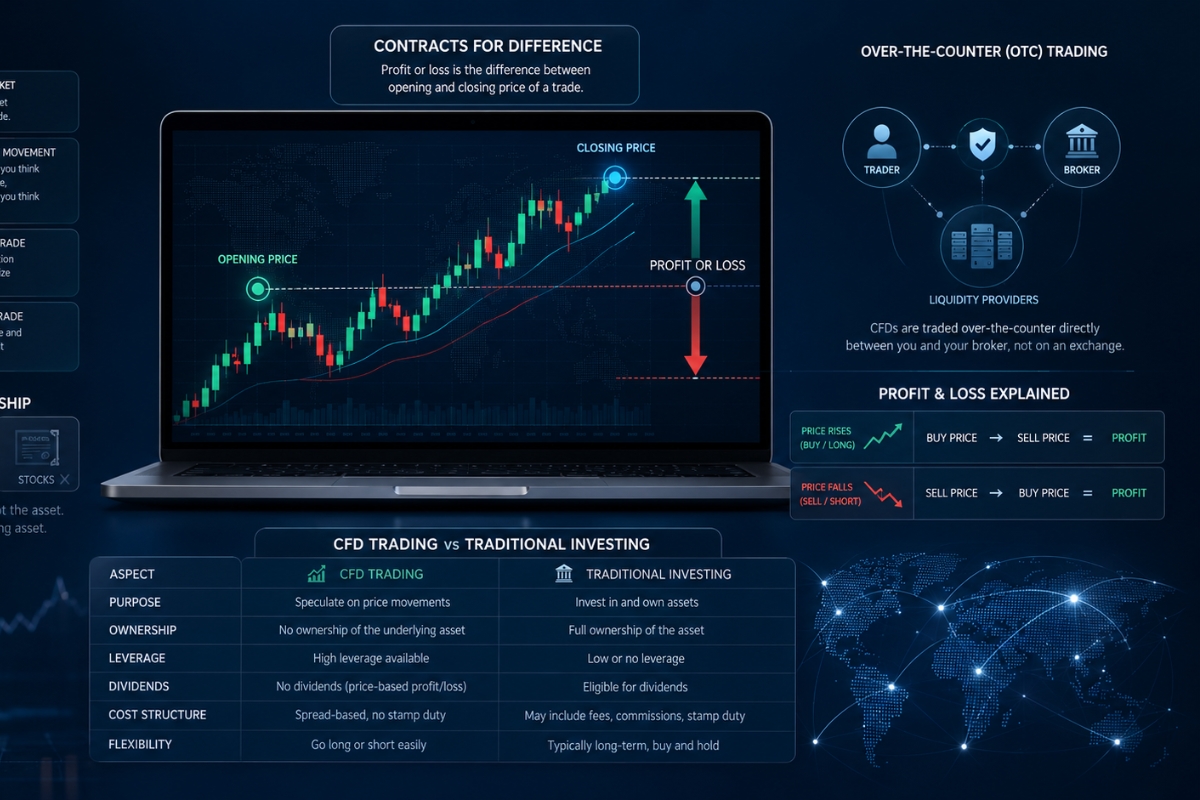
Statistically, CFDs do not have a fixed expiration date, allowing traders to hold positions indefinitely as long as their accounts maintain the mandatory margin requirements. This contract model shifts the focus entirely away from physical asset possession, transforming trading into a pure, streamlined mathematical game of price trajectory tracking.
What is CFD in financial markets?
In global financial architecture, a CFD is an agreement where your profit or loss is determined strictly by calculating the formula:
Profit/Loss = ( Closing Price – Opening Price ) x Number of Contracts
Because it is an over-the-counter derivative product, you do not interact with a centralized exchange like the New York Stock Exchange (NYSE); instead, the transaction liquidity is counter-backed directly by the broker’s liquidity network. This unique structural framework allows for the seamless integration of short-selling, meaning you can borrow and sell an asset you do not own to profit from market crashes.
This direct detachment from physical ownership creates deep operational contrasts when compared to traditional buy-and-hold investing.
How are CFDs different from traditional investments?
The operational mechanics of CFDs differ fundamentally from traditional asset investing across several core parameters:
- Ownership Rights: Traditional investing grants you physical asset ownership and shareholder voting rights; CFDs grant you zero ownership and are purely used for price speculation.
- Leverage Limits: Traditional stock investing typically requires a 1:1 or 1:2 cash-to-asset ratio; CFDs offer massive internal leverage up to 1000:1, allowing for minimal capital outlays.
- Dividend Treatment: Traditional investors receive direct corporate dividend payments; CFD holders receive corresponding cash adjustments credited to or debited from their balances depending on whether they are long or short.
- Transaction Fees: Traditional investing carries fixed custody and exchange clearance fees; CFDs generate costs primarily through variable spreads and overnight financing fees (swaps).
With these definitions clarified, let’s explore the vast universe of global asset markets accessible through this derivative gateway.
Markets available for CFDs XM trading
The markets available for CFDs XM trading encompass five primary global asset categories: Foreign Exchange (Forex), Individual Shares, Major Stock Indices, Hard and Soft Commodities, and Energies.
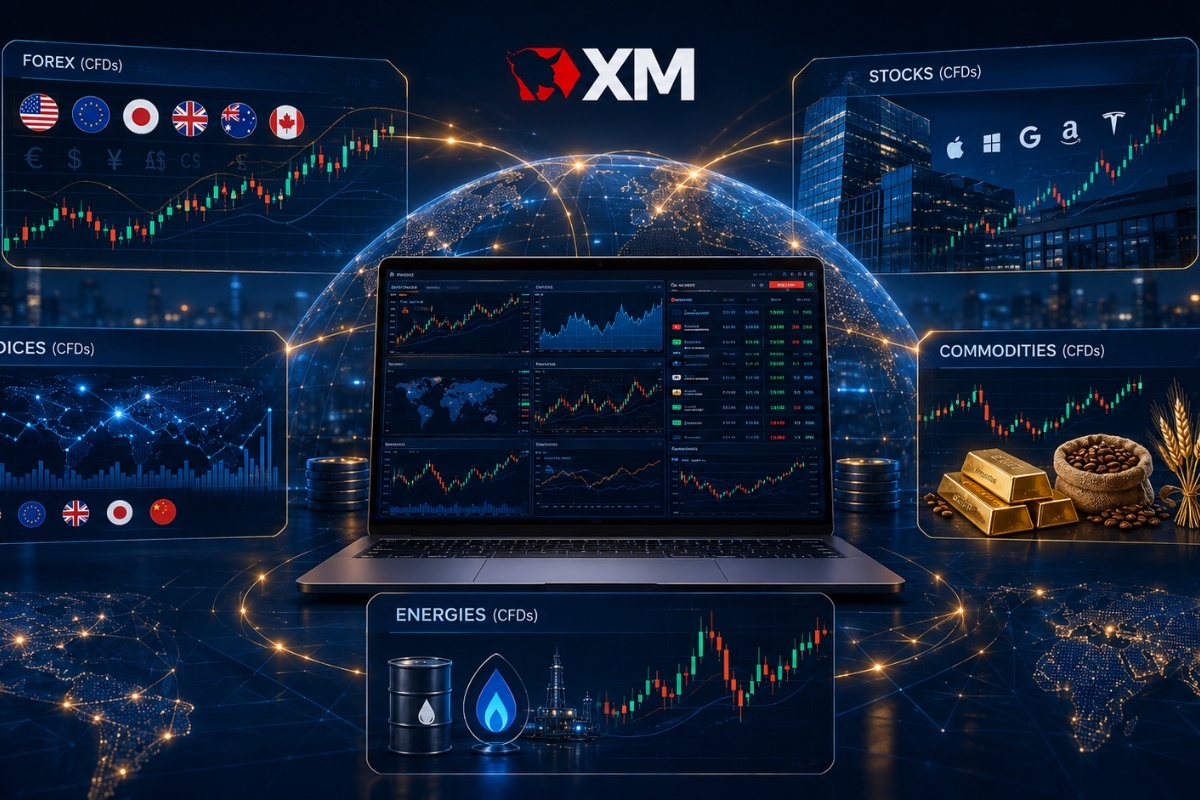
This multi-market access allows a trader to shift capital seamlessly across different global sectors using a single, consolidated trading account balance. Because these diverse markets are deeply interconnected via global macroeconomics, having direct access to all sectors simultaneously maximizes your tactical flexibility during times of geopolitical or economic change.
What CFD markets are available on XM?
The platform architecture categorizes its massive inventory into distinct, liquid asset groups:
- Forex CFDs: Over 50+ currency pairs, including majors (EUR/USD), minors (GBP/JPY), and exotic combinations.
- Stock CFDs: Direct access to hundreds of blue-chip corporate giants listed across the US, UK, Germany, and Asian exchanges (e.g., Apple, Tesla, SAP).
- Indices CFDs: Spot and futures contracts on major baskets of national economies, including the S&P 500, NASDAQ 100, and DAX 40.
- Commodities & Energies: Contracts covering physical goods like Crude Oil, Brent, Natural Gas, Coffee, Wheat, Sugar, and Copper.
While having massive market choice is a benefit, you must recognize that each individual sector operates with its own localized volatility rules.
How do different CFD markets behave?
Every individual asset class behaves differently based on its unique liquidity sources, fundamental drivers, and average daily ranges. Forex pairs are highly liquid and trend smoothly based on central bank interest rate differentials and macroeconomic data releases. Equity indices and shares exhibit intense intraday volatility during corporate earnings seasons, frequently resulting in large price gaps. Meanwhile, energy and commodity CFDs behave with extreme cyclical volatility, reacting aggressively to real-world geopolitical tensions and supply-demand imbalances.
Understanding these varied market characteristics is the direct prerequisite to evaluating your net profitability potential over time.
Profitability of CFDs XM and trading potential
The profitability of CFDs XM relies on a trader’s ability to maintain a positive expectancy model by combining a disciplined win-rate with an optimized risk-to-reward ratio.
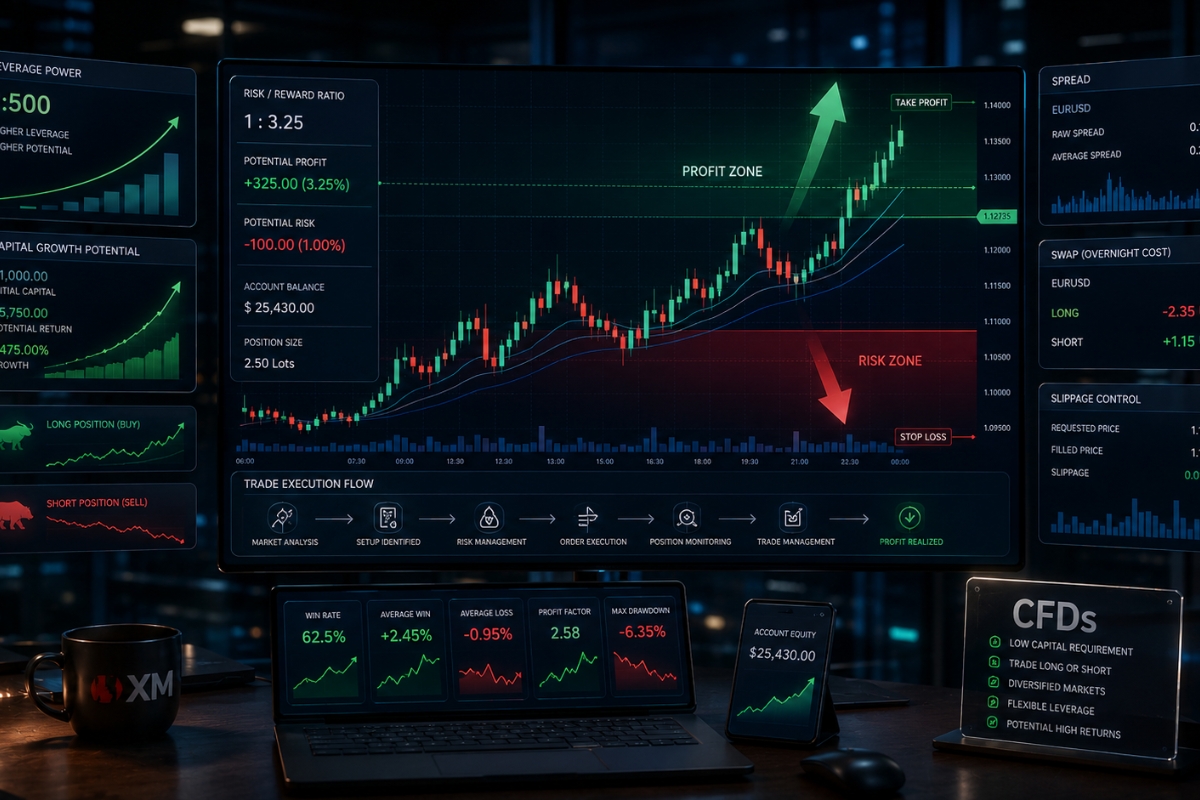
Statistically, because CFDs utilize leverage, the profitability potential is mathematically amplified, meaning that a minor 1% shift in the underlying asset’s price can generate a 20% to 50% return on your deployed margin. However, this amplification is a double-edged sword, as the exact same mathematical leverage rules apply to your losses if the market moves against your technical setup.
Are CFDs a good investment option?
From a strictly professional viewpoint, CFDs are not classified as long-term “investment” options like retirement index funds; rather, they are premier short-term trading vehicles. Because they carry daily overnight swap charges (financing costs for holding leveraged positions open past the daily rollover hour), keeping a position open for multiple years will slowly erode your profit margin. They are an exceptional option for active income generation, swing trading, and tactile portfolio protection over horizons spanning from minutes to several weeks.
Achieving sustainable net returns during these active trading windows requires managing specific hidden operational costs.
What factors affect profitability in CFDs XM?
Your net bottom-line profitability when interacting with these instruments is driven by four core financial variables:
- The Bid-Ask Spread: The baseline transaction cost charged by the broker; keeping spreads narrow ensures you enter profitability faster.
- Overnight Swap Rates: The interest rate differential between the currencies or assets you are holding; positive swaps pay you income, while negative swaps incur costs.
- Execution Slippage: The difference between your requested entry price and the actual execution price; using the low-latency order routing championed by MBroker keeps slippage to an absolute minimum.
- Emotional Discipline: The psychological ability to cut losing trades early and let your profitable trades run to their complete mathematical targets.
With the profitability variables calculated, we can finally map out the precise mechanical journey of executing a live trade from start to finish.
How CFDs XM work in real trading conditions?
In real trading conditions, CFDs XM work through a highly structured, automated electronic process that instantly locks in your margin requirements and updates your floating profit and loss statement in real-time.
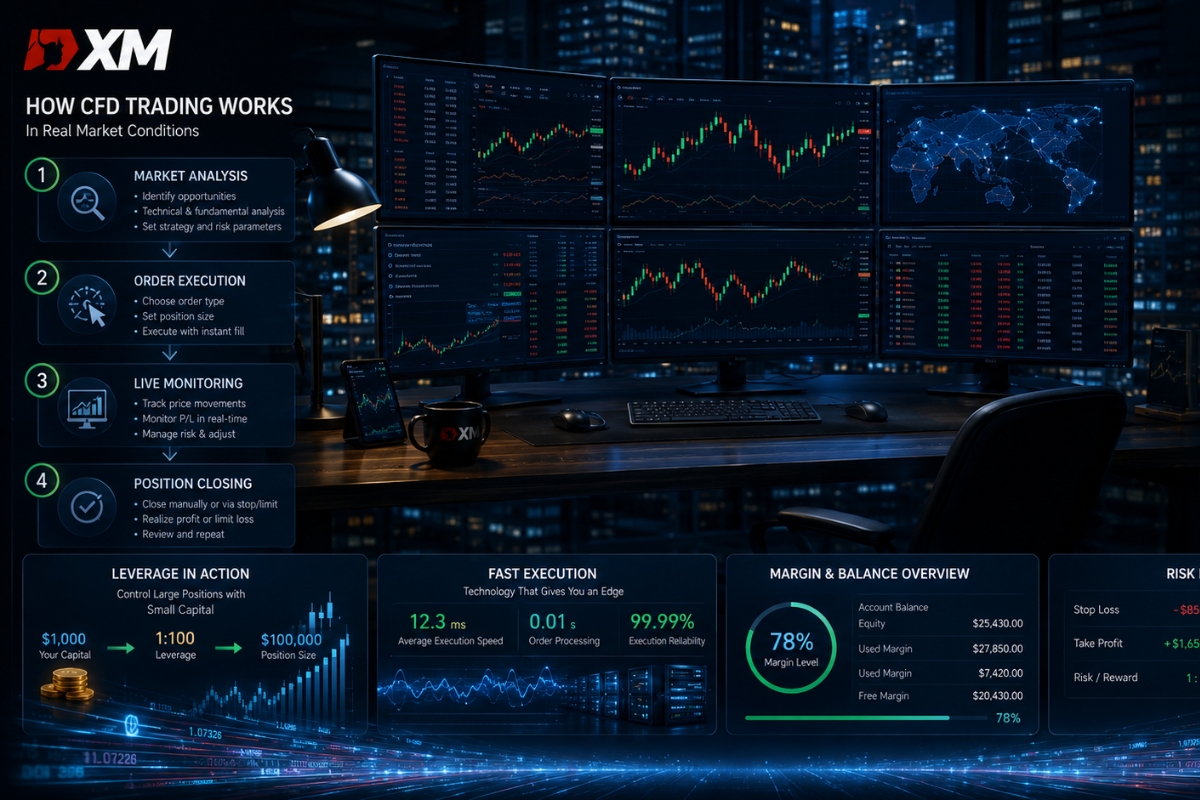
The entire process takes place in milliseconds on the trading server, removing all manual settlement delays found in older, legacy banking models. By operating within a highly optimized environment, traders can move in and out of multi-million dollar positions with a single mouse click, making it a highly streamlined approach for digital portfolio management.
How does a CFD trade work step by step?
The execution of a live contract follows a strict chronological timeline:
- Step 1: Formulate Market Bias: Analyze your technical charts and macro data. For example, your research indicates that Eurozone inflation will drive the EUR/USD exchange rate upward from its current price of 1.1000.
- Step 2: Allocate Deployed Capital: Open your trading terminal and select the asset. Instead of spending $110,000 cash to buy a full lot, you allocate a tiny fraction of that amount as your required security collateral.
- Step 3: Execute Buy or Sell Order: Click the “Buy” button on your terminal to instantly initiate the contract. The broker matches your order with their institutional liquidity providers, filling the position in milliseconds.
- Step 4: Live Position Monitoring: Track your floating profit or loss in the “Trade” window. If the EUR/USD price rallies up to 1.1100 (a 100-pip gain), your contract displays a floating profit of exactly $1,000.
- Step 5: Close Contract and Settle Balance: Click the “Close” button to finalize the trade. The platform instantly terminates the agreement, liquidates the position, and credits the net cash profits directly to your wallet balance.
To execute this step-by-step sequence safely, you must understand the exact internal mechanics of the leverage engine that drives the platform.
How do leverage and margin work in CFDs XM?
Leverage and margin act as the mechanical gears of a CFD transaction, working inversely to dictate your account’s purchasing power and risk exposure. Margin is the minimum dollar deposit required as security collateral to keep a position open, while Leverage is the multiplier that grants you large market access.
For instance, if you utilize a 100:1 leverage structure on a $10,000 contract, your required margin is calculated via the formula:
Required Margin = Total Position Value /Leverage Leve
In this scenario, the required margin is exactly $100. This means you control a full $10,000 portfolio while only locking up $100 of your cash balance. By routing these leveraged transactions through the transparent execution frameworks found on the MBroker, traders can monitor their margin health precisely, avoid margin calls, and protect their capital with absolute professional confidence.
In summary, CFDs XM are exceptionally powerful financial derivatives that provide modern traders with direct, leveraged access to global asset price movements across all major asset classes. By understanding their contract structures, matching your strategy to specific market personalities, and strictly managing your leverage parameters, you can build a scalable technical trading edge.

Thoren Vextal is a specialist in XM trading guides, offering practical insights and real-market experience to help traders improve their strategies and trading performance. Email: [email protected]