
 Tiếng Việt

Forex market movers are key events and factors that directly cause price movements in currency pairs, including economic releases, interest rate decisions, and geopolitical news.
As a result, these market movers often trigger high volatility with rapid price fluctuations, especially during major news releases or overlapping trading sessions.
Moreover, forex market movers play a crucial role in forming and reversing market trends, as strong economic data or policy changes can shift long-term price direction.
Consequently, market movers significantly affect trade execution, spreads, and slippage, increasing both profit opportunities and trading risks during volatile periods.
Therefore, traders need clear strategies and real-time tools to track market movers effectively, helping them manage risk and capitalize on high-impact trading opportunities.
In forex, price movements are driven by forex market movers like economic data and central bank decisions. Understanding volatility and trends is essential for trading—alongside managing costs in the XM Trading Fees category.
Forex market movers today and key price drivers
Forex market movers today represent the primary economic catalysts, central bank policies, and geopolitical events that systematically dictate global capital flows and shift international currency valuations.

Statistically, global currency markets are heavily dominated by interest rate differentials, with historical data confirming that a sudden 25 to 50 basis point shift in central bank rate expectations can trigger immediate, multi-hundred-pip moves across major pairs within milliseconds. Without a structured framework to identify these underlying catalysts, technical chart setups are highly vulnerable to unexpected order-book imbalances, making fundamental tracking the absolute starting point for modern risk management.
What are the top forex market movers today?
The primary catalysts capable of instantly reshaping the international currency order-book are divided into three high-impact institutional categories:
- Central Bank Monetary Policy: Forward guidance and unexpected interest rate decisions from major institutions like the Federal Reserve (Fed), European Central Bank (ECB), and Bank of Japan (BOJ).
- Macroeconomic Indicator Releases: High-priority scheduled data points, specifically the US Non-Farm Payrolls (NFP), Consumer Price Index (CPI) inflation metrics, and Gross Domestic Product (GDP) growth numbers.
- Geopolitical Shock Events: Sudden macro shifts, including trade policy reconfigurations, international tariff implementations, or energy flow blockades in critical maritime logistics channels.
Identifying these overarching structural forces allows you to predict which financial instruments will experience the heaviest institutional order flow.
Which currency pairs are moving the most right now?
The currency pairs exhibiting the highest daily trading ranges are typically major crosses that combine conflicting central bank policies or extreme safe-haven funding dynamics. For instance, GBP/JPY (historically nicknamed “The Dragon”) frequently moves over 150 to 200 pips daily due to the wide structural yield divergence between the Bank of England and the Bank of Japan’s slow policy tightening. Similarly, commodity-linked majors like AUD/USD show intense price velocity whenever global industrial metal demand fluctuates or Chinese economic growth models adjust, presenting substantial volatility for short-term breakout traders.
While tracking these active instruments offers substantial commercial opportunity, it requires a deep understanding of why these catalysts generate such intense price shocks.
Volatility spikes caused by market movers
Volatility spikes occur when a market-moving event releases data that deviates substantially from the consensus estimated by institutional Wall Street analysts.

In active financial markets, a wider divergence between the actual economic print and market expectations triggers an immediate, aggressive repricing phase as algorithmic trading models rapidly adjust their risk parameters. This massive injection of sudden order flow completely overwhelms normal retail liquidity, causing the standard bid-ask spread to widen significantly and driving violent, multi-directional price swings across the global network.
Why do market movers create sudden volatility?
Market movers create immediate volatility spikes due to the mathematical mechanics of the interbank order book, which relies heavily on liquidity density. Ahead of an important macroeconomic release, commercial banks and institutional market makers routinely withdraw their pending limit orders to protect themselves from uncalculated loss. This operational withdrawal creates an instantaneous “liquidity void”—meaning that when the data is finally released, subsequent high-frequency market orders pull prices sharply through a thin, empty order book, resulting in aggressive price slippage and vertical chart candles.
To navigate this institutional mechanics safely, day traders must schedule their execution around the precise hours when global market volumes overlap.
When does volatility peak during trading sessions?
Forex market volatility reaches its absolute daily peak during the London-New York session overlap (13:00 GMT to 16:00 GMT), where the world’s two largest financial ecosystems are simultaneously active. Over 60% of all daily transaction volume is compressed into this critical 3-hour window, providing the necessary liquidity to sustain aggressive, directional trend expansions. Conversely, a secondary volatility peak routinely occurs during the first 30 minutes of the Asian session open, specifically when the Reserve Bank of Australia or the Bank of Japan delivers unscheduled monetary policy shifts.
Understanding these micro-spikes in intraday velocity is important, but a professional trader’s ultimate goal is tracking how these events establish macro directional trends.
Forex trends driven by economic and news events
Forex trends are structural, long-term directional paths carved by sustained macroeconomic shifts and evolving central bank policy paths over multi-month horizons.

Unlike brief, news-driven intraday price spikes, a true macroeconomic trend reflects a fundamental capital migration out of low-yielding, slowing economies and into high-yielding, resilient financial jurisdictions. By monitoring the gradual evolution of these underlying economic drivers, macro investors can safely position their capital alongside major institutional funds, avoiding the chaos of short-term market noise.
How do news events shape forex trends?
News events shape sustainable forex trends by altering the long-term interest rate differentials between two global economies. For example, if the Federal Reserve signals a cautious, data-dependent monetary approach due to persistent service inflation, US Treasury yields will naturally adjust higher over several consecutive quarters. This structural yield advantage continuously draws global corporate capital into dollar-denominated assets, creating a steady, multi-month bullish trend on the US Dollar Index (DXY) that shapes the background of every major currency pair.
When these fundamental forces shift direction, they possess the structural power to break even the most heavily defended technical chart boundaries.
Can market movers reverse existing trends?
Yes, high-impact market movers can completely reverse multi-month technical trends if they deliver a structural surprise that invalidates the market’s long-term growth assumptions. A classic example occurs when a major central bank unexpectedly transitions from an aggressive monetary tightening phase to an emergency liquidity-injection program due to underlying banking system stress. Such a fundamental pivot causes institutional funds to liquidate their legacy positions simultaneously, triggering a massive macro trend reversal that completely overrides existing historical support and resistance zones.
Recognizing these trend-shifting dynamics is essential for protecting your account balance from severe execution hazards.
Trading impact of forex market movers
The trading impact of forex market movers directly dictates the efficiency of your order routing, the accuracy of your technical indicators, and your overall portfolio safety metrics.

During high-impact news releases, standard retail market conditions degrade rapidly, exposing unhedged accounts to severe execution variances and rapid margin depletion. By understanding how these institutional forces impact live account performance, an investor can transition from a reactive retail mindset to a proactive risk-management framework that protects capital during market stress.
How do market movers affect trade execution?
Market-moving events affect trade execution by triggering severe slippage and unexpected order rejection across standard retail networks. When you submit a market order during a high-impact event, the thin liquidity density means your broker cannot fill your position at the exact price displayed on your chart; instead, your order is filled at the next available institutional quote, which could be dozens of pips away. To mitigate these execution hazards, professional traders ensure their platform routing is perfectly optimized by utilizing the deep institutional liquidity pools and transparent execution infrastructure provided on premium networks like MBroker.
Beyond simple execution slippage, operating during these intense news events introduces multiple layers of capital risk.
What risks should traders watch during market-moving events?
During high-impact financial events, active traders must continuously defend their accounts against three severe operational risks:
- The Double-Sided Stop-Out: A hostile market condition where price swings violently up and down within seconds, triggering both your buy stops and sell stops before moving in the actual intended direction.
- Margin Call Vulnerability: A rapid contraction in available account margin caused by extreme spread expansion, forcing the automated liquidation of open positions.
- Gap Risk: A severe market condition where price skips directly over your defined stop-loss order during a weekend opening or a black swan announcement, executing your loss at a significantly worse price level than anticipated.
Defending your portfolio against these institutional hazards requires a highly disciplined, rule-based execution strategy.
How to trade forex market movers effectively?
Trading forex market movers effectively requires abandoning emotional guesswork and adopting a highly calculated, mechanical approach designed to capitalize on post-news momentum safely.
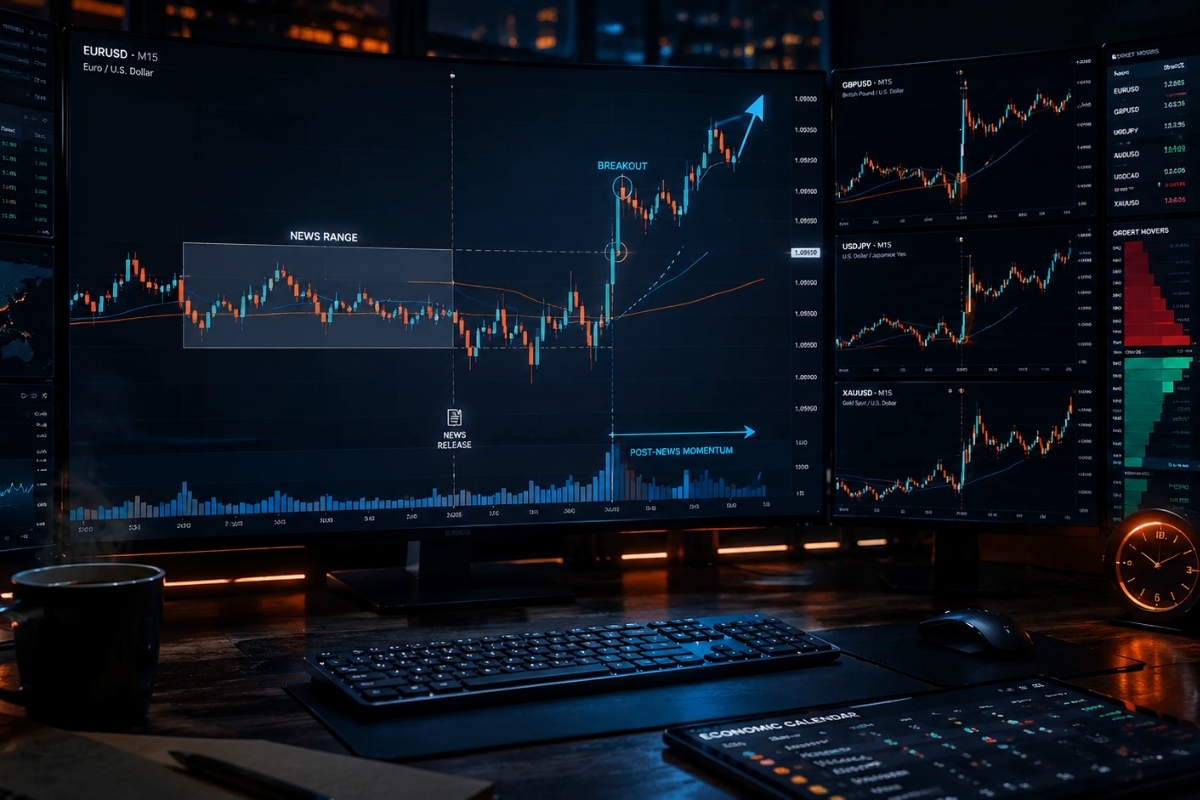
Instead of attempting to predict the exact data outcome of an economic release—which is a statistically unviable approach—professional traders wait for the initial volatility spike to conclude before entering the market. This structural approach allows the market to fully absorb fundamental shock, identify genuine institutional direction, and reveal high-probability technical entry points.
What is a simple strategy for trade market movers?
A highly effective, risk-mitigated methodology for trading news events is the Post-News Breakout Strategy, executed via three precise sequential steps:
1.Establish the News Range: First 15 Minutes.
Allow economic data to release completely. Do not place any trades during the initial 15 minutes; instead, map out the absolute highest and lowest price boundaries established by the initial volatility candle.
2.Identify the Confirmed Breakout: Wait for Candle Close.
Wait for a 5-minute or 15-minute candle to break completely outside of the established news range. The candle must close cleanly beyond the boundary to confirm that institutional momentum is backing the move.
3.Execute with Strict Risk Controls: Position Entry.
Enter a position in the direction of the confirmed breakout. Place your hard stop-loss inside the midpoint of the news candle, and target a minimum 1:2 Risk-to-Reward ratio to ensure a positive mathematical expectancy.
Transitioning this mechanical procedure into a live terminal requires premium tracking tools to maintain a constant data edge over the market.
What tools track market movers today in real time?
To track market movers with high precision, professional operators utilize real-time Economic Calendars configured with automated sound alerts and institutional impact ratings (Low, Medium, High). Advanced day traders supplement these basic schedules with live algorithmic news feeds, such as Bloomberg Terminal streams or Reuters Squawk boxes, which translate raw economic data into audio alerts within milliseconds of release. By combining these advanced real-time data feeds with extensive daily research, market analysis, and premium educational resources hosted on the MBroker, retail chartists can successfully eliminate execution delays and navigate macro events with absolute institutional clarity.
In conclusion, Forex Market Movers are the foundational lifelines of the financial markets, dictating the rise and fall of global asset pricing. By learning to identify key fundamental drivers, avoiding execution during uncalculated liquidity voids, and deploying strict post-news breakout strategies, you can transform high-impact volatility into a highly structured commercial advantage.

Neria Solven is a financial analyst specializing in XM trading fees and account types, known for her clear and practical insights. Email: [email protected]