
 Tiếng Việt
Neither XM nor XTB is always cheaper. Total trading cost depends on the account, instrument, live spread, commission, holding period and account currency. XM currently lists accounts with a $5 minimum deposit on the English page reviewed, while XTB’s international offer states that it has no minimum deposit.
XM is the clearer option for traders who require MT4 or MT5. Both platforms support Expert Advisors, whereas XTB concentrates its current service around a proprietary web and mobile platform covering stocks, ETFs and CFDs.
Regulation must be compared at legal-entity level. The company holding an account, its regulator and the available client protections can change according to the trader’s country and registration route.
XM generally fits MetaTrader-focused Forex and CFD traders, while XTB may suit users seeking an integrated platform for trading and investing. The better choice therefore depends on total costs, required instruments, platform compatibility and the contracting company rather than one overall broker rating.
XM vs XTB Fees: Which Broker Has Lower Trading Costs?
The cheaper broker depends on the account, instrument and trading pattern. A minimum spread cannot show the full cost because commission, overnight financing, currency conversion and inactivity charges may also apply.
XM’s account structure varies by legal entity and region. On the current English page reviewed, XM lists Ultra Low and Zero accounts with a $5 minimum deposit. The Zero account uses fixed commissions with spreads that may start from zero, while Ultra Low focuses on lower spreads and reduced trading costs.
XTB’s international account page currently states that there is no minimum deposit, CFD trading carries 0% commission and a 0.5% conversion charge may apply. However, a zero explicit commission does not mean that a position has no cost because the quoted spread and any overnight financing remain relevant.
For a broader explanation of XM’s spreads, swaps and other charges, readers can review Mbroker’s XM trading fees guide before comparing a specific instrument.
The following infographic shows the main components that should be included in a like-for-like cost comparison.
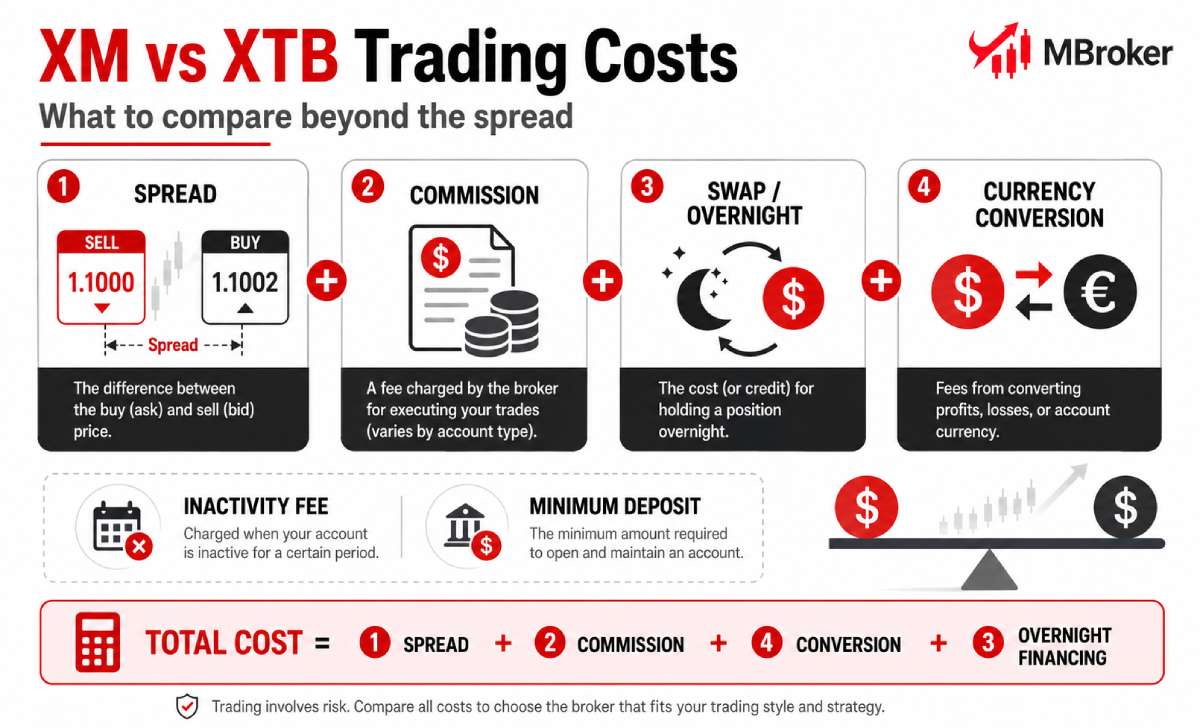
The table below compares the main cost areas rather than relying only on each broker’s advertised minimum spread.
| Cost factor | XM | XTB | Why it matters |
| Account structure | Account options and pricing vary by entity; the reviewed page lists Ultra Low and Zero | International pricing is presented through one main CFD offer | The pricing model determines whether costs are spread-based or include commission |
| Minimum deposit | $5 on the Ultra Low and Zero accounts reviewed | No minimum deposit on the international page | This affects account entry but does not measure trading risk |
| CFD commission | Zero Account uses fixed commission; other conditions vary | 0% commission is stated for CFDs | Zero commission does not remove the spread |
| Spread | Variable by account, product and market conditions | Minimum spread is listed from 0.5 on the international offer | Live spreads may widen during volatility or low liquidity |
| Overnight cost | Swap or account-specific treatment may apply | Swap points apply to some CFDs | Holding costs can outweigh the opening spread |
| Currency conversion | Depends on the account currency and instrument | A 0.5% CFD conversion fee is currently listed | Conversion affects trades settled in another currency |
| Inactivity | Conditions depend on the applicable XM agreement | €10 monthly may apply when both inactivity conditions are met | Occasional traders should check how long an account can remain unused |
XM’s data above comes from the account page serving the reviewed entity, while XTB’s figures come from its international fee page and English help centre. Conditions may differ under another regional company.
How Do XM and XTB Account Structures Differ?
XM provides more visible separation between account pricing models. Its current English page distinguishes Ultra Low from Zero, allowing users to compare lower-spread pricing with a fixed-commission structure.
In contrast, XTB’s international offer presents its CFD conditions through a simplified pricing page. This can make the account selection process shorter, but users still need to check each instrument’s spread, swap points and conversion treatment.
Therefore, the appropriate account depends on how frequently the trader enters positions and how long those positions remain open. A short-term trader may focus on the round-trip spread and commission, whereas an overnight trader must place greater weight on financing costs.
Which Fees Matter Beyond the Advertised Spread?
Commission, swaps, currency conversion and inactivity charges are the main additional costs to examine. Payment providers or banks may also impose charges even when the broker does not charge a direct deposit fee.
XTB’s English help centre currently states that a monthly inactivity fee of €10, or the equivalent in the account currency, can apply when no position has been opened or closed for 365 days and no deposit has been made for 90 days. The fee is not charged when the account balance is zero.
A practical comparison can use the following formula:
Total trading cost = spread cost + opening commission + closing commission + currency conversion + overnight financing
For example, two brokers cannot be compared fairly when the XM quote is taken during a liquid market period and the XTB quote is recorded during a volatile announcement. Position size, account currency, instrument and measurement time must remain the same.
Costs are only the first part of the decision. The cheaper account may still be unsuitable when it does not support the trader’s existing platform, indicators or automated system.
XM vs XTB Platforms: MT4/MT5 or the XTB Platform?
XM is more suitable for established MetaTrader workflows, while XTB provides a more integrated proprietary platform. The decision depends on whether the trader prioritises MT4/MT5 compatibility or wants stocks, ETFs and CFDs inside one interface.
XM officially provides MT4, MT5 and its mobile application. MT4 includes more than 50 indicators and charting tools, while MT5 currently includes more than 58 indicators and 44 analytical objects. Both platforms support Expert Advisors.
XTB’s current platform provides web, desktop, tablet and mobile access. Its international page advertises more than 11,800 instruments across stocks, ETFs and CFDs, although the exact products available depend on the client’s region and legal entity.
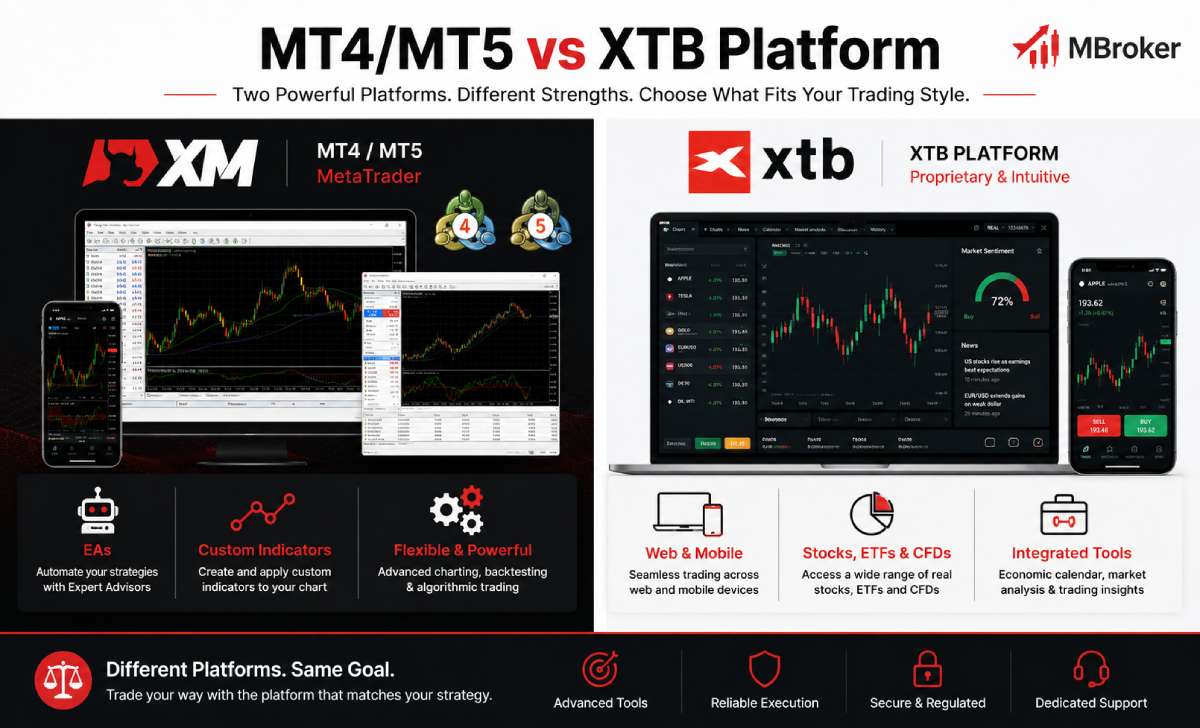
The following image highlights the difference between XM’s MetaTrader ecosystem and XTB’s proprietary interface.
Can MetaTrader Strategies and EAs Be Used at Both Brokers?
Existing MT4 and MT5 Expert Advisors can be used directly on XM’s corresponding platforms. XM confirms support for EAs and access to the MQL4 or MQL5 programming environment.
Traders who rely on MQL4 automation, custom indicators or an established Forex setup can read Mbroker’s detailed XM MT4 guide to review the platform’s tools and practical limitations.
Meanwhile, users who require additional timeframes, analytical objects or MQL5 automation can consult the XM MT5 platform review.
XTB’s current retail offer focuses on its own platform rather than providing direct MT4 or MT5 access. Consequently, an existing MetaTrader EA cannot simply be installed on XTB’s platform. The strategy would need to be recreated through another supported technical solution.
How Does Market Access Differ Between XM and XTB?
Both brokers provide Forex and CFD markets, but XTB places more emphasis on combining leveraged trading with stocks and ETFs. The international XTB platform currently advertises more than 11,800 instruments across these categories.
XM’s reviewed European pages list Forex, stock CFDs, commodities, indices, metals, energies, shares and thematic indices. However, the products available may differ under XM’s other legal entities.
Readers should also distinguish between an underlying share and a share CFD. Underlying shares may provide ownership-related rights, whereas CFDs are derivatives used to speculate on price changes without owning the underlying instrument.
Platform functions only become relevant after the trader confirms which regulated company will hold the account and which legal protections apply.
XM vs XTB Regulation: How Does Client Protection Differ?
Neither XM nor XTB should receive one global regulation score. Each brand operates through several companies, and the applicable entity depends on residence, local rules and the registration route.
For XM’s European operation, Trading Point of Financial Instruments Limited is licensed by the Cyprus Securities and Exchange Commission under licence 120/10. The relevant XM regulation page also states that this entity keeps client funds segregated and participates in the Investor Compensation Fund.
XTB’s international page identifies XTB International Limited as a Belize company authorised by the Financial Services Commission under registration number 6442514. XTB also lists other group companies regulated in Poland, the United Kingdom and Spain.
The existence of several regulated companies does not mean that a user can freely select any entity. The company named in the client agreement determines the regulator, legal documents, complaint route and available protections.
Readers who need a broader assessment of XM’s accounts, fees and limitations can consult Mbroker’s independent XM Review.
The following diagram explains how residence, legal entity and regulatory protection connect.
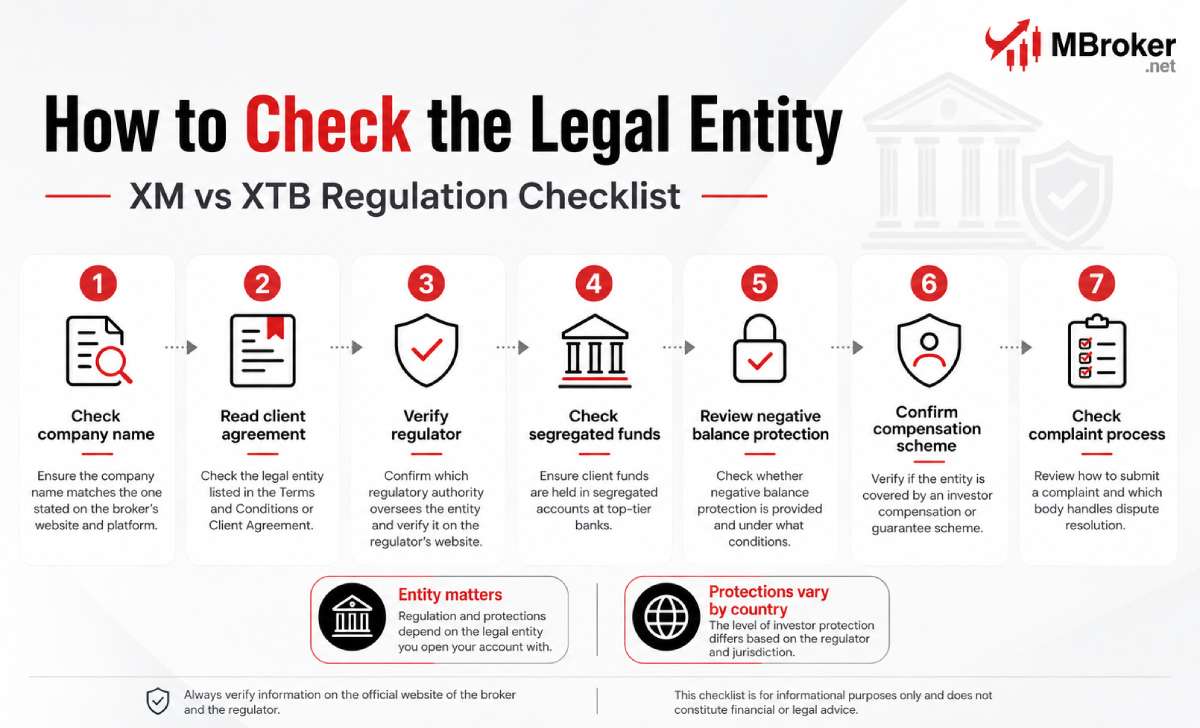
Before relying on a licence or client-protection claim, check the following information:
- Read the company name shown during registration
- Match that company with the client agreement
- Verify the licence through the regulator’s official register
- Check whether client funds are segregated
- Review negative balance protection conditions
- Check whether a compensation scheme applies
- Confirm the complaint and dispute-resolution process
For a more focused explanation of legal entities, segregated funds and negative balance protection, see Is XM Safe?. These measures can reduce particular operational risks, but they do not insure a trader against normal market losses.
Risk warning: Forex and CFDs are leveraged products that can cause rapid losses. Regulation, segregated funds and negative balance protection do not prevent losses caused by market movements, unsuitable leverage or poor risk control. XM’s current European page states that 75.12% of retail investor accounts lose money when trading CFDs with that provider.
Once the relevant legal entity has been confirmed, the remaining differences can be matched to the trader’s actual platform, product and cost requirements.
XM or XTB: Which Broker Is Better for Your Trading Needs?
XM is the stronger starting point for MetaTrader-dependent traders, while XTB may suit users seeking a proprietary platform that combines CFDs with stocks and ETFs. Neither broker is automatically the better option for every trader or country.
The following matrix matches each broker to specific requirements instead of selecting one universal winner.
| Trader priority | Better starting point | Main reason | What to verify |
| Existing MT4 workflow | XM | XM directly supports MT4 and MQL4 tools | Account eligibility and instrument availability |
| Existing MT5 workflow | XM | XM supports MT5, EAs and MQL5 | Whether the required products are available on MT5 |
| Expert Advisors | XM | Existing MetaTrader EAs can be installed | Execution, VPS and strategy compatibility |
| Proprietary all-in-one platform | XTB | XTB integrates trading and investing tools | Required order types and device support |
| Stocks, ETFs and CFDs | XTB | These product groups appear in one ecosystem | Whether underlying assets are offered locally |
| Lowest initial deposit requirement | XTB international offer | No minimum deposit is currently stated | Payment-method minimums and regional restrictions |
| Low-deposit MetaTrader access | XM | The reviewed XM accounts show a $5 minimum | The account offered under the relevant entity |
| Occasional trading | Compare both | Inactivity policies may affect unused accounts | Exact inactivity period and available balance |
| Overnight CFD positions | Compare live specifications | Financing can exceed the opening spread | Long and short swap rates |
| Strongest legal protection | Entity dependent | Protection follows the contracting company | Regulator, compensation scheme and agreement |
XM deserves closer consideration when MT4, MT5, EAs or existing MQL tools are essential. Conversely, XTB may be more suitable when the priority is one proprietary interface for stocks, ETFs and CFDs, subject to regional availability.
Mbroker.net does not identify a universal winner in this comparison. Before making a decision, verify the contracting company, live spread, commission, swap rate, conversion cost, available instruments and withdrawal conditions for the exact account offered in your country.

Thoren Vextal is Mbroker’s XM Reviews and How-To Guides Editor, covering broker reviews, regulation, comparisons and practical account guides.Email: [email protected]