

XM Fees
XM charges fees through a combination of spreads, commissions, swap charges and select non-trading fees, with the exact structure depending on the account type chosen. According to XM’s official Account Types page, spreads start from a variable floating rate on Standard accounts, while Zero-spread accounts operate on fixed commissions instead of spread markups. Trading costs also include swap fees for overnight positions, alongside select non-trading charges.
Spread and commission structures differ across the account lineup, with Zero and Ultra Low accounts positioned around tighter spreads paired with a fixed commission model rather than the variable spread markup used on Standard accounts. Zero accounts typically combine tighter spreads with a fixed commission per lot, while Standard and Ultra Low accounts rely on commission-free, spread-only pricing.
Non-trading costs at XM include swap charges and an inactivity fee. Traders should also be aware of swap charges applied to positions held overnight and an inactivity fee that may be triggered after a period without trading activity, with exact rates and thresholds varying and best confirmed directly on XM’s official pricing pages before trading. Withdrawal fees vary depending on the payment method and the client’s region.
Official confirmation of these costs appears in XM’s published contract specifications and account comparison pages. XM’s published contract specifications and account comparison pages, alongside a minimum deposit requirement that starts from $5 depending on account type, as confirmed on XM’s official Account Types page. This overview draws directly on those official XM sources to give readers a clear picture of XM’s cost structure.
The breakdown below starts with a direct answer to how much XM charges in fees, spreads and commissions before comparing account types and non-trading costs in detail. The XM Fees category is overseen by Neria Solven, Mbroker’s XM Accounts, Fees and Promotions Editor, who focuses on trading costs, spreads, commissions, overnight swaps, and account-related charges.
How Much Does XM Charge in Fees, Spreads and Commissions?
XM applies four main cost categories: variable or fixed spreads, a per-lot commission on Zero and Shares accounts, overnight swap charges, and limited non-trading fees such as inactivity charges. These categories together determine the total trading cost, and each one varies depending on the account type selected and the legal entity a client registers under.
The sections below break down each category individually, covering how spreads and commissions differ across Standard, Zero and Ultra Low accounts, how swap rates apply to overnight positions, and which non-trading fees apply outside regular trading activity. This information reflects XM’s published terms as last checked by the editorial team in 2025-05, and it remains subject to change without prior notice on official XM pages. Readers are encouraged to verify current figures directly on XM’s official website before making trading decisions.
What Types of Trading Costs Does XM Apply?
XM applies four categories of trading costs: spread-based costs, commission-based costs, overnight swap or rollover fees, and non-trading fees such as deposit, withdrawal and inactivity charges. These categories together set up the structure covered in the rest of this guide.
The four cost categories break down as follows:
- Spread-based costs: apply on every account type as the gap between bid and ask prices, forming the primary cost on Standard and Ultra Low accounts.
- Commission-based costs: apply as a fixed per-lot charge, mainly on Zero accounts and share CFD trading, layered on top of tighter spreads.
- Overnight swap or rollover fees: accrue on positions held past the daily cutoff time and vary by instrument and direction (buy or sell).
- Non-trading fees: cover payment processing charges tied to certain withdrawal methods and an inactivity fee triggered after an extended period without trading activity.
Each category is broken down individually in the sections that follow, including how spreads and commissions differ across account types and how swap and inactivity charges are calculated.
Are XM’s Fees the Same for All Traders?
No, XM’s fees do not stay uniform across all traders, since costs shift based on account type, instrument traded, legal entity or regulator, and client status. This variability directly affects the total trading cost each client faces, beyond the spread and commission categories already outlined above.
Several factors drive this difference:
- Account type sets the base cost structure, since Standard and Ultra Low accounts rely on spread-only pricing while Zero accounts add a fixed per-lot commission.
- Instrument traded changes the applicable spread and swap rate, since forex pairs, metals, indices and share CFDs each carry distinct contract specifications.
- Legal entity or regulator determines which terms apply, since XM operates under separate regulated entities and conditions differ by jurisdiction.
- Client status influences non-trading charges, since inactivity fees and certain withdrawal costs depend on account activity and the payment method selected.
Conditions confirmed for one XM entity or account type do not automatically apply to all XM clients globally. Traders confirm exact fees for their specific account and region directly through XM’s official pricing pages before trading.
How Do Spreads and Commissions Compare Across XM Account Types (Standard, Zero, Ultra Low)?
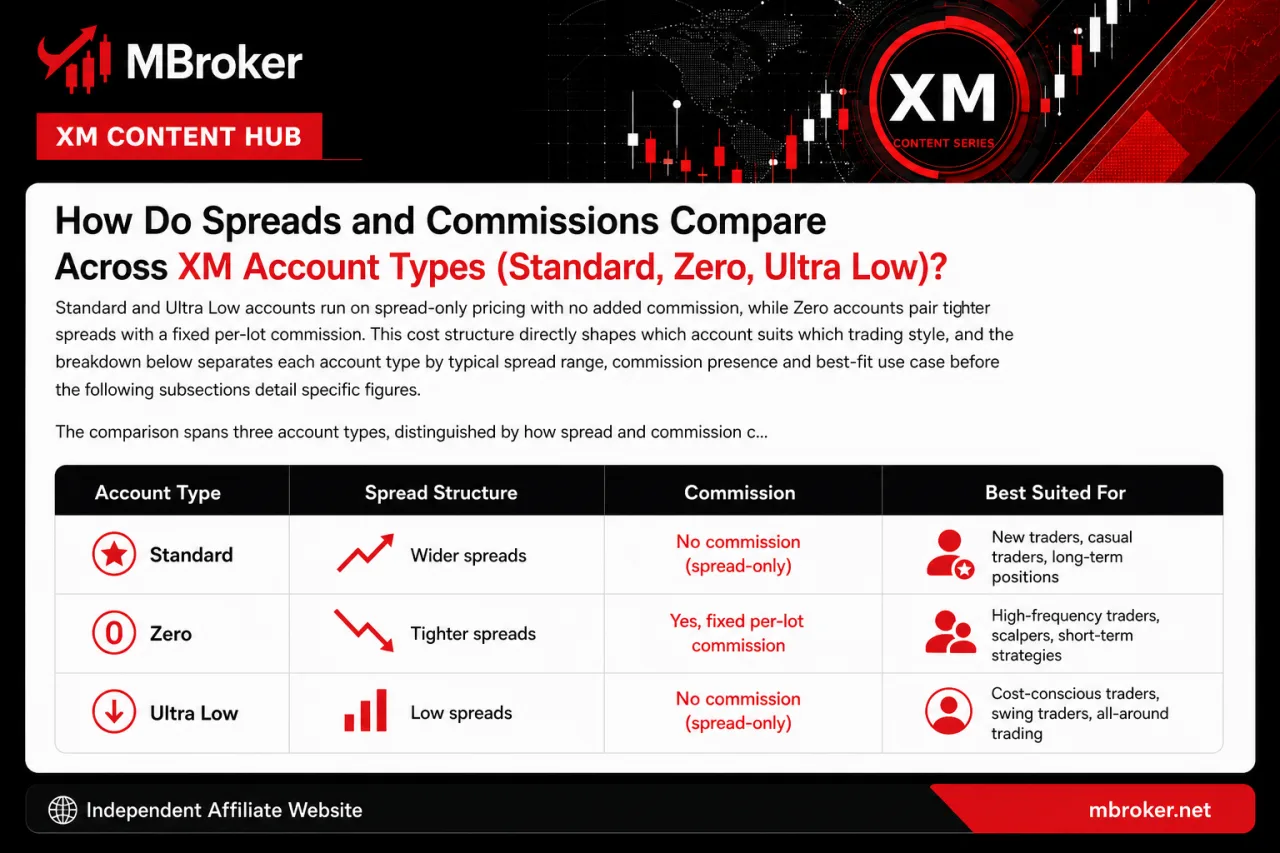
Standard and Ultra Low accounts run on spread-only pricing with no added commission, while Zero accounts pair tighter spreads with a fixed per-lot commission. This cost structure directly shapes which account suits which trading style, and the breakdown below separates each account type by typical spread range, commission presence and best-fit use case before the following subsections detail specific figures.
The comparison spans three account types, distinguished by how spread and commission combine to form total trading cost:
- Standard accounts carry variable floating spreads with zero added commission, suiting traders who prefer a single, simple cost line.
- Zero accounts combine near-zero spreads on major pairs with a fixed commission per lot, suiting cost-sensitive traders who calculate spread and commission together.
- Ultra Low accounts offer reduced variable spreads without commission, positioned between Standard and Zero pricing.
Exact spread ranges and commission rates differ by instrument and change over time, so traders should confirm current figures directly on XM’s official Account Types page before comparing costs. The subsections below detail each account’s spread and commission profile individually.
What Are the Spreads and Commissions on the XM Standard Account?
The XM Standard account applies variable spreads starting from a floating rate on major pairs, with no added commission on trades. This spread-only pricing directly answers what a Standard account trader pays beyond the raw spread itself.
As explained in the XM Spreads guide, spreads on Standard accounts float according to market conditions, widening during low-liquidity periods such as news releases and tightening during active trading hours. According to XM’s official Account Types page, spreads on major currency pairs on the Standard account start from 1 pip, with exact figures subject to change based on market conditions.
No commission applies on Standard account trades, since the spread itself covers the broker’s cost, unlike Zero accounts where a per-lot commission adds to a tighter spread.
The minimum deposit for the Standard account starts from $5, as confirmed on XM’s official Account Types page. This low entry threshold positions Standard accounts as accessible for traders who prefer a single, transparent spread-only cost structure over calculating spread plus commission separately.
What Are the Spreads and Commissions on the XM Zero Account?
The XM Zero account combines near-zero spreads on major pairs with a fixed commission charged per lot traded, with the XM Commission guide explaining how these charges contribute to the total trading cost. This pricing structure directly addresses what a Zero account trader pays, since the cost splits between the spread itself and a separate commission line.
Spreads on the Zero account start from a near-zero floating rate on major currency pairs, tightening further during high-liquidity market hours. According to XM’s official Account Types page, the Zero account pairs these tighter spreads with a fixed commission charged per lot on each trade, with the exact per-lot rate listed on that page, unlike the Standard account’s spread-only model.
This commission applies regardless of instrument direction, covering both entry and exit of a position. The Zero account suits forex, metals and other CFD instruments where traders calculate spread plus commission together to assess total cost per trade.
The minimum deposit for the Zero account starts from $5, as confirmed on XM’s official Account Types page. This threshold matches the entry point of the Standard account, keeping Zero accessible while shifting the cost model toward a commission-based structure rather than spread-only pricing.
What Are the Spreads and Commissions on the XM Ultra Low Account?
The XM Ultra Low account applies reduced variable spreads on major pairs with no added commission, positioning it between the Standard and Zero account cost models. This spread-only structure directly answers what an Ultra Low account trader pays beyond the raw spread itself.
Spreads on the Ultra Low account float tighter than the Standard account while staying commission-free, unlike the Zero account’s spread-plus-commission model. According to XM’s official Account Types page, the Ultra Low account carries spreads on major currency pairs starting from around 0.6 pips, with no fixed commission charged per lot.
Compared against the Standard account, which starts from around 1 pip on major pairs, Ultra Low offers a narrower spread range while keeping the same commission-free approach. Traders pay less through the spread alone without tracking a separate commission line, a contrast to the Zero account’s near-zero spread plus per-lot commission structure.
The minimum deposit for the Ultra Low account starts from $5, as confirmed on XM’s official Account Types page. This matches the entry threshold of both the Standard and Zero accounts, keeping Ultra Low accessible while offering tighter spread-only pricing than Standard.
What Non-Trading Costs Does XM Charge, Such as Swap and Withdrawal Fees?
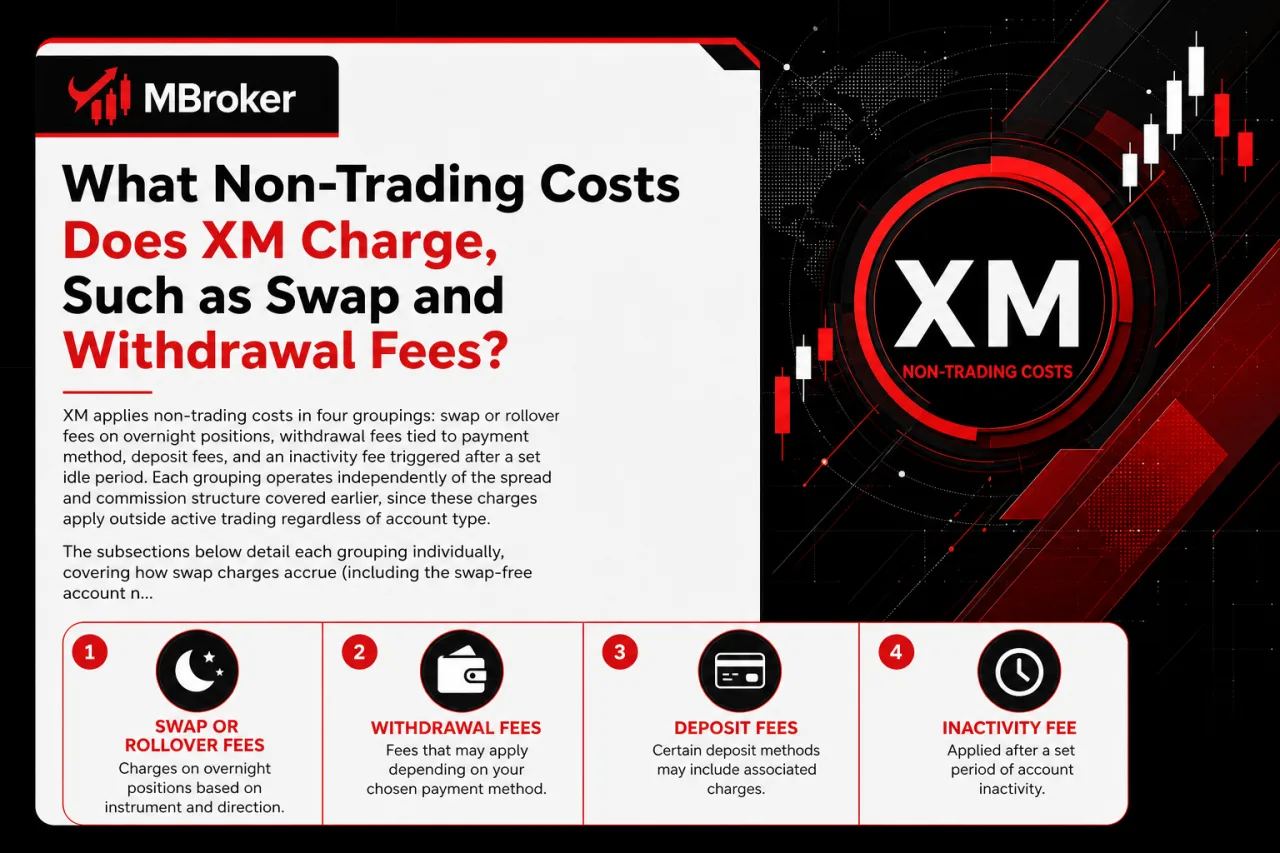
XM applies non-trading costs in four groupings: swap or rollover fees on overnight positions, withdrawal fees tied to payment method, deposit fees, and an inactivity fee triggered after a set idle period. Each grouping operates independently of the spread and commission structure covered earlier, since these charges apply outside active trading regardless of account type.
The subsections below detail each grouping individually, covering how swap charges accrue (including the swap-free account note), how withdrawal and deposit fees vary by payment channel, and the conditions that trigger the inactivity fee, all based on XM’s official fee schedule.
How Are Swap Fees Calculated on XM Accounts?
XM Swap Fees are calculated using the applicable per-instrument overnight rate and position size in lots for trades held past the daily rollover cutoff. This calculation determines how much a trader’s account gets debited or credited each night a position remains open, and the rate itself depends on several variables beyond just the instrument traded.
Several factors shape the final swap value:
- Instrument type sets the base swap rate, since forex pairs, metals, indices and energies each carry distinct long and short swap figures in XM’s contract specifications.
- Position direction changes the applied rate, since buy (long) and sell (short) swaps often differ and one direction may even earn a credit rather than a charge.
- Interest rate differentials between the base and quote currency of a forex pair influence the underlying swap calculation.
- Triple swap days, typically applied once per week to account for weekend settlement, multiply the standard daily rate.
Traders holding a swap-free Islamic account avoid these overnight charges entirely, subject to XM’s eligibility terms. Current swap values for each instrument appear directly in the MT4 or MT5 platform’s Market Watch window under contract specifications, or on XM’s official contract specifications page, since these rates change periodically without prior notice.
Does XM Charge Deposit or Withdrawal Fees?
XM generally does not charge its own fees on most standard deposit and withdrawal methods, as explained in XM Deposit Fees and XM Withdrawal Fees, although exceptions may apply depending on the payment channel, region, and third-party processor. This payment-charge policy sits apart from the swap and spread costs covered earlier, since deposit and withdrawal fees relate strictly to moving funds in and out of an XM account.
Several conditions shape whether a fee applies:
- Bank wire withdrawals sometimes carry a fee below a set transfer amount, with the threshold varying by region and legal entity.
- Certain e-wallet or local payment methods may pass through a processing charge set by the third-party provider rather than XM itself.
- Currency conversion charges apply when the account’s base currency differs from the payment method’s currency, since intermediary banks may deduct a conversion fee outside XM’s control.
- Regional restrictions determine which payment methods and fee structures apply, since terms differ across XM’s regulated entities.
Traders confirm the exact deposit and withdrawal fee schedule for their account by checking XM’s official page on funding fees and charges, which outlines the cost details tied to each supported payment method, before initiating a transaction.
Does XM Charge an Inactivity Fee?
The XM Inactivity Fee may apply once an account meets the dormancy threshold defined in the applicable XM entity’s official terms, provided no qualifying trading, deposit, or withdrawal activity occurs during that period. This charge sits alongside the withdrawal and deposit policies already covered, since inactivity fees apply strictly outside active trading regardless of account type. The exact dormancy period and fee amount vary depending on the XM entity a trader is registered under, so the specific figures are not fixed universally across all XM jurisdictions and are subject to change without prior notice.
Several conditions determine when this fee triggers:
- Dormancy period sets the starting point, since XM defines a specific stretch of time without login, trade or transaction activity before an inactivity fee may begin accruing. The exact threshold is stated on XM’s official terms and conditions page for the relevant entity.
- Once triggered, the inactivity fee is deducted periodically from the account balance, continuing until the account is reactivated or the balance is depleted. The exact fee amount is stated on XM’s official terms and conditions page rather than fixed across all entities.
- Reactivation occurs automatically once the client logs in or executes a new trade, deposit or withdrawal, stopping further charges from that point forward.
- Zero-balance accounts avoid ongoing deductions once the balance reaches zero, though the account itself remains classified as dormant.
Traders confirm the current dormancy threshold and exact fee figure directly on XM’s official terms and conditions page for their specific registered entity, since these details differ by jurisdiction and change without prior notice. No fixed figures are quoted here because XM does not publish a single universal rate across all its regulated entities.
How Can You Check XM’s Official Cost Documentation and Minimum Deposit Requirements?
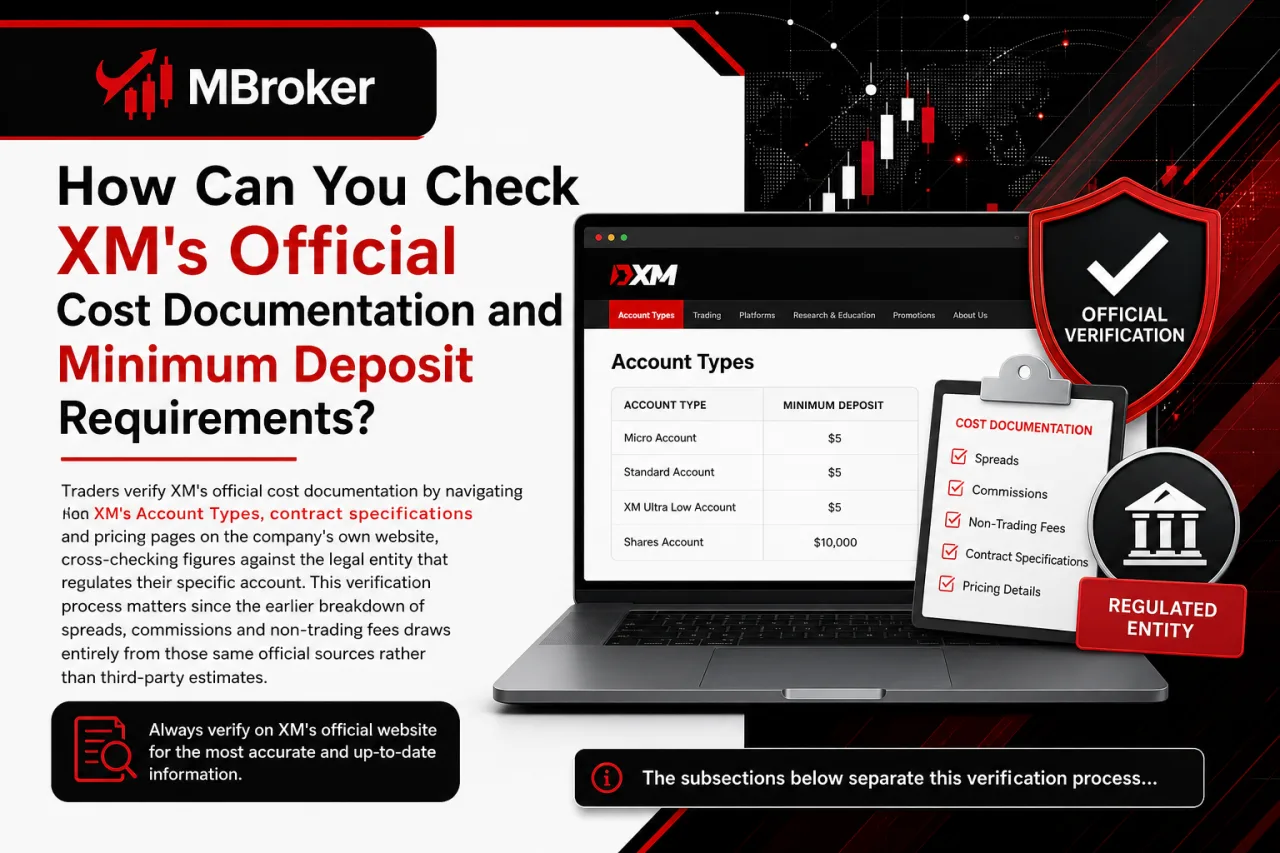
Traders verify XM’s official cost documentation by navigating directly to XM’s Account Types, contract specifications and pricing pages on the company’s own website, cross-checking figures against the legal entity that regulates their specific account. This verification process matters since the earlier breakdown of spreads, commissions and non-trading fees draws entirely from those same official sources rather than third-party estimates.
Figures published on independent sites reflect XM’s official documentation at the time of review and warrant reconfirmation directly on XM’s own pages before making a trading decision.
The subsections below separate this verification process into distinct checkpoints, covering where XM publishes its fee schedule and contract specifications, and how minimum deposit figures and cost terms shift depending on which XM legal entity or regulator governs a given account.
What Are the Minimum Deposit Requirements for Each XM Account Type?
All three account types, Standard, Zero and Ultra Low, share the same minimum deposit starting from $5, though the exact figure and base currency shift depending on the legal entity that regulates a given account. This comparison builds on the individual spread and commission profiles covered earlier, since the entry threshold stays consistent even as the cost model differs across accounts.
No account type carries a higher minimum deposit than another at the entry level, based on the figures confirmed on XM’s official Account Types page. XM’s regulated entities may publish minimum deposit figures in different base currencies depending on the jurisdiction a client registers under, so accounts opened through one entity could display the threshold in USD while another shows it in EUR or GBP.
Traders confirm the exact minimum deposit and base currency for their region by checking the account opening section on XM’s official website before funding an account, since these figures apply differently depending on the legal entity and payment method selected.
How Do You Verify Current XM Fees on Official Sources?
Traders verify current XM fees by navigating directly to XM’s official website, opening the Account Types and contract specifications pages, and cross-checking the displayed figures against the regulatory disclosures published for their specific legal entity. This process confirms the heading’s focus on how a trader locates and validates spread, commission, swap and non-trading fee data rather than relying on third-party summaries.
The verification process follows a few practical steps:
- Open XM’s official Account Types page to review the current spread and commission structure for Standard, Zero and Ultra Low accounts.
- Check the contract specifications section, or the Market Watch window inside MT4 or MT5, to confirm swap rates for a specific instrument.
- Cross-reference the fee schedule with the terms and conditions or regulatory disclosure document tied to the legal entity that regulates the account.
- Reconfirm these figures periodically, since XM updates spreads, swap rates and non-trading charges without prior notice.
Figures published on third-party comparison sites reflect XM’s official documentation at the time of review and warrant reconfirmation directly on XM’s own pages before making a trading decision.
What Rare or Account-Specific Cost Factors Should Advanced XM Traders Know About?
Advanced XM traders account for a few less-common cost factors: negative balance protection’s implicit risk cost, XM Ultra or loyalty-tier trading conditions, and currency conversion charges when the account’s base currency differs from the funding currency. These nuances sit outside the core spread, commission and swap comparison already covered, since they surface only under specific account setups or trading circumstances. The subsections below address each factor individually.
Are There Currency Conversion Charges When Funding an XM Account?
Yes, currency conversion charges apply when a deposit currency differs from the account’s base currency, since the conversion itself introduces an added cost layer on top of spreads and commissions. This factor connects directly to the base currency variations noted earlier across XM’s regulated entities, since a mismatch between funding currency and account currency triggers the conversion charge in the first place.
A few conditions determine when this cost surfaces:
- Funding through a card or e-wallet denominated in a currency other than the account’s base currency triggers a conversion at the payment processor’s or bank’s exchange rate rather than XM’s own trading rate.
- Bank wire transfers carry a similar conversion step when the sending currency differs from the account’s base currency, often applied by an intermediary bank outside XM’s control.
- The effective trading cost rises slightly in these cases, since the converted deposit amount reflects the third-party exchange rate rather than the nominal transfer value.
- Choosing an account base currency matching the primary funding currency avoids this added conversion layer entirely.
Traders confirm the exact conversion rate and any applicable charge through their payment provider or bank rather than through XM’s own fee schedule, since XM does not set these third-party conversion rates.
Do XM Loyalty or Tiered Programmes Affect Trading Costs?
No, XM’s loyalty or tiered rewards structure does not alter the underlying spread, commission or swap rates already set by the account type, since these programmes typically operate as a separate rewards layer rather than a discount on trading costs. This distinction matters directly for the cost impact question raised in this heading, separate from the spread and commission comparison already covered above.
A few points clarify this separation:
- Rewards or loyalty points, where offered, accumulate based on trading volume rather than reducing the posted spread or commission at the point of trade.
- Eligibility for any such programme depends on the legal entity a client registers under, since not every XM regulated entity offers the same rewards structure.
- Regional restrictions apply, meaning clients under certain jurisdictions may find loyalty features unavailable regardless of account type.
- Redeeming any accumulated rewards, where applicable, sits outside the scope of spreads, commissions or swap charges detailed earlier in this guide.
Traders confirm current loyalty programme availability and terms directly on XM’s official promotions page for their specific region and entity.
Are XM’s Fees Competitive?
XM offers several cost structures to suit different trading styles. The Standard account provides simple commission-free pricing with spreads starting from around 1 pip, while the Ultra Low account offers tighter spreads from approximately 0.6 pips without a separate commission. The Zero account may better suit active traders who prefer near-zero spreads and are comfortable paying a fixed commission per lot.
However, the total cost of trading with XM extends beyond spreads and commissions. Swap charges, inactivity fees, currency conversion costs and certain payment-processing fees may also apply. Since rates and conditions vary by instrument, account type, region and regulated XM entity, traders should verify the latest figures on XM’s official Account Types page, contract specifications and terms before opening or funding an account. Ultimately, the most suitable XM account is the one whose complete cost structure aligns with the trader’s strategy, trading volume and holding period.
XM Deposit Fees: Are Deposits Really Free for Traders?
Does XM charge deposit fees? See the real costs, minimum deposit limits, and bank charges...
XM Spreads Explained: Cost by Account Type for Traders
See how XM spreads vary by account type and instrument, what drives variable pricing, and...
XM Swap Fees Explained: How Overnight Charges Are Calculated
Curious how XM swap fees work? See how overnight charges are calculated per account and...
XM Withdrawal Fees: Free or Chargeable? Full Cost Guide
XM withdrawal fees explained: minimum amounts, processing times, and which payment methods stay free or...

XM Inactivity Fee: How Much & When It’s Charged
Wondering about the XM Inactivity Fee? See the exact charge, the 90-day trigger, and how...
XM Commission Explained: Rates & Cost per Trade
Curious how much XM commission really costs? See rates, calculation method and per-trade examples for...