
 Tiếng Việt

Head and Shoulders pattern is a bearish reversal formation that signals trend exhaustion and a potential market reversal, typically appearing after an uptrend.
Moreover, the pattern reflects a shift from bullish to bearish control, where buying pressure weakens and sellers gradually take over the market.
Additionally, the safest entry occurs after a confirmed neckline breakout, providing higher probability setups compared to early or aggressive entries.
Furthermore, effective trade execution requires precise stop loss above the right shoulder and target projection based on pattern height, ensuring proper risk-reward management.
Understanding the Head and Shoulders pattern is essential for identifying high-probability reversal setups and executing trades with precision. At XM Guide, traders gain practical insights to apply price action strategies effectively in real market conditions.
What is the Head and Shoulders pattern?
The Head and Shoulders pattern is a major bearish reversal chart formation that signals the transition of an asset from an established uptrend to a fresh, structural downtrend.

This classic pattern represents a distribution phase where institutional buyers fail to push the market to new heights, creating a distinct visual shape consisting of three consecutive peaks: a Left Shoulder, a higher Head, and a lower Right Shoulder, all resting on a common support baseline known as the Neckline. Correctly identifying this formation on your charting terminal allows you to systematically anticipate macro trend exhaustions and capture high-velocity short-selling opportunities before the broader retail market reacts.
What defines a valid Head and Shoulders pattern?
In classic technical analysis, a valid head and shoulder pattern must exhibit a strict geometrical layout built over multiple trading sessions:
- The Left Shoulder: Price rallies to a fresh high on strong volume, followed by a minor corrective downward wave.
- The Head: Momentum returns, pushing price above the previous peak to form a higher high, before collapsing back to the baseline.
- The Right Shoulder: A final, weaker rally fails to match the height of the Head, peaking roughly near the level of the Left Shoulder before turning downward.
- The Neckline: A horizontal or slightly sloped support line drawn across the intermittent swing lows of the correction waves.
Failing to verify these precise visual benchmarks often results in misidentifying random market noise as a structural signal.
How is it different from inverse Head and Shoulders?
An inverse head and shoulders pattern functions as the exact mirror image of the standard structure, serving as a highly reliable bullish reversal pattern at the bottom of a downtrend. While the standard formation outlines institutional distribution and triggers short-selling orders at the break of a support neckline, the inverse model maps out structural accumulation, printing three distinct troughs (a Left Shoulder, a lower Head, and a higher Right Shoulder) beneath a horizontal resistance line. Recognizing this structural inversion ensures that you remain completely agile, shifting effortlessly between long and short execution strategies as global market cycles rotate.
Once you can visually isolate these shapes on a raw candlestick chart, you must analyze the underlying order-flow mechanics that give the pattern its predictive power.
Reversal mechanics behind the pattern
The reversal mechanics behind the Head and Shoulders pattern are driven by a fundamental shift in market control from aggressive institutional buyers to dominant, high-volume sellers.

This geometric structure marks the precise point where an asset fails to maintain the classic definition of an uptrend, which strictly requires a continuous sequence of higher highs and higher lows. When the Right Shoulder fails to exceed the peak of the Head, it provides concrete quantitative proof that the prevailing buying momentum has completely dried up, laying the foundation for a structural market collapse.
Why does Head and Shoulders signal a reversal?
This chart pattern signals a major trend reversal because it visualizes the complete psychological capitulation of the bulls. During the creation of the Left Shoulder and Head, buyers maintain complete control, aggressively absorbing supply at historical support floors. However, when price drops from the Head back down to the baseline, it reveals that sellers have become aggressive enough to completely erase the recent gains, transforming the subsequent Right Shoulder into a desperate, low-volume failure that confirms buyers have run out of capital.
To prevent getting caught in a false breakout, professionals cross-reference this price exhaustion with dynamic volume indicators.
What role do volume and momentum play?
Volume and momentum serve as the primary validation mechanisms when conducting head and shoulders pattern technical analysis:
- Left Shoulder: Exhibits the highest volume of the entire structure, confirming healthy trend acceleration.
- The Head: Prints a higher nominal price but typically shows lower relative volume, signaling a hidden bearish divergence in momentum.
- Right Shoulder: Features the absolute lowest transaction volume, exposing a total lack of retail and institutional buying interest.
- Neckline Breakout: Requires a sudden 50% or higher surge in volume to confirm that institutional desks are actively funding the bearish breakout.
Now that the underlying structural shift is mathematically verified, your next operational step is identifying the exact coordinates to execute your entry order.
Entry timing and high-probability zones
The optimal entry timing for trading a Head and Shoulders pattern occurs the exact moment a candlestick prints a definitive close below the structural support neckline on a high-volume timeframe.
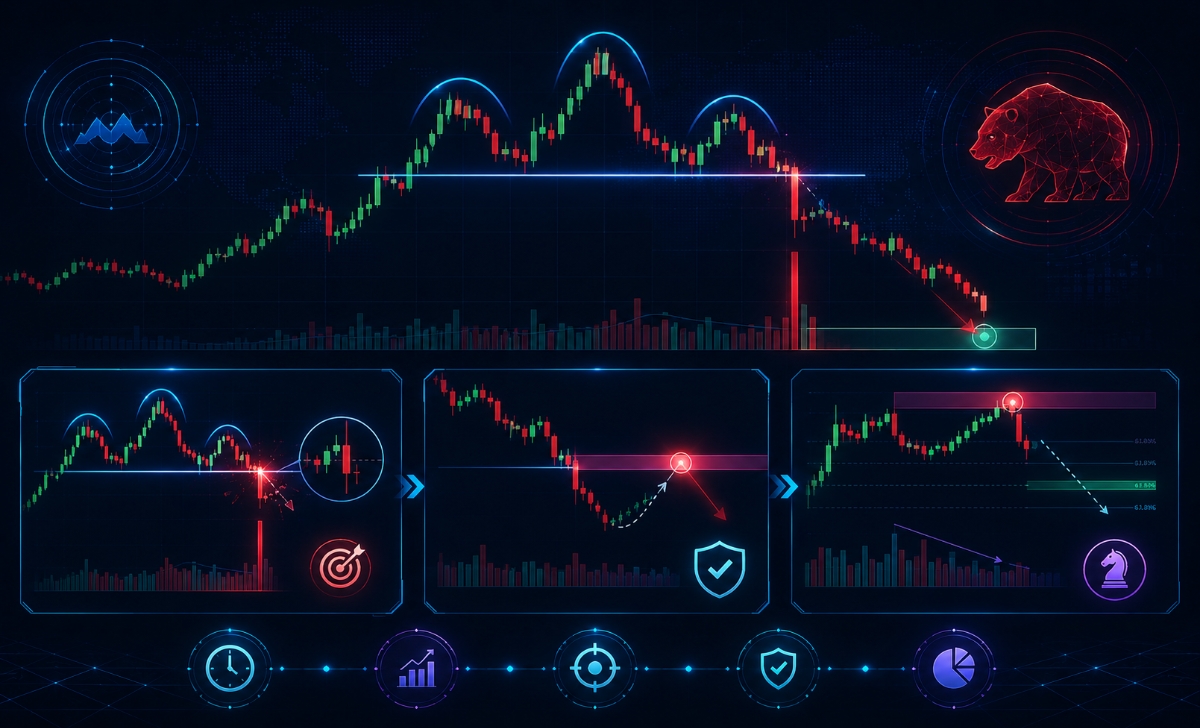
Statistically, entering a position precisely at the breakout zone ensures you catch the initial momentum wave, where compressed stop-losses from trapped long traders are forced to trigger, driving prices rapidly downward. Mapping out these execution zones with high accuracy prevents you from chasing the market too late or getting prematurely stopped out by minor intraday price retracements.
Where is the safest entry after neckline breakout?
The absolute safest entry zone after a confirmed neckline breach is during a minor, low-volume structural retest of the broken baseline:
When price cuts through the neckline, that historical support floor immediately flips to become a fresh resistance ceiling.
Waiting for a corrective bounce to touch this newly established resistance allows you to execute a short position with minimal slippage and a highly compressed risk-to-reward ratio.
For clients running automated expert advisors or conducting manual head and shoulders pattern trading, executing orders near this structural flip provides maximum statistical protection.
While waiting for a retest is highly secure, some aggressive strategists attempt to secure entries before the pattern is fully completed.
Can traders enter before confirmation?
Yes, experienced day traders can execute advanced entries before full neckline confirmation by shorting the peak of the Right Shoulder, though this approach carries a significantly higher risk of failure. To pull off an aggressive entry inside the head and shoulders pattern stock or forex charts, you must wait for the Right Shoulder to rise into a major daily supply zone or an optimal Fibonacci retracement level ($$61.8\$$). If a bearish candlestick confirmation pattern forms alongside a sharp drop in volume, you can establish an early position, securing a highly profitable entry point at the expense of a lower historical win-rate.
Regardless of whether you choose a conservative breakout entry or an aggressive early setup, long-term profitability relies entirely on strict position management rules.
Trade execution and position management
Trade execution and position management for the Head and Shoulders pattern require establishing a non-negotiable, rule-based matrix that defines your exact stop-loss placement and mathematical profit targets before entering the market.

Using a standardized measured-move technique allows you to extract maximum profitability from macro trend shifts while maintaining absolute emotional detachment. Implementing these precise risk boundaries ensures that your trading account balance remains fully protected against unexpected institutional liquidity swings and systemic market shocks.
How to set stop loss and take profit effectively?
To calculate your risk-to-reward ratios with absolute precision, apply this definitive mathematical model:
- Stop-Loss Placement: Position your protective stop-loss order safely above the peak of the Right Shoulder. This structural line invalidates the bearish thesis; if price climbs past this level, the pattern is broken, and you must exit immediately to preserve capital.
- Take-Profit Target: Calculate the absolute vertical distance from the peak of the Head down to the horizontal Neckline. Project that exact pip distance downward from the breakout point to establish your definitive, non-emotional profit target ($$\text{Target} = \text{Breakout Price} – \text{Pattern Height$$).
With your initial risk parameters firmly set, you must now learn to manage your position actively as real-time market data unfolds.
How to manage trades during volatility?
Managing an open short position during high-impact macroeconomic events requires trailing your stop-loss systematically to guarantee capital preservation. Once price targets the halfway point of your projected measured move, immediately move your stop-loss order to your initial break-even entry coordinate to eliminate all remaining financial risk from the trade. By utilizing the ultra-low spreads and raw price feeds provided on the MBroker, you can easily ensure your trailing stop orders are executed without experiencing artificial broker slippage or unexpected tracking gaps.
By cementing these execution habits into your routine, the final challenge is learning to audit your charts for false breakout signals.
Avoiding traps and improving pattern accuracy
Avoiding traps and improving pattern accuracy requires applying a strict multi-timeframe filter and utilizing volume analysis to separate genuine institutional reversals from retail liquidity traps.

Statistically, over 40% of head and shoulders pattern examples on lower timeframes (such as the 5-minute chart) turn into false signals because they lack macro trend alignment, resulting in sudden breakout failures. To significantly elevate your execution success rate, you must combine pure geometric patterns with structural confirmation indicators and institutional-grade data feeds.
What are common false signals in this pattern?
The most destructive trap in head and shoulders pattern in trading is the “Failed Breakout,” where price briefly dips below the neckline before reversing sharply back into the pattern structure. This event is carefully engineered by large institutional algorithms to sweep retail sell-stops and engineer liquidity for their own large buy orders. Another common false signal occurs when the Right Shoulder is overly distorted or fails to exhibit a clear drop in transaction volume, indicating that buyers are still actively funding the asset’s expansion.
To completely insulate your portfolio from these market manipulations, you must implement a strict validation checklist.
How to increase accuracy when trading this pattern?
To dramatically elevate the mathematical predictability of your chart pattern analysis, enforce these three institutional filters:
- The Higher-Timeframe Filter: Only trade a bearish head and shoulders pattern if the broader daily or weekly chart resides in a confirmed downtrend or tests a major macro resistance zone.
- The Candlestick Close Rule: Never enter a position on a live breakout candle; always wait for the specific trading session candle to physically close beneath the neckline to ensure the breakout is real.
- Deploy Verified Trading Infrastructure: Reviewing the live execution frameworks and professional charting metrics highlighted on the MBroker allows you to execute your strategies on clean, unmanipulated price feeds where visual patterns print with absolute clarity.
In short, the Head and Shoulders pattern is an exceptional technical tool for identifying structural trend exhaustion and executing high-probability short positions. By waiting for a confirmed candle close below the neckline, placing your stop-loss safely above the Right Shoulder, and verifying breakouts with high volume, you can easily eliminate costly execution guesswork.

Thoren Vextal is a specialist in XM trading guides, offering practical insights and real-market experience to help traders improve their strategies and trading performance. Email: [email protected]