
 Tiếng Việt

OnBalance Volume (OBV) is a volume-based indicator that measures cumulative buying and selling pressure to identify momentum, divergence, and trend strength in financial markets.
However, the OBV indicator reflects market momentum by tracking volume flow—rising OBV signals accumulation, while falling OBV indicates distribution.
Next, OBV divergence occurs when price and volume move in opposite directions, helping traders detect potential trend reversals early.
Moreover, OBV provides trend insight by confirming whether a price trend is supported by strong volume or weakening due to lack of participation.
Finally, OBV can be applied in trading strategies by combining it with price action or indicators like RSI and moving averages to improve signal accuracy.
OnBalance Volume (OBV) indicator helps traders track volume flow to identify trend strength, divergence signals, and hidden market momentum behind price movements. In Forex Technical Analysis with MBroker to master volume-based indicators and real market strategies.
What is OnBalance Volume and how does it work in trading?
The onbalance volume indicator (OBV) is a cumulative momentum-based technical tool that measures the net flow of transactional volume to determine whether institutional money is actively buying or selling a financial asset.

Statistically, it functions as a running total: on days when the asset price closes higher than the previous day, the entire session’s volume is added to the metric, and on days, that volume is This mathematical formula allows traders to see past raw candlestick shapes and visualize the real momentum energy shifting the underlying order book in real time.
How is OnBalance Volume calculated?
The mathematical calculation behind the onbalance volume obv indicator relies on three strict conditional rules applied at every candle close:
- If Today’s Close > Yesterday’s Close: Today’s OBV = Yesterday’s OBV + Today’s Volume
- If Today’s Close < Yesterday’s Close: Today’s OBV = Yesterday’s OBV – Today’s Volume
- If Today’s Close = Yesterday’s Close: Today’s OBV = Yesterday’s OBV
By running this continuous arithmetic, the indicator transforms random vertical volume bars into a single, smooth directional line that maps out the true velocity of market capital.
Why is OBV important in financial markets?
The indicator is highly important because it operates on the foundational principle that volume precedes price. Developed by technical pioneer Joseph Granville in 1963, financial theory shows that institutional funds quietly accumulate an asset over multiple weeks, causing a slow expansion in the volume line long before the retail market reacts and triggers a massive price breakout. By utilizing this metric, you gain the ability to spot institutional commitment early, protect your account from false breakouts, and align your portfolio with large-scale capital pools.
Once you have mastered the underlying math, you can analyze how this structural line actively reflects broader market momentum.
How does the OBV indicator reflect market momentum?
The onbalance volume indicator reflects market momentum by showing whether the prevailing price trend is backed by aggressive, high-volume institutional consensus or simply thin retail speculation.
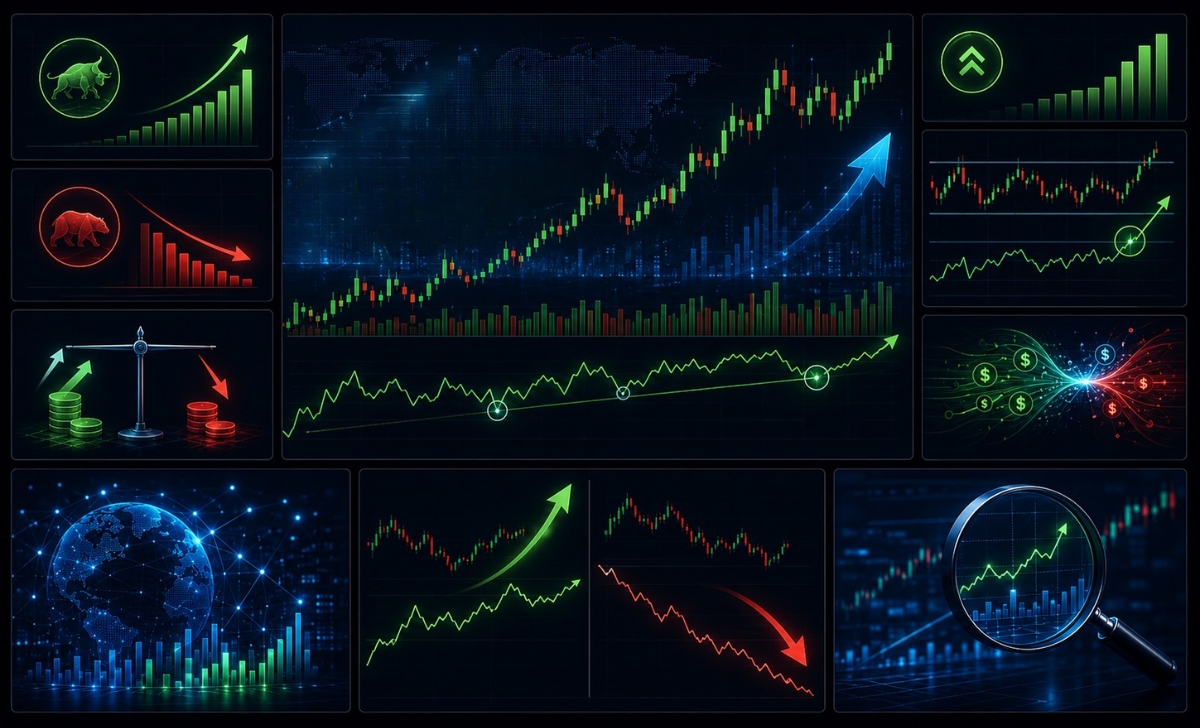
Statistically, when a market moves upward on expanding OBV metrics, it proves that institutional capital is heavily purchasing every available contract, confirming a highly sustainable, high-velocity trend. This transparency strips away the deception of naked price action, giving day traders a definitive look at whether a price surge has genuine structural momentum or is ready to collapse due to institutional abandonment.
What does it mean when OBV rises or falls?
Directional shifts in the cumulative volume line point directly to shifts in institutional power blocks:
- A Rising Line: Confirms that volume on green up-days heavily outweighs volume on red down-days, signaling aggressive institutional buying and a strong bullish market environment.
- A Falling Line: Proves that selling pressure dominates on down-days, indicating that smart money is actively liquidating its positions and supply is overwhelming demand.
Recognizing these broad phases allows you to use the indicator as a reliable tool to forecast upcoming price action.
Can OBV predict price movements?
Yes, the indicator can accurately predict price movements because changes in institutional volume allocations almost always manifest right before price breakouts occur. For example, if an asset is consolidating sideways inside a tight horizontal range, but the volume line breaks cleanly above its previous technical resistance peak, it reveals that smart money is aggressively buying up supply before marking prices higher. This leading behavior allows retail traders to position their orders ahead of the breakout, capturing maximum profit margins before the rest of the market joins the trend.
To extract the absolute highest probability signals from this predictive capability, you must master the identification of structural divergences.
What is OBV divergence and how to identify it?
An onbalance volume obv divergence occurs when the physical path of asset price candles and the trajectory of the volume momentum line move in completely opposite directions, signaling a severe underlying imbalance in market structure.
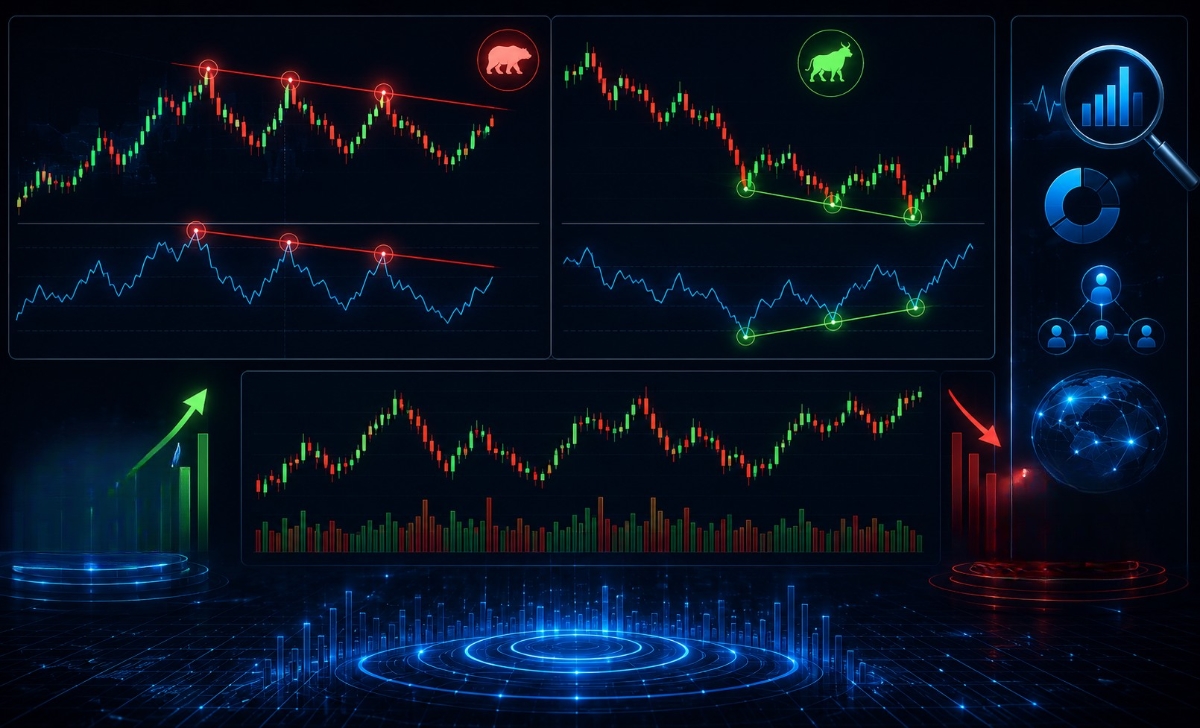
A structural divergence indicates that the current retail price trend has completely decoupled from institutional volume, making it highly unstable and prone to an immediate, explosive reversal. Correctly identifying these geometric discrepancies allows fund managers to position their portfolios against an exhausted trend before a market crash or breakout manifests on standard lagging indicators.
What is bullish and bearish divergence in OBV?
Divergences are split into two primary operational profiles depending on the prevailing trend:
- Bullish Divergence: Price prints a lower swing low on your chart, but the indicator forms a higher swing low, revealing that institutional selling volume has completely dried up and a major bullish reversal is imminent.
- Bearish Divergence: Price makes a higher swing high, but the volume line drops to a lower swing high, proving that institutional buying volume has completely evaporated, leaving the uptrend highly vulnerable to a sharp crash.
Spotting these patterns early requires a calm, systematic review of your charting software to avoid entering late into exhausted trends.
How reliable is OBV divergence in trading?
The onbalance volume obv divergence pattern is exceptionally reliable when it manifests on major higher timeframes, such as the 4-hour or daily charts, because it strips away short-term noise. Because volume represents the physical effort behind price movement, a divergence proves that the current trend is an illusion driven by thin order book liquidity. For clients analyzing structural trend waves and historical cycles on the MBroker, integrating these divergence signals provides a highly dependable checklist to avoid chasing late market trends and locking in profits at the absolute peak of structural exhaustion.
Beyond spotting reversals, this data provides incredible structural value when analyzing long-term trend continuations and institutional cycles.
How does OBV provide trend insight in financial markets?
The indicator provides deep trend insight by exposing the ongoing cycles of institutional accumulation and distribution that drive all long-term macroeconomic financial markets.
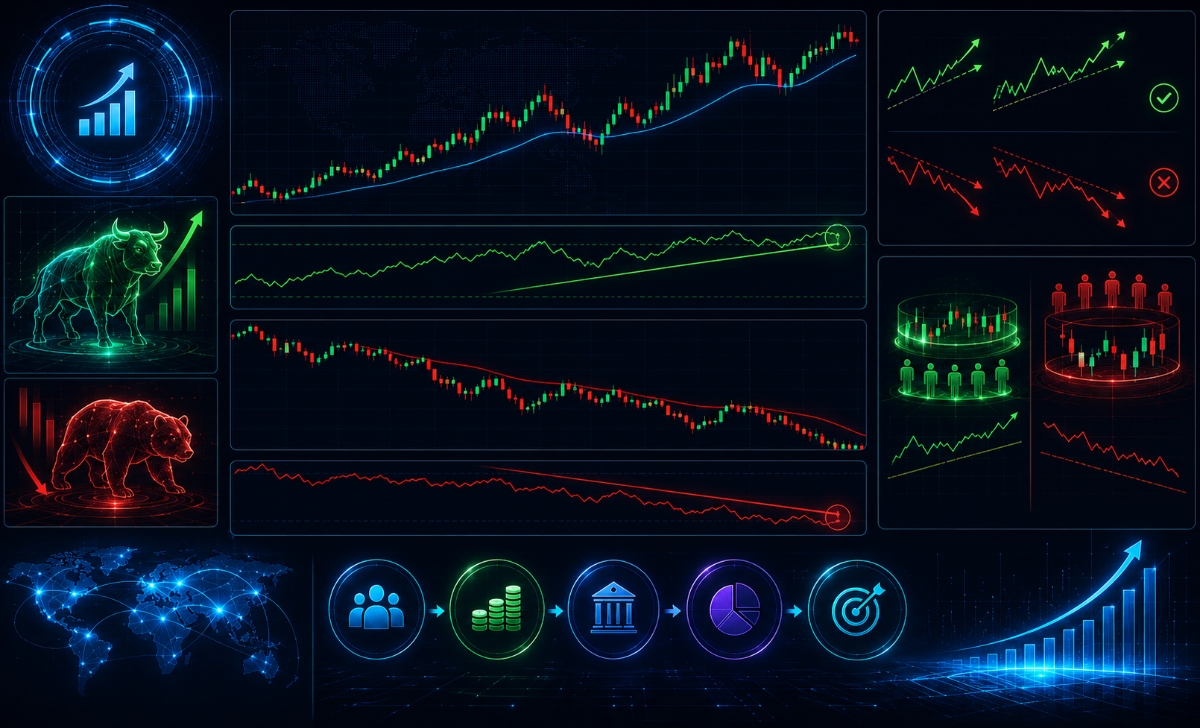
Statistically, matching a trend’s slope with its corresponding volume velocity allows you to determine whether a major trend is structurally healthy or completely hollow. Utilizing these insights ensures you never find yourself positioned on the wrong side of global market-maker order blocks, keeping your capital safe across highly volatile asset classes.
How to use OBV to confirm trends?
To confirm whether a trend is healthy and safe to trade, cross-reference the peaks and troughs of price action directly with the indicator:
- Bullish Trend Confirmation: The price action forms higher highs and higher lows, while the volume line simultaneously prints corresponding higher highs and higher lows.
- Bearish Trend Confirmation: The price action displays lower highs and lower lows, perfectly mirrored by a descending volume line making lower highs and lower lows.
If this visual alignment remains perfectly synchronized, you can confidently deploy trend-continuation or breakout strategies.
What does OBV tell about accumulation and distribution?
The indicator acts as a direct window into the hidden operational phases of the smart money lifecycle:
- Accumulation Phase: During a long sideways market bottom, retail traders become bored and panic sell; meanwhile, the volume line starts grinding steadily upward, proving that institutions are quietly accumulating shares at discount prices.
- Distribution Phase: At a mature market top, prices continue to print small highs, but the volume line drops sharply, signaling that institutions are distributing their heavy inventory to late-coming retail buyers before dropping prices.
Once you possess the ability to read these underlying accumulation structures, the final step involves converting this insight into an actionable, rule-based execution strategy.
How to apply OBV in trading strategies effectively?
Applying the indicator in trading strategies effectively requires establishing clear entry rules, placing strict protective stop-losses, and combining momentum data with secondary trend filters to remove false breakouts.
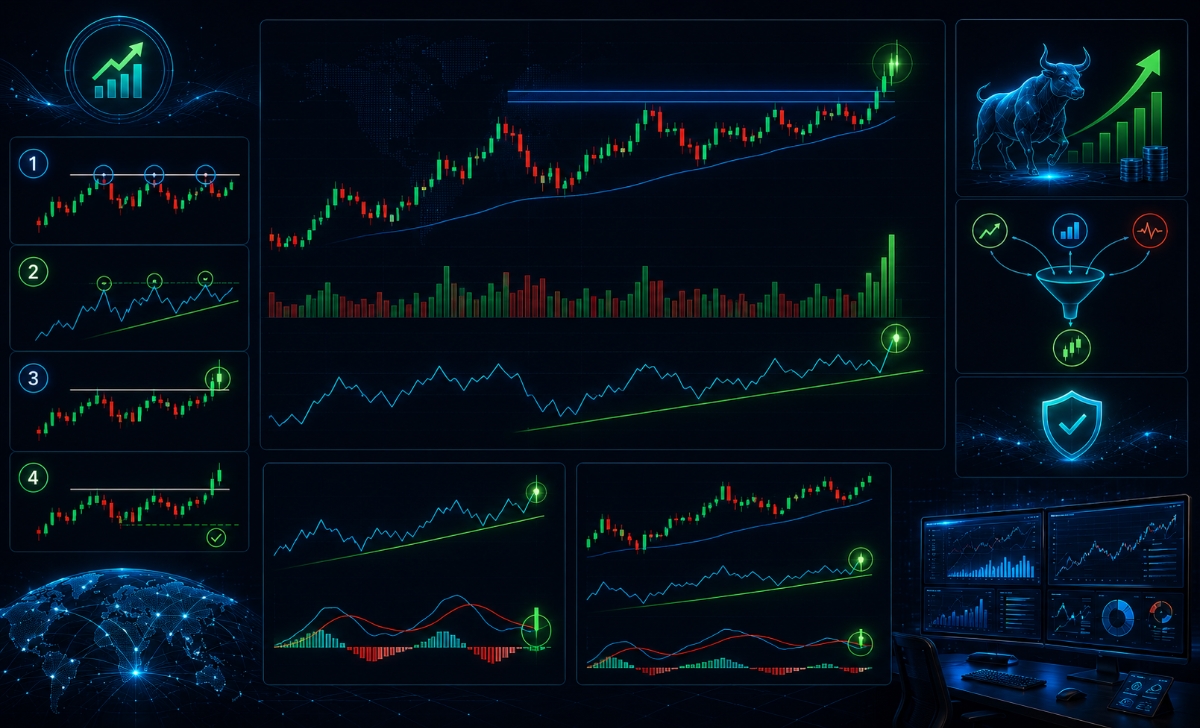
Professional day traders never deploy capital based on a single line; they construct an integrated confirmation matrix that balances volume energy with key structural price levels. By automating this visual verification checklist before hitting the execution button, you protect your trading account from the psychological errors that erode retail capital.
What is a basic OBV trading strategy?
A highly effective, professional trading strategy involves combining horizontal support and resistance breakouts with clear volume validation:
- Step 1: Identify Key Resistance: Locate an asset that has tested a horizontal resistance line at least three times on an H1 or H4 timeframe.
- Step 2: Check the Volume Line: Verify that the volume line is actively rising and printing a higher swing high while price remains capped below resistance.
- Step 3: Trigger the Entry: Execute a long position the exact millisecond a candle closes completely above the horizontal resistance level.
- Step 4: Set Risk Parameters: Place your protective stop-loss safely below the most recent local swing law to insulate your account from sudden fakeouts.
To further elevate this strategy’s profitability, you can easily pair it with complementary lagging indicators to build a robust multi-layer filtering system.
How to combine OBV with other indicators?
To minimize market noise and maximize your technical accuracy, merge the volume line with these two highly specific charting tools:
- The 200-Period Simple Moving Average (SMA): Use the 200 SMA as your structural macro trend filter; only take long volume breakouts when price is trading cleanly above the 200 SMA.
- Moving Average Convergence Divergence (MACD): Combine a volume divergence with a fresh MACD line crossover to gain absolute mathematical confirmation that both momentum and volume have officially flipped in your favor.
By anchoring your indicators with the institutional data streams, professional widgets, and daily technical market analysis updates featured on the MBroker, you can easily ensure your strategic setup remains fully optimized for long-term consistency across global exchanges.
In short, the onbalance volume metric is an invaluable leading indicator for identifying institutional accumulation, validating trend strength, and timing explosive breakout entries. By tracking whether the line rises or falls, enforcing strict multi-indicator rules with the 200 SMA, and executing trades based on confirmed volume breakouts, you remove all emotional guesswork from your routine.

Thoren Vextal is a specialist in XM trading guides, offering practical insights and real-market experience to help traders improve their strategies and trading performance. Email: [email protected]