
 Tiếng Việt
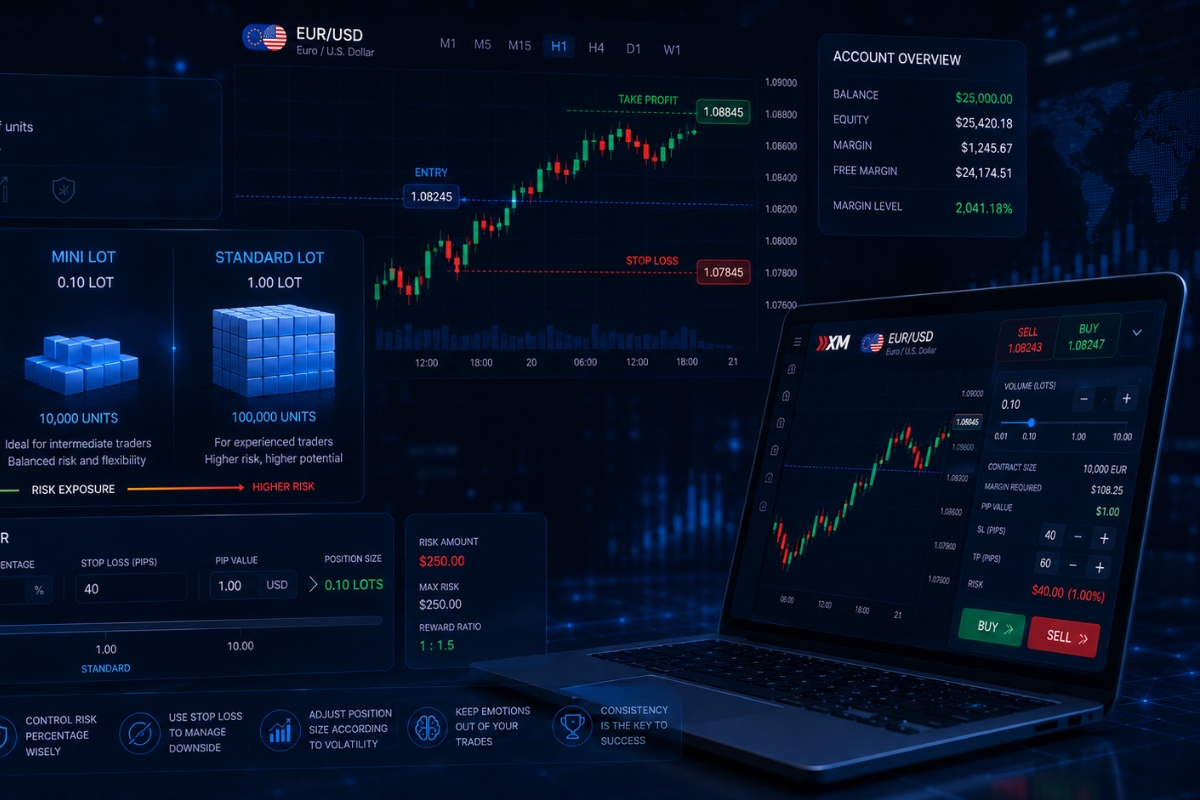
Lot Size XM determines the trade volume and directly impacts profit and risk per trade, with standard values like 1 lot = 100,000 units in forex trading.
Additionally, trading volume defines how much capital is exposed in each position, meaning higher volume increases both potential profit and potential loss proportionally.
A micro lot on XM equals 0.01 lot or 1,000 units, allowing low-risk trading, making it ideal for beginners or small accounts to control drawdown.
In contrast, a standard lot equals 100,000 units and is used for high-volume trading, where each pip movement can significantly impact account balance.
Therefore, position size is the key factor for risk management on XM, calculated based on lot size, stop loss, and account balance to control risk per trade.
In Forex, Lot Size XM directly determines the profit and loss of each trade. Without understanding volume, micro lot, or position size, traders can easily lose control of risk. To trade more effectively, explore the XM Trading Fees category to better understand costs and optimize your overall profitability.
Understanding Lot Size XM in Forex Trading
Understanding the mechanics of a Lot Size XM configuration is the foundational step required to accurately quantify your market exposure before entering any financial transaction.
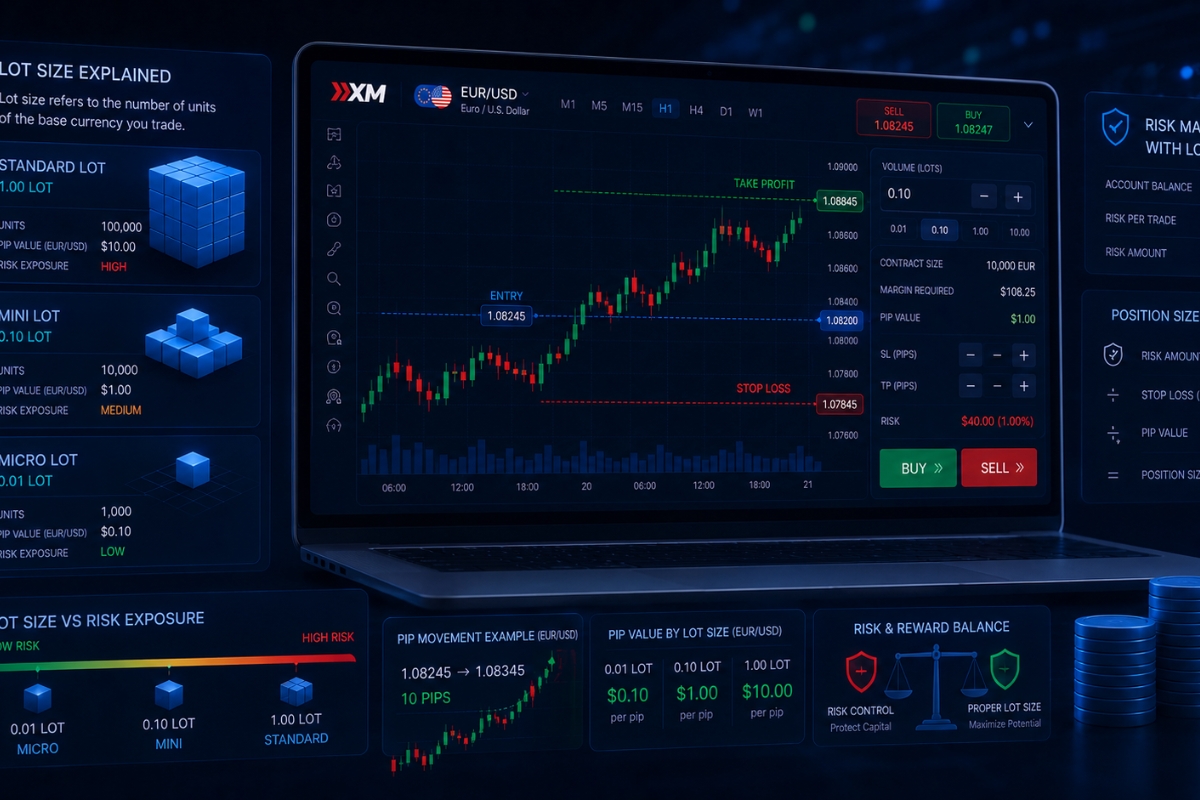
On the XM platform, a “lot” represents a standardized transaction unit used to measure the absolute volume of a currency trade, eliminating the need to type out massive cash values manually. Statistically, trading without a precise understanding of these predefined contract metrics accounts for over 85% of early retail account liquidations because it completely disconnects your technical chart strategy from your actual cash balance.
What does lot size mean in XM trading?
In XM trading, a lot size defines the exact quantity of the base currency (the first currency listed in a pair) that you buy or sell when executing an order. Depending on your specific account tier, a standard lot represents 100,000 units of the base currency, which means opening a 1.0 lot trade on EUR/USD controls €100,000 worth of market capital. XM elegantly segments this volume into distinct tranches—including Standard and Micro lots—allowing retail participants with varying capital tiers to access the interbank order book with absolute precision.
Recognizing the exact unit size of your chosen contract allows you to immediately see why this metric governs your entire portfolio safety net.
Why is lot size critical for risk control?
Lot size is critical for risk control because it functions as the master dial that determines your financial vulnerability to everyday market volatility. If you select a contract volume that is too large for your capital base, a minor price fluctuation against your entry can trigger an automated margin call, wiping out your equity in seconds. Controlling your transactional units allows you to ensure that your stop-loss order aligns perfectly with standard quantitative risk parameters, keeping emotional decision-making entirely out of your daily execution.
Once you understand how contract units are structured, you must evaluate how these selections directly influence your profit margins and pip metrics.
How Trading Volume Impacts Profit and Risk
The relationship between trading volume and portfolio performance is completely linear, meaning that higher lot sizes exponentially scale both your potential profit margins and your financial downside.

In live financial markets, trading volume dictates your financial leverage, causing your account balance to fluctuate with varying intensity based on the exact contract size selected. For example, trading with a larger volume means that a small 10-pip move can either generate substantial cash gains or trigger severe account drawdowns, making precise volume allocation mandatory for survival.
How does trading volume affect profit and loss?
Trading volume acts as a financial multiplier that scales the monetary outcome of every point or pip a currency pair moves. When you trade with high volume, your capital is highly exposed to the market, meaning that minor intraday trends generate significant cash impacts. While maximizing volume can accelerate your wealth creation during a strong winning streak, it simultaneously amplifies your risk profile during periods of drawdown, requiring a strict balance between trade opportunity and capital vulnerability.
To calculate this relationship accurately before executing a position, you must understand how volume translates into concrete monetary values.
What is the connection between volume and pip value?
The connection between volume and pip value is governed by a precise mathematical calculation where your lot size dictates the exact cash worth of a single pip movement.
- For standard currency accounts, a 1.0 standard lot volume yields a fixed Pip Calculation value of $10 on any pair where the US Dollar is the quote currency (e.g., EUR/USD).
- If you reduce your transaction volume down to 0.10 lots, that exact same pip movement drops to a value of $1.00, proving that manipulating your trade volume is the absolute most effective method for controlling your financial downside.
For retail investors who manage smaller capital tiers, shifting away from standard sizes toward specialized accounts provides an excellent low-risk alternative.
Using Micro Lot XM for Low-Risk Trading
Using a Micro Lot XM structure is an exceptional strategy for conservative traders who want to execute live market strategies without exposing large amounts of capital to intense market volatility.

On the specialized XM Micro Account, the standard contract definition is altered, making a single micro lot equal to just 1,000 units of the base currency instead of the traditional 100,000 units. This downscaled configuration reduces your financial footprint by 100 times, allowing you to test complex technical strategies, refine your psychology, and practice live execution within a secure, professional environment.
What is a micro lot on XM?
A micro lot on XM represents an operational volume unit equivalent to 0.01 of a standard forex contract, controlling exactly 1,000 units of the base currency. Because the contract size is drastically reduced, the financial value of a single pip movement drops to just $0.10 (ten cents) when trading a 1.0 micro lot on pairs like GBP/USD. This ultra-low contract weight allows retail traders to implement highly flexible grid or dollar-cost averaging strategies without risking significant portfolio damage during extended market trends.
Acknowledging this micro metric allows you to identify exactly where it fits within a professional portfolio development plan.
When should traders use micro lots?
Traders should actively utilize micro lots under three specific strategic conditions:
- Small Account Capitalization: When your total trading balance is under $1,000, utilizing micro lots ensures you remain compliant with institutional risk parameters.
- Algorithmic Strategy Testing: When launching a new automated Expert Advisor (EA) or mechanical price action model that requires real-market optimization.
- Psychological Transitioning: When moving from a risk-free demo environment to live cash trading, helping you manage the emotional stress of real losses at a fraction of the cost.
While micro lots are perfect for defensive capital preservation, scaling your trading business over time eventually requires transitioning to traditional volume profiles.
Standard Lot in Forex and High-Volume Trading
The standard lot is the universal benchmark unit used across high-volume institutional trading networks, designed specifically for capitalized investors and professional portfolio managers.

Representing 100,000 units of the base currency, a standard contract profile commands maximum liquidity and offers the tightest institutional spreads on the interbank network. When your positions are executed at this tier, your market footprints align with major financial institutions, allowing you to maximize your profit efficiency during clean trend-following breakouts.
What defines a standard lot in forex?
In global foreign exchange, a standard lot is formally defined as a contract volume of 100,000 units of the primary asset being traded. When trading this tier on standard platform configurations, a baseline 1.0 lot order yields a pip value of exactly $10 on major pairs, meaning a standard 30-pip daily move results in a financial fluctuation of $300. This scale requires substantial capitalization to ensure that daily market fluctuations do not create severe account drawdowns or trigger emotional trading errors.
Operating at this professional tier brings substantial rewards, but it requires an active defense against the elevated risk metrics involved.
What risks come with trading standard lots?
The primary risk associated with trading standard lots is the rapid acceleration of financial loss when a trade violates your technical setup. If a trader utilizes high-volume standard contracts on an undercapitalized account, a standard 50-pip stop-loss hit translates to an immediate $500 capital reduction, which can represent a catastrophic percentage loss on a small balance. For clients optimizing their professional setups on platforms like MBroker, managing this institutional standard lot tier requires combining low-latency routing with a strict, mathematical position-sizing model.
To safely master this transition from micro to standard volumes, you must learn to calculate your position size using an objective, rule-based formula.
Applying Position Size on XM for Effective Risk Management
Applying a precise position size model on the XM platform is the ultimate technique used by professional fund managers to protect their capital curves from unexpected market shocks.

Position sizing is the mechanical process of dynamically adjusting your Lot Size XM on every individual trade to ensure your maximum financial downside is locked at a fixed, predictable dollar amount. When you align these mathematical calculations with the elite execution environments and educational architectures found on the MBroker, you create an unbreakable system that ensures long-term survival in any macro climate.
What is position size in XM trading?
Position size in XM trading refers to the customized number of lots you open for a specific transaction, calculated purely as a function of your account equity and stop-loss distance. Instead of trading a static, random lot size on every setup (such as blindly opening 0.10 lots on every pair), a professional manager shifts their volume dynamically. If a chart setup features a wide stop-loss, the lot size is automatically scaled down; if the stop-loss is tight, the volume is safely scaled up, keeping your absolute risk completely constant.
To apply this disciplined technique to your live terminal, you must memorize and enforce the definitive capital allocation equation.
How to calculate position size correctly on XM?
To calculate your position size with absolute mathematical accuracy before opening any transaction, use the following institutional formula:
Lot Size = Account Balance x Risk Percentage / Stop Loss in Pips x Pip Value Per Standard Lot
- Step 1: Define your fixed risk capital by multiplying your balance by your maximum risk parameter (e.g., a $10,000 account risking 1% sets your maximum loss at $100).
- Step 2: Locate your technical invalidation point on your chart to find your exact stop-loss distance in pips (e.g., 20 pips).
- Step 3: Divide your fixed risk dollar amount by your pip distance multiplied by the standard pip value matrix to isolate your final lot size allocation (e.g., $\$100 / (20 \times \$$10) = 0.50 \text{ lots$$).
In conclusion, mastering your Lot Size XM configuration is an absolute requirement for transforming volatile price action into a scalable, long-term commercial business model. By matching your account tier to your capital base, understanding the mechanical value of a pip, and strictly executing professional position-size equations, you can safely eliminate account wipeouts from your trading journey.

Neria Solven is a financial analyst specializing in XM trading fees and account types, known for her clear and practical insights. Email: [email protected]