
 Tiếng Việt
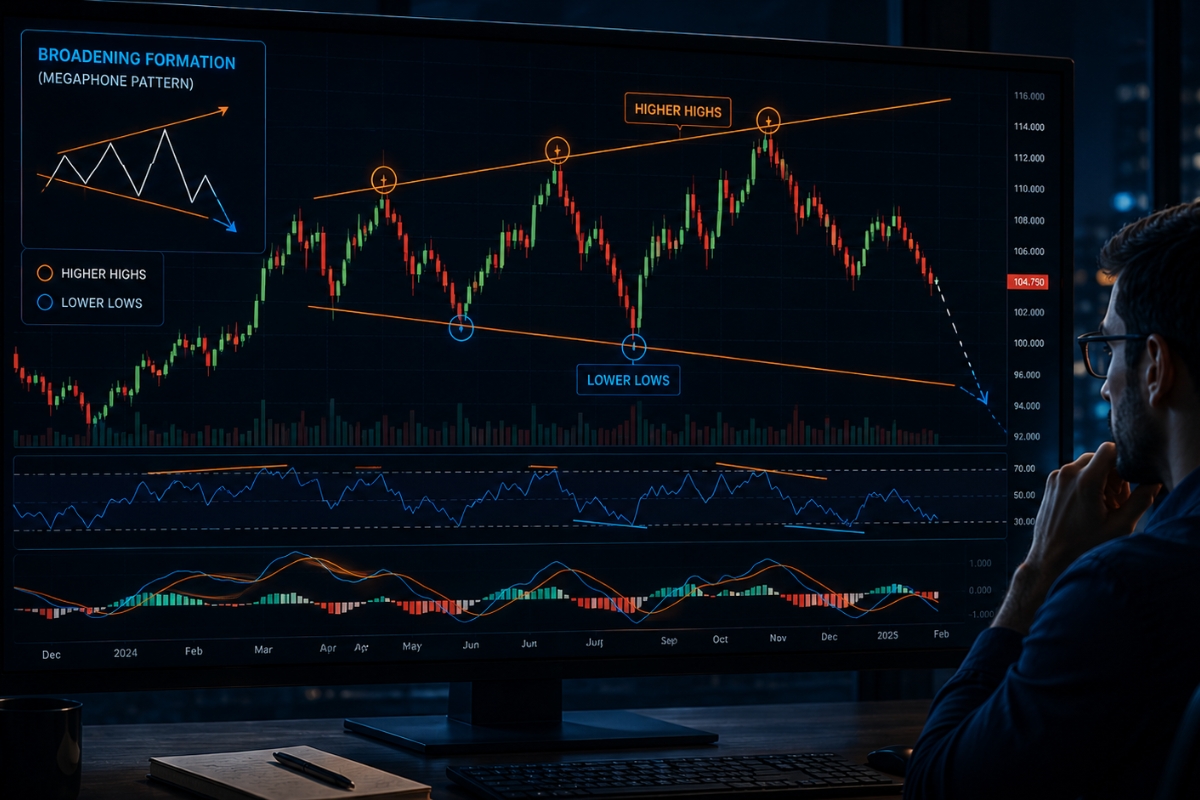
Broadening formations are patterns that indicate increasing volatility and market indecision, typically formed by higher highs and lower lows, showing expanding price range over time.
Additionally, broadening formations include multiple types such as megaphone patterns, broadening wedges, and ascending or descending variations, each reflecting different market structures and trading implications.
These patterns primarily signal high volatility rather than clear direction, where price swings widen and volume behavior often becomes irregular within the formation.
Therefore, traders commonly use breakout strategies when trading broadening formations, focusing on confirmed breakouts with proper stop loss and risk management to avoid false signals.
However, traders often misinterpret broadening formations or overtrade within the pattern, leading to losses due to unpredictable price swings and false breakouts.
In technical analysis, Broadening Formations are price patterns characterized by an expanding price range, reflecting increasing volatility and unstable market sentiment. Understanding the meaning, structure, and trading approach of this pattern helps traders identify opportunities while effectively managing risk.
Broadening formations meaning and market context
Broadening formations are classical chart patterns characterized by a series of higher highs and lower lows that develop between two diverging, outward-sloping trendlines.
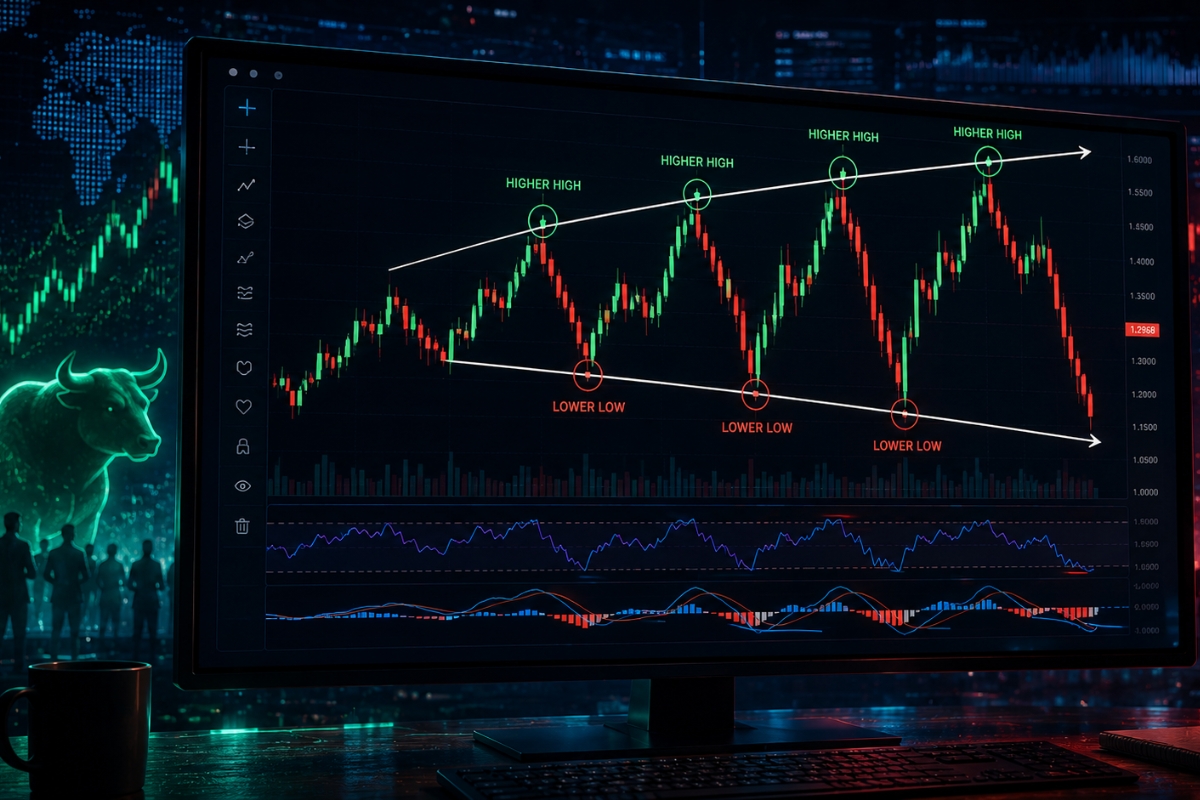
Statistically, these patterns occur when a market enters a state of hyper-volatility, often driven by high-impact macroeconomic news, shifting interest rate expectations, or sudden earnings surprises. This unique configuration reflects an environment where market participants are highly emotional, resulting in a structural expansion that breaks standard support and resistance thresholds on both sides of the tape.
How is a broadening formation identified on a chart?
A valid broadening formation is identified by detecting at least five distinct structural pivot points that form an expanding, fan-like shape on your trading terminal.
- Peak Progression: The market must establish at least two consecutive swing highs, where the second peak is visibly higher than the first.
- Trough Progression: The market must simultaneously print at least two consecutive swing lows, where the second trough is deeper than the preceding one.
- Trendline Divergence: Drawing a line across the peaks and another across the troughs must reveal two trendlines that move further apart from left to right.
Understanding the visual layout is simple, but recognizing the underlying market macro environment tells you why the pattern exists in the first place.
What market conditions create broadening formations?
Broadening formations typically form during the late stages of a mature bull market or during intense macroeconomic transition periods when the financial community lacks a unified consensus. This occurs when retail momentum chasing collides head-on with aggressive institutional distribution, causing dramatic intraday price sweeps. For instance, a positive corporate press release might drive an initial higher high, followed immediately by heavy institutional selling that dumps the price to a brand-new lower low within the same week.
This behavioral dynamic occupies a unique position within classical charting literature, separating it from more common pattern families.
How is this pattern positioned in technical analysis theory?
In classical chart theory, pioneered by pioneers like Richard Schabacker and Edwards & Magee, the broadening formation is positioned as a highly sophisticated reversal or continuation structure that explicitly represents market exhaustion. Unlike symmetrical triangles which show a balance of power and decreasing risk, the broadening formation represents a total breakdown of market discipline. It serves as a stark technical warning that the prevailing trend is losing structural control due to emotional overreaction from both buyers and sellers.
Once you comprehend the theoretical market context, you can begin categorizing the specific structural variations seen across live asset markets.
Types of broadening formations in trading
The types of broadening formations available in financial markets vary based on the specific slope, orientation, and symmetry of their boundaries.
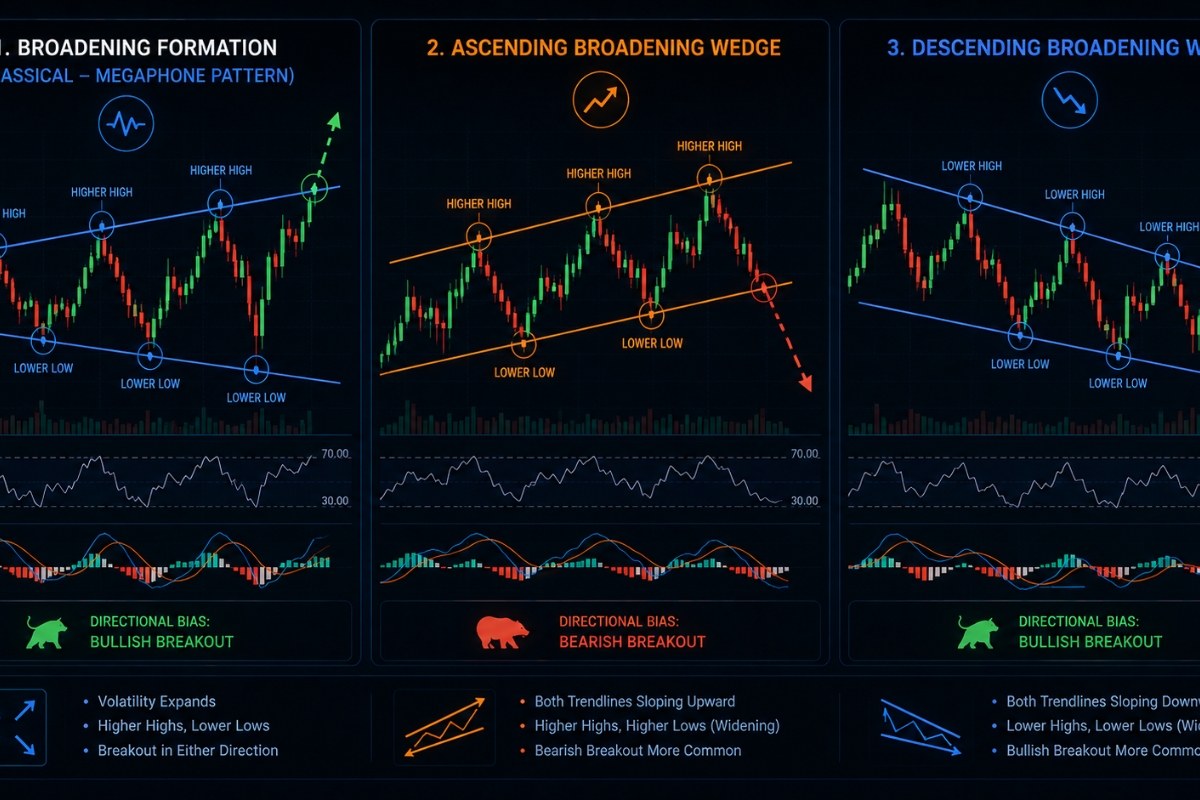
While all variations share the core characteristic of diverging trendlines, their individual geometry alters the localized supply and demand mechanics, meaning they carry different predictive values for future price breakouts. Professional analysts categorize these variations into classical, wedge-based, and biased structures to apply the appropriate strategic filters during live execution.
What is a classical broadening formation (megaphone pattern)?
The classical broadening formation, commonly referred to as the “Megaphone Pattern,” features a symmetrical expansion where the upper resistance line slopes upward and the lower support line slopes downward at roughly equal angles. This specific structure represents absolute directional neutrality during its formation, showing that neither bulls nor bears have gained an upper hand. The pattern resembles a megaphone or an inverted triangle, indicating that price volatility is growing exponentially wider with each passing market cycle.
While the classical megaphone expands symmetrically, certain variations present a distinct directional lean that alters their breakout probabilities.
How does broadening wedge differ from standard formation?
The primary difference between a broadening wedge and a standard broadening formation lies in the directional slope of the boundaries.
- Standard Formation: The trendlines move in opposite directions (one up, one down), creating a perfectly balanced expansion.
- Broadening Wedge: Both trendlines slope in the same direction (either both upward or both downward), but they still diverge because one line is steeper than the other.
An ascending broadening wedge slopes entirely upward, while a descending broadening wedge slopes downward, meaning they carry built-in directional biases that standard megaphones do not possess.
This brings up an essential operational question regarding whether these directional biases require unique execution parameters.
Are ascending and descending broadening patterns traded differently?
Yes, ascending and descending broadening formations are traded with completely different directional biases due to their structural implications. An ascending broadening pattern (sloping upward) shows that buyers are pushing prices higher but are meeting massive distribution, making it an inherently bearish structure that frequently breaks down through its support line. Conversely, a descending broadening pattern (sloping downward) indicates aggressive selling that is constantly met by deep-value institutional buying, rendering it a highly bullish structure that typically breaks out toward the upside.
Before deploying capital onto these specific types, you must analyze the core internal market signals and volume metrics that drive the pattern from within.
Market signals from broadening formations
Market signals from broadening formations provide crucial clues regarding the health of an asset’s liquidity and the hidden intentions of institutional market makers.

Because these structures feature expanding boundaries, the signals they generate are far more intense than those found in standard consolidation patterns, often leading to massive multi-month trend changes. Interpreting these signals accurately requires an analyst to ignore short-term price noise and focus purely on the broader macro relationship between price spikes and volume distribution.
Do broadening formations signal volatility or indecision?
Broadening formations signal an extreme combination of both hyper-volatility and deep structural indecision. The widening price swings prove that market volatility is escalating rapidly, meaning that traditional risk models based on static stop loss are often wiped out. At the same time, the failure of the market to sustain a clear directional trend after making a new high or a new low confirms that major institutional funds are highly undecided about the asset’s fair valuation, leading to violent tug-of-war behavior.
To verify whether this indecision is nearing its end, you must closely monitor the internal price and volume footprints.
How do price and volume behave inside the pattern?
Inside a valid broadening formation, price and volume follow a highly unique, irregular path:
- Price Behavior: Price swings become progressively larger, faster, and more erratic as the pattern moves from left to right, often ignoring intermediate moving averages.
- Volume Profile: Unlike triangles where volume dries up, volume inside a broadening formation remains consistently high or expands during the wild price swings, confirming heavy active participation.
- The Breakout Trigger: As price nears the outer limits, volume often reaches an absolute peak, signaling that a major liquidity event or breakout sequence is imminent.
Once you can read these internal volatility signals, you are ready to construct a rule-based, professional trading system around the formation.
Trading approach for broadening formations
The trading approach for broadening formations requires an exceptionally high degree of discipline and a strict reliance on objective confirmation systems.

These patterns are designed to trap emotional retail traders on both sides of the market, entering a trade blindly inside the structure can quickly result in catastrophic account drawdowns. Professionals utilize specific breakout execution techniques and mathematical target formulas to ensure they only trade when the market presents a verified structural edge.
What is a practical breakout trading strategy?
The most reliable breakout strategy for this pattern follows a strict 5-step structural sequence:
- Step 1: Identify wedge structure: Scan your charts to locate an expanding megaphone or biased broadening structure with at least three verified touches on one boundary and two on the other.
- Step 2: Wait for breakout confirmation: Patience is mandatory; wait for a full candlestick body to break and close completely outside the upper resistance or lower support trendline.
- Step 3: Enter trade in breakout direction: Execute your position immediately upon the close of the breakout candle, or place a limit order to enter on a successful retest of the broken trendline.
- Step 4: Set stop loss outside wedge: Position your defensive Stop Loss safely inside the pattern, typically below the most recent internal swing pivot to avoid getting caught in minor noise.
- Step 5: Set take profit based on pattern size: Measure the absolute vertical height of the broadening formation at its widest point, and project that exact distance outward from the breakout entry point to find your primary target.
While the mechanical entry sequence is clear, managing your exits requires a strict application of mathematical risk-reward metrics.
Where should stop loss and take profit be placed?
For a bearish breakdown out of a classical broadening formation, your Stop Loss should be positioned above the last structural swing high inside the megaphone, while your Take Profit is set at a distance equal to the pattern’s maximum width projected downward. For a bullish breakout, place your Stop Loss right below the last swing low, ensuring your target provides at least a 1:2 Risk-to-Reward (R:R) ratio. Implementing these precise risk metrics is highly streamlined when utilizing the advanced execution tools and real-time calculators available on the MBroker homepage.
Even with flawless execution, the market will occasionally present false breaks, requiring an active defensive mitigation plan.
How do traders handle false breakouts?
To successfully handle false breakouts within broadening structures, professional traders utilize a “delayed entry filter” or a strict volume validation protocol. If a price pushes past a boundary line but fails to close outside it on the daily chart, it is immediately classified as a liquidity sweep rather than a genuine breakout. Experienced traders will reverse their bias in these situations, shorting a failed bullish breakout or buying a failed bearish breakdown, targeting the opposite side of the megaphone.
By mastering the correct strategic execution, you can actively avoid the classic errors that destroy the capital of uneducated retail traders.
Common mistakes when trading broadening formations
Common mistakes when trading broadening formations usually stem from emotional impatience, cognitive bias, and an inability to recognize the pattern’s unique geometric properties.

Recognizing these psychological and technical traps before they occur is the final step toward achieving professional competency with this pattern family.
Do traders confuse broadening patterns with triangle formations?
Yes, amateur chartists frequently confuse broadening patterns with expanding triangle variations, leading to incorrect strategic biases. The core error involves failing to verify the trendline slope; a true broadening formation requires diverging lines where the price action expands as time moves forward. Misidentifying this structure as a standard channel or a contracting triangle causes traders to place their stop losses much too close to the market, leading to premature stop-outs as the megaphone continues its natural expansion.
Beyond simple identification errors, the wild intraday price action inside the pattern often triggers a highly destructive psychological cycle.
Why does overtrading inside the pattern lead to losses?
Overtrading inside a broadening formation leads to severe financial losses because the internal swing levels are continuously expanding and breaking previous micro-support and resistance lines. Retail traders who attempt to “scalp” the mid-ranges of a megaphone are often chopped to pieces because the market constantly generates fake reversals before driving toward a new higher high or lower low. This erratic behavior triggers emotional revenge trading, causing participants to over-leverage their accounts precisely as the market enters its most dangerous, volatile expansion phase.
In summary, Broadening Formations represent a unique phase of extreme market volatility and institutional distribution that demands an advanced level of trading discipline. By correctly identifying the pattern type, waiting for high-volume breakout confirmation, and utilizing the risk-mitigation tools championed by XM Guide technical analysts can safely convert market chaos into a structured commercial edge.

Thoren Vextal is a specialist in XM trading guides, offering practical insights and real-market experience to help traders improve their strategies and trading performance. Email: [email protected]