
 Tiếng Việt
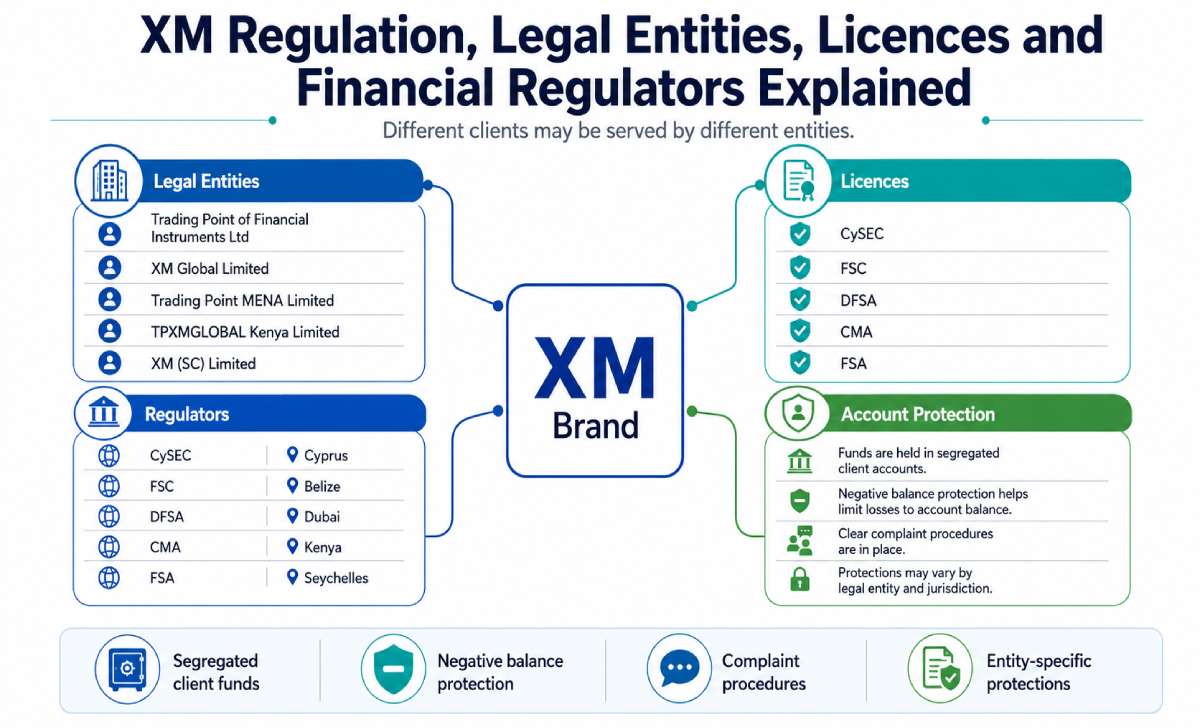
Yes, XM operates through regulated legal entities, but one license does not cover every XM account worldwide. The company responsible for an account depends on the client’s country, registration route and the legal entity named in the agreement.
XM is therefore supervised by different regulators in different jurisdictions. These include CySEC in Cyprus, the FSC in Belize, the DFSA in Dubai, the CMA in Kenya and the FSA in Seychelles, although not every entity is available to every customer.
Account protections also vary by entity. Client-money rules, negative balance protection, complaint procedures and compensation arrangements must be checked in the documents governing the individual account.
Is XM regulated?
XM is regulated through several operating companies, but the applicable regulator depends on the legal entity serving the customer. The XM name should not be treated as one company holding every license listed across the Trading Point group.
A regulation check should separate three elements:
- The XM brand shown on the website
- The legal company named in the client agreement
- The regulator and license supervising that company
For example, XM’s international website currently identifies XM Global Limited as a company regulated by the Financial Services Commission of Belize under license number 8557558. In contrast, CySEC’s public register lists Trading Point of Financial Instruments Ltd under license 120/10 and includes xm.com among its approved domains.
This distinction matters because two XM customers may not have the same contracting company, legal documents or complaint route. XM’s legal-document page states that the documents applicable to an account are identified during registration.
For a broader assessment covering accounts, platforms, fees and trading conditions, readers can also consult the complete XM Review.
Does regulation make XM risk-free?
No. Regulation establishes oversight and conduct requirements, but it does not prevent trading losses.
Forex and CFD positions can lose value because of leverage, volatility, price gaps or incorrect market decisions. Regulatory status should therefore be assessed alongside trading costs, account conditions, execution policies and withdrawal procedures.
To determine which rules apply, the next step is to match the account’s legal entity with the correct regulator.
Which regulators and licenses oversee XM?
XM-related services are provided by separately regulated companies in several jurisdictions. Each company must be checked individually because its license does not automatically apply to accounts held by another XM entity.
The diagram below shows how the XM brand can be connected with different operating companies and supervisory authorities.
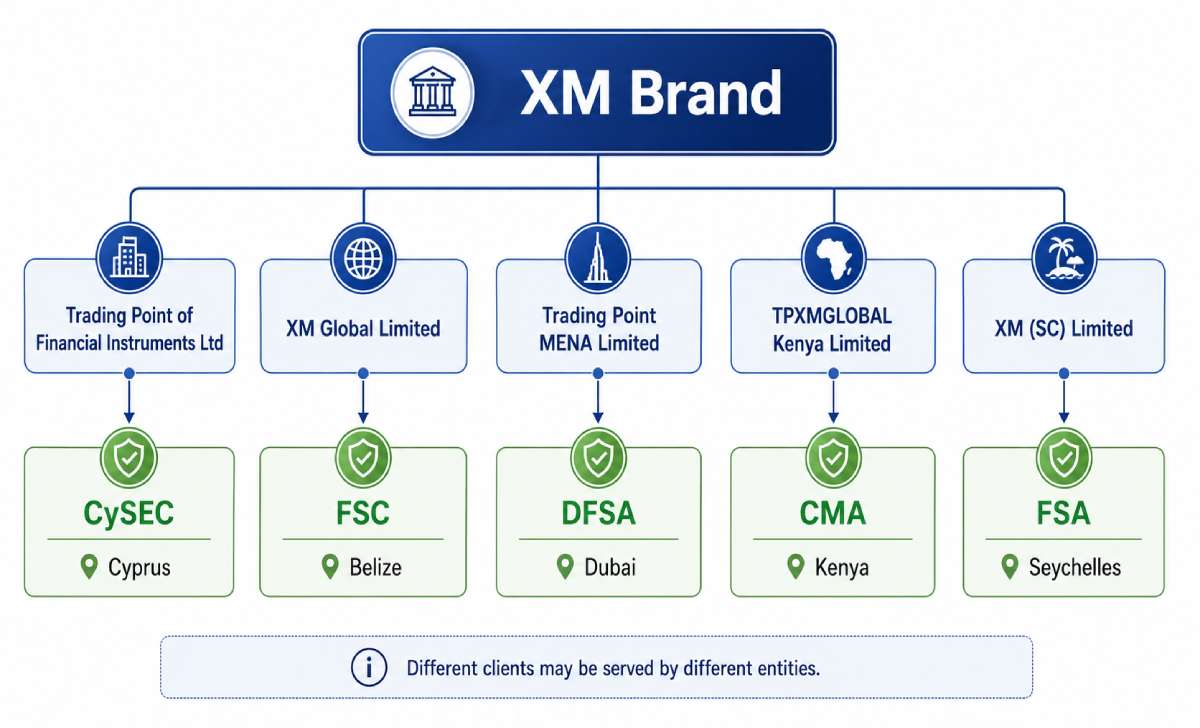
The following table provides a quick entity-level overview. Regulatory details can change, so the company name, domain and license status should be reconfirmed before registration or funding.
| XM-related legal entity | Regulator | Jurisdiction | Public license or registration reference |
| Trading Point of Financial Instruments Ltd | Cyprus Securities and Exchange Commission | Cyprus | CySEC license 120/10 |
| XM Global Limited | Financial Services Commission | Belize | FSC license 8557558 |
| Trading Point MENA Limited | Dubai Financial Services Authority | Dubai International Financial Centre | DFSA reference F003484 |
| TPXMGLOBAL Kenya Limited | Capital Markets Authority | Kenya | CMA-authorised non-dealing online forex broker |
| XM (SC) Limited | Financial Services Authority | Seychelles | Listed in the FSA capital-markets register under the XMGlobal trade name |
CySEC confirms the company name, license number, company-registration number and approved domains for Trading Point of Financial Instruments Ltd. The Seychelles FSA also publicly lists XM (SC) Limited with the XMGlobal trade name and xm.com domain.
Similarly, XM’s Kenya legal documents identify TPXMGLOBAL Kenya Limited as a non-dealing online foreign exchange broker regulated and authorised by the CMA.
A company-registration number should not be confused with a financial-services license. CySEC, for example, separately displays license 120/10 and company-registration number 251334 for Trading Point of Financial Instruments Ltd.
Readers evaluating whether regulatory records support the broker’s legal status can continue with Is XM Legit?. That review considers regulation together with company identity, official domains and operational history rather than relying only on the number of licenses.
Once the correct entity has been identified, its legal documents determine which protections may apply to the account.
What account protection does XM regulation provide?
Regulation may provide client-money controls, complaint procedures and other safeguards, but the exact protection depends on the account’s contracting entity. A protection available under one jurisdiction should not automatically be assumed under another.
The following image outlines the main steps for matching an XM account with the correct company and license.

Use this five-step verification process:
- Check the website footer: Record the complete company name, regulator and license reference.
- Read the client agreement: Confirm that the same company is named as the service provider.
- Search the regulator’s register: Match the entity name, approved domain and license status.
- Review protection documents: Check client-money, negative-balance and complaint provisions.
- Verify country eligibility: Confirm that the entity is permitted to provide services in your jurisdiction.
The main protection areas to examine include:
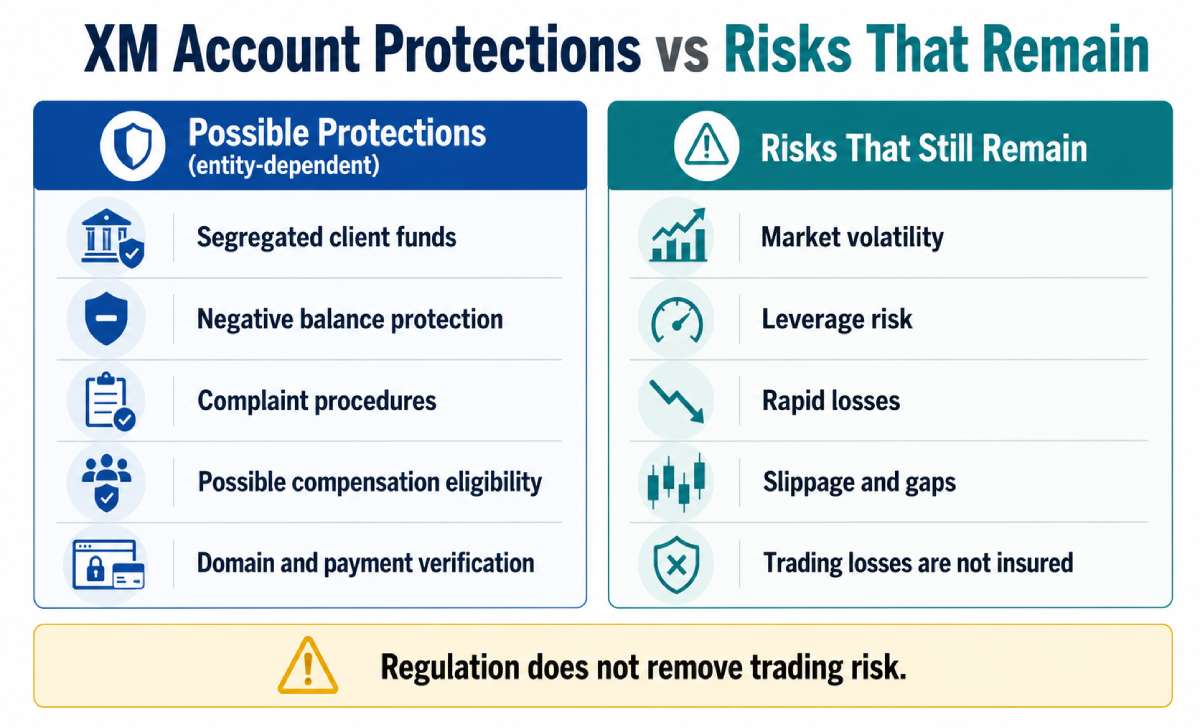
- Segregated client funds: Client money may be held separately from the company’s operating funds, subject to the rules and documents applying to the entity.
- Negative balance protection: This may prevent a qualifying account from remaining below zero, but its scope should be checked in the governing agreement.
- Complaint procedures: Each legal entity may have its own internal complaint process and regulator escalation route.
- Compensation eligibility: Compensation schemes are jurisdiction-specific and should not be assumed for every XM account.
- Domain verification: The website and payment beneficiary should be consistent with the company listed in the agreement and regulator register.
The image below distinguishes regulatory or account-level protections from risks that remain with the trader.
For a more detailed review of fund handling, account security and the limits of regulatory protection, see Is XM Safe?.
Risk warning: Forex and CFDs are leveraged products and can cause rapid losses. Regulation, segregated funds or negative balance protection do not insure traders against losses caused by unsuccessful positions.
XM can therefore be described as operating through regulated entities, but that statement alone is not enough to assess an individual account. Mbroker.net readers should check the company named in their agreement, confirm its status in the official regulator register and review the protections attached to that entity before depositing funds.

Thoren Vextal is Mbroker’s XM Reviews and How-To Guides Editor, covering broker reviews, regulation, comparisons and practical account guides.Email: [email protected]