
 Tiếng Việt
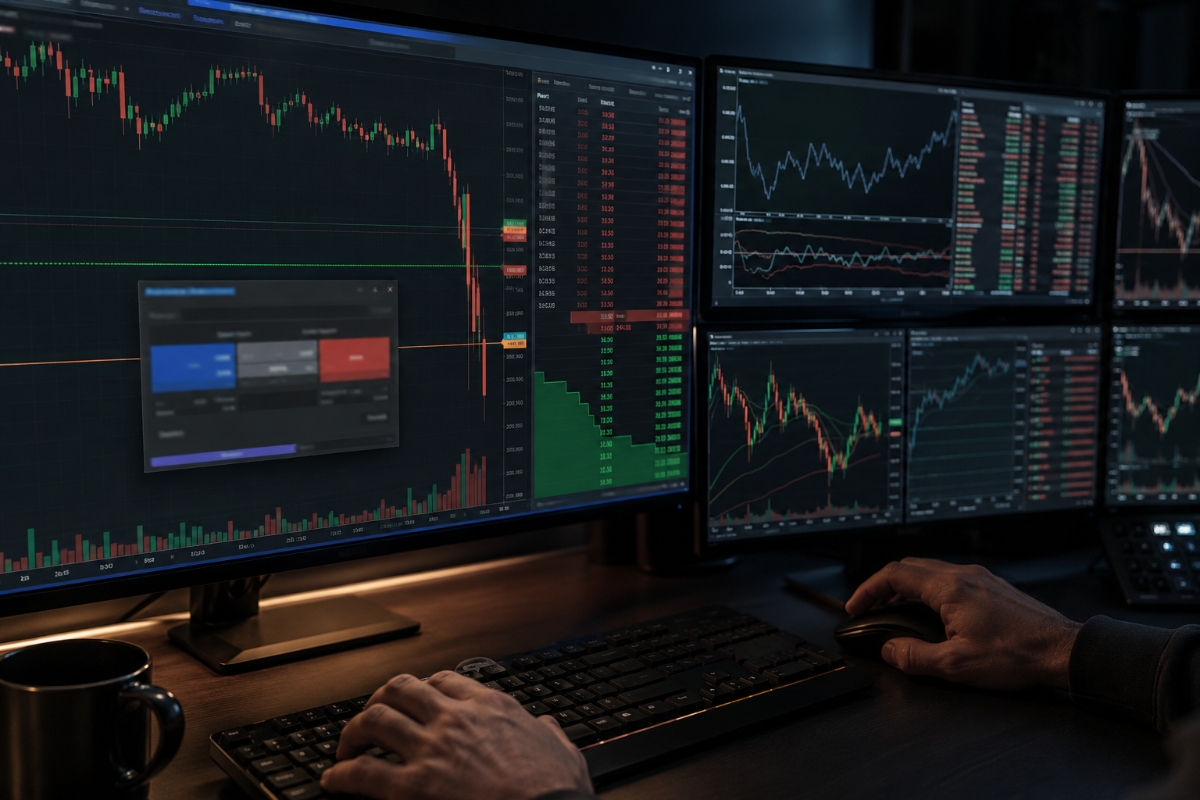
Slippage XM is the difference between the expected price and the actual execution price, occurring when market conditions change rapidly during order processing.
However, slippage on XM mainly occurs due to market execution without requotes, where orders are filled at the best available price based on real-time liquidity.
As a result, price differences can be either positive or negative depending on market movement, meaning traders may receive a better or worse price than expected.
Meanwhile, XM does not use requotes but applies real market execution instead, ensuring orders are executed instantly without rejection or price re-confirmation.
Therefore, slippage directly impacts trading profit and risk by altering entry and exit prices, especially during high volatility or low liquidity conditions.
Slippage XM directly affects execution price, so understanding how it works helps you control risk and optimize your trade entries. For better performance, explore more strategies in the Forex Trading Strategy category to minimize slippage and improve your trading results.
What is slippage in trading and how does it appear on XM?
Slippage is the mathematical difference between the exact price you request on your trading terminal and the actual final price at which your order is executed on the interbank order book.
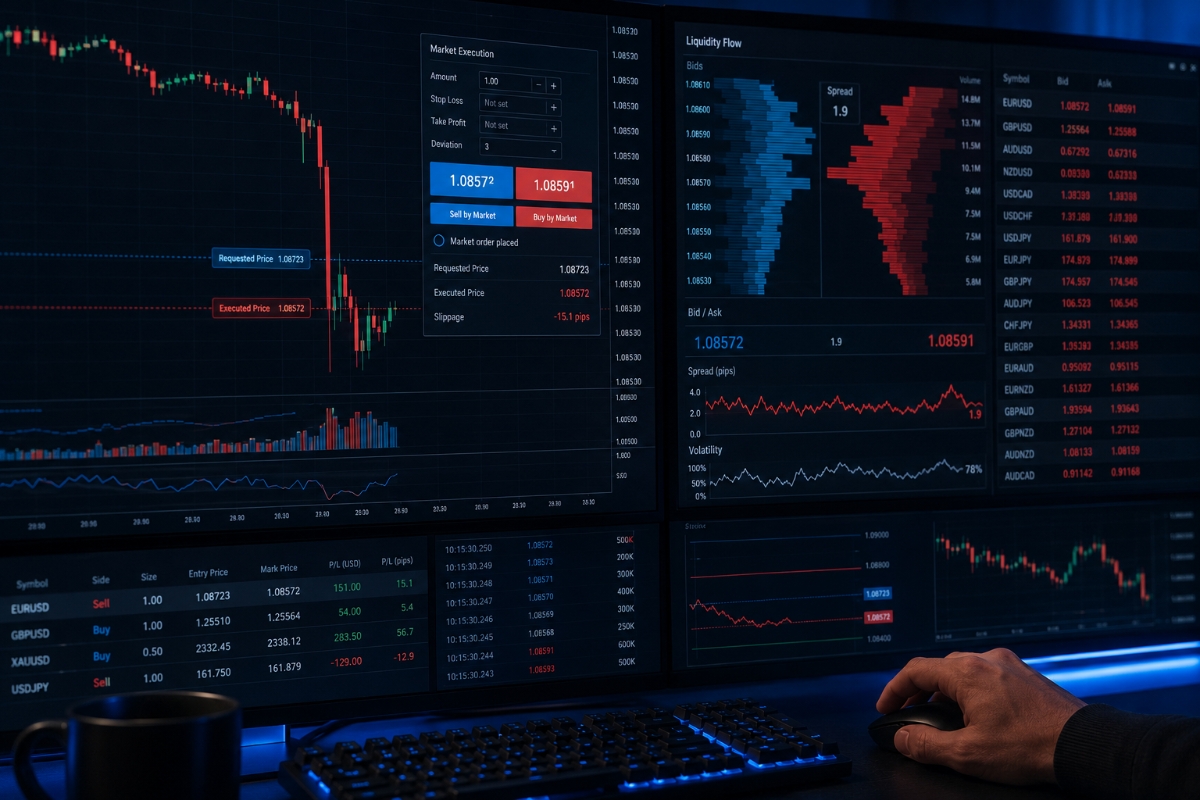
Slippage occurs within fractions of a second during high-velocity market environments, typically ranging from a minor 0.1 pip to multiple pips depending on available market depth. On the XM platform, slippage appears as a transparent price adjustment during volatile periods, meaning your market orders or pending stop orders may fill at a slightly better or worse rate than the visual price displayed on your chart at the millisecond of click execution.
What is slippage in forex trading?
In forex trading, slippage is an organic structural event that represents a mismatch between the current retail price stream and the available institutional liquidity. Because the foreign exchange market is a decentralized, continuous network, prices change rapidly as global banks reallocate capital. When you hit the buy or sell button, your order is transmitted electronically to a liquidity provider; if the price changes while your order is transit over the network, slippage occurs naturally to match you with the next available market rate.
Understanding this macro characteristic helps clarify the localized infrastructure factors that trigger these price adjustments.
Why does slippage occur on XM platform?
Slippage occurs on the XM platform primarily because the broker utilizes a pure Market Execution model designed to guarantee that your trade is filled, rather than guaranteeing a static price. When you execute an order during a high-impact macroeconomic event, such as a central bank interest rate decision, the underlying asset’s price can move faster than the data packets traveling from your computer to the server. This millisecond transmission delay means the matching engine fills your position at the true, live interbank rate available the exact instant your order arrives at the liquidity pool.
To fully understand this transmission loop, you must analyze the core architectural mechanics that govern order execution behind the scenes.
Execution mechanics behind slippage XM
The execution mechanics behind slippage XM Mbroker are centered entirely on a strict no-rejection, no-requote routing infrastructure that connects retail traders directly to global institutional liquidity networks.

Statistically, XM boasts a 99.35% order execution rate in under one second, proving that the platform prioritizes immediate structural fulfillment over arbitrary order rejection. This infrastructure eliminates artificial broker interference, meaning your trades are pushed directly into competitive electronic communication networks (ECNs) where real-time matching determines your final entry and exit fill parameters.
How does market execution work on XM?
Market execution on XM functions by matching your incoming trade request instantly with the best available bid or ask price resting on the institutional order book. When you place a market order, the system does not pause to ask if you accept a new price; instead, it immediately fills your required volume using the available market depth. This model guarantees that you will never miss a major market move due to an annoying trade rejection, though it leaves the final fill price open to organic market adjustments if the order book is moving too fast.
This mechanical process is heavily influenced by the immediate volume and volatility characteristics of the asset class you are trading in.
How do liquidity and volatility affect execution?
Liquidity distribution and market volatility are the two primary structural variables that dictate the severity of order slippage:
- High Liquidity, Low Volatility: During standard trading sessions, thousands of limit orders are packed tightly together, keeping the bid-ask spread narrow and reducing slippage to near-zero levels.
- Low Liquidity, High Volatility: Ahead of major economic data releases, institutional banks withdraw their resting limit orders to protect their capital, causing the order book to hollow out. When a retail order hits a thin book during a volatility spike, it must slide through multiple price tiers to find enough volume to fully execute, increasing your net slippage.
Recognizing how these mechanics operate allows us to analyze the resulting price discrepancies and categorize the different types of slippage.
Price difference and types of slippage in trading
The price difference generated by slippage is categorized into two distinct operational types: positive slippage and negative slippage, both of which affect your portfolio’s bottom line differently.
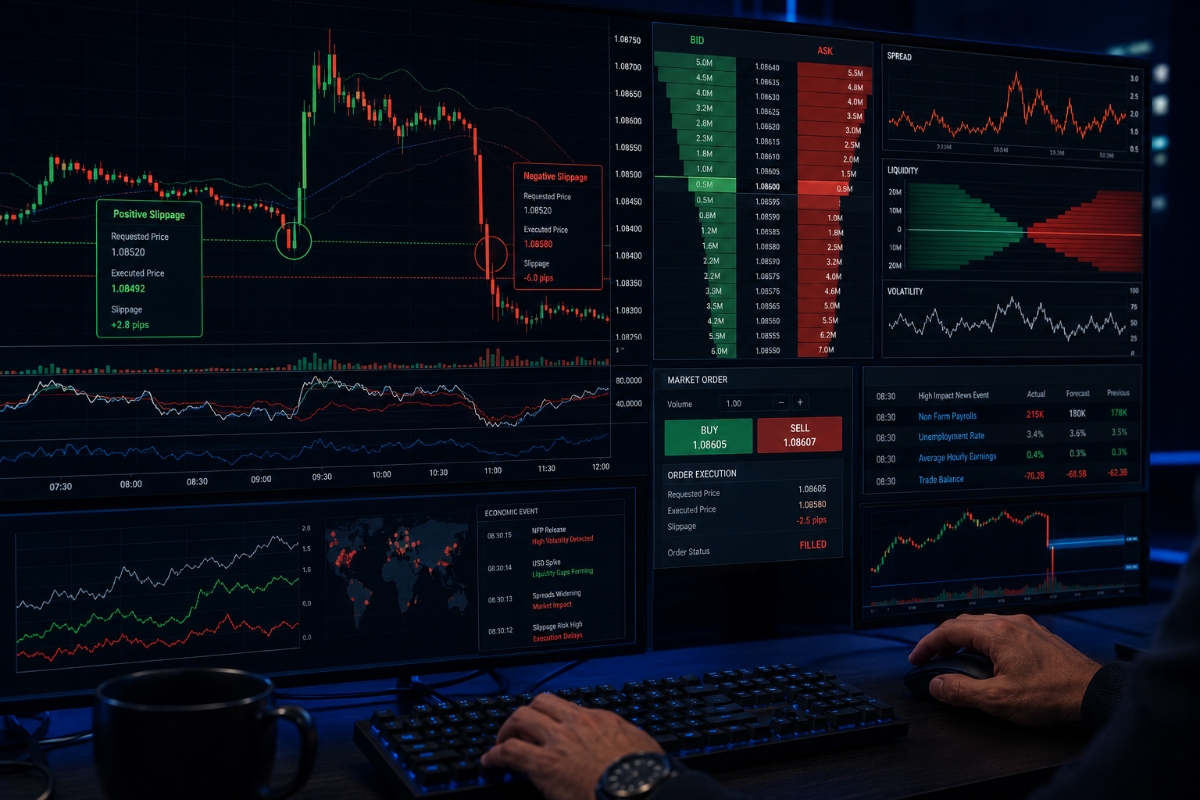
Statistically, in a completely fair and transparent execution environment, the distribution between these two types should remain relatively balanced over a large sample size of trades. This dual outcome proves that price differences are not an artificial fee hidden by the broker, but are rather a direct reflection of real-time directional momentum and order matching velocity on the global exchange.
What is positive and negative slippage?
Slippage is a two-way street that can either improve or reduce your trading margins depending on price direction:
- Positive Slippage: Occurs when the market moves favorably during your order transmission, resulting in a better fill price than requested. For example, if you place a buy limit order or take-profit at 1.1000 and the market gaps downward instantly, you might get filled at 1.0998, saving you 2 pips.
- Negative Slippage: Occurs when the market moves against your position before execution, resulting in a worse fill price. For instance, if your stop-loss is set at 1.1000 during a market crash, the closest available institutional buyer might be at 1.0995, causing a 5-pip larger loss than anticipated.
To successfully defend your capital, you must identify the precise historical times when these price gaps are most active.
When is slippage most likely to happen?
Slippage is highly concentrated during specific calendar periods characterized by extreme order imbalances or massive gaps in global liquidity:
- Macroeconomic Announcements: The minutes surrounding Non-Farm Payrolls (NFP), Consumer Price Index (CPI) reports, and Federal Reserve interest rate announcements.
- Weekly Market Openings: When the market opens on Sunday evening (GMT), asset prices often gap significantly past Friday’s close due to breaking weekend geopolitical news.
- Daily Rollover Windows: The exact period when the New York session closes (22:00 EET), as global banks settle their books and liquidity drops to its absolute lowest daily levels.
While slippage represents organic execution volatility, it must never be confused with an outdated, restrictive routing hurdle known as a requote.
Requotes meaning and relationship with slippage
A requote is an electronic message generated by a market-maker broker that halts your trade execution because the exact price you requested is no longer available on their internal trading desk.

Unlike slippage, which fills your order immediately at the next available market rate, a requote completely freezes your execution, forcing you to manually accept or reject a worse price while the market continues to race away from you. This creates a massive conflict of interest in fast-moving markets, often trapping retail traders in losing positions because they cannot exit their trades efficiently.
What are requotes in trading?
In traditional retail brokerage models, a requote serves as a protective buffer for dealing-desk brokers (B-Book) who internalize their clients’ risk. If a trader attempts to open a position during a fast trend, the broker’s internal computer system rejects the order because filling it at the requested rate would cause an immediate financial loss for the broker. The system then sends a pop-up window stating “Price has changed,” offering a new, less profitable entry price that protects the broker’s profit margins at the direct expense of the client.
Recognizing this restrictive practice highlights the massive operational advantages of trading with an execution model that eliminates these artificial delays.
Does XM use requotes or slippage?
XM maintains a strict, transparent No Requotes policy across all its account types, choosing to let market slippage process your orders naturally instead of rejecting them. By enforcing a pure market execution protocol, the platform ensures that your positions are always filled with 100% certainty, even during intense black swan market events. For clients tracking data and reviewing expert educational materials on the MBroker, this zero-requote guarantee provides a reliable technical environment where automated expert advisors (EAs) and manual scalpers can run their strategies without experiencing unexpected system-enforced trading pauses.
Once you know how these pricing models function, the final milestone is evaluating their financial impact and minimizing your overall risk exposure.
Trading impact of slippage and how to manage it?
The trading impact of slippage can directly influence your system’s win rate, average risk-to-reward metrics, and long-term capital preservation if left unmanaged.

For high-frequency scalpers or algo-traders who target tiny profit margins of 5 to 10 pips, a minor 1-pip negative slippage adjustment can instantly erode up to 20% of their projected trade profitability. Managing this operational friction requires implementing a strict blend of advanced pending order configurations, tactical session timing, and institutional broker selection.
How does slippage impact profit and risk?
Slippage alters the mathematical expectation of your trading system by shifting your actual risk-to-reward ratios away from your theoretical plan. If your strategy relies on a tight 10-pip stop-loss to achieve a 30-pip profit target ($$1:3 \text{ R:R$$), experiencing a 2-pip negative slippage on your entry and another 1-pip slippage on your stop-loss expands your total risk to 13 pips while shrinking your actual entry window. Over a sequence of 100 sample trades, this minor variance can turn a mathematically winning technical strategy into a net-losing portfolio due to excessive friction costs.
To protect your equity curve from this mathematical decay, you must implement professional order-filtering protocols on your terminal.
How can traders reduce slippage on XM?
To dramatically reduce the frequency and severity of order slippage on your account, enforce these five strict institutional risk habits:
- Deploy Limit Orders: Utilize Buy Limit and Sell Limit orders instead of Market Orders; limit orders are engineered to only execute at your requested price or better, completely eliminating negative slippage.
- Trade High-Liquidity Sessions: Focus your main capital execution within the London and New York session overlaps, when global interbank volume reaches its daily peak.
- Avoid News Gambling: Refrain from opening new positions within the 15-minute window before and after major macroeconomic data releases.
- Utilize VPS Hosting: Connect your trading terminal to an automated Virtual Private Server (VPS) located close to the broker’s execution servers to reduce network latency to under 1 millisecond.
- Leverage Verified Infrastructure: Reviewing the execution standards and liquidity access guides highlighted on the MBroker helps you select optimal account configurations that minimize spread widening and maximize routing speeds.
In short, Slippage XM is an organic market event that reflects real-time volatility and available liquidity distribution on the global interbank network. By understanding that market execution guarantees fulfillment over a static price, utilizing limit orders to block negative adjustments, and avoiding high-impact news spikes, you can easily minimize execution friction.

Thoren Vextal is a specialist in XM trading guides, offering practical insights and real-market experience to help traders improve their strategies and trading performance. Email: [email protected]