
 Tiếng Việt
XM does not charge a fee on most withdrawal methods, but exceptions may apply depending on the payment channel and account currency. Bank wire withdrawals below a certain threshold may incur a charge, while e-wallets and cards are typically processed without an XM-side fee.
Withdrawal costs at XM vary by method, with most channels processed free of charge, though certain payment methods or account currencies may involve additional charges. Credit/debit card and cryptocurrency withdrawals generally carry no direct XM fee, though network or processing conditions can differ.
According to the XM Help Center, the minimum withdrawal amount for any account type is $5, though this minimum can vary depending on the payment method, and processing time ranges from same-day to several business days. Bank wires typically take longer to settle than e-wallet or card withdrawals.
Bank wire, card, e-wallet and crypto withdrawals at XM differ in cost structure, with e-wallets and crypto generally being faster and involving lower additional charges than other methods. Card withdrawals are capped by the original deposited amount, while bank wires suit larger transfers.
XM covers bank wire fees on withdrawals above a certain amount, while smaller transfers may be subject to a deduction charged by the receiving bank. Clients are advised to check the exact threshold and applicable charges directly on the XM Help Center before initiating a bank wire withdrawal, as this detail is not fixed across all account types and regions. Third-party or intermediary bank charges outside XM’s control can still apply regardless of the payment method chosen.
Mbroker breaks down each of these cost components in detail below, starting with whether XM charges a fee on withdrawals, how much each method costs, and the minimum amount and processing time clients should expect.
Does XM Charge a Fee on Withdrawals?
XM does not charge its own fee on withdrawals in most cases, covering transfer costs on the first withdrawal request within a given period, though this depends on the client’s legal entity, account type and chosen payment method. This policy addresses the core question of whether a withdrawal costs anything at XM.
The following subsections break down how this policy applies across different payment channels, what happens beyond the fee-free allowance, and where regional or entity-specific rules may change the outcome.
This information was reviewed as of March 2025, and fee policies are subject to change without prior notice. Readers should confirm the withdrawal fee terms applicable to their specific country, account type and assigned XM legal entity directly through the official XM client portal or Help Center before requesting a withdrawal.
Which XM Legal Entity Determines Your Withdrawal Fee Terms?
The client’s assigned XM legal entity determines which withdrawal methods are available, whether a fee applies and what limits or processing rules govern each transaction. This distinction directly affects the withdrawal cost terms discussed throughout this guide.
XM operates through several regulated entities, including XM Global (offshore-regulated), XM UK (FCA-regulated) and XM EU entities regulated under CySEC or equivalent frameworks in the European Economic Area. Clients are onboarded to a specific entity based on their country of residence during registration, and this assignment cannot typically be changed afterward without opening a new account under different eligibility criteria.
Because each entity operates under its own regulatory framework, fee coverage on the first withdrawal, available payment channels and minimum withdrawal amounts can differ between an XM Global client and an XM UK or EU client. Bank wire fee waivers, e-wallet availability and card withdrawal limits are set per entity rather than uniformly across all XM clients worldwide.
Readers can verify which legal entity governs their account and its corresponding withdrawal terms directly through the XM client portal or a signed account statement before requesting a withdrawal.
When Does XM Cover Bank or Third-Party Charges vs When Do Fees Apply?
XM covers intermediary or correspondent bank charges only on a limited number of withdrawal requests within a given period, after which subsequent withdrawals or certain payment methods may incur charges imposed by the receiving bank or payment provider rather than XM itself. This waiver condition determines whether a bank or third-party fee gets absorbed by XM or passed on to the client.
The fee-free allowance typically resets on a periodic basis, meaning a client who withdraws once within that period pays no intermediary charge, while a second withdrawal in the same cycle may trigger a deduction from the receiving bank. This deduction originates from the correspondent bank handling the international transfer, not from XM’s own fee schedule.
Card and e-wallet withdrawals generally fall outside this waiver structure since these channels rarely involve intermediary banks. Bank wire withdrawals remain the method most exposed to third-party deductions, particularly for cross-border transfers processed through multiple correspondent banks before reaching the client’s local account.
Clients confirm whether a specific withdrawal falls within the free allowance or triggers a third-party charge directly through the XM client portal transaction history or by contacting XM support before submitting the request.
How Much Does XM Charge Per Withdrawal Method?
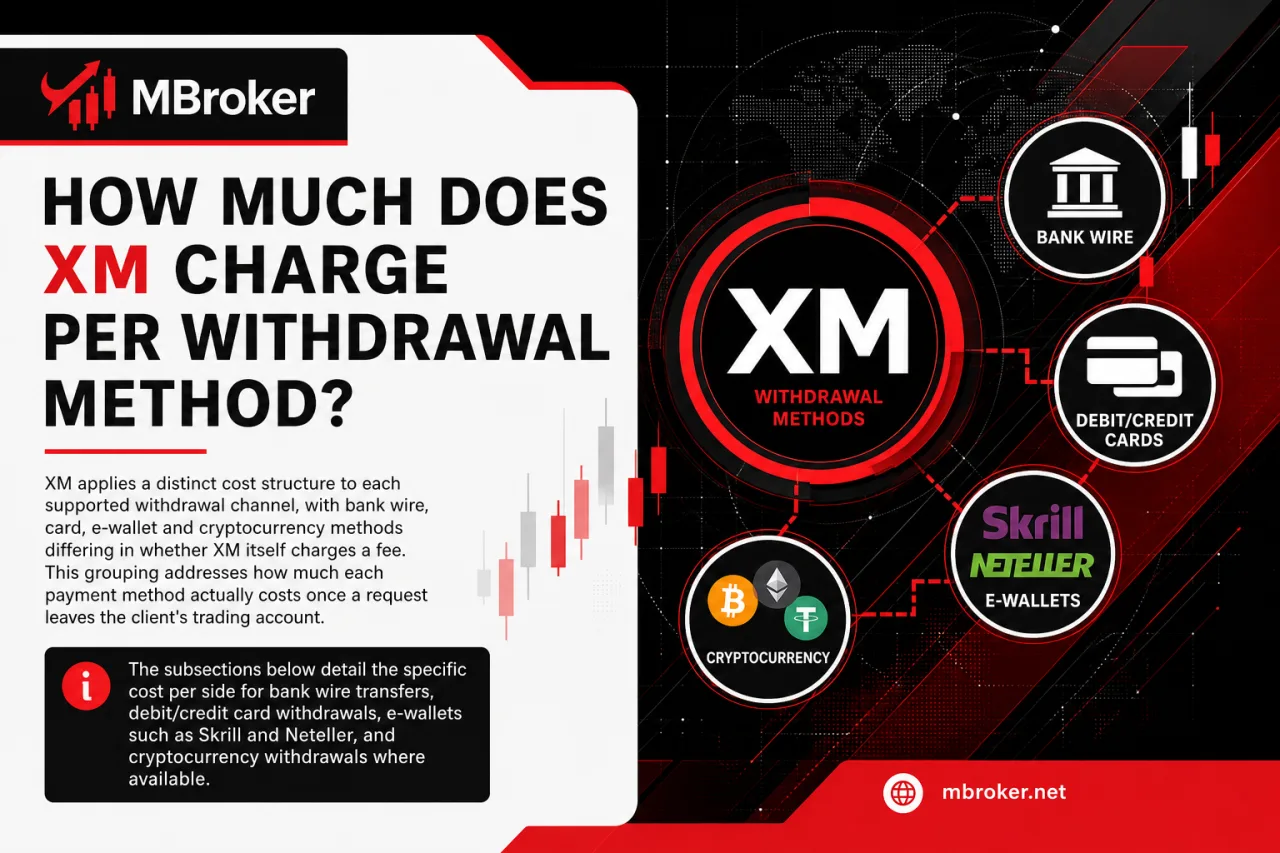
XM applies a distinct cost structure to each supported withdrawal channel, with bank wire, card, e-wallet and cryptocurrency methods differing in whether XM itself charges a fee. This grouping addresses how much each payment method actually costs once a request leaves the client’s trading account.
The subsections below detail the specific cost per side for bank wire transfers, debit/credit card withdrawals, e-wallets such as Skrill and Neteller, and cryptocurrency withdrawals where available. Each breakdown notes whether the charge originates from XM’s own fee schedule or from a third-party processor, bank or network outside XM’s control.
Clients should treat these figures as method-specific rather than universal, since the same payment channel can carry different conditions depending on the assigned XM legal entity, account currency and withdrawal amount. The exact cost applicable to a given transaction is confirmed through the XM client portal before the withdrawal is submitted.
What Are the Bank Wire Withdrawal Fees at XM?
XM covers standard bank wire transfer costs on withdrawal requests above a set minimum amount, while transfers below that threshold may absorb a deduction charged by the receiving or correspondent bank. This wire-specific structure builds on the general fee-free policy noted earlier and applies specifically to the bank transfer channel.
Once a withdrawal request is submitted, XM processes the transfer to the client’s designated bank account, but the funds often pass through one or more correspondent banks before reaching the final destination. Each correspondent bank in this chain can apply its own handling charge, and this deduction is outside XM’s fee schedule since it originates from the banking network rather than from XM directly.
The net amount a client receives from a bank wire withdrawal can therefore be lower than the amount requested, since intermediary or correspondent banks may deduct their own handling charges before the funds reach the client’s account.
Processing time also affects the practical cost of choosing bank wire over other methods:
- Settlement typically takes longer than card or e-wallet withdrawals due to the correspondent banking chain.
- Cross-border transfers involve additional verification steps at each intermediary bank.
- Currency conversion during the transfer, where applicable, can further reduce the final received amount.
Clients confirm the exact wire fee treatment for their withdrawal amount and destination bank through the XM client portal before submitting the request.
What Are the Card and E-Wallet Withdrawal Fees at XM?
XM does not charge a fee on card or e-wallet withdrawals, with costs on these methods coming only from the payment provider rather than XM’s own fee schedule. This confirms the definition raised in the heading regarding whether card and e-wallet withdrawals carry any XM-side charge.
Building on the wire transfer structure covered earlier, card and e-wallet channels follow a simpler cost path since no correspondent banking chain is typically involved. Visa and Mastercard withdrawals return funds directly to the card used for the original deposit, capped at the deposited amount, with any remaining balance routed to another available method. Skrill and Neteller withdrawals process through the e-wallet provider’s own network, and any charge applied at that stage originates from the provider’s terms rather than from XM.
Processing speed also distinguishes these two channels from bank wire:
- Card withdrawals settle faster than bank wires in most cases.
- E-wallet withdrawals process near-instantly once approved by XM.
- Provider-side charges, where they exist, appear in the client’s card statement or e-wallet account history rather than in the XM client portal.
Clients confirm any provider-imposed charge directly through their card issuer or e-wallet account terms before requesting a withdrawal.
What Is the Minimum Withdrawal Amount and Processing Time at XM?
According to the XM Help Center, the minimum withdrawal amount at XM is $5 across account types, though this minimum can vary depending on the payment method, while processing time splits into XM-side approval and separate bank or provider settlement time. This overview addresses both the minimum threshold and the timeframe question raised in the heading before breaking each payment method down separately.
The subsections below detail how the $5 minimum and approval window apply specifically to bank wire, card and e-wallet withdrawals, distinguishing the portion XM controls from the portion handled by external banks or payment providers.
How Long Does XM Take to Process a Withdrawal Request?
XM processes a withdrawal through three sequential stages: request submission, internal approval, and external transfer time that varies by payment method. This sequence explains why the same $5 minimum withdrawal noted earlier can still reach different clients at different speeds.
Once a client submits a withdrawal request through the client portal, XM reviews the request internally before releasing funds. This internal approval step checks account verification status, matches the withdrawal method against the original deposit source, and confirms sufficient free margin remains on the account.
Verification status can affect how quickly this internal approval step completes, since an account with outstanding KYC documents may face delays until identity checks clear.
After internal approval, the transfer time depends entirely on the payment method chosen:
- Bank wire transfers take the longest due to correspondent banking steps.
- Card withdrawals settle faster once approved.
- E-wallet withdrawals complete near-instantly after XM releases the funds.
Clients track the current status of a submitted request through the XM client portal transaction history at any stage of this process.
How Do Withdrawal Costs Compare Across Bank Wire, Card, E-Wallet and Crypto at XM?
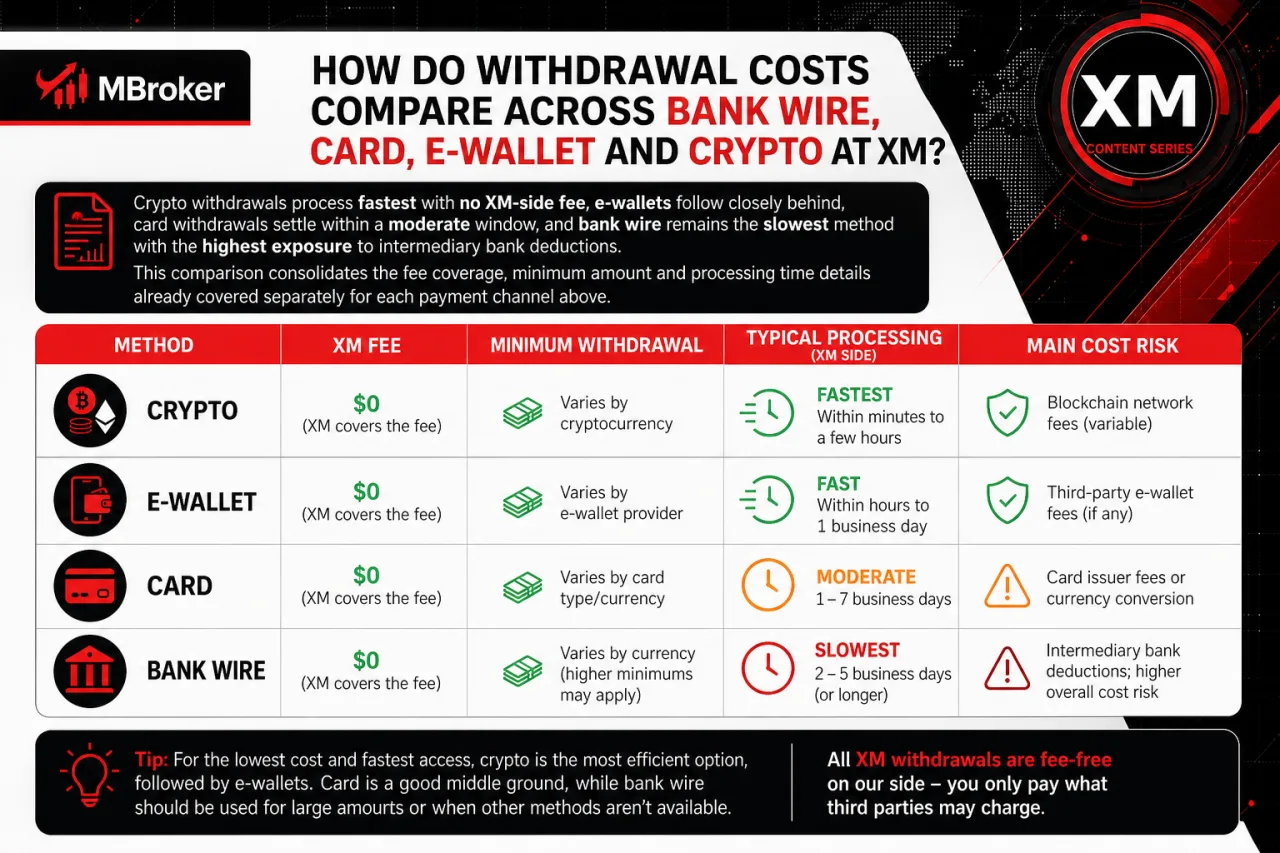
Crypto withdrawals process fastest with no XM-side fee, e-wallets follow closely behind, card withdrawals settle within a moderate window, and bank wire remains the slowest method with the highest exposure to intermediary bank deductions. This comparison consolidates the fee coverage, minimum amount and processing time details already covered separately for each payment channel above.
| Method | XM Fee | Minimum Withdrawal | Typical Processing (XM side) | Main Cost Risk |
|---|---|---|---|---|
| Bank Wire | No XM fee under normal circumstances, subject to account conditions | $5, may vary by method | Longest among all methods | Correspondent/intermediary bank deductions |
| Card (Visa/Mastercard) | No XM fee | $5, capped at deposited amount | Faster than bank wire | Possible card issuer charge |
| E-Wallet (Skrill/Neteller) | No XM fee | $5, may vary by method | Near-instant after approval | Possible provider-side charge |
| Cryptocurrency | No direct XM fee | [Not confirmed] | Near-instant to fast, network-dependent | Network/blockchain processing conditions |
Card withdrawals remain limited to the originally deposited amount before any excess routes to another method. Bank wire carries the greatest variability since correspondent banks outside XM’s network can deduct handling charges independent of XM’s own policy.
The $5 minimum applies to bank wire, card and e-wallet withdrawals as confirmed on the XM Help Center. A specific minimum for cryptocurrency withdrawals is not separately confirmed in that source, so this figure is marked as not confirmed rather than assumed to match the other methods. Clients confirm the exact figures applicable to their account currency and legal entity through the XM client portal before submitting a withdrawal request.
What Other Costs or Limitations Can Affect Your Net Withdrawal Amount at XM?
Beyond whether a fee applies, currency conversion charges, withdrawal method-matching rules and account verification status can each reduce or delay the net amount a client actually receives. These secondary factors sit outside the core fee-or-free question covered earlier and apply regardless of which payment channel is chosen. The subsections below detail how conversion costs, method-matching limits and verification requirements each affect the final withdrawal outcome.
Does Currency Conversion Add Extra Cost to XM Withdrawals?
Yes, currency conversion adds an extra cost to XM withdrawals whenever the payment method’s settlement currency differs from the trading account’s base currency. This conversion charge sits separately from the fee-or-free question covered earlier and can originate from XM, the receiving bank, or the payment provider handling the transfer.
The applied exchange rate rarely matches the interbank mid-market rate, since banks and payment providers typically embed a margin into the rate they offer at the time of conversion. A card withdrawal settling in a currency different from the account’s base currency, for example, passes through the card network’s own conversion process rather than XM’s internal pricing. Bank wires and e-wallet transfers follow a similar pattern, with the conversion margin applied by whichever party executes the currency exchange step.
Clients confirm the effective conversion rate applied to a specific withdrawal directly through the XM client portal or the payment provider’s transaction record before submitting the request, since this rate can shift with market conditions and is not fixed by XM in advance.
What Withdrawal Limitations Could Indirectly Increase Your Cost at XM?
Two withdrawal limitations at XM indirectly raise cost or delay funds: the method-matching rule tying withdrawals to the original deposit source, and unresolved verification requirements. This grouping expands on the currency conversion issue covered above and shifts the focus to structural rules within XM’s withdrawal process itself.
- Method-matching rule: Clients withdraw through the same channel used for deposit, up to the amount originally deposited through that method, before any remaining balance routes to an alternative payment option. A client who deposited via card cannot redirect the full withdrawal to an e-wallet or bank wire if the card-eligible amount has not yet been exhausted, which forces a slower or less convenient method for part of the funds. Per-transaction limits tied to each payment channel further split a single large withdrawal into multiple requests, extending the total time before all funds clear.
- Verification requirements: An account with outstanding KYC documents faces processing delays until identity checks clear, holding the withdrawal in a pending state regardless of the method or amount selected.
Clients confirm their specific method-matching balance, per-transaction limit and verification status directly through the XM client portal before submitting a withdrawal request.
Conclusion: Does XM Charge Withdrawal Fees?

Neria Solven is Mbroker’s XM Accounts, Fees and Promotions Editor, covering account types, trading costs, payment methods and promotional programmes. Email: [email protected]