

An XM swap fee is the overnight financing charge applied when a forex, metal, index, energy or crypto CFD position stays open past the daily rollover time. This cost is added to or subtracted from the trading account depending on the direction of the trade and the underlying interest rate differential of the instrument.
XM calculates overnight swap charges by applying a swap rate, expressed in points or as a percentage, to the position’s contract size and multiplying it by the number of nights held, with a triple charge typically applied on Wednesday, the industry-standard triple-swap day used to account for weekend settlement. These rates differ by instrument, account type and the client’s assigned XM legal entity.
XM swap costs are generally compared against other forex brokers by matching the same currency pair, trade volume and holding period across each broker’s published swap tables. Swap costs can vary between brokers depending on each provider’s markup and rollover policies, so traders are advised to compare swap rates directly on each broker’s official trading platform before holding positions overnight. Differences in swap rates often stem from each broker’s liquidity provider pricing and account structure rather than a single fixed markup.
Swaps are avoided or reduced through an XM swap-free (Islamic) account, which removes overnight interest charges on eligible instruments. Some account types apply an administration fee after a defined grace period, with specific eligibility rules, grace period length, and fee amounts varying by broker and account type. Eligibility depends on the trader’s account type, region and instrument selection.
Exact swap values per instrument are found using XM’s swap or pip calculator, which displays the long and short swap rate for each traded symbol before opening a position. This calculator is accessible directly on XM’s official platform and reflects the rates currently in effect for each account type. Checking this tool before holding a trade overnight helps confirm the applicable cost for that specific instrument.
Mbroker breaks down each of these cost components in detail below, starting with what an XM swap fee actually represents, how it is calculated night by night, and how it stacks up against overnight charges at other forex brokers.
What Is an XM Swap Fee?
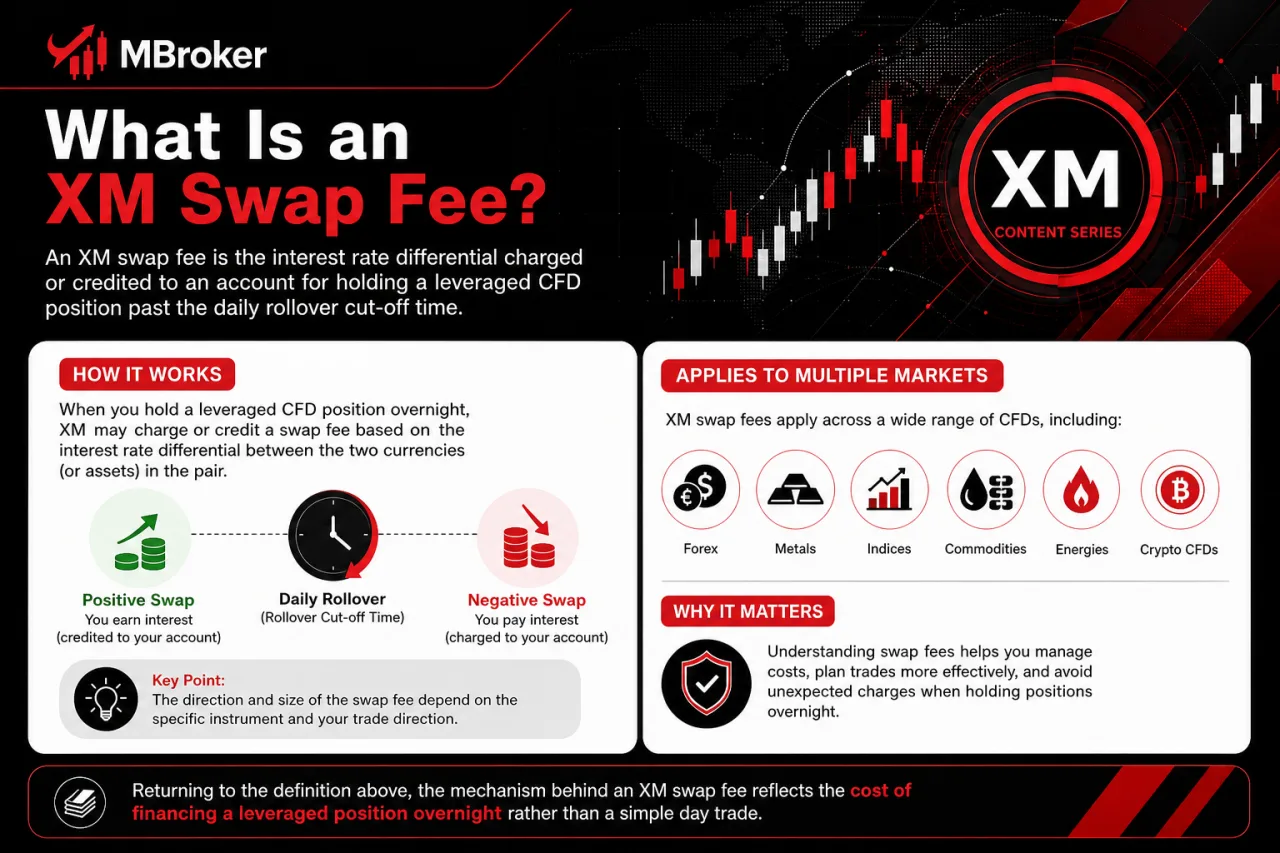
An XM swap fee is the interest rate differential charged or credited to an account for holding a leveraged CFD position past the daily rollover cut-off time. This charge applies across Forex, metals, indices, commodities, energies and crypto CFDs, though the direction and size of the adjustment depend on the specific instrument and trade direction.
Returning to the definition above, the mechanism behind an XM swap fee reflects the cost of financing a leveraged position overnight rather than a separate broker markup layered on top of the spread.
To understand how bid-ask pricing differs from overnight financing charges, see our XM Spreads guide, which explains spread calculations, account-specific pricing, and trading cost differences.
The fee applies differently depending on account structure. Standard account types under XM’s regulated legal entities carry swap charges on eligible instruments, while swap-free accounts remove this cost on approved symbols under specific conditions. The exact swap terms depend on which legal entity a client is registered under, since, according to the XM Client Agreement, Terms and Conditions of Business, XM’s brokerage services are provided through distinct regulated entities, such as Trading Point of Financial Instruments Ltd. (regulated by the Cyprus Securities and Exchange Commission), and the rate applied to each position can differ depending on the entity governing the account.
Because swap rates, account eligibility and legal entity terms change periodically, this overview reflects information reviewed as of the current publication date. Traders are reminded to confirm the swap conditions currently applicable to their country, account type, instrument and assigned XM legal entity directly through XM’s official trading platform or contract specifications before holding any position overnight.
How Does XM Calculate Overnight Swap Charges?
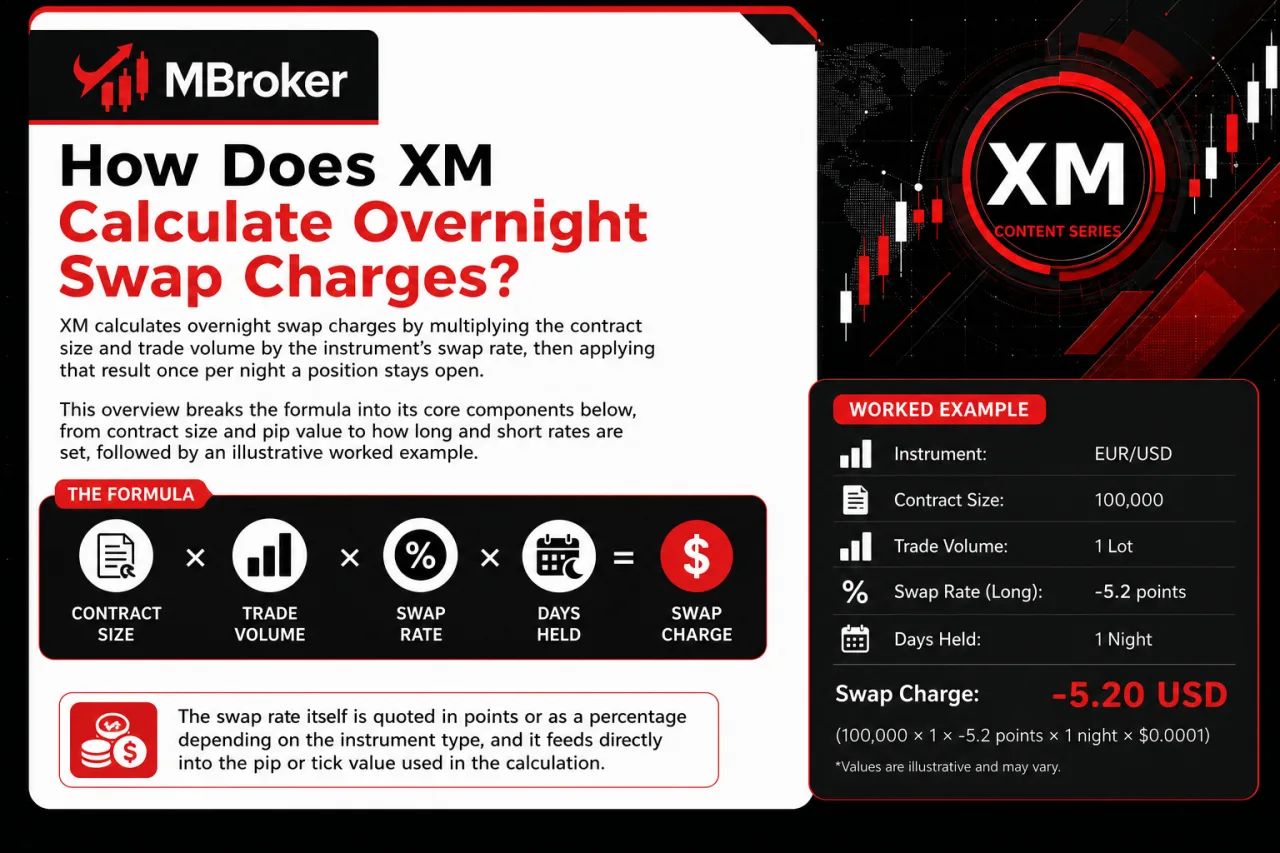
XM calculates overnight swap charges by multiplying the contract size and trade volume by the instrument’s swap rate, then applying that result once per night a position stays open. The breakdown below covers the core components of this formula, from contract size and pip value to how long and short rates are set, followed by an illustrative worked example.
The swap rate itself is quoted in points or as a percentage depending on the instrument type, and it feeds directly into the pip or tick value assigned to that symbol. Long and short swap rates are not identical, since the buy-side and sell-side rates originate from the underlying interbank interest rate differential between the two currencies or assets involved, with XM applying its own markup on top of that base rate.
A common formula structure looks like this:
- Contract size multiplied by trade volume in lots
- Result multiplied by the swap rate for the trade direction (long or short)
- Result multiplied by the number of nights the position remains open
For illustration only, a 1-lot position on a currency pair held for one night would apply the published swap rate for that direction to the standard contract size, producing a single overnight debit or credit. This example uses assumed inputs and does not represent guaranteed costs for any specific account or instrument.
What Is the Triple Swap Day and Why Does It Matter?
The triple-swap day is the single weekday when XM charges swap fees at three times the normal rate to account for weekend settlement, since forex markets close on Saturday and Sunday. This mechanism matters because it concentrates the two extra days of financing cost into one trading day rather than spreading it across the weekend when no rollover would otherwise apply.
For most forex pairs, triple swap falls on Wednesday, though this can vary by instrument and must be confirmed in each symbol’s contract specifications.
XM applies the daily overnight charge based on server time, meaning a position must remain open at the rollover cut-off on the trading platform’s clock to trigger a swap debit or credit, with XM’s MT4/MT5 servers running on the Cyprus time zone, set to GMT+2 in winter and GMT+3 in summer.
This cut-off time is not identical across every instrument category. Traders holding forex, metals, indices, energies or crypto CFDs are reminded to check the specific rollover time and triple-swap day listed in XM’s contract specifications for that symbol, since timing differences directly affect how many nights of swap a position actually accrues.
How Do Long and Short Swap Rates Differ Per Instrument?
Long and short swap rates differ per instrument because each direction reflects a different interest rate differential, so a buy position can carry a positive credit while the corresponding sell position carries a negative debit, or both sides can show a debit depending on the underlying rate spread. This distinction matters across every CFD category XM offers, since the sign and size of the swap change with each instrument’s benchmark rates rather than following one fixed pattern.
The gap between long and short rates varies by asset class:
- Forex pairs typically show the widest gap between long and short rates, since each currency in the pair carries its own interbank rate, and a positive carry trade can produce a credit on one side while the opposite side accrues a debit.
- Metals such as gold and silver, indices, energies and crypto CFDs generally apply a debit on both the long and short side, since these instruments lack a currency interest rate differential and instead reflect financing or storage-style costs built into the swap rate.
Traders should verify the exact swap conditions for each instrument in its contract specifications on the trading platform, since these figures differ from one asset to another.
Sign conventions follow a simple rule:
- Positive swap values add funds to the account balance
- Negative swap values subtract funds from the account balance
Swap rates fluctuate with market conditions and central bank interest rate benchmarks, so the exact figure for any instrument is not static and requires direct confirmation through XM’s contract specifications or swap calculator before holding a position overnight.
XM Swap Rates for Popular Instruments
The table below shows a snapshot of swap rates for several popular instruments on the XM Standard Account under XM Global. The figures were checked on 29 July 2026 and are expressed in points.
| Instrument | Swap Long | Swap Short | Contract Size |
| EUR/USD | -7.53 | +1.27 | 100,000 units |
| GBP/USD | -3.55 | -4.05 | 100,000 units |
| USD/JPY | +2.11 | -29.59 | 100,000 units |
| AUD/USD | -1.31 | -3.61 | 100,000 units |
| EUR/GBP | -6.14 | +0.96 | 100,000 units |
| Gold | -83.01 | +10.39 | 100 ounces |
A negative rate indicates an overnight debit, while a positive rate may result in a credit. These figures are rates in points—not necessarily the final charge in the account currency. The monetary amount depends on the position size, contract size, point size and applicable currency conversion.
Rates shown are a snapshot from the XM All-in-One Calculator and may change without notice. XM Global also states that rollover rates are calculated nightly, with a three-day rollover generally applied on Wednesday for forex positions. Traders should confirm the current Long and Short values in MT4, MT5 or the calculator before holding a position overnight.
How Do XM Swap Costs Compare to Other Forex Brokers?
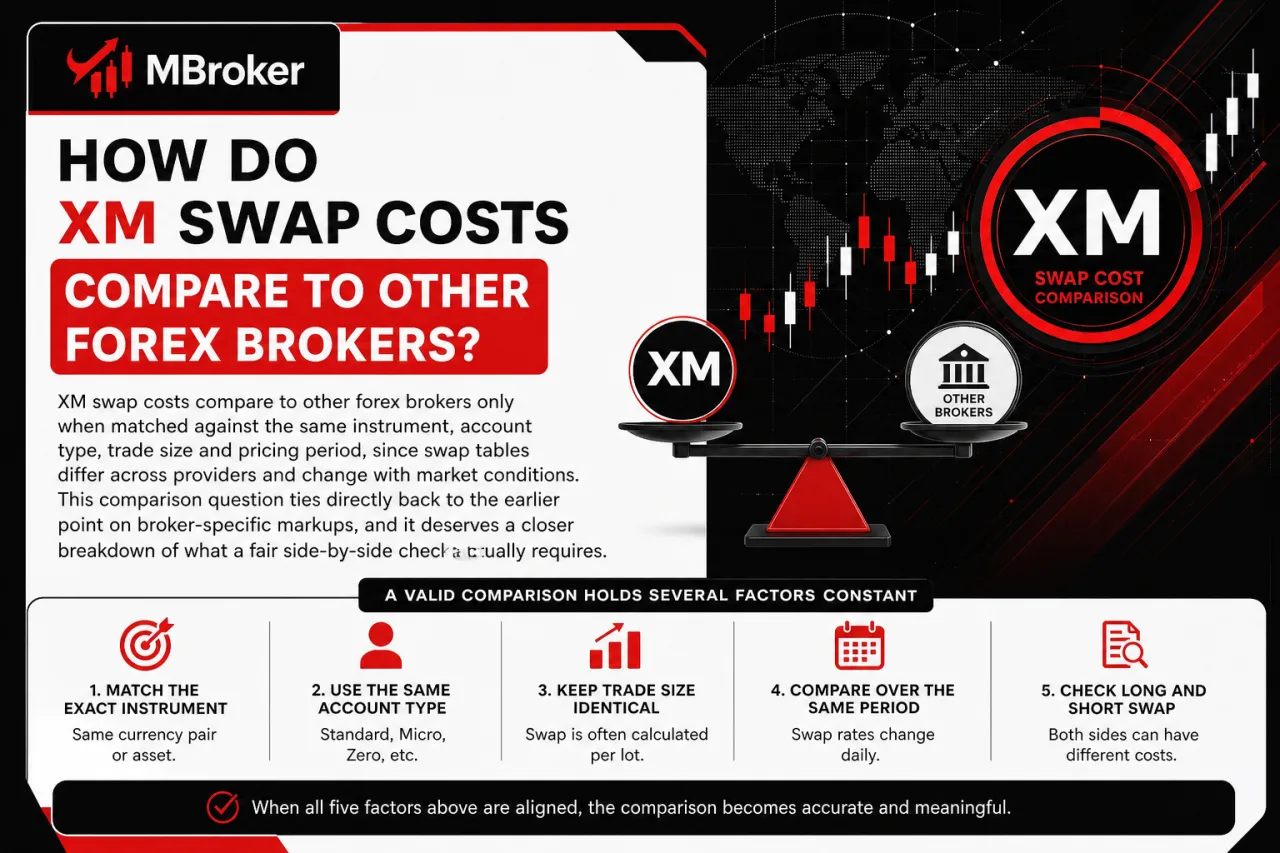
XM swap costs compare to other forex brokers only when matched against the same instrument, account type, trade size and pricing period, since swap tables differ across providers and change with market conditions. This comparison question ties directly back to the earlier point on broker-specific markups, and it deserves a closer breakdown of what a fair side-by-side check actually requires.
A valid comparison holds several factors constant before drawing any conclusion:
- Matching the exact currency pair, metal, index or crypto CFD across both brokers
- Using the same account type, since standard and swap-free accounts carry different terms
- Applying identical trade volume and holding period across the comparison
- Pulling swap rates from the same pricing period, since rates shift with interbank benchmarks
Swap rates alone do not determine overall trading cost. Spreads and commissions factor into the total cost alongside swaps, so a broker with a lower swap rate can still carry a higher round-turn cost once the spread and commission are added.
For a closer look at transaction-based charges, our XM Commission guide explains commission rates, per-lot calculations, and how these fees contribute to total trading expenses.
No broker, including XM, is confirmed as the cheapest option across every instrument and account type without verified, published data covering all three cost components together. Traders comparing overnight charges are reminded to check current swap tables directly on each broker’s official platform, since these figures are not fixed and shift with market conditions.
How Can Traders Avoid or Reduce XM Swap Fees via Swap-Free Accounts?
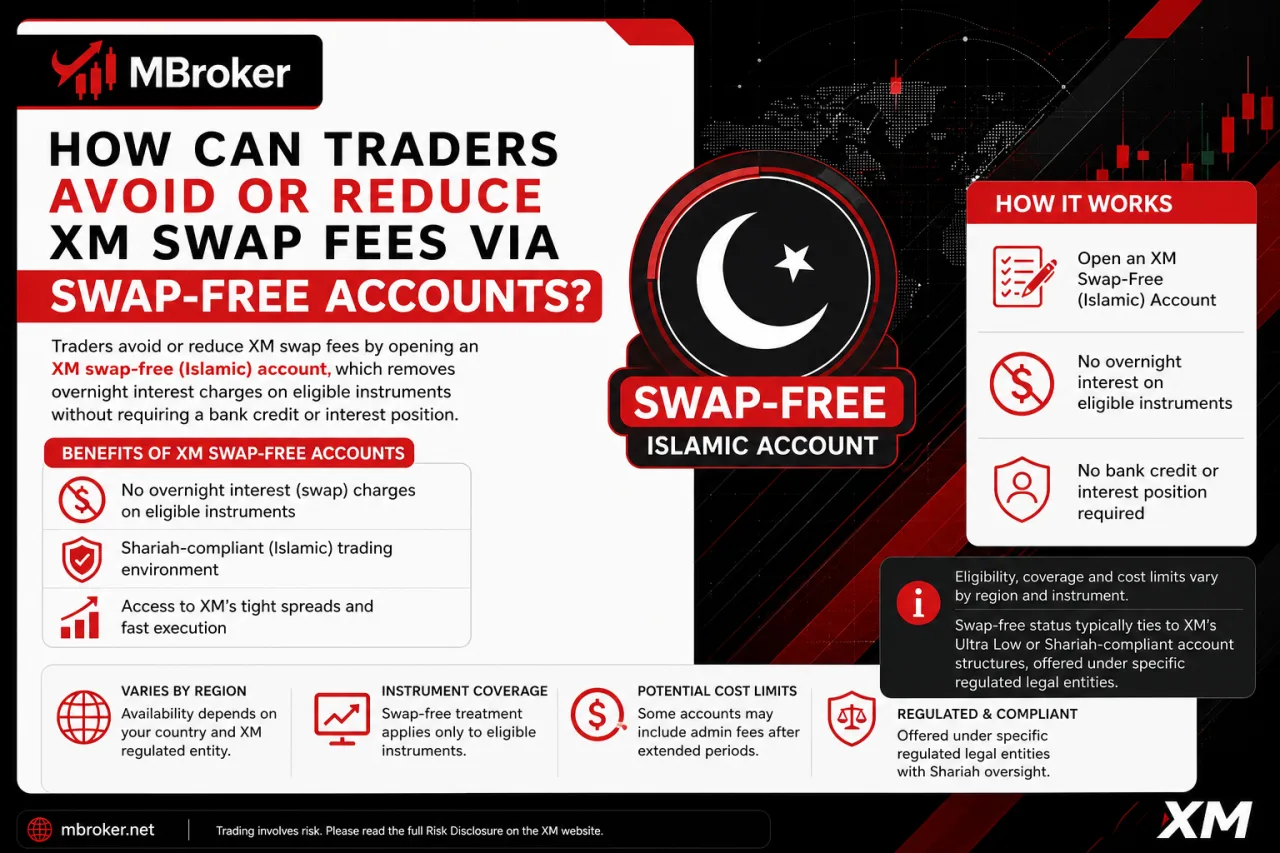
Traders avoid or reduce XM swap fees by opening an XM swap-free (Islamic) account, which removes overnight interest charges on eligible instruments without requiring a bank credit or interest position. This setup answers the swap-avoidance question directly, though eligibility, coverage and cost limits vary by region and instrument, which the details below break down.
Swap-free status typically ties to XM’s Ultra Low or Shariah-compliant account structures, offered under specific regulated legal entities rather than universally across every XM entity and region. Availability depends on the client’s country of residence and assigned legal entity, so a trader registered under one XM entity may not see the same swap-free option as a trader under another; eligibility and specific account types offering swap-free trading vary by region and legal entity, as confirmed on XM’s official account types page.
Coverage and limitations follow a consistent pattern:
- Eligible instruments include a defined list of Forex, metals and other CFDs approved for swap-free trading, not the entire symbol universe
- Grace periods allow a position to remain open for a set number of days before an administration fee applies; the exact grace period length and fee amount vary by account type and are confirmed directly through XM’s official documentation
- Restricted account types or instruments outside the approved list still accrue standard swap charges
Swap-free does not equal completely fee-free trading. Spreads, commissions and any post-grace-period administration charges still apply, so the account removes only the overnight interest component rather than every trading cost. Traders confirm current eligibility, covered instruments and fee terms directly through XM’s official account documentation before switching account types.
How Can Traders Find Swap Values Per Instrument Using XM’s Swap/Pip Calculator?
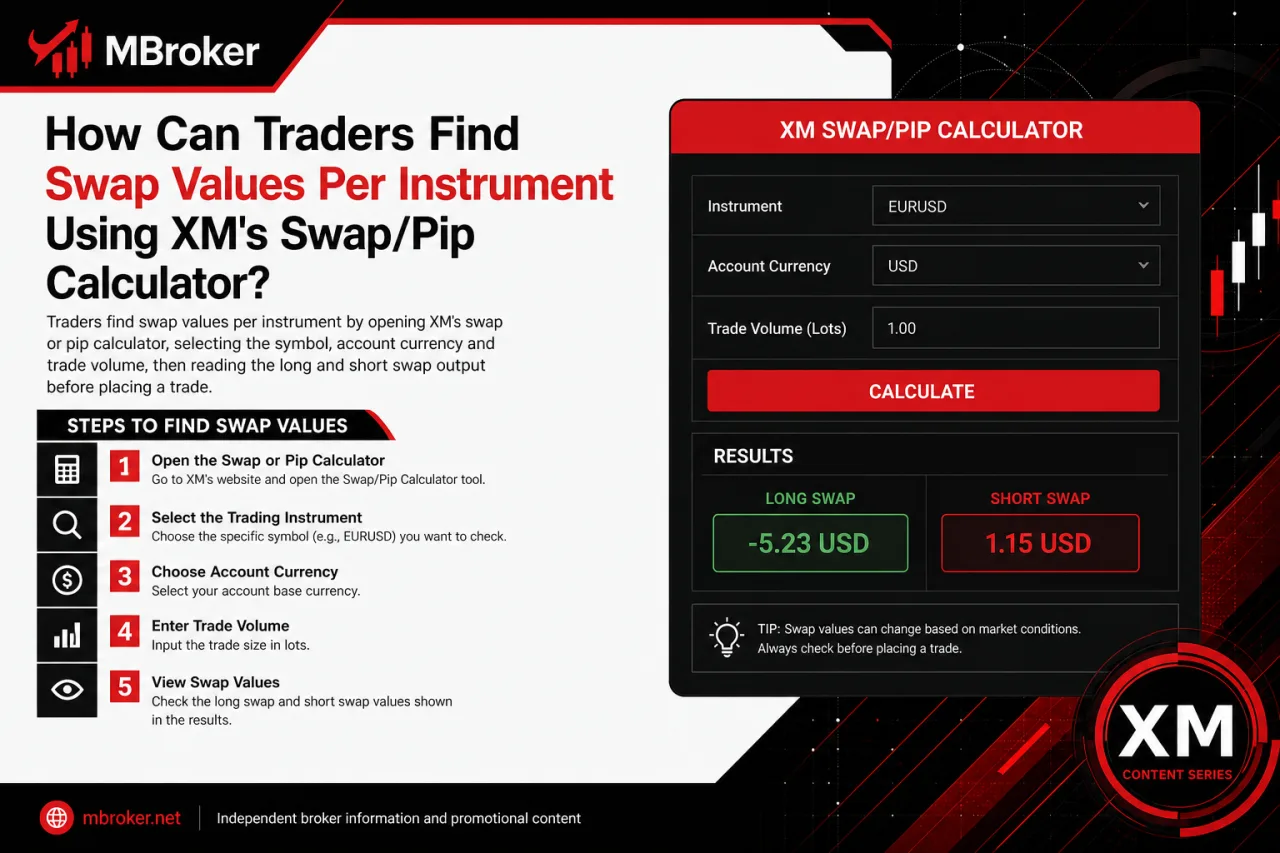
Traders find swap values per instrument by opening XM’s swap or pip calculator, selecting the symbol, account currency and trade volume, then reading the long and short swap output before placing a trade. This tool directly answers the swap-lookup question raised earlier, and the steps below break the process into its component inputs and the resulting output.
The calculator or contract specifications page requires a few inputs before it returns a usable figure:
- Selecting the specific instrument, whether a currency pair, metal, index, energy or crypto CFD
- Setting the account currency, since the swap value converts into that denomination
- Entering the trade volume in lots to scale the result to the intended position size
- Choosing the trade direction, buy or sell, since long and short rates differ as covered above
The output returned is the swap value per lot per night, meaning the figure shown reflects a single overnight charge or credit before any multiplication for multiple nights or the Wednesday triple-swap adjustment.
Swap rates shift with interbank benchmarks and broker-side adjustments, so the figure displayed on any given day does not carry forward indefinitely. Traders confirm current values directly on XM’s official trading platform or contract specifications page before holding a position overnight, since the calculator reflects live pricing rather than a fixed historical rate.
Are There Any Exceptions or Regional Limitations Affecting XM Swap Charges?
Yes, exceptions and regional limitations affect XM swap charges, primarily through the client’s assigned legal entity, account classification and jurisdiction-specific overnight financing rules. This overview sets up the specific variations covered in the sections below, from entity-based differences to classification-based rate changes and jurisdictional financing restrictions.
Swap terms are not identical across XM’s regulated entities, since a client registered under XM Global, XM UK or XM EU can see different swap rates or swap-free availability depending on which entity governs the account. Client classification can also play a role, as retail and professional traders may fall under different overnight financing terms depending on the regulatory framework applied to that classification.
Some jurisdictions impose additional rules on overnight financing that do not apply uniformly across every XM entity. Traders confirm the exact swap terms, swap-free eligibility and any regional restrictions applicable to their assigned XM legal entity directly through official account documentation before holding positions overnight.
Regional and account-specific conditions can also affect costs unrelated to overnight trading. Our XM Withdrawal Fees guide explains potential payment-method charges, withdrawal limits, and processing costs across different XM entities.
Does Weekend or Holiday Trading Affect Swap Charging Days?
Yes, weekend or holiday trading affects swap charging days, since a closed market shifts which night triggers rollover or removes a charge entirely for that instrument. This question ties back to the triple-swap day mechanism covered earlier, and a few related situations explain why the schedule shifts.
Several factors adjust the standard charging pattern:
- Bank holidays in a specific country can suspend trading on affected instruments, meaning no swap accrues that night
- Reduced liquidity around holiday sessions can prompt brokers to adjust rollover timing for certain symbols
- Crypto CFDs often continue trading through weekends, so their overnight charging schedule does not follow the same Saturday/Sunday closure pattern as forex
These adjustments are not identical across every instrument, so traders should confirm the current holiday trading calendar and any rollover timing changes directly through XM’s official trading platform before holding a position over a weekend or public holiday.
Conclusion
In conclusion, XM swap fees are variable overnight financing adjustments that depend on the instrument, trade direction, account type, position size and number of rollover days. A position may generate either a debit or a credit, while holding a forex trade through Wednesday can normally result in a triple rollover charge. Since rates can change and account conditions differ across XM legal entities, traders should check the latest specifications in MT4, MT5 or the XM All-in-One Calculator before leaving a trade open overnight.
Those who cannot use swaps for religious reasons may consider an Islamic account, subject to XM’s eligibility requirements and regional terms. Readers can learn more about our independent editorial approach, research standards, and XM trading cost resources on the About Mbroker page.

Neria Solven is the XM Accounts, Fees and Promotions Editor at Mbroker, specializing in XM trading accounts, brokerage fees, trading costs, and promotional programs. She focuses on analyzing account conditions, spreads, commissions, and bonus eligibility to provide clear, accurate, and practical information for Forex and CFD traders.