
 Tiếng Việt
XM has advertised spreads starting near 0.0 pips on the Zero account and around 1.0 pip on the Standard account, though these figures vary by legal entity and market conditions. The exact cost depends on the instrument traded, current market liquidity, and the specific XM entity a trader is registered under.
These figures represent minimum advertised spreads rather than fixed rates applied to every trade. Traders should confirm current numbers directly on XM’s official contract specifications page for their assigned entity, since published figures can change without notice.
The Ultra Low account is generally positioned to offer tighter spreads than Standard but wider than Zero, which instead applies a fixed commission per lot. The Ultra Low account operates on a commission-free, spread-only pricing model.
The Zero account applies tighter, near-zero spreads alongside a commission fee that XM has published on its contract specifications pages in the past, though the exact rate depends on the entity and account currency. Traders are advised to verify the current commission rate on XM’s official site rather than relying on a single fixed figure. Real trading cost depends on combining the spread with any commission charged, not the spread figure alone.
XM spreads are variable, meaning pip values widen or narrow continuously based on interbank liquidity and volatility around news events. Tighter spreads typically occur during high-liquidity trading sessions, while wider spreads appear when liquidity thins out, such as around major news events or off-peak hours.
This pricing model reflects real-time market supply and demand rather than a static broker markup.
Whether XM spreads count as high or low depends on comparing its live pip data against other regulated brokers offering the same instrument and account type, using verifiable spread data rather than promotional claims. The breakdown below explains what XM spreads are and how much they cost across account types and instruments, based on information reviewed as of March 2025 and subject to change on XM’s official contract specifications page.
What Are XM Spreads and How Much Does XM Charge Across Account Types and Instruments?
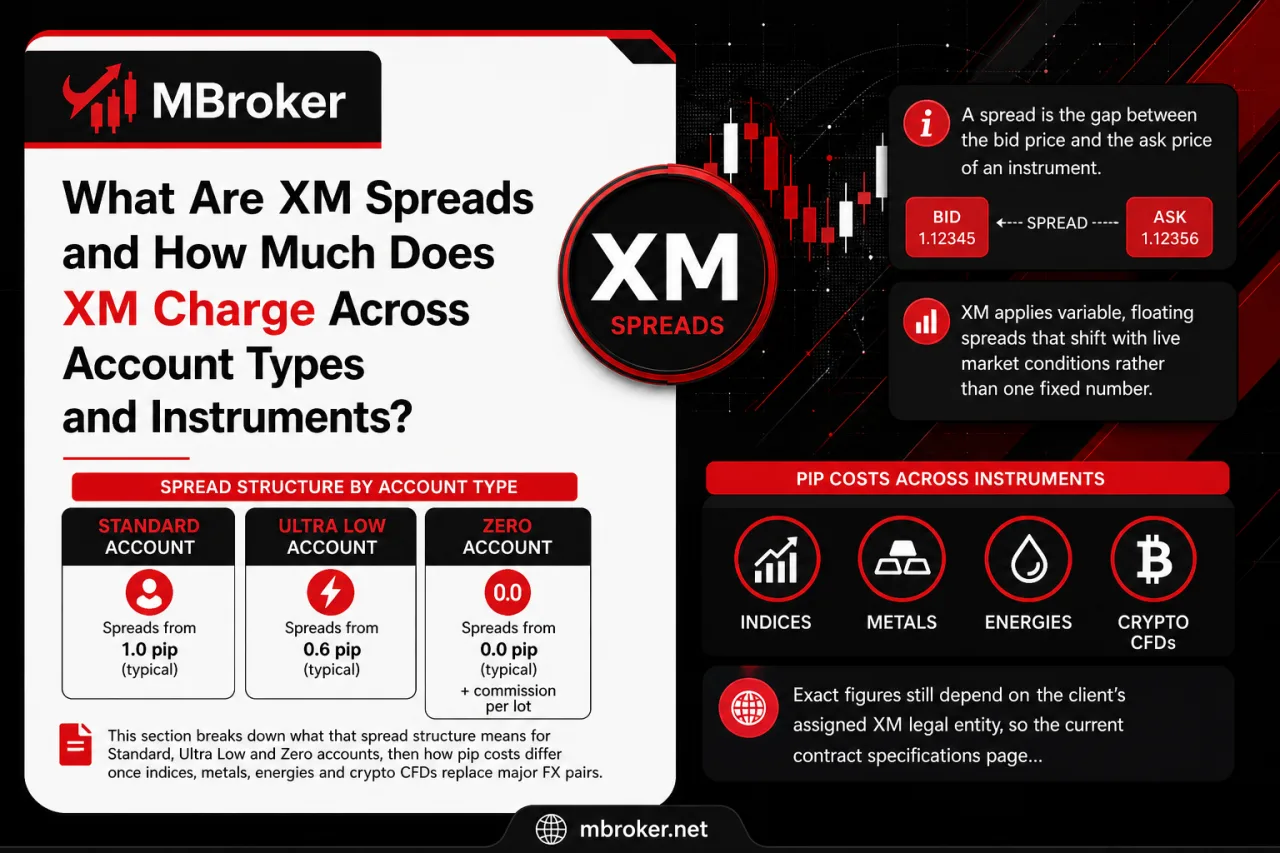
A spread is the gap between the bid price and the ask price of an instrument. XM applies variable, floating spreads that shift with live market conditions rather than one fixed number. This section breaks down what that spread structure means for Standard, Ultra Low and Zero accounts, then how pip costs differ once indices, metals, energies and crypto CFDs replace major FX pairs. Exact figures still depend on the client’s assigned XM legal entity, so the current contract specifications page remains the reference point before opening any position. The details below (reviewed as of the current date) are organized by account type first, then by instrument group.
What Instruments Do XM Spreads Apply To (Forex, Stocks, Indices, Commodities, Metals, Energies, Crypto)?
XM applies spread-based pricing across seven core asset groups: forex, stock CFDs, indices, commodities, precious metals, energies and cryptocurrencies. Each group carries its own minimum spread figure rather than one uniform pip value across the board.
This distinction matters because the instrument coverage question determines where variable pricing actually applies, not just the account type discussed above. XM’s contract specifications page lists the minimum spread separately for every symbol, since liquidity conditions differ between a major FX pair and, for example, a stock index or an energy CFD.
The asset groups covered by spread-only or spread-plus-commission pricing include:
- Forex pairs across majors, minors and exotics
- Precious metals such as gold and silver
- Energy products including crude oil benchmarks
- Stock indices tracking major global exchanges
- Stock CFDs on individual listed companies
- Cryptocurrency CFDs on major digital coins
Minimum spread values differ per instrument category, so a figure quoted for EUR/USD does not carry over to gold, oil or an index CFD. Traders confirm the live spread for the specific symbol and account type in the official contract specifications before calculating expected cost, since the number published there reflects the instrument being traded rather than a single fixed rate applied across the entire asset list.
How Is the Spread Cost Calculated on a Trade?
To calculate spread cost on a trade, multiply the spread in pips by the pip value and by the lot size traded, producing the cost in the account’s base currency. This formula answers how the abstract pip figure quoted on the contract specifications page turns into an actual monetary cost per position.
The illustrative formula reads: spread (pips) x pip value x lot size = cost in account currency.
For example, a trader opening 1 standard lot (100,000 units) on a pair with a pip value of $10 and a spread of 1.0 pip pays approximately $10 for that single round-turn transaction. This example uses a standard contract size of 100,000 units, with each pip valued at $10 as is standard across the forex market for illustration purposes, and does not represent a guaranteed or fixed charge on every trade.
Actual cost shifts whenever the live spread widens or narrows during trading hours, so the same formula produces a different result depending on market timing. Traders confirm the current spread for their specific instrument and account type before estimating total cost, since pip value also varies by currency pair and by the account’s base currency.
XM Standard vs Ultra Low vs Zero Account: Which Has the Lowest Spread Cost?
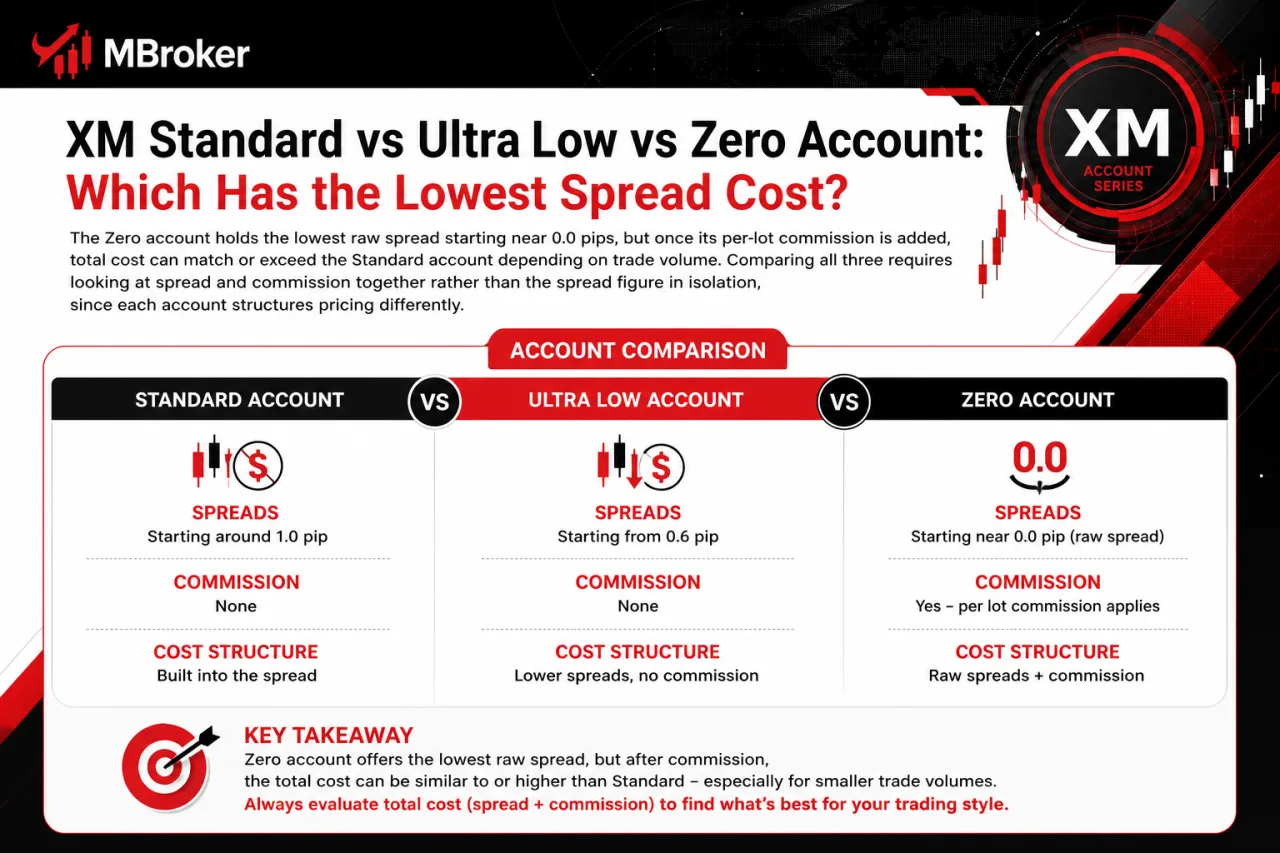
The Zero account holds the lowest raw spread starting near 0.0 pips. Once its per-lot commission is added, total cost can match or exceed the Standard account depending on trade volume. Comparing all three requires looking at spread and commission together rather than the spread figure in isolation, since each account structures pricing differently.
The three account types split by pricing model as follows:
- Standard account: commission-free, wider spreads starting around 1.0 pip, cost embedded entirely in the spread.
- Ultra Low (Micro) account: tighter spreads than Standard, no separate commission charged, cost still embedded in the spread but at a reduced markup.
- Zero account: near-zero spreads from around 0.0 pips, plus a fixed commission of $3.50 per lot charged separately from the spread.
Total round-turn cost on the Zero account combines the raw spread with the commission charged per lot, so a low pip figure alone does not confirm the lowest overall cost. Traders comparing account types confirm both the spread and commission line on the current XM contract specifications page before assuming one account type is cheaper for a specific instrument and trade size.
How Do Commissions Combine With Spreads on the XM Zero Account to Affect Total Cost?
Total round-turn cost on the XM Zero account combines the near-zero raw spread with a fixed $3.50 commission per lot, charged separately from the pip cost already covered above.
The commission applies per side of the trade. A round-turn position pays this fee once on entry and once on exit, doubling the per-lot charge across the full trade cycle.
For example, opening and closing 1 standard lot on a pair with a spread near 0.0 pips generates roughly $7.00 in total commission for the round turn, since $3.50 is charged per side. This example treats the spread cost as negligible near 0.0 pips purely for illustration; actual spread widening during the trade adds further cost on top of the $3.50 per-side commission.
This combined cost structure varies by instrument, since commission rates and minimum spreads differ across forex, metals, indices and other symbol groups covered earlier. Traders confirm the current commission schedule and live spread for the specific instrument on the official XM contract specifications page before estimating total round-turn cost on the Zero account.
Is the XM Standard Account Cheaper or More Expensive Than Ultra Low for Small Trade Sizes?
The XM Standard account tends to cost less than Ultra Low on very small trade sizes, since both are spread-only pricing models but Ultra Low’s tighter pip markup only produces a net saving once volume reaches a meaningful threshold. This ties directly into the cost-by-trade-size comparison raised above, since neither account adds a commission line.
Neither the Standard nor the Ultra Low account charges a separate commission, so total cost on both sits entirely inside the quoted spread rather than in a per-lot fee. On a single micro lot or a fractional standard lot, the pip difference between the two accounts translates into a marginal dollar amount. Standard’s slightly wider spread does not produce a cost gap that matters for small orders, and the two accounts sit at effective cost parity until trade size scales up.
The advertised minimum spread on either account does not guarantee the spread paid in live trading, since real-time pip values can exceed that published floor during thin liquidity or high-volatility periods. This makes the true cost comparison volume-dependent rather than fixed.
Traders confirm live spread data for their specific instrument and trade size on the current XM contract specifications page before assuming either account is cheaper at small volume.
How Do Variable Spreads on XM Work and Why Do They Change With Liquidity and Market Conditions?
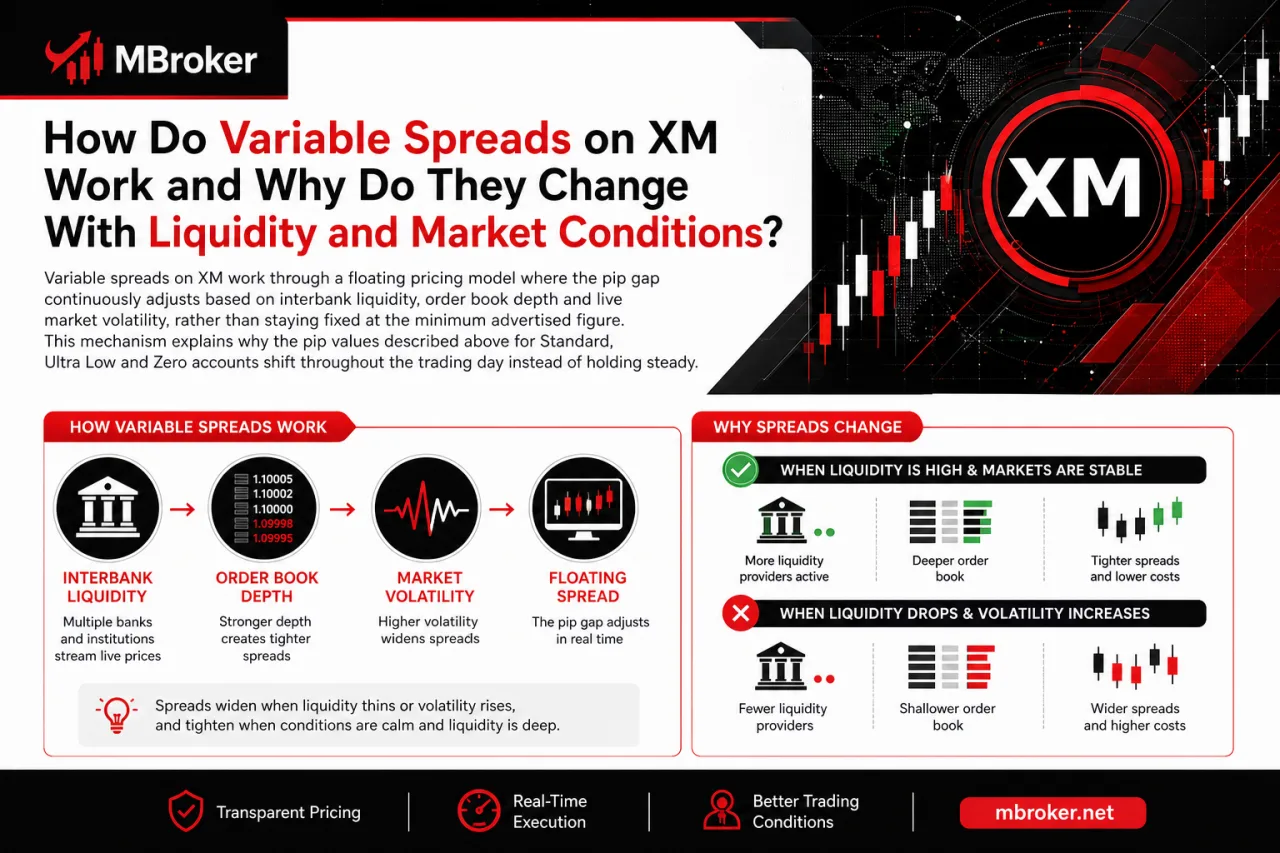
Variable spreads on XM work through a floating pricing model where the pip gap continuously adjusts based on interbank liquidity, order book depth and live market volatility, rather than staying fixed at the minimum advertised figure. This mechanism explains why the pip values described above for Standard, Ultra Low and Zero accounts shift throughout the trading day instead of holding steady.
Liquidity depth drives most of this movement. When multiple liquidity providers quote tight prices during active trading sessions, XM’s spread narrows toward its minimum; when fewer providers are active, the gap between bid and ask widens.
Spreads typically widen during specific conditions:
- Session gaps between major market closes and openings
- Bank holidays when fewer institutional participants trade
- High-impact news releases such as central bank rate decisions
- Weekend market opens following reduced Friday liquidity
The advertised minimum spread reflects the tightest pip value XM publishes under optimal liquidity, while the real-time spread paid during actual trading sessions often runs wider than that floor figure.
XM does not guarantee a fixed spread on any account type or instrument, since the floating model ties pricing directly to external market conditions rather than a broker-set constant.
Are XM Spreads Considered High or Low Compared to Real-Time Broker Spread Data?
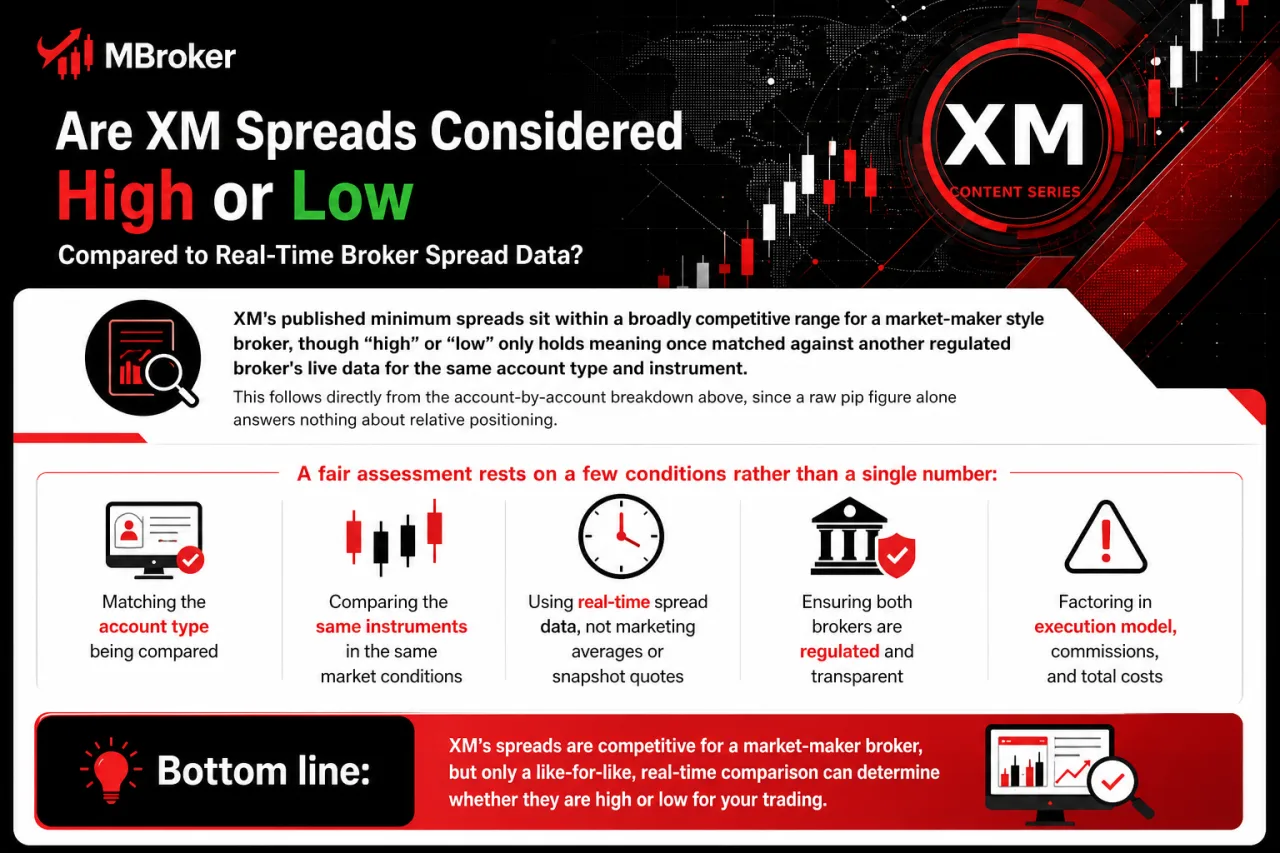
XM’s published minimum spreads sit within a broadly competitive range for a market-maker style broker. “High” or “low” only holds meaning once matched against another regulated broker’s live data for the same account type and instrument. This follows directly from the account-by-account breakdown above, since a raw pip figure alone answers nothing about relative positioning.
A fair assessment rests on a few conditions rather than a single number:
- Matching the account type being compared, since Standard, Ultra Low and Zero each carry different pricing models.
- Matching the instrument, since a major FX pair and an energy CFD move on separate liquidity conditions.
- Matching the time period, since spreads widen or narrow with session liquidity as covered earlier.
- Reviewing a live spread widget or real-time data feed rather than a static advertised figure.
Any comparison built only on XM’s minimum advertised spread against a competitor’s minimum advertised spread produces an incomplete picture, since neither figure reflects the pip value paid during actual trading conditions.
XM is not positioned here as the cheapest option in the market. Traders confirm current live spreads for their specific account and instrument through XM’s official contract specifications or a real-time spread widget before drawing a cost conclusion.
Do Spread Costs Differ Between XM Legal Entities or Regions?
Yes, spread costs differ between XM legal entities, since each legal entity publishes its own contract specifications, account types and minimum spread figures for the same instrument. This regional variation adds another layer on top of the account-type and instrument differences covered earlier.
XM operates through multiple legal entities across different jurisdictions, and each legal entity sets its own minimum spread, available account types and instrument list for clients registered under it. A trader assigned to one legal entity may see a different published spread for the same currency pair than a trader assigned to another legal entity, even on the same account type.
This entity-based split happens because regulatory frameworks and local market conditions vary by region, which shapes what each legal entity offers. Instrument availability also differs, so a symbol tradable under one legal entity may not appear under another.
Traders confirm their specific assigned legal entity and its current fee schedule directly through XM’s official contract specifications before calculating expected spread cost.
How Can a Trader Confirm Which XM Entity and Spread Schedule Applies to Their Account?
To confirm which XM entity and spread schedule applies, a trader checks the entity name shown during account registration, the terms accepted at signup, and the live contract specifications page tied to that account login. This verification step matters directly because of the entity-based pricing split covered above, where the same instrument can carry a different minimum spread under a different regulated entity.
A few checkpoints confirm the correct assignment:
- Reviewing the client agreement or terms document accepted during registration, which names the specific regulated entity holding the account.
- Checking the account dashboard or trading platform login details, which typically display the entity under which the account operates.
- Cross-referencing the instrument’s spread figure against the contract specifications page published for that specific entity, not a generic global page.
- Reconfirming this match before each trading session, since spread schedules and entity terms can update over time.
Spread schedules published for one entity do not automatically carry over if account terms or regional assignment change, so the confirmation step repeats rather than being a one-time check. Traders keep this verification current by revisiting the official contract specifications page tied to their registered entity before opening new positions.
Conclusion
XM spreads should be evaluated based on total trading cost, not the advertised minimum alone. Actual costs vary by account type, instrument, position size, liquidity, market volatility and the XM legal entity serving the trader. Standard and Ultra Low accounts generally include costs in the spread, while the Zero account may combine tighter raw spreads with a separate commission where available. Before opening a position, traders should check the live spread, applicable commission and current contract specifications for their assigned XM entity to make an accurate, like-for-like comparison.

Neria Solven is Mbroker’s XM Accounts, Fees and Promotions Editor, covering account types, trading costs, payment methods and promotional programmes. Email: [email protected]