

XM charges commission only on its Zero account, at a rate of $3.5 per side (equivalent to $7 round turn) per standard lot traded on forex pairs, as confirmed in the XM costs and charges document, which states commissions are USD 7 per USD 100,000 transaction. This fee is charged separately from the spread and applies specifically to trades executed through this account type.
Commission-based accounts and zero-commission accounts differ mainly in how the trading cost is bundled: Zero accounts charge a fixed commission on top of raw, near-zero spreads, while Standard-type accounts embed the cost entirely into a wider spread with no separate commission line. This distinction affects how traders calculate total cost per transaction, and the exact figures are broken down in the sections below.
Comparing XM commission with spread-only pricing and other brokers’ fee structures shows that total trading cost depends on combining commission, spread and swap charges rather than looking at commission alone. Mbroker breaks down this full-cost comparison to help traders evaluate XM against alternative brokers using consistent criteria.
How Much Commission Does XM Charge on Trades?
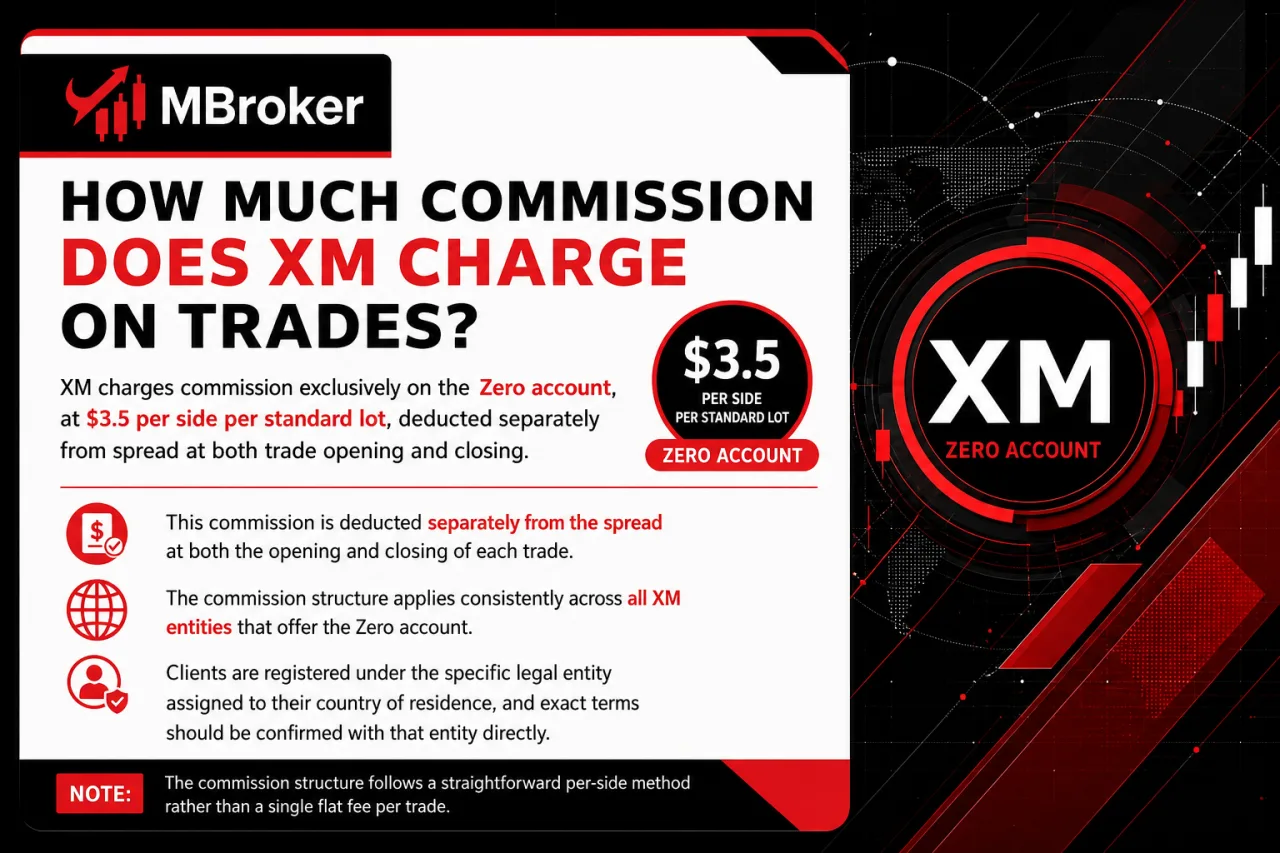
XM charges commission exclusively on the Zero account, at $3.5 per side per standard lot, deducted separately from spread at both trade opening and closing. This charging method applies consistently across the XM entities that offer the Zero account, though clients register under the specific legal entity assigned to their country of residence, and exact terms should be confirmed with that entity directly.
The commission structure follows a straightforward per-side method rather than a single flat fee.
- Opening a position deducts $3.5 per standard lot traded.
- Closing that same position deducts another $3.5 per standard lot, completing the $7 round-turn charge already outlined above.
- Standard, Micro and Ultra Low accounts carry no separate commission line, since their trading cost sits entirely inside a wider spread.
This distinction means traders selecting a commission-based structure only encounter this fee if they hold a Zero account. All other XM account types remain spread-only by design.
This commission information reflects terms reviewed as of the current date, and readers should verify current rates with their assigned XM legal entity before trading, since account availability and conditions vary by region.
What Is the XM Zero Account Commission Structure?
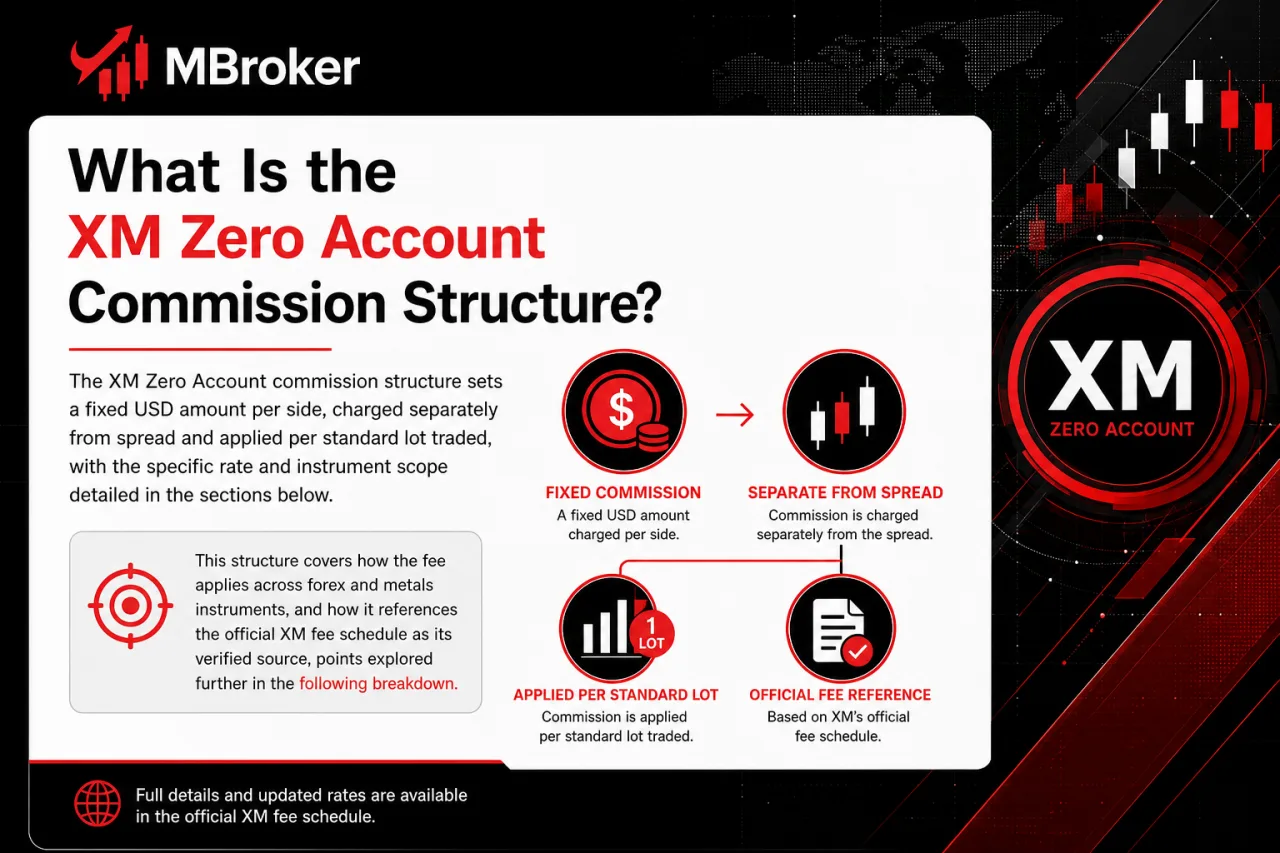
XM Zero account charges a fixed $3.5 per side ($7 round turn) per standard lot on forex and metals majors, separate from spread. This fee applies consistently across forex and metals instruments, and the exact rate is confirmed in the official XM fee schedule, with further details covered in the breakdown below.
How Is Commission Calculated per Lot / per $100,000 Traded?
To calculate XM Zero account commission, multiply the traded volume in standard lots by $3.5 per side, since the fee scales directly with contract size rather than a flat rate. This formula applies uniformly across the eligible forex pairs the Zero account covers, and it follows directly from the per-side charging method described above.
The reference unit stays fixed at one standard lot, defined as 100,000 units of the base currency, regardless of the currency pair traded.
- Trading 1.0 standard lot deducts $3.5 per side, or $7 round turn.
- Trading 0.5 lots deducts $1.75 per side, or $3.5 round turn.
- Trading 5.0 lots deducts $17.5 per side, or $35 round turn.
For illustration only, a trader opening and closing a 2-lot position on a Zero account incurs an estimated $14 in commission: $3.5 x 2 lots x 2 sides = $14. This figure assumes standard lot pricing with no volume discounts applied and excludes spread or swap costs. Actual charges depend on the specific instrument, execution conditions and the XM legal entity governing the account, so traders confirm exact commission terms before opening a position.
What Is the Cost per Side vs Round Turn on XM Zero?
Cost per side refers to the $3.5 commission charged once, either at trade opening or trade closing, while round turn refers to the combined $7 charge covering both actions on a Zero account. This distinction matters when comparing quoted commission rates, since round turn always equals exactly twice the per-side figure already outlined in the calculation method above.
The relationship follows a fixed mathematical link rather than a variable one.
- Per side: $3.5 charged once, applying only to the opening or the closing leg of a trade.
- Round turn: $7 charged in total, combining both the opening and closing legs of the same position.
- Ratio: round turn always equals per side multiplied by two, with no exceptions for lot size.
For illustration only, a trader who opens a 1-lot position and later closes it pays $3.5 at entry and $3.5 at exit, totalling the $7 round-turn cost already described above. Quoted commission figures published by XM typically reference the round-turn number, so traders confirm whether a stated rate reflects per side or round turn before comparing costs across brokers.
Commission-Based Zero Account vs Spread-Only Accounts: What Is the Difference?
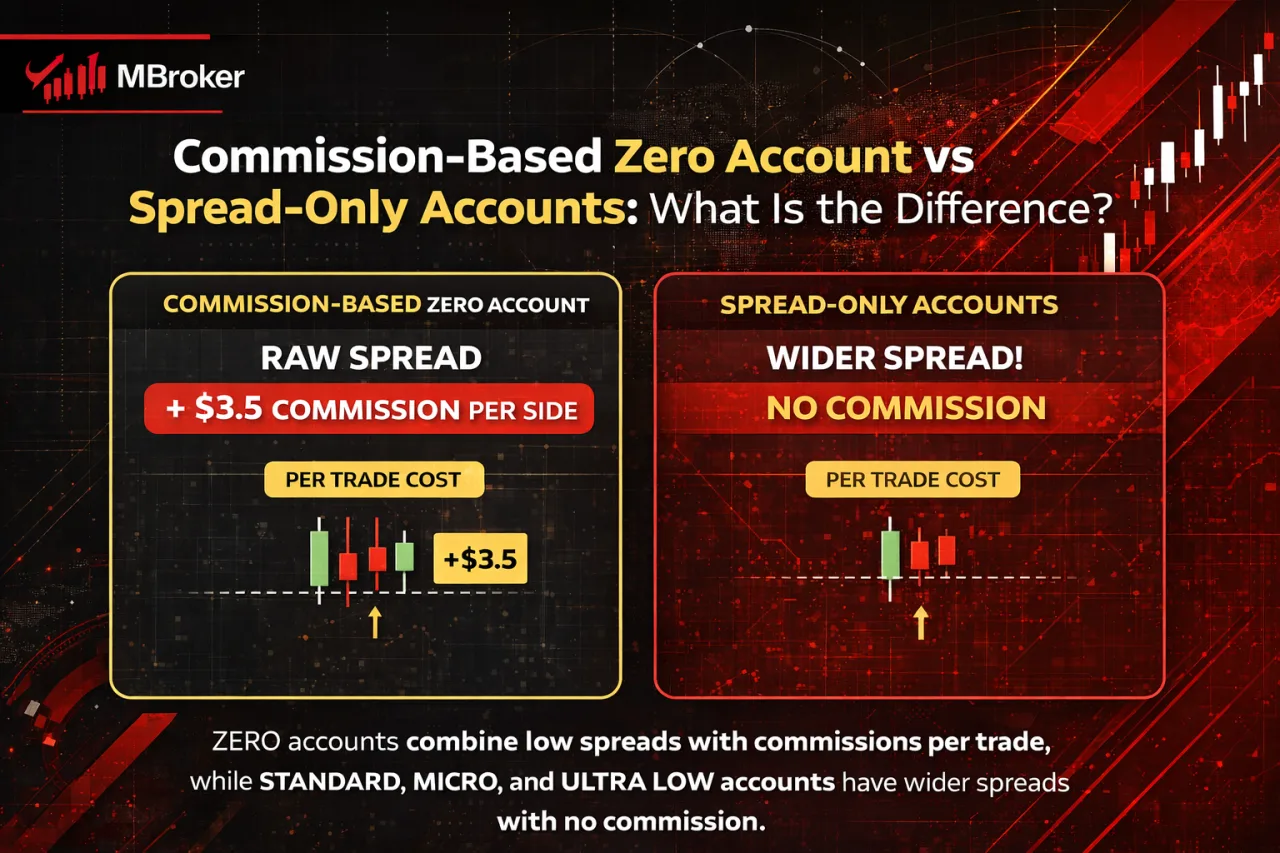
The core difference lies in cost structure: the Zero account combines raw spreads with a separate $3.5 per side commission, while Standard, Micro and Ultra Low accounts embed all trading cost into a single wider spread with no commission line. This split changes how traders calculate total cost per trade, an area covered in more detail through the comparisons below.
The two models represent conceptually opposite approaches to pricing rather than simply different fee amounts. Zero account pricing separates the raw market spread from the commission charge, so the spread itself stays close to the interbank rate while the $7 round-turn fee, already outlined earlier, covers the broker’s cost. Spread-only accounts fold that same cost into the quoted spread, meaning the number displayed on the platform already reflects the full trading expense with nothing deducted afterward.
Account and legal entity availability varies by region, since not every XM entity offers the Zero account structure to clients in every jurisdiction. Traders confirm which account types their assigned XM entity permits before comparing commission-based and spread-only pricing directly.
For a closer look at spread-based trading costs, see our XM Spreads guide, which explains how bid-ask spreads vary across account types, trading instruments, and market conditions.
Which Account Types Charge Commission and Which Are Commission-Free?
XM groups its account types into two commission categories: the Zero account charges commission on every trade, while Standard, Micro and Ultra Low accounts remain commission-free. This grouping determines whether a trader sees a separate fee line on the trading platform or pays the entire trading cost through the spread alone.
This distinction carries directly from the pricing models already outlined above. The two groups apply the fee differently across the same range of tradable instruments rather than differing by market access.
- Zero account: charges $3.5 per side per standard lot on forex pairs, deducted independently from the near-raw spread.
- Standard account: applies no commission line, with trading cost embedded fully into a wider spread.
- Micro account: applies no commission line, following the same spread-only pricing model as the Standard account.
- Ultra Low account: applies no commission line, embedding cost into spread while typically offering tighter markups than Standard or Micro.
Account availability differs by the XM legal entity assigned to a client’s country of residence. Eligibility for the Zero account specifically is confirmed with that entity before opening it for commission-based trading.
How Does XM Zero Commission Compare with Spread-Only Costs and Other Brokers’ Fees?
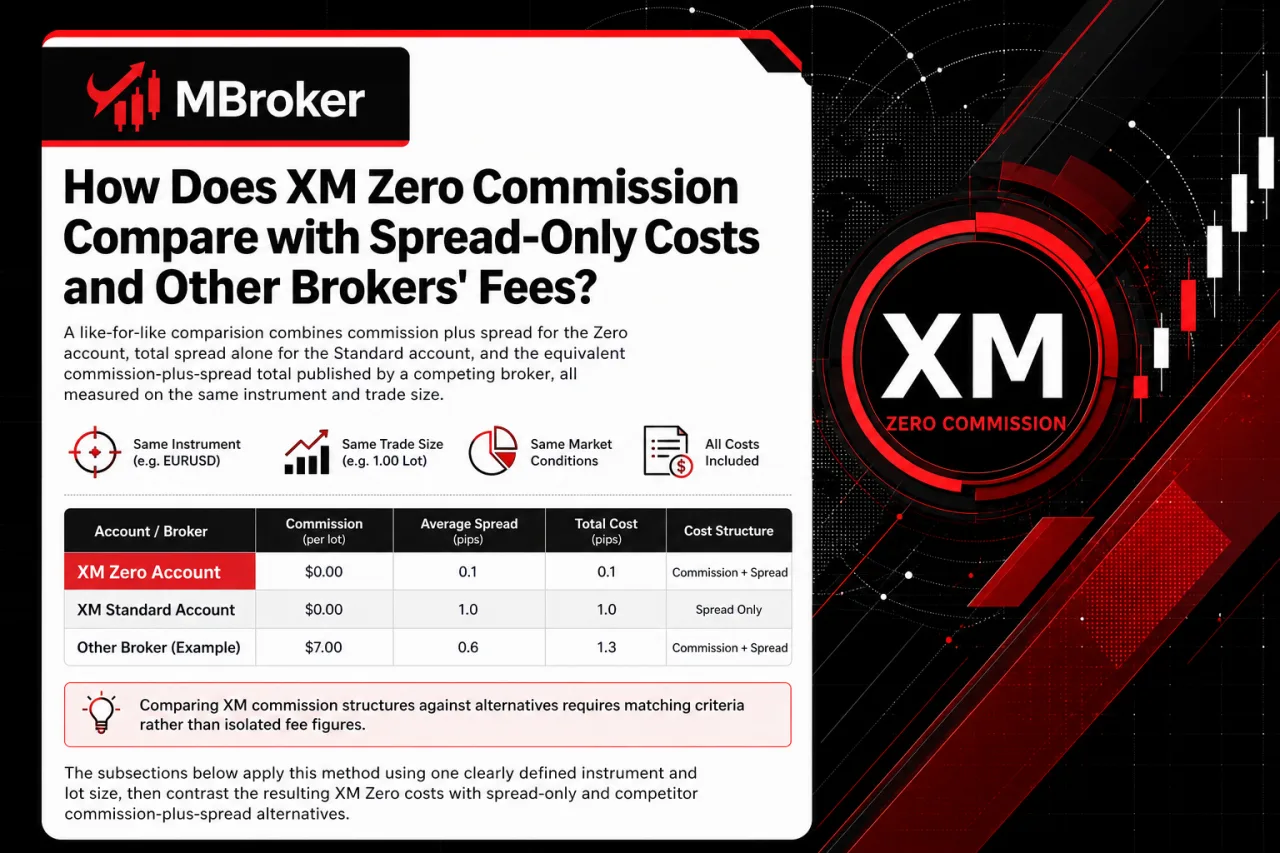
A like-for-like comparison combines commission plus spread for the Zero account, total spread alone for the Standard account, and the equivalent commission-plus-spread total published by a competing broker, all measured on the same instrument and trade size. Comparing XM commission structures against alternatives requires matching criteria rather than isolated fee figures.
The subsections below apply this method using one clearly defined instrument and lot size, then contrast the resulting XM Zero total, the XM Standard total, and a comparable broker’s published total under identical conditions.
All figures shown remain illustrative examples for demonstrating the calculation method, since actual spreads and commissions fluctuate with market conditions. Readers verify current official rates for their assigned XM legal entity, account type and chosen instrument, along with the competing broker’s current published fee schedule, before drawing any cost conclusion or executing a trade.
How Do You Calculate Total Trading Cost Including Commission and Spread?
To calculate total trading cost on a Zero account, add the spread cost converted into USD to the fixed $7 round-turn commission already outlined above, using one defined example trade. This formula applies the same combination method regardless of currency pair, since only the spread value and pip cost change between instruments.
Take EUR/USD as an illustrative example, assuming a 0.1 pip average spread and a standard lot size of 100,000 units, where each pip equals $10 for this pair.
- Step 1: Multiply the assumed 0.1 pip spread by the $10 pip value to get a $1 spread cost per side, or $2 round turn on a standard lot.
- Step 2: Add the $7 round-turn commission already confirmed in the XM costs and charges document to that $2 spread cost.
- Step 3: Sum both figures to reach an estimated $9 total round-turn cost for one standard lot traded on EUR/USD.
This total remains illustrative only, since actual spreads fluctuate with market conditions and the assumed 0.1 pip figure does not represent a guaranteed or advertised constant rate. Traders confirm live spread data and current commission terms with their assigned XM legal entity before estimating real trading costs on any instrument.
Traders holding positions overnight should also consider rollover costs beyond spreads and commissions. Our XM Swap Fees guide explains how overnight charges are calculated, when triple swaps apply, and how holding periods affect total trading expenses.
Are There Any Exceptions or Regional Variations in XM Zero Commission Charges?
Yes, exceptions and regional variations apply to XM Zero commission charges, primarily through legal entity terms, instrument-specific rules and swap-free account conditions. This section covers those less common but relevant nuances across the areas explored below.
Commission rates on the Zero account can vary by the XM legal entity a client registers under, since each entity publishes its own fee schedule under its regulatory framework. This regional dimension matters because Zero account availability itself is not uniform across all XM entities already noted earlier in this article. Clients register under the specific XM entity assigned to their country of residence, and that entity determines the exact terms applicable to their account. Traders confirm the exact commission schedule with their assigned entity before opening a Zero account.
As confirmed in the XM costs and charges document, commission on Zero account instruments is not uniform across asset classes: while forex pairs are charged at $3.5 per side ($7 round turn) per standard lot, metals, indices and other instrument groups follow their own separately published commission figures. Traders check the specific rate for each instrument rather than assuming the forex rate applies, since this distinction affects total cost calculations for any instrument outside forex majors.
Does the Swap-Free (Islamic) Version of the Zero Account Change the Commission Rate?
Swap-free or Islamic versions of the Zero account may carry additional conditions beyond the standard $3.5 per side commission, since removing swap charges can involve separate administration terms. This falls outside standard round-turn calculations already outlined for the regular Zero account.
- Eligibility for swap-free status typically depends on religious affiliation or account approval by XM.
- Grace periods and potential administration fees may apply after a defined holding period, though specific terms should be confirmed directly with XM.
- The base commission structure itself may remain unchanged regardless of swap-free status.
Traders confirm exact swap-free terms and any related fees with their assigned XM legal entity, since these details can change and vary by region.
Beyond transaction costs, traders should also consider potential account funding expenses. Our XM Deposit Fees guide explains deposit charges, payment method conditions, and possible currency conversion costs that are separate from trading commissions.
Does the Swap-Free (Islamic) Version of the Zero Account Change the Commission Rate?
No, the swap-free version of the Zero account does not change the standard $3.5 per side commission rate, though it introduces separate conditions unrelated to that fee.
This question follows directly from the swap-free commission implications already touched on above, since traders often assume removing swap charges also alters the base trading cost. The published $3.5 per side, $7 round-turn structure applies to the Zero account regardless of swap-free status, because swap-free terms only replace the overnight interest mechanism rather than the commission model. Eligibility for swap-free status still depends on account approval by XM, and grace periods or administration fees may apply after a defined holding period, though these terms sit apart from the commission itself and should be confirmed directly with XM.
Traders confirm exact swap-free administration terms and any related charges with their assigned XM legal entity, since regional availability and specific conditions vary and are subject to change.
Conclusion
XM’s commission structure can be competitive, but the actual cost depends on the account type, trading instrument and XM entity serving your region. Traders should not assume that every standard lot carries the same fixed fee, because commission may be calculated from the position’s USD-equivalent notional value. Before opening an account, confirm the latest fee schedule and compare the complete round-turn cost—including commission, spread, swap and any applicable charges—with XM’s spread-only accounts.
This provides a more accurate basis for choosing the option that best suits your trading volume, strategy and holding period. Readers can learn more about our independent editorial approach, research standards, and XM trading cost resources on the About Mbroker page.

Neria Solven is the XM Accounts, Fees and Promotions Editor at Mbroker, specializing in XM trading accounts, brokerage fees, trading costs, and promotional programs. She focuses on analyzing account conditions, spreads, commissions, and bonus eligibility to provide clear, accurate, and practical information for Forex and CFD traders.