
 Tiếng Việt

Pip Calculation XM is the method used to measure price movement and calculate profit or loss per trade, typically based on lot size, contract size, and pip value.
Additionally, pip calculation on XM depends on factors like lot size, currency pair, and quote precision, which directly affect how much each pip is worth in real money.
Pips on XM are calculated using a standard formula: (lot × contract size × pip value), allowing traders to determine exact profit or loss for each price movement.
In forex, a pip represents the smallest price movement, usually 0.0001 for most currency pairs, while on XM it can extend to fractional pips (0.00001) for higher precision.
Therefore, pip calculation is essential for risk management and position sizing, helping traders control losses and optimize profit in every trade.
In Forex trading, pip is the core unit that determines the profit and risk of each trade. However, not all traders fully understand pip calculation XM and how to apply it in practice. This article will help you clearly understand how to calculate pips, their meaning, and how to use them effectively in trading.
Pip Calculation XM overview
Pip Calculation XM is a standardized technical process used by traders to quantify price movements, determine transaction sizes, and evaluate the financial impact of market fluctuations on an active trading account.
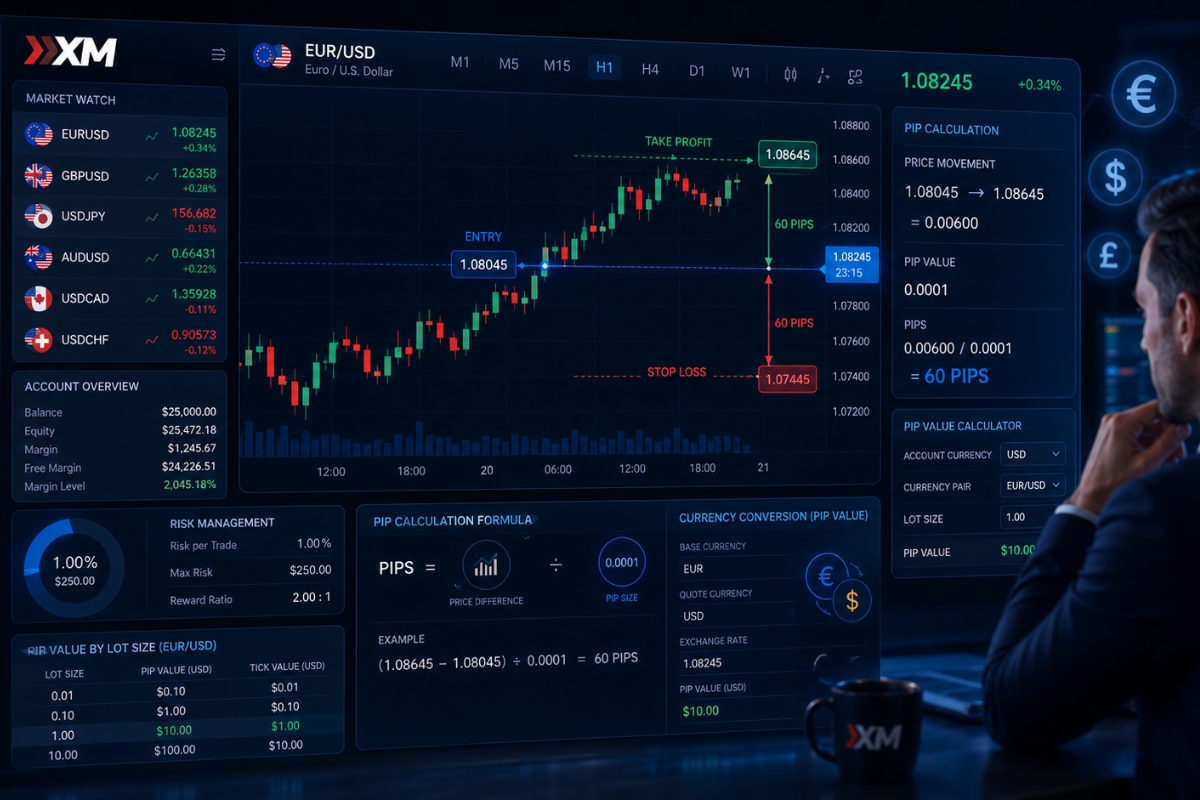
Statistically, accurately tracking these metric changes allows investors to calculate their precise dollar-value exposure across multiple asset classes before an order is even processed by the exchange. Mastering this internal measurement system is essential for maintaining portfolio stability, as it directly governs how trading software displays floating profits, losses, and margin requirements in real time.
What is pip calculation used for on XM?
On the XM platform, pip calculation is primarily used to measure the precise distance between your trade entry point and your target exit zones, such as your Stop Loss or Take Profit levels. By converting abstract, decimalized chart movements into concrete pip units, traders can quickly determine their exact Risk-Reward ratios and establish standardized position-sizing rules. Additionally, this calculation allows the platform’s automated engine to determine the financial value of each price tick relative to your specific account base currency.
While the primary utility of pip tracking is universal, the exact mechanical results depend heavily on several platform-specific parameters.
What factors affect pip calculation on XM?
The financial outcome of a pip calculation on XM is directly shaped by three key operational variables:
- The Account Base Currency: Whether your account is funded in USD, EUR, or GBP alters how pip values are converted into your usable balance.
- The Lot Size (Volume): Trading a Standard Lot (100,000 units), a Micro Lot (1,000 units), or an Ultra Low account variation changes the underlying cash weight of each pip.
- The Specific Currency Pair: The current exchange rate of the quote currency against your account’s base asset dictates the final conversion multiplier.
Understanding how these platform-specific variables interact sets the stage for exploring the broader, universal concept of pips within the global foreign exchange market.
Overview of pip in forex trading
An overview of pip in forex trading highlights its historical position as the universal unit of measurement used by international banking networks to express changes in value between two distinct global currencies.

Derived from the phrase “Percentage in Point” or “Price Interest Point,” a pip represents the smallest conventional price increment that a standard financial exchange rate can move. Historically, this measurement provides a uniform benchmark that allows retail participants and multi-billion dollar institutional funds to trade with absolute structural clarity across decentralized networks.
What is a pip in forex and how does it work?
In classical currency markets, a pip is represented by the fourth decimal digit ($$0.000$$) in an exchange rate quotation, such as a shift in the EURUSD from $$1.085$$ to $$1.085$$. For currency pairs involving the Japanese Yen (JPY), because of its uniquely low nominal value, a pip is instead located at the second decimal digit ($$0.0$$). This structured decimal system allows the global interbank network to execute multi-million dollar transactions with extreme fractional accuracy, stabilizing the daily flow of international commerce.
However, modern electronic communication network (ECN) brokerage systems have refined this classical structure even further to provide tighter pricing spreads.
How many points equal one pip on XM?
On the XM platform, exactly 10 points (fractional pips or pipettes) are equal to one standard pip. XM utilizes a high-precision 5-decimal pricing structure for standard majors (and a 3-decimal structure for JPY pairs) to offer institutional-grade floating spreads that are compressed far tighter than traditional 4-digit layouts. For example, if the EURUSD rate moves from 1.08500 to 1.08515, the price has expanded by exactly 15 points, which is mathematically translated as 1.5 standard pips.
Recognizing the exact relationship between points and pips allows you to confidently apply the primary mathematical formulas used for live account execution.
How to calculate pips on XM trading platform?
Calculating pips on the XM trading platform requires an active application of a standardized mathematical formula that links the nominal decimal movement of an asset with your chosen trade volume.

Because the financial value of a pip changes dynamically based on your transaction size, a professional trader must never rely entirely on automated platform displays to estimate potential risk. By mastering the core mathematical mechanics behind each tick, you gain the ability to maintain complete cognitive control over your capital allocations regardless of sudden market volatility.
What is the pip calculation formula in forex?
The universal mathematical formula used to calculate the absolute monetary value of a pip for any given transaction size is structured as follows:
Pip Value + (One Pip Value in Decimals / Current Exchange Rate ) x Trade Volume ( Lot Size)
When trading pairs where the quoted currency matches your account base currency (such as trading EURUSD on a USD-based account), the formula simplifies automatically to a fixed constant. In a standard 100,000-unit lot contract, this base calculation yields a uniform value of exactly $10 USD per pip, providing an easy mental anchor for immediate position scaling.
To execute this formula quickly across varying market conditions, you can break the process down into a simple step-by-step technical routine.
Step-by-step guide to calculate pips on XM
To perform a complete manual pip calculation on any asset listed in your market terminal, follow these five precise steps:
- Identify the Contract Size: Determine if you are executing a Standard Lot (100,000 units) or a Micro Lot (1,000 units) based on your chosen XM account type.
- Isolate the Decimal Shift: Locate the exact position of the standard pip digit (4th decimal for most pairs, 2nd decimal for JPY pairs).
- Multiply by Volume: Multiply the absolute decimal increment (0.0001 or 0.01) by the total units of your open trade position.
- Convert to Base Currency: If your account base currency differs from the quote asset, divide or multiply the result by the current spot exchange rate.
- Verify with MBroker: Cross-reference your manual figures with the automated calculator tools provided on the MBroker to ensure zero mathematical errors before market entry.
To see this step-by-step framework in action, let us review how these equations function within real-world trading environments.
How to calculate pips on XM with real trading scenarios
Calculating pips on XM with real trading scenarios requires evaluating the specific structural properties of different asset classes, as a currency pair does not move on the same decimal scale as a physical commodity contract.
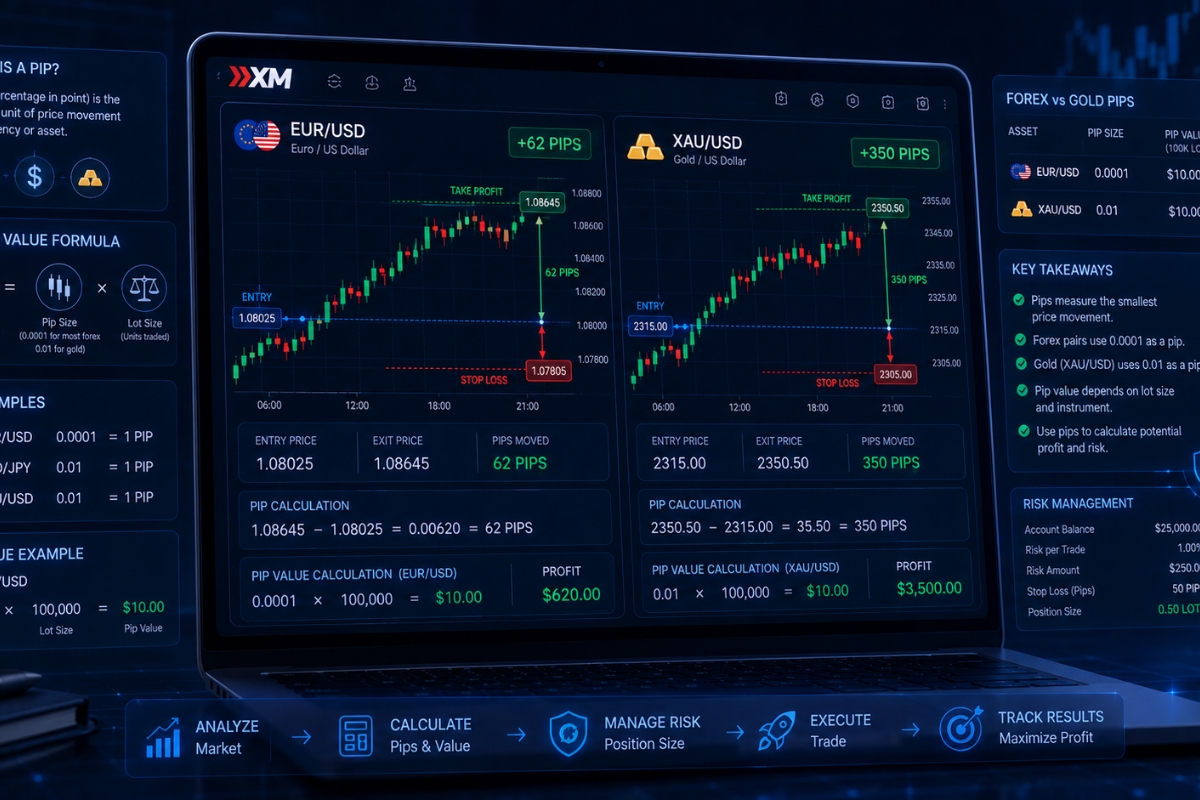
In live financial markets, a 50-pip move on a standard foreign exchange major represents an entirely different structural shift than a similar point fluctuation in precious metals. By reviewing precise case studies for both major currency pairs and gold contracts, you can protect your portfolio from severe position-sizing mistakes.
Example of pip calculation for EURUSD on XM
Suppose you open a buy position of 1 Standard Lot (100,000 units) of EURUSD on a USD-based XM account, entering the trade at $$1.0920$$ and exiting at $$1.0935$$.
- Determine the Point Shift: The absolute price difference is $$1.09350 – 1.09200 = 0.0015$$, which is exactly 150 points or 15 standard pips.
- Apply the Formula: Multiply the standard pip decimal ($$0.000$$) by the trade volume ($$100,00$$ units) to find a fixed pip value of $10 USD per pip.
- Calculate Net Profit: Multiply the 15 pips gained by the $10 USD pip value to find a clean, verified net profit of $150 USD on the transaction.
While major currency calculations remain highly uniform, shifting your terminal focus toward physical commodities introduces an altered decimal structure.
Example of pip calculation for gold (XAUUSD) on XM
Precious metals like Gold (XAUUSD) utilize an altered structural pricing layout where a standard pip is located in the first decimal place (0.10) instead of the fourth. Suppose you execute a short position of 1 Standard Lot (100 ounces of Gold) at a price of 2,350.00 and close the position out at 2,342.50.
- Determine the Price Shift: The absolute net change is $$2,350.00 – 2,342.50 = 7.5$$ dollars, which translates to exactly 75 standard pips (or 750 fractional points).
- Calculate Pip Value: For a standard 100-ounce contract, a 0.10 price change represents a pip value of exactly $10 USD.
- Find Total Financial Impact: Multiply the 75 pips by the $10 USD valuation to determine a final net return of $750 USD on the trade.
Once you can effortlessly calculate these financial values across multiple assets, you can comfortably integrate this mathematical data into advanced risk frameworks.
Applying pip calculation XM in risk and profit management
Applying pip calculation XM protocols in risk and profit management represents the ultimate boundary that separates sophisticated portfolio managers from emotional retail participants.
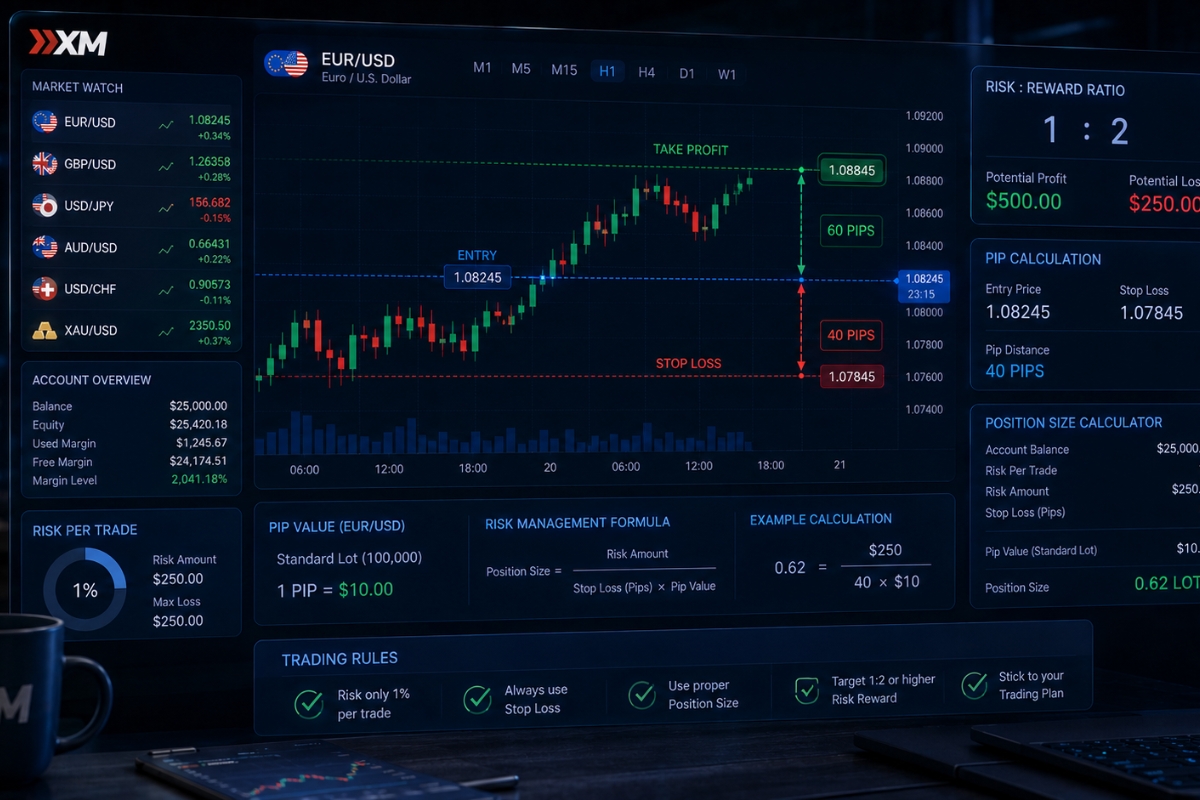
In professional trading, pips are never viewed as merely abstract numbers on a screen; they are treated as the definitive mathematical inputs used to dictate capital protection parameters and enforce strict drawdown caps. By mastering the relationship between structural chart distances and account equity changes, you can ensure your strategy remains completely viable over long-term holding cycles.
How does pip affect risk management in trading?
Pip calculations directly control your capital preservation metrics by establishing an ironclad, measurable boundary for your maximum allowed loss per trade. For example, if your personal portfolio rules state that you can never risk more than 1% of a $10,000 account ($100 USD) on a single setup, your position size must be adjusted entirely based on your stop-loss pip distance. If your technical setup requires a wide, 50-pip stop-loss, your size must be capped at 0.2 lots, whereas a tight 20-pip stop-loss allows you to safely scale up to 0.5 lots while keeping your risk perfectly fixed at $100 USD.
Beyond basic capital survival, you can actively leverage these metrics to enhance your overall execution efficiency over time.
How to optimize pip usage for better trading performance?
To optimize your pip efficiency and maximize your risk-adjusted metrics, focus on executing trades that fulfill strict corporate filtering criteria:
- Target a High Reward-to-Risk Ratio: Only accept setups where your projected Take Profit distance is at least 2 to 3 times larger than your defined Stop Loss pip distance.
- Filter with Volume Analysis: Combine your pip targets with the premium structural market profiles, liquidity heatmaps, and advanced tutorials provided on the XM Trading Fees to ensure your entries align with genuine institutional interest.
- Trail Your Parameters: Once a trade moves 20 pips into profit, trail your stop loss to break-even to eliminate your market risk and secure a completely free position.
In summary, mastering Pip Calculation XM metrics is a mandatory requirement for achieving absolute control over your financial destiny in live markets. By understanding the standard decimal architecture of currency pips, applying manual calculation formulas to your lot sizes, and strictly bounding your risk parameters to a fixed percentage of your account balance, you transform erratic chart volatility into a highly structured commercial enterprise.

Neria Solven is a financial analyst specializing in XM trading fees and account types, known for her clear and practical insights. Email: [email protected]