
 Tiếng Việt
IC Markets offers the clearer raw-pricing model, while XM provides Ultra Low and Zero accounts with a published $5 minimum deposit. The lower-cost choice still depends on the instrument, account type, trade size and holding period.
For platform choice, IC Markets has the broader range. Both brokers support MT4 and MT5, but IC Markets also provides cTrader and TradingView, while XM adds its proprietary XM App.
Regulation must be checked at legal-entity level. Global and European clients may contract with different companies, so a licence held elsewhere in the group may not govern a specific account.
The better fit depends on how the trader operates. XM may suit users who prefer its Ultra Low or Zero structure and XM App, whereas IC Markets may better match traders who need raw pricing, cTrader, TradingView or more automation options.
Which broker has the more suitable trading costs and account structure?
IC Markets is more transparent about its raw-spread commission model, while XM gives users a simpler choice between Ultra Low and Zero accounts. Neither broker is automatically cheaper because spreads are variable and overnight charges can outweigh the opening spread.
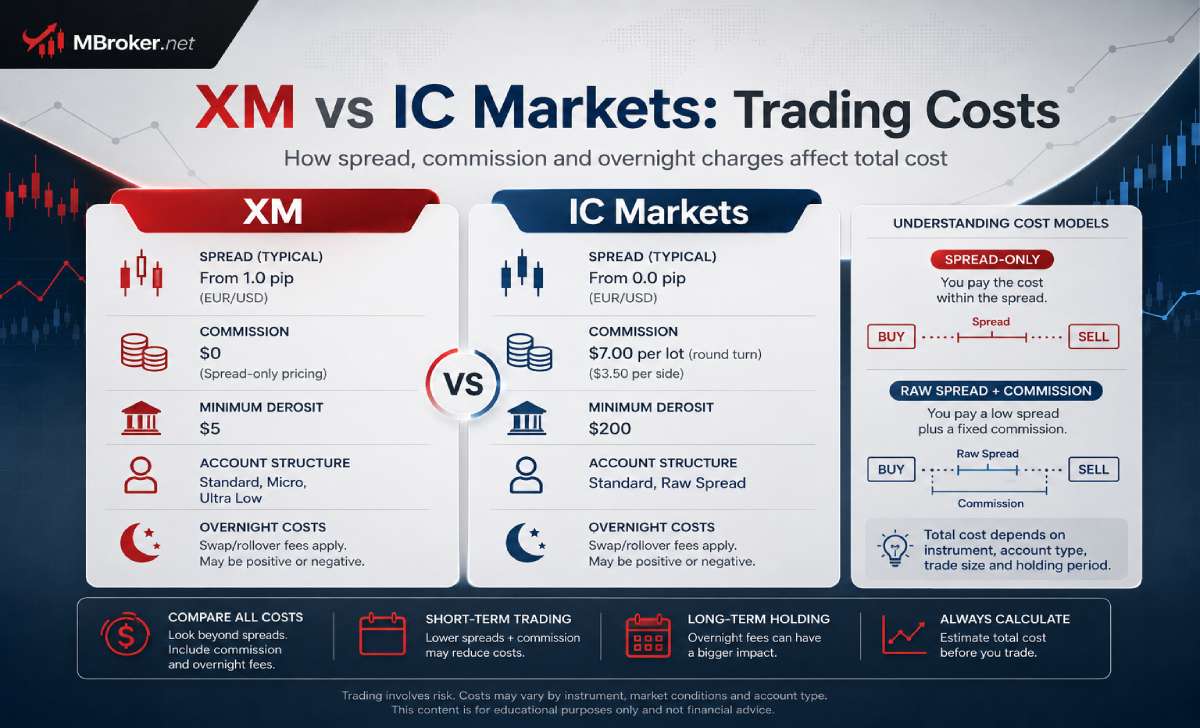
XM’s current account page lists Ultra Low and Zero accounts with a minimum deposit of $5. XM describes Ultra Low as a lower-cost option for higher trading volume, while the Zero account combines spreads that can reach zero with fixed commissions. Both account types include negative balance protection, hedging and an Islamic option, although conditions may depend on location.
In contrast, IC Markets lists three main pricing routes. Its MetaTrader Raw Spread account has spreads from 0.0 pips and a commission of $3.50 per standard lot per side. The cTrader Raw Spread account charges $3 per USD 100,000 traded, while the Standard account uses no separate commission and advertises spreads from 0.8 pips. The current global overview lists a $0 minimum deposit for these three accounts.
The table below separates published account features from the practical questions traders should check.
| Comparison point | XM | IC Markets | Why it matters |
| Main account choices | Ultra Low and Zero | Standard, Raw Spread MetaTrader and Raw Spread cTrader | Determines how costs are charged |
| Published minimum deposit | $5 | $0 on the current global overview | Entry level is not the same as ongoing cost |
| Spread model | Low-spread and zero-spread options | Spread-only or raw spread plus commission | Total cost matters more than headline spread |
| MetaTrader Raw commission | Depends on account and instrument | $3.50 per lot per side | Important for frequent trading |
| cTrader commission | Not available | $3 per USD 100,000 traded | Uses a different charging unit |
| Standard commission | Account-dependent | $0 separate commission | Cost is included in the spread |
| Overnight cost | Check account and symbol | Check swap or swap-free conditions | Holding time can change the result |
| Regional availability | Entity-dependent | Entity-dependent | Products can differ by country |
These figures come from the brokers’ current official account pages and should be rechecked before publication.
These account conditions should also be assessed alongside XM’s regulation, platforms, regional restrictions and non-trading fees. For the broader evaluation, read Mbroker’s XM Review
Risk warning: Forex and CFD trading can produce rapid losses, especially when leverage is used. A low spread or minimum deposit does not reduce market risk.
The graphic below explains why “spread from zero” does not mean a zero-cost trade.
How should traders calculate the all-in cost?
Add the spread cost, commission and any overnight financing instead of comparing the headline spread alone. Use the same currency pair, lot size and trading session, then include both sides of the commission and any rollover charge.
For example, IC Markets reports an average EUR/USD raw spread of 0.1 pips, but the final cost must also include its commission. Therefore, occasional traders may prefer simpler spread-inclusive pricing, while high-frequency traders should calculate the commission-adjusted cost over their expected monthly volume.
Is XM cheaper than IC Markets?
There is no universal cost winner. IC Markets provides a clearly defined raw-spread model, while XM’s result depends on the available Ultra Low or Zero account and the instrument traded.
Platform choice is the next factor because it determines which pricing models and automation tools the trader can use.
Which broker offers the more suitable platforms and trading tools?
IC Markets offers the wider platform selection, while XM covers the main MetaTrader workflow and adds its own app. Both support Expert Advisors through MT4 and MT5, but only IC Markets lists cTrader and direct TradingView integration on its global pages.
The platform image below shows the practical difference between the two ecosystems.
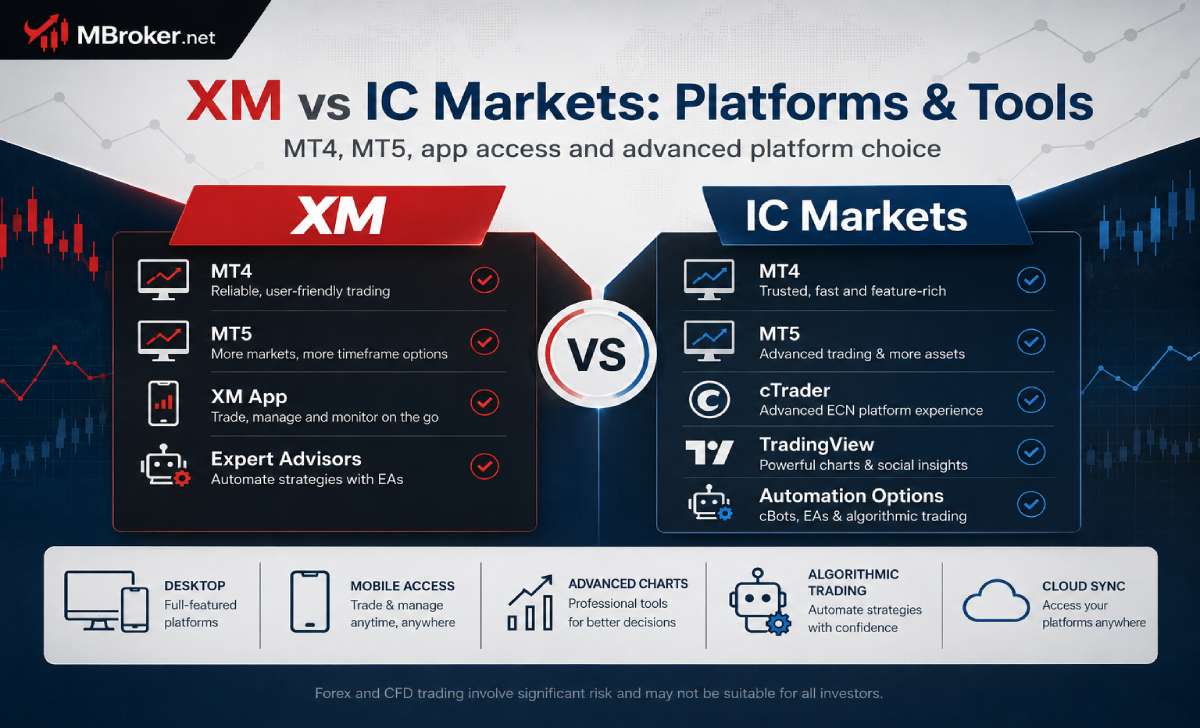
XM supports MT4, MT5, MetaTrader Expert Advisors and the XM App. IC Markets supports MT4, MT5, cTrader and TradingView, with TradingView available through a cTrader Raw account. IC Markets also supports MetaTrader automation and cTrader development using C#.
Which broker is more suitable for automated trading?
Both can support automated strategies on MetaTrader, but IC Markets provides more development routes. XM users can run MQL4 and MQL5 Expert Advisors, whereas IC Markets supports the same MetaTrader languages and adds cTrader’s C# environment.
However, platform support does not guarantee profitable or identical execution. Traders should test symbol specifications, commissions and strategy behaviour on a demo account before using live funds.
A wider platform list concerns functionality, whereas regulation identifies the company legally responsible for the account.
How do XM and IC Markets differ in regulation and client protection?
Both brands operate through multiple legal entities, so the company named in the client agreement is the relevant comparison. A licence held by one group entity should not be assumed to cover an account opened with another.
For global pages, XM states that XM Global Limited is regulated by the Financial Services Commission of Belize under licence 8557558. IC Markets’ global disclosure states that IC and IC Markets Global are trading names of Raw Trading Ltd, regulated by the Seychelles Financial Services Authority under Securities Dealer licence SD018.
In the European Economic Area, CySEC lists Trading Point of Financial Instruments Ltd under licence 120/10 and includes xm.com among its approved domains. CySEC also lists IC Markets (EU) Ltd under licence 362/18 and identifies icmarkets.eu as its approved domain.
The diagram below shows the correct order for verifying regulatory status.
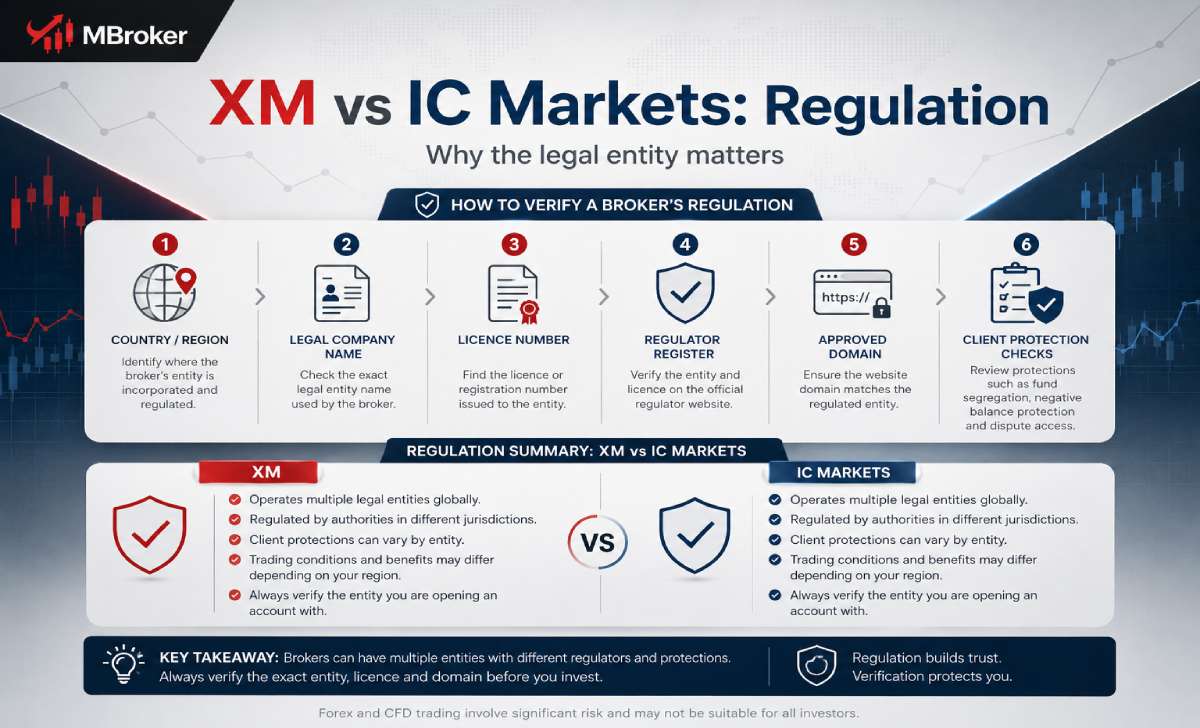
Before opening or funding an account, check:
- The legal company name shown during registration
- The licence number in the footer or client agreement
- The regulator’s public register and approved domain
- Negative balance and client-money rules
- The complaints process and compensation arrangements
- Country restrictions and local leverage limits
Does the same protection apply in every country?
No. Client protections, leverage limits and complaint routes can differ by entity and jurisdiction. An EEA account under a CySEC-regulated company should not be assessed only through terms shown on a Belize- or Seychelles-regulated global page.
Mbroker.net therefore treats the legal entity as a separate decision factor rather than assigning one brand-level “safety winner.” Once the applicable entity is verified, costs and tools can be matched to the trader’s behaviour.
Who may find XM or IC Markets more suitable?
XM may fit traders who prefer its Ultra Low or Zero structure and MetaTrader-plus-XM-App ecosystem, while IC Markets may fit traders prioritising raw pricing, cTrader, TradingView or additional automation options. This is a feature-based assessment, not a prediction of trading results.
The matrix below links common trader profiles to the conditions that should be checked.
| Trader profile | Potential fit | Main reason | What to verify |
| MetaTrader-focused beginner | Either broker | Both support MT4 and MT5 | Demo access, account simplicity and legal entity |
| XM App user | XM | Proprietary app alongside MetaTrader | Regional app functions |
| Spread-only pricing user | IC Standard or eligible XM account | No separate commission may simplify tracking | Actual instrument spread |
| Active forex trader | IC Raw Spread may be easier to model | Published spread and commission schedule | Monthly all-in cost and slippage |
| cTrader user | IC Markets | XM does not list cTrader | Commission and available instruments |
| TradingView user | IC Markets | Integration through cTrader Raw | Account eligibility and TradingView fees |
| EA or algorithmic trader | Either; IC offers more environments | MetaTrader EAs on both, cTrader C# on IC | VPS, symbol rules and live conditions |
Readers who want to compare XM with another broker offering MetaTrader accounts can also read Mbroker’s XM vs Exness comparison, which examines differences in costs, account structures, platforms and funding conditions.
Is XM or IC Markets more suitable for scalping?
IC Markets provides the clearer documented case for scalping because its Raw Spread account is explicitly presented for scalpers, day traders and Expert Advisors.
Still, suitability depends on the instrument, trading session, commission, order size and sensitivity to slippage. These conditions should be tested rather than inferred from the account name.
Overall, IC Markets has the advantage in platform breadth and published raw-pricing detail, while XM offers a more focused account and platform ecosystem. The final choice should follow three checks: confirm the exact legal entity, estimate all-in costs on the intended instruments and test the required platform on a demo account. Neither broker removes the risk created by leverage or market volatility.

Thoren Vextal is Mbroker’s XM Reviews and How-To Guides Editor, covering broker reviews, regulation, comparisons and practical account guides.Email: [email protected]