
 Tiếng Việt
XM and Exness suit different traders. Compare accounts, costs, platforms and trading conditions to decide which broker better matches your needs. XM currently presents Ultra Low and Zero accounts, while Exness separates its offering into Standard, Pro, Zero and Raw Spread pricing models.
However, safety depends on the legal entity holding the account. Both brands operate through regulated companies, but the regulator, complaint procedure and client protections can differ between regions.
Therefore, the better fit depends on how you trade. XM may be more practical for traders seeking a simpler account choice and a MetaTrader-focused setup, while Exness provides more pricing structures and its own web terminal alongside MT4 and MT5.
How Do XM and Exness Compare on Trading Conditions?
XM has a simpler account structure, while Exness offers more distinct spread and commission models. Neither broker is automatically cheaper because the final cost depends on the account, instrument, position size, holding period and market conditions.
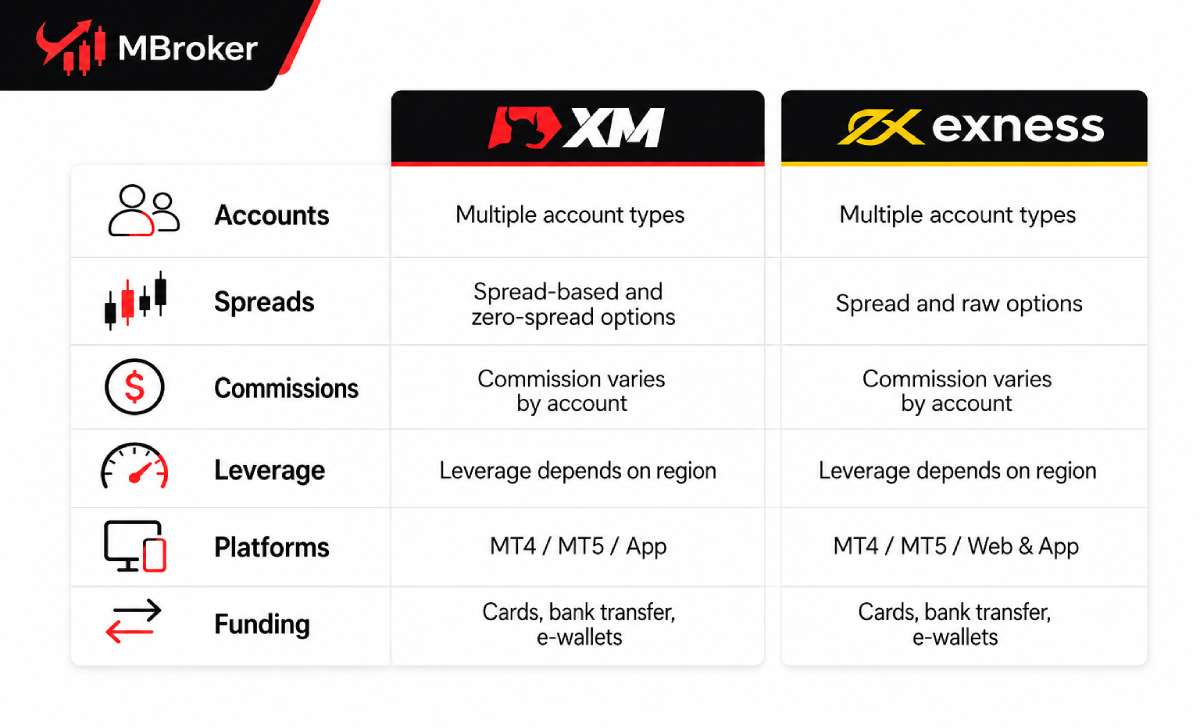
The following table compares the main conditions published on official XM and Exness pages as checked on July 20, 2026. Availability can change according to the client’s country and contracting entity.
| Comparison criterion | XM | Exness | What traders should check |
| Main account structures | Ultra Low and Zero on the current account page | Standard, Pro, Zero and Raw Spread | Whether the account is available in the trader’s region |
| Published minimum deposit | $5 for Ultra Low and Zero | Standard may start from $10; professional accounts may start from $200 | Payment method, country and account requirements |
| Spread-based account | Ultra Low | Standard and Pro | Typical spread on the specific instrument, not only the minimum |
| Zero or raw pricing | Zero Account | Zero and Raw Spread | Round-turn commission plus the actual spread |
| Published starting spreads | Zero Account from 0 pips | Standard from 0.2 pips, Pro from 0.1 pips, Zero and Raw Spread from 0 pips | Spreads can widen with volatility and lower liquidity |
| Commission structure | Fixed commission applies to the Zero model | Standard and Pro have no separate commission; Zero and Raw Spread charge commission | Commission per side, per lot and per instrument |
| Platforms | MT4, MT5 and XM App | MT4, MT5, Exness Trade and Exness Terminal | Expert Advisor support, web access and account compatibility |
| Market access | Forex and several other leveraged products, depending on the entity | Forex, metals, cryptocurrencies, energies, stocks and indices on listed accounts | Whether the required instrument is offered under the chosen entity |
| Leverage | Depends on entity, instrument, equity and local rules | Depends on entity, account conditions and eligibility | Margin call, stop-out rules and maximum effective exposure |
This visual comparison should help readers distinguish account structure from headline spread claims.
Which Broker Has Lower Trading Costs?
Neither broker is consistently cheaper across every instrument and account. XM’s Ultra Low structure may be easier to evaluate when the cost is primarily included in the spread, whereas Exness provides separate spread-only, zero-spread and raw-spread models.
For example, the total cost of a Forex position can include:
- Bid–ask spread when opening the trade
- Commission when opening and closing the position
- Overnight swap for positions held beyond the rollover time
- Currency conversion or payment-provider charges
- Slippage between the requested and executed price
Exness currently publishes spreads from 0.2 pips on Standard, 0.1 pips on Pro and 0 pips on Zero or Raw Spread accounts. Its Zero commission starts from $0.05 per side per lot, while Raw Spread commission is listed at up to $3.50 per side per lot. These are starting conditions rather than guaranteed costs for every trade.
XM lists a $5 minimum deposit for its current Ultra Low and Zero accounts. The Zero account combines spreads from zero with fixed commissions, while Ultra Low is positioned as a lower-spread account. Traders can review the components of XM trading fees before comparing them with the same instrument and position size at Exness.
How Do Accounts, Leverage and Platforms Differ?
XM is more streamlined, whereas Exness provides more account-level pricing choices. XM’s current page focuses on Ultra Low and Zero accounts, while Exness separates its commission-free Standard and Pro accounts from the commission-based Zero and Raw Spread accounts.
Both brokers support MT4 and MT5. However, Exness also provides Exness Terminal, a browser-based platform with TradingView charting, one-click trading, account information and compatibility with Exness account types supported by MT5. XM provides its own app alongside MT4 and MT5.
Leverage should not be used as the main reason to select a broker. Specifically, the maximum displayed leverage may be reduced by regional regulation, account equity, instrument type or broker risk controls. A lower margin requirement increases exposure but does not reduce market risk.
How Do Deposits and Withdrawals Compare?
Funding conditions are method- and region-specific at both brokers. The practical comparison is whether the trader can deposit and withdraw through an eligible method in the same name, currency and country.
XM states that its minimum deposit or withdrawal is generally $5, although the applicable minimum can vary by payment method. Exness states that processing time varies according to the selected method and reports that more than 98% of withdrawals are processed automatically; this does not guarantee that every withdrawal is instant.
Before depositing, check the supported method, processing range, external bank charges, currency conversion and any source-of-funds verification requirements. These operational conditions are meaningful only after confirming which legal entity will hold the account.
How Safe Are XM and Exness?
Both brands operate through regulated entities, but regulation must be assessed at company level rather than brand level. The relevant question is not how many licences appear on a group website, but which company is named in the client agreement.
The table below shows what readers should verify before relying on a licence or protection claim.
| Verification item | XM | Exness | Required action |
| Contracting company | Varies by region and website version | Varies by jurisdiction and regional website | Read the account agreement and website footer |
| Examples of regulated entities | Trading Point of Financial Instruments Ltd under CySEC; XM Global Ltd under Belize FSC | Entities regulated in Seychelles, BVI, Belize, South Africa, Kenya and other jurisdictions | Verify the exact company in the regulator’s register |
| European retail availability | The CySEC entity serves eligible EEA clients under its applicable terms | Exness states that its CySEC and FCA entities do not serve retail clients | Do not assume an EU or UK licence applies to a retail account |
| Segregated funds | Stated for the CySEC-regulated XM entity | Protection details depend on the contracting entity and legal documents | Confirm that the policy applies to the selected entity |
| Negative balance protection | Listed on XM’s current account page and CySEC entity page | Must be checked in the applicable client-protection terms | Review scope, exclusions and account eligibility |
| Compensation or dispute route | The CySEC entity states Investor Compensation Fund membership | Exness publishes entity-specific complaint procedures and a separate Financial Commission arrangement | Check eligibility, limits and escalation procedure |
| Regional restrictions | Products and conditions vary by location | Exness lists several restricted jurisdictions, including the United States | Confirm legal availability before registration |
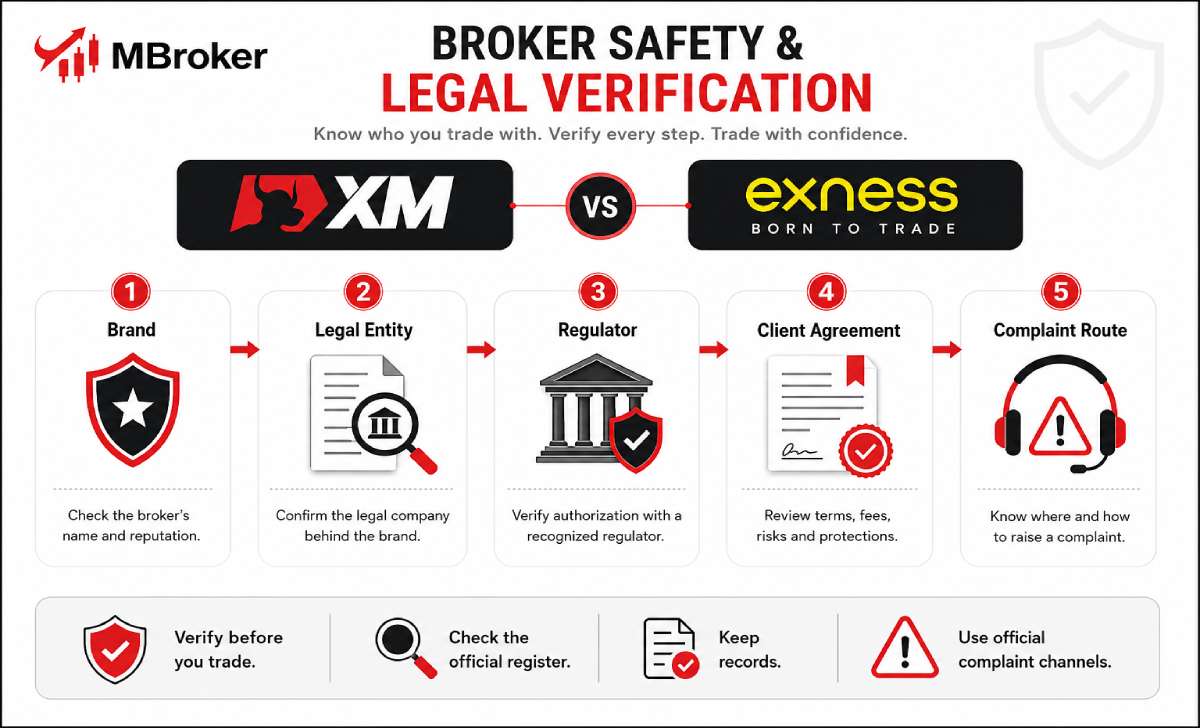
Which Legal Entity Would Hold Your Account?
The legal entity shown during registration determines the applicable regulator and contract. For example, XM’s European regulation page identifies Trading Point of Financial Instruments Ltd under CySEC licence 120/10, while another XM page identifies XM Global Ltd under Belize FSC licence 8557558.
Exness lists several operating companies. Importantly, it states that Exness (Cy) Ltd and Exness (UK) Ltd do not provide services to retail clients, despite holding CySEC and FCA authorisations. A retail trader should therefore not assume those licences protect an account opened through a different Exness entity.
The following diagram should show the verification chain from brand name to legal entity, regulator, client agreement and complaint route.
What Client Protections Actually Apply?
Client protection is entity-specific and may not be identical across countries. XM’s CySEC page states that the entity segregates client funds, participates in the Investor Compensation Fund and uses negative balance controls. These statements should not automatically be extended to every company using the XM brand.
Similarly, Exness publishes separate legal documents for Exness (SC) Ltd, Exness B.V., Exness (VG) Ltd and Forexite Ltd. Readers should open the documents for the company named in their registration flow rather than relying only on the group regulation page.
How Should Trader Complaints Be Assessed?
Complaints can reveal recurring service issues, but an individual review does not independently prove safety or misconduct. Payment delays, verification requests and account restrictions should be checked against the client agreement, transaction records and formal complaint procedure.
For a broader evaluation framework, Mbroker’s guide on whether XM is safe explains how to separate regulatory evidence from user allegations. In practice, a useful complaint should identify the legal entity, relevant dates, payment method, broker response and final outcome.
Once the applicable protection and dispute route are clear, XM and Exness can be compared according to the reader’s actual trading requirements.
Which Broker Fits Your Trading Needs?
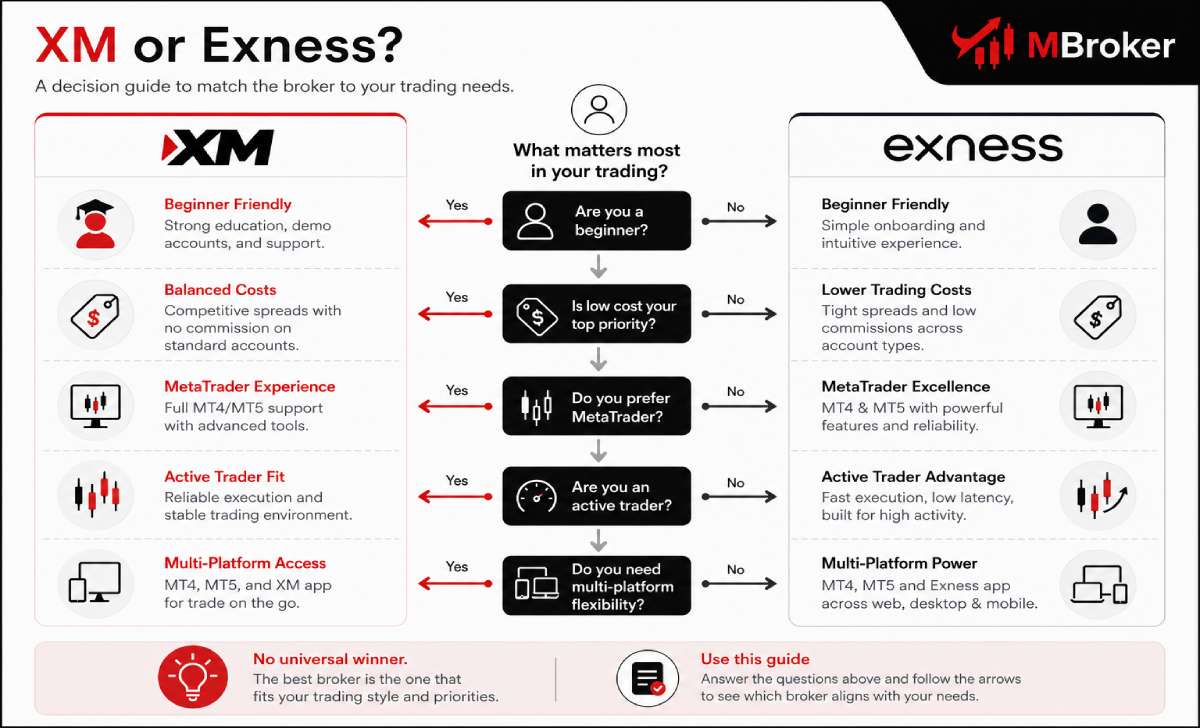
XM may suit traders prioritising a simpler account selection, while Exness may suit those comparing several pricing and execution models. The final choice should still be based on regional availability, the legal entity and the total cost of trading the required instrument.
When Might XM Be the More Practical Option?
XM may be more practical when simplicity and MetaTrader access are the main requirements. Its current account page presents two main live structures with a $5 minimum deposit and provides MT4, MT5 and the XM App.
XM may therefore deserve closer consideration when a trader:
- Wants to choose between a spread-focused and zero-spread structure
- Primarily uses MT4 or MT5
- Requires a low stated entry deposit
- Prefers fewer account models to compare
- Has confirmed that XM supports the required instruments and payment methods locally
However, XM should not be selected solely because the minimum deposit is lower. Spread, commission, swap and entity-level protection remain more important for ongoing use.
When Might Exness Be the More Practical Option?
Exness may be more practical for traders who want several cost structures or a proprietary web platform. Standard and Pro accounts use commission-free pricing, while Zero and Raw Spread separate part of the trading cost into commissions.
Exness may merit comparison when a trader:
- Wants to compare spread-only, zero-spread and raw-spread accounts
- Uses short-term, algorithmic or higher-frequency strategies
- Requires MT4, MT5 or a browser-based proprietary terminal
- Wants platform-level account management and TradingView charts
- Has verified that an eligible Exness entity serves the trader’s country
Even so, a “from 0 pips” account is not automatically the cheapest. Commission and the instrument’s typical spread must be included in every comparison.
What Should You Verify Before Choosing?
Verify the account under real regional conditions rather than relying on a general comparison page. The image below should present the final decision process for selecting XM or Exness.
Before using real funds, check:
- The legal company named in the registration documents
- The regulator and licence number in the official register
- The required instrument and its contract specifications
- The typical spread and complete round-turn commission
- Swap charges for the expected holding period
- Effective leverage, margin call and stop-out rules
- Available deposit and withdrawal methods
- Complaint and dispute-escalation procedures
- Platform compatibility with indicators, scripts or Expert Advisors
- Demo execution under the intended trading conditions
Risk warning: Forex and CFDs are leveraged products that can cause rapid losses. Lower spreads, higher leverage or faster withdrawals do not reduce market risk or guarantee profitable results.
Neither XM nor Exness is the better broker for every trader. XM provides a more streamlined account comparison, while Exness offers more pricing models and proprietary platform options. Mbroker recommends comparing the same instrument, trade size and holding period, then verifying the contracting entity and withdrawal route before deciding whether either broker meets your requirements.

Thoren Vextal is Mbroker’s XM Reviews and How-To Guides Editor, covering broker reviews, regulation, comparisons and practical account guides.Email: [email protected]