
 Tiếng Việt
XM and FBS differ mainly in regulatory scope, account structure and cost model, not in which one is universally “better”. Traders choosing between the two must weigh which entity serves their country, since conditions vary by regulator and legal jurisdiction.
Beginners generally benefit from lower minimum deposits and simpler account types, a factor where both XM and FBS offer entry-level options; for instance, according to XM’s official help center, the minimum deposit for any XM account type is as low as $5, depending on the payment method. Safety for new traders depends less on brand reputation and more on which regulator licenses the specific entity a trader signs up with.
FBS and XM apply different spread and commission structures across their account types, with cost varying by instrument and account tier. These pricing differences directly affect net trading costs, especially for high-frequency or high-volume strategies.
XM and FBS both list a broad range of tradable instruments, though the exact number of assets and available account types differs between the two brokers. Platform choice, leverage limits and execution model also vary and shape overall trading conditions. Mbroker breaks down these distinctions below, starting with a direct side-by-side look at how XM and FBS compare for traders in 2026 followed by their regulatory status and suitability for beginners.
XM vs FBS: Which Broker Is Better for Traders in 2026?
XM vs FBS: Which Broker Is Better for Traders in 2026
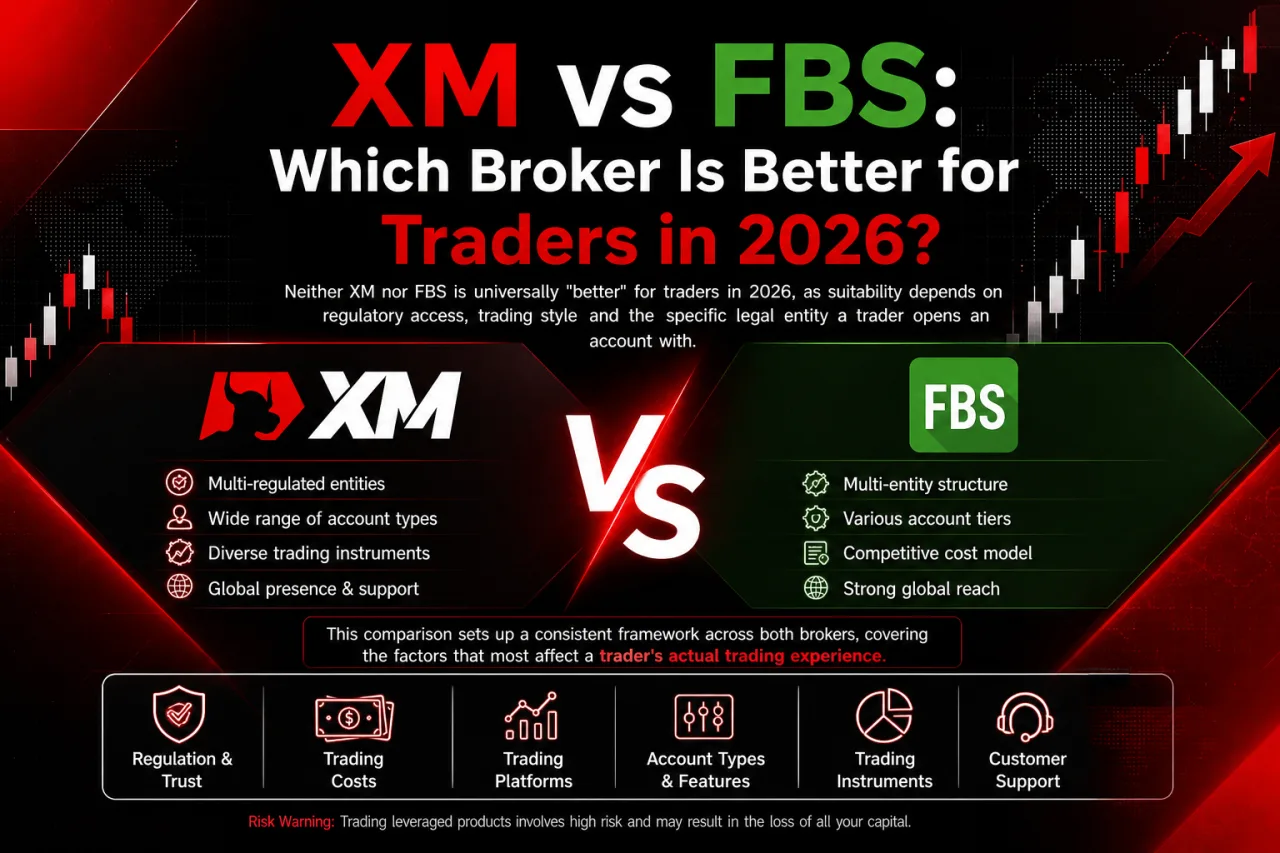
Neither XM nor FBS is universally “better” for traders in 2026, as suitability depends on regulatory access, trading style and the specific legal entity a trader opens an account with. XM operates through multiple regulated entities offering a range of account types and instruments, while FBS runs a comparable multi-entity structure with its own account tiers and cost model.
This comparison sets up a consistent framework across both brokers, covering the factors that most affect a trader’s actual experience. The sections below examine each of these criteria in turn:
- Regulation and which legal entity accepts traders from a given country
- Cost structure, including spreads and commissions per account type
- Trading platforms and execution models offered by each broker
- Account types and their minimum deposit or leverage conditions
- Range of tradable instruments across forex, indices, metals and other assets
- Customer support quality and available channels
Reading these criteria together, rather than any single feature, clarifies which broker aligns better with a specific trader’s region and profile.
Are XM and FBS Regulated and Safe for Traders?

Are XM and FBS Regulated and Safe for Traders
Both XM and FBS operate as regulated brokers, though protection level depends entirely on which specific entity a trader registers with, not the brand name itself. XM holds licenses from authorities such as CySEC and ASIC, while FBS carries licenses from regulators such as ASIC, CySEC, FSCA and IFSC depending on the entity a trader signs up with, and each entity carries its own compensation scheme and fund-segregation rule. Comparing regulation properly means looking at the entity level rather than treating XM or FBS as a single global company.
The subsections below break this down by examining licensing bodies, investor compensation access and core safety mechanisms like segregated accounts and negative balance protection for each broker.
What Client Protection Does Each Entity Offer?
XM and FBS both segregate client funds and offer negative balance protection, but compensation fund access differs by entity and jurisdiction. Comparing client protection means checking each broker’s specific regulated entity rather than treating either brand as one uniform structure.
Key differences across the two brokers include:
- Compensation schemes apply only to entities under top-tier regulators, while offshore entities of both brokers typically lack investor compensation fund access. Regarding investor protection, according to XM’s Investor Compensation Fund Protection Statement, the Fund’s main objective is to secure the claims of covered clients of regulated CIFs by compensating them for losses arising from investment services provided by the covered entity. According to FBS’s regulation and license information page, compensation fund eligibility depends on the specific regulated entity a client is registered under, and the exact per-entity fund limits for both brokers should be verified directly against each broker’s current regulatory disclosures.
- Segregation rules require both brokers to hold client money in separate bank accounts from company operating funds, though the specific custodian banks and audit frequency vary by entity. Segregation practices and audit frequency differ across XM’s and FBS’s regulated entities. According to FBS’s client funds security page, FBS describes its segregated account approach for client funds, and these details for both brokers should be verified directly against each entity’s current regulatory disclosures.
- Negative balance protection prevents client accounts from falling below zero, with both brokers applying this policy to retail clients under most regulated entities. Negative balance protection terms differ by entity; according to XM’s Client Agreement, Terms and Conditions of Business, XM follows a negative balance protection policy on a per-account basis, aiming to ensure that a client’s maximum losses from trading CFDs, including all related costs, do not exceed the funds deposited into that account. According to FBS’s negative balance protection policy page, FBS applies negative balance protection for retail clients, though eligibility and exact conditions for both brokers can vary by client location and should be verified directly against each broker’s current regulatory disclosures.
Traders verifying protection level check the entity name printed on their account statement against that regulator’s public register, since coverage does not automatically extend across a broker’s other entities.
Which Broker Is Better for Beginner Traders, XM or FBS?
Which Broker Is Better for Beginner Traders, XM or FBS
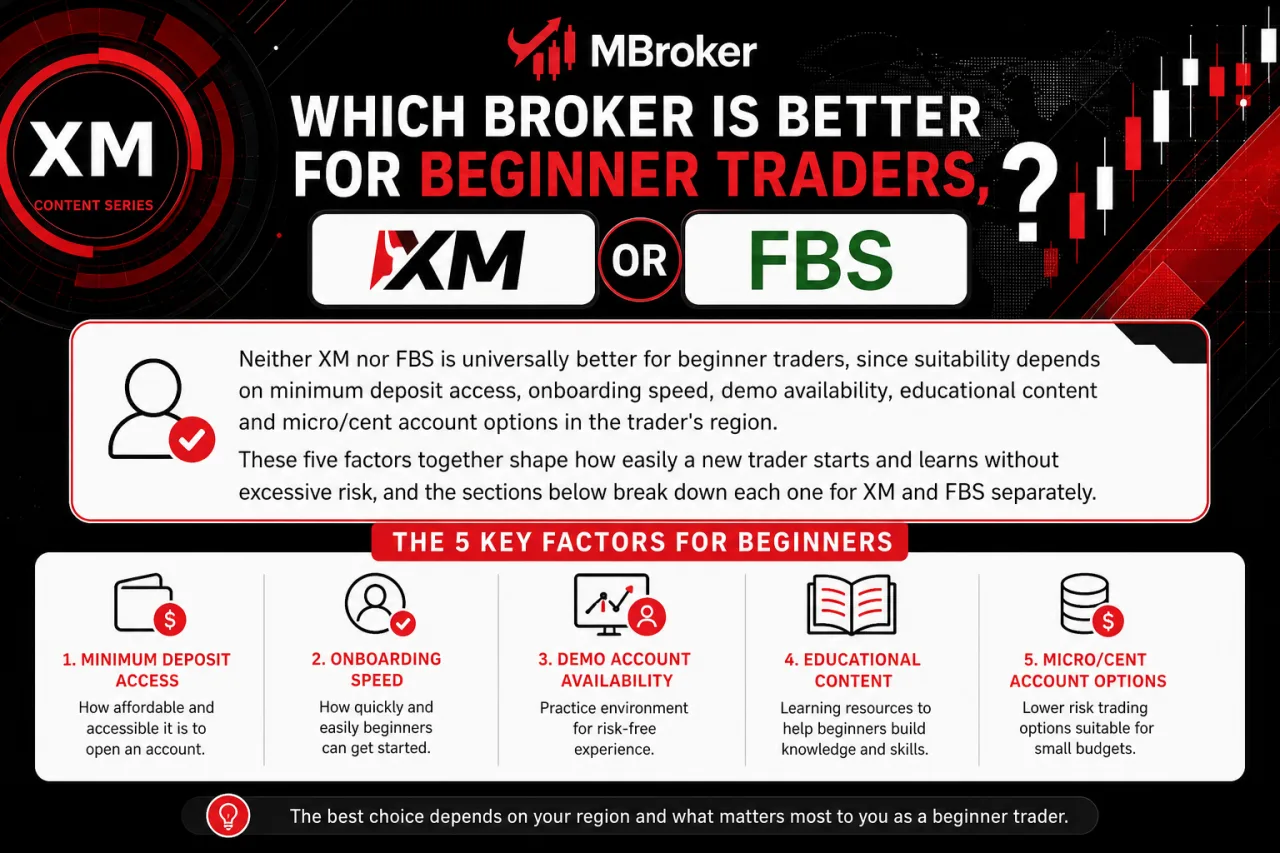
Neither XM nor FBS is universally better for beginner traders, since suitability depends on minimum deposit access, onboarding speed, demo availability, educational content and micro/cent account options in the trader’s region. These five factors together shape how easily a new trader starts and learns without excessive risk, and the sections below break down each one for XM and FBS separately.
What Account Types Do XM and FBS Offer?
XM and FBS both offer standard, micro/cent, and zero-spread/ECN-type accounts, plus Islamic swap-free options, though minimum deposits and spread conditions differ by entity. Comparing account types across the two brokers means checking deposit thresholds, spread models and instrument access per tier rather than assuming uniform terms globally.
Main account categories include:
- Standard accounts carry variable spreads with no separate commission on most instruments, targeting traders who prefer simpler cost structures. XM’s Standard account applies a floating spread model rather than a fixed one; for instance, according to XM’s official account types page, the broker highlights low spreads alongside low swap fees and commissions, though exact minimum pip figures per instrument should be verified directly against XM’s current trading conditions page.
- Micro/cent accounts, as a general industry category, let traders size positions in smaller lots, reducing exposure while learning live execution. Specific lot sizing and terms for XM and FBS versions of this account type are detailed on each broker’s respective account types page.
- Zero-spread/ECN-type accounts, as commonly structured across the industry, charge a fixed commission per lot alongside near-zero raw spreads, suiting high-frequency or scalping strategies. Exact commission figures for XM and FBS should be confirmed against each broker’s official trading conditions page.
- Islamic swap-free accounts, in general industry practice, remove overnight interest charges for eligible clients, replacing swaps with an administrative fee on certain instruments. Eligibility criteria and fee structures for XM and FBS versions vary and are outlined on each broker’s official website.
Minimum deposit requirements vary by account tier and regulated entity for both brokers.
According to XM’s official help center, XM’s minimum deposit across account types starts as low as $5 depending on payment method.
According to FBS’s official account types page, the broker’s Cent account requires a minimum deposit starting from $1, while Standard and Zero Spread account tiers carry higher minimum deposit thresholds that vary by region and payment method. Traders comparing both brokers should check each provider’s current official disclosures for the exact figure applicable to their entity and payment channel.
What Educational and Support Resources Are Available for New Traders?
Based on general observation, XM appears to offer a wider range of structured educational content, while FBS focuses on a mobile-first onboarding flow with simpler guides, though exact content volume should be confirmed on each broker’s official site. Both brokers provide demo accounts for practicing without capital risk, addressing the education, demo account and onboarding support attributes relevant to new traders. XM’s content includes live webinars, video tutorials and in-person seminars.
Comparing the two directly:
- Demo accounts remain free and unlimited in duration for both XM and FBS, letting beginners test strategies before funding a live account.
- Webinars and video courses appear more frequently on XM’s education section, covering technical analysis and platform navigation topics.
- Beginner guides and FAQ-style articles exist on both broker websites, though depth and update frequency differ by entity and region.
- Onboarding support channels, including live chat and account manager assistance, vary in availability depending on the regulated entity a trader registers with.
FBS emphasizes quick account opening paired with a simplified mobile app tutorial, while XM structures its onboarding around a broader multi-language education portal, though the exact number of webinars and videos offered by each broker should be verified directly against their current official platforms. Traders verifying current course offerings and demo account terms check each broker’s official education and support pages directly, since content scope shifts periodically by entity and region.
How Do XM and FBS Compare on Spreads, Fees and Commissions?
How Do XM and FBS Compare on Spreads, Fees and Commissions
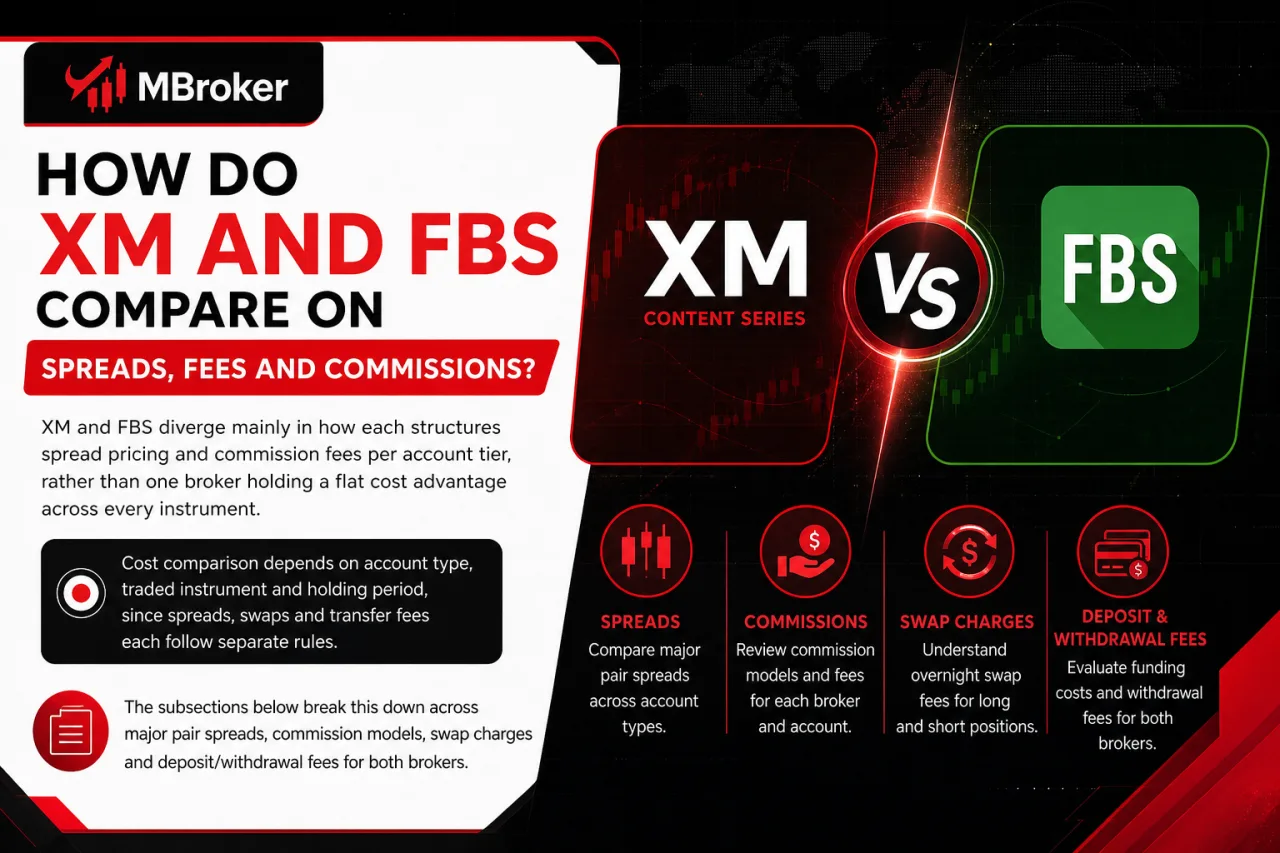
XM and FBS diverge mainly in spread pricing and commission structure per account tier. Neither broker holds a flat cost advantage across every instrument. Cost comparison depends on account type, traded instrument and holding period, since spreads, swaps and transfer fees each follow separate rules. The subsections below break this down across major pair spreads, commission models, swap charges and deposit/withdrawal fees for both brokers.
Which Account Types Have Lower Trading Costs?
Zero-spread/ECN-type accounts hold lower trading costs for high-volume traders, while standard accounts suit lower-frequency trading due to the absence of a separate commission line. Comparing account tiers for cost means weighing the commission-plus-raw-spread model against the wider all-in spread of standard accounts, since the cheaper option shifts depending on trade frequency and lot size.
Cost differences across comparable tiers include:
- Standard accounts on XM and FBS carry no fixed commission, embedding cost into a variable spread that widens during low liquidity periods.
- Zero-spread/ECN-type accounts on both brokers charge a fixed per-lot commission alongside near-raw spreads, favoring scalpers and high-frequency strategies.
- Micro/cent accounts reduce absolute cost exposure through smaller position sizes rather than through a lower spread or commission rate itself.
- Swap charges apply across all account tiers for both brokers, though Islamic swap-free versions replace this with an administrative fee on certain instruments.
Exact spread and commission figures per account tier for XM and FBS shift periodically, so traders comparing net cost should verify current per-instrument pricing directly against each broker’s official trading conditions page.
How Do XM and FBS Compare on Instruments, Platforms and Trading Conditions?
How Do XM and FBS Compare on Instruments, Platforms and Trading Conditions
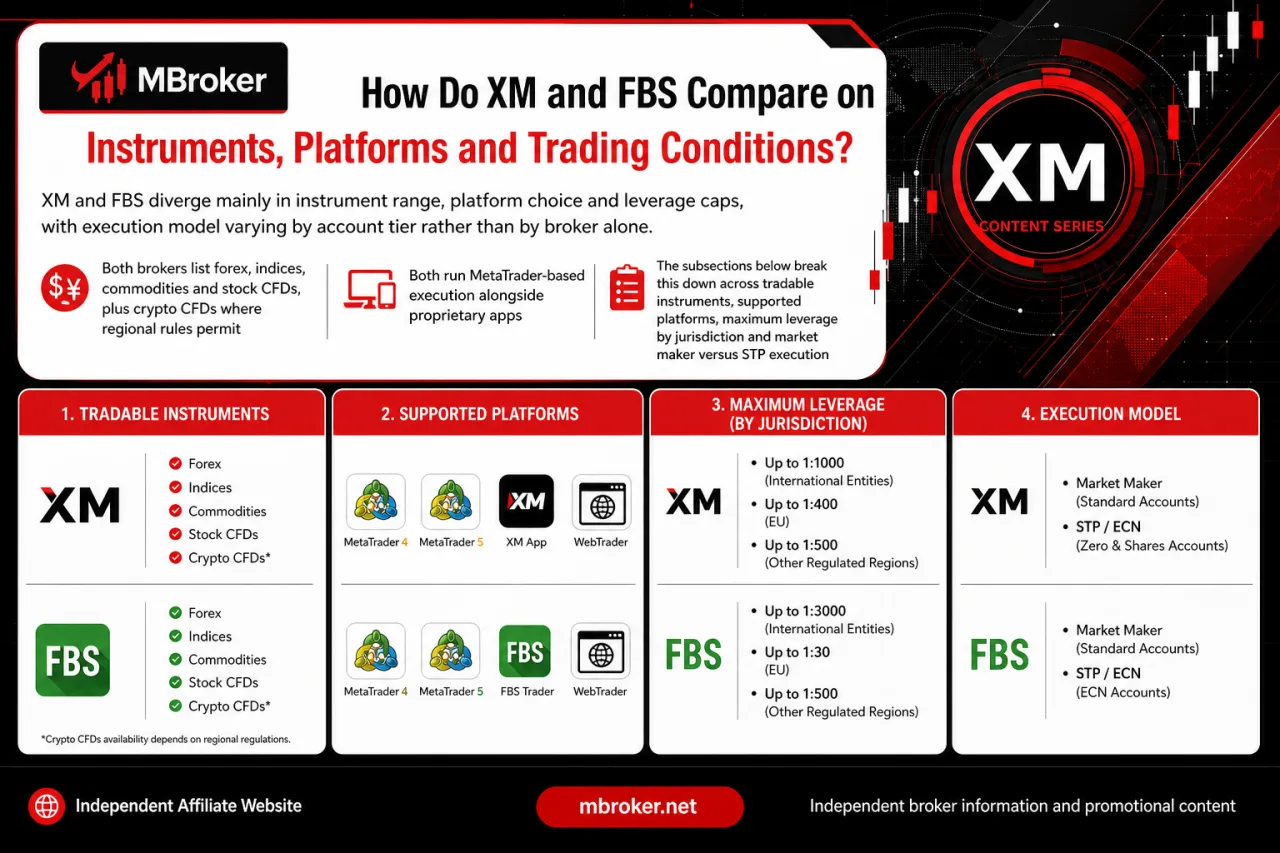
XM and FBS diverge mainly in instrument range, platform choice and leverage caps, with execution model varying by account tier rather than by broker alone. Both brokers list forex, indices, commodities and stock CFDs, plus crypto CFDs where regional rules permit, and both run MetaTrader-based execution alongside proprietary apps. The subsections below break this down across tradable instruments, supported platforms, maximum leverage by jurisdiction and market maker versus STP execution.
What Trading Platforms Do XM and FBS Support?
XM supports MetaTrader 4, MetaTrader 5 and a proprietary XM app, while FBS offers MetaTrader 4, MetaTrader 5 and its own FBS Trader app, with both brokers covering desktop, web and mobile access. Platform choice affects charting tools, order execution speed and cross-device syncing, so comparing desktop, web and mobile options across the two brokers matters for traders switching between setups.
Key distinctions include:
- Desktop terminals cover MetaTrader 4 and MetaTrader 5 on both brokers, supporting expert advisors and custom indicators.
- Web-based platforms let traders log in through a browser without installing software, mirroring most desktop terminal functions.
- Mobile apps include MetaTrader 4/5 mobile versions plus each broker’s proprietary app, XM App for XM and FBS Trader for FBS.
- Proprietary apps add features like in-app deposits, account management and market news alongside standard trading functions.
Exact feature sets and platform version availability differ by regulated entity and region for both XM and FBS, so traders should verify current platform offerings directly against each broker’s official platform page.
What Financial Instruments Can You Trade With Each Broker?
XM and FBS both list forex, indices, commodities and stock CFDs, while crypto CFDs and certain share CFDs remain restricted or unavailable depending on the client’s regulated entity and country. Comparing instrument range across the two brokers means checking category availability per entity rather than assuming a single global list applies to every trader.
Instrument categories offered across both brokers include:
- Forex pairs spanning majors, minors and exotics, with pricing and available pairs varying slightly by account type.
- Indices covering major global stock benchmarks as CFDs rather than direct equity ownership.
- Commodities including metals and energy products, traded as CFDs with leverage limits set per entity.
- Stock CFDs offering exposure to individual company shares, though the specific list differs between XM and FBS.
- Crypto CFDs available to clients under certain entities only, since regulators in some jurisdictions restrict or prohibit retail access to crypto derivatives.
Regional restrictions on crypto CFDs and select stock CFDs apply mainly to clients registered under stricter regulatory entities of both XM and FBS, so traders should verify current instrument availability directly against each broker’s official asset list for their specific region.
What Payment Methods and Country Restrictions Apply to XM and FBS?
XM and FBS both accept a range of deposit and withdrawal methods, while country access differs by regulated entity, with certain jurisdictions excluded from either broker’s client base entirely. Payment options, processing speed and fee structure vary by method and entity, and so does the list of restricted countries, points covered separately below.
XM supports deposits and withdrawals through bank wire transfer, credit and debit cards, and a selection of e-wallets, with the exact list of available options depending on the client’s country of residence and the entity under which the account is registered. Processing times generally differ between instant e-wallet transfers and slower bank wire settlements, and fee structures vary depending on the payment channel and the account’s regulated entity. Traders are advised to check XM’s official website for the current list of payment methods, processing timelines and any applicable charges tied to their specific region.
FBS likewise offers a mix of bank transfers, card payments and e-wallet options for funding and withdrawing accounts, with availability again tied to the client’s country and the FBS entity handling the account. Processing speed and transaction fees differ by method, and FBS publishes its own updated schedule of supported payment channels on its official platform.
Both brokers exclude residents of certain countries from opening accounts, largely due to local regulatory restrictions or sanctions affecting specific regulated entities. The precise list of restricted jurisdictions changes periodically and is best confirmed directly through each broker’s official website before attempting to register or fund an account.
How Do XM and FBS Customer Support Channels Compare?
XM operates support across live chat, phone and email in multiple languages with broad availability, while FBS offers similar channels with a comparable multilingual scope, though exact hours and language count differ by regulated entity. Comparing support quality across the two brokers means checking channel responsiveness, language coverage and availability window rather than assuming identical service applies globally.
Key distinctions across both brokers include:
- Live chat responds fastest on both XM and FBS for account and platform queries, functioning as the primary first-contact channel.
- Phone support covers region-specific numbers for both brokers, with availability tied to the regulated entity a trader registers under.
- Email support handles more complex account verification or dispute issues, typically carrying a longer response time than live chat.
- Availability windows differ by broker and entity, with some regions receiving near-continuous coverage and others limited to standard business hours.
Exact operating hours, language count and channel responsiveness for XM and FBS support teams shift periodically by entity and region, so traders should verify current support availability directly against each broker’s official contact page.

Thoren Vextal is Mbroker’s XM Reviews and How-To Guides Editor, covering broker reviews, regulation, comparisons and practical account guides.Email: [email protected]