
 Tiếng Việt
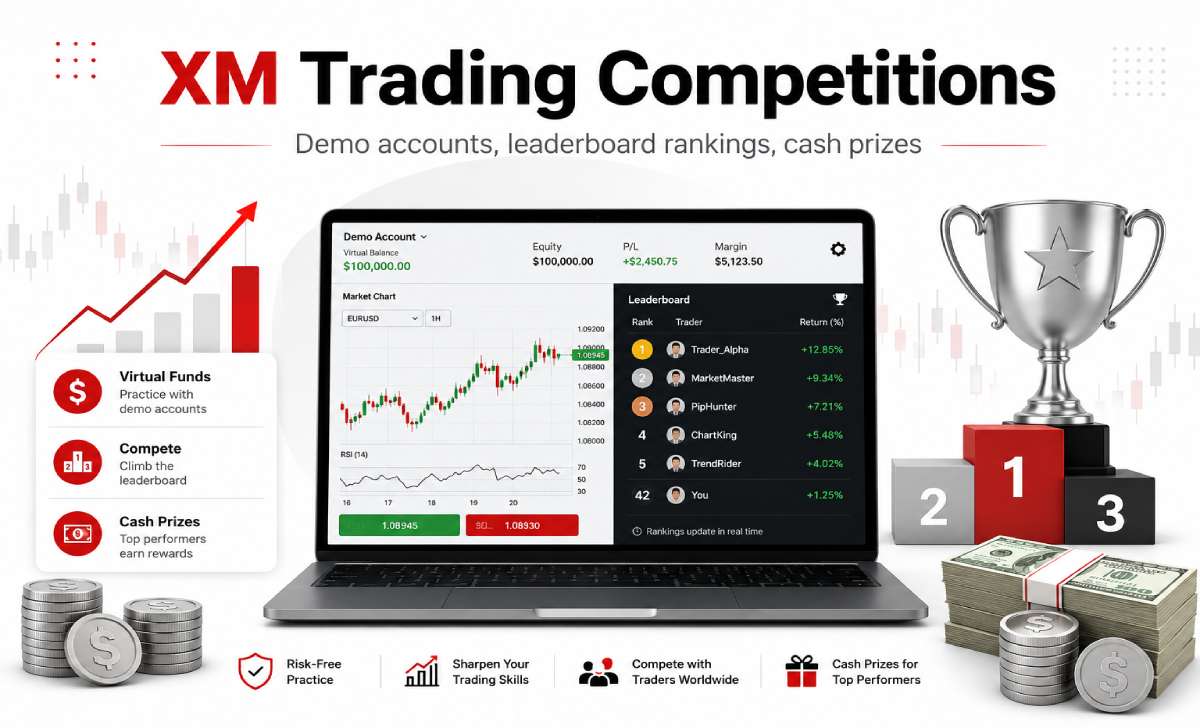
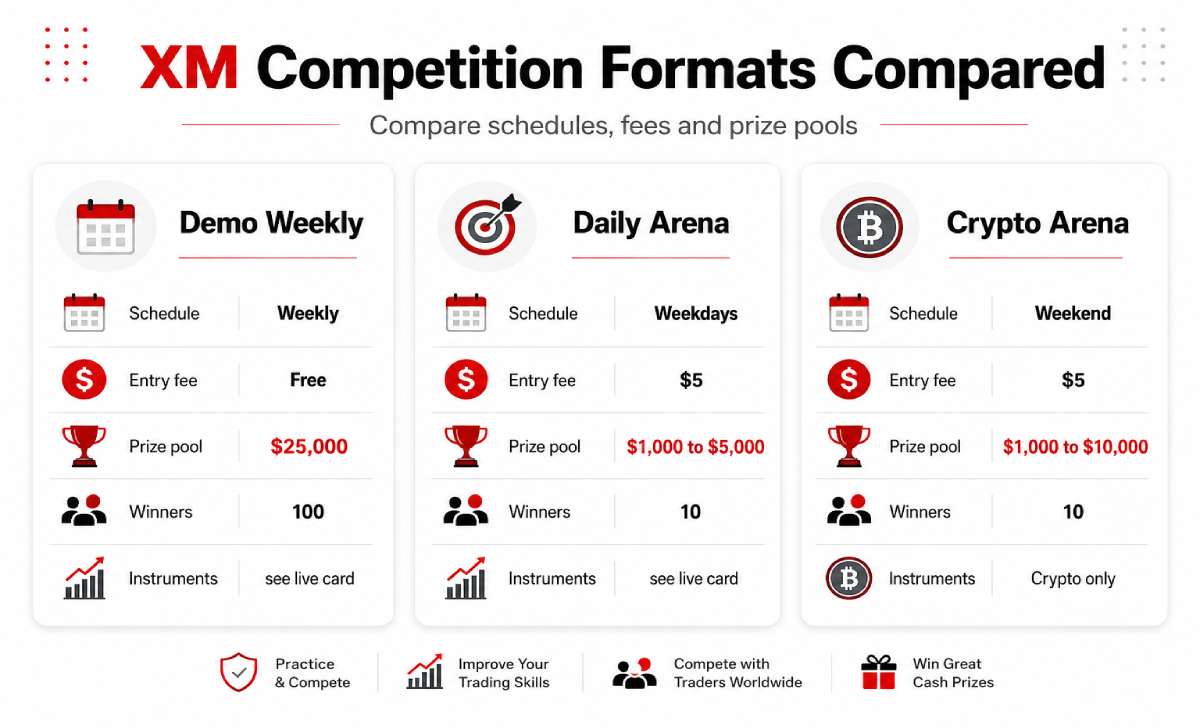
XM currently presents three demo-based competition formats: Demo Weekly, the $5,000 Daily Arena and the $10,000 Crypto Arena. Demo Weekly has no entry fee and advertises a $25,000 cash prize pool for 100 winners, while the two Arena formats charge $5 and award prizes to 10 winners.
To enter an XM trading competition, an eligible client needs at least one verified real trading account and must select an available event through XM’s dedicated competitions portal. Paid-demo entry fees are deducted from the client wallet and are non-refundable.
Leaderboard ranking is based on competition-account performance, not a random draw. XM orders participants by equity at the end of the event, while maximum-loss breaches, inactivity, duplicate registrations or prohibited trading activity can affect prize eligibility.
What XM Trading Competition Formats and Prizes Are Available?
XM currently advertises one free weekly demo competition and two paid demo arenas. They all use virtual trading funds, but their schedules, fees, prize structures and eligible instruments differ.
The following comparison shows the publicly advertised conditions checked on 17 July 2026. XM may change individual competition cards or limit availability by country, legal entity or client profile.
| Feature | Demo Weekly | $5,000 Daily Arena | $10,000 Crypto Arena |
| Schedule | Weekly | Every weekday | Every weekend |
| Entry fee | No entry fee | $5 | $5 |
| Trading funds | Virtual funds; amount shown on the competition card | Virtual funds; amount shown on the competition card | $1,000 in virtual funds |
| Advertised prize pool | $25,000 cash | Minimum $1,000, growing to $5,000 | Guaranteed $1,000, growing to $10,000 |
| Advertised winners | 100 | 10 | 10 |
| Instruments | Defined on the live competition card | Defined on the live competition card | Crypto only |
| Prize structure | Fixed prizes | Dynamic prizes based on participation | Dynamic prizes based on participation |
The advertised schedules, fees, prize pools and winner numbers come from XM’s public competition page. The terms define free demo prizes as fixed real funds and paid-demo prizes as dynamic cash rewards.
How Do Free and Paid XM Demo Competitions Differ?
The main difference is whether participants pay an entry fee and whether the prize pool changes with participation. Demo Weekly has no advertised entry fee and offers a fixed $25,000 pool, while the Daily and Crypto Arenas require $5 and use dynamic prize pools.
The initial competition balance and any profit generated inside the demo account remain virtual. They cannot be withdrawn or transferred. However, an eligible cash prize is credited as real funds to the winner’s XM wallet after the event, provided no disqualification or prize-cancellation condition applies.
A normal XM demo account is separate from a competition account. XM automatically creates the competition account for one event and permanently closes it when that event ends.
For other region-dependent offers, readers can review the broader XM Promotions section. An offer displayed on one country page should not be assumed to apply to every XM client.
The graphic below helps distinguish the three competition schedules, fees and advertised prize pools.
How Do You Enter an XM Trading Competition?
First, confirm that the competition appears in your XM profile and that your account meets its eligibility conditions. XM’s general terms require at least one verified real trading account for both free and paid demo competitions.
The entry process can be completed in four steps:
- Complete account verification. The profile must contain at least one verified real trading account with an accepted base currency.
- Open the Competitions section. Select an active or upcoming event available to the account.
- Review the competition card. Check the duration, starting balance, instruments, leverage, entry fee, participant limit, maximum-loss level and prize allocation.
- Confirm participation. XM creates a dedicated one-use competition account, which is closed when the event ends.
All competition trades must be placed through XM’s dedicated competition portal. The terms do not permit competition trading through MT4, MT5 or Expert Advisors unless a specific competition rule expressly states otherwise.
The following diagram shows why verification and a review of the live competition card should come before confirming entry.

What Should You Check Before Joining?
Do not rely only on the competition’s headline prize. The live card contains the conditions that determine how the account can be used and when it may be disqualified.
Check these details before confirming:
- Exact start and end times
- Entry and possible re-entry fees
- Initial virtual balance
- Available instruments
- Leverage and position limits
- Maximum-loss percentage
- Number of available places
- Prize distribution by rank
The $5 fee for a paid demo competition is deducted from the XM wallet and is non-refundable. Where re-entry is offered, each re-entry may require another fee and can be subject to a limit.
In addition, XM may offer competitions only to selected clients, countries or regions. Therefore, the competition portal assigned to the account is more reliable than instructions written for a different jurisdiction.
How Do XM Competition Ranking and Prize Rules Work?
XM ranks participants according to the performance of their dedicated competition accounts. The terms state that accounts with higher equity at the end of the competition receive higher leaderboard positions.
How Is XM Leaderboard Performance Calculated?
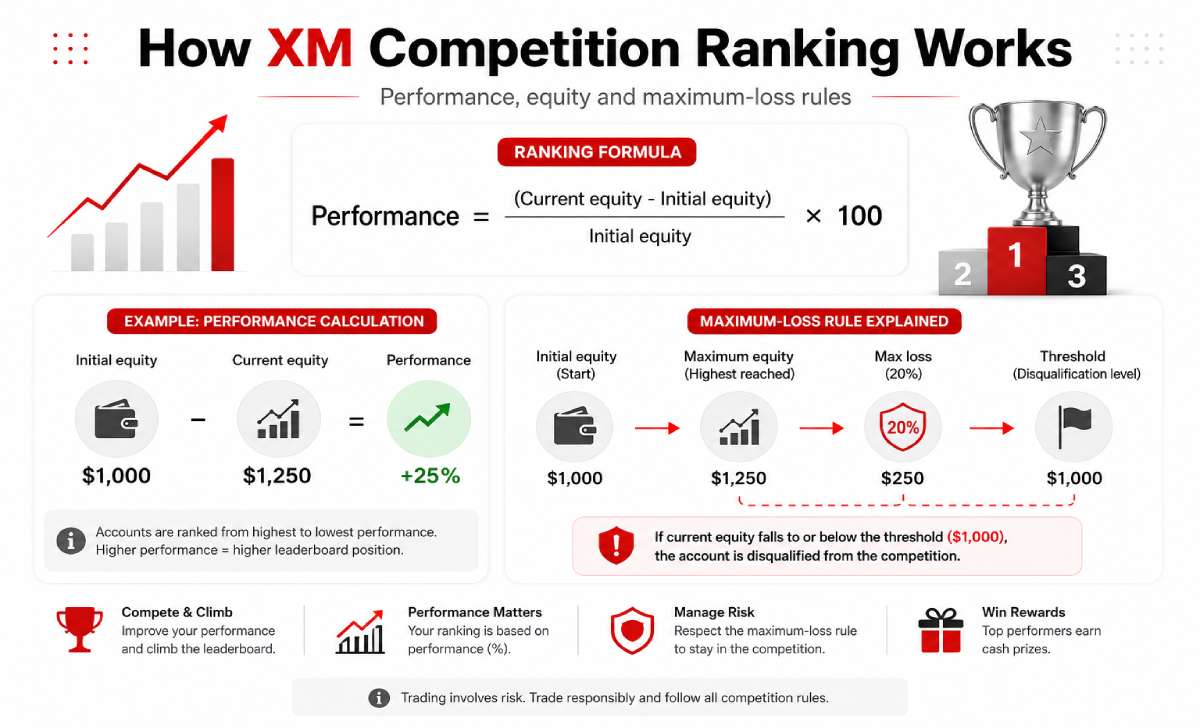
Performance measures the percentage change between current equity and initial equity. XM presents the calculation as:
Performance = (Current equity − Initial equity) ÷ Initial equity × 100
For example, an account beginning with $1,000 and reaching $1,250 has a 25% increase from its initial equity. XM records performance at observation intervals determined for the individual competition, while the final leaderboard is ordered from the highest ending equity to the lowest.
A participant’s broader XM account history does not count toward this ranking. Only activity recorded in the one-use competition account and competition portal is considered.
How Does the Maximum-Loss Rule Work?
A maximum-loss level can disqualify an account when its equity falls to or below the permitted threshold relative to its highest recorded equity. The applicable percentage is shown on the individual competition card.
For example, suppose:
- Initial equity is $1,000
- Maximum equity later reaches $1,250
- The maximum-loss level is 20%
- The disqualification threshold becomes $1,000
If current equity reaches or falls below $1,000, the competition account is disqualified under that example. XM’s terms note that equity is usually recorded at recurring observation intervals, often around ten minutes, although the exact interval varies by event.
This competition threshold is different from a trader-set Stop Loss order. A Stop Loss closes a selected position at a specified level, while the competition’s maximum-loss rule applies to overall account equity.
The diagram below illustrates how initial equity, maximum equity and the loss threshold interact.
What Can Cause Disqualification or Loss of a Prize?
A high leaderboard position does not guarantee payment when the account breaches competition rules. XM may review trading activity before distributing a prize.
Potential causes include:
- Reaching the competition’s maximum-loss level
- Registering more than one account for the same competition
- Using the same IP address for multiple participant registrations
- Using another client’s account
- Copying another participant’s trading strategy
- Using automated trading unless expressly permitted
- Remaining inactive throughout the competition
- Providing incorrect or fraudulent registration information
- Engaging in suspected manipulation, fraud or abusive activity
Where two or more eligible participants finish with exactly the same performance and ranking, the corresponding prize is divided equally between them. Inactive participants are excluded from prize distribution regardless of their displayed position.
A structured Forex trading strategy may help define entries, exits and risk limits, but it cannot guarantee a leaderboard position or prize.
Risk warning: Competition trading uses virtual funds, but paid entry fees are real and non-refundable. Results achieved in a demo competition do not indicate that the same strategy will perform similarly in live Forex or CFD trading, where leverage can result in substantial losses.
XM competitions can provide a structured way to test trading decisions against other participants, but the prize headline should not be the only selection criterion. Before entering, check the live card for eligibility, instruments, maximum loss, fees and prize allocation. Mbroker.net provides independent general information and cannot confirm whether a particular competition is available to an individual XM account.

Sylas Trenven is a forex strategist who helps traders master risk and timing. His work focuses on behavior-driven market entries and portfolio optimization for XM users looking to trade with precision and discipline. Email: [email protected]