
 Tiếng Việt

Best trading products are those that match your capital, risk tolerance, and trading experience, not a fixed list, as each product has different volatility and behavior.
However, trading products are mainly divided into forex, commodities, indices, and crypto, each with distinct characteristics in terms of volatility, liquidity, and trading conditions.
Therefore, beginners on XM should prioritize stable products like major forex pairs and indices, which offer lower volatility and more predictable price movements.
Additionally, XM provides access to multiple product types with flexible conditions, allowing traders to test and choose suitable instruments based on their strategy.
Finally, the best approach is to focus on 1–2 trading products and align them with a clear strategy, helping beginners avoid overtrading and improve consistency.
In financial markets, choosing the right trading products not only impacts trading performance but also determines the level of risk you face. However, there is no single “best” product for everyone—especially for beginners—because each asset within XM Products comes with its own characteristics and volatility.
What are the best trading products and how to define them correctly
The best trading products are financial instruments that align perfectly with a trader’s capital constraints, risk tolerance, and mechanical trading strategy.

Statistically, global financial markets process over $7.5 trillion in daily volume, distributed across various asset classes like currencies, equities, and commodities. Correctly defining these products involves evaluating their daily liquidity profiles, structural volatility percentages, and transaction cost margins (spreads) rather than hunting for an imaginary, universally profitable instrument.
What are trading products in financial markets?
In financial markets, trading products—often referred to as asset classes or instruments—are contract structures used by participants to speculate on price movements or hedge physical exposure. These products include foreign exchange pairs (Forex), contracts for difference (CFDs) on commodities, spot stock indices, and decentralized cryptocurrencies. Each product is governed by unique macroeconomic drivers, distinct trading hours, and specific margin requirements that dictate how capital behaves on your terminal.
Recognizing the diversity of these instruments helps clarify why an individual product can never satisfy the needs of every market participant.
Why is there no single “best” trading product for everyone?
There is no single “best” trading product because individual retail traders operate with entirely different psychological profiles, risk thresholds, and capital balances. For instance, an institutional day trader with a $100,000 portfolio might thrive in the high-volatility, 24/7 environment of Cryptocurrency CFDs, whereas a part-time retail beginner with a $500 account requires the predictable liquidity and tight spreads of major Forex pairs. What serves as an optimal wealth-generation vehicle for one portfolio strategy could quickly cause catastrophic drawdowns in another.
To isolate the specific instrument that fits your current profile, you must evaluate the structural differences across the broader financial spectrum.
Product types in trading and their market characteristics
Product types in trading are categorized into distinct asset classes, each possessing a unique market signature characterized by varying levels of daily volatility, systemic risk, and liquidity.

For example, the Foreign Exchange market operates with massive daily liquidity, resulting in ultra-low transaction costs, while commodities like gold or crude oil are heavily influenced by geopolitical events and supply-demand shocks, yielding wider intraday price swings. Sifting through these asset families allows a technical analyst to select an environment that matches their exact tactical requirements.
How do forex, commodities, indices and crypto differ?
The four primary asset classes differ fundamentally across several critical operational metrics:
- Forex (Currencies): The largest market globally, trading 24/5. It is driven by interest rate differentials and macroeconomic data, offering the tightest spreads and highly predictable trend channels.
- Commodities (Gold, Oil): Physical assets traded via CFDs. They exhibit intense directional volatility driven by geopolitical tensions, weather patterns, and global inflation metrics.
- Indices (S&P 500, DAX): Baskets of top-tier corporate stocks that represent the overall health of an economy. They have an inherent long-term upward bias and are less prone to single-company manipulation.
- Cryptocurrencies (Bitcoin, Ethereum): Highly speculative digital assets trading 24/7. They offer massive intraday percentage swings but suffer from wider spreads and sudden liquidity gaps.
Understanding these structural differences is the first step toward identifying which environments are safest for developing market skills.
Which trading products are more stable and beginner-friendly?
Major currency pairs (such as EUR/USD or GBP/USD) and blue-chip stock indices (like the S&P 500) are universally recognized as the most stable and beginner-friendly trading products. Statistically, major currency pairs maintain an average daily volatility range of just 0.5% to 1%, allowing beginners to manage their risk parameters without facing sudden, unmanageable gaps in price. Stock indices offer a similar safety shield because the diversification of holding dozens of underlying companies prevents single-stock earnings surprises from destroying your trading margin.
Once you understand these generic asset characteristics, you can apply this knowledge directly to the specific infrastructure offered by top-tier global brokers.
How to choose the right trading products on XM?
Choosing the right trading products on XM requires a systematic evaluation of the broker’s underlying account specifications, contract sizes, and localized fee structures.

The XM platform provides access to over 1,000+ instruments across multiple asset classes, allowing traders to customize their portfolios with institutional precision. Making the correct choice involves filtering this massive asset catalog through your personal capital restrictions and execution constraints to ensure your strategy operates at peak mathematical efficiency.
What factors should traders consider when selecting products?
When selecting an instrument on your trading terminal, you must calculate four definitive operational metrics:
- Average Spread Cost: The pip or point distance between the buy and sell price, which directly impacts your entry friction.
- Margin Requirements: The amount of collateral required to open a position, governed by the asset’s built-in leverage ratio.
- Daily Volatility Index: The average historical pip movement over a rolling 20-day period, highlighting the asset’s speed.
- Swap Fees (Overnight Interest): The cost or credit received for holding a position past the daily market close, which is vital for swing traders.
While these mathematical variables are fixed, how you weigh them depends entirely on your operational timeframe.
How does trading style influence product selection?
Your choice of trading style dictates which asset characteristics will optimize your performance. A scalper or day trader requires ultra-tight spreads and maximum liquidity, making high-volume instruments like EUR/USD or the US30 index their primary battlegrounds. Conversely, a swing trader or position investor holds trades for weeks and focuses heavily on macro trends and swap fees, allowing them to comfortably trade volatile commodities or exotic currency pairs without being hindered by minor intraday spread expansions.
By aligning these trading styles with the specialized product categories structured on XM, beginners can drastically flatten their learning curves.
Best trading products for beginners on XM
The best trading products for beginners on XM are structured instruments that allow micro-lot allocation, feature transparent pricing models, and maintain low margin requirements.
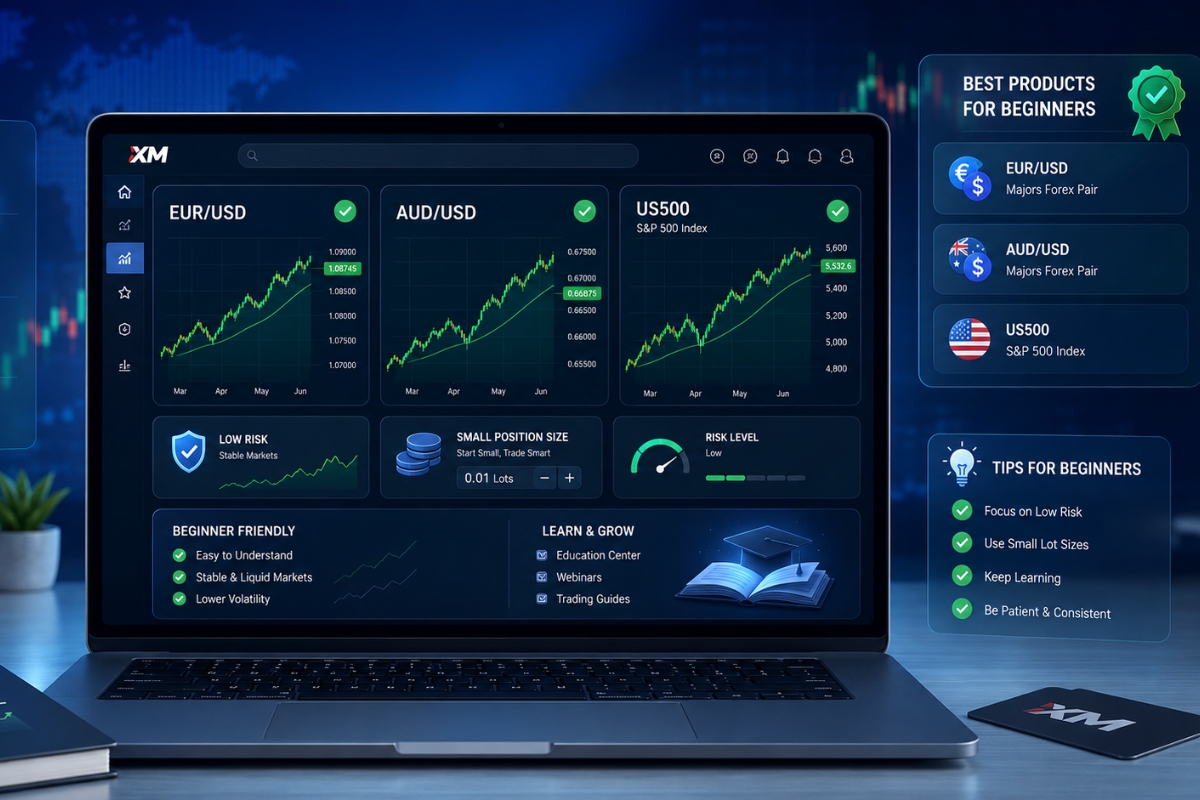
For a trader entering the live market with limited experience, the ideal starting point on XM is the Standard or Micro Account utilizing major currency pairs like EUR/USD, AUD/USD, and USD/JPY. These specific setups provide a highly defensive learning environment where a beginner can execute real trades, experience live market psychology, and absorb mistakes without risking significant sums of capital.
Which trading products are best for beginners on XM?
For a beginner navigating the XM platform, the top three recommended instruments are:
- EUR/USD (Euro/US Dollar): Offers the absolute lowest spreads on the platform (often dropping to 0.0 pips on XM Ultra Low accounts), ensuring minimal entry costs.
- AUD/USD (Australian Dollar / US Dollar): Exhibits highly stable, clean technical trend structures that respect classic support and resistance lines.
- US500 (S&P 500 CFD): Allows beginners to capture the broader upward momentum of the US economy with fractional contract sizes, bypassing single-stock volatility.
Selecting these defensive assets is a vital strategic move designed to keep you safe from the extreme market anomalies that routinely wipe out uneducated retail participants.
Why should beginners avoid high-risk products?
Beginners must strictly avoid high-risk products like exotic currency pairs, crude oil, and minor cryptocurrencies because these instruments are highly prone to slippage, massive spread widening, and sudden liquidity blackouts. An exotic pair like USD/TRY can experience rapid intraday swings of 3% to 5% during low-liquidity sessions, which can completely bypass a trader’s standard stop-loss order and trigger an immediate margin call. Without advanced data feeds and automated risk scripts, managing these volatile environments is mathematically impossible for a novice.
To transition from a defensive defensive posture to active wealth generation, you must learn to integrate these approved products into a structured trading plan.
Applying trading products to real trading strategies
Applying trading products to real trading strategies requires a methodical process where the behavioral properties of the chosen asset perfectly complement the core logic of your technical indicators.
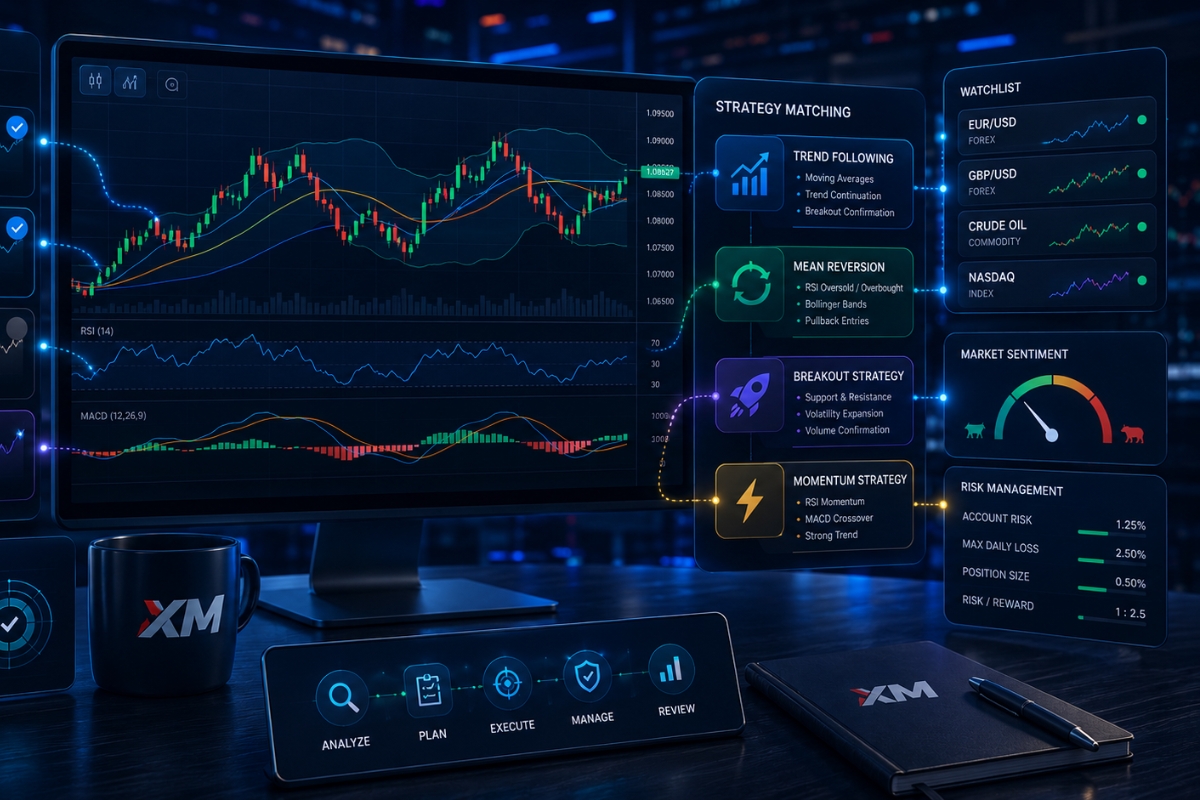
For example, trend-following strategies using moving averages require highly directional assets that maintain consistent momentum over long periods. When traders deploy these structured strategy-product pairings through the advanced educational portals and premium execution setups advocated by MBroker, they create an institutional-grade workflow that eliminates emotional bias.
How to match trading strategies with specific products?
To maximize your win rate, you must pair your technical strategy with an asset class that natively exhibits the matching behavioral profile:
- Trend-Following Strategies (e.g., Moving Average Crossovers): Should be applied to highly directional macro instruments like Crude Oil (WTI) or GBP/USD, which tend to maintain prolonged trends due to macroeconomic forces.
- Mean-Reversion Strategies (e.g., RSI Overbought/Oversold): Work best on highly stable, range-bound instruments like EUR/GBP, where price naturally gravitates back toward a central historical average.
- Breakout Strategies (e.g., Bollinger Band Expansion): Should be deployed on highly explosive equity indices like the US100 (Nasdaq) during the New York session open when institutional volume floods the market.
While matching your strategy is critical, keeping your absolute focus tight and concentrated prevents cognitive overload from destroying your execution discipline.
How many trading products should beginners focus on?
A beginner should focus exclusively on a maximum of 1 to 3 trading products during their first six months of live market execution. Attempting to scan a watchlist of 30 different currency pairs, stocks, and crypto tokens creates intense cognitive fatigue, leading to forced entries and missed setups. By deeply concentrating on a single instrument like EUR/USD, a novice can intimately learn its daily session ranges, understand how it reacts to specific news events (like Non-Farm Payrolls), and master its structural quirks, resulting in superior execution quality.
In summary, selecting the Best Trading Products is a highly individualized process that relies on finding a perfect match between asset liquidity, structural volatility, and your personal risk parameters. By focusing on stable instruments like major Forex pairs on XM, limiting your live watchlist to 3 assets, and utilizing the execution frameworks championed by MBroker, you can safely transform market volatility into a sustainable commercial business model.

Sylas Trenven is a forex strategist who helps traders master risk and timing. His work focuses on behavior-driven market entries and portfolio optimization for XM users looking to trade with precision and discipline. Email: [email protected]