
 Tiếng Việt
XM Forex trading is a form of CFD trading, a financial instrument that allows individuals to speculate on price movements, such as exchange rate movements between currency pairs, without actually owning or exchanging any physical currency or asset. Traders open Buy or Sell positions based on whether they expect a currency pair’s price to rise or fall.
XM classifies its Forex offering into several categories. Forex trading generally involves major, minor and exotic currency pairs, with tickers such as EURUSD, GBPUSD, USDJPY, AUDUSD, EURGBP and USDTRY representing each category. The exact list and number of pairs offered depend on the trading platform and account type used.
Trading conditions on XM Forex pairs are defined by several key factors. Trading conditions such as contract size, minimum and maximum volume, spread, commission, swap and leverage vary by currency pair and account type. These figures determine both the cost of opening a position and the margin required to maintain it.
Trading costs on XM Forex combine several elements. Spread, commission where applicable, and swap charges for positions held overnight are all trading costs that fluctuate rather than stay fixed. These floating costs depend on market liquidity, the specific pair traded and the chosen account type.
Risks in XM Forex CFD trading stem from leverage and market conditions. Leverage can amplify losses, and traders should also be aware of sudden volatility, spread widening, price slippage, margin calls and stop outs. Leverage levels themselves differ according to the trading entity, region and account equity involved.
Forex profit, loss and margin on XM are calculated using pip value, lot size and leverage, where a simple example shows how a small price movement translates into monetary gain or loss, based on the general formula: pip value = lot size × contract size × pip size. Checking each pair’s current contract specifications before trading confirms these figures precisely.
This article, prepared independently by Mbroker as an educational resource on XM rather than an official XM channel, begins by explaining what XM Forex trading is and how currency pair CFDs function in practice.
What Is XM Forex Trading?
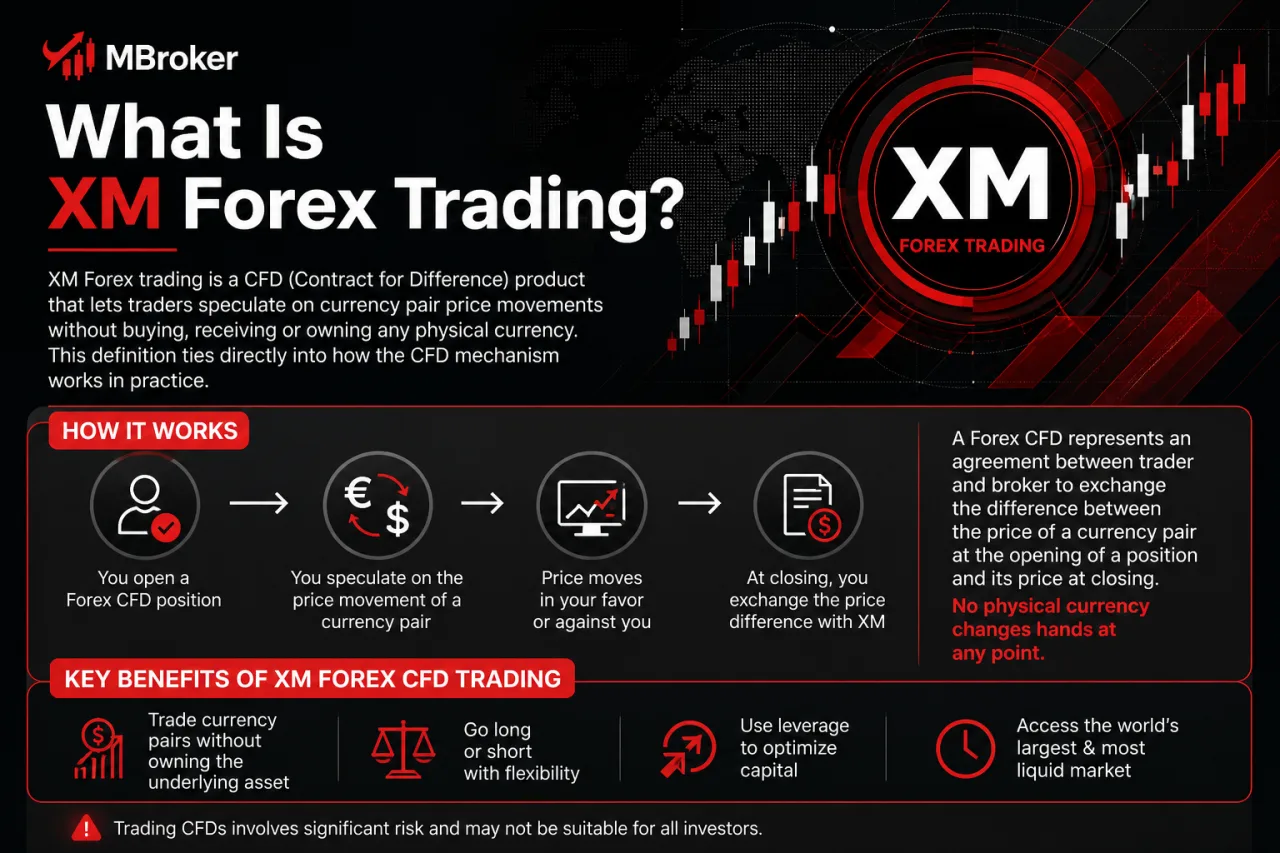
XM Forex trading is a CFD (Contract for Difference) product that lets traders speculate on currency pair price movements without buying, receiving or owning any physical currency. This definition ties directly into how the CFD mechanism works in practice.
A Forex CFD represents an agreement between trader and broker to exchange the difference between the price of a currency pair at the opening of a position and its price at closing. No physical currency changes hands at any point.
The trader’s profit or loss depends entirely on the direction and size of that price difference:
- Opening a Buy position speculates on the pair’s price rising.
- Opening a Sell position speculates on the pair’s price falling.
- Closing the position settles the difference between entry and exit price in the account’s base currency.
Because ownership of currency is never involved, XM Forex CFDs separate speculative trading from actual currency exchange or holding foreign funds. This structure applies across all currency pairs offered on the platform, regardless of category or ticker.
Which Forex Currency Pairs Are Available on XM?
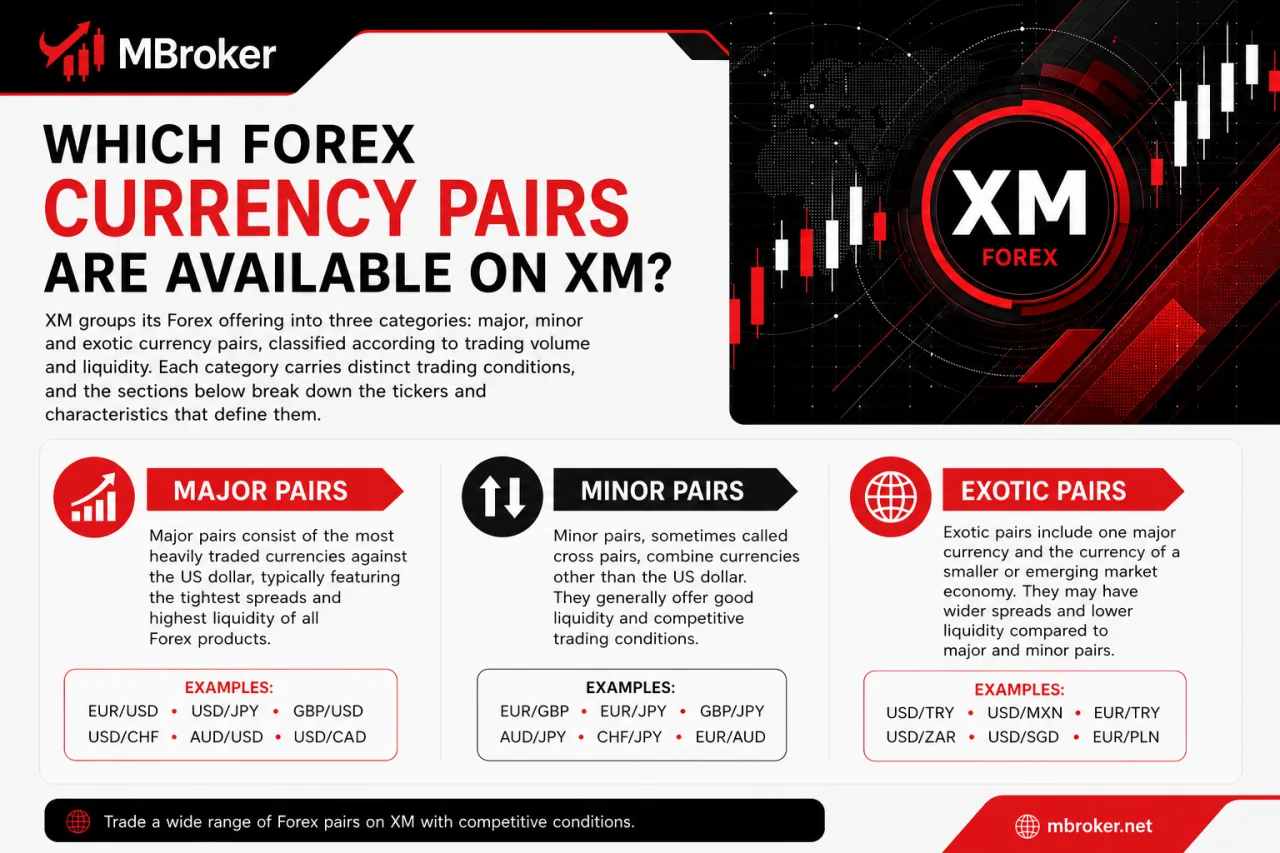
XM groups its Forex offering into three categories: major, minor and exotic currency pairs, classified according to trading volume and liquidity. Each category carries distinct trading conditions, and the sections below break down the tickers and characteristics that define them.
Major pairs consist of the most heavily traded currencies against the US dollar, typically featuring the tightest spreads and highest liquidity of all Forex products. Minor pairs, sometimes called cross pairs, combine two major currencies without involving the US dollar directly. Exotic pairs pair a major currency with the currency of a smaller or emerging economy, generally carrying wider spreads and lower liquidity than majors or minors.
- EURUSD and GBPUSD represent common major pairs.
- USDJPY and AUDUSD also fall under the major pairs category.
- EURGBP illustrates a typical minor pair.
- USDTRY serves as an example of an exotic pair.
The exact total number of Forex pairs available on XM varies by trading platform and account type, so traders should verify the current list directly on the platform before opening any position.
What Are Major Forex Pairs on XM?
Major Forex pairs on XM consist of the most heavily traded currency pairs, each involving the US dollar paired against another leading global currency. This category anchors the broader currency pair classification described above, so the traits below explain what sets majors apart.
Major pairs carry the tightest spreads and highest liquidity among Forex products on XM, a result of the trading volume concentrated in these tickers globally. Major currency pairs such as EURUSD, GBPUSD and USDJPY are typically listed among the currency pairs offered on the XM platform.
Common characteristics of major pairs include:
- Pairing the US dollar with another dominant global currency.
- Carrying narrower spreads compared to minor or exotic pairs.
- Offering higher liquidity due to greater trading volume.
- Reacting closely to major economic releases and central bank policy.
Exact spread and margin figures for each major pair still vary by account type and prevailing market conditions on the platform.
What Are Minor and Exotic Forex Pairs on XM?
Minor Forex pairs on XM combine two major currencies without the US dollar, while exotic pairs pair a major currency with an emerging market currency. This distinction directly separates the two remaining categories in the currency pair classification introduced earlier, each carrying its own liquidity and spread profile.
Minor pairs, also called cross pairs, exclude the US dollar entirely and instead combine two currencies from major economies. EURGBP represents a typical minor pair, pairing the euro against the British pound. Minor pairs generally carry moderate liquidity and spreads that sit between majors and exotics on the XM platform.
Exotic pairs combine one major currency with the currency of a smaller or emerging economy. USDTRY illustrates a typical exotic pair, pairing the US dollar against the Turkish lira. Exotic pairs on XM typically carry wider spreads and lower liquidity than major or minor pairs, a result of thinner trading volume in these emerging market currencies.
Key differences between the two categories:
- Composition: minor pairs combine two major currencies, while exotic pairs combine a major currency with an emerging market currency.
- Liquidity: minor pairs offer moderate liquidity, while exotic pairs offer lower liquidity overall.
- Spread: minor pairs carry tighter spreads, while exotic pairs carry noticeably wider spreads.
Exact spread and volume conditions for each minor or exotic pair still vary by account type and current market liquidity, so checking the live contract specifications on the platform before trading remains necessary.
How Do XM Forex Pairs Work?
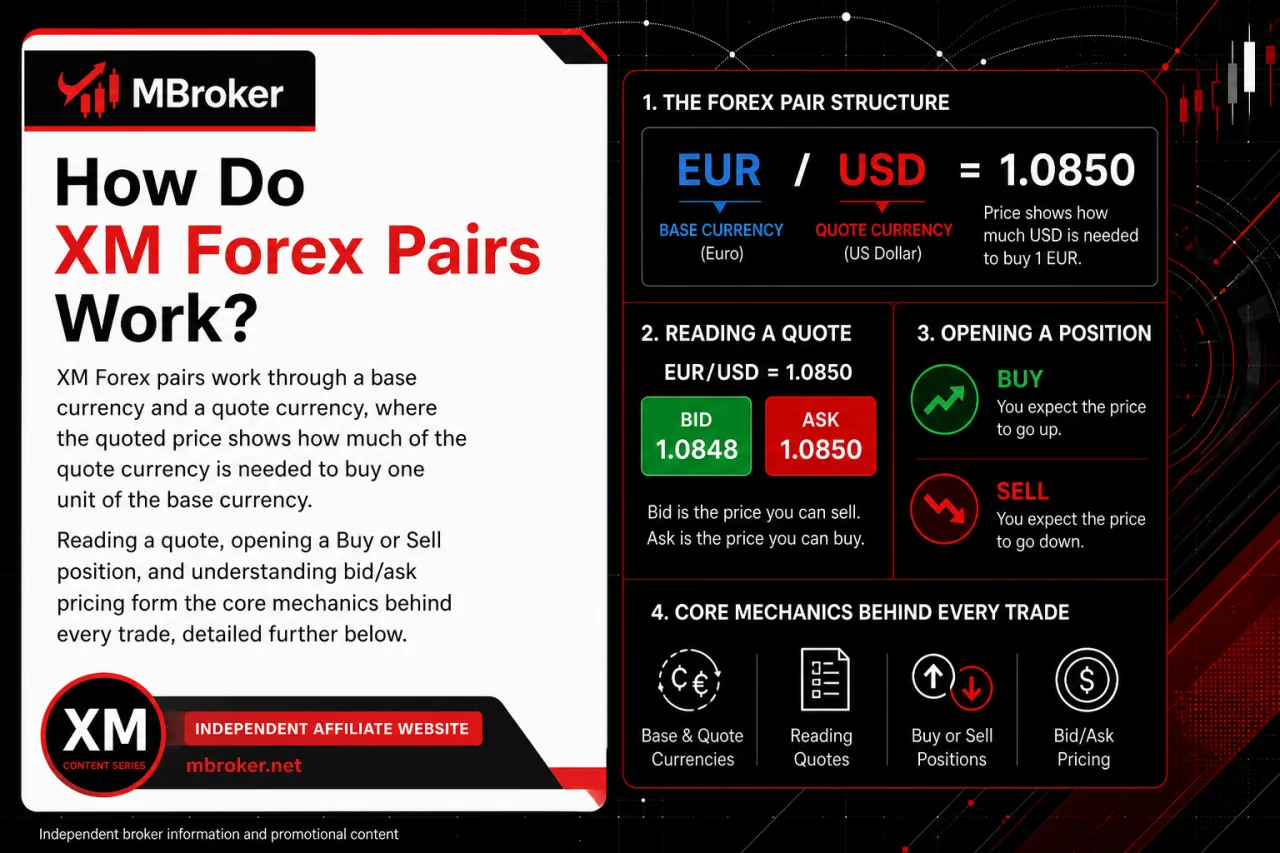
XM Forex pairs work through a base currency and a quote currency, where the quoted price shows how much of the quote currency is needed to buy one unit of the base currency. Reading a quote, opening a Buy or Sell position, and understanding bid/ask pricing form the core mechanics behind every trade, detailed further below.
How to Read a Currency Pair Quote?
To read a currency pair quote, the first three letters identify the base currency and the last three identify the quote currency, showing how much of the quote currency equals one unit of the base currency. This structure applies to every ticker on XM, from majors to exotics, and understanding it clarifies exactly what a price movement means for a position.
Take EURUSD as an example. EUR sits as the base currency, USD sits as the quote currency, and the displayed price shows how many US dollars are needed to buy one euro.
Every quote also shows two prices side by side: the bid price and the ask price. The bid represents the price at which the market buys the base currency from the trader, while the ask represents the price at which the market sells it to the trader.
The gap between these two figures forms the spread, which reflects the cost of entering a position at that moment. Spread width on XM fluctuates rather than staying fixed, moving with market liquidity and the specific pair being quoted.
How Do Buy and Sell Positions Work in Forex?
Opening a Buy position on an XM Forex pair expresses an expectation that the base currency appreciates against the quote currency, while opening a Sell position expresses an expectation that it depreciates. This direction determines how lot size and pip movement translate into profit or loss on the position.
The mechanics of order execution differ depending on direction:
- A Buy order enters the market at the ask price and closes at the bid price, gaining value as the pair’s price rises.
- A Sell order enters at the bid price and closes at the ask price, gaining value as the pair’s price falls.
- Lot size sets the volume of the position, determining how much each pip of movement is worth in monetary terms.
- A larger lot size means each pip shift produces a larger swing in profit or loss, regardless of whether the position is a Buy or a Sell.
The direction chosen, Buy or Sell, only decides which way price movement generates a gain rather than affecting the pip value calculation itself. Position size and pip movement together determine the actual monetary result once the trade closes.
What Are the XM Forex Trading Conditions?
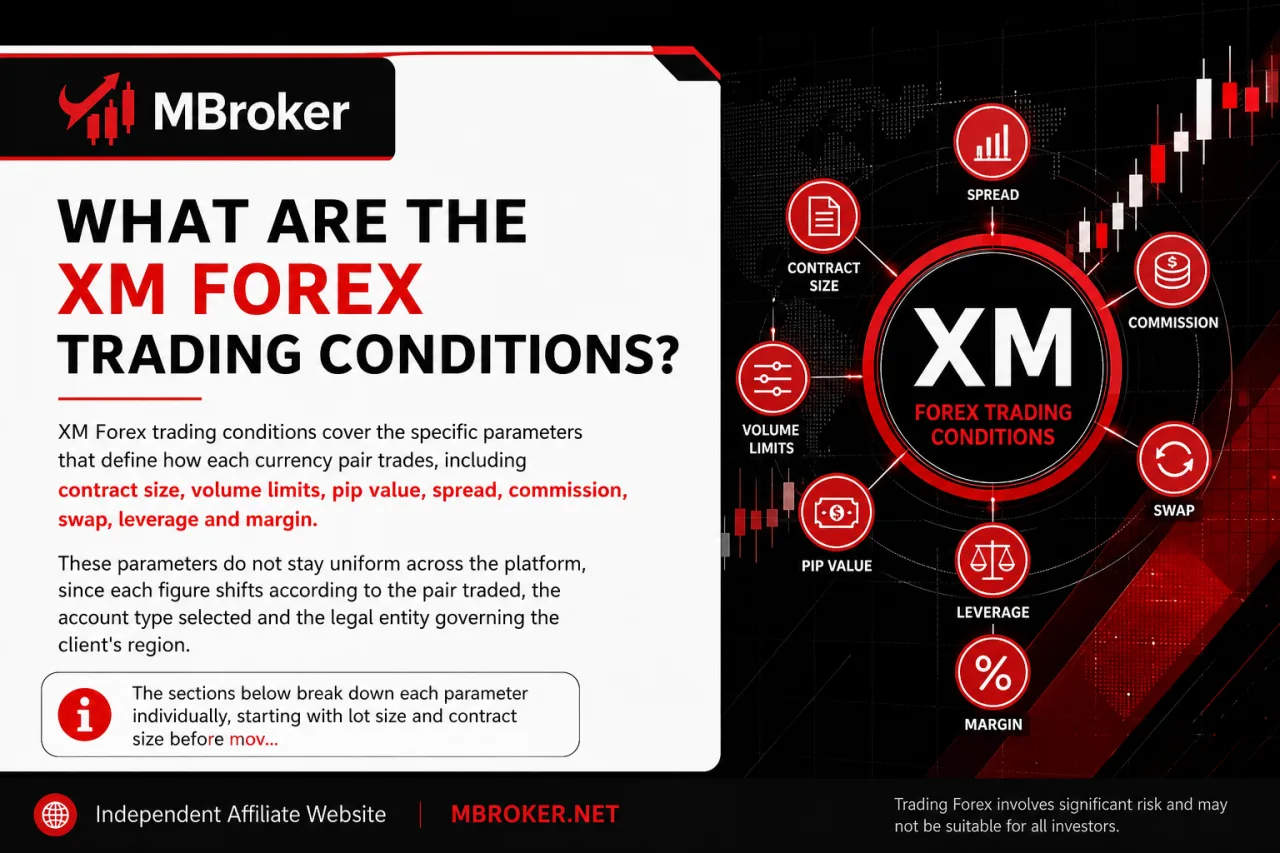
XM Forex trading conditions cover the specific parameters that define how each currency pair trades, including contract size, volume limits, pip value, spread, commission, swap, leverage and margin. These parameters do not stay uniform across the platform. Each figure shifts according to the pair traded, the account type selected and the legal entity governing the client’s region.
The sections below break down each parameter individually. The breakdown starts with lot size and contract size before moving into cost and margin components.
What Is Contract Size, Lot and Volume in XM Forex?
Contract size, lot and volume in XM Forex define how much currency a single position represents, with a standard lot equal to 100,000 units of the base currency. This measurement determines the actual exposure behind any Buy or Sell position, so understanding the different lot sizes and volume limits clarifies how position sizing works before a trade opens.
A standard lot represents 100,000 units of the base currency, while a mini lot represents one-tenth of that amount (10,000 units) and a micro lot represents one-hundredth (1,000 units). Smaller lot sizes allow traders to open positions with reduced exposure per pip movement compared to a standard lot.
Each currency pair on XM carries its own minimum volume, maximum volume and volume step, meaning the smallest position size, the largest position size and the increment allowed between them differ from one instrument to another. On many XM account types, the minimum volume for a standard trade sits at 0.01 lot (a micro lot), with the volume step typically also set at 0.01 lot, though maximum volume limits vary depending on the specific pair and account category.
Contract size itself also differs by instrument category, since exotic pairs sometimes carry different contract terms than majors or minors. Traders comparing a major pair against an exotic pair notice this difference directly in the margin required and in the pip value calculation, which underlines why verifying specifications per pair remains a practical step rather than assuming uniform values across the platform.
What Are Leverage and Margin Requirements for XM Forex?
Leverage and margin requirements for XM Forex define how much exposure a trader controls relative to the capital deposited, expressed as a ratio such as 1:30 or higher depending on the legal entity and account regulation. This ratio, along with the margin needed to open and sustain a position, directly determines how much capital a trade actually requires beyond the pip and cost mechanics already outlined.
Leverage multiplies the position size a trader can control using a smaller amount of deposited capital, meaning a modest deposit opens a much larger notional position than the account balance alone would allow. According to the Client Agreement, Terms and Conditions of Business published for the XM UK entity, leverage ratios can be adjusted, and any decrease in the leverage ratio affects the Margin Level, Margin Call Level and Stop-out Level for that entity. Leverage ratios and these related thresholds differ across accounts, account types and regulatory regions, so the same trader may see different terms depending on which legal entity holds the account, and the specific terms applicable to the registered entity should be checked directly.
Margin represents the portion of account equity set aside as collateral to open and hold a position, calculated from the position’s notional value divided by the leverage ratio applied. Free margin refers to the remaining equity still available to open new positions or absorb floating losses after the required margin has been allocated.
As open positions move against the trader, free margin shrinks, and checking the live margin requirement for each currency pair before opening a position confirms the exact figures under current account conditions.
How Much Does It Cost to Trade Forex on XM?
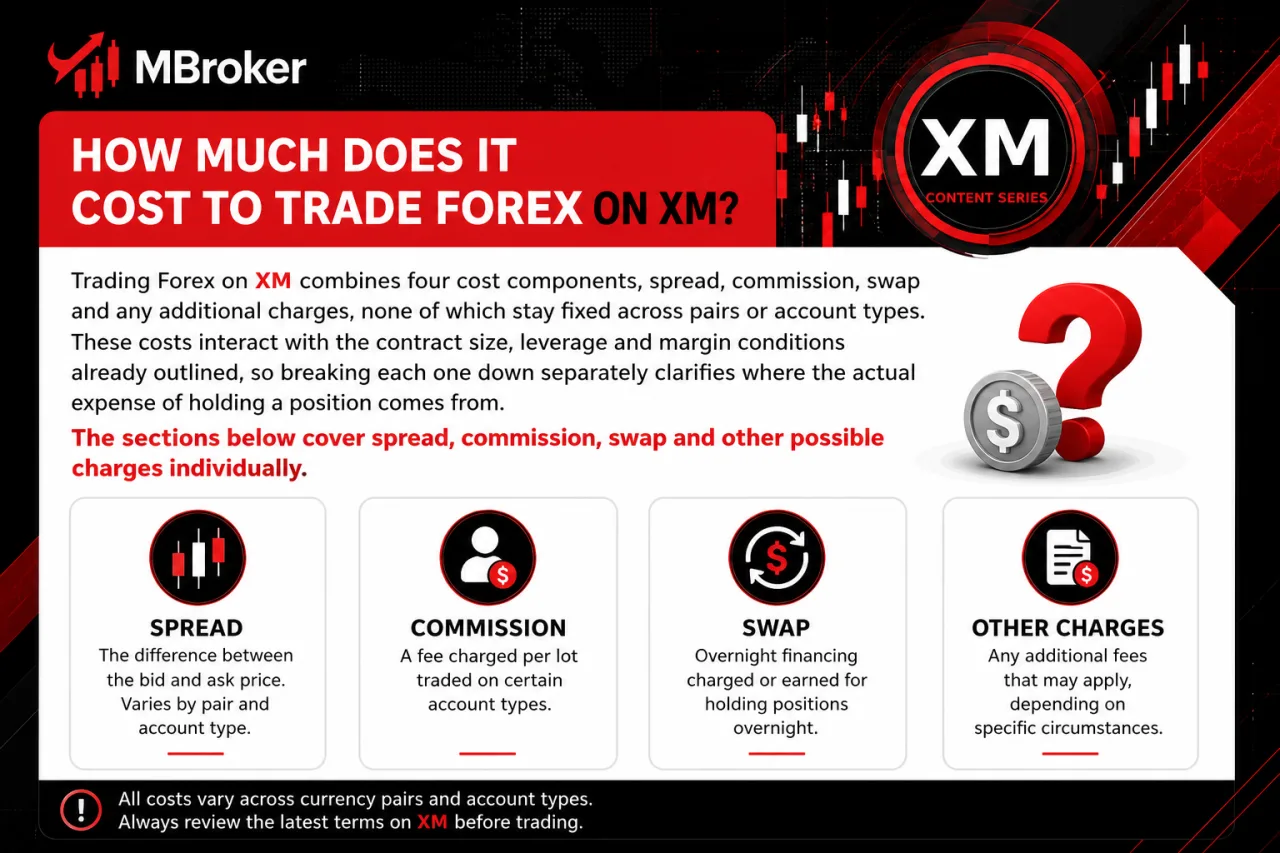
Trading Forex on XM combines four cost components, spread, commission, swap and any additional charges, none of which stay fixed across pairs or account types. These costs interact with the contract size, leverage and margin conditions already outlined, so breaking each one down separately clarifies where the actual expense of holding a position comes from. The sections below cover spread, commission, swap and other possible charges individually.
What Is Spread and Commission in XM Forex?
Spread and commission in XM Forex represent two separate cost components, where spread stays floating and shifts with market liquidity, while commission applies as a fixed charge only on specific account types. This distinction determines the actual cost structure behind every position, so breaking down how each component behaves clarifies where the expense comes from.
Spread is the gap between the bid and ask price of a currency pair, and it widens or narrows depending on liquidity conditions and the specific pair traded rather than staying fixed throughout the trading day. Spread-only accounts price this cost into the bid/ask gap itself, meaning no separate charge appears alongside the trade.
Commission-based accounts work differently. Commission-based accounts on XM add a separate fixed charge per trade, typically paired with a narrower spread compared to spread-only account types, though exact figures vary by account type and should be verified on the platform before trading.
The choice between these two cost structures affects the total cost of a position:
- Spread-only accounts embed the entire trading cost into the bid/ask difference.
- Commission-based accounts split the cost between a narrower spread and a fixed per-trade fee.
- Account type selection changes which of these two cost structures applies to a given position.
Checking the current spread and commission figures on the platform confirms the exact cost for each pair and account type before opening a trade.
What Is Swap or Overnight Fee in XM Forex?
Swap or overnight fee in XM Forex is a charge or credit applied when a position stays open past the platform’s daily rollover cutoff, reflecting the interest rate differential between the two currencies in the pair. This mechanism sits apart from spread and commission already covered, since it only activates when a trade carries over rather than closing within the same trading day.
Each currency pair holds its own long swap rate and short swap rate, meaning a Buy position and a Sell position on the same pair typically incur different overnight charges. A swap is essentially the interest rate differential between the currencies in the pair being traded, and it is credited or debited depending on the position held, so holding a position where the base currency carries a higher interest rate than the quote currency generally generates a credit rather than a charge.
Swap rates also fluctuate rather than staying fixed, since central bank rate changes and shifts in market conditions adjust the differential over time. Positions held over certain weekdays sometimes incur a multiplied swap charge to account for weekend settlement.
Checking each pair’s current swap rate on the platform confirms the exact figure applied to a specific position before holding it overnight.
What Are XM Forex Trading Hours?
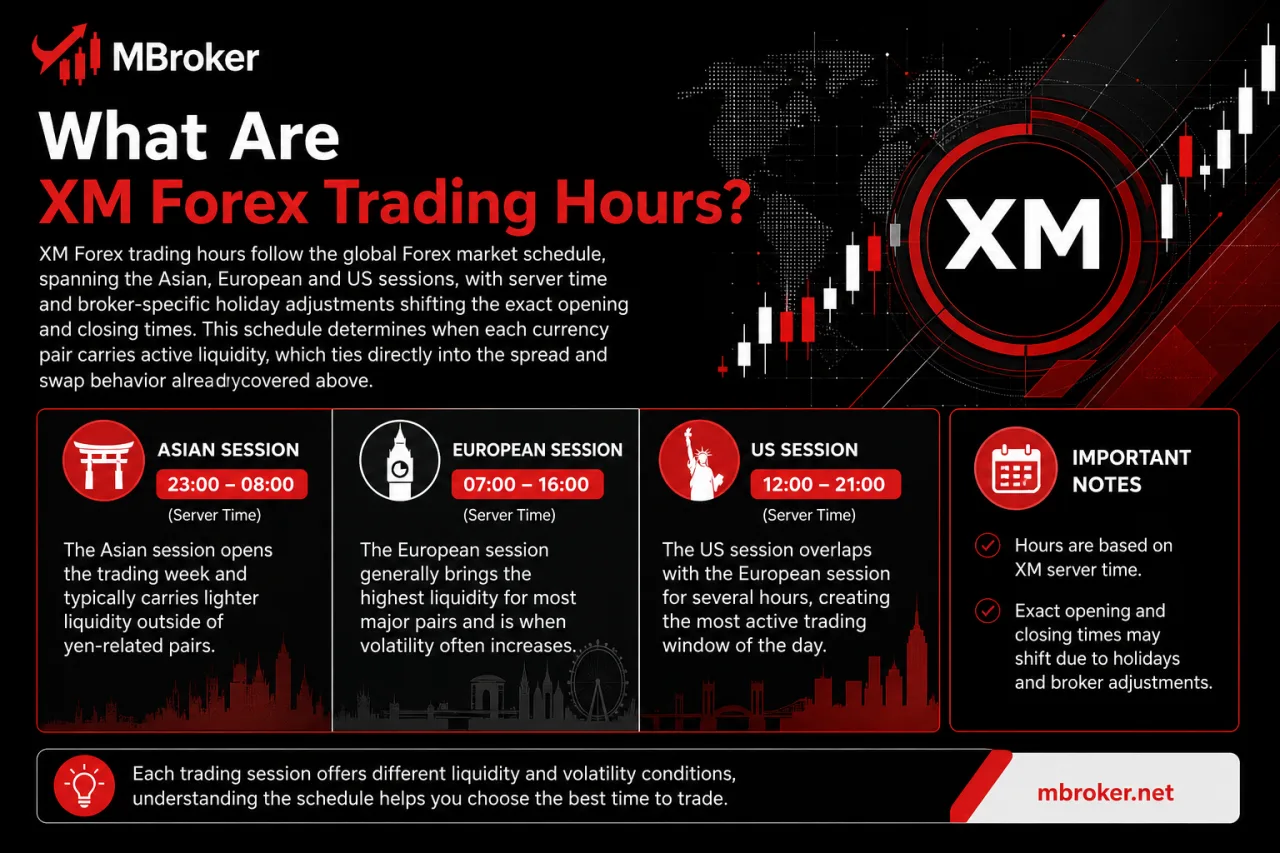
XM Forex trading hours follow the global Forex market schedule, spanning the Asian, European and US sessions, with server time and broker-specific holiday adjustments shifting the exact opening and closing times. This schedule determines when each currency pair carries active liquidity, which ties directly into the spread and swap behavior already covered above.
The Asian session opens the trading week and typically carries lighter liquidity outside of yen-related pairs. The European session generally brings a noticeable rise in trading volume, particularly for pairs involving the euro, pound and Swiss franc, so traders should check XM’s platform for the exact server-time schedule of this session.
The US session overlaps partially with the European session, and this overlap window typically produces the highest liquidity and tightest spreads of the trading day across major pairs. Trading activity tends to thin outside these overlap periods, widening spreads on some tickers as a result.
Public holidays and reduced-liquidity periods can shorten trading hours or widen spreads on specific currency pairs, so traders should check XM’s platform for the exact holiday schedule and server-time adjustments before placing trades.
Checking the current trading schedule and server time on the platform before placing an order confirms the exact hours applicable to a given pair at that moment.
How Are Forex Profit, Loss and Margin Calculated?
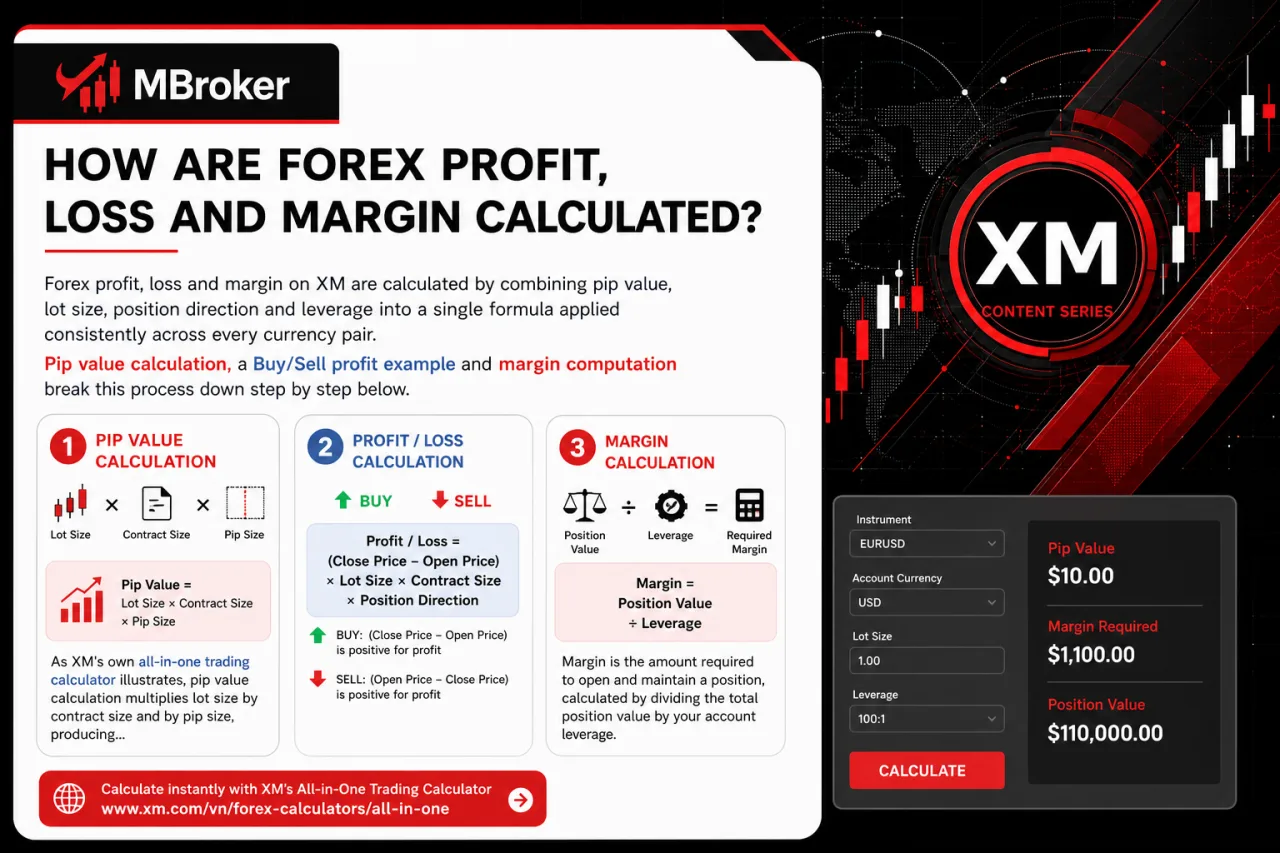
Forex profit, loss and margin on XM are calculated by combining pip value, lot size, position direction and leverage into a single formula applied consistently across every currency pair. Pip value calculation, a Buy/Sell profit example and margin computation break this process down step by step below.
Pip value calculation multiplies lot size by contract size and by pip size, producing the monetary value of a single pip movement for a given position, though traders should verify the exact figures for each currency pair on the platform before opening a trade.
For a Buy position, profit accrues when the closing bid price sits above the opening ask price, while a Sell position profits when the closing ask price sits below the opening bid price. The difference between entry and exit price, converted through pip value, produces the total profit or loss once the position closes.
Margin required to open a position divides the notional value of that position, calculated as lot size multiplied by contract size and by the current market price, by the leverage ratio applied to the account. A higher leverage ratio lowers the margin required for the same position size, while a lower leverage ratio raises it.
Free margin equals total account equity minus the margin already allocated to open positions, representing the capital still available to absorb floating losses or open additional trades. Checking the exact pip value, contract size and leverage figures on XM’s platform before trading confirms these calculations for a specific pair and account type.
How to Calculate Pip Value in XM Forex?
To calculate pip value in XM Forex, multiply lot size by contract size and by pip size, then convert the result into the account’s base currency if the quote currency differs. This formula, already introduced earlier when covering profit and margin calculation, applies the same way to a standard lot on a major pair.
Take a standard lot of 100,000 units on EURUSD as an example. As XM’s own all-in-one trading calculator illustrates, a pip on EURUSD typically equals 0.0001, and multiplying 100,000 by 0.0001 produces a pip value of 10 USD per pip for a standard lot, though traders should verify the exact figures on the platform before opening a trade.
That figure means each 1-pip movement in EURUSD shifts the position’s profit or loss by that same amount when trading a full standard lot. A mini lot or micro lot scales this value down proportionally, since pip value moves in direct proportion to lot size.
Pip size and pip value differ slightly for yen-based pairs, since those pairs quote price to a different decimal place than most other majors. Checking the live contract specifications for a specific pair on XM’s platform confirms the exact pip size and pip value before opening a position.
How to Calculate Margin for a Forex Position?
To calculate margin for a Forex position, divide the notional value of that position, which equals lot size multiplied by contract size and by the current market price, by the leverage ratio applied to the account. This formula, already introduced when covering margin requirements earlier, applies consistently across pairs, though the resulting figure changes with lot size, price and leverage.
Take a standard lot of 100,000 units on EURUSD as an example, with a market price of 1.1000 and a leverage ratio of 1:100. Notional value equals 100,000 multiplied by 1.1000, producing 110,000 USD of exposure. Dividing that notional value by the leverage ratio of 100 produces a required margin of 1,100 USD to open the position.
According to XM’s own Client Agreement, Terms and Conditions of Business, leverage ratios can be adjusted and differ across accounts, so the same lot size on the same pair can require a different margin amount depending on which legal entity, account type or regulatory region the leverage applies to.
A lower leverage ratio raises the margin required for an identical position, while a higher leverage ratio lowers it. Checking the current leverage setting and contract specifications for a specific pair on the platform confirms the exact margin figure before opening a trade.
What Influences Forex Prices on XM?
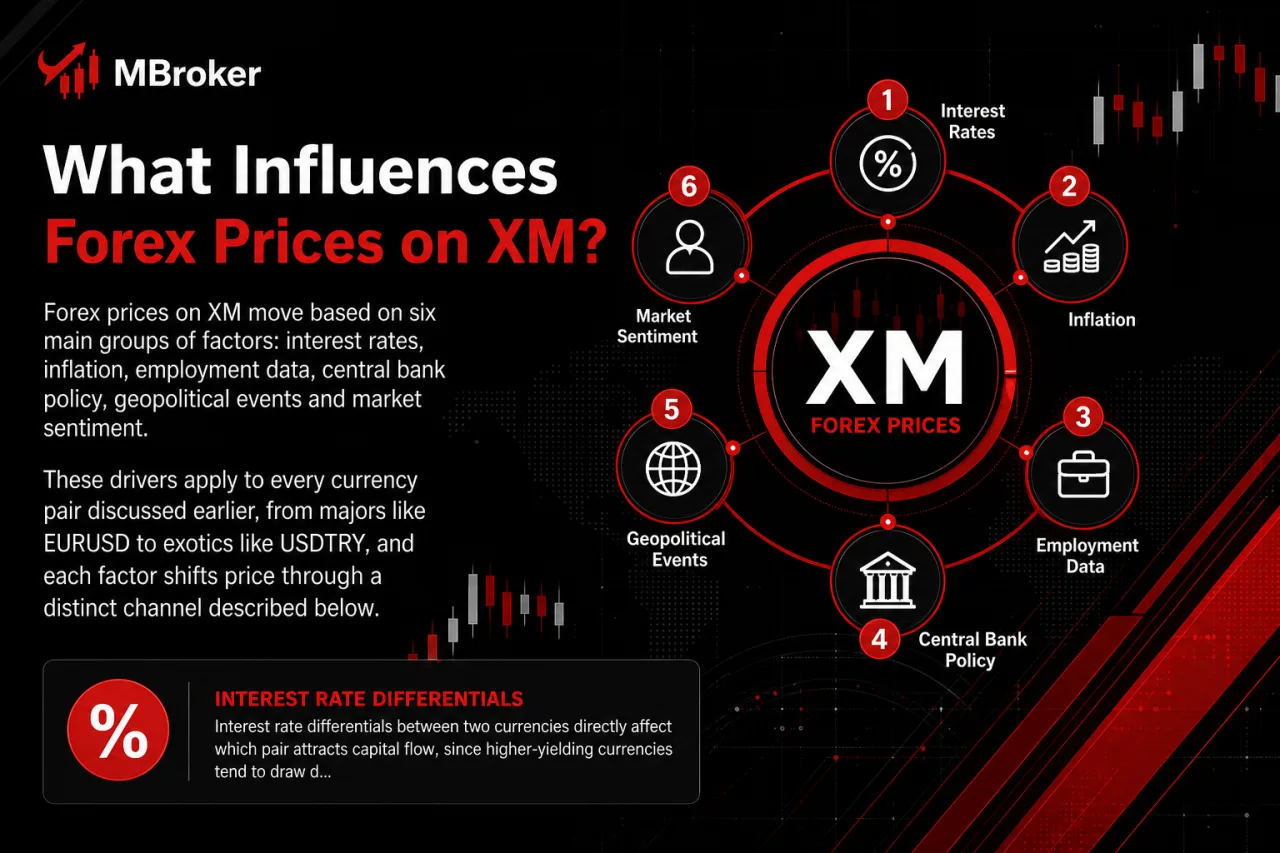
Forex prices on XM move based on six main groups of factors: interest rates, inflation, employment data, central bank policy, geopolitical events and market sentiment. These drivers apply to every currency pair discussed earlier, from majors like EURUSD to exotics like USDTRY, and each factor shifts price through a distinct channel described below.
Interest rate differentials between two currencies directly affect which pair attracts capital flow, since higher-yielding currencies tend to draw demand relative to lower-yielding ones. Inflation data alters expectations of future interest rate decisions, and a currency often reacts before any actual rate change takes effect.
Employment data, such as job creation or unemployment figures, signals economic strength or weakness and feeds directly into interest rate expectations. Central bank policy announcements, including rate decisions and forward guidance, often produce the sharpest price reactions among all six factors.
Geopolitical events, such as elections, trade disputes or conflicts, introduce sudden volatility that can widen spreads temporarily, tying back to the spread behavior covered earlier. Market sentiment reflects the collective positioning of traders and can amplify or dampen price reactions to the same underlying news.
- Interest rates shift capital flow between currencies.
- Inflation data reshapes rate expectations.
- Employment data signals economic strength.
- Central bank policy triggers the sharpest reactions.
- Geopolitical events introduce sudden volatility.
- Market sentiment amplifies or dampens price moves.
Checking XM’s economic calendar and current news feed on the platform confirms which of these factors is actively influencing a specific pair before opening a position.
What Are the Risks of Trading XM Forex?
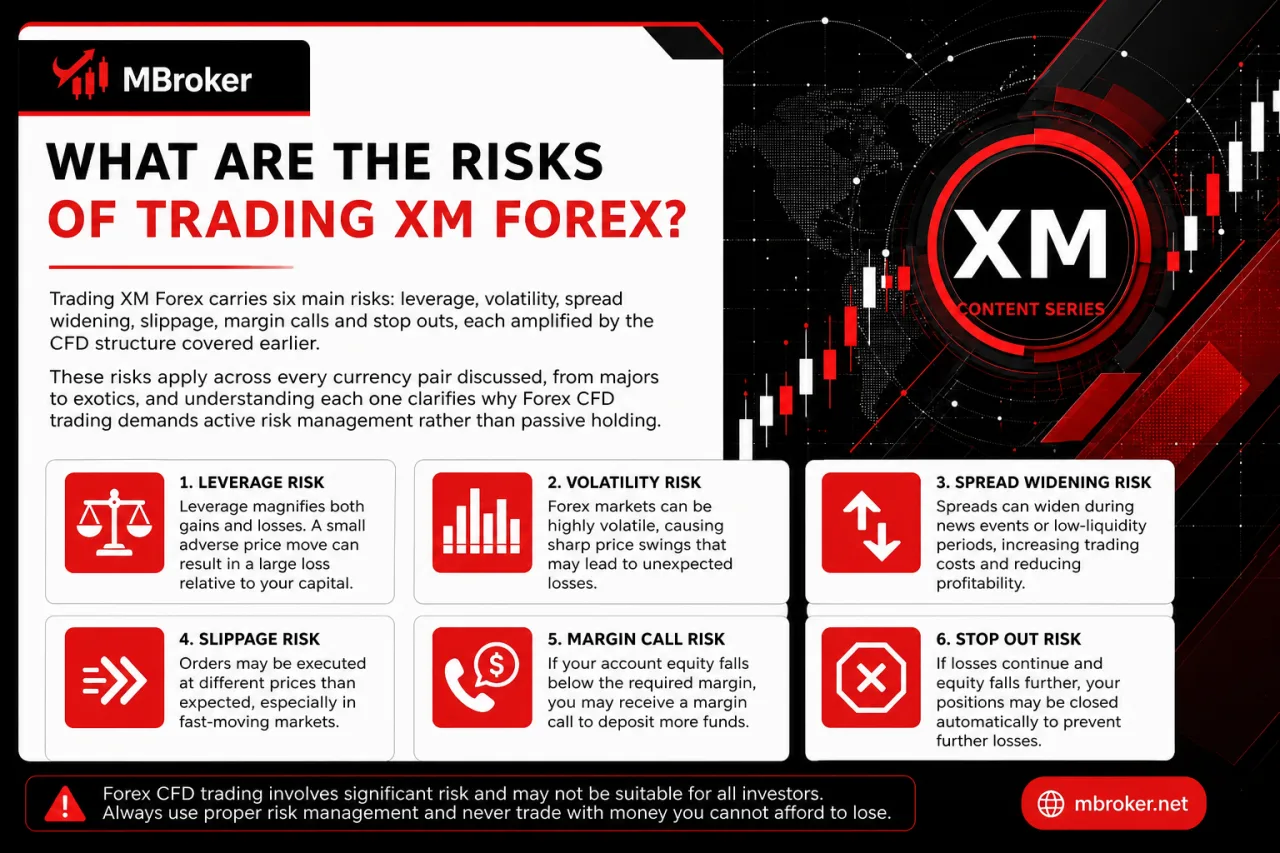
Trading XM Forex carries six main risks: leverage, volatility, spread widening, slippage, margin calls and stop outs, each amplified by the CFD structure covered earlier. These risks apply across every currency pair discussed, from majors to exotics, and understanding each one clarifies why Forex CFD trading demands active risk management rather than passive holding.
Leverage magnifies both gains and losses relative to the capital deposited, meaning a small adverse price move produces a loss larger than the initial margin without careful position sizing. Volatility drives sudden price swings around news releases or geopolitical events already outlined, and these swings often coincide with the spread widening described in the trading conditions section above.
Slippage occurs when an order executes at a different price than requested, typically during fast-moving markets or low-liquidity periods outside major trading sessions. A margin call triggers when account equity falls toward the margin requirement of open positions, warning the trader to add funds or reduce exposure before losses deepen further.
A stop out follows when equity drops below the broker’s stop-out level, automatically closing open positions to prevent the account balance from falling further into negative territory.
- Leverage risk amplifies losses beyond the initial deposit.
- Volatility risk produces sudden, unpredictable price swings.
- Spread widening risk raises entry and exit costs during thin liquidity.
- Slippage risk executes orders away from the requested price.
- Margin call risk signals insufficient equity against open exposure.
- Stop out risk force-closes positions once equity falls too low.
Checking current leverage settings, margin levels and stop-out thresholds on the platform confirms the exact risk parameters applicable to a specific account before opening any Forex position.
How to Check XM Forex Contract Specifications?
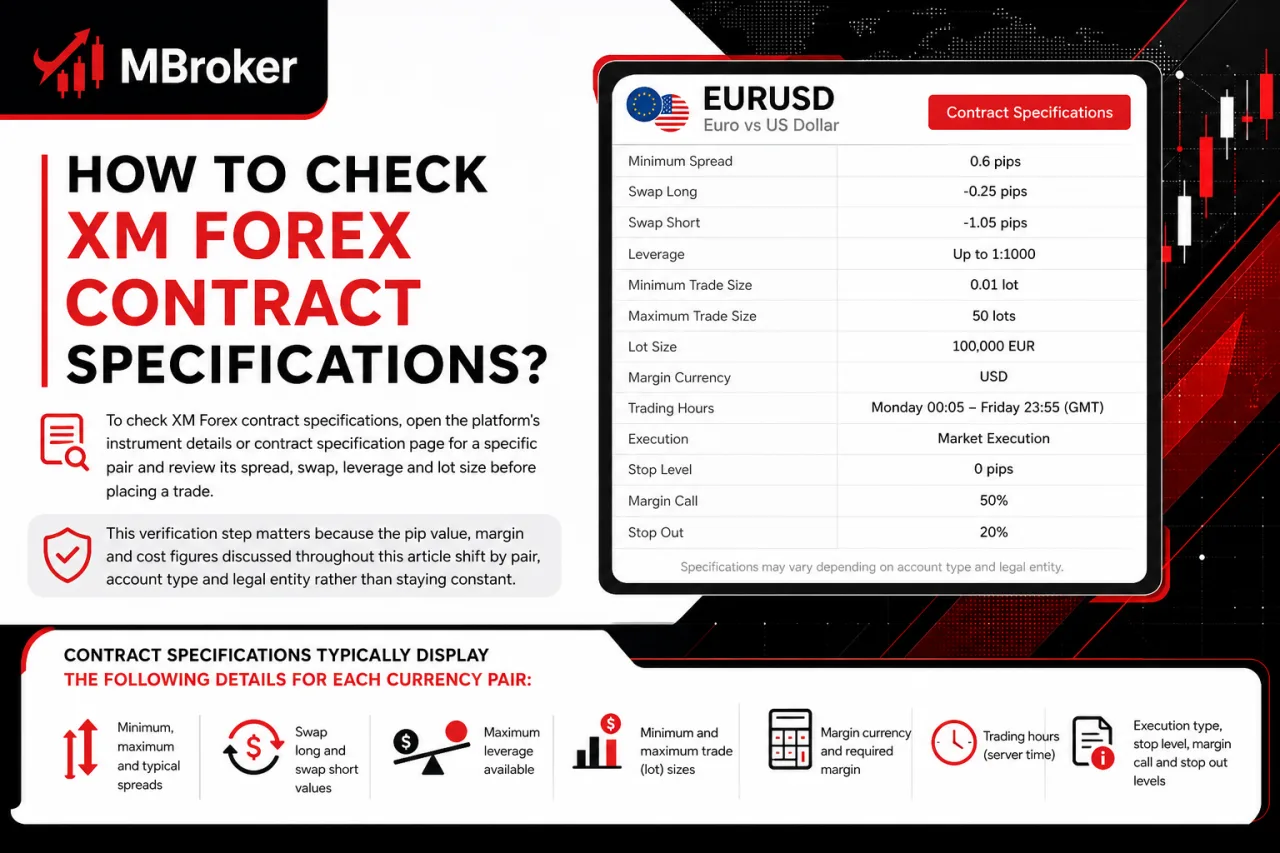
To check XM Forex contract specifications, open the platform’s instrument details or contract specification page for a specific pair and review its spread, swap, leverage and lot size before placing a trade. This verification step matters because the pip value, margin and cost figures discussed throughout this article shift by pair, account type and legal entity rather than staying constant.
Contract specifications typically display the following details for each currency pair:
- Minimum, maximum and step values for lot size.
- Current spread range under prevailing market conditions.
- Long and short swap rates applied for overnight positions.
- Maximum leverage permitted for that instrument and account type.
- Contract size defining the notional value of one lot.
Contract specifications on XM change over time as market conditions, regulatory requirements and account settings shift, so figures verified weeks or months ago no longer apply with certainty.
Traders comparing multiple pairs, such as EURUSD against USDTRY, find noticeably different spread and swap figures once checking each instrument’s specification individually rather than assuming uniform conditions across the platform. Reviewing these details directly before every trade, rather than relying on past figures, confirms the exact cost and margin requirement applicable at that moment.
Frequently Asked Questions About XM Forex
These seven questions address the most direct queries about XM Forex, covering the CFD structure, pair categories, trade size, commission, leverage, overnight holding and currency ownership already outlined above. Each answer below stays consistent with the definitions and mechanics covered earlier in this article.
Is XM Forex traded as CFDs?
Yes, XM Forex operates entirely as a CFD product, settling on price difference rather than physical currency delivery. Profit or loss reflects only the movement between opening and closing price.
Does XM offer major, minor and exotic currency pairs?
Yes, XM organizes its Forex offering into major, minor and exotic categories, matching the classification detailed earlier in this article. The exact number of pairs within each category varies by platform and account type, so the current list requires verification on the platform.
What is the minimum Forex trade size on XM?
Minimum trade size on XM Forex depends on the specific currency pair and account type selected, since each instrument carries its own minimum volume setting. Checking the live contract specification for that pair confirms the exact figure before opening a position.
Does XM charge commission on Forex trades?
Commission on XM Forex trades applies only to certain account types, while other accounts price the entire cost into the spread instead. This split mirrors the spread-only versus commission-based structure already explained in the trading costs section above.
What leverage is available for XM Forex?
Leverage on XM Forex differs by legal entity, account type and regulatory region, ranging from lower ratios under stricter regulation to higher ratios elsewhere. The applicable maximum requires confirmation through the account’s own trading conditions.
Can XM Forex positions be held overnight?
Yes, XM Forex positions carry over past the daily rollover cutoff, triggering a swap charge or credit based on the interest rate differential between the two currencies involved.
Does XM Forex involve ownership of currencies?
No, XM Forex never involves ownership, receipt or exchange of physical currency at any stage of the trade. The CFD structure settles purely on price difference, consistent with the mechanism described at the start of this article.
Do XM Forex Conditions Differ by Legal Entity and Account Type?
Yes, XM Forex conditions differ by legal entity and account type, since leverage caps, available currency pairs and margin requirements shift according to which entity regulates the account. This variation sits apart from the general contract parameters already outlined in the trading conditions section above, so the points below narrow in specifically on entity-based and account-based differences.
A regulated entity operating under stricter oversight typically applies a lower maximum leverage ratio compared to an offshore entity, and each entity may also restrict the list of tradable currency pairs differently.
Account type layers a second source of variation on top of entity-based differences:
- Standard accounts often carry different margin requirements than accounts priced with commission.
- Micro accounts scale contract size differently, changing the margin needed for an identical lot count.
- Ultra-low or zero-spread accounts sometimes cap maximum leverage below what other account types allow.
Mbroker operates as an independent guide rather than an official XM representative, so confirming the exact leverage cap, pair list and margin figure for a specific entity and account requires checking XM’s own platform directly before trading.
How Does Account Type Affect Forex Spread and Commission on XM?
Account type on XM affects Forex spread and commission through two distinct pricing models: a spread-only structure and a spread-plus-commission structure, each tied to a different account category. This variation builds directly on the cost breakdown covered earlier, so the comparison below narrows in specifically on how account selection shifts the balance between spread and commission.
Spread-only account types embed the entire trading cost into a wider bid/ask gap, meaning no separate line-item charge appears on the trade confirmation. Spread-plus-commission account types apply a narrower spread alongside a fixed per-trade commission, splitting the cost across two components instead of one.
- Spread-only accounts favor traders who prefer a single, all-inclusive cost per trade.
- Spread-plus-commission accounts favor traders who prefer transparent separation between raw spread and broker fee.
- Account category, rather than the currency pair itself, determines which of these two pricing models applies.
Exact spread and commission figures still differ by currency pair and prevailing market conditions within each account type, so verifying the current numbers on the platform confirms the applicable cost before trading.
How Does Legal Entity Affect Leverage for XM Forex?
Legal entity affects leverage for XM Forex because each entity operates under a different regulatory regime, capping the maximum leverage ratio at a different level regardless of account type or pair traded. This regional variation already surfaced earlier when covering leverage and margin requirements, so the comparison below narrows in on why entity registration specifically drives the difference.
A stricter regulatory framework typically caps maximum leverage at a lower ratio to limit client exposure, while an entity operating under lighter oversight often permits a considerably higher ratio. According to XM’s own Client Agreement, Terms and Conditions of Business, leverage ratios can be adjusted and differ across accounts, meaning the entity a client registers under directly shapes the maximum ratio, the Margin Call Level and the Stop-out Level applied to that account.
This variation carries three practical implications:
- Registration under a specific entity fixes the leverage ceiling available to that account.
- Margin requirements for an identical lot size shift depending on the entity’s leverage cap.
- Verification of the exact leverage figure on the platform confirms the applicable ratio before trading.
Conclusion
XM Forex allows traders to speculate on the price movements of major, minor and exotic currency pairs through CFDs without owning or exchanging physical currencies. Traders can open Buy or Sell positions, but contract size, volume limits, spreads, commissions, swap rates, leverage and margin requirements may vary by currency pair, account type, client region and XM legal entity.
Before opening a position, traders should review the latest contract specifications, calculate the pip value and required margin, and confirm the applicable trading costs directly through their XM account. Since leverage can magnify both gains and losses, unexpected volatility, spread widening and slippage may quickly lead to margin calls or stop outs. Conservative position sizing, sufficient free margin and disciplined risk management are therefore essential when trading XM Forex with real funds.
Mbroker provides this guide independently for educational purposes and is not an official representative of XM. Traders should always rely on the current conditions displayed in their XM account before making any trading decision.

Sylas Trenven is a forex strategist who helps traders master risk and timing. His work focuses on behavior-driven market entries and portfolio optimization for XM users looking to trade with precision and discipline. Email: [email protected]