
 Tiếng Việt
Trading oil CFDs on XM requires opening an account, selecting a supported oil symbol such as XTIUSD or XBRUSD, and placing a leveraged position through the MT4 or MT5 platform. No physical barrel of oil changes hands since the position tracks the underlying price movement through a derivative contract.
This guide covers the practical steps for setting up an oil trade on XM, along with the trading hours, volatility profile compared to other commodities, and regulatory framework traders should check beforehand. Each of these topics is broken down in detail in the sections below.
Mbroker compiles this independent overview to help traders verify these details before opening a position.
How Do You Trade Oil CFDs on XM?
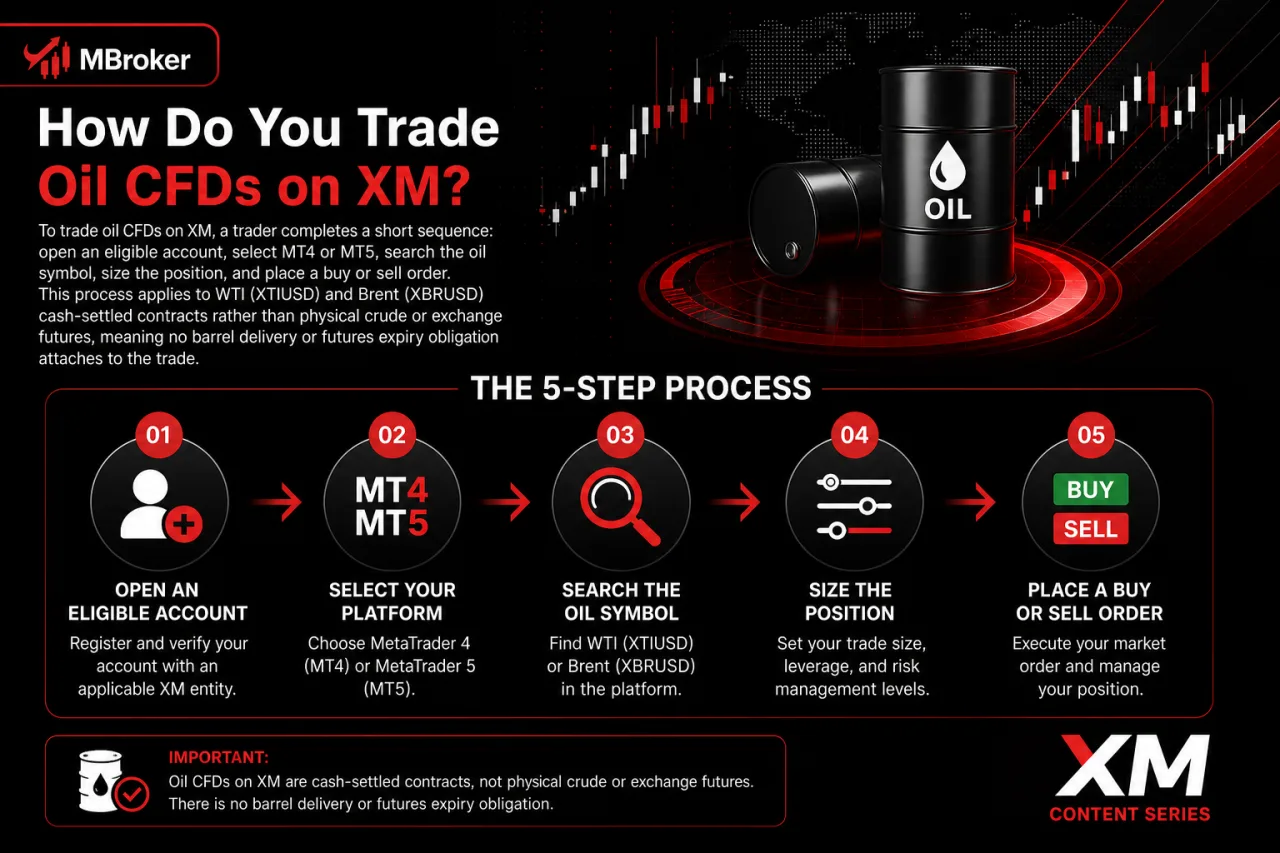
To trade oil CFDs on XM, a trader completes a short sequence: open an eligible account, select MT4 or MT5, search the oil symbol, size the position, and place a buy or sell order. This process applies to WTI (XTIUSD) and Brent (XBRUSD) cash-settled contracts rather than physical crude or exchange futures. No barrel delivery or futures expiry obligation attaches to the trade.
The general workflow follows a few sequential steps:
- Opening a trading account with the applicable XM entity and completing verification.
- Choosing a compatible platform, MT4 or MT5, on desktop, web, or mobile.
- Searching the Market Watch window for the oil symbol, XTIUSD or XBRUSD.
- Selecting a trade size in lots and reviewing margin required against account leverage.
- Choosing a buy or sell direction based on the anticipated price direction.
- Monitoring the open position and adjusting stop loss or take profit levels.
Beginners typically start with smaller lot sizes to manage margin exposure, while more active traders may monitor multiple energy symbols alongside oil for portfolio diversification.
Steps, symbol availability, and account eligibility vary by XM legal entity, account type, and regional regulation, so this outline serves educational purposes only and does not constitute investment advice. Confirming exact symbol names and platform compatibility with XM before opening a position remains necessary.
What Are the XM Trading Symbols for Crude Oil?
XM lists two primary crude oil symbols: XTIUSD for WTI Crude Oil and XBRUSD for Brent Crude Oil, both structured as cash-settled CFDs. These tickers represent the two benchmark crude grades most commonly offered across CFD brokers, tracking the underlying futures price without granting ownership of physical barrels.
Symbol naming can differ slightly depending on the platform version or account setup a trader uses on XM.
- Searching the Market Watch panel on MT4 or MT5 confirms the exact ticker displayed for the account in use.
- Checking the “Specification” tab within Market Watch reveals the underlying instrument, contract size, and quote currency tied to that symbol.
- Comparing symbol names across demo and live accounts helps identify any naming variation before trading.
Some platform builds or regional XM entities may present these symbols with alternate suffixes or grouping under a broader energy category. Symbol naming conventions such as XTIUSD and XBRUSD can vary depending on the broker’s legal entity, platform build, or regional server configuration. Verifying the live symbol list directly in the trading terminal before placing an order remains the most reliable way to confirm naming accuracy.
Which Accounts and Platforms Support Oil Trading on XM?
XM supports oil CFD trading across Standard, Ultra Low, and Shares accounts, with MT4 and MT5 available on desktop, web, and mobile, though exact symbol access depends on the registered legal entity and client classification. This account and platform question ties directly into how a trader accesses XTIUSD or XBRUSD once the setup steps outlined above are complete.
Account type determines margin and spread conditions rather than basic symbol visibility, since oil CFDs generally appear across the main retail account categories offered by XM. Platform choice affects the trading experience more than product access:
- Desktop MT4 and MT5 display full order types and chart tools for oil positions.
- Web platforms mirror desktop functionality without requiring software installation.
- Mobile apps for MT4 and MT5 support monitoring and executing oil trades on the go.
Client classification, such as retail versus professional status, changes the leverage caps applied to oil CFDs. Different XM entities and regulatory jurisdictions apply different maximum leverage rules.
Regional regulation also restricts which entity, and therefore which account types, a trader can register under. Confirming current account eligibility and platform-specific symbol availability directly through the XM client portal or trading terminal remains necessary before opening any oil position.
What Are the Contract Specifications for Oil CFDs on XM?
XM structures WTI (XTIUSD) and Brent (XBRUSD) crude oil CFDs with distinct contract size, volume, and tick parameters that determine margin and position value. These figures sit at the core of the setup process described above, since lot sizing and margin calculation depend directly on the specification a trader confirms in the platform terminal.
The table below summarizes the key contract details for both symbols as displayed on the MT4/MT5 Market Watch specification tab.
| Specification | XTIUSD (WTI Crude Oil) | XBRUSD (Brent Crude Oil) |
|---|---|---|
| Quote/Settlement Currency | USD | USD |
| Contract Size per Lot | 1 lot = 1,000 barrels | 1 lot = 1,000 barrels |
| Minimum Volume | 0.01 lots | 0.01 lots |
| Maximum Volume | Varies by account, confirm in platform | Varies by account, confirm in platform |
| Volume Increment | 0.01 lots | 0.01 lots |
| Tick Size / Tick Value | Set per point movement, confirm in platform | Set per point movement, confirm in platform |
Exact contract size, maximum volume, and tick value figures can change over time, so traders should verify these details directly on XM’s official contract specification page before opening a position.
Contract size and volume limits shift with periodic broker updates. Verifying the live specification tab within the MT4 or MT5 terminal remains necessary before calculating margin or placing an oil position.
How Does Leverage and Margin Work When Trading Oil on XM?
Margin for oil CFDs on XM calculates from contract size, current market price, and the leverage ratio applied to the trading account, with the maximum leverage figure itself depending on the XM entity, account type, and client classification. This margin question connects directly to the contract specifications above, since position value and lot size feed straight into the margin formula.
Retail clients registered under stricter regulatory jurisdictions generally face lower maximum leverage caps than clients classified as professional traders under entities with more flexible rules. Leverage limits applied to instruments like XTIUSD and XBRUSD differ across XM’s regional legal entities according to the licensing conditions each entity operates under, so traders should check the specific leverage rules that apply to their registered account.
Margin requirement moves inversely with available leverage: higher leverage lowers the margin locked per lot, while lower leverage raises it. Leverage magnifies both gains and losses on an oil position, meaning a small adverse price move against a highly leveraged trade erodes account equity faster than the same move would on an unleveraged position.
Confirming the exact leverage tier, margin percentage, and any professional classification requirements directly through the XM client portal remains necessary before sizing an oil trade, since these figures adjust by entity and regulatory update.
Can You Go Long and Short on Oil CFDs with XM?
Yes, XM allows both long (buy) and short (sell) positions on oil CFDs like XTIUSD and XBRUSD, since the contract structure does not require owning physical crude to open either direction. This long/short flexibility ties directly into the margin and leverage mechanics covered above, since both directions draw margin from the same account leverage tier.
A long position opens when a trader buys the contract, profiting if the oil price rises above the entry level and losing if it falls. A short position opens when a trader sells the contract first, profiting if the price declines and losing if it rises instead.
Both directions carry the same leveraged risk profile described earlier, meaning losses can accumulate quickly on either side of the market during sharp price swings. Oil prices react to supply data, geopolitical events, and inventory reports, which can move XTIUSD and XBRUSD in either direction without warning. Crude oil markets can experience sharp price swings tied to supply disruptions and geopolitical developments, so traders should stay aware of global news events that may affect oil prices before opening a position.
This overview covers general CFD mechanics rather than trading recommendations, and confirming order execution behavior for both directions directly on the XM MT4 or MT5 terminal remains necessary before opening a position.
What Are XM’s Oil Trading Hours and Market Schedule?
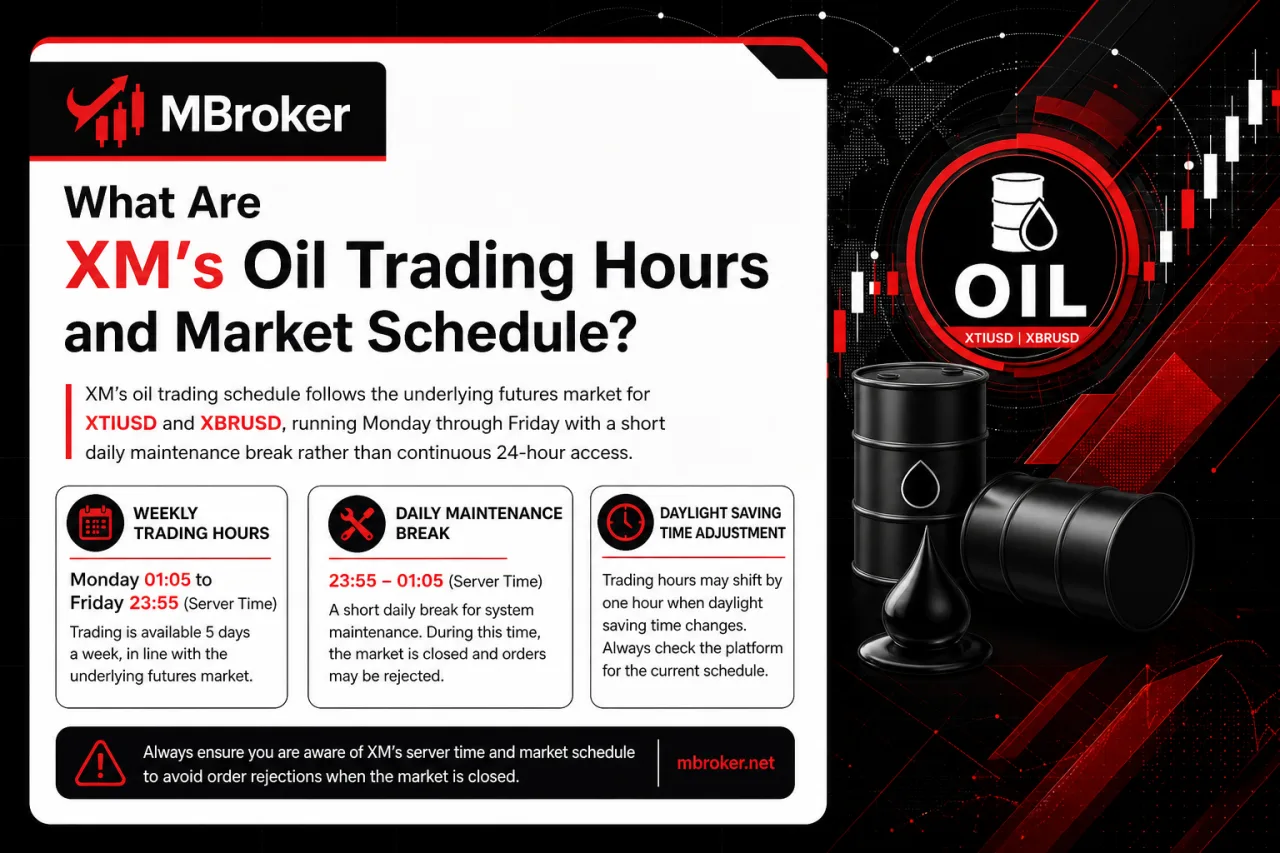
XM’s oil trading schedule follows the underlying futures market for XTIUSD and XBRUSD, running Monday through Friday with a short daily maintenance break rather than continuous 24-hour access. This schedule question connects directly to the account and platform setup already covered, since confirming the correct session window prevents order rejections when the market sits closed. The subsections below break down the standard weekly hours, the daily maintenance gap, and how daylight saving shifts affect the displayed server time on MT4 and MT5.
How Do Market Holidays Affect Oil Trading Hours on XM?
Market holidays on the underlying futures exchange shift XM’s oil trading hours by shortening sessions, delaying the daily open, or suspending XTIUSD and XBRUSD trading entirely for that period. This holiday question builds directly on the weekly schedule and daily maintenance break already outlined for oil trading on XM.
XM publishes a separate holiday trading schedule listing the adjusted or suspended hours for affected instruments, including oil, around major public holidays on the reference exchange. This schedule typically appears as a downloadable calendar or notice section within the client portal rather than inside the standard Market Watch specification tab.
Reduced trading activity around these holiday windows can affect liquidity and spread behavior on XTIUSD and XBRUSD, since fewer market participants remain active during shortened sessions. Thinner liquidity around holiday periods can widen spreads and increase price gaps on oil CFDs, so traders should factor this into their risk management when trading around holiday sessions.
Checking XM’s official holiday calendar before placing an oil position remains necessary, since holiday adjustments change from year to year and vary by the specific exchange underlying each contract.
What Happens with Oil Contract Expiration and Rollover on XM?
XM’s cash-settled oil CFDs carry no physical expiration, but XTIUSD and XBRUSD still track an underlying futures contract that rolls periodically, with XM adjusting open positions to reflect the new reference price. This rollover mechanism connects directly to the holiday and liquidity behavior already covered, since both factors shift around the same underlying futures calendar.
Because XTIUSD and XBRUSD reference futures rather than a perpetual spot instrument, the broker shifts pricing from the expiring contract month to the next active contract at scheduled intervals. This rollover process can create a price adjustment on the chart, and brokers typically apply a corresponding balance adjustment to open positions so the trader’s net exposure remains unaffected by the underlying contract switch, though the exact mechanism and frequency should be verified directly on XM’s official website before trading.
Traders holding positions across a rollover date do not need to manually close or reopen trades, since the adjustment applies automatically at the broker level. Rollover dates and times typically appear in XM’s official contract specification sheet or a dedicated rollover schedule published through the client portal.
Confirming the exact rollover date, time, and any associated adjustment directly through XM’s official documentation or client support remains necessary before holding an oil position across a scheduled rollover window.
How Does Oil Compare to Other XM Commodities and Energy Instruments?
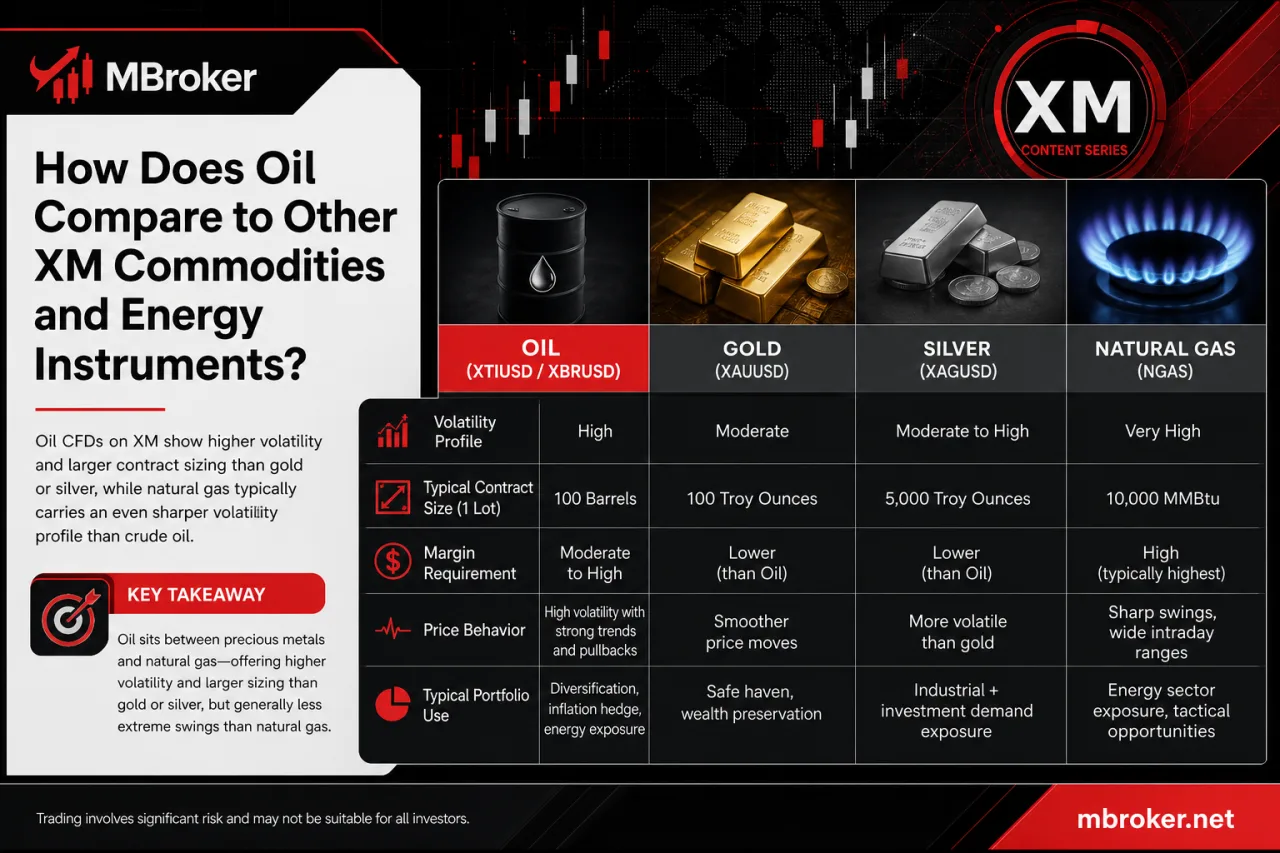
Oil CFDs on XM show higher volatility and larger contract sizing than gold or silver, while natural gas typically carries an even sharper volatility profile than crude oil. This comparison question builds directly on the contract specification and margin mechanics already covered for XTIUSD and XBRUSD. The following subsections break down how oil stacks up against gold, silver, and natural gas across product structure, volatility behavior, contract size, and typical portfolio use, without forecasting price direction for any instrument.
Is Oil More Volatile Than Gold or Other XM Commodities?
Yes, oil generally trades with higher volatility than gold on XM, since crude oil prices react more sharply to supply shocks, geopolitical events, and inventory data than the precious metal does. This volatility comparison builds directly on the contract specification and margin mechanics already outlined for XTIUSD and XBRUSD.
Several factors explain this behavioral difference between the two commodity classes:
- Oil prices respond to production decisions, geopolitical disruptions, and inventory reports that shift supply expectations quickly.
- Gold tends to move more gradually, often reacting to interest rate expectations and currency strength rather than sudden supply events.
- Larger price swings on oil translate into faster margin usage on a leveraged CFD position compared to an equivalent gold position.
Academic research on commodity market volatility, including studies examining oil, industrial commodities, and stock markets published in finance journals such as the Journal of Banking & Finance, generally indicates that crude oil (WTI and Brent) ranks among the most volatile commodities, while gold ranks among the least volatile, reflecting oil’s sensitivity to global supply and demand shifts.
This general volatility pattern applies as an educational comparison of instrument behavior rather than a forecast of future price movement. Position sizing and stop levels account for this difference, and verifying current volatility characteristics directly through XM’s platform charts remains necessary before trading either instrument.
What Are the Main Differences Between Oil and Natural Gas CFDs on XM?
Oil CFDs and natural gas CFDs on XM differ mainly in symbol structure, contract sizing, and volatility intensity, with natural gas typically showing sharper price swings than XTIUSD or XBRUSD. This comparison extends the volatility discussion above by narrowing the focus onto natural gas as a distinct energy instrument.
Symbol naming separates the two markets immediately, since crude oil trades under XTIUSD and XBRUSD while natural gas typically appears under its own dedicated ticker within XM’s energy category. Contract size and volume increments also diverge, as natural gas futures reference a different unit of measurement than the barrel-based sizing used for crude oil.
As a general educational observation rather than a data-backed statistic, natural gas prices are often described as more volatile than crude oil prices over extended periods, a pattern commonly attributed to greater sensitivity to seasonal demand shifts and storage report data. This description reflects a broad conceptual tendency without citing specific figures, so traders should treat it as background context and confirm present-day volatility directly through live XM price charts.
Market hours for both instruments generally follow the same Monday-through-Friday futures-based schedule with a daily maintenance break, though holiday adjustments can differ depending on which reference exchange underlies each contract.
Margin requirements also diverge, since natural gas’s sharper volatility profile is known to consume margin faster than an equivalent oil position under the same leverage tier.
Verifying the exact symbol, contract specification, and trading hours for natural gas directly through the XM platform terminal remains necessary before comparing it against oil.
Is XM a Reliable Broker for Trading Oil and Energy CFDs?

XM operates as a regulated broker across multiple legal entities offering oil CFDs, though reliability factors like licensing, fund segregation, and execution model differ by the specific entity a trader registers under. This regulation question ties directly into the legal entity distinctions already noted for XTIUSD and XBRUSD trading. The subsections below break down XM’s regulatory status per entity, general reliability indicators, and where fee-related details sit outside this scope.
Regulatory oversight varies by jurisdiction, and each XM entity operates under its own license, capital requirement, and client fund protocol. General reliability factors worth checking include:
- Confirming the license number and regulator for the specific XM entity handling the account.
- Verifying whether client funds sit in segregated bank accounts separate from company operating capital.
- Reviewing the execution model, such as market execution versus dealing desk, disclosed for oil CFD orders.
Detailed spread, commission, and swap figures fall outside this reliability discussion and belong to dedicated XM Fees content instead. Trading oil CFDs carries leveraged-market risk regardless of broker regulation, so no claim here suggests the activity is safe or guaranteed profitable. Verifying current licensing and entity-specific terms directly through XM’s official regulation page remains necessary before opening an account.
Which XM Legal Entities and Regions Offer Oil CFD Trading?
XM operates oil CFD trading through several regulated entities, including those licensed under CySEC, ASIC, and FSC, with symbol access, leverage caps, and account eligibility for XTIUSD and XBRUSD depending on the entity tied to a trader’s country of residence. This entity question ties directly into the legal entity distinctions already noted for margin and account access on oil CFDs.
Regional regulation shapes which specific entity a client registers under, and this registration in turn determines the trading conditions applied to oil positions. Several regulators oversee distinct XM entities:
- CySEC-regulated entities generally serve clients within the European Economic Area under stricter leverage caps for retail accounts.
- ASIC-regulated entities generally serve clients registered in Australia under separate margin and product rules.
- FSC-regulated entities, such as XM Global Limited noted earlier in this article, generally serve clients from regions outside stricter EU or Australian frameworks.
Leverage limits, symbol availability, and restricted-country lists can differ across these entities according to each regulator’s licensing framework, so traders should verify the specific conditions that apply to their registered account.
Confirming which entity applies during account opening, along with the specific leverage tier and symbol list available, remains necessary directly through XM’s official regulation page or client portal before trading oil CFDs.
What Risks Should You Understand Before Trading Oil CFDs on XM?
Trading oil CFDs on XM carries four core risks: price gaps, event-driven volatility, margin calls, and potential losses beyond the initial deposit depending on the registered entity’s negative balance protection policy. This risk question ties directly into the volatility and leverage mechanics already covered for XTIUSD and XBRUSD.
Price gaps occur when XTIUSD or XBRUSD opens at a materially different level than the previous close, often following weekend news or a sudden supply announcement, leaving stop loss orders exposed to slippage. Volatility around geopolitical developments and supply reports, such as OPEC decisions or inventory releases, can accelerate price swings beyond typical daily ranges within short windows.
Margin calls arise when equity falls toward the maintenance margin threshold on a leveraged oil position, prompting the broker to request additional funds or close positions automatically. Whether losses can exceed the initial deposit depends on the specific XM entity and its negative balance protection policy; according to XM’s Client Agreement, Terms and Conditions of Business, XM applies a Negative Balance Protection policy on a per-account basis designed to ensure that maximum losses from trading CFDs do not exceed the funds in the account, though the specific terms can vary since regulatory frameworks differ across jurisdictions.
Confirming the exact margin call threshold, stop-out level, and negative balance protection terms directly through the registered XM entity’s legal documentation remains necessary before opening any oil position.
What Are the Underlying Benchmarks Behind XM’s WTI and Brent Oil Symbols?
XTIUSD tracks West Texas Intermediate (WTI) crude, a light sweet oil benchmark sourced from US production regions, while XBRUSD tracks Brent Crude, extracted from North Sea fields and used as the global seaborne pricing reference. According to Schwab, WTI crude oil is extracted from fields located in the United States (specifically Texas, North Dakota, and Louisiana), while Brent Crude is extracted from the North Sea, making it the reference for seaborne oil pricing globally. This benchmark distinction explains why the two XM symbols move independently rather than mirroring one another tick for tick.
Each benchmark’s supply region and delivery logistics shape a typical pricing gap between the two contracts. The subsections below cover the WTI benchmark’s characteristics, the Brent benchmark’s characteristics, and how the spread between them behaves on XM’s charts, purely as educational background on the underlying market rather than a forecast of future pricing.
How Is the WTI-Brent Price Spread Reflected in XM Oil CFDs?
The WTI-Brent spread appears on XM’s platform as the price difference between the XTIUSD quote and the XBRUSD quote at any given moment, rather than as a single tradable instrument. This spread question follows directly from the benchmark distinction already noted between the two crude grades and their separate supply regions.
Each symbol moves according to its own underlying futures market, so the two charts can widen or narrow relative to each other depending on regional supply conditions, refinery demand, and transport logistics tied to each benchmark. XM does not quote a combined “WTI-Brent spread” ticker; a trader observes the differential manually by comparing the two live prices side by side in the terminal.
Because XTIUSD and XBRUSD settle independently, any position taken to reflect a view on the spread itself requires opening two separate CFD positions rather than one instrument. This structure carries the combined leveraged risk of both contracts simultaneously, not the risk of a single reduced-exposure position. Reviewing the live specification and quote for both symbols directly in MT4 or MT5 remains necessary before assessing how the current differential appears on the platform.
Information reviewed as of the current publication date; XM’s symbol list, contract specifications, and trading conditions change periodically, so verifying current details directly through XM’s official platform and documentation before trading remains necessary.
Conclusion
XM oil CFDs provide access to the price movements of WTI and Brent crude through XTIUSD and XBRUSD on MT4 and MT5. Traders can open both long and short positions without owning physical oil, but contract size, leverage, margin requirements, trading hours and rollover conditions may differ by account type and XM legal entity.
Because crude oil can react sharply to inventory reports, geopolitical events, production decisions and changes in global demand, leveraged positions may generate rapid gains or losses. Before placing an order, traders should verify the latest specifications directly in the XM platform, maintain sufficient free margin and use position sizes appropriate to their risk tolerance. Beginners may benefit from practising on a demo account before trading oil CFDs with real funds.

Sylas Trenven is a forex strategist who helps traders master risk and timing. His work focuses on behavior-driven market entries and portfolio optimization for XM users looking to trade with precision and discipline. Email: [email protected]