
 Tiếng Việt
CFD trading with XM means speculating on price movements of an underlying asset through a Contract for Difference, without owning the asset itself. XM offers this structure across multiple markets, settled in cash rather than physical delivery. Traders open long or short positions depending on their market view, using leverage provided by the applicable XM entity.
The costs and trading conditions of XM CFDs, including spreads, commissions and swap rates, vary depending on the specific instrument, account type and legal entity a client is registered under. Leverage limits, margin requirements and minimum trading volumes also vary by region due to differing regulatory frameworks.
XM offers CFDs across several asset classes, including forex, stock indices, individual equities, precious metals and select cryptocurrency instruments, though the exact range of instruments available can vary by region and legal entity. Availability of each category depends on the client’s country of residence and the XM entity servicing the account.
Evaluating XM as a CFD broker requires checking the regulatory status, client fund protections and independent user feedback associated with the specific legal entity handling an account. Reputation and safety standards differ between XM entities operating in different jurisdictions.
Mbroker breaks down each of these areas in detail below, starting with what CFD trading through XM actually involves before moving into the specific asset classes and trading conditions clients should verify.
What Is CFD Trading with XM?
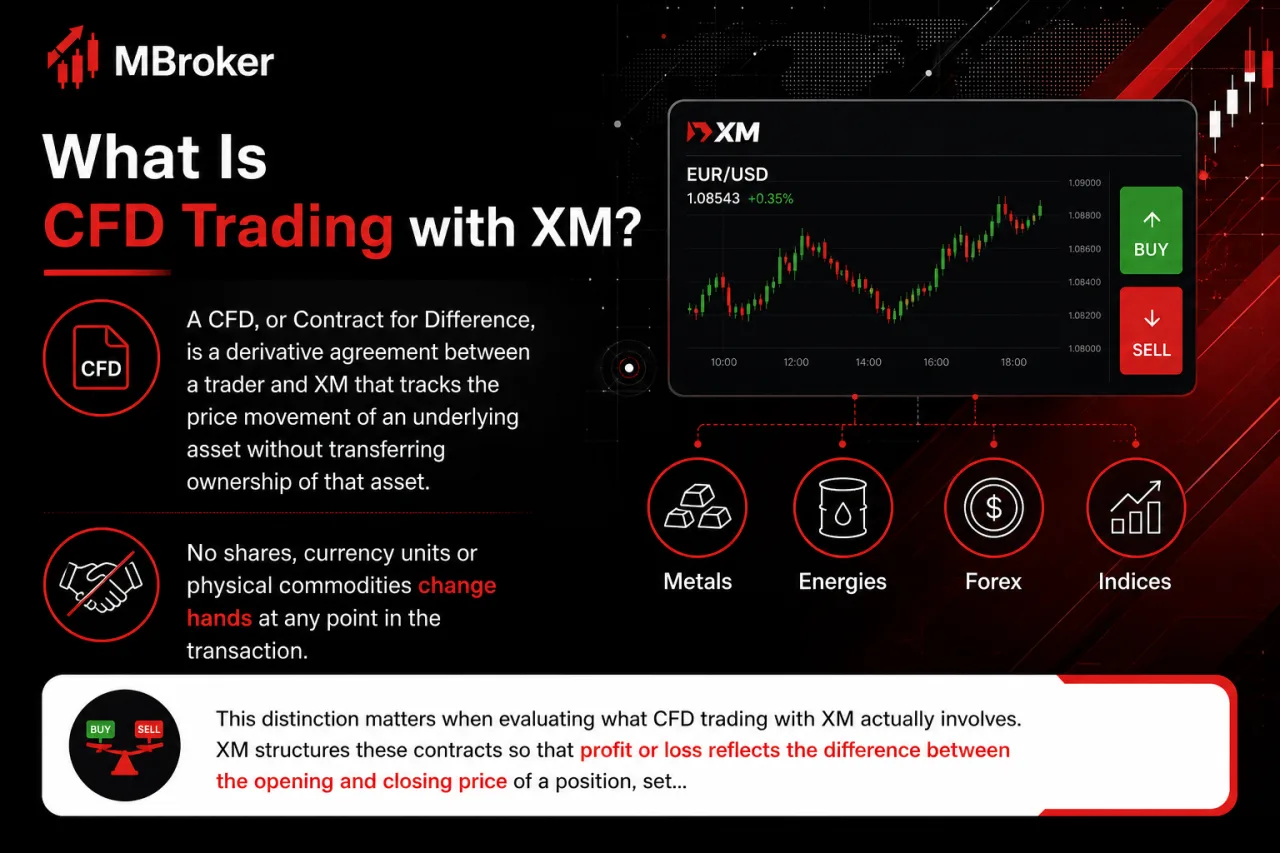
A CFD, or Contract for Difference, is a derivative agreement between a trader and XM that tracks the price movement of an underlying asset without transferring ownership of that asset. No shares, currency units or physical commodities change hands at any point in the transaction.
This distinction matters when evaluating what CFD trading with XM actually involves. XM structures these contracts so that profit or loss reflects the difference between the opening and closing price of a position, settled in cash rather than through delivery of the underlying instrument. The sections below cover how this structure applies across forex, indices, equities, metals and other asset classes offered through XM, along with the specific conditions attached to each.
How Does an XM CFD Trade Work?
Opening an XM CFD trade starts with choosing a direction, buying to open a long position when expecting the price to rise, or selling to open a short position when expecting the price to fall. Both directions use the same margin mechanics, since no underlying asset is borrowed or delivered at any stage.
The mechanics behind this process follow a consistent pattern across every instrument XM offers. Once a position opens, it stays live until the trader closes it manually, or until a stop loss, take profit or margin call triggers an automatic closure. Profit or loss on the position equals the difference between the opening price and the closing price, multiplied by the position size, then converted into the account’s base currency where applicable.
- Long position: profit accrues if the closing price is higher than the opening price.
- Short position: profit accrues if the closing price is lower than the opening price.
- Losses: move in the opposite direction to the profit scenarios above, and can exceed the initial margin depending on leverage.
Margin requirements, contract size and available leverage differ by instrument and by the XM legal entity servicing the account, so traders should confirm these figures before opening any position.
Which XM Legal Entities Offer CFD Trading?
Multiple regulated XM entities offer CFD trading, each licensed in a different jurisdiction and serving clients from specific regions. These typically include entities regulated in jurisdictions such as Cyprus, Australia, Belize and other regions, though the exact list and current licensing status should always be confirmed on XM’s official regulatory disclosures.
Product range, leverage caps and regulatory protections differ across these entities rather than applying uniformly worldwide. A client onboarded under a European-regulated XM entity generally faces stricter leverage limits and negative balance protection rules than one registered under an offshore entity, for instance.
- Regulatory status: varies by entity, with some falling under stricter oversight than others.
- Instrument availability: differs, since not every CFD category is offered in every region.
- Leverage caps: depend on the entity’s licensing jurisdiction and client classification.
- Fund protection schemes: apply only to specific entities, not universally across the XM group.
Traders should confirm which specific XM entity services their account before assuming any product, leverage or protection detail applies to their situation.
What Asset Classes Are Available as CFDs at XM?
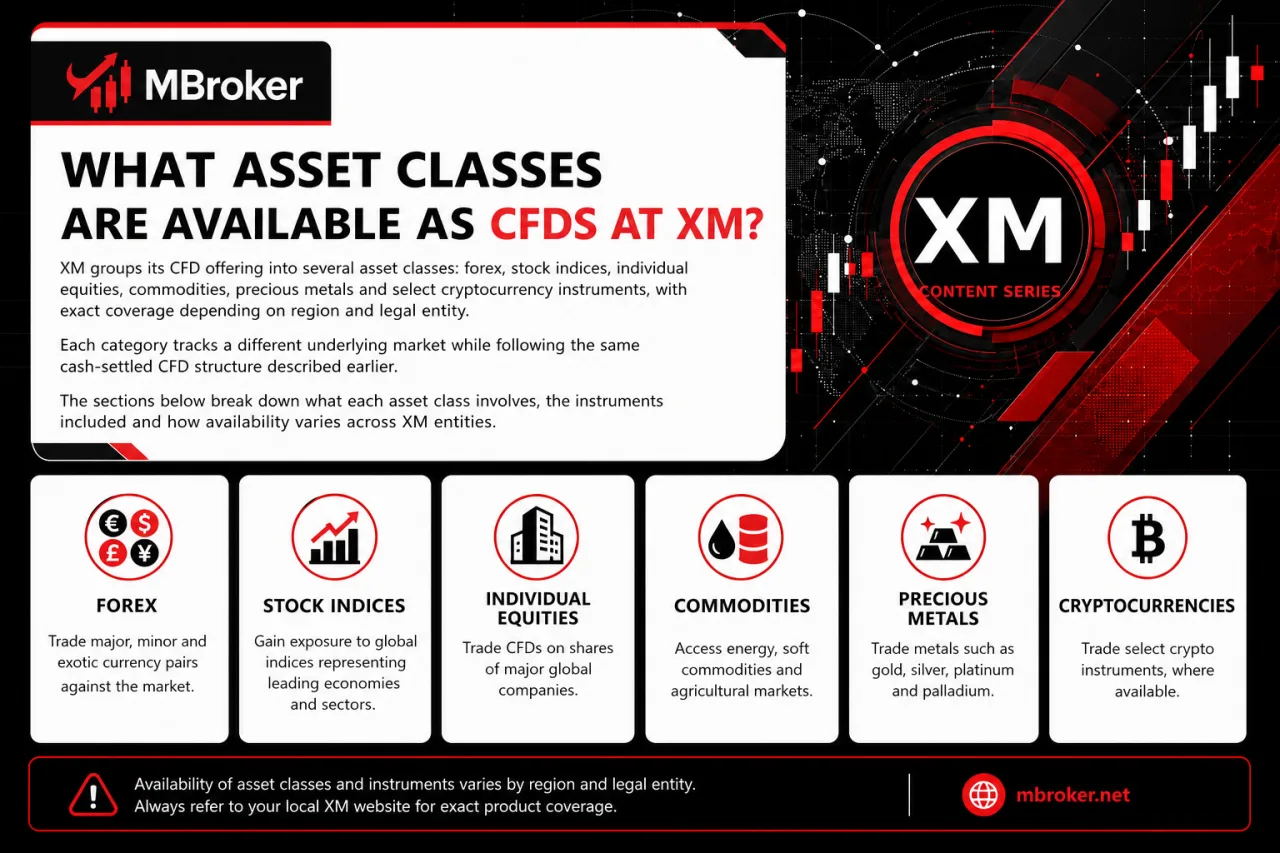
XM groups its CFD offering into several asset classes: forex, stock indices, individual equities, commodities, precious metals and select cryptocurrency instruments, with exact coverage depending on region and legal entity. Each category tracks a different underlying market while following the same cash-settled CFD structure described earlier. The sections below break down what each asset class involves, the instruments included and how availability varies across XM entities.
Are Forex Pairs Traded as CFDs at XM?
Yes, XM offers forex pairs as CFD contracts, allowing traders to speculate on currency price movements without exchanging the underlying currencies. Each forex CFD tracks the exchange rate between two currencies, settled in cash rather than physical currency delivery.
This structure applies consistently across the currency pairs XM lists, though grouping and quote conventions differ by pair type. XM categorizes its forex offering into three broad groups based on liquidity and trading volume in the underlying market.
- Major pairs: combine the US dollar with other widely traded currencies, typically carrying the tightest spreads and highest liquidity.
- Minor pairs: exclude the US dollar but still involve widely traded currencies, generally showing wider spreads than majors.
- Exotic pairs: pair a major currency with a currency from a smaller or emerging economy, usually carrying the widest spreads and lowest liquidity.
Every forex CFD quotes a base currency against a quote currency, with the quote currency determining settlement of profit or loss. Exact pairs offered, along with applicable spreads, leverage and margin requirements, depend on the XM entity servicing a given account.
Are Stocks, Indices and Commodities Traded as CFDs at XM?
Yes, XM offers stock shares, stock indices, precious metals and energy products as CFDs, all structured as cash-settled contracts rather than direct ownership of the underlying asset. This distinction applies consistently across every product in this group, unlike direct equity or commodity ownership through a traditional exchange account.
The CFD structure explained earlier for forex carries over into these markets, with a few category-specific points worth noting.
- Stock CFDs: track the share price of individual listed companies without granting shareholder rights such as voting or physical certificate ownership.
- Index CFDs: track the aggregated value of a basket of stocks within a given index, rather than any single company.
- Precious metal CFDs: cover instruments like gold and silver, tracking spot or futures-referenced prices without physical bullion delivery.
- Energy CFDs: cover products such as oil, tracking benchmark contract prices without physical barrel delivery.
Exact instrument availability, contract specifications, leverage and margin requirements depend on the XM legal entity servicing a given account, along with the client’s country of residence.
Are Cryptocurrencies Available as CFDs at XM?
Yes, XM offers select cryptocurrency instruments as CFDs, though availability depends heavily on the legal entity servicing an account and the client’s region. This differs from the forex, index and commodity CFDs discussed earlier, since crypto CFD access carries tighter restrictions across the XM group.
Trading a cryptocurrency CFD at XM does not involve owning any actual coin or holding a wallet address on a blockchain network. The contract simply tracks the price movement of the underlying digital asset, with profit or loss settled in cash once a position closes.
- Entity restrictions: some regulated XM entities exclude crypto CFDs entirely due to local regulatory limits.
- Regional restrictions: availability shifts depending on the client’s country of residence.
- Leverage limits: crypto CFDs typically carry lower maximum leverage than forex or index CFDs offered through the same entity.
- No ownership transfer: closing a position never results in receiving or transferring any cryptocurrency.
Traders should confirm current crypto CFD availability, contract specifications and leverage caps directly through their specific XM account portal before attempting to open a position.
What Are the Trading Conditions for XM CFDs?
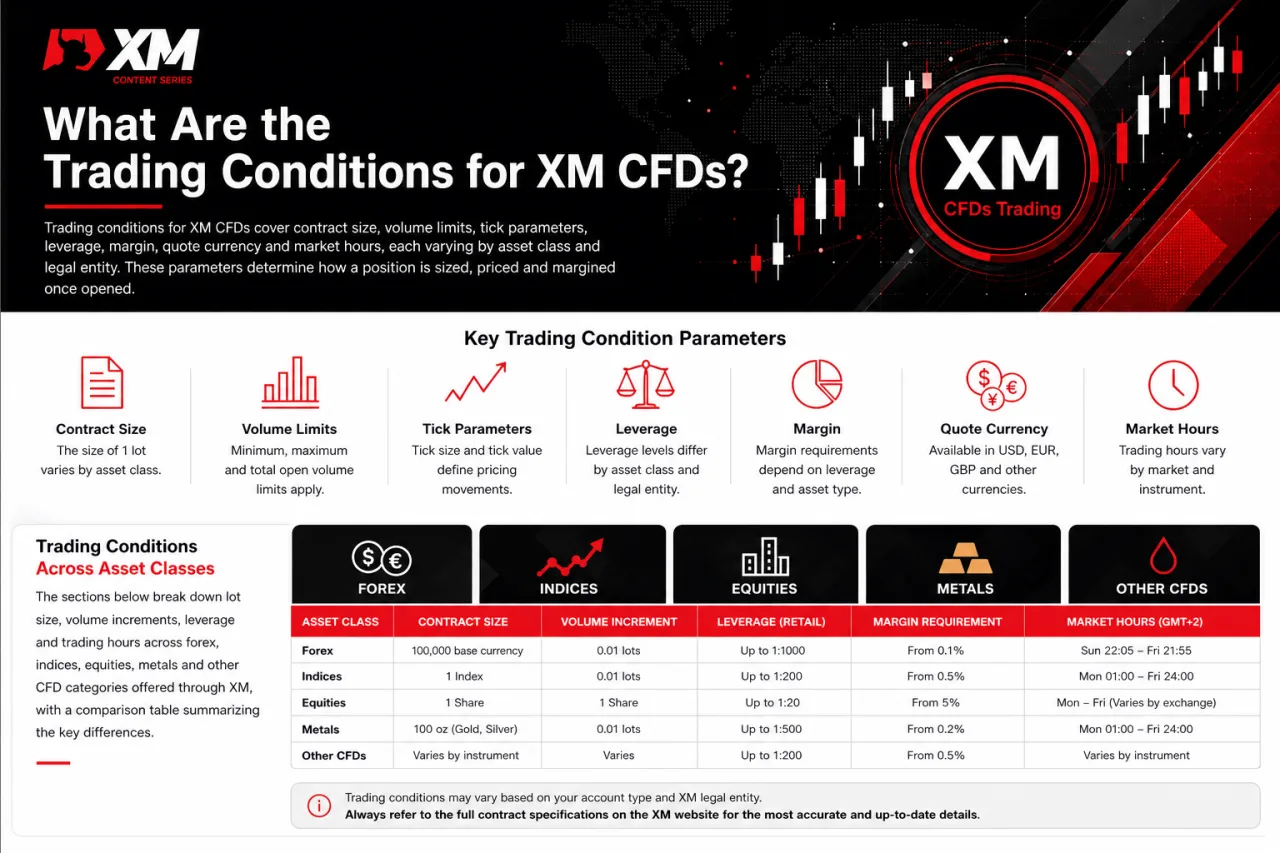
Trading conditions for XM CFDs cover contract size, volume limits, tick parameters, leverage, margin, quote currency and market hours, each varying by asset class and legal entity. These parameters determine how a position is sized, priced and margined once opened. The sections below break down lot size, volume increments, leverage and trading hours across forex, indices, equities, metals and other CFD categories offered through XM, with a comparison table summarizing the key differences.
How Does Leverage and Margin Work for XM CFDs?
Leverage on XM CFDs magnifies both potential gains and potential losses by allowing a trader to control a position larger than the deposited margin. This mechanism applies across every CFD asset class discussed earlier, though the exact ratio offered depends on the instrument, account type and the XM entity servicing the account.
Margin works as the portion of position value a trader must set aside to open and maintain a trade, with the remaining exposure effectively funded through leverage. Higher leverage lowers the margin required to open a given position size, but it also increases the speed at which losses can erode account equity.
- Instrument-based limits: forex pairs typically carry higher maximum leverage than indices, equities or crypto CFDs offered through the same entity.
- Account-based limits: some account types cap leverage lower than others, even within the same legal entity.
- Entity-based limits: regulated entities under stricter regulatory frameworks generally impose lower maximum leverage than offshore entities.
- Classification-based limits: client categorization, such as retail or professional status, alters the leverage ceiling available on an account.
Traders should verify current leverage caps and margin requirements directly through their XM account portal, since these figures change based on jurisdiction and regulatory updates.
What Are the Trading Sessions and Market Hours for XM CFDs?
Trading sessions for XM CFDs follow the market hours of each instrument’s underlying asset, ranging from near round-the-clock forex trading to exchange-limited hours for stock CFDs. This distinction matters when planning entries or exits across different asset classes covered earlier.
Forex CFDs trade across overlapping global sessions, giving access to pricing for most of the trading week with brief pauses around weekly close. Index and commodity CFDs generally mirror the hours of their underlying futures or exchange markets, often extending beyond a single exchange’s official session but still carrying defined open and close times. Stock CFDs stay tied most closely to the listed exchange’s trading hours, since the underlying share only prices during that exchange’s session.
A holiday schedule affects availability across every category, since underlying exchanges, futures markets and interbank liquidity providers all close or reduce activity around national and market holidays. XM publishes an official market hours page listing exact session times, early closes and holiday adjustments for each instrument.
Traders should check this page directly before opening or holding a position, since session times and holiday closures shift by instrument and by year.
Do XM CFD Contracts Expire or Roll Over?
Cash-based XM CFDs do not expire, while futures-based CFDs carry set expiration and rollover dates tied to the underlying futures contract. This distinction determines whether a position stays open indefinitely or requires action as an expiration date approaches.
Cash CFDs, common across forex, spot metals and many index instruments at XM, roll no fixed closing date, letting a trader hold a position as long as margin requirements stay met. Futures-based CFDs, by contrast, track an underlying futures contract that expires on a set date, after which XM either closes the position automatically or rolls it into the next contract period, depending on the instrument and account settings.
- Cash CFDs: carry no expiration date, remaining open until the trader closes the position or margin runs short.
- Futures-based CFDs: carry a defined expiration date, after which the position closes or rolls into the next contract.
- Rollover adjustments: apply price differences between expiring and new contracts to avoid distorting the client’s realized profit or loss.
Stock and index CFDs held over an ex-dividend date also receive a dividend adjustment, crediting or debiting the account to reflect the dividend paid on the underlying shares. Traders should confirm expiration schedules and dividend adjustment policies for each instrument directly through their XM account terms.
How Reputable and Safe Is XM as a CFD Broker?
XM operates as a reputable CFD broker overall, holding multiple regulatory licenses across its group entities and, according to XM’s official company information, maintaining an operating history of over 15 years, though reputation and safety still depend on the specific entity servicing an account.
This factors directly into the broker evaluation intent raised earlier when discussing which XM legal entities offer CFD trading. Reputation assessment for XM rests on a few consistent factors.
- Regulatory licensing: each XM entity holds authorization from a distinct financial regulator, with oversight strength varying by jurisdiction.
- **Operating history:**Founded in Cyprus in 2009, XM has since serviced retail and institutional clients across multiple regions, building a track record referenced in independent broker reviews, and, according to XM’s official company information, maintaining an operating history of over 15 years.
- Client fund segregation: regulated entities typically separate client deposits from company operating funds, though exact protections differ by license.
- Independent feedback: user reviews and third-party ratings offer additional context, though these vary in reliability and should supplement, not replace, regulatory verification.
CFD trading itself carries leveraged-product risk regardless of broker reputation, since losses can exceed initial margin. Readers should verify XM’s current regulatory status for their specific region and entity before opening an account.
Which Account and Platform Options Support XM CFD Trading?
Multiple XM account types support CFD trading, and the platform compatibility spans MT4 and MT5 across desktop, web and mobile versions. This addresses the account and platform compatibility question raised for CFD instruments discussed throughout this guide. The subsections below cover account-type distinctions and platform-specific compatibility, while specific spreads, commissions and account-level trading costs belong to dedicated XM Accounts and XM Fees content rather than this section.
Can CFDs Be Traded on Both MT4 and MT5 with XM?
Yes, CFDs trade on both MT4 and MT5 with XM, though instrument lists and symbol counts differ slightly between the two platforms. This addresses the rare attribute of platform-specific CFD symbol availability raised in the account and platform compatibility question above.
MT5 generally carries a broader instrument list than MT4, since XM continues expanding certain asset classes primarily on the newer platform. Symbol naming stays largely consistent across both platforms for the same instrument, though occasional suffix differences appear depending on account type or contract variant.
- Forex and metals: available on both platforms with matching or near-matching symbols.
- Indices and equities: broader coverage often appears on MT5 rather than MT4.
- Newer instrument additions: typically launch on MT5 first, with MT4 availability lagging or absent.
Traders should confirm the exact CFD symbol list available on their assigned platform directly through their XM account before opening a position.
Conclusion
XM CFDs allow traders to speculate on the price movements of forex pairs, stocks, indices, precious metals, energy products and selected cryptocurrencies without owning the underlying assets. Traders can open long or short positions, but instrument availability, contract specifications, leverage, margin requirements, trading costs and regulatory protections vary by account type, region and the XM legal entity serving the client.
Before opening a position, traders should verify the latest spreads, commissions, swap rates, trading hours, dividend adjustments and expiration or rollover rules directly through their XM account. Because leverage magnifies both potential gains and losses, appropriate position sizing, sufficient free margin and disciplined risk management are essential. Beginners should consider practising on a demo account before trading XM CFDs with real funds.

Sylas Trenven is a forex strategist who helps traders master risk and timing. His work focuses on behavior-driven market entries and portfolio optimization for XM users looking to trade with precision and discipline. Email: [email protected]