
 Tiếng Việt
XM stock CFDs let traders speculate on the price movement of global company shares without owning the underlying stock itself. These instruments are derivative contracts, known as Stock CFDs or Stock Derivatives, that track the market price of listed companies like Apple, Tesla or Sirius XM Holdings through the XM platform.
The real-time price of Sirius XM Holdings (SIRI) as a stock CFD on XM mirrors the quote of the underlying share on its home exchange, updated continuously during market hours. Traders check this live quote directly inside the XM trading platform under the stock’s designated symbol.
Trading stock CFDs on XM differs from buying real shares mainly in leverage, cost structure and ownership rights, as leverage for stock CFDs is significantly lower than the leverage available on other instruments — according to XM Trading Conditions, overall leverage options range up to 1:1000 depending on account equity, though individual CFD products, including stocks, carry their own specific leverage caps set by XM. CFD positions allow leveraged exposure and short selling, while real share purchases require full capital and grant actual ownership plus shareholder rights.
Historical price data, trading volume and market capitalization for stock CFD instruments are available through the XM platform’s chart tools and instrument specification sheets. These figures reflect the underlying company’s exchange-listed data, not a separate XM-created market.
This guide from Mbroker, an independent information resource on XM, breaks down how XM stock CFDs work, starting with the core product mechanics.
What Are XM Stock CFDs and How Do They Work?
What Are XM Stock CFDs and How Do They Work
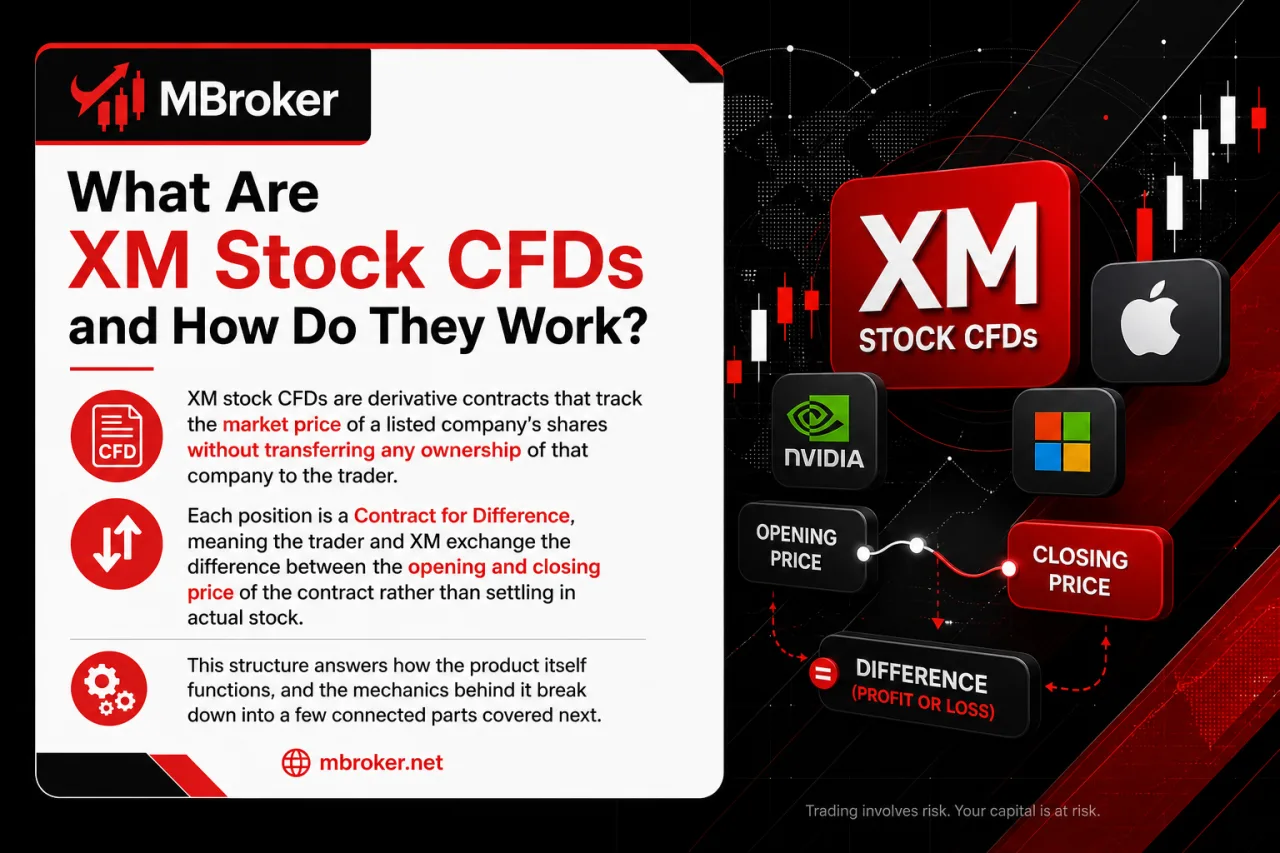
XM stock CFDs are derivative contracts that track the market price of a listed company’s shares without transferring any ownership of that company to the trader. Each position is a Contract for Difference, meaning the trader and XM exchange the difference between the opening and closing price of the contract rather than settling in actual stock.
This structure answers how the product itself functions, and the mechanics behind it break down into a few connected parts covered next.
A CFD position mirrors the underlying stock’s price movement in real time, so when the listed share rises or falls on its home exchange, the corresponding XM stock CFD quote adjusts in the same direction. Traders never hold a share certificate, receive a shareholder registry entry, or gain voting rights through this product.
Availability and exact product terms depend on the XM legal entity servicing the client’s account and region. The following subsections outline the specific building blocks of this structure, including pricing behavior and the entities offering the product.
What Is the Difference Between a Stock CFD and Owning a Real Share?
A stock CFD grants no shareholder rights or physical ownership, while owning a real share confers voting rights, a registered ownership stake and standard dividend entitlement. This distinction covers ownership status, corporate rights and income treatment.
CFD traders speculate purely on the price difference between opening and closing a position, so no share certificate, registry entry or company ownership ever transfers to the account holder. Real share buyers, by contrast, become registered stockholders with the ability to vote at company meetings and hold a legal claim on the business.
Dividend treatment also separates the two products. Real shareholders receive dividend payments directly as declared by the company, whereas stock CFD holders on XM depend on whether XM applies a dividend adjustment to open positions around the ex-dividend date, a mechanism distinct from an actual dividend payout and not guaranteed as a standard feature across every account or instrument.
Traders confirm each stock CFD’s specific dividend adjustment policy through the XM instrument specification sheet before opening a position, since terms vary by symbol and account type.
What Asset Class and Legal Entity Cover XM Stock CFDs?
XM stock CFDs belong to the equity derivatives asset class, and their availability depends on the specific XM regulated entity servicing the trader’s account and region. This links the product back to a defined asset category while tying access directly to jurisdiction.
The connection between asset class and legal entity matters because it determines which stock symbols, leverage caps and account terms actually apply to a given trader.
Equity derivatives cover any contract deriving its value from an underlying company share rather than the share itself, and stock CFDs fit this category since traders never acquire the listed stock. XM operates through multiple regulated entities, including XM Global, XM UK and XM EU-regulated branches, each licensed under a different regulator and serving distinct regions.
Product range, leverage limits and permitted account types differ across these entities based on local regulatory requirements. Traders should confirm which XM entity services their account and which stock CFD terms apply through the instrument specification sheet and account agreement before trading, since a symbol listed under one XM entity may carry different conditions under another.
Reviewing the current entity-specific terms directly on official XM documentation before opening any stock CFD position remains the standard practice for confirming applicable conditions.
What Are the Trading Conditions for XM Stock CFDs?
What Are the Trading Conditions for XM Stock CFDs
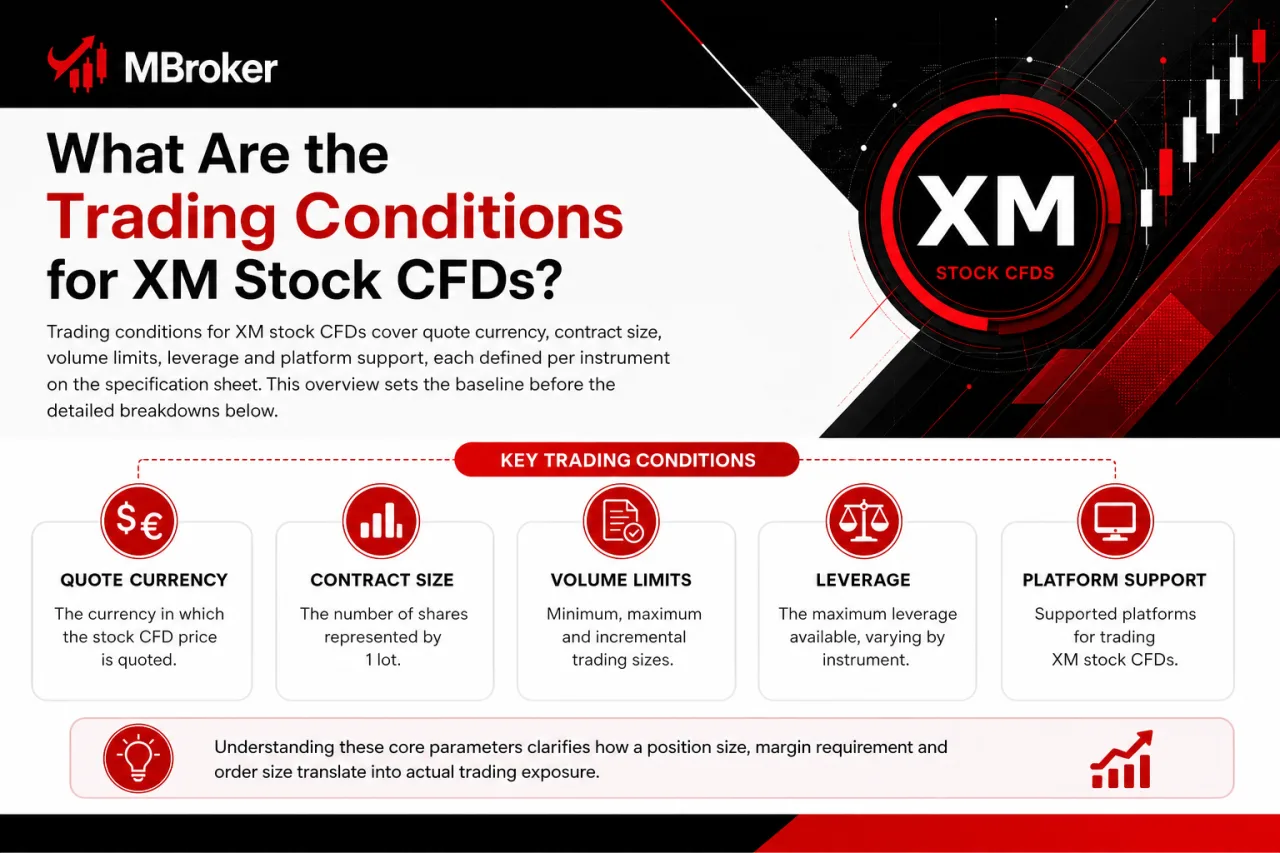
Trading conditions for XM stock CFDs cover quote currency, contract size, volume limits, leverage and platform support, each defined per instrument on the specification sheet. This overview sets the baseline before the detailed breakdowns below.
Understanding these core parameters clarifies how a position size, margin requirement and order size translate into actual trading exposure. The subsections that follow expand on quote currency and lot conventions, volume and increment rules, leverage and margin ranges, and platform compatibility, so traders confirm each figure against the live instrument specification before opening a position.
What Leverage and Margin Apply to XM Stock CFDs?
Leverage on XM stock CFDs sits lower than leverage on forex or index instruments, with the exact ratio set per symbol, account type and servicing XM entity. This directly addresses the leverage and margin question raised in this heading.
Margin requirements move inversely to leverage, so a lower leverage cap on a given stock CFD demands a proportionally higher margin percentage to open and maintain a position. XM publishes margin requirement ranges that vary across stock symbols, account classifications and regulatory jurisdiction, rather than one fixed percentage applied uniformly to every instrument, so traders should check the instrument specification sheet for their specific account before trading.
Traders confirm the current leverage cap and margin percentage for each stock symbol through the instrument specification sheet before opening a trade, since these figures differ by account and entity as noted earlier in this guide.
A margin call risk accompanies every leveraged stock CFD position. If the account equity falls below the required maintenance margin level as the underlying share price moves against an open position, XM issues a margin call or triggers automatic closure of positions, so traders monitor equity levels closely when holding leveraged stock CFDs.
What Are the Trading Hours and Market Holidays for XM Stock CFDs?
Trading hours for XM stock CFDs follow the opening hours of the underlying stock’s home exchange, such as the NYSE, NASDAQ or LSE, rather than a separate XM-defined schedule. This directly determines when a given stock CFD position on XM opens, updates and closes for trading each day.
Since the CFD quote mirrors the listed share’s exchange price, a stock only trades on XM while its home market is open and active. A US-listed stock CFD like Sirius XM Holdings tracks NYSE or NASDAQ session times, while a UK-listed company CFD follows LSE hours instead.
Market holiday closures align with the respective exchange’s official calendar as well. When the underlying exchange observes a public holiday and suspends trading, the corresponding XM stock CFD remains inactive for that same session, since no live reference price exists from the home market during the closure.
Traders confirm exact session times and upcoming holiday closures for each stock symbol through the XM instrument specification sheet or trading calendar before placing an order, since these details vary by exchange and change periodically.
Are Dividend Adjustments Applied to XM Stock CFD Positions?
Yes, XM applies dividend adjustments to open stock CFD positions, crediting or debiting the account around the ex-dividend date to reflect the underlying company’s declared payout. This directly answers whether an open stock CFD position on XM receives any dividend-related treatment.
The mechanism ties the CFD price back to the real corporate action happening on the stock’s home exchange, so it links to the ownership distinction raised earlier in this guide. A few points clarify how this works in practice:
- Long positions typically receive a credit adjustment reflecting the dividend amount declared by the underlying company.
- Short positions typically receive a debit adjustment of the same amount, since the trader profits from a price decline that the dividend payout itself partly causes.
- The adjustment applies only to positions held open through the ex-dividend date, not to positions closed beforehand.
- The exact amount, timing and whether an adjustment applies at all depends on the specific symbol, account type and servicing XM entity.
Traders confirm the dividend adjustment policy for each stock CFD through the XM instrument specification sheet before holding a position across an ex-dividend date, since this treatment differs from an actual dividend payment received by registered shareholders.
How Can You Check the Real-Time Price of a Stock CFD Like Sirius XM Holdings (SIRI) on XM?
How Can You Check the Real-Time Price of a Stock CFD Like Sirius XM Holdings (SIRI) on XM
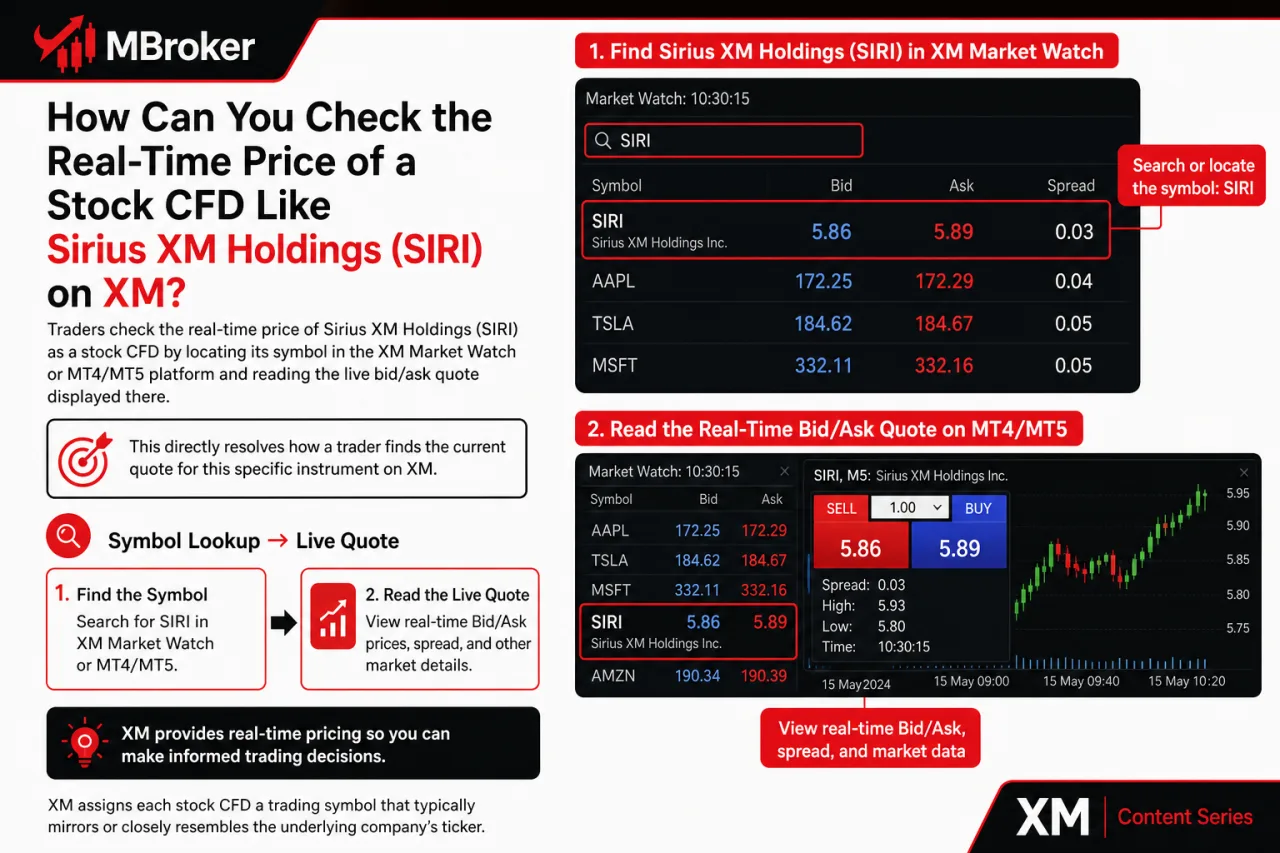
Traders check the real-time price of Sirius XM Holdings (SIRI) as a stock CFD by locating its symbol in the XM Market Watch or MT4/MT5 platform and reading the live bid/ask quote displayed there. This directly resolves how a trader finds the current quote for this specific instrument on XM.
The symbol lookup and quote source raised in this heading break down into a naming convention and a platform display, covered next.
XM assigns each stock CFD a trading symbol that typically mirrors or closely resembles the underlying company’s exchange ticker, so Sirius XM Holdings appears under a symbol tied to its SIRI ticker within the XM platform’s instrument list. Traders search or scroll the Market Watch panel on MT4/MT5 to locate this symbol, then view the bid price (sell) and ask price (buy) updating continuously beside it during active trading hours.
Opening the symbol’s chart or specification window shows the same live pricing in a larger, more detailed format. This displayed quote reflects XM’s own CFD price feed, which tracks the underlying exchange-listed price rather than pulling the exchange feed directly.
Traders confirm the exact symbol format and feed source through the XM instrument specification sheet before trading.
How Do XM Stock CFD Trading Conditions Compare to Buying Real Shares?
How Do XM Stock CFD Trading Conditions Compare to Buying Real Shares
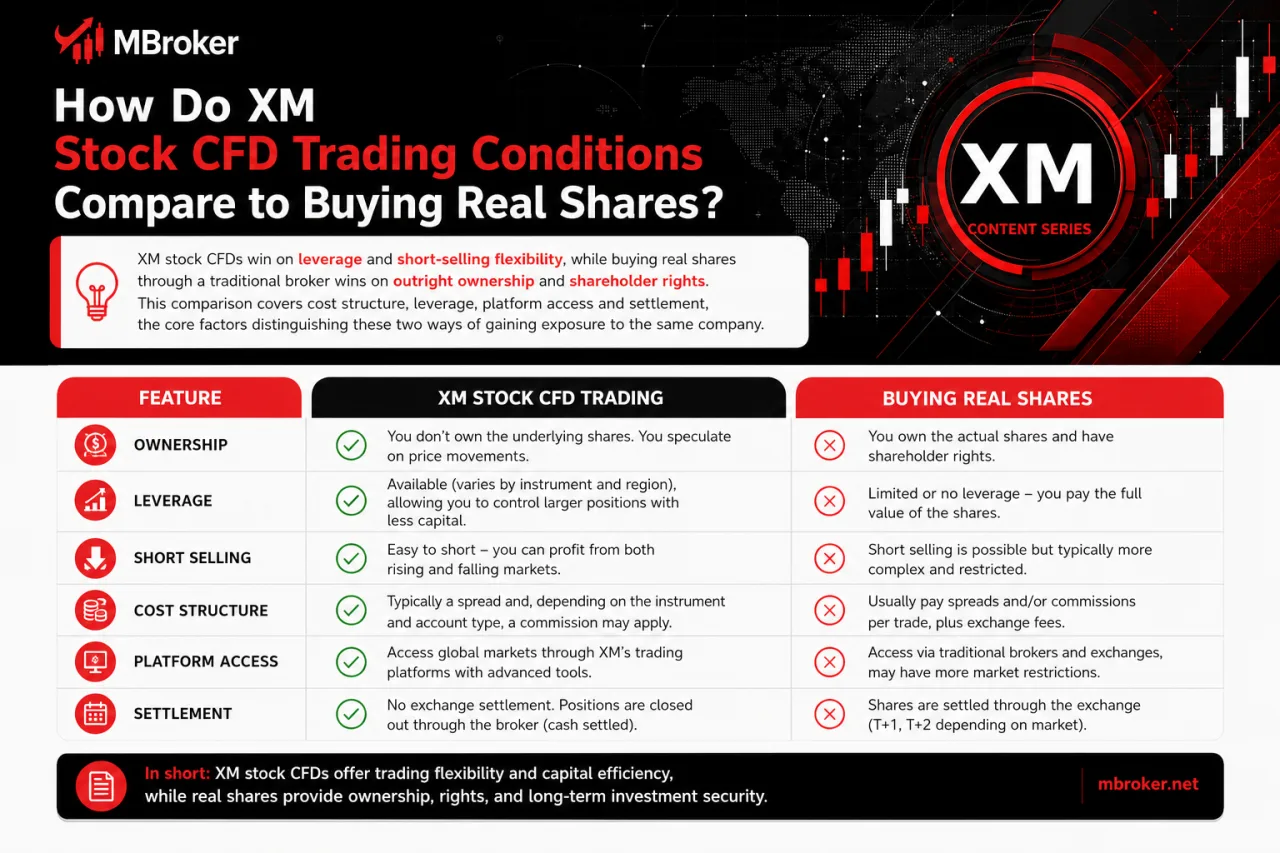
XM stock CFDs win on leverage and short-selling flexibility, while buying real shares through a traditional broker wins on outright ownership and shareholder rights. This comparison covers cost structure, leverage, platform access and settlement, the core factors distinguishing these two ways of gaining exposure to the same company.
Cost structure differs at the mechanism level. Stock CFD trading on XM typically applies a spread and, depending on the instrument and account type, a commission charge, while traditional share purchases usually involve a fixed brokerage commission plus exchange fees and custody charges over time.
Leverage separates the two products most sharply. Stock CFDs allow leveraged exposure with a fraction of the capital required for the full position, whereas buying real shares through a traditional broker demands full payment of the purchase price with no leverage.
Platform access also varies. XM stock CFDs trade through MT4/MT5 alongside forex, indices and other CFD instruments, while real shares typically require a separate brokerage account linked to a stock exchange.
Settlement marks the clearest structural difference. CFD positions settle as a cash difference between opening and closing price, with no share transfer, while real share purchases settle through actual delivery of stock into a registered account. Trading XM stock CFDs carries leveraged risk and grants no ownership of the underlying company, a distinction covered earlier in this guide regarding shareholder rights and dividend treatment.
Where Can You Find Historical Price Data, Market Cap, and Volume for XM Stock CFD Instruments?
Where Can You Find Historical Price Data, Market Cap, and Volume for XM Stock CFD Instruments
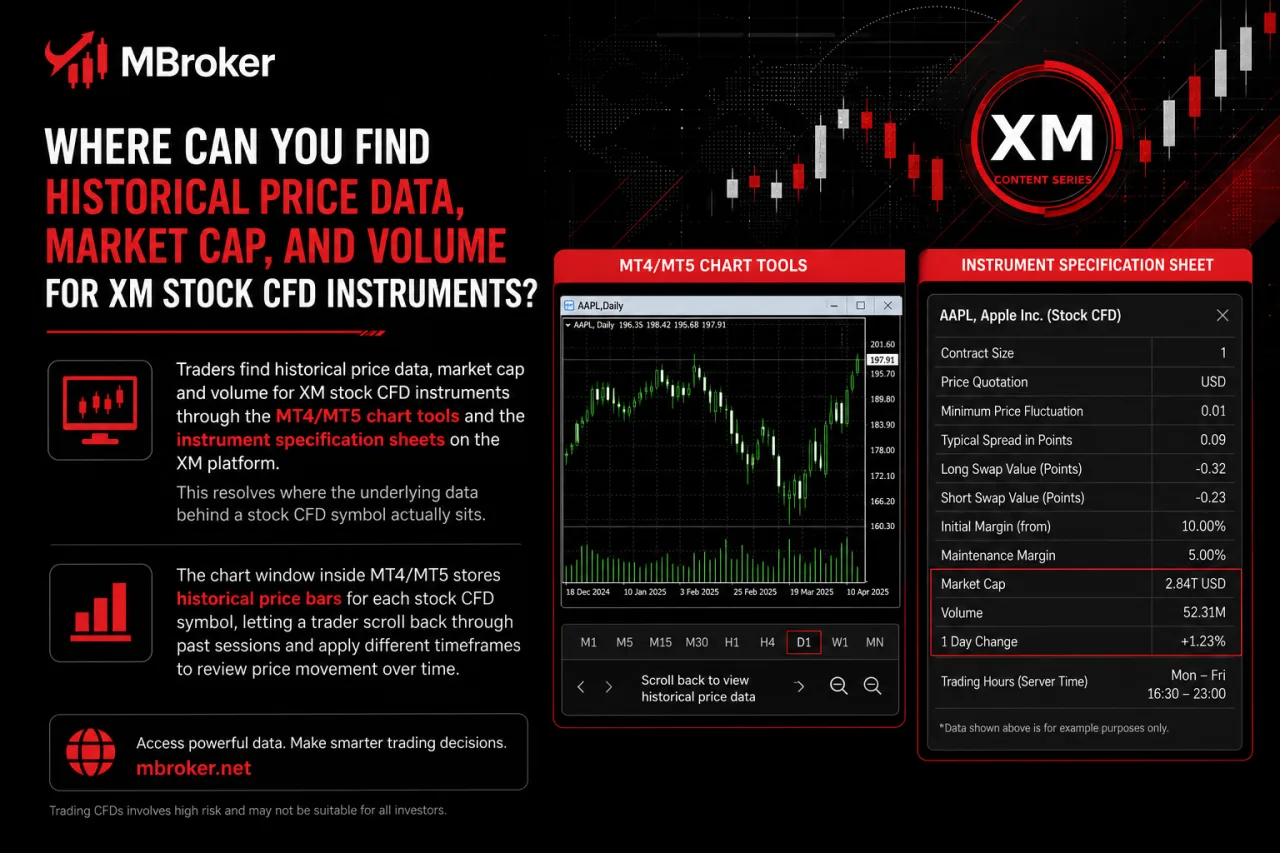
Traders find historical price data, market cap and volume for XM stock CFD instruments through the MT4/MT5 chart tools and the instrument specification sheets on the XM platform. This resolves where the underlying data behind a stock CFD symbol actually sits.
The chart window inside MT4/MT5 stores historical price bars for each stock CFD symbol, letting a trader scroll back through past sessions and apply different timeframes to review price movement over time. The specification sheet attached to each symbol displays additional reference details such as contract size and trading hours alongside the chart data.
Market capitalization and share volume figures, however, reference the underlying listed company on its home exchange rather than any XM-created number. Market cap reflects the total value of a company’s outstanding shares as calculated by the exchange where the stock trades, rather than a figure XM generates independently.
Volume shown on the XM chart, by contrast, represents CFD trading activity on XM’s own platform, a separate dataset from the underlying exchange’s official share trading volume. Traders cross-reference the underlying company’s official exchange page for authoritative market cap and volume figures, using the XM instrument specification sheet strictly to confirm CFD-specific contract terms.
What Rare Order Types and Restrictions Apply to XM Stock CFD Trading?
XM stock CFD trading involves a few less commonly discussed restrictions: stop-out levels tied to stock CFD margin, limits on hedging or scalping under certain account types, and entity-specific limits on which stock symbols a trader accesses. These rules sit outside the standard leverage, hours and dividend terms covered earlier in this guide. The subsections below break down each restriction individually.
Which Regions or Account Types Have Restricted Access to Certain XM Stock CFDs?
Regional and account-type restrictions on XM stock CFDs stem from the regulatory scope of the specific XM entity servicing a trader’s account, not a single global rule. This ties directly back to the entity distinction covered earlier in this guide regarding jurisdiction and product access.
A few examples illustrate how this plays out in practice:
- Clients under an ESMA-aligned XM EU entity typically face tighter leverage caps and a narrower stock CFD symbol list than clients under XM Global.
- Retail account classifications generally carry lower leverage ceilings and fewer available stock symbols than professional-classified accounts, subject to eligibility criteria set by the servicing entity.
- Certain stock CFD symbols tied to specific national exchanges may sit unavailable under one regulated branch while remaining listed under another.
- Some jurisdictions restrict CFD trading entirely for retail clients due to local regulatory policy, removing stock CFD access altogether regardless of account type.
These restrictions vary by country, regulator and account classification, so no fixed list applies universally across every XM entity, and traders should verify the applicable restrictions for their specific account before trading.
Traders confirm current symbol availability and account eligibility through their live XM client portal or the instrument specification sheet tied to their registered entity before trading.
Does Contract Expiration or Rollover Apply to XM Stock CFDs?
No, most XM stock CFDs carry no fixed expiration and roll over automatically as cash-settled contracts, unlike futures-based instruments with set delivery dates. This differs from a futures contract, which expires on a scheduled date and forces a rollover or closure.
A stock CFD position stays open indefinitely as long as margin requirements remain met, since the contract simply tracks the underlying share price without a settlement deadline. Exceptions arise from corporate actions rather than a calendar expiration date, though. A merger, acquisition, delisting or exchange suspension affecting the underlying company can force XM to close an open stock CFD position, since no live reference price exists once the underlying share stops trading normally.
Traders confirm any corporate-action-related closure policy for a specific stock CFD through the XM instrument specification sheet before holding a position long term.
Conclusion
XM stock CFDs provide leveraged exposure to global company shares without requiring traders to purchase or own the underlying stocks. Traders can open long or short positions, monitor real-time quotes on the XM platform and access historical charts, while dividend adjustments, margin requirements, trading hours and symbol availability vary by instrument, account type and XM legal entity.
Before opening a position, traders should check the latest contract specifications, exchange schedule and corporate-action rules directly on the platform. Because leverage can amplify both gains and losses—and CFD holders receive no voting or ownership rights—XM stock CFDs are most suitable for traders who understand derivatives and apply disciplined risk management.

Sylas Trenven is a forex strategist who helps traders master risk and timing. His work focuses on behavior-driven market entries and portfolio optimization for XM users looking to trade with precision and discipline. Email: [email protected]