
 Tiếng Việt
XM and HFM are both multi-regulated brokers offering Forex and CFD trading. Choosing between the two depends on which regulated entity a trader qualifies for and how each broker’s fee structure fits their trading style.
XM and HFM each operate under licenses from multiple financial regulators depending on the client’s registered entity, with the specific regulator applying to each entity, such as CySEC, ASIC, the FCA or FSC Belize, determined by the client’s country of residence. Client fund protection, including segregated accounts and compensation schemes, varies by the specific entity a trader is onboarded under.
Minimum deposits, spread types and commission structures differ across XM’s and HFM’s account tiers: XM’s account minimum deposit starts from $5, as noted by XM, while HFM’s account comparison page lists tiers starting from $0 minimum deposit, according to HFM, with offerings across both brokers ranging from standard no-commission accounts to raw-spread accounts with fixed fees per lot. These distinctions directly affect cost efficiency for different trading volumes.
Beginners, scalpers and high-frequency traders each benefit from different account setups offered by XM and HFM. XM’s account plans are detailed on its official account types page. HFM’s trading account comparison, including minimum trade size and maximum leverage across account tiers, is listed on its official trading accounts page. These setups vary based on execution speed, spread tightness and available leverage. Matching a trading style to the right broker configuration reduces unnecessary trading costs.
This comparison, compiled by Mbroker as an independent information resource on XM, breaks down these differences starting with XM vs HFM: Which Broker Is Better in 2026?, followed by a review of their regulatory standing and account structures.
XM vs HFM: Which Broker Is Better in 2026?
XM vs HFM: Which Broker Is Better in 2026
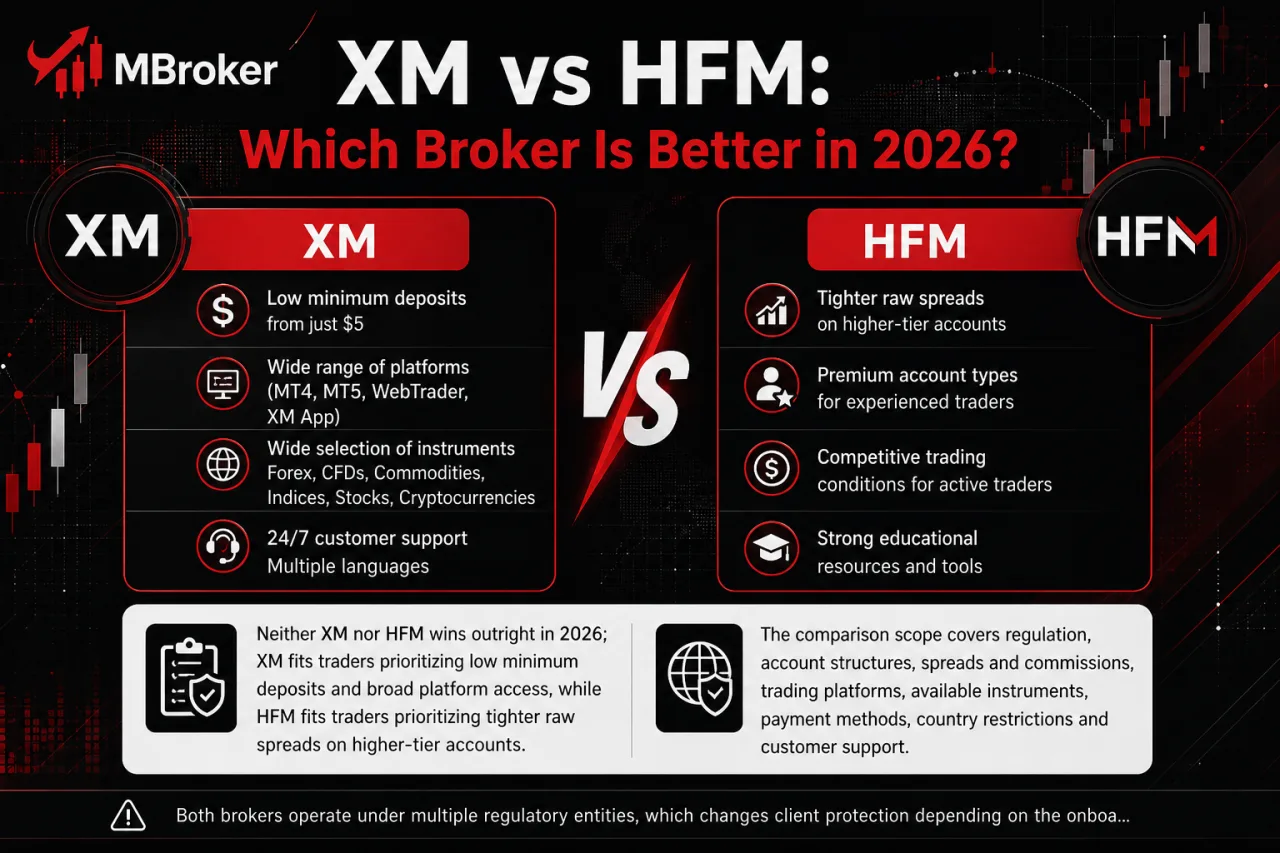
Neither XM nor HFM is universally better in 2026. XM fits traders prioritizing low minimum deposits and broad platform access, while HFM fits traders prioritizing tighter raw spreads on higher-tier accounts. The comparison scope covers regulation, account structures, spreads and commissions, trading platforms, available instruments, payment methods, country restrictions and customer support.
Both brokers operate under multiple regulatory entities, which changes client protection depending on the onboarding jurisdiction. Account tiers and minimum deposits differ, as outlined in the previous sections on entity structure and account conditions. Spread and commission models vary between standard and raw-spread account types across both brokers.
A neutral summary table below outlines these dimensions side by side without declaring one broker superior overall, since suitability depends on the trader’s regulated entity, funding method and preferred execution style. The following sections break down each criterion individually, starting with regulation and legal entities.
| Criterion | XM | HFM |
|---|---|---|
| Regulatory entities | Multiple offshore and CySEC-regulated entities | Multiple entities, including one FCA-regulated entity |
| Minimum deposit | From $5 | From $0 |
| Account types | Standard, no-commission focus | Standard to raw-spread tiers |
| Platforms | MT4/MT5 | MT4/MT5 |
| Instrument range | Forex, CFDs | Forex, CFDs |
| Payment methods | Bank cards and e-wallets, availability varies by entity | Bank cards and e-wallets, availability varies by entity |
| Country restrictions | Access limited under the FCA-regulated entity | Access limited under the FCA-regulated entity |
Are XM and HFM Regulated Brokers?
Are XM and HFM Regulated Brokers
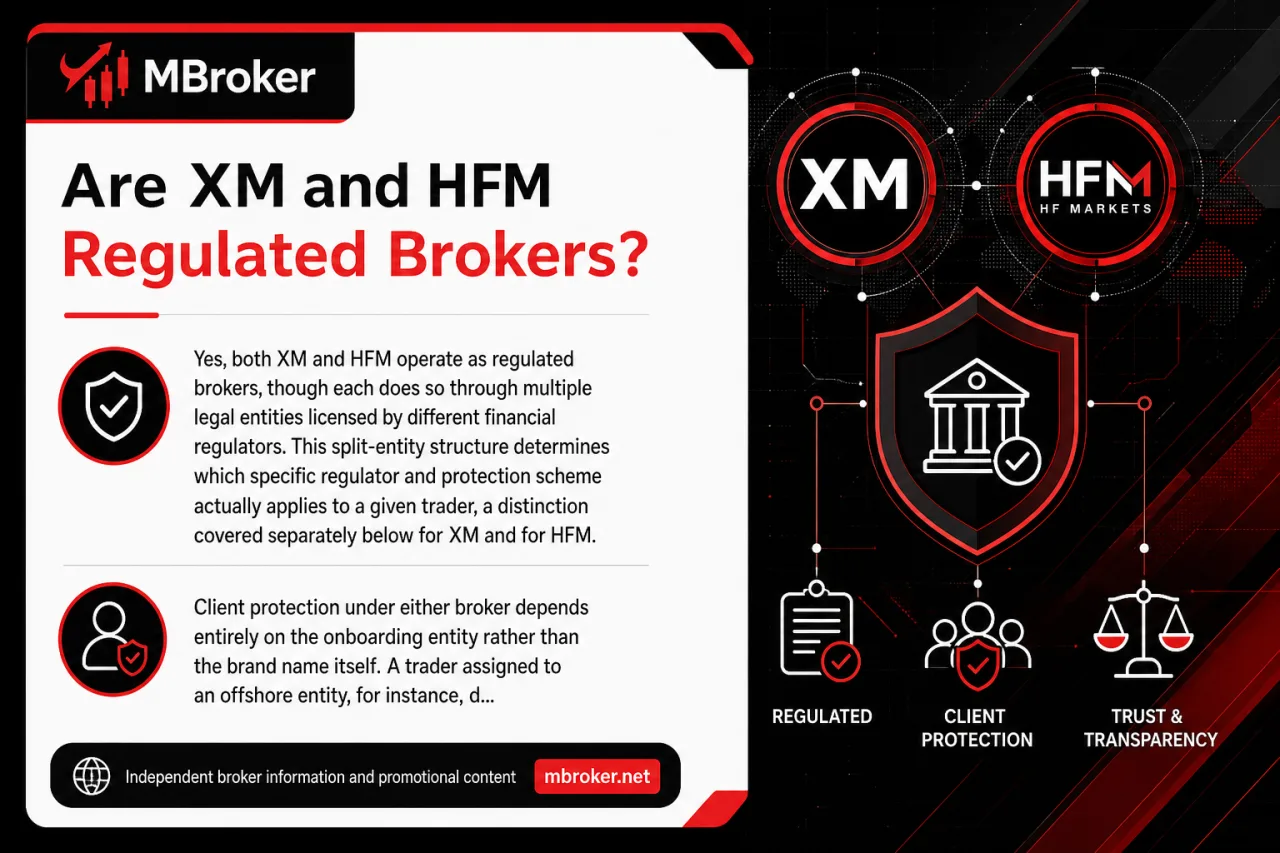
Yes, both XM and HFM operate as regulated brokers, though each does so through multiple legal entities licensed by different financial regulators. This split-entity structure determines which specific regulator and protection scheme actually applies to a given trader, a distinction covered separately below for XM and for HFM.
Client protection under either broker depends entirely on the onboarding entity rather than the brand name itself. A trader assigned to an offshore entity, for instance, does not receive the same compensation scheme access as one onboarded under an EU or UK-regulated entity. XM and HFM each operate under licenses from multiple financial regulators depending on the client’s registered entity. The specific regulator applying to each entity is determined by the client’s country of residence and includes:
- CySEC (Cyprus)
- ASIC (Australia)
- The FCA (United Kingdom)
- FSC Belize
Segregated client funds and negative balance protection generally apply across entities. Compensation scheme eligibility, such as the UK’s FSCS, only applies to clients onboarded under an FCA-regulated entity. Traders confirm their assigned entity and applicable regulator through account opening documents rather than assuming global uniformity.
How Do XM and HFM Compare in Client Fund Protection?
XM and HFM both apply segregated client accounts and negative balance protection across their regulated entities, but investor compensation scheme eligibility differs by entity rather than by brand. This distinction matters for traders comparing client fund protection between the two brokers beyond the general regulatory overview already covered.
Segregated accounts keep client funds separate from company operating capital under both brokers, a standard practice across their regulated entities. Negative balance protection also applies broadly, preventing a trader’s account balance from falling below zero after volatile market moves.
Compensation scheme access, however, depends on the specific onboarding entity. The breakdown below outlines how eligibility differs across regulatory jurisdictions:
- HFM clients onboarded under its FCA-regulated entity may be eligible for protection under the UK’s Financial Services Compensation Scheme (FSCS), subject to the scheme’s standard eligibility criteria.
- Clients onboarded under XM’s or HFM’s CySEC-regulated entities may be eligible for protection under the Investor Compensation Fund (ICF), subject to the fund’s standard eligibility criteria.
- Clients onboarded under offshore entities, such as FSC Belize or similar jurisdictions, do not gain access to either scheme.
Traders confirm compensation scheme eligibility through their specific account entity rather than assuming uniform protection across the entire brand.
XM vs HFM: How Do Their Account Types Compare?
XM vs HFM: How Do Their Account Types Compare
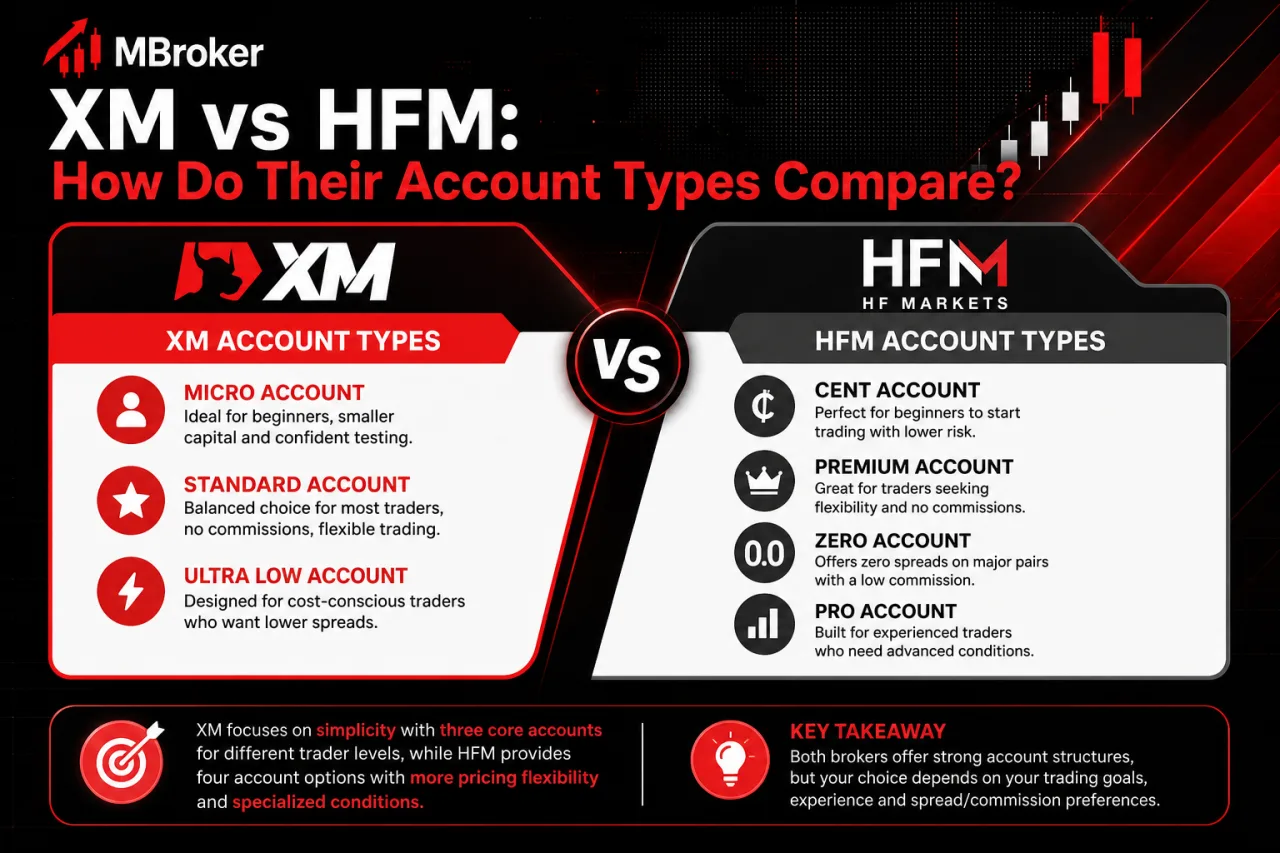
XM structures its account tiers around Micro, Standard and Ultra Low accounts, while HFM offers Cent, Premium, Zero and Pro accounts, with the two sets differing in minimum deposit, spread type and target trader profile. This account tier comparison builds on the entity and protection differences covered above, focusing on structure and suitability rather than regulation.
XM’s account tiers break down as follows:
- Micro account: spread-based, no-commission pricing with smaller lot sizing, targeting beginners.
- Standard account: same spread-based, no-commission pricing as Micro but with standard lot sizing, targeting smaller-volume traders.
- Ultra Low account: lower spreads paired with a fixed commission per lot, targeting cost-conscious active traders.
XM’s minimum deposit across these account types starts from $5, as stated by XM.
HFM’s account tiers break down as follows:
- Cent account: smaller position sizes denominated in cents, targeting traders testing strategies.
- Premium account: standard spread-based trading for general-purpose use.
- Zero account: raw spreads with commission-based pricing, targeting scalpers.
- Pro account: raw spreads with commission-based pricing, targeting high-frequency traders.
HFM’s account tiers start from $0 minimum deposit, according to HFM.
Traders prioritizing low entry cost lean toward XM’s Micro or Standard accounts or HFM’s Cent account, while those executing high-frequency strategies lean toward XM’s Ultra Low account or HFM’s Zero and Pro accounts.
XM vs HFM: Whose Spreads and Commissions Are Lower?
XM vs HFM: Whose Spreads and Commissions Are Lower
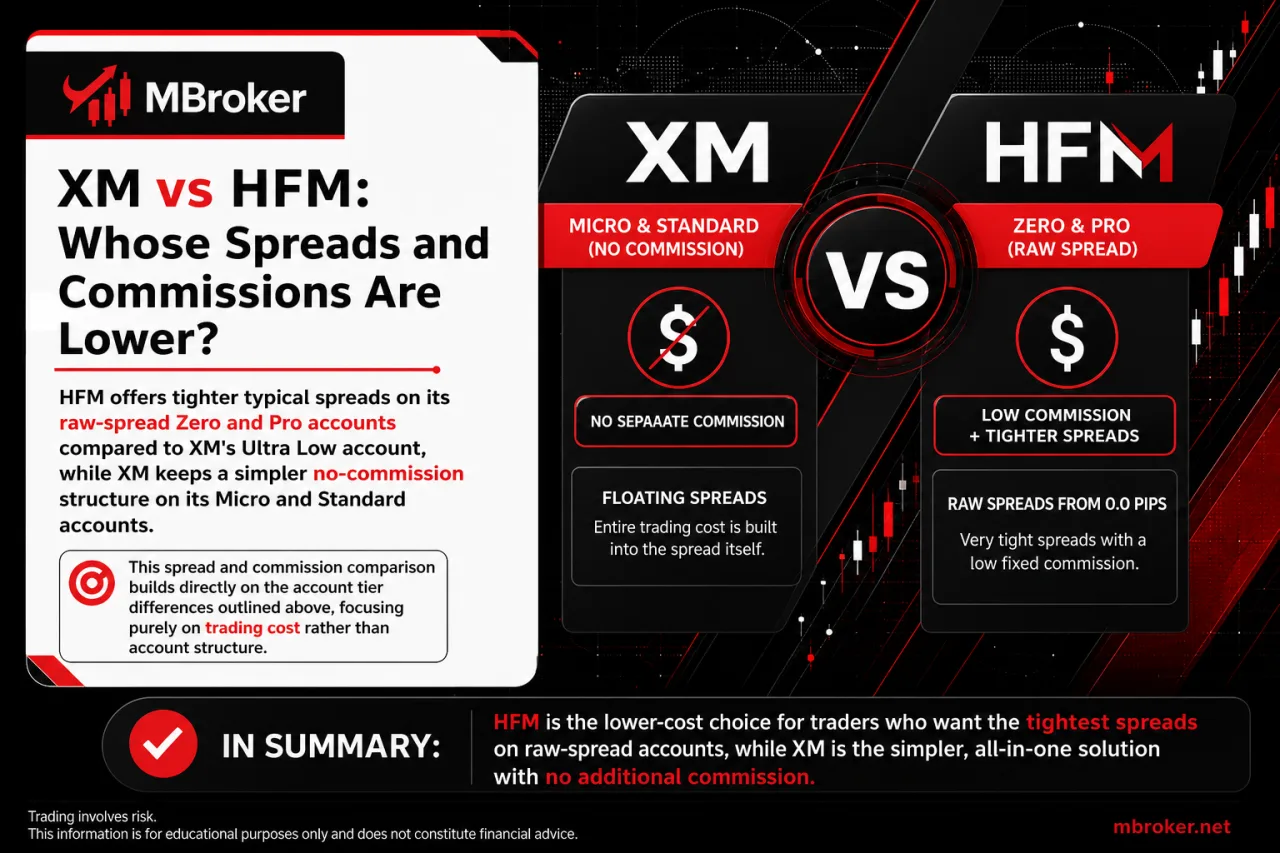
HFM offers tighter typical spreads on its raw-spread Zero and Pro accounts compared to XM’s Ultra Low account, while XM keeps a simpler no-commission structure on its Micro and Standard accounts. This spread and commission comparison builds directly on the account tier differences outlined above, focusing purely on trading cost rather than account structure.
XM’s Micro and Standard accounts run on floating spreads with no separate commission, folding the entire trading cost into the spread itself. Its Ultra Low account narrows spreads further but adds a fixed commission per lot, matching HFM’s raw-spread model in concept.
HFM’s Cent and Premium accounts follow the same spread-only pricing as XM’s Micro and Standard tiers, while its Zero and Pro accounts charge a commission per lot alongside near-raw spreads. HFM’s Zero account markets spreads from 0.0 pips on major currency pairs, according to HFM.
Overall trading cost between the two brokers depends on account tier, traded instrument and executed volume rather than a single fixed figure. Traders running high-frequency or scalping strategies compare commission-inclusive total cost per lot across both brokers’ raw-spread tiers before selecting one over the other.
XM vs HFM: Which Trading Platforms Are Available?
XM vs HFM: Which Trading Platforms Are Available
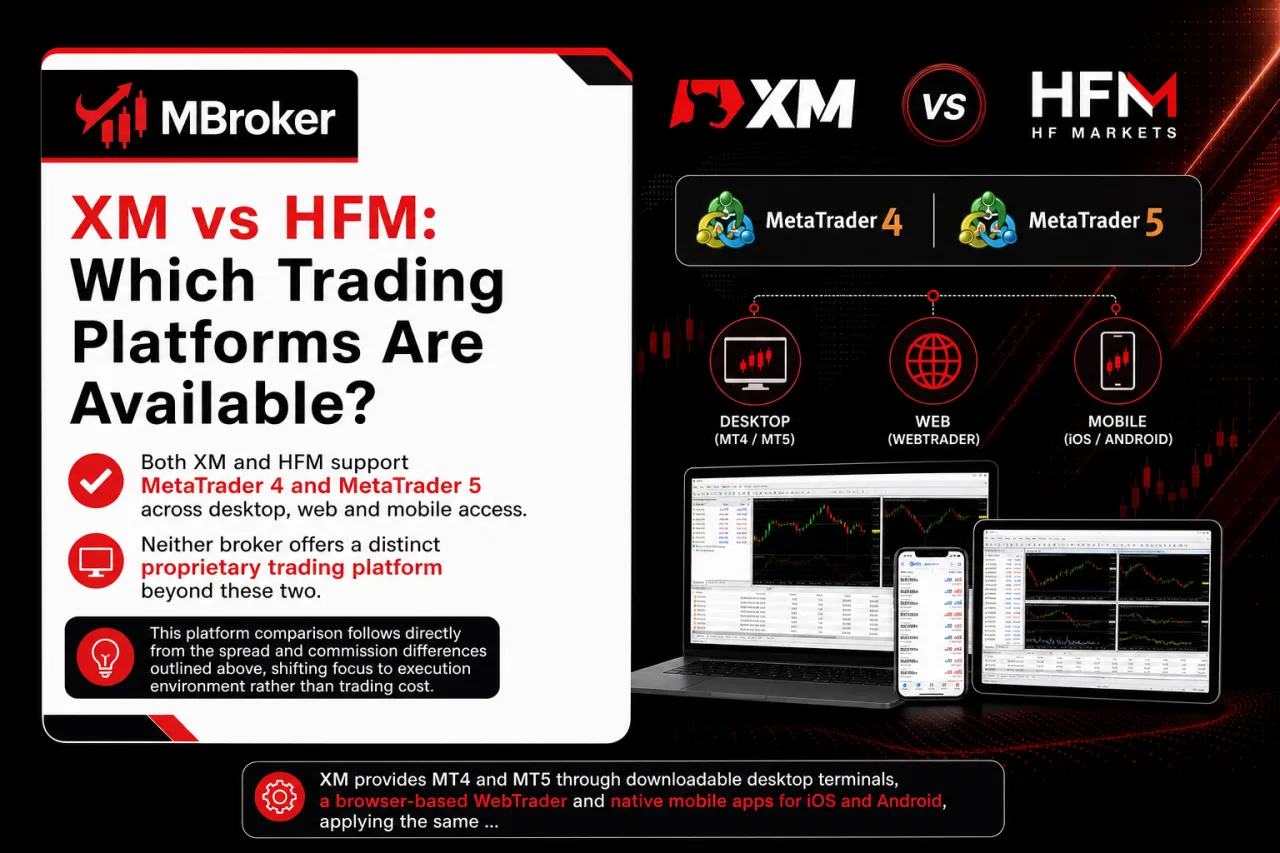
Both XM and HFM support MetaTrader 4 and MetaTrader 5 across desktop, web and mobile access, with neither broker offering a distinct proprietary trading platform beyond these two. This platform comparison follows directly from the spread and commission differences outlined above, shifting focus to execution environment rather than trading cost.
XM provides MT4 and MT5 through downloadable desktop terminals, a browser-based WebTrader and native mobile apps for iOS and Android, applying the same account tiers and spreads discussed earlier across all access points. HFM mirrors this setup, offering MT4 and MT5 through desktop, web and mobile versions, with its Cent, Premium, Zero and Pro accounts all accessible through either platform.
Neither broker restricts specific account tiers to a single platform version, letting traders run Micro, Standard or Ultra Low accounts on XM’s MT4 or MT5 interchangeably, and Cent, Premium, Zero or Pro accounts on HFM’s MT4 or MT5 in the same way. Platform-specific tools, such as one-click trading, custom indicators and automated Expert Advisors, remain standard across MT4 and MT5 on both brokers rather than differing by tier.
XM vs HFM: What Financial Instruments Can You Trade?
XM vs HFM: What Financial Instruments Can You Trade
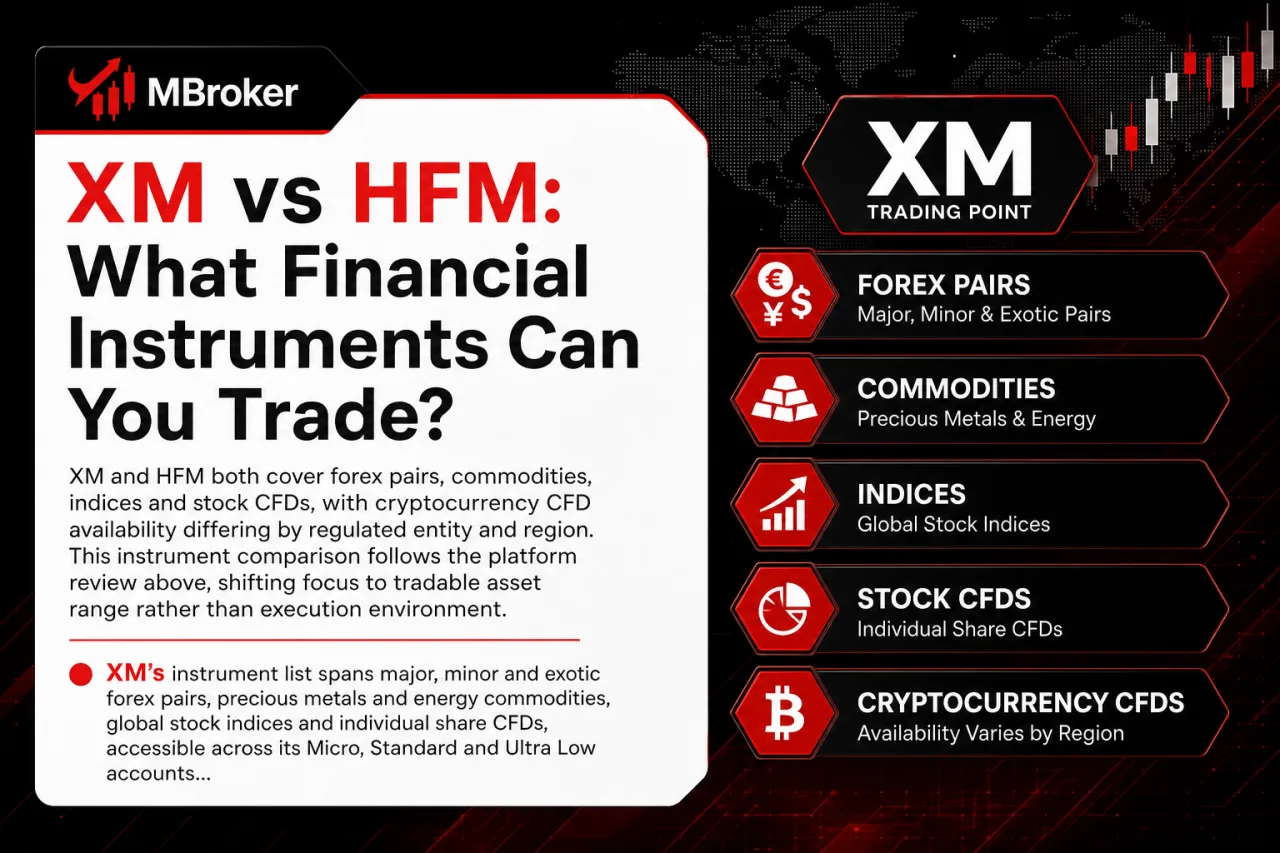
XM and HFM both cover forex pairs, commodities, indices and stock CFDs, with cryptocurrency CFD availability differing by regulated entity and region. This instrument comparison follows the platform review above, shifting focus to tradable asset range rather than execution environment.
XM’s instrument list spans major, minor and exotic forex pairs, precious metals and energy commodities, global stock indices and individual share CFDs, accessible across its Micro, Standard and Ultra Low accounts. HFM offers a comparable range across forex, commodities, indices and stock CFDs, spread across its Cent, Premium, Zero and Pro tiers discussed earlier.
Cryptocurrency CFD trading appears on both brokers’ platforms in certain regions, though availability narrows or drops entirely depending on the specific regulated entity and local restrictions applicable to the client’s country of residence.
Traders confirm exact instrument availability, including crypto CFDs and specific stock CFD listings, through their assigned regulated entity’s contract specifications rather than assuming uniform access across every XM or HFM account worldwide.
XM vs HFM: How Do Payment Methods and Deposit/Withdrawal Processes Compare?
XM vs HFM: How Do Payment Methods and Deposit/Withdrawal Processes Compare
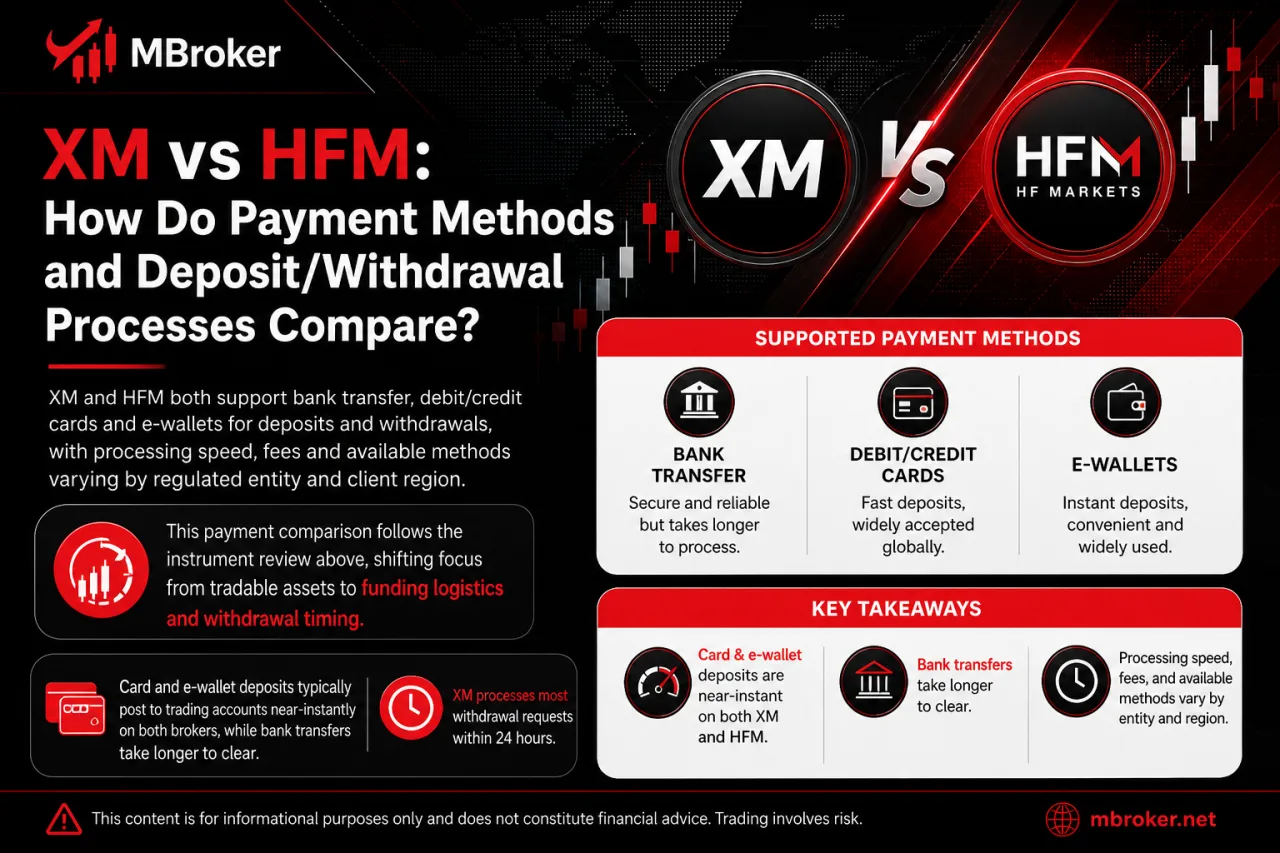
XM and HFM both support bank transfer, debit/credit cards and e-wallets for deposits and withdrawals, with processing speed, fees and available methods varying by regulated entity and client region. This payment comparison follows the instrument review above, shifting focus from tradable assets to funding logistics and withdrawal timing.
Card and e-wallet deposits typically post to trading accounts near-instantly on both brokers, while bank transfers take longer to clear. XM processes most withdrawal requests within one business day, according to XM, though the receiving bank or e-wallet provider adds further delay before funds actually appear.
HFM lists similar withdrawal processing timelines for e-wallets and cards, according to HFM, with bank wire withdrawals taking noticeably longer due to intermediary bank processing.
Neither broker charges a deposit fee on standard payment methods. Third-party payment providers or intermediary banks deduct additional charges outside the broker’s control on certain transactions. Traders account for these external deductions when reconciling deposit amounts against what actually lands in their trading balance.
Available payment methods also narrow by country, since certain e-wallets or local bank transfer options only appear for clients onboarded under specific XM or HFM entities. Traders confirm supported methods and current processing times through their account’s cashier section rather than assuming identical availability across every region.
Are XM and HFM Available in Your Country?
Are XM and HFM Available in Your Country
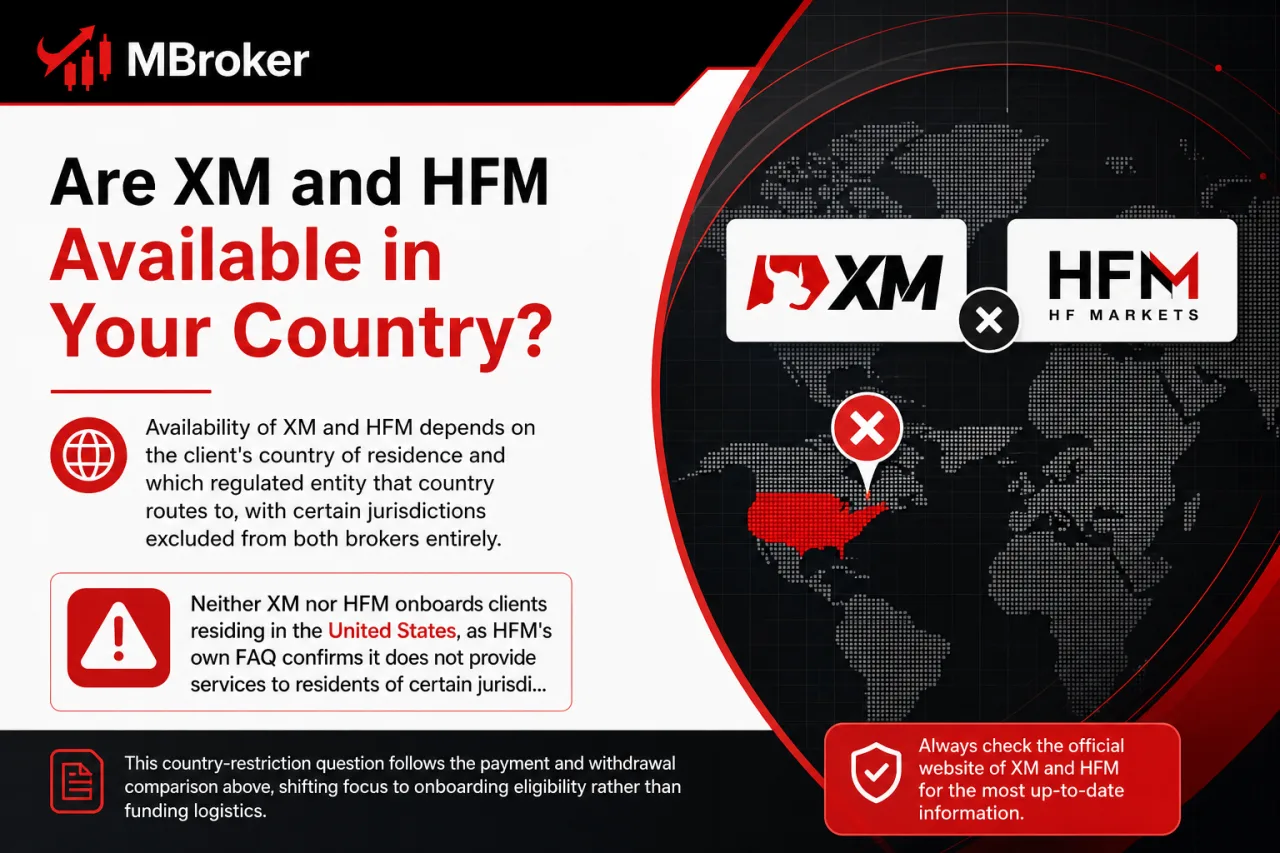
Availability of XM and HFM depends on the client’s country of residence and which regulated entity that country routes to, with certain jurisdictions excluded from both brokers entirely. This country-restriction question follows the payment and withdrawal comparison above, shifting focus to onboarding eligibility rather than funding logistics.
Neither XM nor HFM onboards clients residing in the United States, as HFM’s own FAQ confirms it does not provide services to residents of certain jurisdictions, including the United States, Canada, Sudan, Syria, Iran, North Korea, the UAE and other countries, according to HFM.
Beyond the US, both brokers also restrict onboarding in select sanctioned or high-risk jurisdictions, though the exact list varies by which entity a resident’s country falls under. A trader from a CySEC-eligible EU country, for instance, onboards under a different XM or HFM entity than one from an ASIC-eligible or FSC Belize-eligible country.
Each entity carries its own restriction list rather than a single global set of rules.
Available account types, leverage caps and instrument access also shift depending on the assigned entity rather than staying uniform worldwide. Traders confirm current country eligibility directly through XM’s or HFM’s account registration process, since restriction lists change periodically based on regulatory updates.
XM vs HFM: How Do Their Customer Support Services Compare?
XM vs HFM: How Do Their Customer Support Services Compare
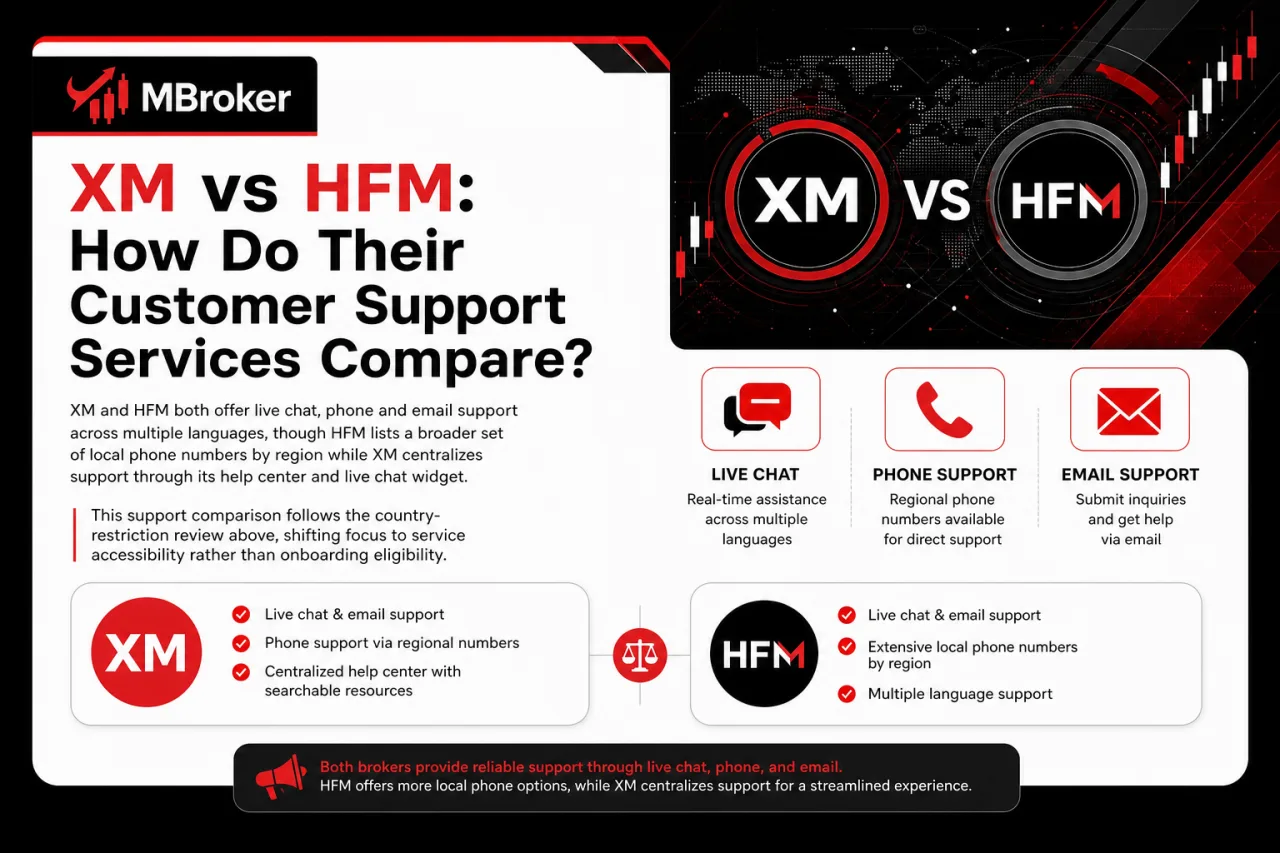
XM and HFM both offer live chat, phone and email support across multiple languages, though HFM lists a broader set of local phone numbers by region while XM centralizes support through its help center and live chat widget. This support comparison follows the country-restriction review above, shifting focus to service accessibility rather than onboarding eligibility.
XM operates live chat and email support alongside a searchable help center, with phone support available through regional numbers tied to specific offices. XM’s support team responds in multiple languages, with availability varying depending on the client’s registered entity and region.
HFM likewise offers live chat, email and phone lines, with dedicated local numbers listed for several regions rather than a single global line. HFM’s support team responds in multiple languages, with contact channels and availability varying depending on the client’s registered entity and region.
Neither broker’s support hours run uniformly worldwide, since availability shifts based on the client’s regulated entity and time zone. Traders confirm current language coverage and support hours directly through their account portal before relying on either broker’s contact channels.
XM vs HFM: Which Broker Suits Beginners, Scalpers or Specific Trading Styles Better?
XM vs HFM: Which Broker Suits Beginners, Scalpers or Specific Trading Styles Better
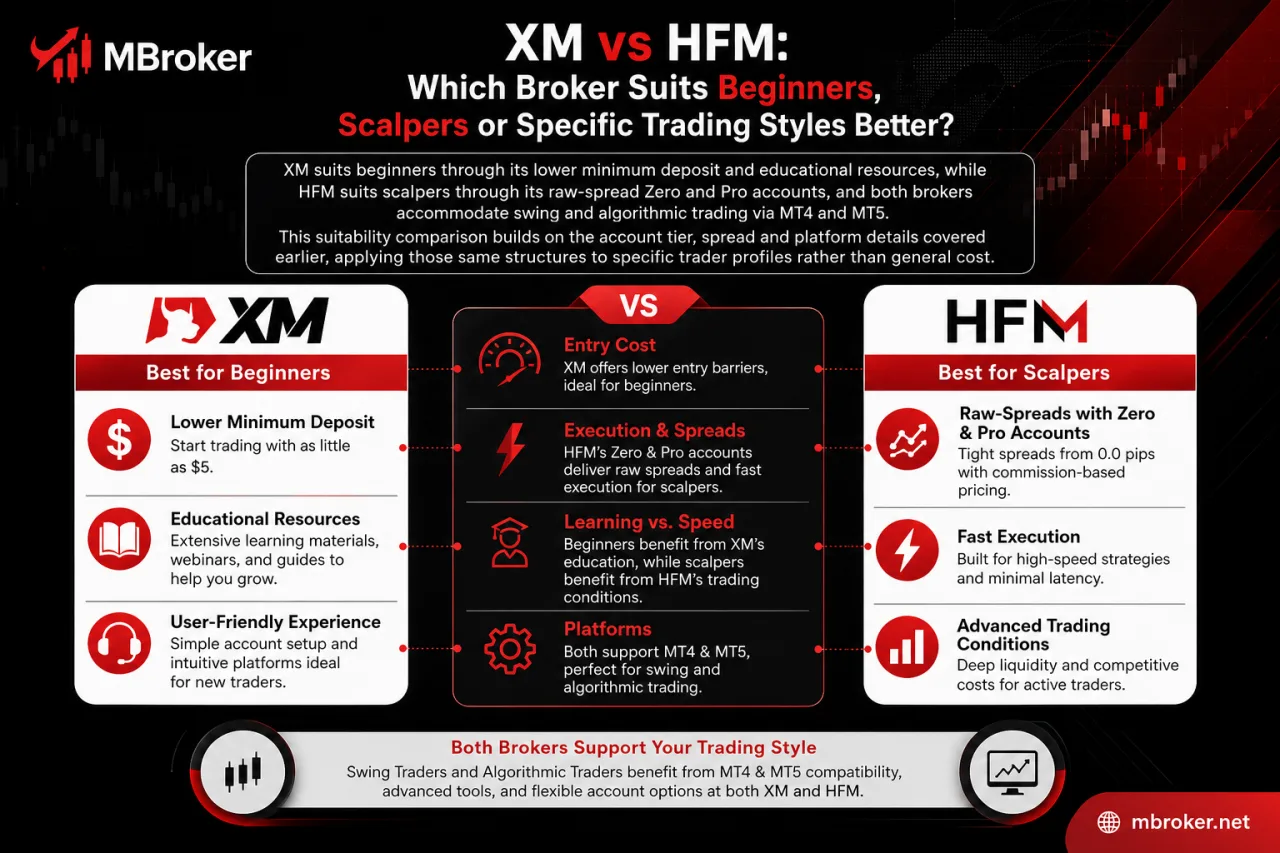
XM suits beginners through its lower minimum deposit and educational resources, while HFM suits scalpers through its raw-spread Zero and Pro accounts, and both brokers accommodate swing and algorithmic trading via MT4 and MT5. This suitability comparison builds on the account tier, spread and platform details covered earlier, applying those same structures to specific trader profiles rather than general cost.
Beginners weigh entry cost and learning support before execution speed. Scalpers weigh spread tightness and commission structure over broad instrument range. Swing and algorithmic traders weigh platform stability and Expert Advisor compatibility over minimum deposit size.
- Beginners lean toward XM’s Micro or Standard accounts or HFM’s Cent account, given their lower entry barriers already outlined in the account comparison above.
- Scalpers lean toward XM’s Ultra Low account or HFM’s Zero and Pro accounts, given the tighter raw spreads and commission-based pricing discussed in the spread comparison section.
- Swing traders and algorithmic traders lean toward either broker’s MT4 or MT5 setup, since both platforms support automated Expert Advisors and multi-timeframe charting regardless of account tier.
Demo accounts remain available on both brokers across account types, letting beginners and strategy testers trial conditions before funding a live account. Traders confirm specific scalping policy terms and execution speed guarantees through each broker’s account documentation rather than assuming identical treatment across every entity.
XM vs HFM: How Do Their Bonuses and Promotions Differ?
XM and HFM both offer welcome or deposit-based promotions in select regions, while loyalty or cashback programs are listed on both brokers’ official promotions pages, though eligibility for either narrows depending on the client’s regulated entity. This bonus and promotion comparison follows the customer support review above, shifting focus from service channels to incentive offerings tied to account funding and trading activity.
Bonus structures on both brokers typically fall into a few categories, including welcome bonuses for new accounts, deposit-matching bonuses tied to funding amounts, and loyalty or cashback programs rewarding trading volume over time. Availability of each type depends heavily on regulatory restrictions, since regulators such as the FCA and CySEC commonly prohibit or limit bonus-based incentives for retail clients under their jurisdiction.
Regions falling under stricter EU or UK regulatory oversight generally see fewer or no bonus offers compared to clients onboarded under offshore entities.
Traders confirm current bonus terms, eligibility criteria and regional availability directly through XM’s or HFM’s official promotions page before assuming a specific offer applies to their account, since such promotions change periodically and remain subject to each broker’s terms and conditions.
Do XM and HFM Offer Copy Trading or Social Trading Tools?
Neither XM nor HFM provides a native copy trading or social trading platform, though both allow copy trading indirectly through third-party MT4/MT5 signal services and external providers. This copy trading question follows the bonus and promotion review above, shifting focus to automated strategy-following tools rather than incentive offerings.
Traders link an MT4 or MT5 account from either broker to external copy trading services or signal providers that support standard MetaTrader connectivity, rather than using an in-house XM or HFM copy trading dashboard. Account tier restrictions still apply, since raw-spread accounts such as XM’s Ultra Low or HFM’s Zero and Pro carry different commission structures that affect copied trade costs. Traders confirm compatibility between their specific account type and any third-party copy trading service before connecting it, since not all signal providers support every account tier or leverage setting offered by XM or HFM.

Thoren Vextal is Mbroker’s XM Reviews and How-To Guides Editor, covering broker reviews, regulation, comparisons and practical account guides.Email: [email protected]