
 Tiếng Việt
According to XM’s official account types page, the Standard account applies a spread-only pricing model with no separate commission, while the Ultra Low account is built for tighter spreads under a different cost structure. Standard features like negative balance protection apply across both account types. The right choice depends on trading frequency, position size and sensitivity to spread versus fixed cost.
Beyond the pricing model itself, several other factors distinguish these two account types, including swap fee treatment, minimum deposit requirements, lot size flexibility and overall suitability for different trading styles.
Mbroker breaks down these distinctions further below, starting with a direct comparison of XM Standard and Ultra Low accounts to determine which one matches a trader’s specific style.
XM Standard vs Ultra Low Account: Quick Comparison
The key difference is that the XM Standard Account focuses on general trading and eligible promotional benefits, whereas the XM Ultra Low Account prioritises lower spreads and reduced trading costs. Both currently require a minimum deposit of $5 under XM Global, but availability and conditions vary by jurisdiction.
| Feature | XM Standard Account | XM Ultra Low Account |
| Main advantage | General-purpose trading with eligible bonuses | Lower-cost trading conditions |
| Minimum deposit | $5 under XM Global | $5 under XM Global |
| Spreads | Standard variable spreads | Generally lower variable spreads |
| Commission | Depends on the instrument and XM entity | Lower commissions where applicable |
| Overnight costs | Standard instrument-specific swap rates | Generally lower swap fees |
| Contract size | 1 standard lot typically equals 100,000 currency units | Ultra Low Standard: 100,000 units; Ultra Low Micro: 1,000 units where available |
| Trading platforms | MT4, MT5 and supported XM applications, subject to entity | MT4, MT5 and supported XM applications, subject to entity |
| Instruments | Broad multi-asset selection | Broadly similar, although symbols may differ |
| Bonus eligibility | More suitable for eligible XM promotions | Certain bonuses or loyalty schemes may be restricted |
| Islamic option | Available under applicable conditions | Available under applicable conditions |
| Best suited for | Beginners and traders interested in promotional benefits | Active, high-volume and cost-sensitive traders |
Account types, spreads, commissions, swaps, leverage, instruments and promotions depend on the client’s country and XM legal entity. For example, XM’s EEA website currently lists Ultra Low and Zero rather than Standard.
XM Standard vs Ultra Low Account: Which One Should You Choose?
XM Standard vs Ultra Low Account: Which One Should You Choose
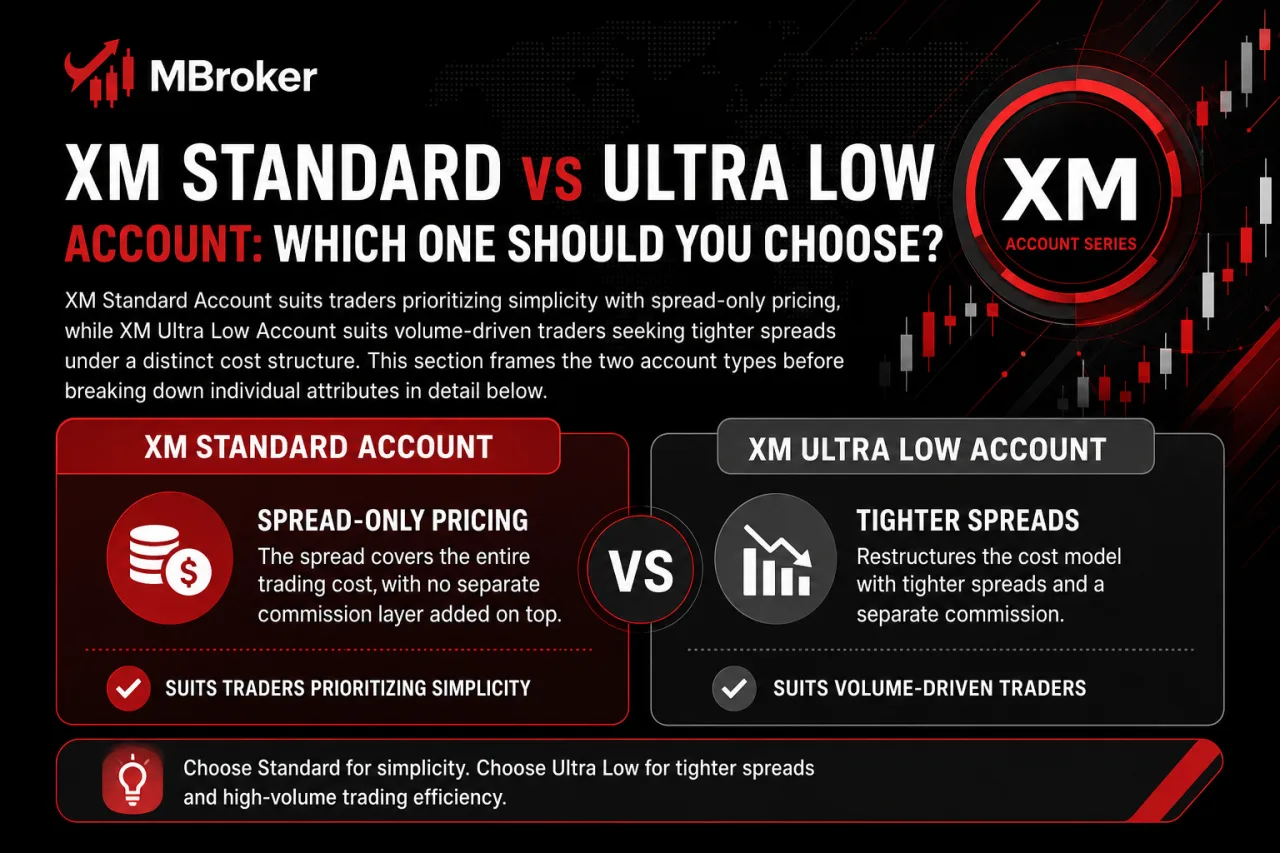
XM Standard Account suits traders prioritizing simplicity with spread-only pricing, while XM Ultra Low Account suits volume-driven traders seeking tighter spreads under a distinct cost structure. This section frames the two account types before breaking down individual attributes in detail below.
The Standard account carries a straightforward pricing model where the spread covers the entire trading cost, with no separate commission layer added on top. The Ultra Low account restructures that model, narrowing spreads while applying a different fee arrangement, a setup already outlined in the pricing comparison above.
Both account types share core XM features such as negative balance protection, MT4 and MT5 compatibility, and the same $5 minimum deposit threshold. The distinction sits mainly in cost structure and lot size flexibility rather than platform access or account safety features.
The comparison below evaluates spreads, commissions, minimum deposits, lot sizes and suitability by trading style, giving traders a structured basis for choosing between XM Standard and XM Ultra Low based on objective account conditions rather than general preference.
What Are the Key Feature Differences Between XM Standard and Ultra Low Accounts?
What Are the Key Feature Differences Between XM Standard and Ultra Low Accounts
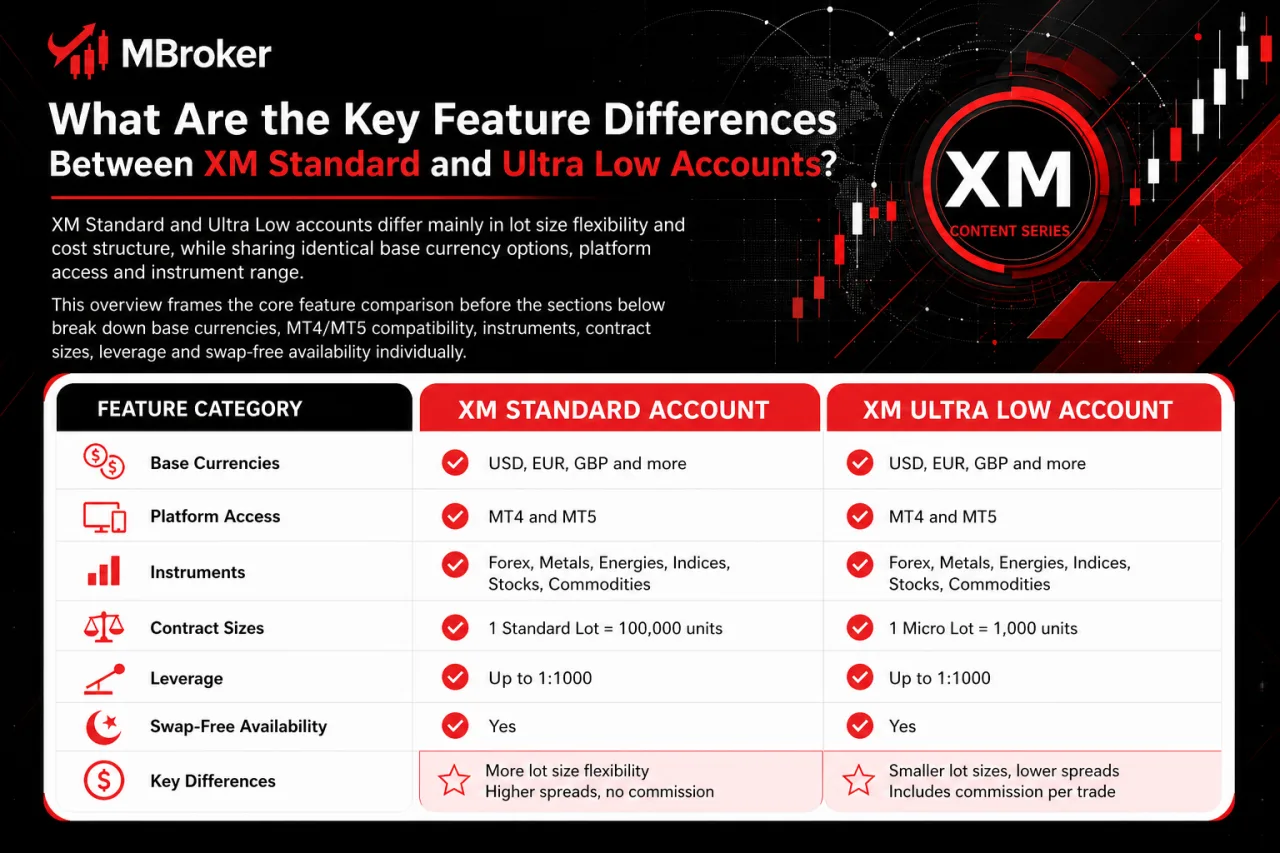
XM Standard and Ultra Low accounts differ mainly in lot size flexibility and cost structure, while sharing identical base currency options, platform access and instrument range. This overview frames the core feature comparison before the sections below break down base currencies, MT4/MT5 compatibility, instruments, contract sizes, leverage and swap-free availability individually.
Which Countries and Client Types Are Eligible for Each Account?
XM Standard and Ultra Low accounts remain open to retail clients across most supported countries, with eligibility depending on the specific XM legal entity registering the trader rather than the account type itself. This distinction matters because XM operates through multiple regulated entities, each carrying its own country restrictions and client classification rules.
XM Group operates through several licensed legal entities registered in different jurisdictions, and account availability, including for Standard or Ultra Low accounts, can vary depending on a client’s country of residence and category.
Both account types generally serve retail clients by default, while professional client status changes leverage caps and certain protections depending on the entity’s regulatory framework. Traders classified as professional under an EU-regulated entity generally face different leverage limits and reduced negative balance protection guarantees compared to retail clients, regardless of account type, since these classifications relate to regulatory client categorization rather than the account type itself.
Residents of certain countries face restrictions on opening any XM account regardless of type, based on the entity’s licensing scope in that jurisdiction. Traders confirm eligibility directly during the XM registration process, where the system routes applicants to the appropriate legal entity based on residency.
How Do Spreads and Commissions Differ Between Standard and Ultra Low Accounts?
How Do Spreads and Commissions Differ Between Standard and Ultra Low Accounts
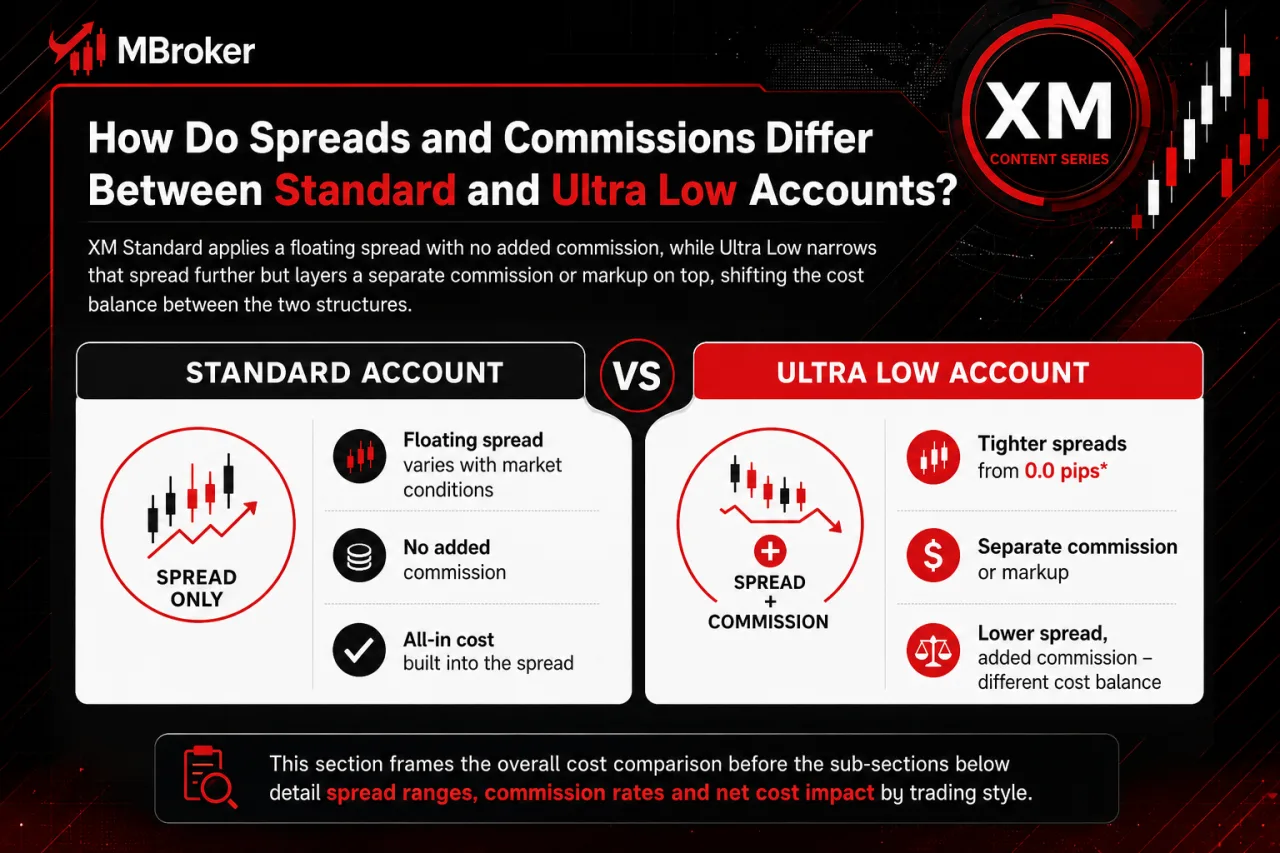
XM Standard applies a floating spread with no added commission, while Ultra Low narrows that spread further but layers a separate commission or markup on top, shifting the cost balance between the two structures. This section frames the overall cost comparison before the sub-sections below detail spread ranges, commission rates and net cost impact by trading style.
Do Standard and Ultra Low Accounts Have Different Swap Fees?
Standard and Ultra Low accounts follow the same swap fee structure, applying identical overnight financing rates per instrument regardless of account type, except where a trader opts into a swap-free Islamic account. This distinction separates swap charges from the spread and commission differences covered above.
XM calculates swap fees based on the instrument traded and the position’s overnight holding duration, not the account type carrying that position. A Standard account and an Ultra Low account holding the same instrument and lot size at the close of the trading day accrue the same swap charge.
The one exception applies to swap-free accounts, available to eligible clients under Islamic account terms. XM offers a swap-free option that replaces overnight interest with an administrative fee on certain instruments after a set number of days, available to eligible clients regardless of whether they hold a Standard or Ultra Low account.
Traders sensitive to overnight costs verify swap rates per instrument directly through the XM trading platform before holding positions past the daily rollover time.
What Are the Minimum Deposit and Lot Size Requirements for Each Account?
What Are the Minimum Deposit and Lot Size Requirements for Each Account
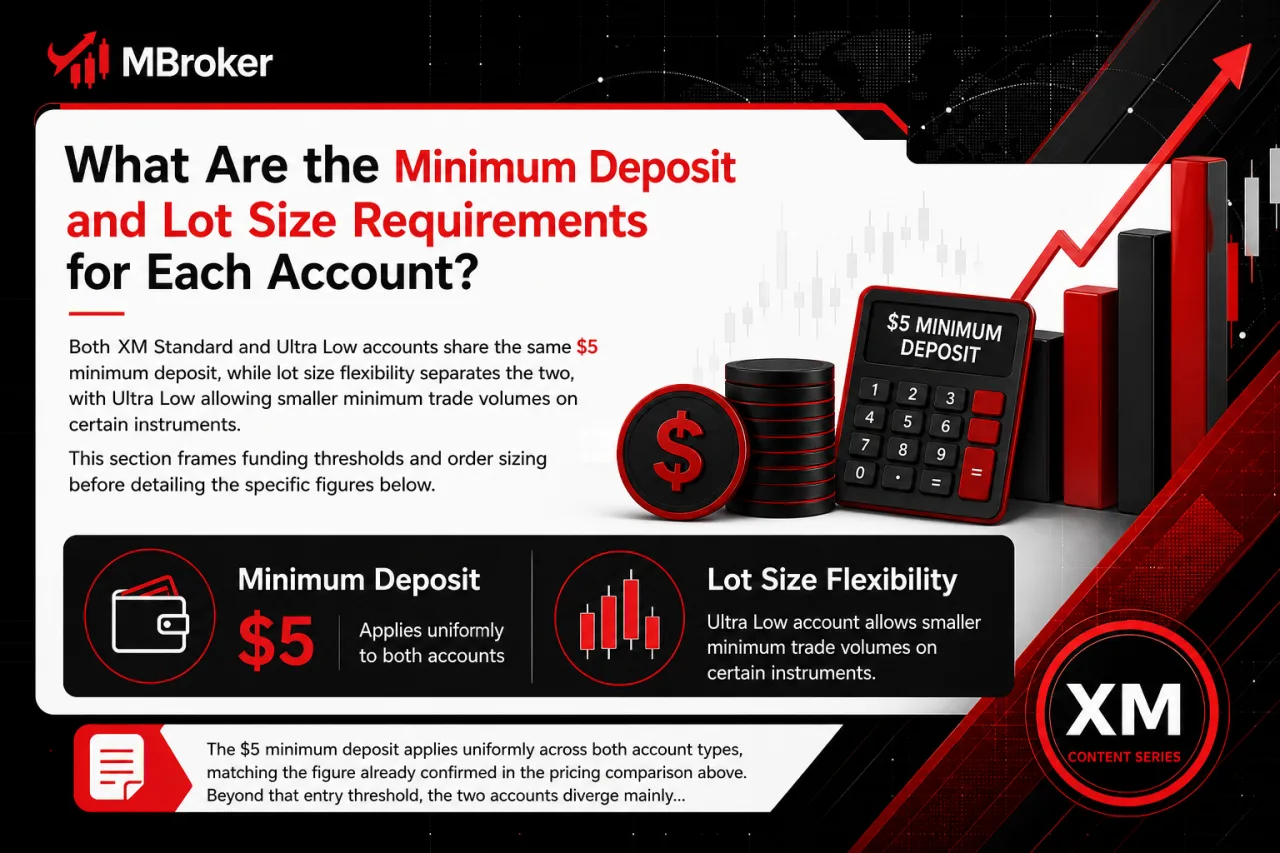
Both XM Standard and Ultra Low accounts share the same $5 minimum deposit, while lot size flexibility separates the two, with Ultra Low allowing smaller minimum trade volumes on certain instruments. This section frames funding thresholds and order sizing before detailing the specific figures below.
The $5 minimum deposit applies uniformly across both account types, matching the figure already confirmed in the pricing comparison above. Beyond that entry threshold, the two accounts diverge mainly in how small or large a single position can be.
According to XM’s official account types page, a standard lot represents 100,000 units of the base currency, and both Standard and Ultra Low accounts allow trading in fractional lot sizes. Traders comparing the two account types confirm the exact minimum lot increments per instrument directly on the XM platform before placing an order, since fractional sizing varies across different symbols.
XM applies its order execution rules, including limits on the number of simultaneous positions a client may hold, uniformly across its account types. This policy does not change based on which of the two account types a trader chooses.
Key figures traders weigh before opening an account:
- Minimum deposit: $5, identical for both Standard and Ultra Low accounts.
- Lot increments: Fractional lot sizes are supported on both account types, with exact minimum volumes varying by instrument.
- Order execution rules: Applied consistently by XM across account types, not a point of difference between Standard and Ultra Low.
- Verification step: Traders funding smaller accounts or testing strategies with reduced capital confirm exact lot increments and volume caps directly on the XM platform before placing an order.
Which Account Fits Scalping, Day Trading or High-Volume Strategies Better?
Which Account Fits Scalping, Day Trading or High-Volume Strategies Better
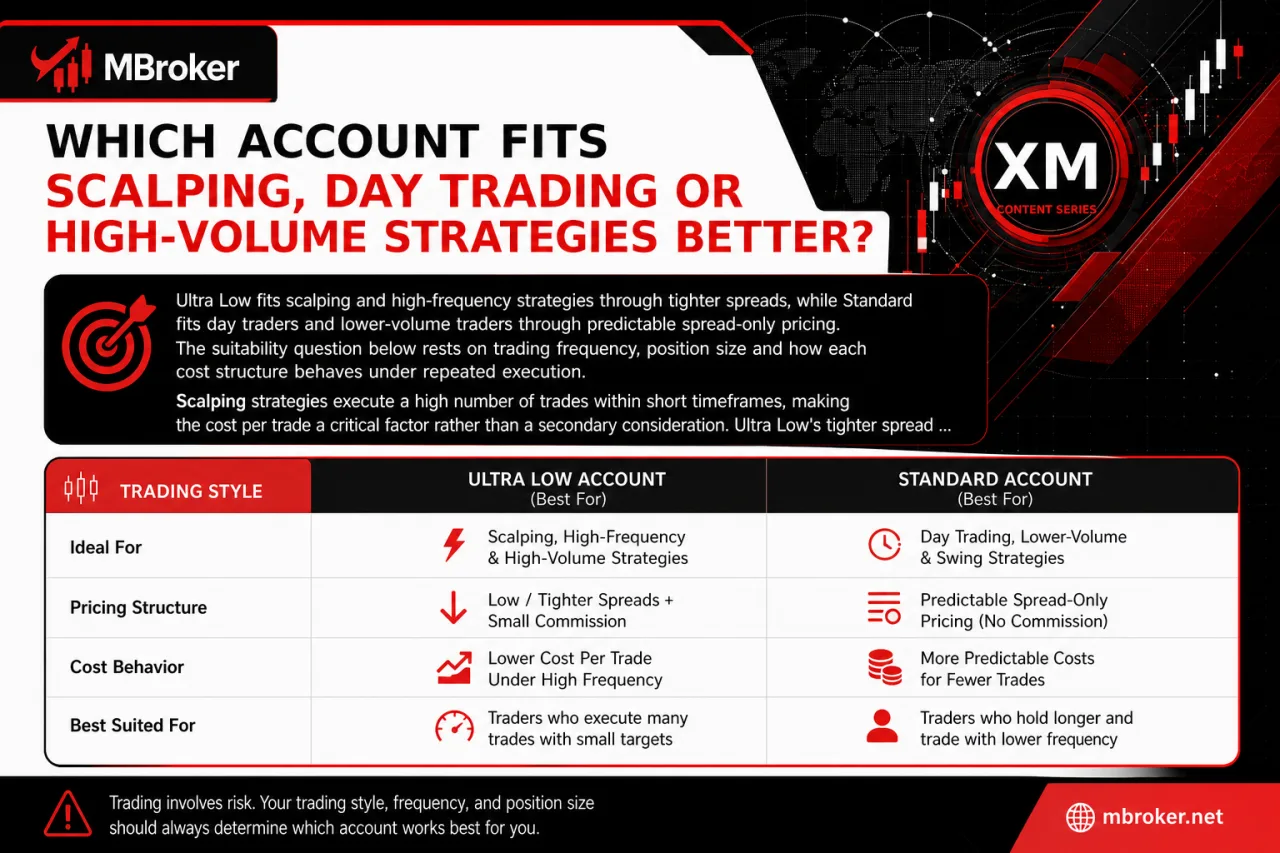
Ultra Low fits scalping and high-frequency strategies through tighter spreads, while Standard fits day traders and lower-volume traders through predictable spread-only pricing. The suitability question below rests on trading frequency, position size and how each cost structure behaves under repeated execution.
Scalping strategies execute a high number of trades within short timeframes, making the cost per trade a critical factor rather than a secondary consideration. Ultra Low’s tighter spread structure reduces the cumulative cost impact across many small, frequent entries and exits, which benefits traders running high-volume or algorithmic-style execution.
Standard accounts suit traders placing fewer trades per session, since the spread-only model avoids stacking a separate commission on top of each transaction. Day traders and swing traders holding positions longer face less sensitivity to micro-cost differences between the two spread structures.
Objective suitability criteria include:
- Trade frequency per session, with higher frequency favoring Ultra Low’s tighter spread structure
- Average position size, where larger or repeated volume amplifies the cost advantage of narrower spreads
- Holding duration, where shorter holds increase sensitivity to spread cost and longer holds reduce it
- Preference for cost simplicity, which favors Standard’s single spread-only pricing without added commission layers
These criteria apply independently of any personal trading preference, based strictly on the account’s underlying pricing mechanics already outlined in the earlier cost comparison.
What Rare Account Conditions or Restrictions Should Traders Know Before Switching Between Standard and Ultra Low?
Yes, rare account conditions exist for both XM Standard and Ultra Low accounts, covering switching limitations, hedging permissions and expert advisor policies detailed in XM’s official terms. This overview frames the fine-print restrictions traders check before moving between account types.
Hedging is permitted on both XM Standard and Ultra Low accounts, allowing opposite positions on the same instrument within a single account. Traders using this strategy across both account types find the hedging rules consistent, since XM applies the same margin treatment regardless of account category.
Expert advisor use follows the same policy on Standard and Ultra Low accounts as well. Automated trading systems run freely on either account type, though traders test EA compatibility with each account’s spread and execution style before committing capital.
The sub-section below breaks down the switching rules for traders holding both account types at once.
Can a Trader Hold Both a Standard and an Ultra Low Account at the Same Time?
Yes, XM permits a trader to hold both a Standard and an Ultra Low account simultaneously under one client profile, since the two account types operate as separate sub-accounts within a single registration. This setup answers the account-holding question raised in the heading above through three main points.
Traders open multiple accounts of different types through the XM Members Area without closing an existing account first. Each sub-account carries its own balance, lot size rules and cost structure, so funds and open positions on a Standard account remain independent from those on an Ultra Low account. Switching between the two happens by logging into either account separately rather than converting one type into the other, a process traders confirm directly through XM’s official account management panel before funding a second account.
Conclusion
In conclusion, the XM Standard Account is generally better suited to traders seeking a versatile account and access to eligible promotional benefits. By contrast, the XM Ultra Low Account may be the stronger choice for active or high-volume traders who prioritise lower spreads and reduced overnight costs. However, Ultra Low is not automatically cheaper for every trade, as the final cost depends on the instrument, live spread, applicable commission, position size and holding period. Traders should therefore compare the current conditions offered by their specific XM legal entity before choosing an account.

Neria Solven is Mbroker’s XM Accounts, Fees and Promotions Editor, covering account types, trading costs, payment methods and promotional programmes. Email: [email protected]