
 Tiếng Việt
According to XM’s official website, XM offers multiple trading account types, including Micro, Standard, Ultra Low, and Shares, which differ mainly in lot size, minimum trade unit, and target trader profile. The Standard Account uses full-size lots, while the Micro Account allows smaller trade volumes suited to lower budgets.
According to XM’s official help center, the minimum deposit or withdrawal amount for any XM account type, including Micro and Standard, is $5, though the exact minimum can vary depending on the payment method used. Separately, the two account types differ mainly in contract size, with the Micro Account using a smaller lot size than the Standard Account. This difference in contract size directly affects the monetary value of each pip movement.
According to XM’s official website, XM’s Micro and Standard account types are designed to serve different trader profiles, with the Micro Account generally suiting beginners with limited capital, while the Standard Account tends to attract intermediate or more active traders. The Ultra Low Account and Shares Account, meanwhile, cater to more specific trading needs and will be covered in later sections.
Mbroker breaks down these distinctions further below, starting with a direct comparison of the XM Standard Account vs Micro Account and their key differences in structure and purpose.
XM Micro vs Standard Account: Quick Comparison
The main difference between XM Micro and Standard accounts is the contract size assigned to one forex lot. A Micro lot represents 1,000 units of the base currency, while a Standard lot represents 100,000 units. This allows Micro users to control their market exposure with smaller position sizes.
| Feature | XM Micro Account | XM Standard Account |
| Forex contract size | 1 lot = 1,000 currency units | 1 lot = 100,000 currency units |
| Exposure at 1.00 lot | 1,000 units | 100,000 units |
| Approximate EUR/USD pip value at 1.00 lot | About $0.10 per pip | About $10 per pip |
| Position sizing | Smaller and more granular | Conventional standard-lot sizing |
| Capital exposure | Easier to keep individual positions small | Greater exposure at the same numerical lot size |
| Minimum trade volume | Depends on the XM entity and platform | Depends on the XM entity and platform |
| Spreads | Vary by instrument, market conditions and entity | Vary by instrument, market conditions and entity |
| Trading commission | Not necessarily determined by contract size; verify regional terms | Not necessarily determined by contract size; verify regional terms |
| Overnight swap | Instrument- and entity-specific | Instrument- and entity-specific |
| Minimum deposit | Depends on the applicable XM entity | Depends on the applicable XM entity |
| Leverage and margin | Subject to regional limits and instrument rules | Subject to regional limits and instrument rules |
| Trading platforms | Subject to account and regional availability | Subject to account and regional availability |
| Best suited for | Beginners, strategy testing and traders seeking smaller exposure | Experienced traders comfortable with conventional position sizing |
| Main limitation | Smaller profit and loss values at the same numerical lot size | Position-sizing errors can produce substantially greater exposure |
The 1,000-unit Micro and 100,000-unit Standard contract sizes are stated in XM’s official product documentation. Minimum trading volume may differ by region; for example, XM MENA currently states a 0.1-lot minimum for its Micro account. Traders should therefore check the conditions shown during registration for their specific XM legal entity.
XM Standard Account vs Micro Account: What Are the Key Differences?
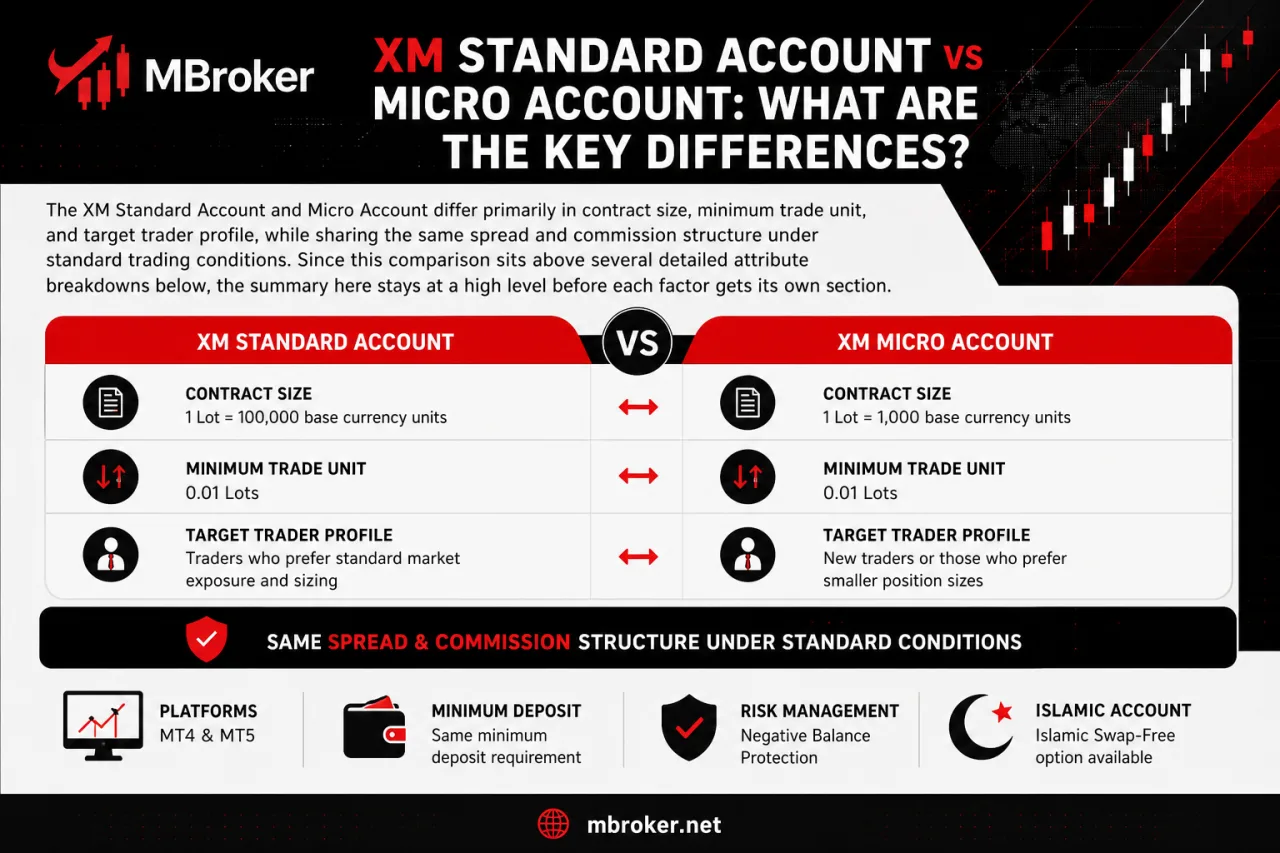
The XM Standard Account and Micro Account differ primarily in contract size, minimum trade unit, and target trader profile, while sharing the same spread and commission structure under standard trading conditions. Since this comparison sits above several detailed attribute breakdowns below, the summary here stays at a high level before each factor gets its own section.
Both accounts share several core features:
- Available on MT4 and MT5.
- Same minimum deposit floor.
- Negative balance protection included.
- Islamic swap-free option available.
The core distinction lies in lot size. The Standard Account trades in full-size lots, making each pip movement carry a larger monetary value. The Micro Account uses a smaller contract size, keeping pip value lower and more manageable for smaller account balances.
This structural gap shapes who each account suits. The Standard Account fits traders working with larger position sizes or higher capital allocation, while the Micro Account fits beginners or those testing strategies with tighter risk exposure. The sections below break down lot size, minimum trade units, spreads, and trader suitability in more detail.
What Is Lot Size and How Does It Differ Between Micro and Standard Accounts?
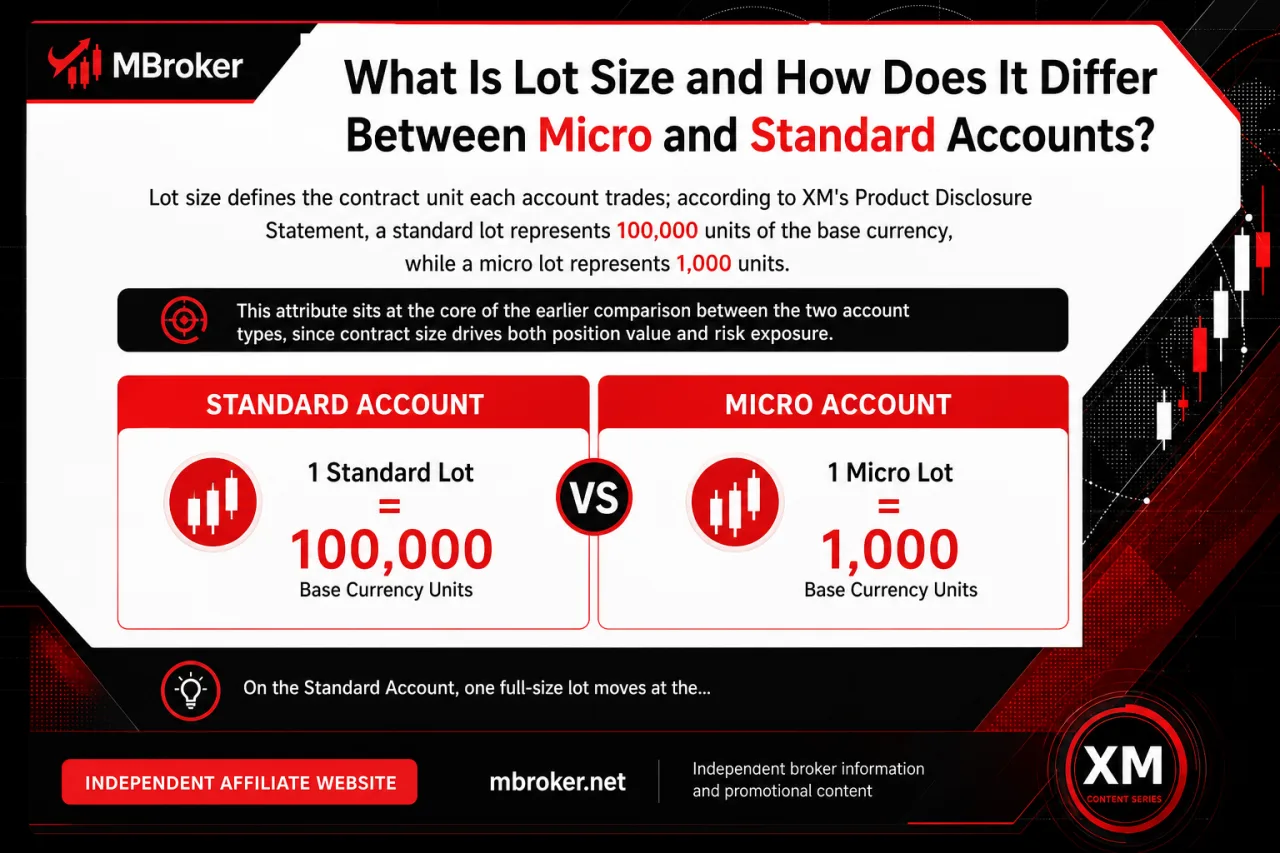
Lot size defines the contract unit each account trades; according to XM’s Product Disclosure Statement, a standard lot represents 100,000 units of the base currency, while a micro lot represents 1,000 units.
This attribute sits at the core of the earlier comparison between the two account types, since contract size drives both position value and risk exposure.
On the Standard Account, one full-size lot moves at the 100,000-unit rate, meaning each pip carries a larger monetary value and requires more margin to open a position. On the Micro Account, trades execute at the 1,000-unit rate, so each pip carries a smaller monetary value, allowing traders to open positions with tighter risk exposure relative to account balance.
This gap in contract size explains why the two accounts fit different capital levels. A trader running the same strategy on both accounts sees a much smaller swing in equity per pip on the Micro Account than on the Standard Account, since the position value scales directly with the lot size chosen.
What Is the Minimum Trade Unit for Micro vs Standard Accounts?
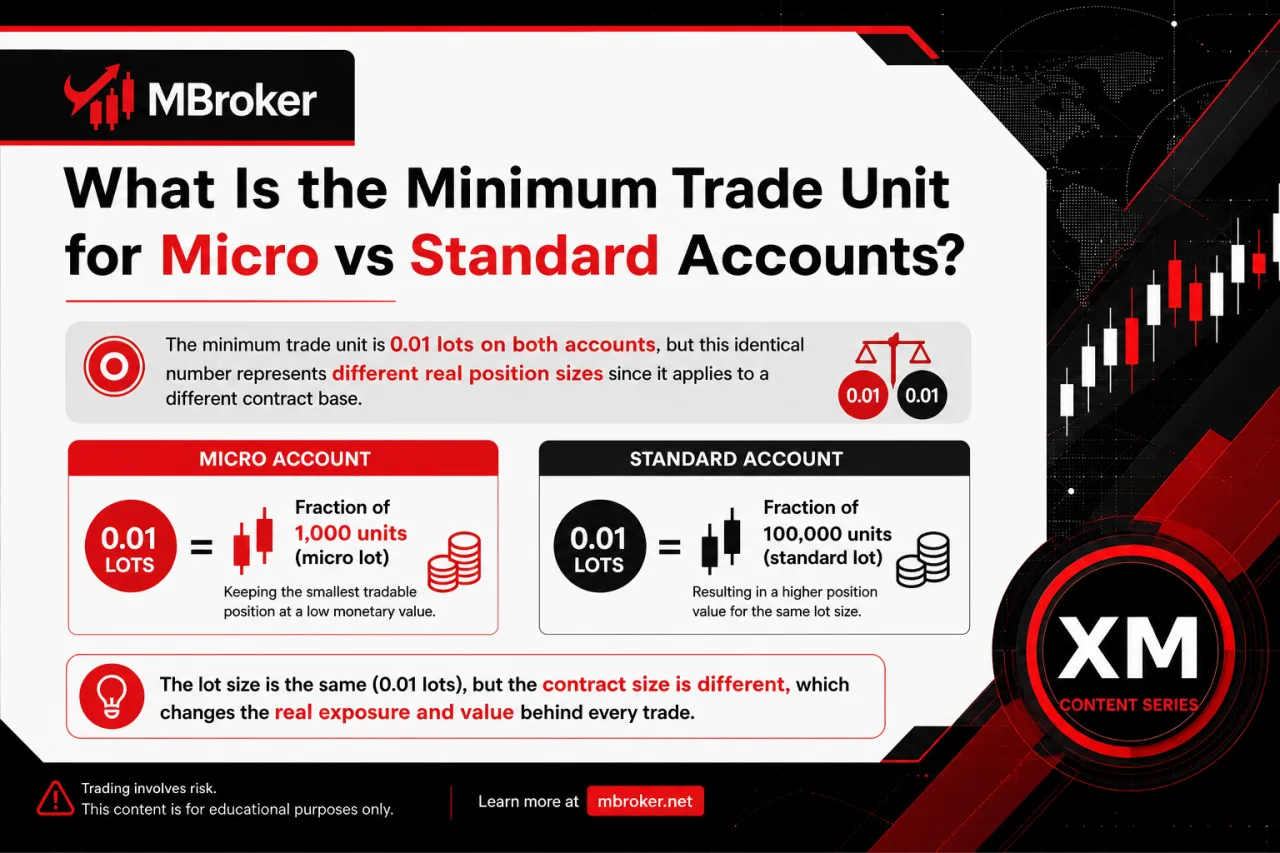
The minimum trade unit is 0.01 lots on both accounts, but this identical number represents different real position sizes since it applies to a different contract base. This distinction connects directly to the lot size gap covered above, where contract size drives position value.
The two account types define that minimum differently:
- Micro Account: 0.01 lots corresponds to a fraction of the 1,000-unit micro lot, keeping the smallest tradable position at a low monetary value.
- Standard Account: 0.01 lots corresponds to a fraction of the 100,000-unit standard lot, so the same displayed minimum volume translates into a position roughly 100 times larger in underlying currency exposure.
Two traders opening the smallest possible position on each account face very different margin requirements and pip values. This holds true even though both order tickets show “0.01” as the entered volume.
- Margin requirement: The Standard Account minimum ties up notably more margin than the Micro Account minimum, despite the identical “0.01” entry.
- Pip value: The Standard Account minimum carries a pip value far above that of the Micro Account minimum, reflecting the larger underlying exposure.
Traders comparing risk exposure across the two account types need to look past the volume number itself and check the underlying contract size. The numeric minimum alone does not reflect actual position value.
How Do Spreads Compare Between XM Micro and Standard Accounts?
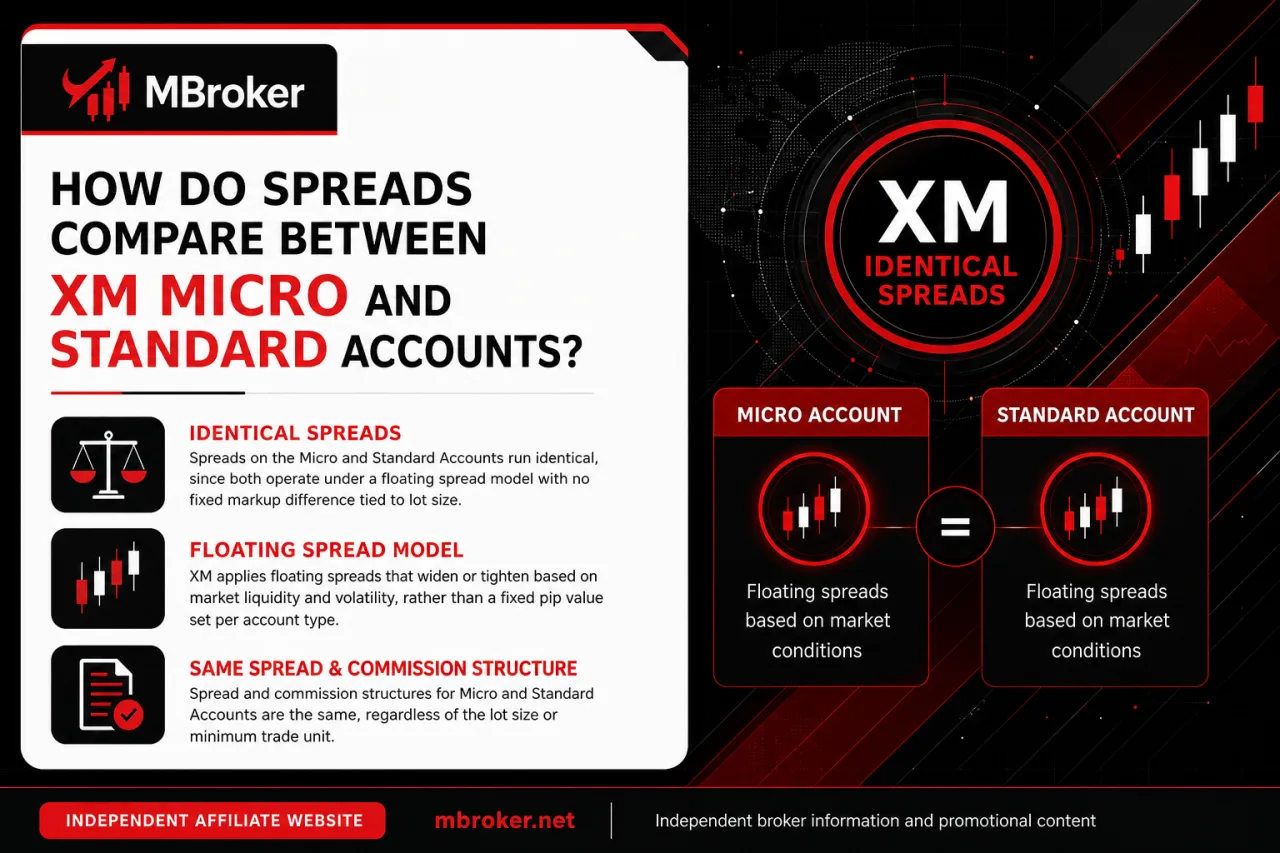
Spreads on the Micro and Standard Accounts run identical, since both operate under a floating spread model with no fixed markup difference tied to lot size. This point follows directly from the lot size and minimum trade unit gap covered above, since contract size does not factor into how spreads get quoted.
XM applies floating spreads that widen or tighten based on market liquidity and volatility, rather than a fixed pip value set per account type. Spread and commission structures for Micro and Standard Accounts can vary depending on market conditions, but XM generally applies similar pricing principles across these two account types under standard trading conditions.
This shared execution model means a trader does not gain a pricing advantage by choosing Standard over Micro, or vice versa. The real cost difference between the two accounts comes from position size, not spread width, since a wider Standard Account lot moving through the same spread translates into a larger monetary cost per pip than the same spread applied to a Micro Account lot. Traders comparing total trading cost across both account types need to factor in contract size alongside the quoted spread, not spread alone.
Which Trader Type Is Each Account Suitable For?
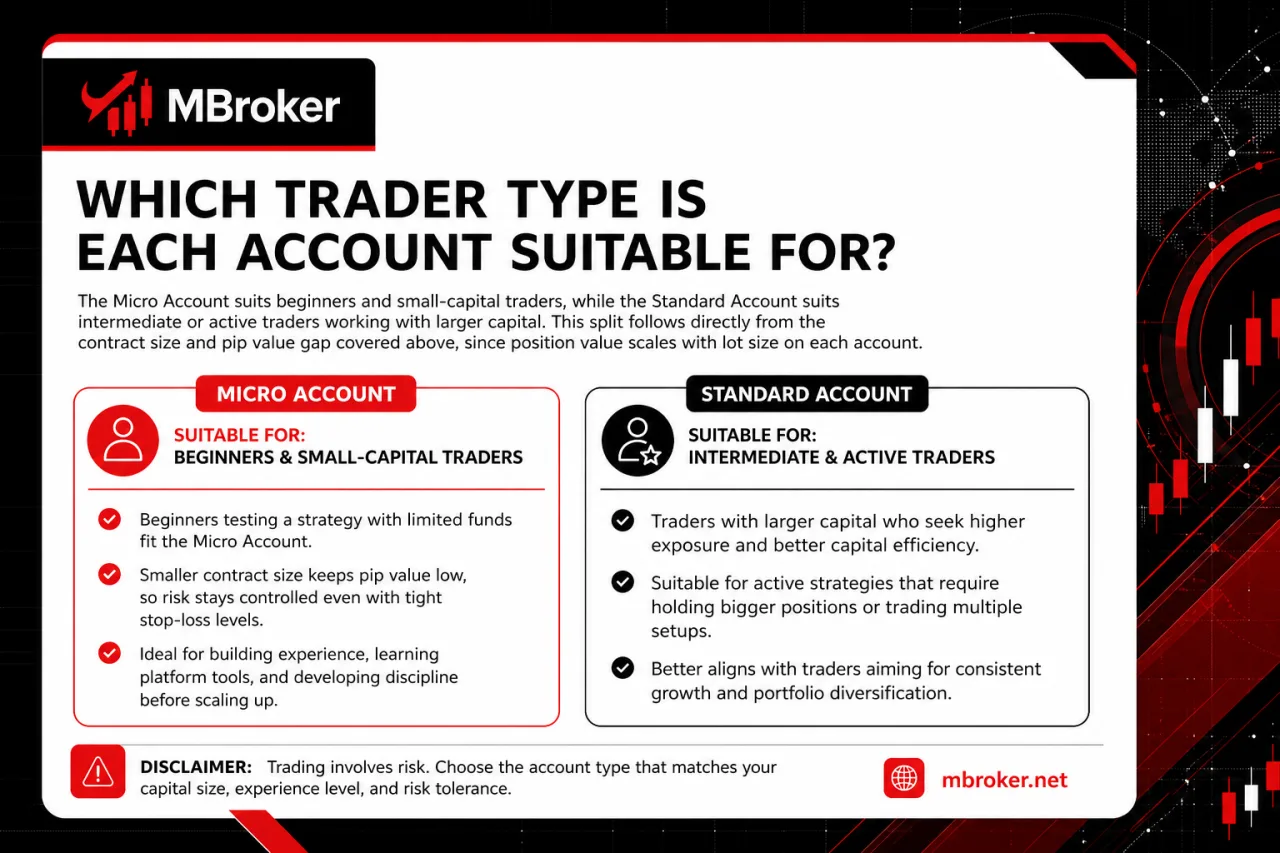
Micro Account fits beginners and small-capital traders. Standard Account fits intermediate or active traders working with larger capital. This split follows directly from the contract size and pip value gap covered above, since position value scales with lot size on each account.
Deposit size and risk tolerance mark the main dividing line between the two profiles:
- Beginners testing a strategy with limited funds fit the Micro Account, since smaller contract size keeps pip value low and margin requirements light relative to account balance.
- Traders holding a larger deposit and comfortable with wider equity swings fit the Standard Account, since full-size lots carry a larger monetary value per pip.
- Traders prioritizing low-risk exposure while learning order execution fit the Micro Account, since the smaller contract unit limits downside per trade.
- Traders running multiple positions or scaling strategies with higher capital allocation fit the Standard Account, since full lot sizing supports larger position value without needing excessive lot counts.
Neither account restricts access based on experience level or account status, so the choice comes down to matching deposit size and risk tolerance to the contract size each account applies.
What Is the Minimum Deposit Required for Micro vs Standard Accounts?
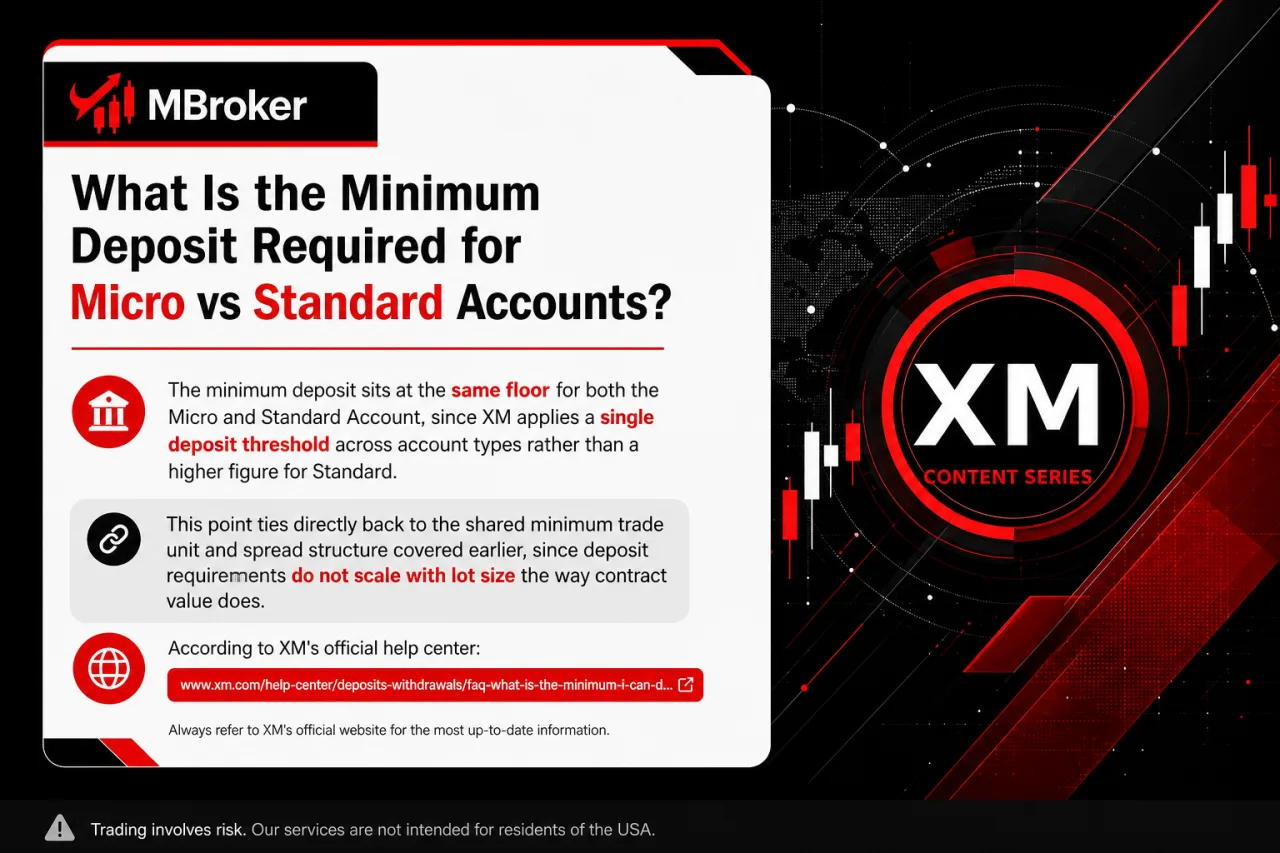
The minimum deposit sits at the same floor for both the Micro and Standard Account, since XM applies a single deposit threshold across account types rather than a higher figure for Standard. This point ties directly back to the shared minimum trade unit and spread structure covered earlier, since deposit requirements do not scale with lot size the way contract value does.
According to XM’s official help center, the minimum deposit or withdrawal amount stands at $5 across XM account types, though the exact figure fluctuates depending on the payment method processing the transaction. This baseline applies equally to the Micro and Standard Account, so choosing one account type over the other carries no deposit-based cost advantage.
Currency selection affects the equivalent amount a trader ends up funding, since XM supports multiple base currencies and the $5 floor converts to a different local figure depending on which currency the account holds. A trader funding an account in a currency other than USD sees the deposit minimum expressed at the prevailing conversion rate rather than a fixed local amount.
Payment method also plays a role in the practical minimum a trader faces. Some providers set a higher practical floor than the account-level minimum XM lists, meaning the actual amount required to complete a transaction depends on the channel used rather than on the account type chosen.
How Do XM Ultra Low and Shares Accounts Compare to Micro and Standard?
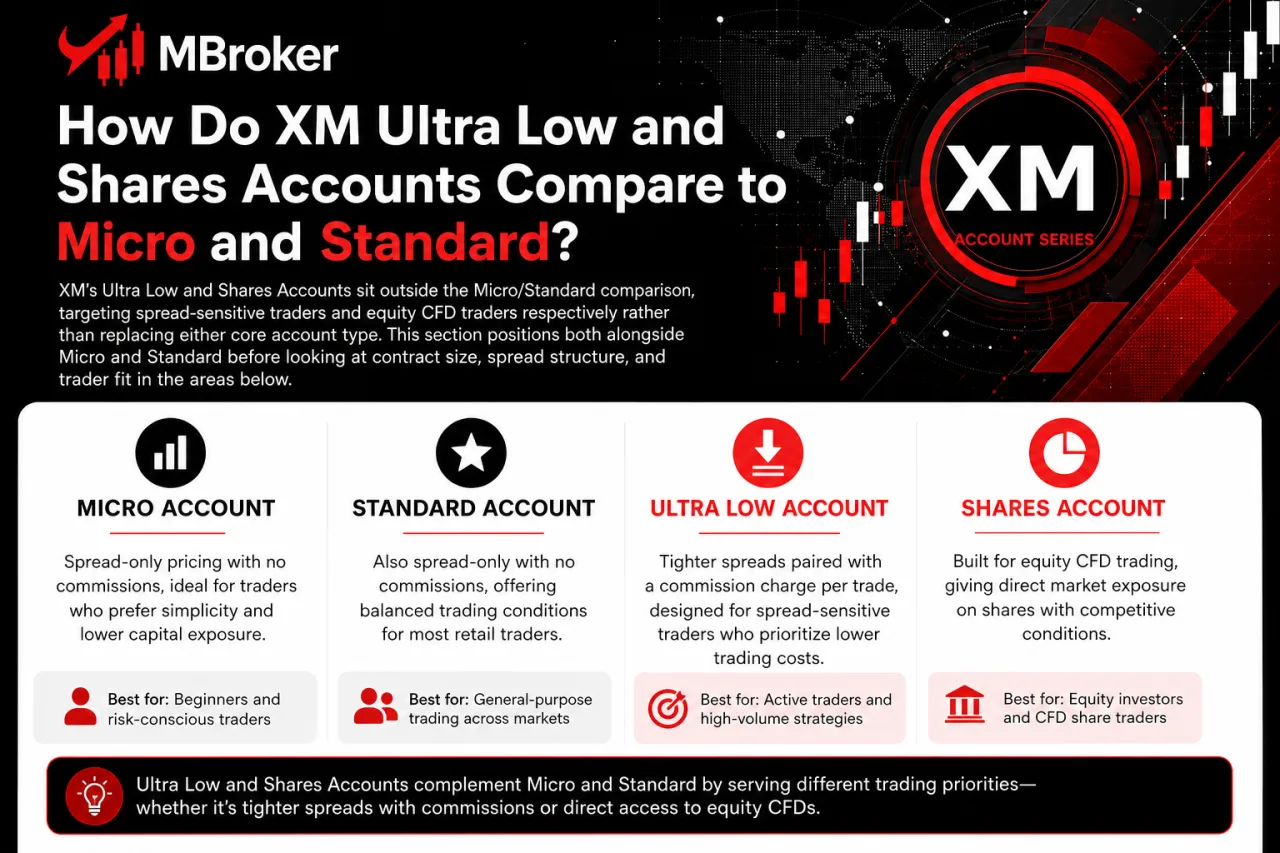
Ultra Low and Shares Accounts serve different needs than Micro or Standard, targeting spread-sensitive traders and equity CFD traders respectively. Neither replaces the core account types; instead, both sit alongside Micro and Standard as specialized options. This section positions both before looking at contract size, spread structure, and trader fit in the areas below.
Ultra Low runs on tighter spreads paired with a commission charge per trade, differing from the spread-only pricing model covered earlier for Micro and Standard. Shares Account, on the other hand, focuses specifically on equity CFD instruments rather than the broader forex-oriented lot structure that defines Micro and Standard trading.
Who Should Choose Ultra Low Account Instead of Micro or Standard?
Cost-sensitive active traders running frequent, high-volume trades fit the Ultra Low Account instead of Micro or Standard, since its tighter spread and commission structure lowers per-trade cost at scale. This suitability question follows directly from the pricing gap noted earlier between Ultra Low’s spread-plus-commission model and the spread-only pricing shared by Micro and Standard.
Traders running strategies that depend on tight execution cost, such as scalping or high-frequency entries, gain more from the reduced spread on Ultra Low than from the simpler pricing structure on Micro or Standard. The added commission charge offsets against the tighter spread, so the net benefit favors traders placing enough volume to make that trade-off worthwhile.
Beginners or low-volume traders generally fit Micro or Standard instead, since the commission layer on Ultra Low adds a fixed cost that low-frequency trading does not offset. Traders prioritizing simplicity over marginal cost savings also fit better with the spread-only structure covered earlier for Micro and Standard.
Who Should Choose the Shares Account Instead of Micro or Standard?
Traders wanting direct stock market exposure through CFDs fit the Shares Account instead of Micro or Standard, since it centers on equity instruments rather than the forex-oriented lot structure covered earlier. This suitability question follows the same logic applied to Ultra Low above, matching account structure to the instrument type a trader actually wants to trade.
The Shares Account prices positions per share unit tied to individual companies, differing from the currency-pair contract sizing that defines both Micro and Standard. Traders building exposure to specific companies or diversifying beyond currency pairs gain a more direct fit from the Shares Account than from the lot-based structure Micro and Standard apply to forex CFDs.
Forex-focused traders, including beginners testing strategies or intermediate traders scaling position size, stay better matched to Micro or Standard, since those accounts structure contract size specifically around currency-pair trading rather than equity CFDs.
What Base Currencies Are Available for Micro and Standard Accounts?
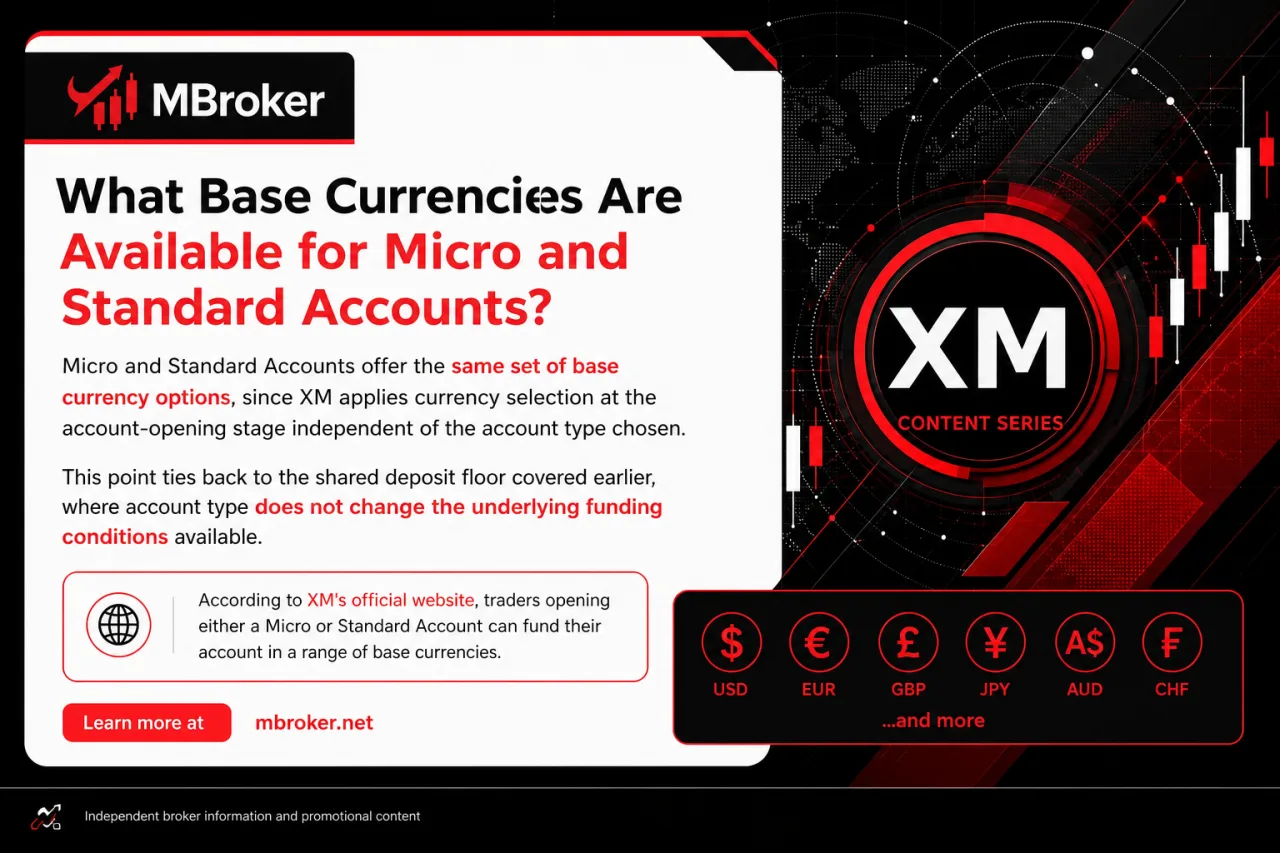
Micro and Standard Accounts offer the same set of base currency options, since XM applies currency selection at the account-opening stage independent of the account type chosen. This point ties back to the shared deposit floor covered earlier, where account type does not change the underlying funding conditions available.
According to XM’s official website, traders opening either a Micro or Standard Account can fund their account in several base currencies, including USD, EUR, GBP, JPY, AUD, and other major currencies listed on the official account types page, with USD serving as the default currency and conversion fees applying if the deposited currency differs from the account’s base currency.
No currency restriction ties to lot size or contract structure, so a trader picks a base currency purely based on personal preference or regional convenience rather than account type limitations.
This shared currency list means switching between Micro and Standard does not require a change in account currency, keeping the funding setup consistent regardless of which account a trader ultimately chooses for trading.
Are Fees and Swaps the Same Across XM Account Types?
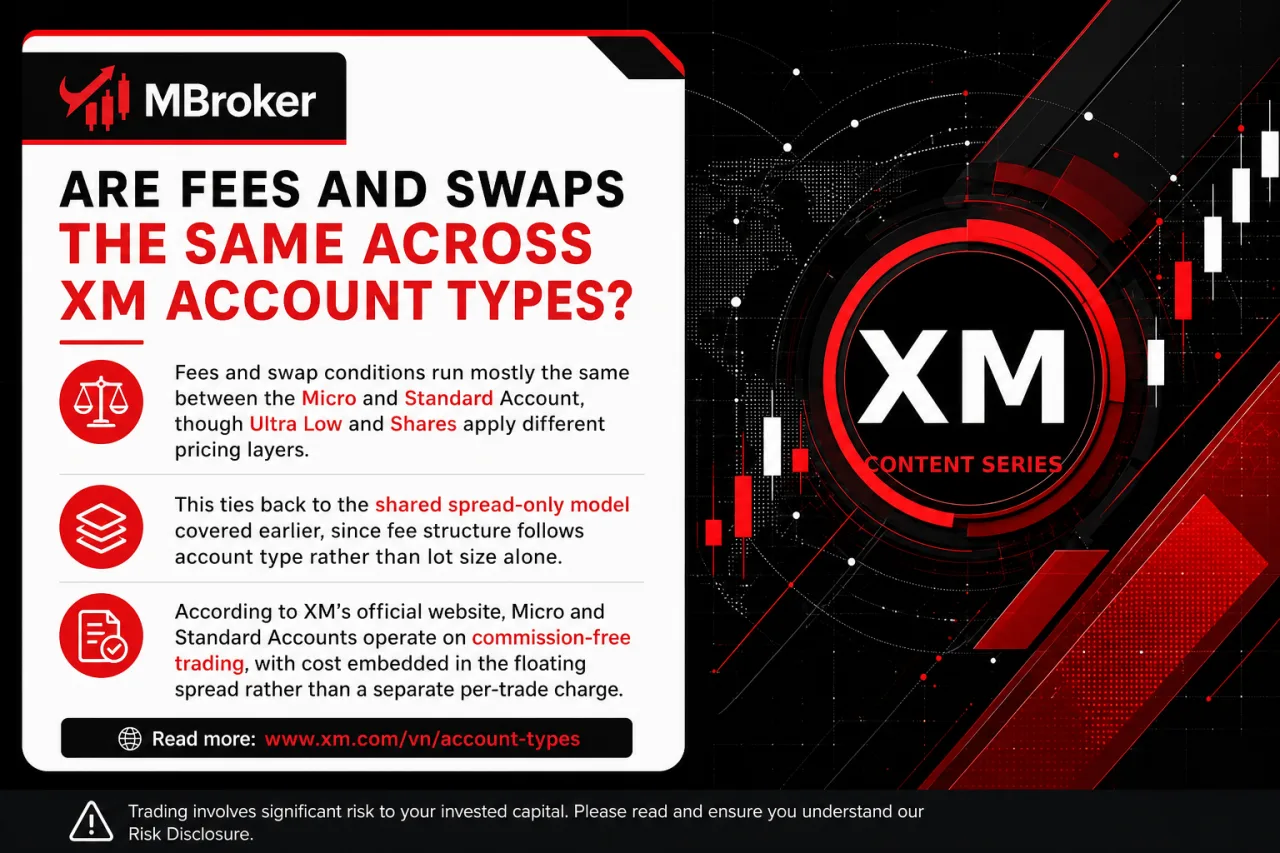
Fees and swap conditions run identical between Micro and Standard Accounts, though Ultra Low and Shares apply different pricing layers. This ties back to the shared spread-only model covered earlier, since fee structure follows account type rather than lot size alone.
According to XM’s official website, Micro and Standard Accounts operate on commission-free trading, with cost embedded in the floating spread rather than a separate per-trade charge. Overnight positions on both accounts incur swap charges calculated per instrument, with the Islamic swap-free option removing that charge for eligible traders regardless of whether the account runs Micro or Standard.
Ultra Low departs from this model by pairing a tighter spread with a per-trade commission, adding a fee layer that Micro and Standard do not carry. Shares Account pricing follows the underlying equity CFD structure, which can differ from the forex-oriented spread applied to Micro and Standard.
Traders comparing total cost across account types need to check both spread and commission together rather than assuming Micro and Standard fee treatment extends to Ultra Low or Shares.
Are Micro and Standard Accounts Compatible with MT4, MT5, Demo and Islamic Account Options?
Yes, both the Micro and Standard Account support MT4 and MT5, come with a demo version for practice, and offer an Islamic swap-free variant. This platform and account-variant compatibility follows the same shared-conditions pattern covered earlier for base currency and deposit floor, where account type does not restrict access to these options. The sections below break down platform availability, demo access, and Islamic account eligibility separately.
What Leverage and Margin Conditions Apply to Micro vs Standard Accounts?
Leverage and margin conditions on Micro and Standard Accounts run identical within the same legal entity, since XM ties leverage tiers to jurisdiction and client classification rather than account type. This comparison connects directly to the shared deposit floor and currency setup covered earlier, since leverage sits alongside those as another condition that stays constant regardless of whether a trader picks Micro or Standard.
Maximum leverage available generally differs by the legal entity a trader registers under, with regulated entities in jurisdictions such as the EU applying stricter caps for retail clients than entities operating under offshore regulation.
Retail clients face lower leverage ceilings and higher margin requirements under stricter regulatory entities, while professional clients meeting eligibility criteria access higher leverage tiers with reduced margin requirements. This classification, not the Micro or Standard label, drives the actual leverage figure a trader sees on their account.
Margin requirements move inversely with leverage, so a lower leverage cap under a stricter entity raises the margin needed to open the same position size on either account. Traders comparing leverage across Micro and Standard need to check their registered legal entity and client classification rather than assume the account type itself sets the leverage figure.
What Restrictions Apply Based on Country or XM Legal Entity?
Account restrictions tie to the legal entity a trader registers under, not to the Micro or Standard label itself, since jurisdiction determines leverage caps and available features. This ties back to the leverage discussion above, where entity and classification, not account type, set the actual trading conditions a client sees.
Traders registered under entities regulated in stricter jurisdictions face lower leverage ceilings and tighter feature availability compared to those under offshore-regulated entities. Retail versus professional client classification also shifts these conditions, with professional status generally unlocking higher leverage in exchange for reduced regulatory protections.
Country of residence often determines which XM legal entity a trader registers under in the first place, which then cascades into leverage, feature set, and account eligibility. Traders checking restrictions need to confirm their registered entity and classification directly, since neither Micro nor Standard account labels carry these limitations on their own.
Conclusion
In conclusion, the XM Micro Account is generally the more suitable option for beginners, strategy testing and traders who want finer control over position size and market exposure. The XM Standard Account may better suit experienced traders who understand conventional lot sizing and are comfortable managing larger positions. Neither account is automatically better in terms of spreads, execution or profitability; the defining difference is the contract size assigned to each lot. Before choosing, traders should verify the minimum trade volume, fees, leverage, available platforms and account eligibility offered by their specific XM legal entity.

Neria Solven is Mbroker’s XM Accounts, Fees and Promotions Editor, covering account types, trading costs, payment methods and promotional programmes. Email: [email protected]