
 Tiếng Việt
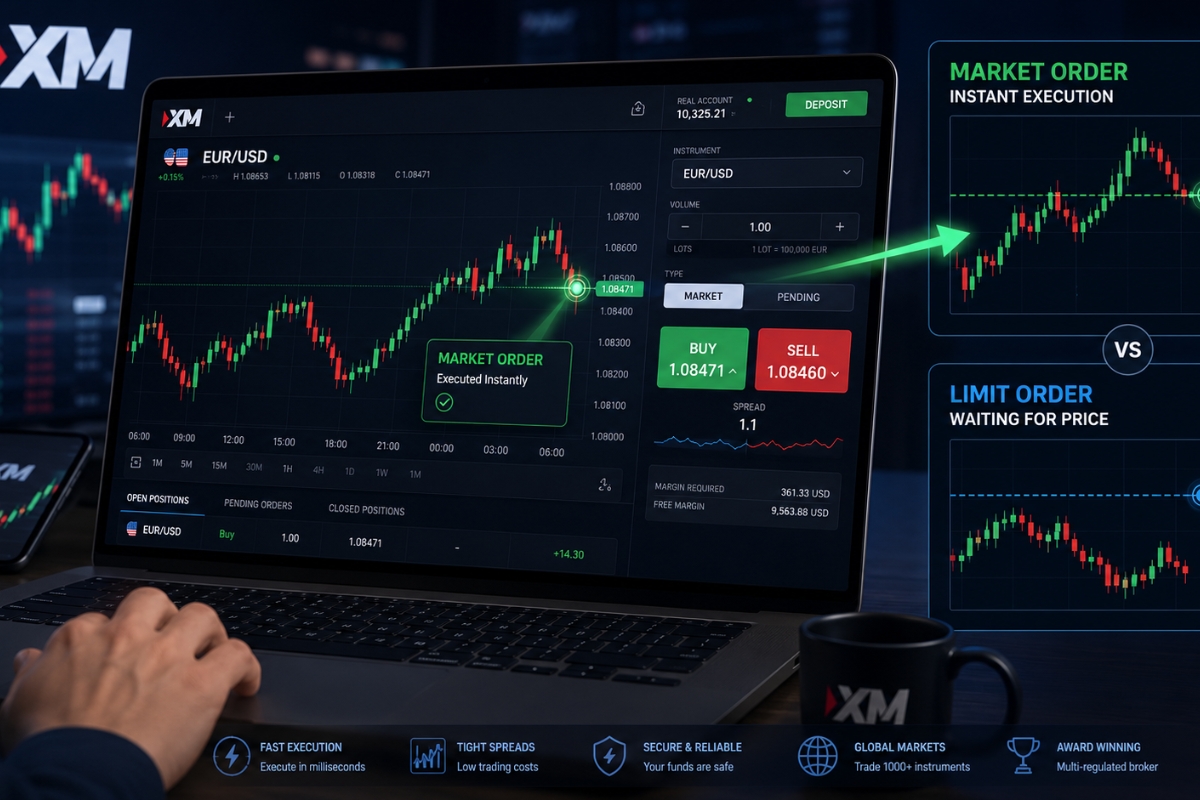
Market orders on XM are executed instantly at the current market price, allowing traders to enter or exit positions immediately without waiting for a specific price level.
Additionally, market orders include Buy and Sell orders executed at Ask and Bid prices, forming the core execution types used across all trading platforms.
In forex trading, market orders are mainly used for fast execution during high volatility or strong trends, helping traders capture opportunities without delay.
However, market orders differ from limit orders as they prioritize speed over price control, while limit orders allow traders to set a specific entry price.
Therefore, effective use of market orders requires proper timing and risk management, especially to avoid slippage and unexpected price movements in fast markets.
In Forex trading, Market Orders on XM allow instant execution at the current price, helping traders enter or exit positions quickly. However, understanding their types and differences from limit orders is essential for better risk control. For deeper insights, explore the Forex Technical Analysis category to improve your trading decisions.
How market orders work on XM trading platform?
Market orders work on the XM trading platform by instantly matching a trader’s buy or sell request with the best available liquidity quotes provided by top-tier interbank market makers.
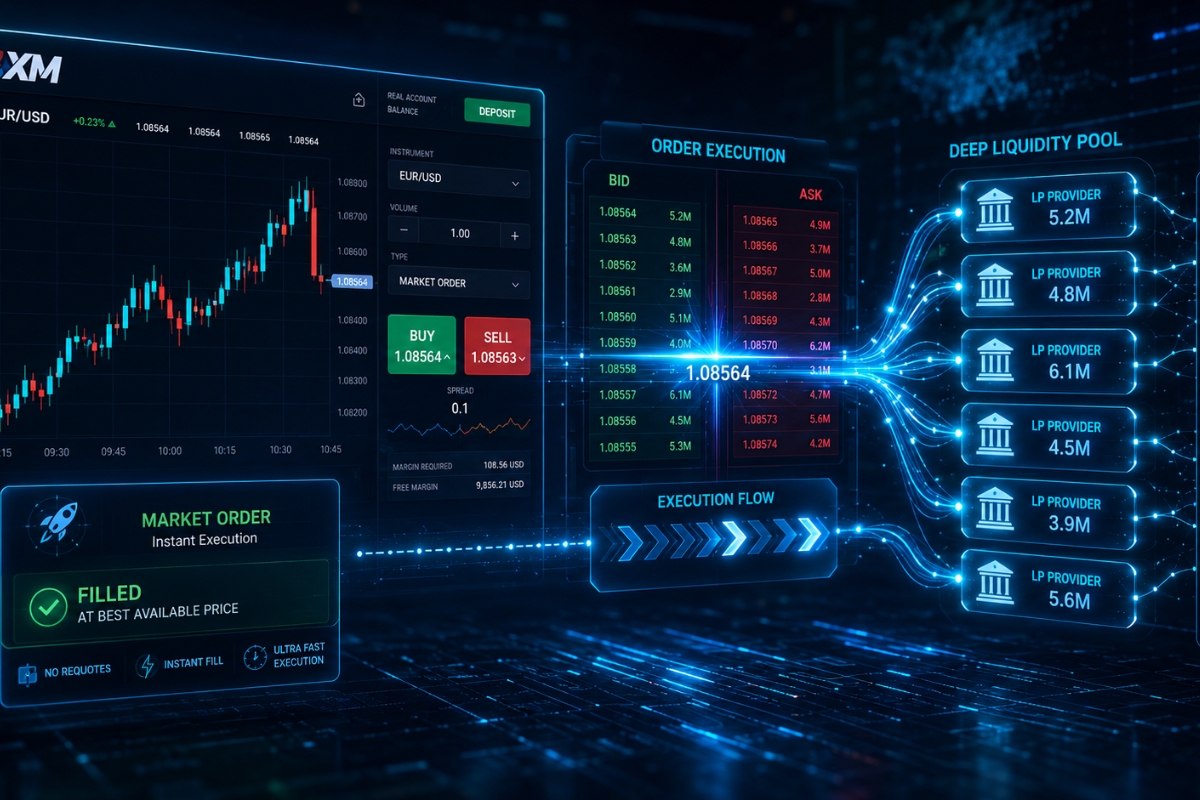
On XM, this process utilizes an institutional No Re-quotes execution policy, where 99.35% of all orders are filled in under 1 second without any artificial price modifications. This high-speed infrastructure guarantees that your trade is opened immediately, allowing you to capture rapid price movements the exact moment you click the button.
What is a market order and when is it executed?
A market order is a formal instruction sent to the broker to buy or sell a financial instrument immediately at the current prevailing market price. It prioritizes speed of execution over price precision, meaning it will aggressively sweep the available order book to fill your requested volume right away. It is executed the microsecond your order packet reaches the XM trade server, making it the default choice for day traders who need to enter a moving market without delay.
While the execution is nearly instantaneous, the exact price you receive depends heavily on live network and structural market variables.
What affects execution speed and price on XM?
Execution speed and final filled prices on XM are primarily driven by four distinct factors:
- Network Latency: The physical distance between your trading terminal and the XM matching servers located in major financial data hubs.
- Available Liquidity: The volume of resting orders at the top of the book; thin liquidity causes your order to fill at deeper, less favorable price levels.
- Market Volatility: During major macroeconomic events, prices change so rapidly that the price you click may shift by a few fractions of a pip before the order hits the engine.
- Order Size: Larger institutional blocks require sweeping multiple layers of the liquidity pool, resulting in different filled averages.
Understanding these operational mechanics allows us to explore the different structural variations of market execution available in the broader financial landscape.
Types of market orders available in trading
Types of market orders available in trading are categorized by how they handle contract volume fills, shifting between standard execution, fill restrictions, or structural derivatives.
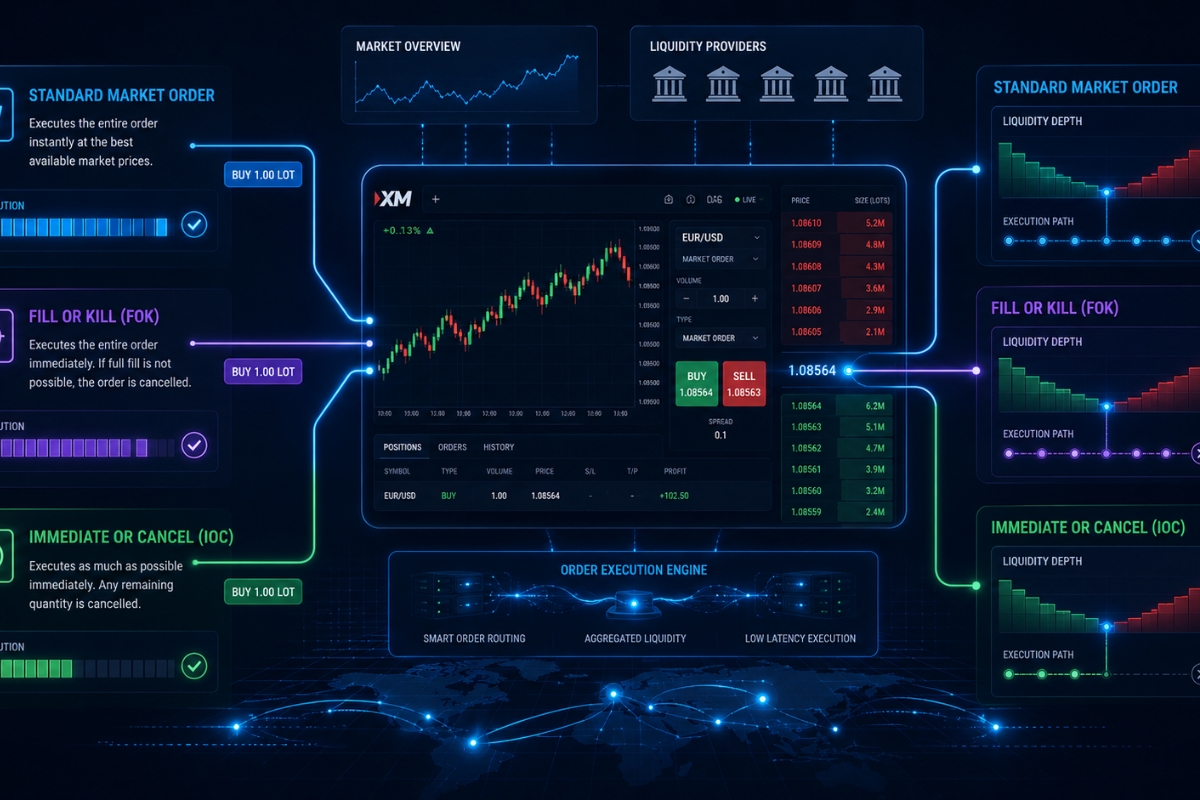
While most retail traders are only familiar with the simple click-and-trade interface, institutional networks utilize advanced modifications to control how multi-lot orders interact with the global liquidity pool. Selecting the appropriate order type variation helps professional traders protect their accounts from getting filled at unfavorable average prices.
What are the main market order types in trading?
The institutional trading landscape relies on three primary market order configurations:
- Standard Market Order: The default execution where you specify the lot size, and the platform fills the entire volume at the best available market prices, regardless of how many liquidity tiers it takes.
- Fill or Kill (FOK): A specialized order that mandates the entire requested volume must be filled immediately at the current price, or the entire order is completely canceled (killed) with zero partial fills.
- Immediate or Cancel (IOC): An instruction that fills as much of the order as possible at the current price, while any remaining unfilled lot volume is instantly canceled.
While these core configurations govern standard trading desks, their application alters slightly as you transition across distinct global markets.
Are there variations of market orders in different markets?
Yes, variations of market orders adjust structurally depending on whether you are trading centralized stock exchanges or decentralized networks. In centralized stock trading, market orders can be modified into “Market on Open” (MOO) or “Market on Close” (MOC) orders, which execute exclusively during the volatile opening or closing auctions of the exchange. In decentralized asset classes like cryptocurrencies or spot forex, market orders are bound entirely by real-time electronic communication network (ECN) liquidity, meaning partial fills and slippage are directly linked to live interbank order depths.
To see these mechanics in a real-world scenario, let’s analyze how market execution behaves under standard currency market conditions.
Forex use of market orders in real trading conditions
Forex use of market orders in real trading conditions focuses on capitalizing on sudden directional momentum, executing news-driven breakout setups, or managing immediate manual trade exits.
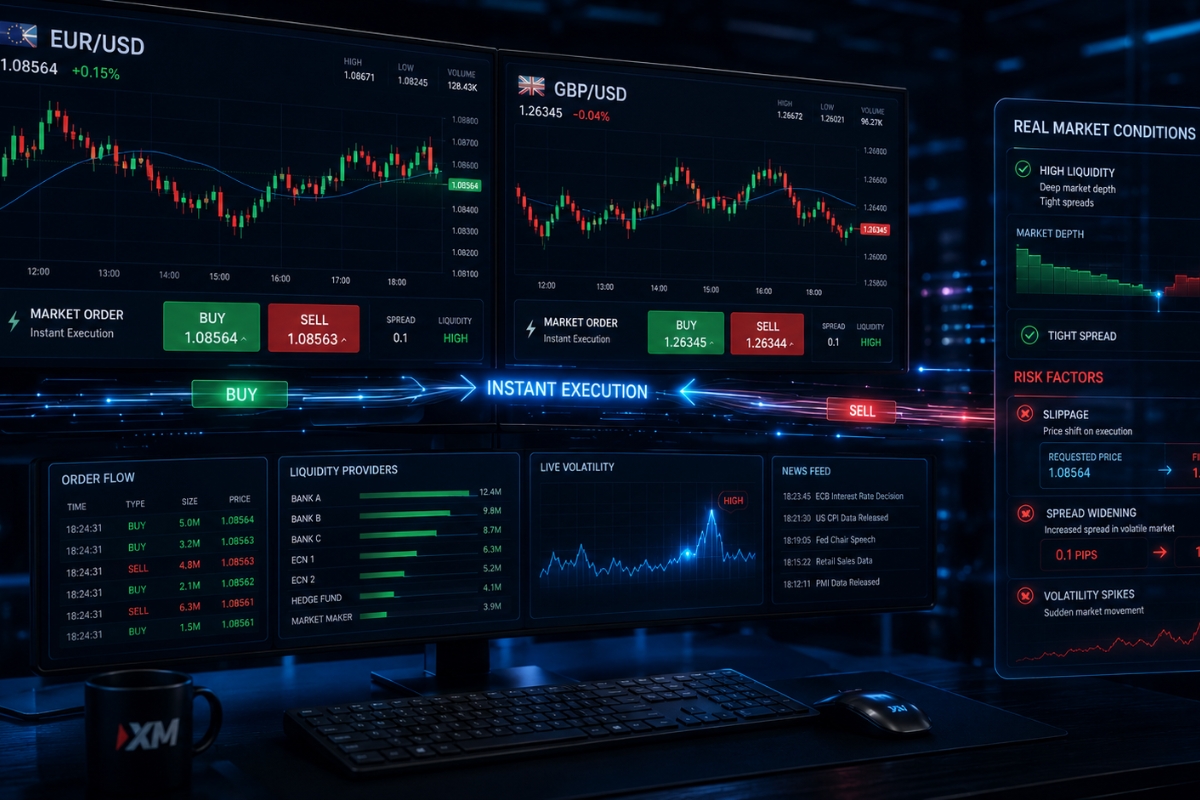
Because the foreign exchange market processes over $7.5 trillion in daily volume, the top-tier liquidity allows market orders to be filled with minimal friction on major pairs like EUR/USD or GBP/USD. This high-liquidity profile makes market orders an exceptionally powerful execution tool when your trading strategy values an immediate market entry over micro-price precision.
When should traders use market orders in forex?
Professional technical analysts deploy market orders under specific high-velocity chart conditions:
- Trend Reversal Breaks: When an asset decisively breaches a multi-month trendline, a market order secures your entry before the breakout wave accelerates.
- Pattern Confirmation Closes: Immediately after a daily candle closes outside a classical formation, such as a double bottom or a wedge pattern.
- Emergency Risk Management: When unexpected geopolitical events or corporate crises occur, using a market order ensures you exit your open positions instantly to prevent further capital damage.
However, prioritizing absolute execution speed means you must accept specific structural cost vulnerabilities.
What are the risks of using market orders in forex?
The primary risk of relying on market orders is slippage, which occurs when the final filled price is significantly different from the price displayed on your chart screen when you click execute. Additionally, during low-volume periods like the daily rollover or a major central bank interest rate decision, bid-ask spreads can widen dramatically. Executing a market order during these low-liquidity spikes forces you to absorb these massive spread costs, instantly putting your new position into a deep structural deficit.
To completely eliminate these slippage and spread risks, you must learn to contrast market execution against its primary alternative: the limit order.
Market orders vs limit orders in trading
Market orders vs limit orders in trading represents the fundamental strategic choice between prioritizing guaranteed execution speed or guaranteed price precision.
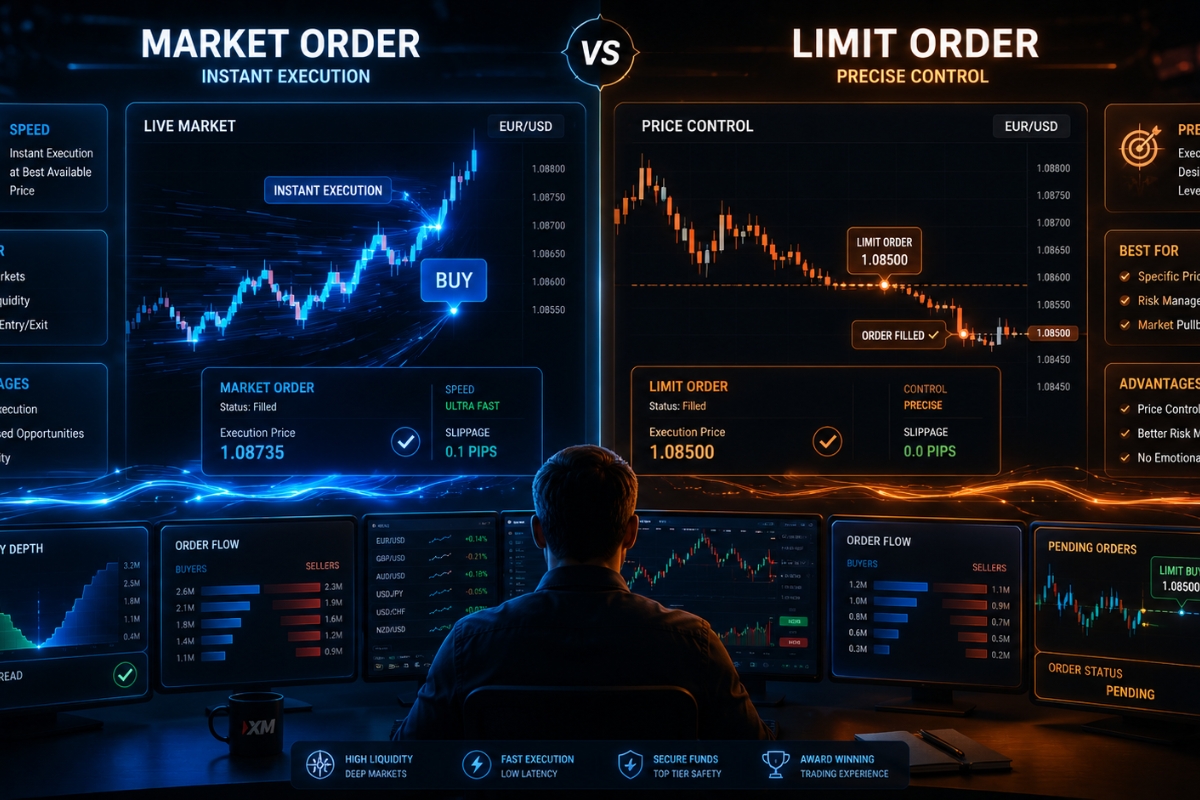
While a market order commands the broker to fill the trade immediately at whatever price the market presents, a limit order instructs the broker to execute the trade only if the price reaches a specific, pre-determined level or better. Balancing these two distinct order types is what allows a professional portfolio manager to minimize transaction friction and maximize risk-reward ratios over time.
What is the difference between market and limit orders?
The differences between these two foundational order types can be organized across four core operational metrics:
| Operational Metric | Market Order | Limit Order |
| Execution Speed | Instantaneous (Guaranteed execution) | Delayed (No guarantee of execution) |
| Price Control | None (Filled at current market rate) | Absolute (Filled only at specified rate or better) |
| Slippage Risk | High (Especially during high volatility) | Zero (Slippage is structurally impossible) |
| Market Role | Removes liquidity from the order book | Adds resting liquidity to the order book |
Understanding this structural division allows you to dynamically choose the correct execution tool based on your active trading setup.
When to use market orders vs limit orders?
You should use a market order when you are actively day trading, scalping fast-moving breakouts, or when missing out on an entry represents a higher strategic risk than losing a few fractions of a pip to minor slippage. On the other hand, you should deploy a limit order when you are swing trading, executing range-bound mean-reversion strategies, or trying to buy an asset at a precise key historical support zone. By checking the educational resources and platform specifications on the MBroker, traders can easily learn to master this balance and ensure their execution fits their underlying methodology.
With both execution models defined, let us look at the practical, step-by-step process of managing these orders securely on the XM platform.
Applying market orders effectively on XM platform
Applying market orders effectively on the XM platform requires pairing rapid platform execution with strict risk-management calculators to eliminate emotional mistakes.
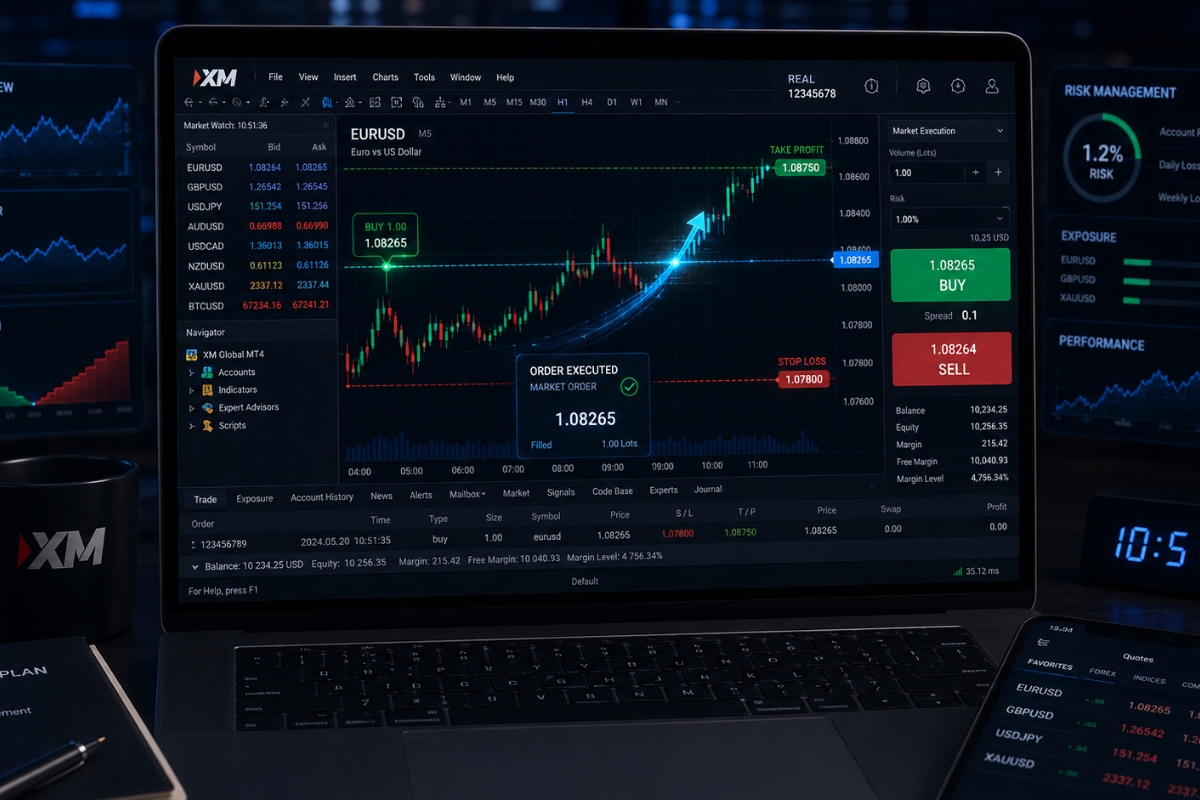
Because a market order takes effect the exact microsecond you execute it, your protective stop-loss levels and target parameters must be thoroughly calculated prior to opening the order ticket. When traders align this disciplined, systematic preparation with the low-latency processing networks championed by XM, they create a highly efficient, professional environment for growing their trading equity.
How to use market orders step by step on XM?
Follow this definitive step-by-step roadmap to place market orders safely and review the advanced risk filters needed to keep your capital secure.
- Step 1: Analyze asset chart structure: Open your MetaTrader terminal and identify a verified technical setup that has met all your system’s entry requirements on a high timeframe.
- Step 2: Open the new order ticket: Press F9 on your keyboard or double-click the desired currency pair in the Market Watch window to launch the execution control panel.
- Step 3: Configure order type and volume: In the “Type” dropdown box, select “Market Execution.” Input your exact, pre-calculated position size in the “Volume” field.
- Step 4: Program pre-calculated risk parameters: Enter your precise Stop Loss and Take Profit price points directly into their designated input fields before sending the packet to the server.
- Step 5: Execute the instant trade: Click the blue “Buy by Market” button or the red “Sell by Market” button to transmit your order instantly to the XM live matching system.
While the manual placement sequence is simple, long-term commercial survival requires locking down your risk management parameters.
How to manage risk when using market orders?
Proper risk control when deploying instant market executions relies on enforcing fixed mathematical boundaries:
- Strict Capital Caps: Limit your total financial risk to a maximum of 1% to 2% of your aggregate account equity per transaction.
- The Volatility Filter: Avoid clicking market execution during the initial 5 to 10 minutes surrounding high-impact macroeconomic news releases like the US Consumer Price Index (CPI).
- Spread Monitoring: Always check the live bid-ask spread matrix on your terminal to verify that current broker transaction costs are within your strategy’s acceptable limits.
- Premium Infrastructure Alignment: Routing your trades through the verified accounts and low-spread setups accessible via the MBroker ensures that your market orders experience minimal slippage and maximum fill efficiency under all market conditions.
Market Orders are indispensable technical execution tools that guarantee immediate market access and rapid trade completion on the XM platform. By understanding how execution speed links to live liquidity, selecting the correct order type variation, and matching market orders with high-volume momentum strategies, you can safely turn short-term market movements into a scalable commercial edge.

Thoren Vextal is a specialist in XM trading guides, offering practical insights and real-market experience to help traders improve their strategies and trading performance. Email: [email protected]