
 Tiếng Việt
XM and Pepperstone differ mainly in regulatory footprint, fee structure and platform range, making the choice dependent on a trader’s priorities. XM operates through multiple offshore and regulated entities, while Pepperstone is licensed and regulated by top-tier regulators, including the Australian Securities and Investments Commission (ASIC) and the Financial Conduct Authority (FCA).
Pepperstone generally offers tighter raw spreads on its Razor-type accounts, while XM markets itself around no-commission Standard accounts, though exact average spreads can vary depending on market conditions and account type. Commission structures on ECN-style accounts vary between the two brokers and directly affect overall trading costs.
Pepperstone’s regulatory licenses from multiple top-tier authorities generally position it as a solid choice for traders prioritizing oversight and fund protection, though the actual level of protection depends on the specific entity and account a trader is registered under. Both brokers provide segregated client accounts and multilingual customer support channels.
XM suits beginners with its low minimum deposit and bonus programs, while Pepperstone, which does not enforce a fixed minimum deposit, is better aligned with algorithmic and high-volume traders through its raw spread accounts. Copy trading features also differ between the two platforms.
Mbroker breaks down these differences point by point, starting with an overall comparison of how XM and Pepperstone stack up before examining regulation, safety and cost structures in detail.
XM vs Pepperstone: How Do These Two Brokers Compare Overall?
XM vs Pepperstone: How Do These Two Brokers Compare Overall
XM and Pepperstone compare across four core areas: regulation, safety, fees and platform range, each shaping which trader profile a broker fits best. This overview sets the framework used throughout the rest of the comparison.
Both brokers operate as multi-entity forex and CFD providers serving a global client base, though their company backgrounds differ in founding year, headquarters and regional focus. The following sections examine how each broker’s regulatory licenses, client fund protection, spreads, commissions and trading platforms compare in practice.
No single broker is presented as universally superior, since suitability depends on a trader’s location, account type and trading style.
What Are the Key Facts About XM and Pepperstone as Companies?
XM was founded in 2009 in Cyprus and Pepperstone in 2010 in Australia, each operating multiple regulated entities across different jurisdictions. This snapshot ties together the company background behind the regulation and safety comparisons already outlined above.
XM operates under Trading Point Holdings, a group founded in 2009 and headquartered in Limassol, Cyprus, running several regulated subsidiaries across different jurisdictions.
Pepperstone was established in 2010 in Melbourne, Australia, and now operates through subsidiary entities licensed in multiple regions beyond its home market, according to the company’s own corporate background information.
Both brokers report serving a large international client base, though verified client numbers are best confirmed through each company’s official disclosures rather than third-party estimates. XM states it serves clients across a wide range of countries through its various regulated branches, though the company does not publicly break this figure down into a specific client or account count.
Pepperstone, by contrast, publishes a specific figure on its official “About Us” page, stating that it serves more than 110,000 individual trading accounts across over 150 countries. This difference reflects each broker’s own disclosure practices rather than a gap in the scale of their operations.
These company profiles set the stage for the deeper look at regulation, fund protection and cost structures that follows.
Is XM or Pepperstone More Regulated and Safer for Traders?
Is XM or Pepperstone More Regulated and Safer for Traders
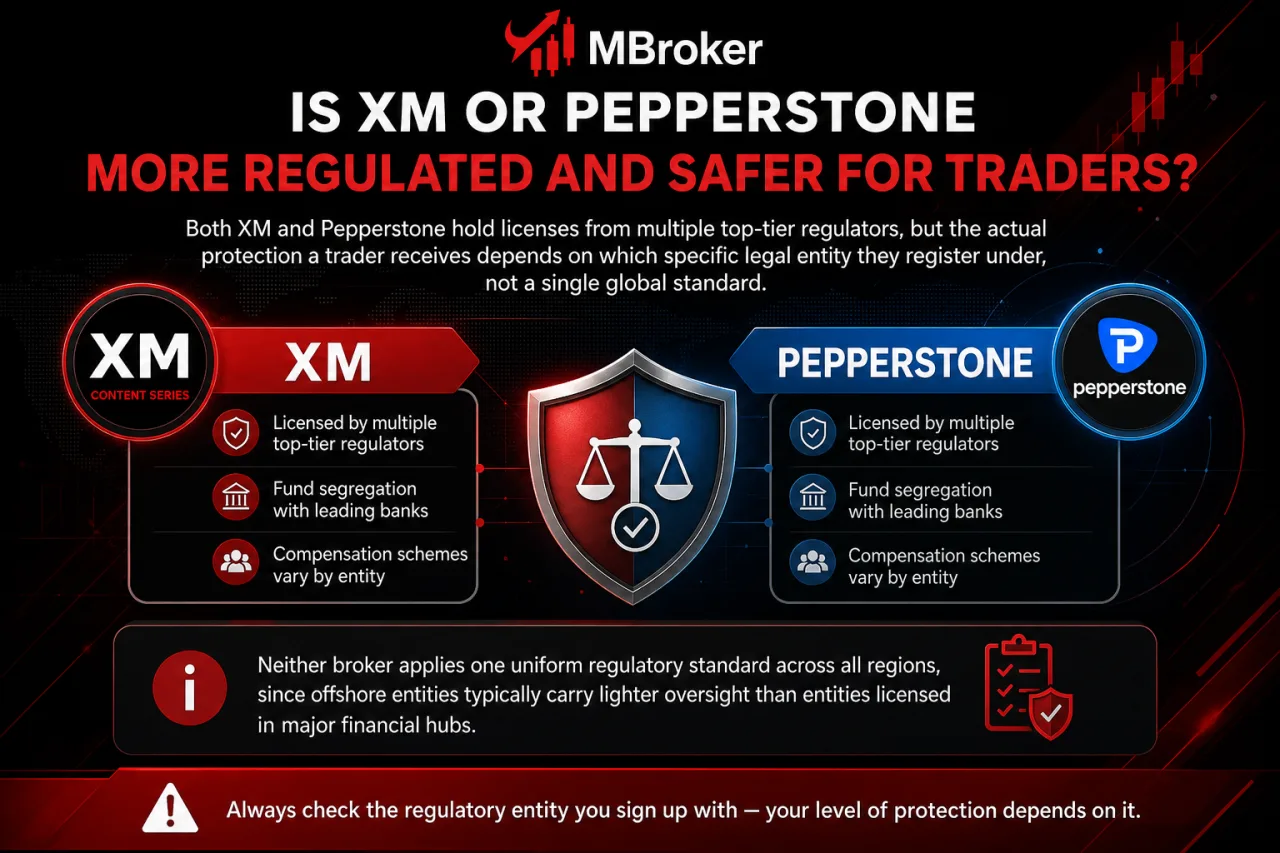
Both XM and Pepperstone hold licenses from multiple top-tier regulators, but the actual protection a trader receives depends on which specific legal entity they register under, not a single global standard. This overview leads into a closer breakdown of each broker’s regulatory bodies, fund segregation practices and compensation schemes below.
Neither broker applies one uniform regulatory standard across all regions, since offshore entities typically carry lighter oversight than entities licensed under ASIC, FCA or CySEC. The sections that follow detail which regulator governs each entity, how client funds are segregated, whether negative balance protection applies, and what investor compensation schemes cover traders under each jurisdiction.
Which Legal Entities and Regulators Oversee XM vs Pepperstone in Different Regions?
XM operates through several offshore and EU-linked entities while Pepperstone runs its business under a smaller set of top-tier licensed entities, with leverage caps and compensation coverage differing by entity. This entity-level breakdown builds directly on the regulatory overview above, mapping which specific company within each broker’s group serves clients in a given region.
XM operates through several regulated entities across different jurisdictions, including entities licensed by CySEC in Cyprus, the FCA in the UK, an offshore regulator in Belize, and ASIC in Australia.
Pepperstone operates through several regulated entities across different jurisdictions, each licensed by the relevant local regulator, though the exact entity names and license numbers can vary by region and account type.
Leverage limits differ sharply between entities, since ASIC and FCA-regulated accounts cap retail leverage far lower than offshore Belize or Bahamas entities. Negative balance protection and investor compensation schemes also apply only to clients registered under the specific EU, UK or Australian entities, not the offshore branches of either broker.
How Do Client Fund Protection and Compensation Schemes Compare Between XM and Pepperstone?
XM and Pepperstone both segregate client funds and offer negative balance protection, but compensation fund coverage limits differ by the specific regulated entity a trader is registered under. This distinction builds on the entity-level breakdown above and separates fund segregation policy from compensation scheme mechanics below.
Both brokers hold client deposits in segregated bank accounts kept apart from company operating funds, a standard practice across their regulated entities. According to XM’s own Client Agreement, Terms and Conditions of Business, XM applies negative balance protection on a per-account basis, aiming to ensure that clients cannot lose more than the balance held in their trading account.
Pepperstone likewise reports on its Regulated Offices page that negative balance protection is provided to retail clients, while noting on its FAQ page that this guaranteed protection does not apply to Pepperstone Pro or Professional clients.
Investor compensation coverage varies by jurisdiction rather than applying a single global limit. Clients registered under XM’s CySEC-regulated entity fall under the Cyprus Investor Compensation Fund, while UK-regulated clients of either broker fall under the Financial Services Compensation Scheme, though exact compensation limits depend on the specific entity and case circumstances.
Offshore entities of both brokers generally fall outside these compensation schemes, so traders should verify which entity and jurisdiction cover their specific account before relying on these protections.
XM vs Pepperstone: Which Broker Has Lower Spreads, Commissions and Fees?
XM vs Pepperstone: Which Broker Has Lower Spreads, Commissions and Fees
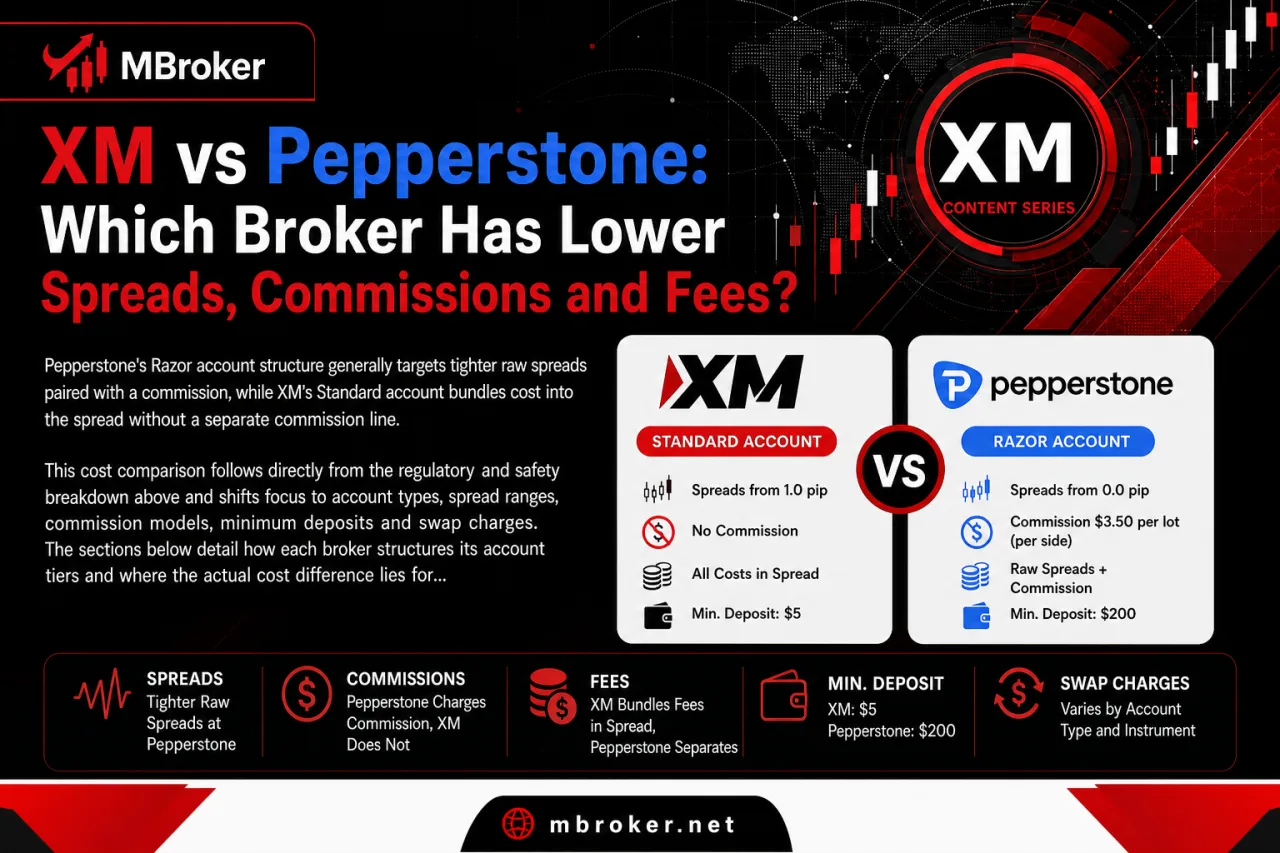
Pepperstone’s Razor account structure generally targets tighter raw spreads paired with a commission, while XM’s Standard account bundles cost into the spread without a separate commission line. This cost comparison follows directly from the regulatory and safety breakdown above and shifts focus to account types, spread ranges, commission models, minimum deposits and swap charges. The sections below detail how each broker structures its account tiers and where the actual cost difference lies for active traders.
Both brokers offer more than one account type, and the true cost of trading depends on which tier a client selects rather than a single flat rate. Minimum deposit requirements, swap fee policies and commission schedules also vary by account and by regulated entity, so the figures presented in the following subsections apply specifically to the account type named in each case.
What Account Types Do XM and Pepperstone Offer?
XM offers three main account tiers (Micro, Standard and XM Ultra Low), while Pepperstone offers two core tiers (Standard and Razor), each aimed at a different trader profile based on deposit size and cost preference. This tier-by-tier breakdown continues from the cost comparison above and details minimum deposits, base currency options and the intended trader profile for each account.
XM’s Micro and Standard accounts carry a low minimum deposit and suit beginners trading smaller position sizes, while the XM Ultra Low account targets cost-sensitive traders through reduced spreads. According to XM’s own account types page, all account types feature negative balance protection and hedging, and if the deposited currency is not USD, XM offers multiple base currency options depending on the client’s account and region.
Pepperstone’s Standard account bundles cost into the spread with no separate commission, fitting casual or lower-frequency traders, while its Razor account pairs tighter raw spreads with a per-lot commission, aligning with scalpers and algorithmic traders. Pepperstone does not enforce a fixed minimum deposit requirement on either account type, though starting with a practical minimum amount is generally advisable for effective risk management.
Both brokers also offer Islamic swap-free variants of their standard tiers for clients requiring Sharia-compliant trading conditions.
How Do Spreads and Commission Structures Compare Between XM and Pepperstone?
Pepperstone’s Razor account typically posts tighter raw EUR/USD spreads paired with a per-lot commission, while XM’s ECN-style Ultra Low account bundles a smaller commission with a slightly wider spread. This spread and commission breakdown follows the account tier overview above and narrows in on actual EUR/USD pricing and commission figures.
XM’s Ultra Low account is generally marketed with tight EUR/USD spreads combined with a fixed commission charged per lot traded.
Pepperstone’s Razor account is generally marketed with tight EUR/USD spreads combined with a commission charged per lot per side.
Neither broker guarantees these advertised spread figures as fixed, since actual spreads widen or tighten depending on market liquidity, volatility and time of trading session. Traders comparing costs across both brokers should check live spread data during their intended trading hours rather than relying solely on marketing pages, since published averages reflect typical rather than guaranteed conditions.
Are There Other Fees Traders Should Know About, Such as Deposits, Withdrawals or Inactivity?
Yes, both XM and Pepperstone charge additional fees beyond spreads and commissions, covering currency conversion, inactivity and, in some cases, withdrawal processing depending on the payment method. This section extends the cost breakdown above from spreads and commissions into the secondary charges that affect a trader’s net cost of doing business with either broker.
XM does not charge deposit or withdrawal fees on most funding methods, though third-party banks or payment providers may apply their own processing charges outside XM’s control.
Pepperstone likewise does not charge deposit or withdrawal fees, though currency conversion charges may apply when a client’s account base currency differs from the currency of a deposit, withdrawal or traded instrument.
Inactivity fee policies also differ between account types and regulated entities for both brokers, so traders should confirm the exact threshold and charge applicable to their specific account before assuming no fee applies. Checking each broker’s official fee schedule directly remains the most reliable way to confirm current charges, since these terms can change by region.
Which Broker Offers Better Customer Support and Service Quality: XM or Pepperstone?
Which Broker Offers Better Customer Support and Service Quality: XM or Pepperstone
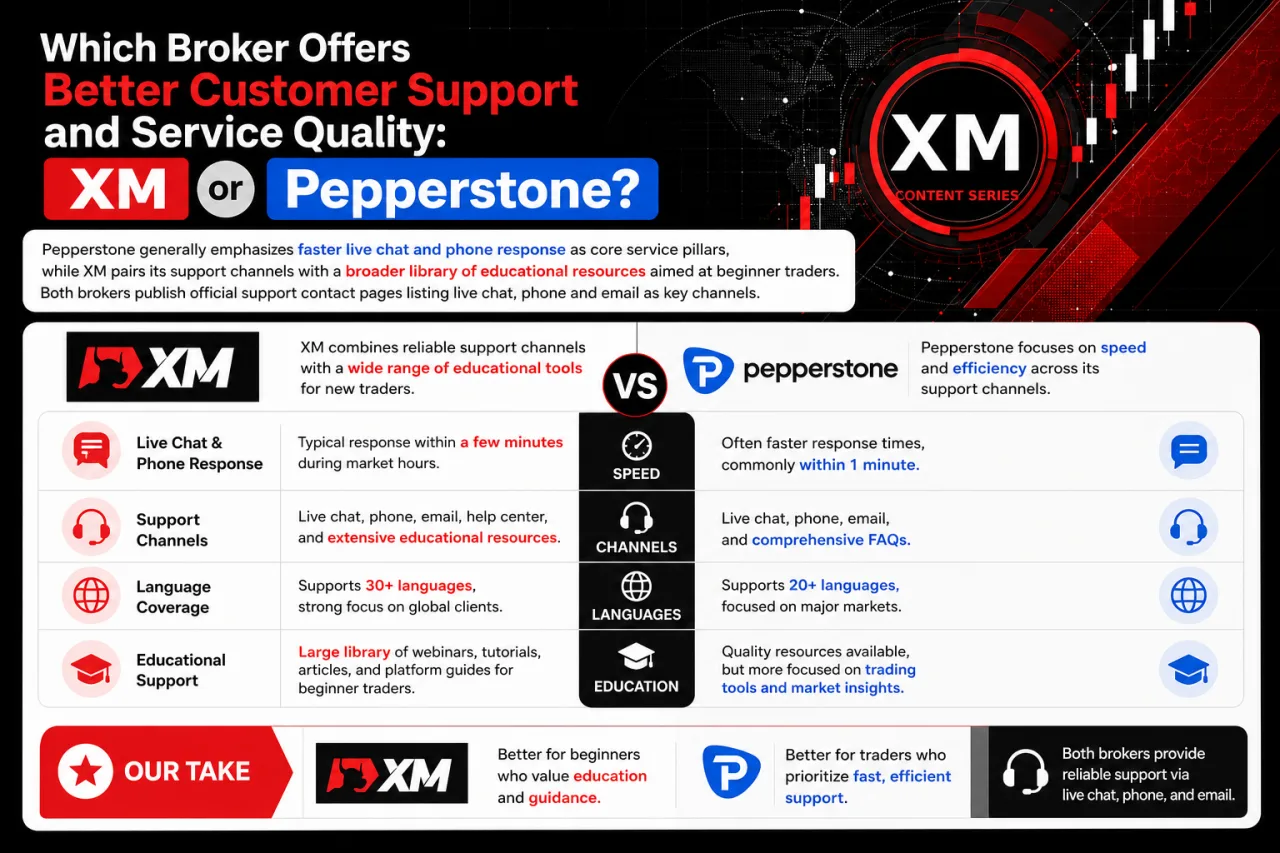
Pepperstone generally emphasizes faster live chat and phone response as core service pillars, while XM pairs its support channels with a broader library of educational resources aimed at beginner traders. This overview builds on the cost breakdown above and shifts focus to how each broker’s support channels, language coverage and response speed compare, with the sections below detailing these differences.
Both brokers publish official support contact pages listing live chat, phone and email as primary channels, though staffed hours and language availability vary by regional entity. The following breakdown separates support channel availability from language coverage, response speed and the educational resources each broker makes publicly accessible.
What Support Channels and Languages Are Available for XM vs Pepperstone Clients?
Both brokers cover live chat, phone and email as primary support channels, but staffed hours and language coverage vary by regional entity rather than following one global standard. This channel-level breakdown follows the support overview above and separates availability, multilingual coverage and regional access differences between XM and Pepperstone.
XM’s support channels operate across multiple languages through its regional entities, with live chat and phone lines generally aligned to the trading hours relevant to each client’s registered jurisdiction.
Pepperstone’s support channels likewise operate across multiple languages, with phone and live chat availability generally tied to the office hours of the specific regional entity a client is registered under.
Regional access also differs by broker, since:
- Clients registered under offshore entities sometimes reach a different support desk than clients under top-tier regulated entities.
- Email response times vary depending on the account’s regional entity and query complexity.
- Language options available through live chat do not always match the full list offered via phone support.
Traders should confirm the exact hours and language options tied to their specific registered entity directly on each broker’s official support page before relying on a particular channel.
Which Broker Is Better Suited for Beginners, Algo/High-Volume Traders or Copy Traders: XM or Pepperstone?
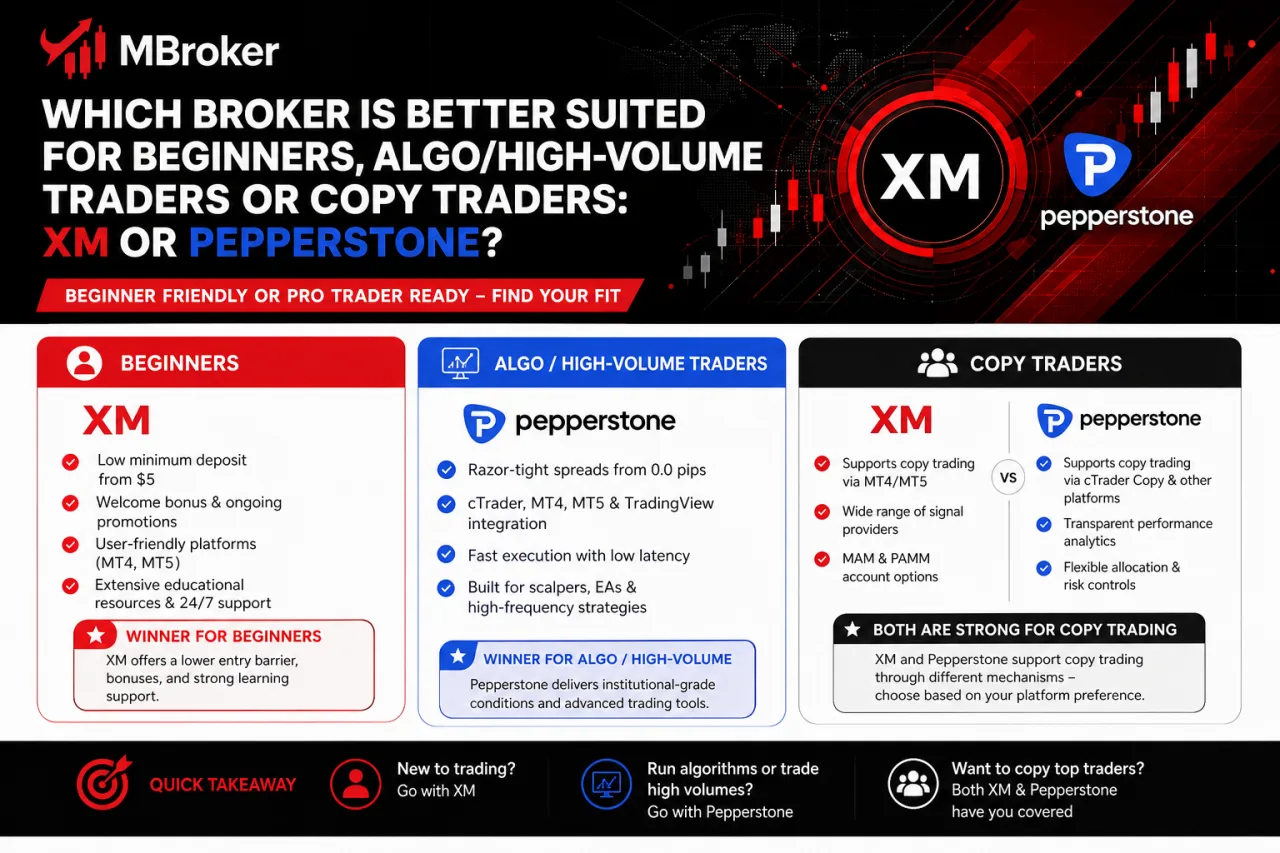
Which Broker Is Better Suited for Beginners, Algo/High-Volume Traders or Copy Traders: XM or Pepperstone
XM aligns closer with beginner traders through its lower entry barrier and bonus programs, Pepperstone suits algorithmic and high-volume traders through its Razor spreads and cTrader access, and both brokers support copy trading through different mechanisms. This suitability comparison follows directly from the support breakdown above and shifts focus to platform range, execution style and copy trading setup, with the subsections below detailing each trader profile separately.
Platform availability differs slightly between the two brokers, since Pepperstone adds cTrader alongside MT4 and MT5 while XM concentrates its offering on MT4 and MT5. Execution speed and algo/EA support also vary by account type and server location rather than by broker alone, and copy trading options follow separate paths for each provider.
What Trading Platforms Do XM and Pepperstone Support?
Both brokers support MetaTrader 4 and MetaTrader 5, but Pepperstone adds cTrader while XM relies on proprietary web and mobile apps built around the MetaTrader engine. This platform breakdown continues from the trader-suitability overview above and separates the exact platform lineup from features relevant to algorithmic execution.
XM offers MT4 and MT5 across desktop, web and mobile, plus its own XM app for account management and trading on the same MetaTrader infrastructure. Pepperstone offers MT4, MT5 and cTrader, giving traders an extra platform choice built with native algorithmic and copy trading tools.
Platform-specific features relevant to algo trading differ between the two setups:
- MT4 and MT5 support Expert Advisors (EAs) written in MQL, used by both brokers’ clients for automated strategies.
- cTrader supports cAlgo and cBots, a separate scripting environment exclusive to Pepperstone among the two brokers.
- Execution speed for algo trading depends on server location and account type rather than the platform alone, applying to both XM and Pepperstone.
Traders relying heavily on custom scripts or bot-based strategies generally weigh whether cTrader’s cBot environment fits their workflow better than the MQL ecosystem shared by MT4 and MT5.
How Do XM and Pepperstone Compare for Copy Trading and Automated/Algo Trading?
Pepperstone leans on cTrader Copy and cAlgo for native copy trading and algo support, while XM relies on third-party MT4/MT5 tools and its own signal service. This copy trading and algo comparison follows the platform breakdown above and narrows in on native copy tools, EA/API support, VPS availability and execution model.
Native copy trading setup differs between the two brokers:
- Pepperstone integrates cTrader Copy directly into its platform lineup, letting clients follow strategy providers without a separate third-party plugin.
- XM relies on MT4/MT5-based copy solutions and its own signal service rather than a fully native in-house copy tool.
- Both brokers support MQL-based EAs on MT4/MT5, while Pepperstone additionally supports cBots through cAlgo for algorithmic strategies.
VPS availability and execution model also matter to algo traders. Both brokers offer VPS hosting options to reduce latency for automated strategies, though exact eligibility conditions vary by account balance or trading volume.
Execution model differs by account type rather than by broker alone, since Pepperstone’s Razor and XM’s Ultra Low accounts generally route toward ECN/STP-style execution, while standard-tier accounts on both sides operate closer to a market maker model.
Which Broker May Be More Suitable for Beginner Traders: XM or Pepperstone?
XM generally suits beginner traders better through its lower minimum deposit, micro lot availability and bonus programs, while Pepperstone appeals more to traders who prioritize raw pricing over hand-holding. This beginner-focused comparison builds on the trader-suitability overview above and narrows in on minimum deposit, educational materials, demo accounts and micro lot access as the four factors most relevant to new traders.
Minimum deposit requirements differ structurally between the two brokers. XM sets a low minimum deposit on its Micro and Standard accounts, positioning the broker toward traders starting with smaller capital. Pepperstone does not enforce a fixed minimum deposit on either account type, though a practical starting amount remains advisable for risk management as noted earlier.
Educational resources and account features also separate the two brokers, as outlined below.
- XM publishes a broader library of webinars, tutorials and market research aimed specifically at newer traders.
- Pepperstone focuses its educational content more narrowly around platform tutorials and market analysis rather than structured beginner courses.
- Both brokers offer free demo accounts, letting new traders test strategies without risking real capital.
- XM’s Micro account supports micro lot trading, allowing smaller position sizes than Pepperstone’s standard lot structure typically permits.
These differences reflect factual product design rather than a definitive recommendation for either broker.
What Financial Instruments and Country Availability Differ Between XM and Pepperstone?
XM and Pepperstone differ in instrument breadth and country eligibility, with XM listing a wider retail asset menu while Pepperstone restricts crypto CFD availability by region and both brokers excluding several jurisdictions outright. This overview shifts focus from cost and platform comparisons above into the tradable asset range and residency rules covered separately below. Instrument categories, crypto CFD access and restricted-country lists vary by broker and by the specific entity a client registers under, so the following breakdown separates these three factors individually.
What Range of Financial Instruments Can Traders Access on XM vs Pepperstone?
XM lists a broader retail catalogue spanning forex, stock CFDs, indices, commodities, metals and cryptocurrencies, while Pepperstone concentrates its instrument menu around forex, indices, commodities and a narrower cryptocurrency CFD selection. This instrument breakdown follows the country-eligibility overview above and separates category count, approximate instrument totals and any exclusive offerings between the two brokers.
XM markets a wide stock CFD range covering companies listed on several major exchanges, positioning this category as one of its more distinctive retail offerings compared to Pepperstone. Traders confirm the current instrument count directly on XM’s official instrument list page, since exact totals change periodically as the broker adds or removes listings.
Pepperstone’s instrument catalogue centers on forex pairs, index CFDs, commodity CFDs and a shorter list of cryptocurrency CFDs, reflecting a narrower but execution-focused product set. The precise instrument count for each category is available on Pepperstone’s official instrument list page rather than on marketing pages alone.
Availability of specific categories, particularly stock CFDs and certain crypto pairs, also depends on the regulated entity a client registers under.
Are XM and Pepperstone Available to Traders in All Countries?
No, both XM and Pepperstone restrict availability in certain countries, with US residents excluded from both brokers’ retail offerings. This exclusion ties into the country-eligibility question raised above and separates the specific jurisdictions, entity redirection rules and verification steps that apply to each broker below.
XM does not accept clients from the United States, Canada and a number of other restricted jurisdictions, redirecting eligible applicants to the regulated entity matching their country of residence.
Pepperstone similarly excludes US residents along with a number of other restricted jurisdictions, routing new applicants toward the entity licensed for their region during onboarding.
Both brokers require identity and residency verification (KYC) before account activation, checking submitted documents against the applicant’s declared country. Restricted-country lists change periodically as regulatory requirements shift, so traders confirm current eligibility directly through each broker’s official signup page rather than relying on outdated summaries.

Thoren Vextal is Mbroker’s XM Reviews and How-To Guides Editor, covering broker reviews, regulation, comparisons and practical account guides.Email: [email protected]