
 Tiếng Việt
XM and AvaTrade differ mainly in regulatory structure, account offerings and platform ecosystem. This makes each broker better suited to different trading styles. Traders choosing between the two must weigh how each broker’s conditions align with their strategy, risk tolerance and preferred trading tools.
AvaTrade generally applies fixed spreads on select account types. XM offers variable spreads instead. Minimum deposit requirements also differ between the two brokers. These cost structures directly affect profitability for high-frequency versus long-term traders.
XM and AvaTrade are both regulated by multiple financial authorities across different jurisdictions. The specific entity a client is onboarded to determines the actual protections and leverage limits applied. Leverage caps and compensation schemes vary depending on the client’s country of residence.
AvaTrade positions itself around AvaTradeGO and social trading integrations. XM relies primarily on MetaTrader platforms paired with in-house research tools. Each approach appeals to distinct trader profiles. Beginners, scalpers and copy traders each find different advantages depending on which ecosystem fits their workflow.
Mbroker breaks down these distinctions below, starting with XM vs AvaTrade: How Do These Two Brokers Compare Overall? before covering regulation, fees and platform suitability.
XM vs AvaTrade: How Do These Two Brokers Compare Overall?
XM vs AvaTrade: How Do These Two Brokers Compare Overall
XM and AvaTrade compare across four core areas: regulation, fees, platforms and instrument range. Each broker shows distinct strengths in specific categories rather than one clearly outperforming the other. This overview sets the framework the following sections examine in detail.
XM operates as a multi-entity broker offering forex, commodities, indices and stock CFDs, while AvaTrade positions itself with a broader mix of instruments including options and cryptocurrency CFDs alongside traditional forex pairs.
Both brokers serve retail and professional traders across multiple regions, though onboarding entity determines exact product availability. The sections below break down regulatory oversight, account and fee structures, platform ecosystems and instrument coverage separately for each broker.
What Are the Core Company Profiles of XM and AvaTrade?
XM and AvaTrade are both privately held retail Forex/CFD brokers, each operating under multiple regulated entities to serve clients across different regions. Their corporate structures shape which products, leverage limits and protections apply to a given trader.
According to XM’s official help center, XM operates as a group of regulated entities with more than 15 years in the industry, offering forex, commodities, indices and stock CFDs, built around a broker model focused on execution speed and educational resources for retail traders.
AvaTrade also functions as a multi-regulated group, with business lines that extend further into options and cryptocurrency CFDs alongside standard forex pairs.
Both brokers present themselves as long-established players in the retail Forex/CFD space, though the exact entity onboarding a client depends on that client’s country of residence. This distinction affects which regulator oversees the account and which compensation scheme, if any, applies. The sections below detail regulation, fees, platforms and instrument range separately for XM and AvaTrade.
Is XM or AvaTrade Safer in Terms of Regulation and Client Protection?
Is XM or AvaTrade Safer in Terms of Regulation and Client Protection
Neither broker qualifies as unconditionally safer since regulatory strength depends on which entity handles the client’s account rather than the brand as a whole. A trader onboarded under a tightly regulated European entity gets different protections than one placed under an offshore branch of the same broker.
The sections below compare the regulatory bodies overseeing XM and AvaTrade, their legal entity structures per region and the compensation schemes tied to each licence.
Which Legal Entities and Licences Does XM Operate Under?
XM operates under several regulated entities grouped by region, each tied to a distinct regulator and set of client protections. This structure directly answers how licensing shapes what a trader receives depending on where the account sits.
- Trading Point of Financial Instruments Ltdhandles clients under the oversight of the Cyprus Securities and Exchange Commission, applying ESMA-aligned leverage caps and coverage under the Investor Compensation Fund (I.C.F).
- Trading Point of Financial Instruments Pty Ltdserves Australian clients through Trading Point of Financial Instruments Pty Ltd, licensed by the Australian Securities and Investments Commission under AFSL number 443760, applying ASIC’s retail leverage limits on major currency pairs.
- XM Global Limitedcovers clients under XM Global Limited, which according to XM’s official leverage page is regulated by the Financial Services Commission (FSC) of Belize under the Securities Industry Act 2021 (license number 8557558), typically offering higher leverage but without the compensation schemes tied to European or Australian licences.
Each entity determines margin requirements, dispute resolution channels and fund segregation rules for the client onboarded under it. Traders confirm their assigned entity directly through account documentation rather than assuming uniform terms across the XM brand.
Which Legal Entities and Licences Does AvaTrade Operate Under?
AvaTrade operates under several regulated entities segmented by region, each tied to a distinct regulator with its own leverage limits and client protection scheme. This structure mirrors XM’s approach, where the onboarding entity rather than the brand name determines which safeguards actually apply.
- Ava Trade EU Limited handles clients under the oversight of the Central Bank of Ireland, which lists the entity as authorised under reference number C53877, applying ESMA-aligned leverage caps and coverage under the Irish Investor Compensation Scheme.
- Ava Capital Markets Australia Pty Ltd serves Australian clients, licensed by the Australian Securities and Investments Commission under AFSL number 406684, applying ASIC’s retail leverage limits such as 30:1 on major currency pairs.
- Ava Trade Middle East Ltd covers clients under offshore or regional licensing structures that typically permit higher leverage without the compensation schemes tied to European or Australian entities. This licensing detail is not accompanied by a public regulator registry link at the time of writing, so traders confirm the exact scope and status of this entity directly with AvaTrade’s support or account documentation before relying on it.
Each entity sets its own margin requirements, dispute resolution process and fund segregation rules for the client placed under it. Traders verify their assigned AvaTrade entity through account opening documentation rather than assuming identical terms apply across every region.
How Do Client Fund Protection and Compensation Schemes Compare?
XM and AvaTrade both apply segregated client accounts and negative balance protection across their regulated entities, though the specific compensation scheme available depends on which entity holds the account. This distinction determines the comparison between the two brokers on fund protection rather than a single blanket guarantee applying to every client worldwide.
Segregation of client funds from company operating capital applies as standard practice at both brokers, keeping trader deposits separate from corporate assets in case of insolvency. Negative balance protection also extends across most XM and AvaTrade entities, preventing retail accounts from losing more than the deposited balance during volatile price swings.
Compensation coverage differs by jurisdiction:
- XM clients under Trading Point of Financial Instruments Ltd access the Cyprus Investor Compensation Fund (I.C.F), while those under XM Global Limited in Belize typically fall outside any statutory compensation scheme.
- AvaTrade clients under Ava Trade EU Ltd access the Irish Investor Compensation Scheme, while those under offshore entities such as Ava Trade Middle East Ltd generally lack equivalent coverage.
Neither broker extends the same compensation protection to every regional entity, making entity verification essential before assuming coverage applies.
XM vs AvaTrade: How Do Fees, Spreads and Minimum Deposit Compare?
XM vs AvaTrade: How Do Fees, Spreads and Minimum Deposit Compare
XM and AvaTrade split fee advantages between spread type, commission structure and minimum deposit tiers, with neither broker holding a uniform cost edge across every account. Traders match these variables against their strategy before ranking one broker cheaper than the other.
The sections below separate spread models, deposit requirements and overnight financing costs for each broker individually.
What Account Types Does Each Broker Offer and What Are the Minimum Deposits?
XM organizes accounts around execution type while AvaTrade organizes accounts around trading style, with minimum deposit thresholds set separately by each broker’s onboarding entity. This split in account structure shapes which tier a trader qualifies for and how much capital opening a position requires.
XM offers Micro, Standard and Ultra Low accounts, each carrying its own minimum deposit figure denominated in the account’s base currency.
AvaTrade structures its offering around a single standard trading account alongside specialized options for AvaTradeGO and AvaOptions users, with minimum deposit requirements varying by region and payment method. AvaTrade publishes these region-specific minimums on its own official site rather than applying one uniform global figure.
Currency denomination differs between the two brokers depending on the legal entity handling the account. Regional variations also apply, since deposit thresholds under a European entity can differ from those under an offshore entity at either broker. Traders confirm the exact figure and currency through their assigned entity’s official account opening page rather than assuming a single global minimum applies.
How Do Spreads and Commissions Differ Between XM and AvaTrade?
XM applies variable spreads that widen or narrow with market conditions, while AvaTrade combines fixed and floating spreads depending on the account and instrument, creating different cost profiles for the same trade. This split in pricing model carries directly into commission structures and typical spread ranges on core instruments.
XM’s Standard and Micro accounts run on a no-commission, spread-only model, while its Ultra Low account pairs a tighter spread with a separate commission charge per lot.
AvaTrade’s standard account operates without separate commissions, embedding its cost into the spread itself, while AvaOptions pricing follows a distinct fee schedule tied to options contracts.
Both brokers publish these figures on their official fee schedule pages, though actual spreads fluctuate with liquidity and volatility rather than staying fixed at the advertised minimum. Traders comparing costs across a specific instrument confirm current figures directly through each broker’s live trading platform rather than relying solely on published minimums.
How Do Safety and Leverage Limits Differ Between XM and AvaTrade?
How Do Safety and Leverage Limits Differ Between XM and AvaTrade
Safety hinges on the regulator attached to a trader’s specific entity, while leverage limits scale with how strict that regulator’s retail caps run, so XM and AvaTrade diverge more by jurisdiction than by brand. This split carries direct risk implications, since a wider margin cushion under an offshore entity magnifies both potential gains and potential losses compared to a capped European or Australian account.
The sections below separate maximum leverage per regulated entity for each broker and connect these figures back to the licensing framework covered earlier.
What Is the Maximum Leverage Available From XM vs AvaTrade by Region?
XM offers higher maximum leverage under its offshore Belize entity than AvaTrade’s offshore Middle East entity restricts to a lower cap, while both brokers apply the same ESMA-aligned ceiling under their EU entities. This regional split ties directly back to the licensing framework covered earlier, since the leverage figure a trader receives depends entirely on which entity holds the account rather than the broker’s overall brand policy.
Under Cyprus and Ireland entities, both XM and AvaTrade cap retail leverage at the ESMA maximum. XM’s Cyprus entity and AvaTrade’s Ireland entity both apply ESMA-aligned leverage caps on major currency pairs for retail clients.
Under Australian entities, both brokers follow ASIC’s retail leverage limits referenced earlier, also set at 30:1 on major pairs. Under offshore entities, XM Global Limited in Belize and AvaTrade’s Middle East entity permit considerably higher leverage ratios than the capped EU or Australian tiers. XM Global Limited’s Belize entity, as noted earlier, is regulated under the Securities Industry Act 2021, and according to XM’s official leverage page typically offers leverage figures reaching into the hundreds-to-one range for retail accounts, without the compensation schemes tied to European or Australian licences. AvaTrade’s Middle East entity similarly offers leverage above the EU-capped tier for eligible clients, in line with the higher leverage typically permitted under offshore or regional licensing structures.
Traders confirm the exact ratio through their assigned entity’s official leverage disclosure rather than assuming one figure applies across every region.
Which Broker Offers Better Trading Platforms and Tools for Different Trader Types?
Which Broker Offers Better Trading Platforms and Tools for Different Trader Types
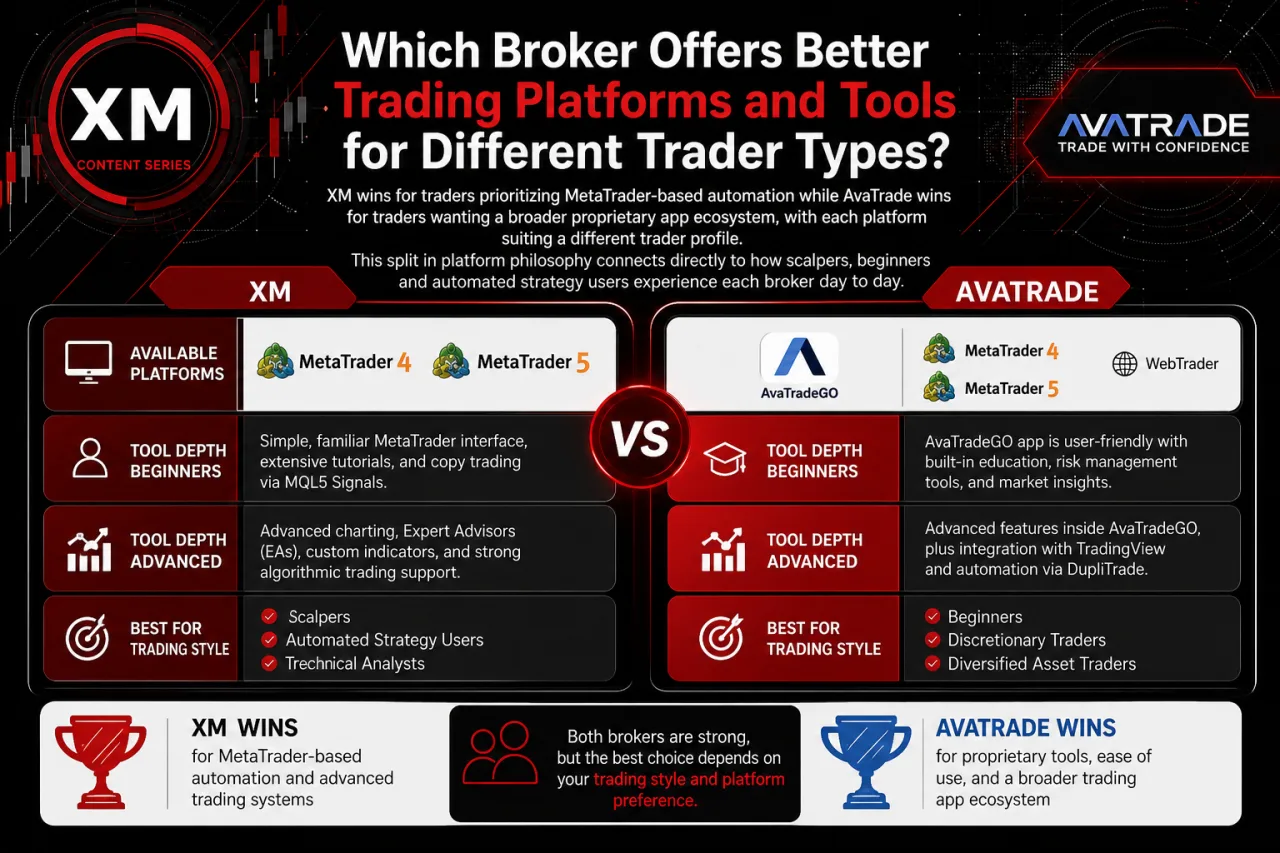
XM wins for traders prioritizing MetaTrader-based automation while AvaTrade wins for traders wanting a broader proprietary app ecosystem, with each platform suiting a different trader profile. This split in platform philosophy connects directly to how scalpers, beginners and automated strategy users experience each broker day to day.
The sections below separate available platforms, tool depth for beginners versus advanced traders, and suitability by trading style for XM and AvaTrade individually.
What Trading Platforms Does XM Provide?
XM provides three core platforms: MetaTrader 4, MetaTrader 5 and the XM mobile app, covering desktop, web and on-the-go execution. This platform lineup shapes what tools a trader accesses depending on device and trading style.
MetaTrader 4 runs as XM’s primary platform for traders relying on expert advisors and custom indicators, supporting automated strategy execution across forex and CFD instruments. MetaTrader 5 extends this with additional order types and an expanded set of built-in technical tools, appealing to traders wanting a broader analytical toolkit within the same MetaQuotes ecosystem.
The XM mobile app mirrors core MetaTrader functionality for iOS and Android devices, letting traders monitor open positions, place orders and review charts away from a desktop terminal. XM does not operate a proprietary web-based charting platform outside the MetaTrader web terminal, keeping its ecosystem centered on the MT4/MT5 framework rather than an in-house alternative.
Traders confirm exact platform availability and supported instruments through their assigned XM entity’s official platform page, since offerings vary slightly depending on regional licensing.
What Trading Platforms Does AvaTrade Provide?
AvaTrade provides four core platforms: MetaTrader 4, MetaTrader 5, AvaTradeGO and AvaOptions/WebTrader, covering desktop, mobile and options-specific execution. This platform lineup answers what tools a trader accesses depending on device, asset class and trading style.
MetaTrader 4 and MetaTrader 5 run as AvaTrade’s platforms for expert advisors, custom indicators and automated strategy execution, mirroring the same MetaQuotes framework XM offers. AvaTradeGO operates as AvaTrade’s proprietary mobile app, built around simplified charting, integrated risk-management tools and account monitoring for traders who prefer a native app experience over the MetaTrader interface.
AvaOptions functions as a dedicated platform for options contracts, separating that product line from the standard forex and CFD flow handled through MT4/MT5 or AvaTradeGO. A browser-based WebTrader extends this access without requiring a downloaded terminal.
Traders confirm exact platform availability through their assigned AvaTrade entity’s official platform page, since regional licensing can affect which tools and instruments appear.
Which Broker’s Platform Suits Which Type of Trader Better?
XM’s platform suits algo traders and scalpers running expert advisors, while AvaTrade’s proprietary app suits beginners and mobile-first traders wanting simplified navigation. This trade-off follows directly from the platform lineups covered above, where each broker’s tools map to a distinct trader profile rather than one setup fitting every style.
Beginners generally find AvaTradeGO easier to navigate given its simplified charting and integrated risk-management tools, compared to the steeper learning curve of a full MetaTrader terminal. Technical traders and scalpers lean toward MetaTrader 4 or MetaTrader 5 at either broker, since both platforms support the order execution speed and charting depth that short-term strategies demand.
Automated and algo traders favor MT4/MT5 across both XM and AvaTrade, as expert advisors and custom indicators run identically within the shared MetaQuotes framework regardless of broker. Mobile-first traders face a clearer split: XM’s mobile app mirrors standard MetaTrader functionality, while AvaTradeGO offers a more native app experience built specifically for on-the-go monitoring.
Traders weighing platform depth against simplicity match their priority, execution control versus ease of use, before settling on one broker’s ecosystem over the other.
What Financial Instruments Can You Trade With XM vs AvaTrade?
What Financial Instruments Can You Trade With XM vs AvaTrade
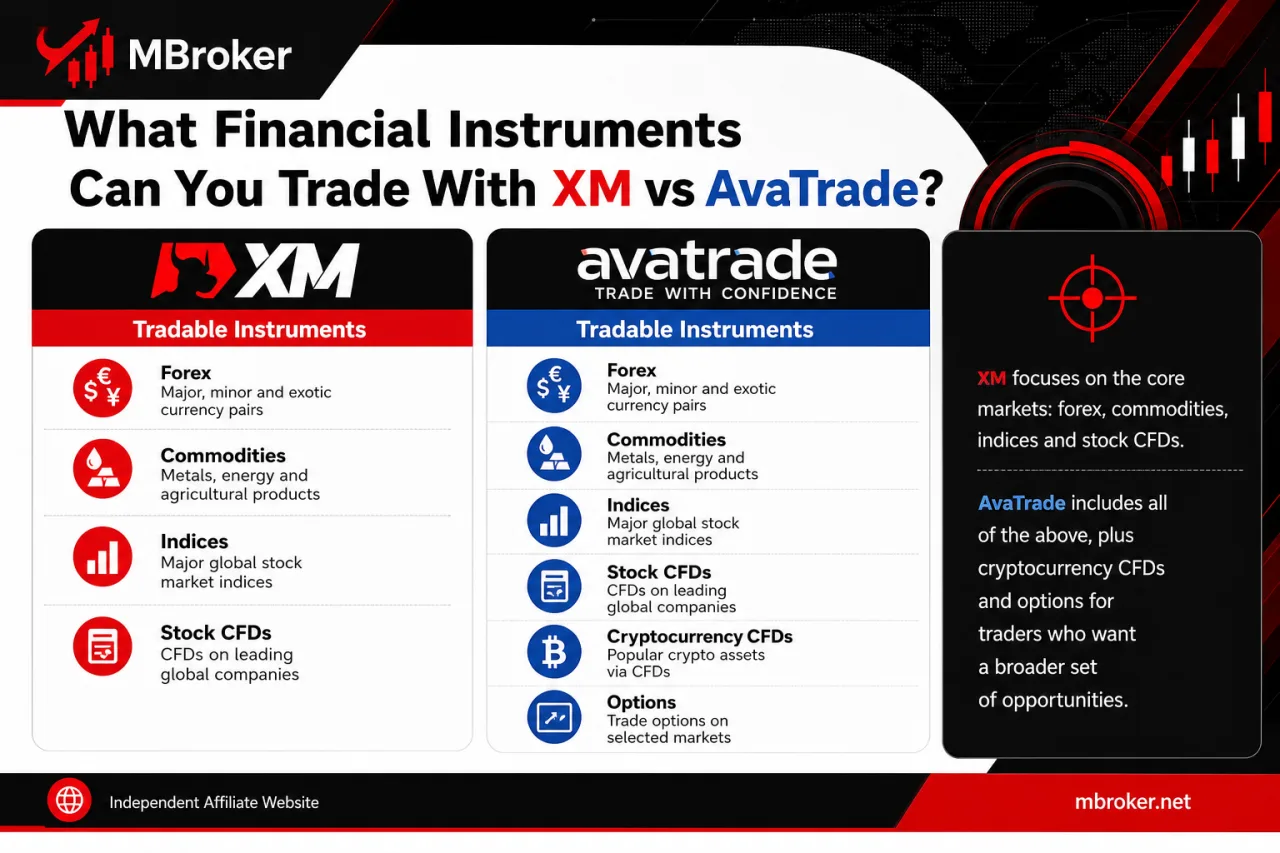
XM covers forex pairs, commodities, indices and stock CFDs, while AvaTrade extends into options and cryptocurrency CFDs alongside the same core forex and CFD categories, giving each broker a different asset mix. This split in tradable instruments follows directly from the product lines outlined in each broker’s company profile above.
XM’s instrument range centers on four main groups: forex currency pairs, commodity CFDs such as metals and energy, index CFDs tracking major global benchmarks, and stock CFDs on individual companies. AvaTrade covers these same four groups but adds two further categories: cryptocurrency CFDs and a dedicated options product line through AvaOptions.
Neither broker’s public materials confirm bond or ETF CFDs as a standard offering, so traders seeking those specific instruments verify availability directly with each broker before opening an account. Cryptocurrency CFD availability at both brokers also depends on the client’s onboarding entity, since certain regulators restrict retail access to crypto derivatives.
Traders prioritizing options exposure or crypto CFDs lean toward AvaTrade’s broader line, while those focused strictly on forex, commodities, indices and stocks find comparable coverage at either broker.
How Do Payment Methods and Withdrawal Conditions Compare?
How Do Payment Methods and Withdrawal Conditions Compare
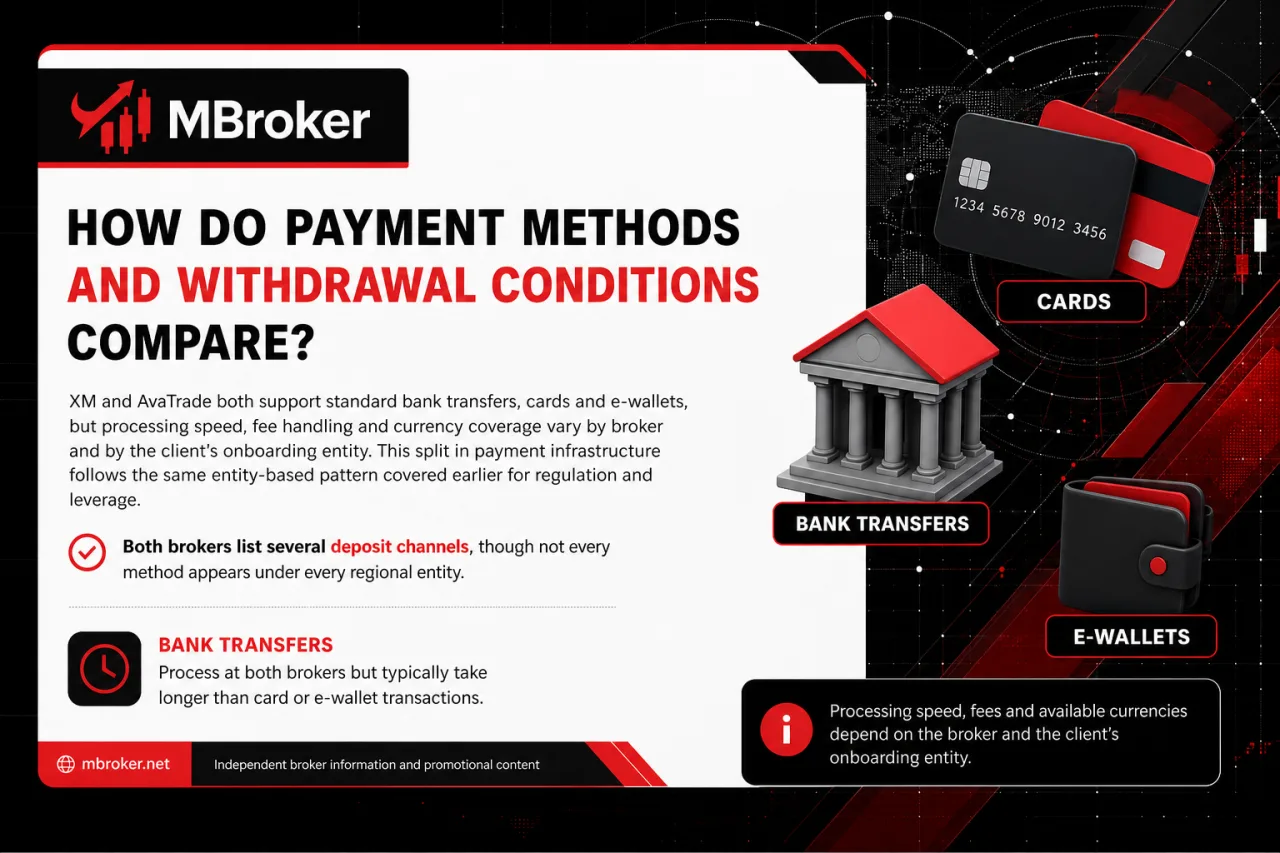
XM and AvaTrade both support standard bank transfers, cards and e-wallets, but processing speed, fee handling and currency coverage vary by broker and by the client’s onboarding entity. This split in payment infrastructure follows the same entity-based pattern covered earlier for regulation and leverage.
Both brokers list several deposit channels, though not every method appears under every regional entity.
- Bank transfers process at both brokers but typically take longer than card or e-wallet transactions, especially for international transfers.
- Debit and credit cards post to trading accounts faster than bank transfers at either broker, subject to card issuer limits.
- E-wallets such as Skrill or Neteller add a quicker deposit and withdrawal path at both XM and AvaTrade, where supported.
Withdrawal charges and processing times at both brokers can vary by payment method and region, so traders should confirm the current fee schedule directly with each broker before withdrawing funds.
Currency support also differs by entity, since some regional accounts denominate in a single base currency while others accept multiple currencies. Traders confirm current fees, processing times and supported currencies through their assigned entity’s official payment page rather than assuming identical terms apply broker-wide.
Are There Country Restrictions for XM or AvaTrade Clients?
Are There Country Restrictions for XM or AvaTrade Clients
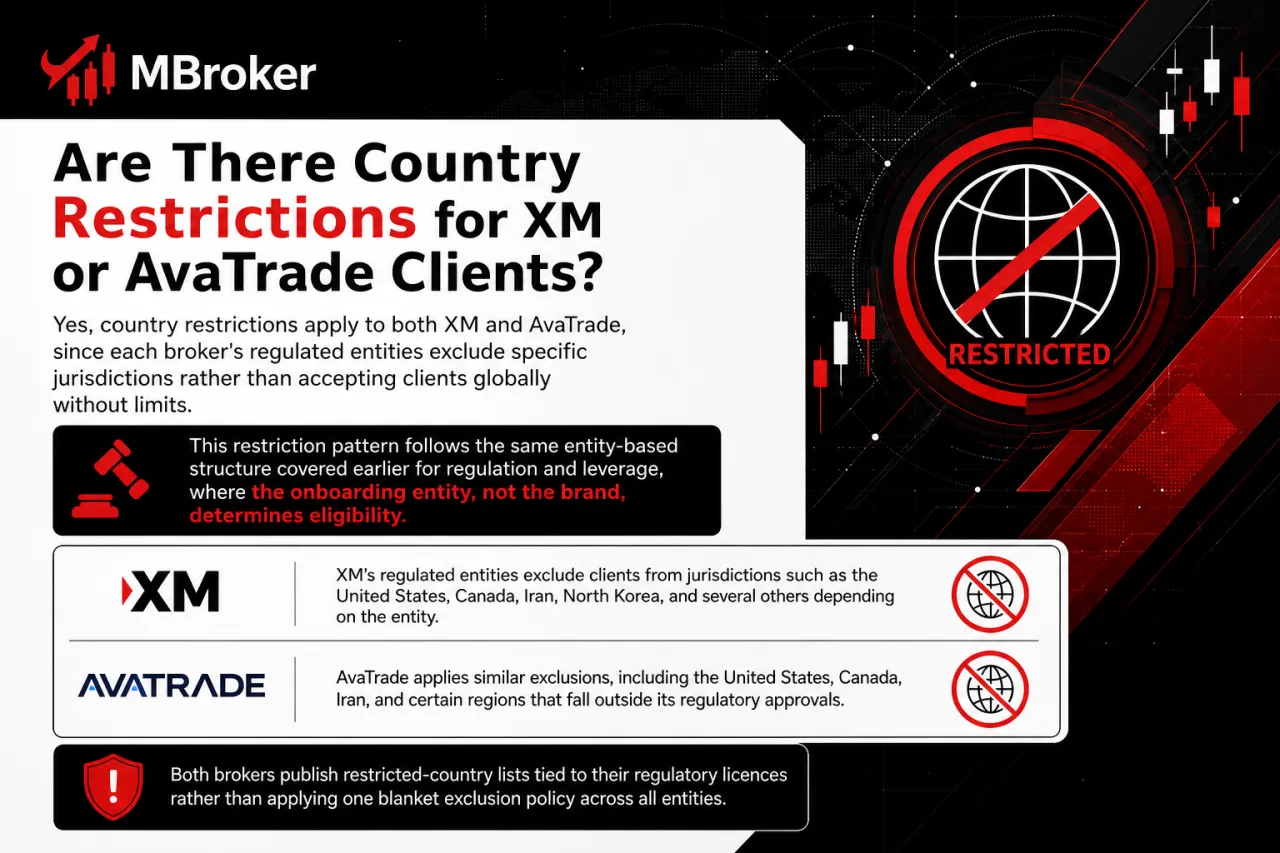
Yes, country restrictions apply to both XM and AvaTrade, since each broker’s regulated entities exclude specific jurisdictions rather than accepting clients globally without limits. This restriction pattern follows the same entity-based structure covered earlier for regulation and leverage, where the onboarding entity, not the brand, determines eligibility.
Both brokers publish restricted-country lists tied to their regulatory licences rather than applying one blanket exclusion policy across every entity.
- XMexcludes residents of certain jurisdictions from its various entities, including the United States, depending on which regional entity a prospective client would otherwise fall under.
- AvaTradeAvaTrade similarly excludes residents of certain jurisdictions from onboarding under its various regulated entities, including the United States, depending on which regional entity a prospective client would otherwise fall under.
Eligibility depends on the specific legal entity a client qualifies for based on country of residence, not on a single global policy applying to the entire brand. Traders confirm current restricted-country status directly through each broker’s official account registration page before attempting to open an account.
How Does Customer Support Compare Between XM and AvaTrade?
How Does Customer Support Compare Between XM and AvaTrade
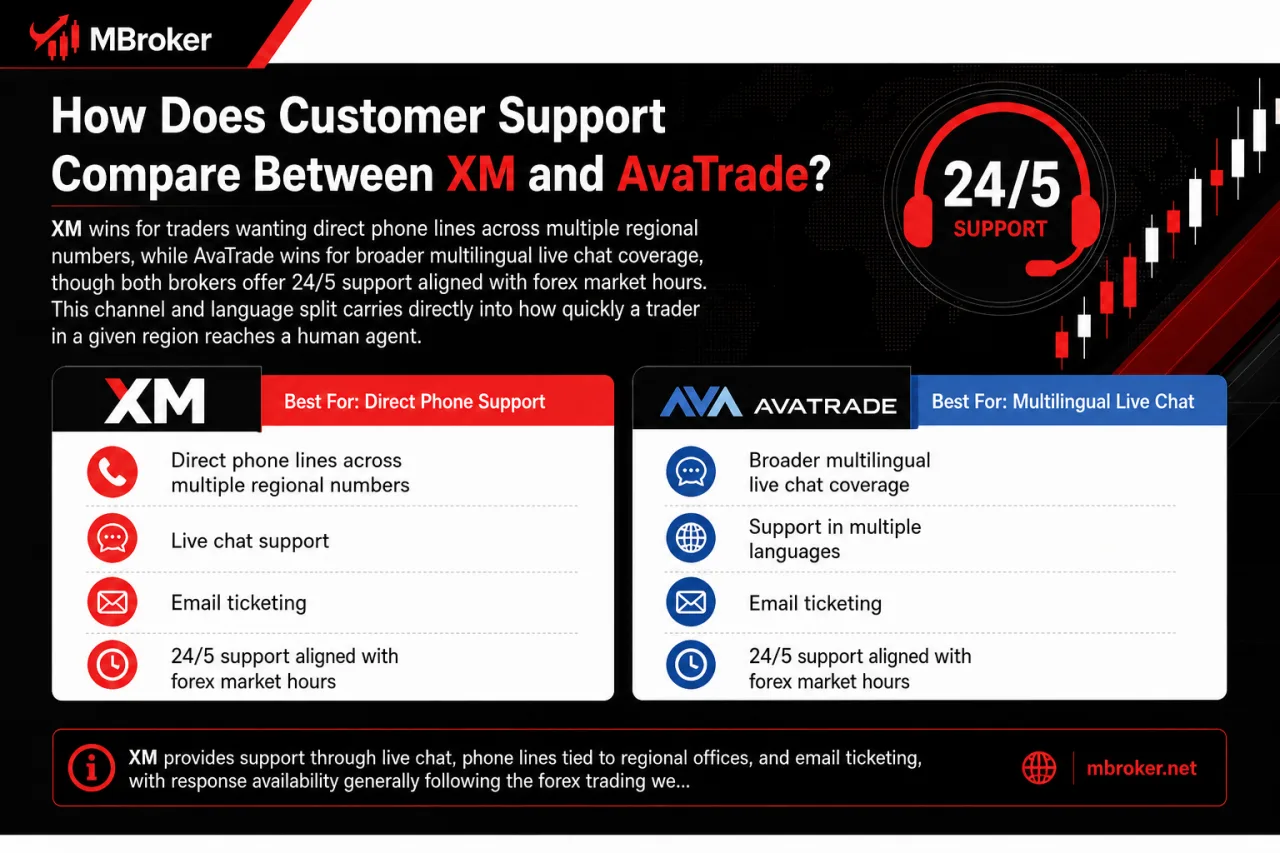
XM wins for traders wanting direct phone lines across multiple regional numbers, while AvaTrade wins for broader multilingual live chat coverage, though both brokers offer 24/5 support aligned with forex market hours. This channel and language split carries directly into how quickly a trader in a given region reaches a human agent.
XM provides support through live chat, phone lines tied to regional offices, and email ticketing, with response availability generally following the forex trading week rather than 24/7 coverage. AvaTrade offers a comparable mix of live chat, phone and email, with its support structure historically built around multiple regional offices serving different language groups.
Both brokers publish language availability tied to the region a client’s entity falls under, so an Ireland-based AvaTrade client and a Cyprus-based XM client may access different language options through the same channel. Neither broker’s official support pages confirm a single unified global hours-of-operation figure applicable to every entity.
Traders confirm current channel availability, language support and operating hours directly through their assigned entity’s official contact page rather than assuming identical service applies across every region.
XM vs AvaTrade: Which Broker Fits Your Trading Style?
XM vs AvaTrade: Which Broker Fits Your Trading Style
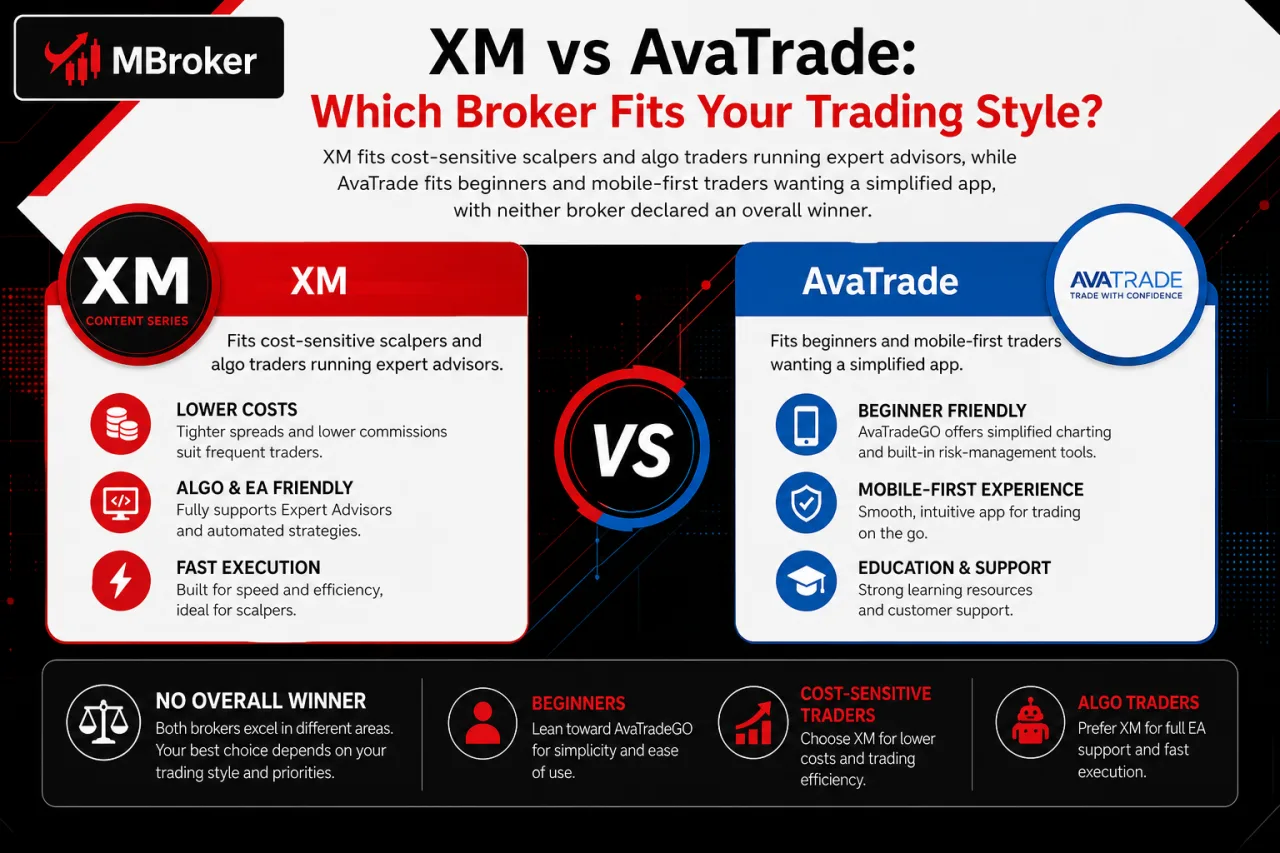
XM fits cost-sensitive scalpers and algo traders running expert advisors, while AvaTrade fits beginners and mobile-first traders wanting a simplified app, with neither broker declared an overall winner. This suitability breakdown pulls together the regulation, fee, platform and instrument comparisons covered above into a per-trader-type summary.
- Beginners lean toward AvaTradeGO for its simplified charting and integrated risk-management tools over a full MetaTrader terminal.
- Cost-sensitive traders weigh XM’s spread-only Standard and Micro accounts against AvaTrade’s fixed-and-floating spread mix before committing capital.
- High-leverage seekers compare XM Global Limited’s Belize entity against AvaTrade’s Middle East entity, since both permit ratios above the ESMA-capped EU tier.
- Platform-dependent traders running expert advisors find MT4/MT5 execution largely equivalent at either broker, while options traders lean toward AvaOptions.
Trader profile determines which broker’s conditions fit best, not a fixed ranking between the two. Confirm current spreads, leverage caps and account terms directly through each broker’s official entity page before opening an account.
What Unique Features and Educational Resources Do XM and AvaTrade Offer Beyond Standard Trading Conditions?
XM differentiates through loyalty rewards and educational webinars, while AvaTrade differentiates through AvaAcademy, AvaProtect and copy-trading integrations, though neither set of extras overrides the core regulation and fee comparisons covered above. These value-added services function as supplementary differentiators rather than primary decision factors, since account safety, spreads and leverage still carry more weight when choosing between the two brokers. The sections below separate XM’s loyalty and education tools from AvaTrade’s academy, protection product and copy-trading network individually.
What Educational and Research Tools Does Each Broker Provide?
XM runs a loyalty rewards program alongside a schedule of educational webinars, giving active traders point-based incentives and structured market learning beyond standard account conditions. This webinar schedule connects to XM’s broader educational push, since the sessions typically cover market analysis and platform tutorials for both new and experienced traders. Traders confirm current program terms and webinar calendars directly through XM’s official education page, since availability varies by region and onboarding entity.
AvaTrade offers AvaAcademy as its core educational resource, centered on video courses and market guides aimed at beginners building foundational trading knowledge. This structured learning path sits alongside AvaTrade’s other added services and gives newer traders a starting point before moving into live markets. Traders verify current course content and access details directly through AvaTrade’s official platform pages.
Does Either Broker Offer Copy Trading or Automated Trading Integrations?
AvaTrade layers two additional services on top of its educational offering: AvaProtect for downside coverage on select positions under its own cost and eligibility terms, and copy-trading integrations through third-party platforms, each governed by its respective current terms of use. AvaProtect functions as an optional add-on letting eligible clients offset losses on qualifying trades under specific conditions. DupliTrade and ZuluTrade extend AvaTrade’s account into automated copy-trading networks, letting clients mirror strategies from other traders rather than executing manually.
XM does not feature an equivalent copy-trading or loss-protection product within the scope covered here, keeping its added value concentrated on loyalty rewards and education instead. Traders verify current eligibility, costs and regional availability for each AvaTrade tool directly through AvaTrade’s official platform pages.
What Educational and Research Tools Does Each Broker Provide?
XM’s research and learning tools center on webinars and seminars, while AvaTrade’s center on AvaAcademy and structured trading guides, giving each broker a distinct educational format. This split separates live, session-based learning from self-paced course content, connecting directly back to the loyalty and academy tools introduced above.
XM’s offering runs through scheduled webinars covering market analysis and platform walkthroughs, supplemented by in-house research material for traders following price action across forex and CFD instruments. AvaTrade’s AvaAcademy instead packages video courses and written guides into a fixed curriculum, aimed at traders building foundational knowledge before committing capital.
- Webinars at XM run on a recurring schedule tied to market events and platform tutorials.
- Research articles at XM support traders monitoring specific instruments or broader market trends.
- Video courses at AvaTrade through AvaAcademy cover structured lessons from basic to advanced concepts.
- Trading guides at AvaTrade supplement AvaAcademy with written reference material for self-paced study.
Traders confirm current session calendars and course content directly through each broker’s official education page, since availability varies by region and onboarding entity.
Does Either Broker Offer Copy Trading or Automated Trading Integrations?
Yes, AvaTrade offers copy trading through third-party integrations, while XM does not publish a comparable native or partnered copy-trading platform on its official channels. This gap follows directly from the copy-trading tools already noted under AvaTrade’s added services above.
AvaTrade connects its accounts to DupliTrade and ZuluTrade, letting clients mirror other traders’ strategies automatically rather than placing orders manually. Both networks operate as third-party platforms layered on top of AvaTrade’s standard trading conditions, governed by their own separate terms of use.
XM’s official platform pages list MetaTrader 4, MetaTrader 5 and its mobile app, without referencing a dedicated social or copy-trading network. Automated execution at XM instead runs through MetaTrader expert advisors rather than a broker-hosted copy-trading marketplace.
Traders confirm current copy-trading availability, costs and eligibility directly through AvaTrade’s official platform pages, since third-party integrations carry their own separate terms.

Thoren Vextal is Mbroker’s XM Reviews and How-To Guides Editor, covering broker reviews, regulation, comparisons and practical account guides.Email: [email protected]