
 Tiếng Việt
XM and FXTM differ mainly in fee structure, regulatory footprint and account flexibility rather than one being universally superior. The right choice depends on a trader’s priorities around cost, safety and platform needs, which the comparison below breaks down criterion by criterion.
XM and FXTM structure their fees differently, with account types typically distinguished by whether spreads are set higher with no separate commission or kept tighter alongside a separate commission charge. This distinction changes the effective cost per trade depending on volume and strategy.
Both brokers hold multiple regulatory licenses across different jurisdictions, but the specific entity a client is onboarded to determines the actual level of client fund protection. Customer support responsiveness and channels also vary between regional entities of each broker.
XM’s account tiers cater more to beginners, with the Micro and Standard accounts requiring a minimum deposit of just $5, while FXTM’s ECN-style accounts are generally positioned toward higher-frequency, cost-sensitive traders who trade at larger volumes. Platform availability, including MT4 and MT5, is comparable across both brokers but leverage caps differ by region.
Mbroker breaks down these differences across trading conditions, regulation and cost structure below, starting with how XM and FXTM compare overall in the terms they offer traders.
XM vs FXTM: Which Broker Offers Better Trading Conditions Overall?
XM vs FXTM: Which Broker Offers Better Trading Conditions Overall
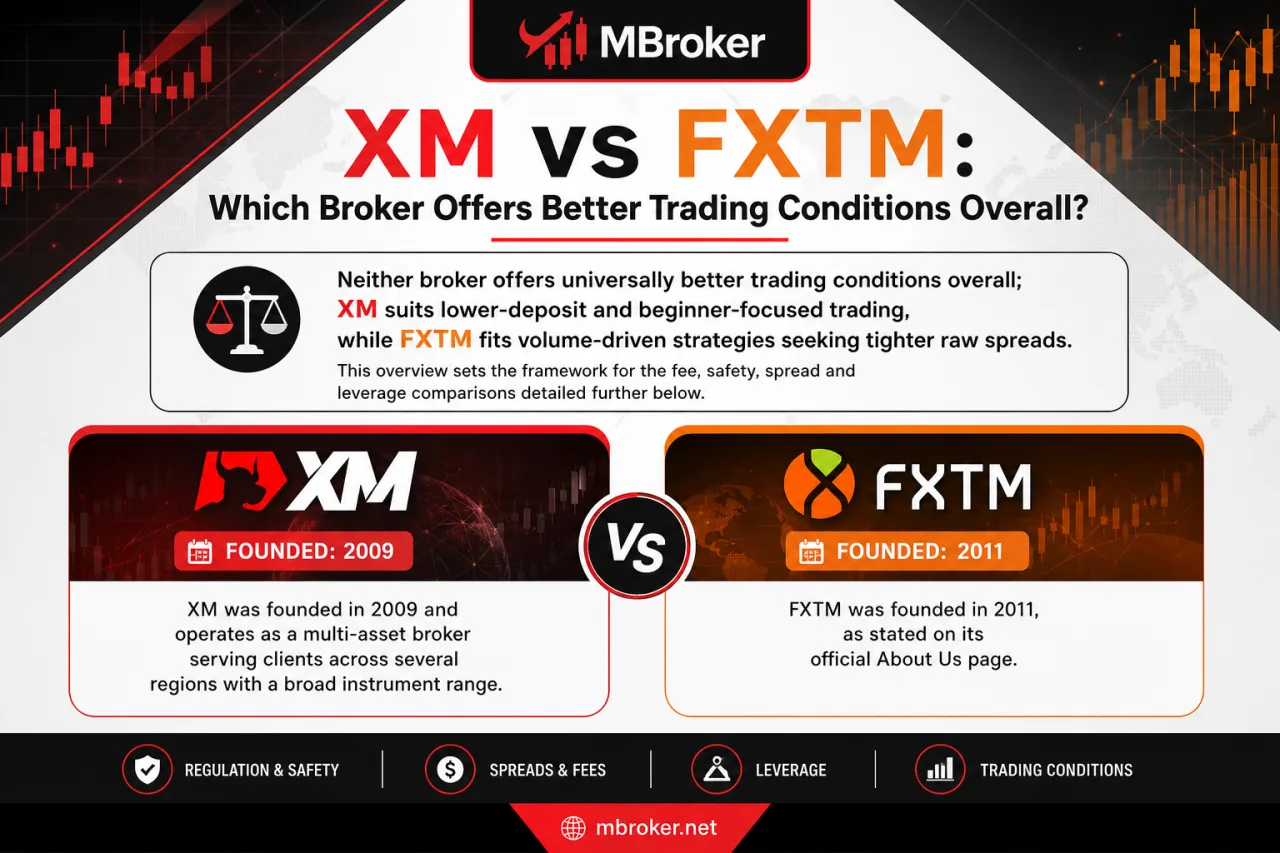
Neither broker offers universally better trading conditions overall; XM suits lower-deposit and beginner-focused trading, while FXTM fits volume-driven strategies seeking tighter raw spreads. This overview sets the framework for the fee, safety, spread and leverage comparisons detailed further below.
XM was founded in 2009 and operates as a multi-asset broker serving clients across several regions with a broad instrument range.
FXTM was founded in 2011, as stated on its official About Us page, and also positions itself as a globally accessible broker with a comparable spread of tradable markets.
The table below summarizes how the two brokers compare across core categories without declaring one an absolute winner:
| Category | XM | FXTM |
|---|---|---|
| Minimum deposit | Lower entry threshold | Higher on ECN-style accounts |
| Spread structure | Commission-free, wider spreads | Tighter spreads, separate commission |
| Regulation | Multiple regional entities | Multiple regional entities |
| Platforms | MT4, MT5 | MT4, MT5 |
| Leverage | Varies by region | Varies by region |
The suitable pick depends on individual trading volume, risk tolerance and whether commission-based or spread-based pricing better fits a trader’s cost expectations.
Is XM or FXTM Safer? How Do Their Regulation and Client Protection Compare?
Is XM or FXTM Safer? How Do Their Regulation and Client Protection Compare
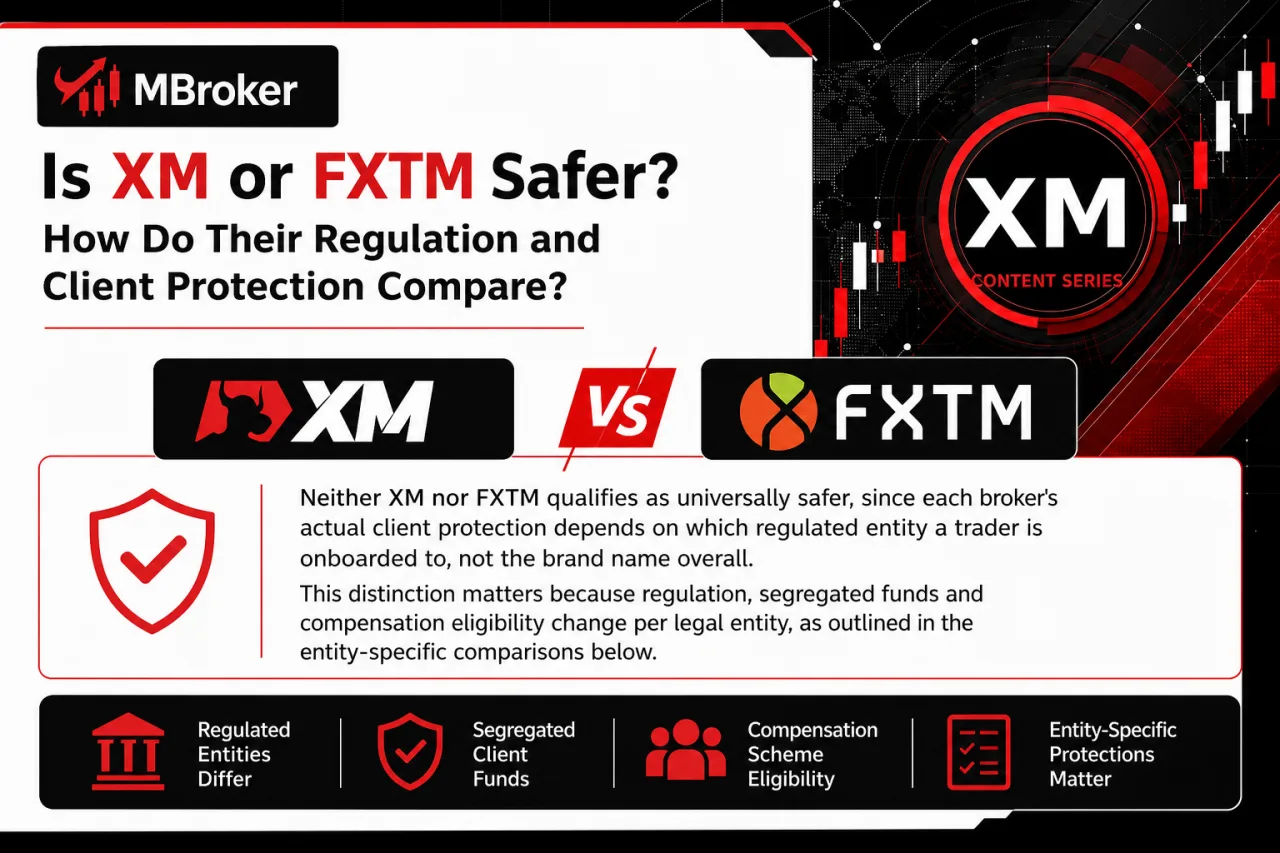
Neither XM nor FXTM qualifies as universally safer, since each broker’s actual client protection depends on which regulated entity a trader is onboarded to, not the brand name overall. This distinction matters because regulation, segregated funds and compensation eligibility change per legal entity, as outlined in the entity-specific comparisons below.
Which Legal Entities and Licenses Does Each Broker Use in Different Regions?
XM and FXTM each operate through several distinct legal entities, with the specific entity a client is assigned to determining which regulator, leverage cap and compensation scheme apply. This grouping breaks down which entity covers which region and what protection level follows from that assignment.
XM onboards clients through multiple legal entities, each tied to a separate regulator depending on the client’s country of residence.
FXTM operates through multiple legal entities, each assigned by region and regulatory oversight depending on the client’s country of residence.
- Regulator type determines whether segregated client funds apply.
- Leverage caps differ sharply between EU-regulated entities and offshore entities.
- Compensation scheme eligibility, where available, only applies to clients onboarded under specific regulated entities, so the level of protection depends on which entity a client is registered with.
Traders confirm their assigned entity directly through the account opening documents rather than assuming brand-wide protection applies uniformly.
Do XM and FXTM Offer Negative Balance Protection and Fund Segregation?
Yes, both XM and FXTM provide negative balance protection and segregated client accounts, though the exact terms depend on the specific regulated entity a trader is assigned to. This connects directly to the entity-based protection structure outlined above, since neither guarantee applies uniformly across every regional license.
Negative balance protection prevents a trading account from going below zero after extreme market moves, while fund segregation keeps client money separate from company operating funds.
- Negative balance protection applies broadly across XM’s regulated entities, though the specific reset mechanism varies by regulator.
- Fund segregation applies to both brokers, with client deposits held at separate banking institutions from corporate funds.
- Offshore entities of either broker carry these protections as company policy rather than as a regulator-enforced legal requirement, which changes the enforceability if a dispute arises.
For EU-regulated entities under both brands, negative balance protection is capped strictly at zero, reflecting a regulatory requirement rather than a discretionary broker policy.
Traders confirm both protections apply to their specific account by checking the terms published for their assigned entity rather than assuming brand-wide coverage.
XM vs FXTM: Which Broker Has Lower Spreads, Commissions and Fees?
XM vs FXTM: Which Broker Has Lower Spreads, Commissions and Fees
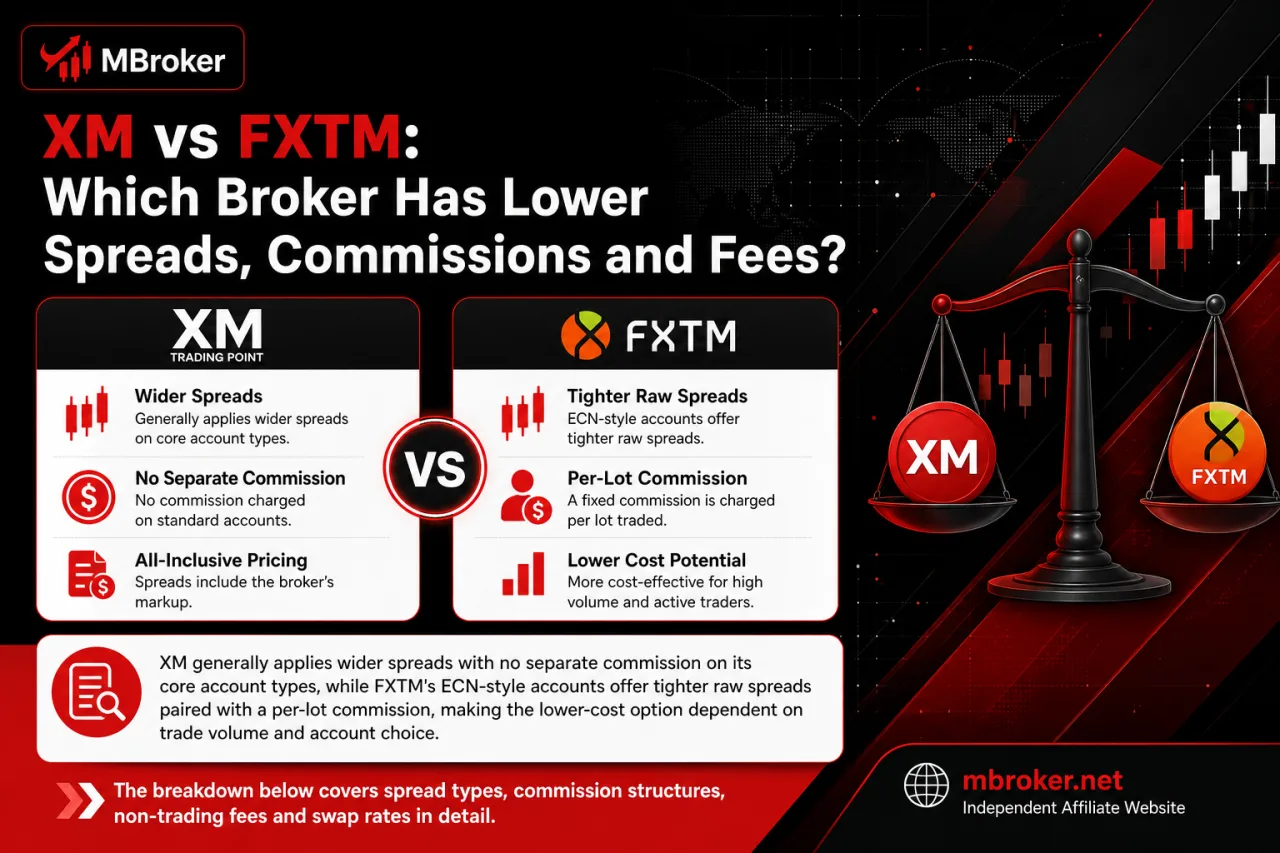
XM generally applies wider spreads with no separate commission on its core account types, while FXTM’s ECN-style accounts offer tighter raw spreads paired with a per-lot commission, making the lower-cost option dependent on trade volume and account choice. The breakdown below covers spread types, commission structures, non-trading fees and swap rates in detail.
What Are the Non-Trading Fees (Deposits, Withdrawals, Inactivity) for Each Broker?
Non-trading fees differ mainly in inactivity charges and withdrawal processing, with currency conversion costs applying to both brokers when the account currency differs from the payment method used. This section breaks down withdrawal fees, minimum withdrawal thresholds, inactivity policies and conversion charges for each broker below.
- Withdrawal processing: Both brokers state that they do not charge a fee directly on standard withdrawal methods, though intermediary banks or e-wallet providers may apply their own charges. XM and FXTM generally require withdrawal requests to route through the same method used for the original deposit, a common industry practice tied to anti-money-laundering compliance.
- Minimum withdrawal amounts: Minimum thresholds vary by payment method and by the regulated entity a client is registered under for both brokers.
- Inactivity fees: Both brokers apply an inactivity charge after an extended period without trading activity, though the exact fee amount and dormancy period depend on the specific entity and account type.
- Currency conversion: Both brokers convert funds when the account base currency does not match the deposit or withdrawal currency, applying a conversion margin at the time of transaction.
Traders confirm exact fee schedules directly through their account dashboard or entity-specific terms, since figures shift between regional legal entities of each broker.
Which Broker Provides Better Customer Support: XM or FXTM?
Which Broker Provides Better Customer Support: XM or FXTM
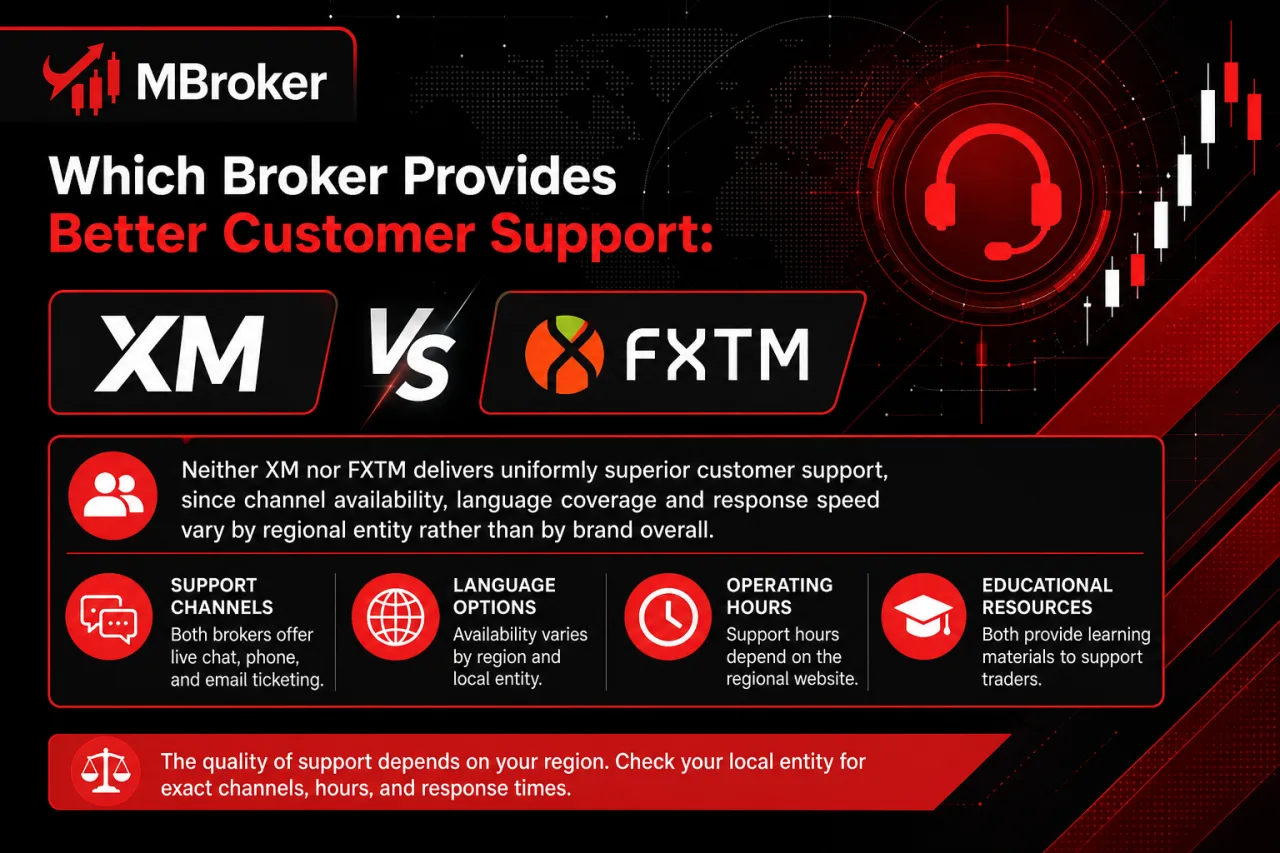
Neither XM nor FXTM delivers uniformly superior customer support, since channel availability, language coverage and response speed vary by regional entity rather than by brand overall. This section compares support channels, language options, operating hours and educational resources for both brokers below.
Support channels for both brokers typically include live chat, phone lines and email ticketing, though the specific contact numbers and chat availability differ per regional website.
- Live chat: Offered by both brokers as the fastest first-response channel for account and platform queries.
- Phone support: Provided through region-specific numbers, meaning the reachable line depends on which entity a client is registered under.
- Email support: Available for both brokers, generally used for account verification and documentation requests rather than urgent trading issues.
Language coverage differs by region for both brokers, with support typically offered in the primary languages of the markets each entity actively serves.
Educational resources, including webinars, market analysis and account tutorials, are published by both brokers, though the depth and update frequency vary between their regional platforms. Traders confirm exact support hours and available languages through the specific regional website tied to their account entity rather than assuming uniform coverage.
XM vs FXTM: How Do Account Types, Leverage and Platforms Compare for Different Traders?
XM vs FXTM: How Do Account Types, Leverage and Platforms Compare for Different Traders
Account tiers, leverage caps and platform choice differ enough between XM and FXTM that suitability depends on trader profile rather than one broker outperforming the other across every category. This overview sets up the detailed breakdown of account types, leverage limits and platforms covered in the sections below.
Both brokers segment their offerings toward distinct trader profiles, from beginners testing strategies with minimal capital to frequency-driven traders prioritizing tight raw spreads. Leverage availability also shifts depending on the regulated entity assigned to a client, which affects risk exposure independent of account tier. Platform access, including MT4 and MT5, remains a shared baseline across both brokers, so the differentiator sits more in account structure and leverage policy than in trading software itself. The subsections below detail how each broker’s account tiers, leverage caps, minimum deposits and platforms compare for different trader needs.
Which Account Types Does Each Broker Offer for Beginners vs High-Frequency Traders?
XM and FXTM group their account types into two broad profiles: beginner-friendly micro and standard accounts on one side, and low-spread ECN or Zero accounts built for scalpers and high-frequency traders on the other. This grouping connects directly to how leverage and platforms are structured further below.
XM’s Micro and Standard accounts target newer traders through smaller lot sizes and lower entry capital, while its Ultra Low or Zero-style tiers narrow spreads for cost-sensitive strategies. FXTM follows a similar split, pairing entry-level Standard accounts with ECN and Pro accounts that carry a per-lot commission in exchange for tighter raw spreads.
- Beginner-oriented accounts favor smaller minimum deposits and fractional lot sizes, reducing capital exposure while a trader builds strategy experience.
- High-frequency accounts favor tighter spreads paired with a fixed commission, benefiting traders who execute frequent, high-volume orders.
- Minimum deposit and minimum lot size requirements differ by account tier and by the regulated entity a client is onboarded to, rather than by brand alone.
Traders match their profile to the account tier by weighing trade frequency and volume against whether a commission-based or spread-based cost model fits their strategy better.
Do XM and FXTM Support the Same Trading Platforms and Instruments?
Yes, XM and FXTM support the same core platforms, MT4 and MT5 with matching mobile and desktop apps, though their instrument ranges differ slightly in depth per asset class. This platform and instrument overlap connects directly to the account and leverage comparisons above, since trading conditions layer on top of the same underlying software.
Both brokers skip a proprietary platform, relying entirely on MetaTrader for execution, charting and automated strategies.
- Platforms: MT4 and MT5 run on desktop, web browser and mobile apps for both brokers, with no native proprietary alternative offered by either.
- Instruments: Forex pairs, CFDs on commodities, indices and stocks, plus cryptocurrency CFDs, appear across both brokers’ offerings, though the exact number of tradable symbols per category varies by regulated entity and account type.
- Access: Mobile trading apps mirror desktop functionality for order execution, charting tools and account management on both brokers.
Traders confirm exact instrument counts and available symbols through the specific regional account portal tied to their assigned entity, since availability shifts by jurisdiction rather than by platform itself.
What Unique Loyalty Programs and Bonus Structures Do XM and FXTM Offer?
XM and FXTM each run distinct promotional structures, XM through a points-based Loyalty Program and FXTM through cashback or deposit-linked bonus offers, though eligibility for either depends on the client’s regulated entity. The subsections below cover how each program works and what restrictions apply.
These promotional perks sit apart from core safety and cost factors, functioning as supplementary incentives rather than indicators of broker reliability or trading cost efficiency.
Are XM and FXTM Bonuses Available to All Clients Worldwide?
No, XM and FXTM bonuses are not available to all clients worldwide, since regulated jurisdictions such as the EU, UK and Australia commonly restrict or prohibit such promotions under local financial rules. This restriction connects directly to the entity-based structure covered earlier, since eligibility depends on which legal entity onboards a given client rather than on the brand itself.
- Restriction: Regulators in markets like the EU, UK and Australia have introduced rules limiting certain deposit bonuses and loyalty incentives tied to trading volume, generally viewing them as encouraging excessive risk-taking.
- Availability: Offshore-regulated entities of both XM and FXTM typically retain the ability to offer these promotions, since fewer restrictions apply outside stricter regulatory zones.
- Verification: Clients confirm bonus eligibility through the terms published for their specific onboarded entity rather than assuming a promotion advertised globally applies to their account.
XM vs FXTM – Which Broker Should You Choose?
XM is generally the more suitable option for beginners and lower-capital traders who prefer accessible account types and straightforward spread-based pricing. FXTM may better suit active or high-volume traders seeking tighter raw spreads and commission-based accounts.
However, neither broker is universally better. Both support MT4 and MT5, while their fees, leverage, promotions and client protections vary by account type and regulated entity. Before choosing, traders should confirm the exact conditions applied in their country and select the broker whose pricing structure best matches their trading volume, strategy and risk tolerance.

Thoren Vextal is Mbroker’s XM Reviews and How-To Guides Editor, covering broker reviews, regulation, comparisons and practical account guides.Email: [email protected]