
 Tiếng Việt

XM CFDs work by allowing traders to speculate on price movements without owning assets, using leverage to control larger positions with smaller capital.
XM offers multiple CFD products, including stocks, indices, commodities, and share CFDs, enabling access to global financial markets in one platform.
Then, trading XM CFDs follows a simple step-by-step process from account setup to placing Buy/Sell orders on MT4/MT5, making it easy to get started.
Moreover, XM CFDs provide key benefits such as low costs, flexible leverage, and fast execution, which support both short-term and long-term trading strategies.
However, XM CFD trading also involves risks including leverage losses and market volatility, requiring proper risk management, especially for beginners.
Overall, XM CFDs combine accessibility, flexibility, and market diversity but require careful risk control. Explore more in the XM Products section to deepen your understanding.
What are CFDs on XM and how do they work?
XM CFDs are financial derivatives that allow you to trade the price difference of an asset between the time a contract is opened and closed. Instead of buying physical gold or actual shares of Apple, you enter into an agreement with XM to exchange the difference in the asset’s value. This mechanism enables you to profit from market volatility in both directions—Buying (Going Long) if you expect prices to rise, or Selling (Going Short) if you expect them to fall.
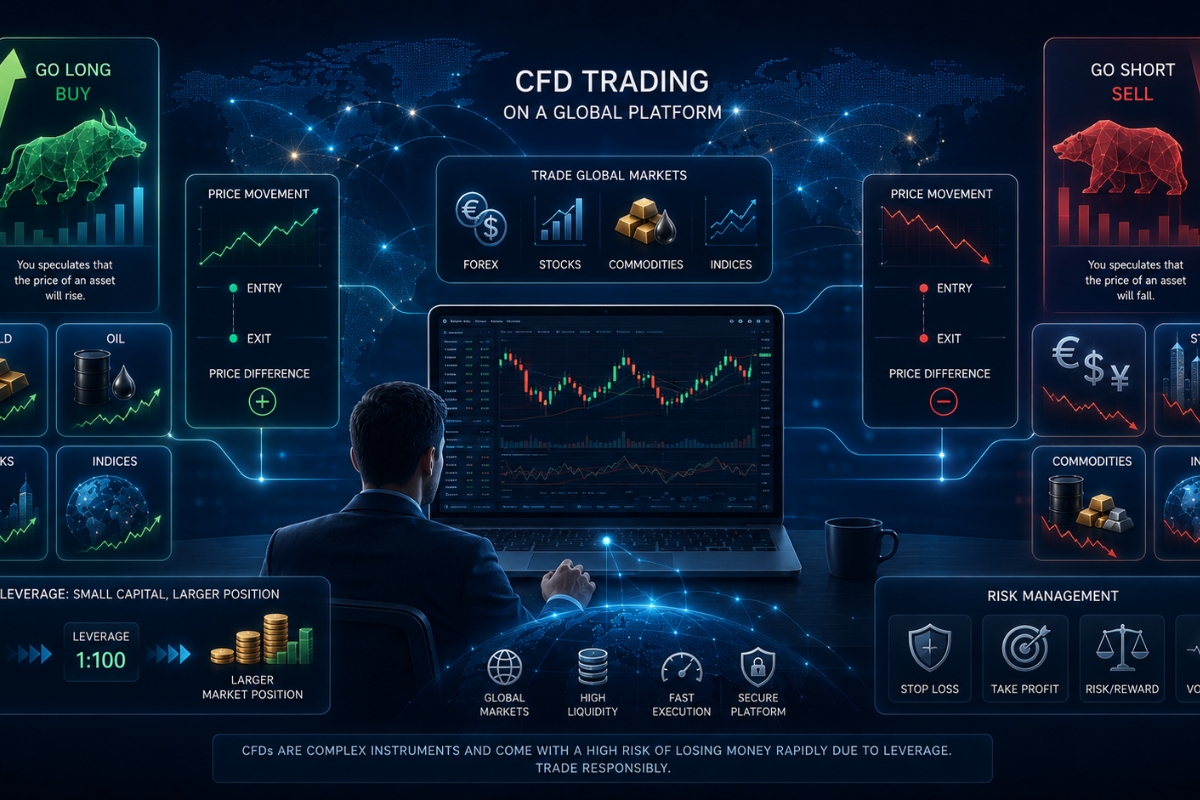
To fully grasp the potential of this trading model, it is essential to understand the technical components that drive CFD transactions.
What is XM CFD trading?
XM CFD trading is the process of using the broker’s platform to access various markets such as indices, commodities, and energies through a single account.
- Direct Market Access: You trade real-time prices sourced from top-tier liquidity providers.
- No Physical Delivery: You never have to worry about the logistics of owning a barrel of oil or a bar of gold.
- Cash Settlement: All profits or losses are settled in cash directly into your XM account balance.
While the ability to trade both ways is a major draw, the primary engine behind CFD popularity is the use of borrowed capital, known as leverage.
How does leverage work in XM CFDs?
Leverage in XM CFDs acts as a force multiplier, allowing you to control a large market position with a relatively small initial deposit (margin).
- Capital Efficiency: With a leverage of 100:1, you can control a $10,000 position with only $100 of your own capital.
- Margin Requirements: XM offers flexible margin tiers, meaning the more equity you have, the more the broker helps manage your exposure.
- Magnified Outcomes: It is vital to remember that while leverage can significantly increase profits, it also increases the risk of losses.
Understanding these core mechanics is the first step; next, we must look at the specific asset classes where you can apply these strategies, particularly in the stock market.
XM stock CFDs and share CFDs available
XM stock CFDs and share CFDs represent one of the most diverse segments of the broker’s portfolio, offering access to hundreds of the world’s leading corporations. These products allow traders to engage with the equity markets of the US, UK, Germany, and beyond with lower capital requirements than traditional stock broking. Whether you are looking to trade high-growth tech giants or stable dividend-paying companies, XM provides the infrastructure to do so through two distinct CFD models.
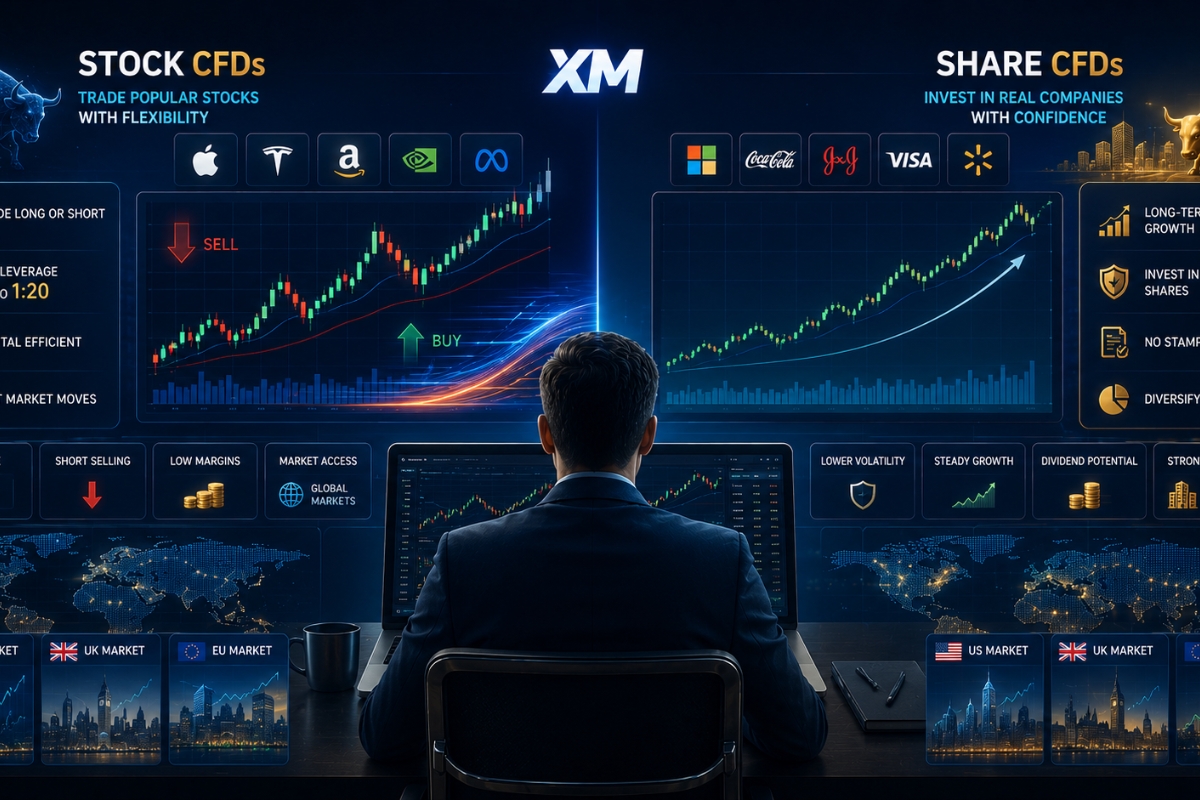
Let’s differentiate between these two popular equity trading options to see which fits your investment style.
What are XM stock CFDs?
Stock CFDs at XM are derivative products where you trade the price movement of a company’s stock with the benefit of leverage.
- Leveraged Trading: Most stock CFDs allow for 20:1 leverage, meaning you only need 5% of the total trade value.
- Short Selling: Unlike traditional stock buying, you can easily profit if a company’s stock price drops.
- Dividends: Even though you don’t own the stock, XM typically adjusts your account for dividend payments if you hold a “Long” position.
What are XM share CFDs?
While often used interchangeably, share CFDs at XM typically refer to the “Shares Account” or specific spot share instruments that focus on the underlying value without the same CFD complexities.
- 1:1 Exposure: In some specific account types, XM offers trading with no leverage, focusing on long-term ownership feel.
- Direct Ownership Feel: These are designed for investors who want the stability of the stock market but within the XM technological ecosystem.
- Lower Risk: Without high leverage, these products are less susceptible to sudden market gaps.
Once you have selected your preferred asset class, the next phase is executing your first trade through a structured, step-by-step approach.
How to trade CFDs on XM step by step?
Trading CFDs on XM is a streamlined process that begins with setting up a professional profile and ends with the strategic management of your open positions. To trade effectively, a user must move through a sequence of six critical steps, ranging from administrative setup to technical market execution. XM facilitates this by providing a unified “Member Area” where all tools and platforms are easily accessible from a single dashboard.

Follow this detailed guide to ensure your trading journey starts on the right foot.
Step-by-step XM CFD trading process
Success in the markets requires a disciplined entry. Here is the exact path to placing your first CFD trade:
- Step 1: Open and verify an XM account: Visit the official XM website and register. You must upload your ID and proof of residency to verify your account—a process usually completed in under 24 hours.
- Step 2: Download and log in to MT4/MT5: Choose your platform. MT5 is generally recommended for CFDs as it supports a wider range of stock and index instruments.
- Step 3: Choose a CFD asset: Use the “Market Watch” window to find your desired instrument (e.g., US30 for the Dow Jones or AAPL for Apple).
- Step 4: Analyze the market: Use technical indicators or check the MBroker homepage for the latest market insights and news to determine your entry point.
- Step 5: Place a Buy or Sell order: Right-click the asset and select “New Order.” Choose “Buy” if you are bullish or “Sell” if you are bearish.
- Step 6: Set stop loss and take profit: Always define your exit points. A Stop Loss protects you from excessive loss, while a Take Profit locks in your gains automatically.
Placing the trade is only half the battle; the other half involves active supervision using the broker’s advanced platform features.
How to manage trades on XM platforms?
Effective trade management involves monitoring your “Equity,” “Margin,” and “Unrealized P/L” in real-time through the Trade Terminal.
- Trailing Stops: You can set a stop loss that moves automatically as the price moves in your favor.
- Partial Closing: XM allows you to close a portion of your position to bank some profit while letting the rest run.
- Mobile Alerts: Use the XM mobile app to receive notifications when your price targets are hit, ensuring you are never away from the market.
Before diving into live trading, every investor must weigh the potential rewards against the inherent dangers of the CFD market.
Benefits and risks of XM CFDs trading
XM CFDs trading offers a unique balance of high-reward potential and significant market risk that every trader must navigate with caution. The primary appeal lies in the ability to access global markets with small capital outlays, but this same advantage can lead to rapid losses if the market moves against your position. According to industry statistics, while many traders find success through disciplined strategies, a significant percentage of retail investors lose money in CFDs due to a lack of risk management.

To trade with a clear head, you must understand both the “Pro” and “Con” sides of the XM experience.
Key benefits of trading CFDs on XM
XM provides several institutional-grade advantages that make CFD trading more accessible and cost-effective:
- Zero Re-quotes: You get the price you click on, with no frustrating rejected orders.
- Ultra-Low Spreads: On accounts like the XM Ultra Low, spreads can be as low as 0.6 pips for major pairs and indices.
- Multi-Asset Platform: Trade Gold, Oil, Stocks, and Forex all from one account, simplifying your portfolio management.
- Education: XM provides free daily webinars and research to help you improve your win rate.
Risks of XM CFD trading
Despite the benefits, the nature of derivative trading carries specific risks that cannot be ignored:
- Leverage Risk: High leverage can deplete your account balance quickly during high-volatility events like NFP or interest rate decisions.
- Market Volatility: Prices can “gap” over your stop loss during weekend breaks or major news, leading to slippage.
- Overtrading: The ease of opening trades can lead beginners to take too many positions, stretching their margin too thin.
To further clarify these points, we have compiled the most frequent inquiries from our global community of traders.
In conclusion, XM CFDs offer a powerful and flexible way to participate in the global financial markets. By understanding the mechanics of leverage, choosing the right stock or share products, and following a disciplined trading process, you can effectively manage the risks involved.
For those looking to stay up to date on the latest CFD strategies or detailed broker comparisons, be sure to visit MBroker for professional guidance and market-leading insights. Your success in CFD trading starts with a reliable partner and a commitment to continuous learning.

Sylas Trenven is a forex strategist who helps traders master risk and timing. His work focuses on behavior-driven market entries and portfolio optimization for XM users looking to trade with precision and discipline. Email: [email protected]