
 Tiếng Việt
XM Markets
XM is an online broker offering access to global financial markets, as described on its official website, including forex, stock CFDs, indices, commodities, and metals through its trading platforms. This guide breaks down what XM offers and how each instrument category works for traders.
XM operates under multiple regulated entities, with regulators such as ASIC (Australia), CySEC (Cyprus), the FSCA (South Africa), the DFSA (Dubai), and the FSC (Belize), as noted in the Privacy Policy on XM’s official website, licensing different XM entities depending on the client’s region. Regulatory status varies by entity, so verifying which XM entity applies to a specific country is essential before trading.
Traders access XM markets through web-based platforms, desktop terminals, and the XM 360 mobile app, after completing an account registration and verification process that, according to XM’s official Help Center, includes signing up, verifying a phone number, and submitting the required identification documents to complete the profile. Account opening typically requires identity documents and a funding step before live trading begins.
Each instrument category carries its own contract specifications, margin requirements, and market hours, and understanding these differences matters before placing any trade.
Mbroker, an independent information resource on XM, compiles these details to help traders understand the platform before committing funds. The following sections explain what XM is and what trading markets it offers, starting with its core product lineup.
What Is XM and What Trading Markets Does It Offer?
What Is XM and What Trading Markets Does It Offer
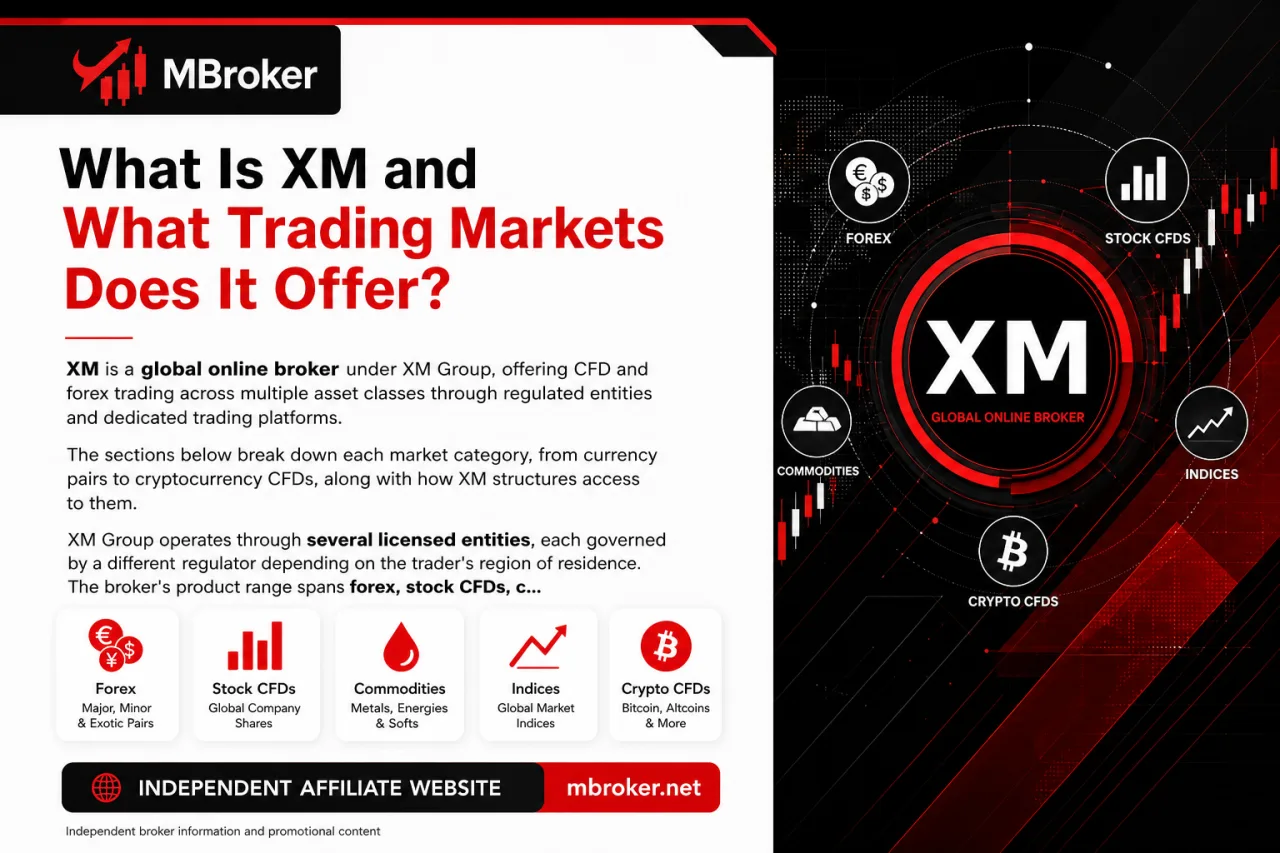
XM is a global online broker under XM Group, offering CFD and forex trading across multiple asset classes through regulated entities and dedicated trading platforms. The sections below break down each market category, from currency pairs to cryptocurrency CFDs, along with how XM structures access to them.
XM Group operates through several licensed entities, each governed by a different regulator depending on the trader’s region of residence. The broker’s product range spans forex, stock CFDs, cash and futures indices, commodities, precious metals, energies, and cryptocurrency CFDs where locally permitted.
Each asset class carries distinct contract specifications, margin requirements, and trading hours that vary by instrument and by XM entity. The following subsections outline these categories individually, covering symbols, underlying markets, and account compatibility.
This overview is informational only and does not constitute financial advice. Traders should verify current product availability and contract terms with the applicable XM entity before opening any position.
Which XM Legal Entities and Regulators Oversee These Markets?
XM markets fall under the oversight of several licensed entities within XM Group, including Trading Point of Financial Instruments Ltd, XM Global Limited, and other regional affiliates. This grouping determines which regulator applies and what instruments a trader can access.
Each entity operates under a distinct regulatory license tied to its jurisdiction:
- Trading Point of Financial Instruments Ltd holds a CySEC license, covering clients in Cyprus and broader EU regions.
- Trading Point of Financial Instruments UK Limited falls under FCA oversight for UK-based traders.
- XM Global Limited operates under an FSC (Belize) license, typically serving international clients outside stricter regulatory zones.
- Trading Point of Financial Instruments Pty Ltd holds an ASIC license for clients in Australia.
- XM entities registered under FSCA (South Africa) and DFSA (Dubai) serve clients within those specific regions.
XM operates under multiple regulated entities, with regulators such as ASIC (Australia), CySEC (Cyprus), the FSCA (South Africa), the DFSA (Dubai), and the FSC (Belize), as noted in the Privacy Policy on XM’s official website, licensing different XM entities depending on the client’s region, though traders should verify each entity’s specific license number directly on the regulator’s official register.
Instrument availability, leverage limits, and account types differ by entity, since each regulator imposes its own compliance rules. A trader registered under one XM entity may not access the same product range or leverage cap as a trader under another.
This information reflects XM’s entity structure as reviewed in 2025. Traders should verify their assigned entity and applicable regulator directly through XM’s account portal or official legal documents before trading, since entity assignment depends on the trader’s country of residence.
Is XM a Legitimate and Regulated Broker?
Is XM a Legitimate and Regulated Broker
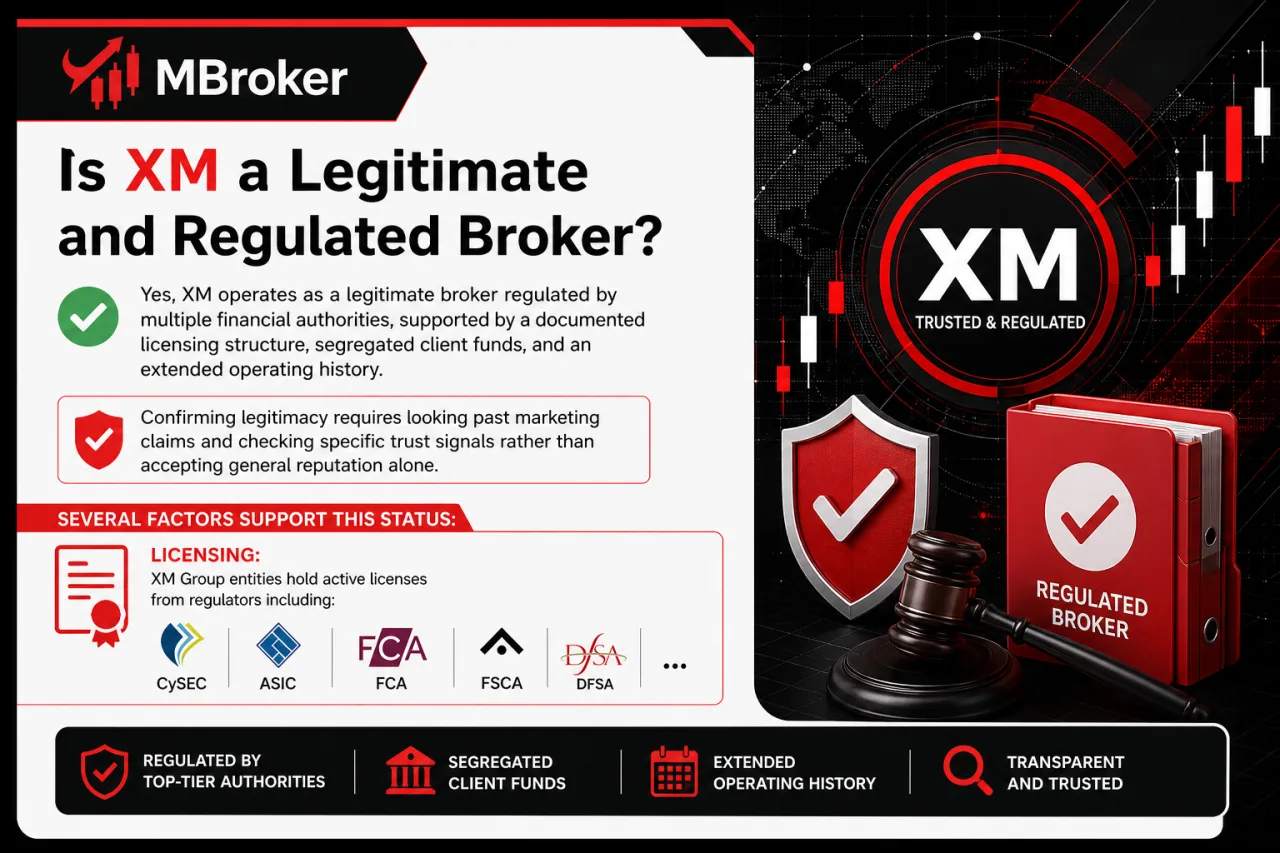
Yes, XM operates as a legitimate broker regulated by multiple financial authorities, supported by a documented licensing structure, segregated client funds, and an extended operating history. Confirming legitimacy requires looking past marketing claims and checking specific trust signals rather than accepting general reputation alone.
Several factors support this status:
- Licensing: XM Group entities hold active licenses from regulators including CySEC, ASIC, the FCA, the FSCA, the DFSA, and the FSC (Belize), as outlined earlier in this guide.
- Fund segregation: XM states that client funds are held in segregated bank accounts separate from company operating capital, which is a standard regulatory requirement for licensed brokers.
- Operating history: According to XM’s official Help Center, XM has an extended operating history in the online trading industry, which contributes to its market presence and public track record.
- Transparency: XM publishes legal documents, entity disclosures, and regulatory registration details on its official website for public verification.
These indicators point to a regulated broker rather than an unregulated operation, though the specific regulator, protections, and compensation schemes applicable differ by XM entity and client jurisdiction. Traders should verify their assigned entity’s license number directly on the relevant regulator’s public register before opening an account, since regulatory oversight and legal recourse depend entirely on which XM entity they are registered under.
How Do You Access XM Trading Platforms and Open an Account?
How Do You Access XM Trading Platforms and Open an Account
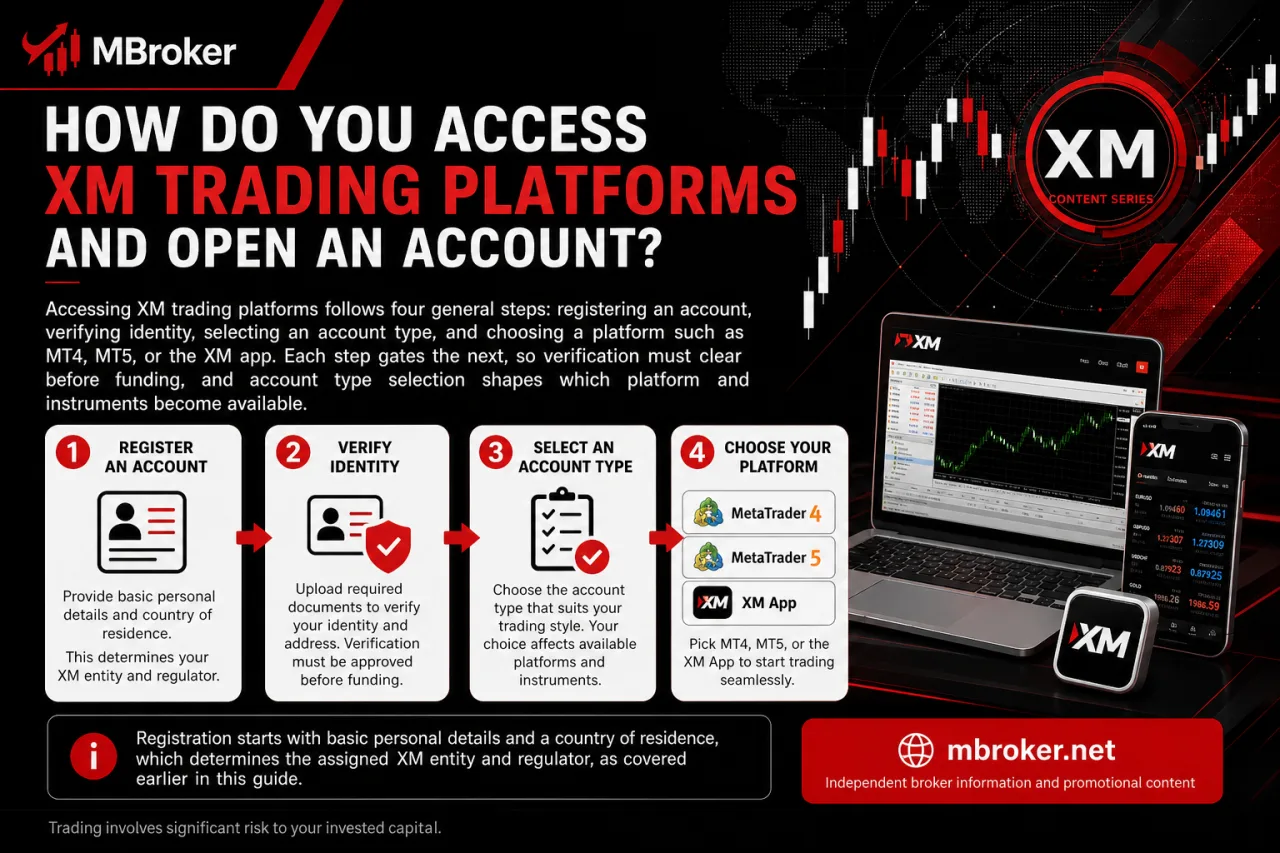
Accessing XM trading platforms follows four general steps: registering an account, verifying identity, selecting an account type, and choosing a platform such as MT4, MT5, or the XM app. Each step gates the next, so verification must clear before funding, and account type selection shapes which platform and instruments become available.
Registration starts with basic personal details and a country of residence, which determines the assigned XM entity and regulator, as covered earlier in this guide. Verification then requires submitting identification documents through the account portal, a process already outlined in the introduction to this guide.
Account type selection follows verification, since XM offers different account categories with varying spreads, minimum deposits, and instrument access, a topic covered in depth under XM Fees and XM Account content. Platform choice comes last: MT4 and MT5 suit desktop and mobile trading with full charting tools, while the XM app or XM 360 offers a simplified mobile interface for monitoring and executing trades.
Installation steps, platform navigation, and technical setup fall outside this guide’s scope and are detailed separately under XM Platform content. Traders should confirm current registration requirements and platform availability for their country directly through XM’s official account portal before proceeding.
Which Platforms and Account Types Are Compatible With Each Market?
MT5 supports the widest instrument range across forex, stock CFDs, indices, commodities, metals, and cryptocurrency CFDs, while MT4 covers forex, commodities, metals, and indices without stock CFDs, and the XM app mirrors account access for monitoring and trade execution on the go. Comparing these three options against each instrument group clarifies which platform fits a given trading focus.
MT4 remains the standard choice for forex, energies, and metals trading, but it does not list stock CFDs, which XM restricts to MT5 accounts. MT5 extends coverage to stock CFDs alongside the full range available on MT4, making it the broader option for traders wanting exposure to shares, indices, and crypto CFDs where locally permitted. The XM app and XM 360 connect to the same underlying account, syncing whichever instruments the linked MT4 or MT5 account already supports rather than adding separate access.
Account type also shapes availability, since certain XM account categories restrict specific instrument groups or apply different margin terms per asset class. Traders confirm which platform and account combination unlocks a given instrument for their region directly through the XM client portal before trading. MT4, MT5, and the XM app differ in available trading tools and features; traders compare each platform’s toolset before choosing one.
What Instruments and Asset Classes Can You Trade Through XM?
What Instruments and Asset Classes Can You Trade Through XM
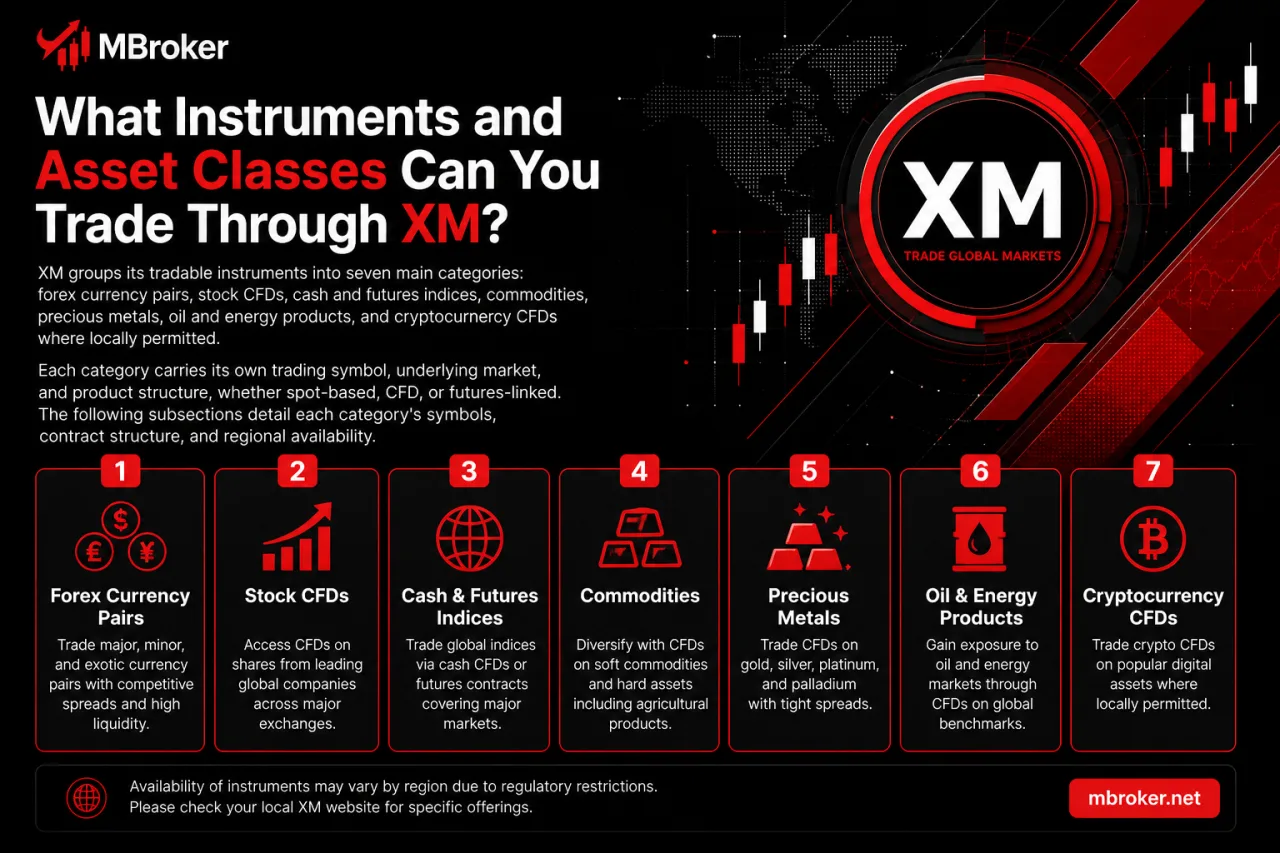
XM groups its tradable instruments into seven main categories: forex currency pairs, stock CFDs, cash and futures indices, commodities, precious metals, oil and energy products, and cryptocurrency CFDs where locally permitted. Each category carries its own trading symbol, underlying market, and product structure, whether spot-based, CFD, or futures-linked. The following subsections detail each category’s symbols, contract structure, and regional availability.
What Are the Key Contract Specifications for These Instruments?
XM’s contract specifications share a common set of fields across every instrument group: symbol, base/quote currency, contract size, minimum-maximum volume, volume increment, tick size/value, leverage/margin, and long-short availability. This structure repeats across forex, stock CFDs, indices, commodities, metals, energies, and cryptocurrency CFDs, though the actual values differ by symbol and by XM entity.
The table below summarizes what each field represents rather than listing exact figures, since precise values vary per instrument and change periodically.
| Specification | What It Defines |
|---|---|
| XM Symbol | The ticker code used to identify the instrument on MT4/MT5 |
| Base/Quote Currency | The currency pair used to price and settle the instrument |
| Contract/Lot Size | The standardized unit size representing one full lot |
| Min-Max Volume | The smallest and largest position size allowed per trade |
| Volume Increment | The smallest step by which volume can be adjusted |
| Tick Size/Value | The minimum price movement and its monetary value per lot |
| Leverage/Margin | The margin percentage or ratio required to open a position |
| Long/Short Availability | Whether buy and sell positions are both permitted |
Traders should verify exact figures for each symbol directly on XM’s official contract specification pages, since values differ per instrument, account type, and legal entity. This overview reflects XM’s general specification structure, accurate as of the 2025 review date, and does not substitute for checking current terms before trading.
Are You Buying the Underlying Asset or Trading a CFD on XM?
No, traders on XM do not buy the underlying asset; they trade CFDs or derivative contracts that track the price movement of stocks, indices, commodities, or cryptocurrencies without granting ownership. This distinction matters because it clarifies what a position on XM actually represents.
A CFD, or contract for difference, settles the price difference between opening and closing a trade rather than transferring any physical share, barrel of oil, or coin. This applies across most of XM’s product range:
- Stock CFDs track a company’s share price without conferring shareholder rights such as dividends or voting.
- Commodity and metal CFDs mirror spot or futures prices without physical delivery.
- Index CFDs replicate a basket of stocks without holding any component security.
- Cryptocurrency CFDs follow coin price movements without wallet custody or blockchain ownership.
Some indices trade as cash products with no expiry, while others follow a futures-based structure carrying set expiration and rollover dates, a distinction covered further in the indices section below. Traders should verify each instrument’s product structure directly on XM’s official contract specification pages before opening a position.
When Are Trading Sessions, Market Hours, and Holidays for Each Market?
Trading sessions on XM split into three structures: forex runs on a continuous five-day schedule, indices and commodities follow their linked exchange hours, and cryptocurrency CFDs trade with extended availability where offered. This section walks through how each market’s hours are set and why holiday schedules shift periodically.
Forex pairs on XM trade nearly around the clock across five days, since currency markets overlap between major financial centers worldwide. Indices and commodities, by contrast, inherit their trading windows from the underlying exchange or futures market each contract tracks, meaning hours differ by symbol rather than following one universal schedule. Cryptocurrency CFDs, where locally permitted, tend to offer broader availability than exchange-linked instruments, though this varies by XM entity.
Holiday closures and session adjustments apply across all categories and change periodically as exchanges update their calendars. Futures-based products carry additional rollover and expiration dates tied to their underlying contracts, distinct from cash-based indices that have no expiry.
Traders should verify current trading hours, holiday schedules, and rollover dates directly on the broker’s official trading hours page before placing any trade.
What Regional or Entity-Specific Restrictions Apply to XM Instruments?
Regional and entity-specific restrictions on XM instruments center on two factors: which XM entity holds a trader’s account, and whether that trader is classified as retail or professional. EU-regulated entities apply tighter leverage caps and narrower product access compared to offshore entities, while client classification further adjusts margin requirements and available instruments. The subsections below break down each factor separately.
What Material Risks Are Specific to Leveraged and CFD-Based Instruments on XM?
Leveraged and CFD-based instruments on XM carry structure-specific risks beyond general market volatility, including gap risk in cash indices, rollover cost exposure in futures-linked CFDs, and amplified volatility in cryptocurrency CFDs. This section walks through these instrument-specific risk nuances rather than repeating the general leverage warnings already covered above.
These structure-specific risks break down into three distinct categories:
- Gap risk in cash indices: Cash indices can gap over weekends or during low-liquidity periods, meaning a position may open at a materially different price than where it closed, bypassing intermediate price levels a stop order would normally catch.
- Rollover cost exposure in futures-linked CFDs: Futures-based CFDs carry rollover costs tied to contract expiration, so holding a position across a rollover date adds or subtracts value unrelated to the underlying market direction.
- Amplified volatility in cryptocurrency CFDs: Cryptocurrency CFDs, where offered, tend to experience sharper and faster price swings than traditional forex or index instruments, magnifying both potential gains and potential losses under leverage.
This list is not exhaustive, and other instrument categories carry their own distinct risk factors not detailed here. Traders should review XM’s official risk disclosure documents and product-specific risk warnings before opening any leveraged position.
Conclusion: What Markets Can You Trade With XM?
XM provides access to forex, stock CFDs, indices, commodities, precious metals, energies and cryptocurrency CFDs where permitted. Most products are derivatives, meaning traders speculate on price movements without owning the underlying assets. Available instruments, platforms, leverage and contract terms depend on the client’s country, account type and assigned XM legal entity.
Before trading, confirm the current product availability, contract specifications, market hours and applicable costs through official XM resources. Because leveraged CFDs can result in rapid losses, each instrument’s structure and risks should be understood before committing real funds.
XM Forex: Currency Pairs, Trading Conditions, Costs and Risks
Discover how XM Forex trading works: currency pair types, spreads, leverage, margin, pip value and...
XM Commodities Trading: Guide to Instruments & Conditions
Explore XM commodities trading: available instruments, trading hours, leverage and platform conditions before you open...
How to Trade Oil on XM: Symbols, Hours & Setup Guide
Discover how xm oil trading works: symbols, contract specs, trading hours and account setup explained...
XM Energies Explained: Oil & Gas CFD Trading Guide
Discover how XM Energies work: available oil & gas CFD instruments, symbols, leverage and trading...
- 1
- 2