
 Tiếng Việt

XM allows clients to trade cryptocurrencies exclusively through CFDs on the MT4, MT5 and XM App platforms, without holding the underlying coin. Positions open and close in the same way as other CFD instruments, using the account’s base currency for margin and settlement.
XM offers CFDs on major cryptocurrencies, including Bitcoin, Ethereum and Ripple. The exact list of tradable crypto pairs depends on the client’s account type and applicable XM legal entity.
XM crypto CFD trading conditions, including leverage, margin and available trading hours, tend to differ from forex, indices or commodity CFDs offered on the same platform. These differences reflect the higher volatility typically associated with digital assets.
XM crypto trading is structured entirely as a CFD product, meaning clients speculate on price movement without ever owning or transferring the actual digital asset. This distinction affects custody, wallet requirements and how positions are opened, closed or rolled over compared to buying coins directly on a crypto exchange.
Mbroker breaks down how each of these mechanics works in practice, starting with how you trade cryptocurrencies through XM step by step.
How Do You Trade Cryptocurrencies Through XM?
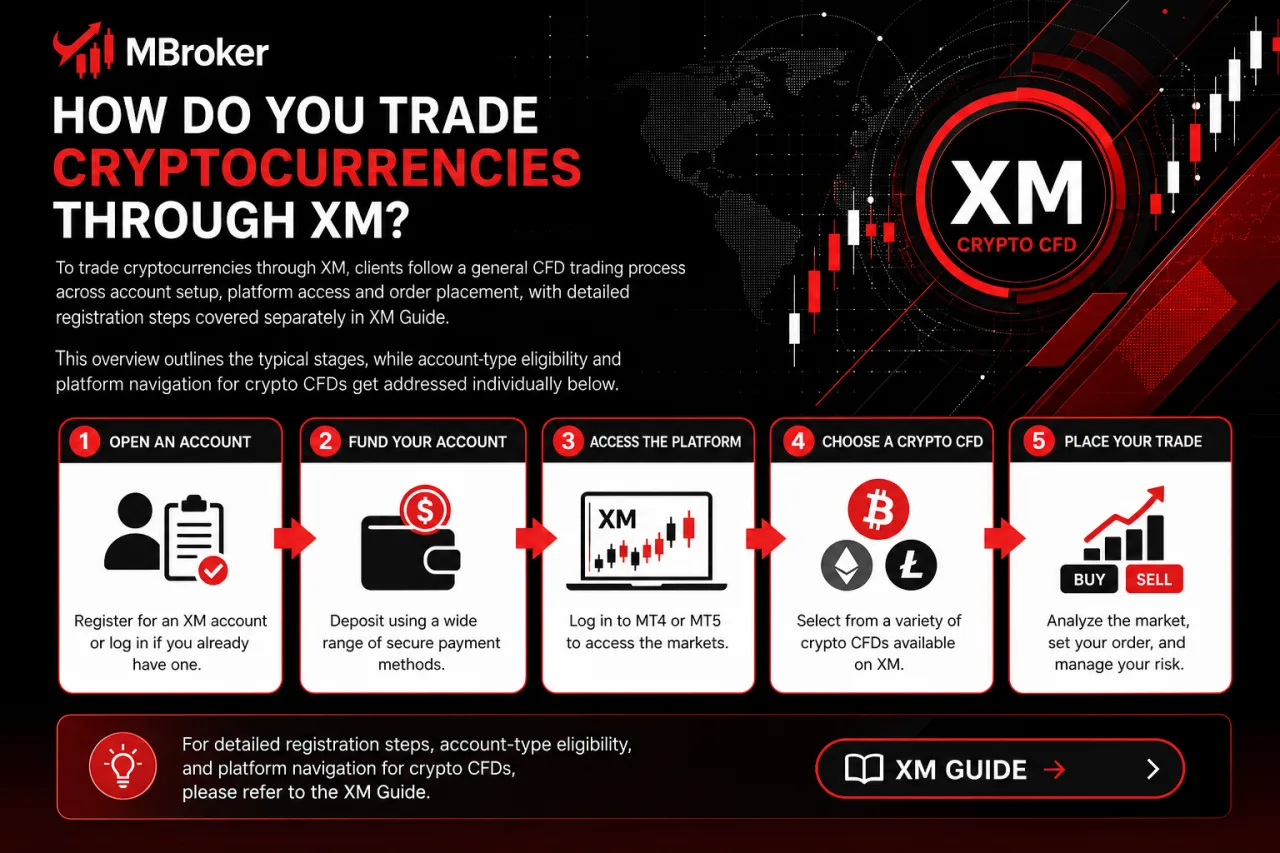
To trade cryptocurrencies through XM, clients follow a general CFD trading process across account setup, platform access and order placement, with detailed registration steps covered separately in XM Guide. This overview outlines the typical stages, while account-type eligibility and platform navigation for crypto CFDs get addressed individually below.
The general process for trading crypto CFDs through XM includes the following steps:
- Open an XM trading account.
- Select an account type that supports crypto CFDs.
- Open the trading platform provided by XM.
- Search for the desired crypto symbol within the platform.
- Place the trade based on the selected order type.
Each of these steps involves specific details regarding account eligibility and platform navigation, which are addressed individually below.
Which Platforms and Account Types Support XM Crypto CFDs?
XM crypto CFDs trade across three platforms: MT4, MT5 and the XM App, though actual symbol availability depends on the client’s account type and the XM legal entity holding that account. This platform question ties directly into the broader account setup process outlined above.
MT4 and MT5 both display crypto CFD symbols in the standard Market Watch window alongside forex, indices and commodity instruments, using the same order execution interface for opening and closing positions. The XM App mirrors this functionality for clients trading from mobile devices, syncing positions with the desktop platforms in real time.
Account type restrictions matter here. Some XM account categories exclude cryptocurrency CFDs entirely or limit the number of tradable crypto pairs, and these restrictions differ by regulatory region since XM operates through separate legal entities with distinct product catalogs.
Readers verify crypto CFD availability directly within their platform’s Market Watch or symbol list, checking against their specific account type and registered XM entity before attempting to open a position. Regional regulatory frameworks restrict crypto CFD access for clients in certain jurisdictions, so availability depends on the local rules that apply to each XM entity.
Which Cryptocurrencies Are Available as CFDs on XM?
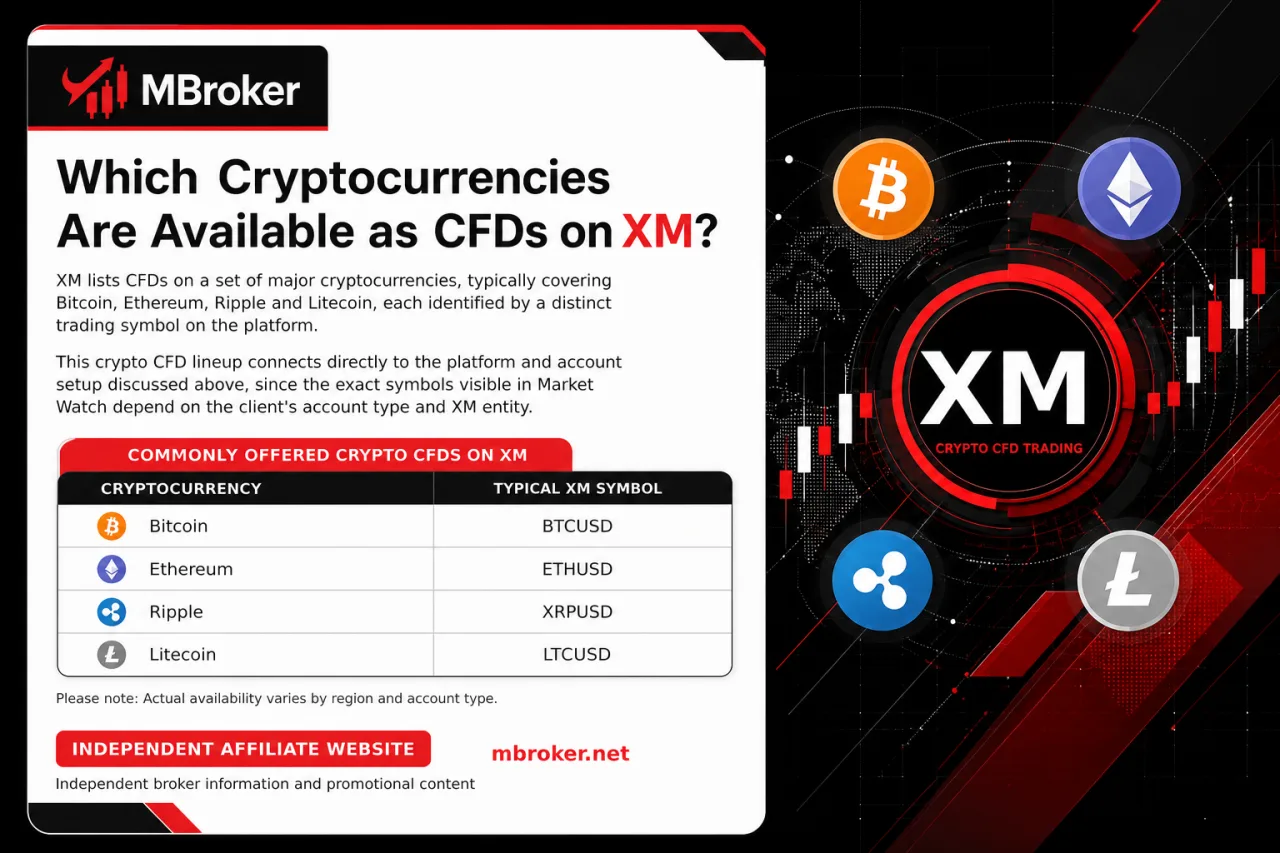
XM lists CFDs on a set of major cryptocurrencies, typically covering Bitcoin, Ethereum, Ripple and Litecoin, each identified by a distinct trading symbol on the platform. This crypto CFD lineup connects directly to the platform and account setup discussed above, since the exact symbols visible in Market Watch depend on the client’s account type and XM entity.
The table below outlines commonly offered crypto CFDs and their typical XM symbols, though actual availability varies by region and account.
| Cryptocurrency | Typical XM Symbol |
|---|---|
| Bitcoin | BTCUSD |
| Ethereum | ETHUSD |
| Ripple | XRPUSD |
| Litecoin | LTCUSD |
The exact list of crypto CFDs and their corresponding symbols on XM can vary by entity and region, so traders should check the specific instrument list within their own XM trading platform for confirmation.
This list is not exhaustive, and additional pairs, such as crosses against other fiat currencies, may appear depending on the trading account. Clients confirm the current symbol list and instrument availability on XM’s live instruments page or directly within their platform’s Market Watch window before placing any trade.
Regional regulatory restrictions tied to the applicable XM legal entity further narrow or expand this list for specific client groups. Traders check their account’s specific entity assignment to understand which instruments and symbols apply to them.
What Are the Trading Symbols for XM Bitcoin and Ethereum CFDs?
XM Bitcoin and Ethereum CFDs use ticker-style symbols that pair the coin abbreviation with the quote currency, most commonly BTCUSD and ETHUSD. This naming convention ties directly into the symbol list covered above, since the same format applies across other crypto pairs on the platform.
The first three or four letters identify the underlying cryptocurrency, such as BTC for Bitcoin or ETH for Ethereum, while the trailing letters denote the quote and settlement currency, typically USD. Profit, loss and margin on these CFDs calculate in that quote currency before conversion into the account’s base currency where applicable.
Symbol formatting can shift slightly between MT4, MT5 and the XM App, or carry suffixes tied to specific account types or server configurations. Traders confirm the exact symbol string within their own Market Watch window rather than assuming a fixed name applies across every platform and account.
Symbol suffixes or naming variations sometimes appear depending on the broker’s server setup or regulatory entity, so traders should verify the exact symbol names shown on their own XM trading platform.
How Do XM Crypto CFD Trading Conditions Compare to Other Asset Classes?
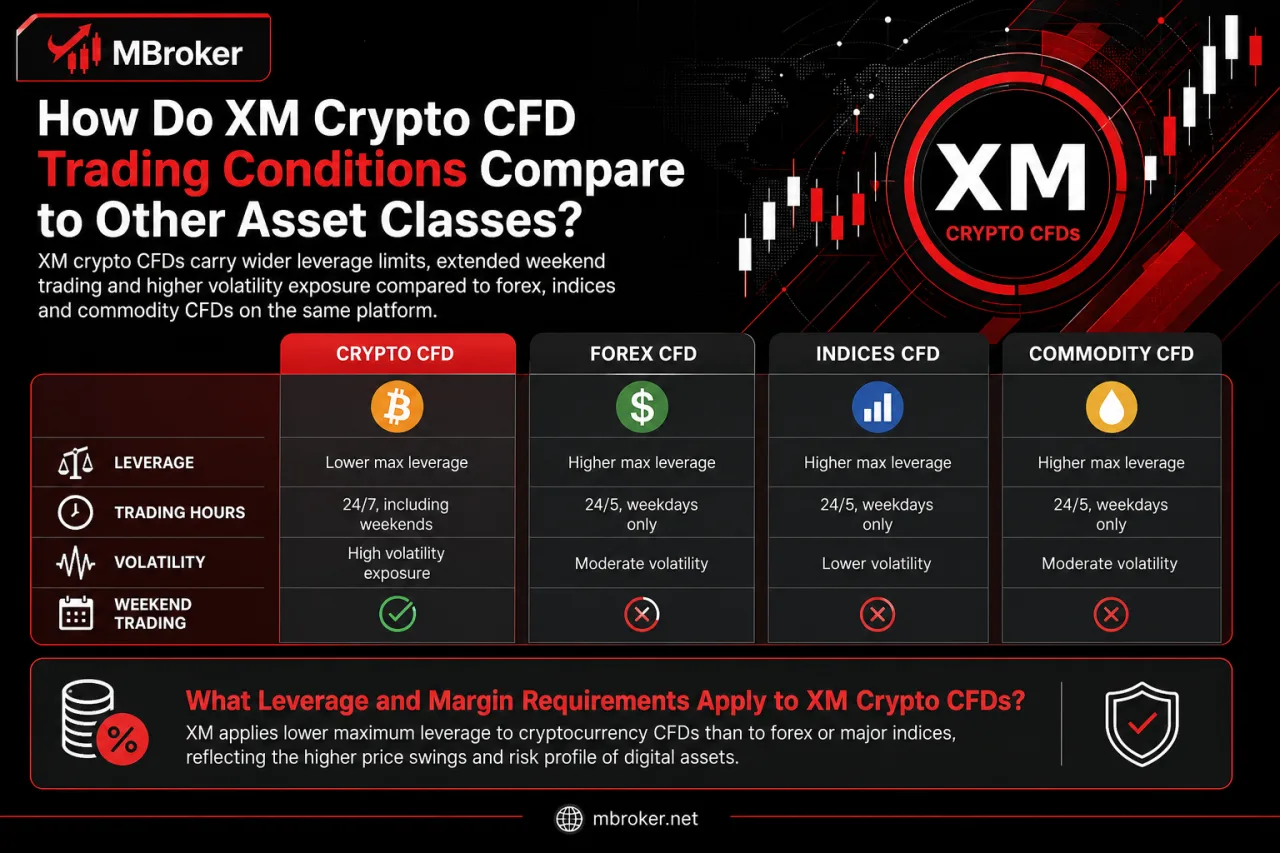
XM crypto CFDs carry wider leverage limits, extended weekend trading and higher volatility exposure compared to forex, indices and commodity CFDs on the same platform. These conditions apply broadly, while specific differences around leverage caps, market hours and price behavior get addressed individually below.
Lower maximum leverage typically applies to cryptocurrency CFDs compared to forex or major indices, reflecting the higher price swings typical of digital assets. Weekend trading availability also sets crypto CFDs apart, since forex, indices and commodity CFDs close following standard weekday market hours while crypto markets keep running.
These two distinctions, leverage and market hours, form the core differences covered in detail within the two sections below.
Are Trading Hours for XM Crypto CFDs Different from Forex or Stock CFDs?
XM crypto CFDs trade during weekends, while forex, indices and commodity CFDs close following standard weekday market hours. This weekend availability distinguishes crypto trading conditions from the rest of the platform’s asset classes.
Forex and indices track underlying markets that close on Saturdays and Sundays, so XM halts trading on those instruments until the next session opens. Cryptocurrencies trade continuously on underlying exchanges, and XM crypto CFDs generally mirror that continuous schedule, though brief maintenance breaks or holiday adjustments still apply.
Exact weekend trading hours and any scheduled maintenance windows for XM crypto CFDs vary by entity, so traders should check the current market hours listed within their own platform.
Does Leverage on XM Crypto CFDs Differ from Other Instruments?
XM applies lower maximum leverage to cryptocurrency CFDs than to forex or major indices, reflecting the higher price swings typical of digital assets. This margin distinction connects directly to the trading conditions comparison outlined above.
Forex pairs and index CFDs generally allow considerably higher leverage ratios on XM, since these instruments historically show more contained price movement over short periods. Crypto CFDs, by contrast, carry capped leverage tiers that reduce exposure relative to account equity, which raises the margin required to open and maintain a position of equivalent notional size.
Exact leverage tiers for crypto CFDs versus forex or indices vary by XM legal entity and account type, so traders should confirm current limits within their own trading platform.
Are Trading Hours for XM Crypto CFDs Different from Forex or Stock CFDs?
Yes, trading hours for XM crypto CFDs differ from forex or stock CFDs, since crypto pairs generally trade across weekends while forex and stocks follow fixed weekday sessions tied to underlying exchange hours. This scheduling gap ties directly into the weekend availability point covered above, but stock CFDs add another layer of restriction beyond forex.
Stock CFDs on XM track the opening and closing times of their underlying exchanges, meaning trading pauses outside listed exchange hours, overnight and on public holidays for that specific market. Forex maintains its own standard weekday session structure, closing over the weekend as previously noted. Crypto CFDs, by contrast, generally follow the near-continuous schedule of underlying digital asset markets.
Holiday-related pauses or maintenance windows still apply to crypto CFDs on occasion, even without a fixed weekend closure. Exact market hours, holiday schedules and any temporary trading suspensions for XM crypto, forex and stock CFDs vary by legal entity and account type, so traders should confirm current session times within their own trading platform.
Does Leverage on XM Crypto CFDs Differ from Other Instruments?
Yes, leverage on XM crypto CFDs differs from other instruments, since crypto pairs generally carry lower maximum leverage than forex or index CFDs on the same platform. This leverage gap builds directly on the margin comparison outlined above, where crypto CFDs already stood out for tighter caps relative to the rest of the platform’s asset classes.
Regulators in several jurisdictions impose stricter leverage ceilings on crypto CFDs specifically, reflecting the sharper price swings these assets show compared to major currency pairs or established stock indices. Regional regulatory frameworks are generally the reason crypto CFD leverage limits tend to be lower than those for forex or indices across XM’s various jurisdictions.
This regulatory layer sits on top of XM’s own internal risk controls, which further adjust margin requirements based on account type and the specific legal entity holding the account. A retail account under one XM entity may face different leverage tiers than a professional account under another entity, even for the identical BTCUSD or ETHUSD symbol.
Traders confirm exact leverage ratios and margin requirements within their own trading platform before opening a crypto CFD position, since these figures shift by entity, account classification and regulatory jurisdiction rather than staying fixed across the whole client base.
Is XM Crypto Trading a CFD Product Rather Than Direct Coin Ownership?
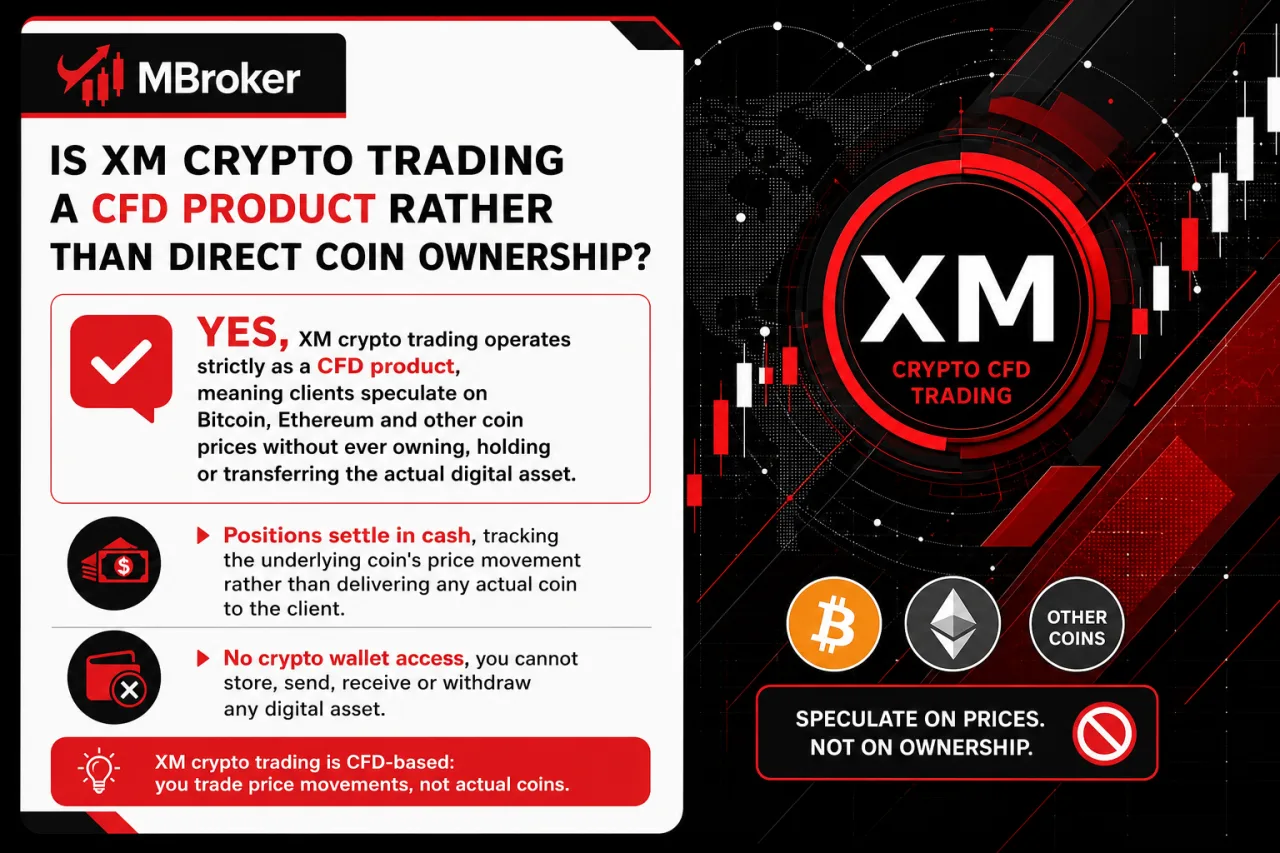
Yes, XM crypto trading operates strictly as a CFD product; clients speculate on price without owning the underlying coin. This structure means clients never hold or transfer the actual digital asset, only tracking its price movement. This confirms the product structure question raised above, with the specifics on cash settlement, wallet limitations and profit calculation covered in the points below.
- Positions settle in cash, tracking the underlying coin’s price movement rather than delivering any actual coin to the client.
- Accounts hold no wallet function, so clients cannot withdraw, transfer or spend the cryptocurrency referenced by a CFD symbol like BTCUSD or ETHUSD.
- Profit and loss calculate purely from the difference between opening and closing price, not from any transfer of coin ownership.
- Custody of the underlying asset never passes to the client, distinguishing this structure from buying and storing coins on a crypto exchange or personal wallet.
Traders confirm this CFD-only structure applies uniformly across MT4, MT5 and the XM App, regardless of account type or XM legal entity, though specific contract terms still vary by region.
How Does Trading an XM Crypto CFD Differ from Owning the Underlying Coin?
Trading an XM crypto CFD differs from owning the underlying coin because the CFD stays a derivative contract on price movement, while direct ownership involves holding the actual coin in a wallet. This contrast builds directly on the CFD-only structure confirmed above, separating XM’s contract-based approach from buying coins on a crypto exchange.
- CFD trading skips any wallet requirement, blockchain transaction or network confirmation, since the position exists purely on XM’s trading platform.
- CFD trading allows leverage, letting a trader control a larger notional position than the margin deposited.
- CFD trading permits short-selling, opening a position that profits from a price decline without ever holding the coin.
- Direct ownership requires a wallet or exchange account, transferring actual custody of the coin to the buyer.
- Direct ownership carries no leverage by default, since the buyer pays the full purchase price for the coin held.
Traders confirm which structure applies to their account by checking whether their platform lists BTCUSD or ETHUSD as a tradable symbol, since XM only supports the CFD version of these markets.
What Are the Specific Contract Details and Risks of XM Crypto CFDs?
XM crypto CFDs carry distinct contract specifications, including lot size, volume increments and tick values, that set them apart structurally from traditional futures-based contracts. This overview groups the key contract mechanics together with the risk profile traders face, while the specific figures and volatility considerations get covered individually in the sections below.
Each crypto CFD contract defines a lot size representing a fixed unit of the underlying coin, and traders open positions in increments of that lot rather than buying the coin directly. Alongside lot size, XM sets a minimum and maximum trade volume per position, placing a floor on how small a trade can be and a ceiling on how large a single order gets before it must be split.
Tick size marks the smallest price increment by which the CFD quote moves, and this granularity determines how precisely profit and loss get calculated as the underlying price shifts. Unlike standardized futures contracts that expire on a fixed date and settle through an exchange clearinghouse, crypto CFDs roll indefinitely and settle bilaterally between trader and broker, a structural difference that shapes how margin and overnight costs apply.
Crypto CFDs carry a risk profile that traders treat as a distinct category from other asset classes. The underlying coins are known for sharp, rapid price swings, and that volatility passes directly through to the CFD position.
Leverage amplifies this exposure in both directions. A relatively small adverse price move against a leveraged position results in a proportionally larger loss, and losses accumulate quickly during volatile market conditions.
An additional distinction sets CFDs apart from direct coin ownership. Since a crypto CFD is a derivative contract rather than an actual holding of the underlying coin, traders do not benefit from any investor compensation scheme or custody protection that applies to holding the coin itself.
Do Regional or Entity-Specific Restrictions Apply to XM Crypto CFD Trading?
Yes, regional or entity-specific restrictions apply to XM crypto CFD trading, since certain XM entities exclude these instruments for retail clients or apply stricter leverage caps depending on the local regulator. This restriction question follows directly from the leverage and jurisdiction points raised above, where regulatory frameworks already shaped crypto CFD conditions differently across regions.
Entities operating under stricter regulatory oversight, such as those governed by ESMA-aligned rules, commonly limit retail access to crypto CFDs or remove certain symbols from the retail account catalog entirely. Some regulators classify cryptocurrency CFDs as high-risk instruments and mandate additional leverage caps or client warnings before retail traders access these markets; ESMA maintains strict leverage limits for retail clients trading CFDs, including crypto-asset CFDs, as part of its broader intervention measures on CFD products across the European Economic Area. Traders confirm the exact leverage tier applicable to their account by checking the official ESMA product intervention notices or the terms disclosed by their specific XM entity.
Other XM entities operating under different regulatory frameworks may permit broader crypto CFD access or higher leverage tiers for eligible account types. Traders confirm which restrictions apply by checking the specific XM legal entity listed on their account registration and reviewing the instrument list within their own trading platform before opening a crypto CFD position.
Can Corporate Actions Like Forks or Airdrops Affect XM Crypto CFD Positions?
No, corporate actions like forks or airdrops generally do not affect XM crypto CFD positions in the same way they affect direct coin holders, since CFD traders never custody the underlying asset. This distinction follows directly from the CFD-only structure confirmed earlier in this guide.
- CFD holders typically forfeit any forked coins or airdropped tokens, since ownership of the underlying asset never transfers to the client.
- Direct coin holders may receive new forked assets or airdrop distributions tied to their wallet balance at the time of the network event.
- XM retains discretion to adjust pricing, spreads or trading availability around major network events such as hard forks.
XM may suspend or restrict trading on a specific crypto CFD symbol during significant network upgrades or contentious forks, so traders should check XM’s official policies or contact support for the exact rules that apply to such events. Traders confirm any planned adjustments or trading halts tied to network events through official XM announcements or their platform’s instrument notices before an anticipated fork or airdrop date.
Conclusion
XM gives traders access to cryptocurrency price movements exclusively through CFDs on MT4, MT5 and the XM App, without requiring a wallet or ownership of the underlying coins. This structure supports both long and short positions, but it also introduces leverage-related risk. Available symbols, margin requirements, trading hours and leverage limits may differ by account type, jurisdiction and the XM entity serving the client.
Before opening a position, traders should verify the latest contract specifications directly in their XM platform and carefully consider volatility, maintenance periods, regional restrictions and the treatment of forks or airdrops. XM crypto CFDs may provide convenient market access for traders who understand leveraged derivatives, but they are not a substitute for directly buying and holding cryptocurrency. Mbroker recommends evaluating the product structure and potential losses carefully before making any trading decision.

Sylas Trenven is a forex strategist who helps traders master risk and timing. His work focuses on behavior-driven market entries and portfolio optimization for XM users looking to trade with precision and discipline. Email: [email protected]