
 Tiếng Việt
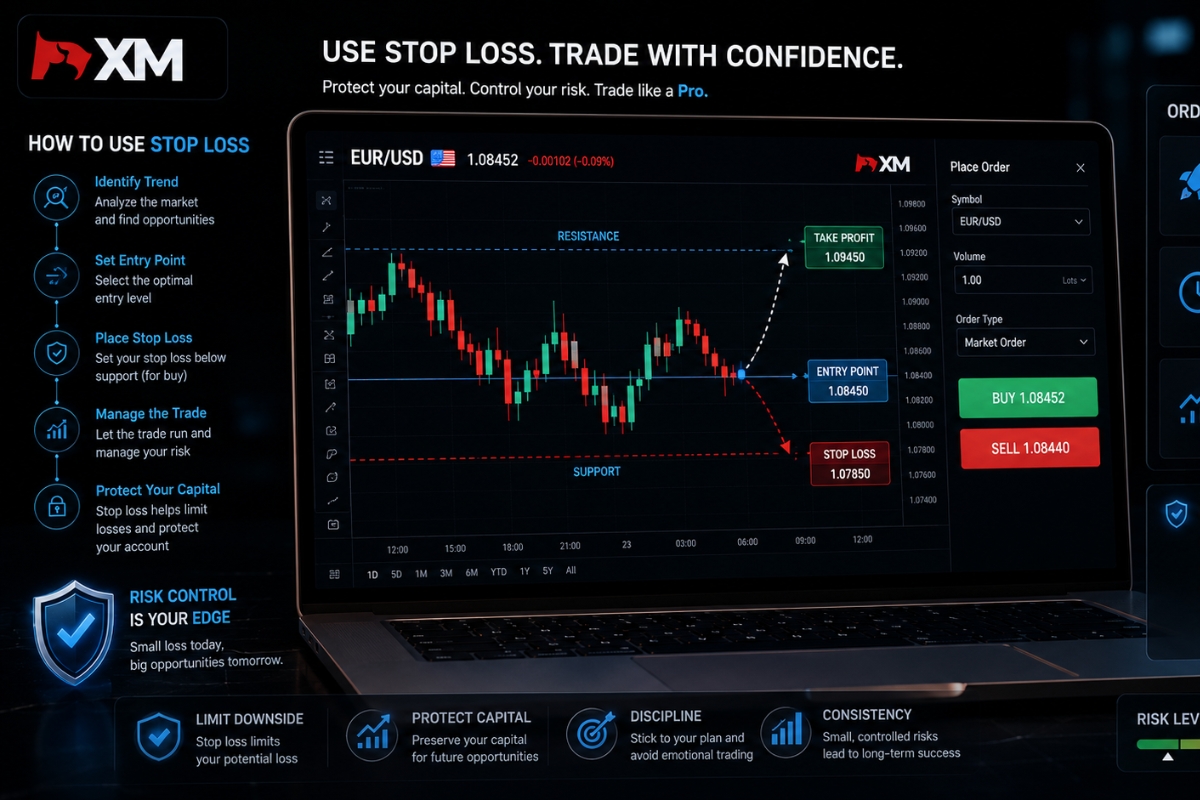
Stop Loss XM is a risk management tool that automatically closes a trade at a predefined loss level, helping traders limit losses and protect capital in volatile market conditions.
However, XM provides multiple stop loss order types including fixed stop loss and trailing stop, allowing traders to adapt risk control based on different trading strategies and market movements.
Additionally, setting stop loss effectively requires placing it based on technical levels such as support, resistance, or volatility, rather than random distances, to avoid premature stop-outs.
Therefore, applying stop loss correctly is essential for managing risk and maintaining consistent trading performance, especially when using leverage in Forex trading.
Finally, optimizing stop loss involves balancing risk and reward ratios, typically at least 1:2, ensuring that potential profits outweigh losses over multiple trades.
In Forex trading, risk control is just as important as entry strategy, especially within Forex Technical Analysis. Stop Loss XM helps limit losses and maintain trading discipline when used correctly.
What is Stop Loss in XM trading?
A Stop Loss on XM is a pre-set automated order that instructs the platform to liquidate an open trading position at a specific price level to prevent further capital loss.
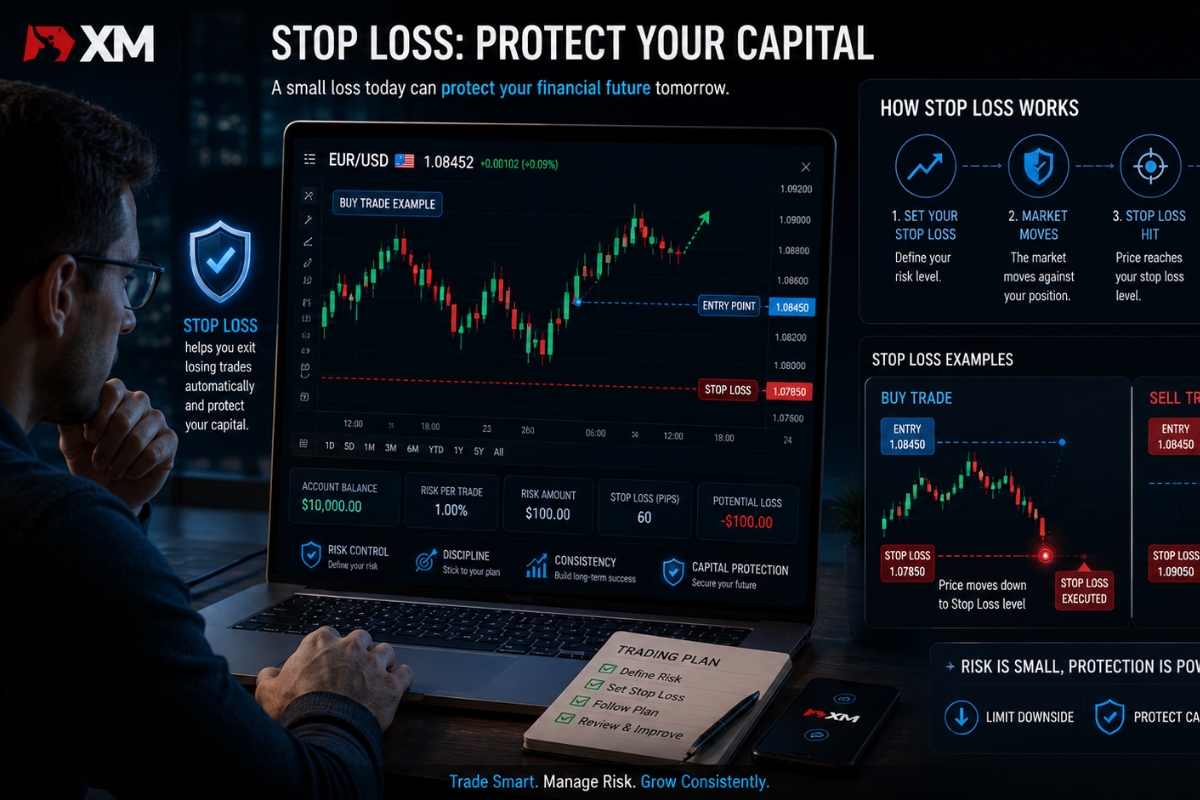
Statistically, enforcing an absolute defensive exit boundary ensures that a single bad trade cannot destroy your portfolio, keeping your maximum account drawdown strictly within your defined 1% to 2% risk tolerance threshold per trade. Without this automated guardrail, an adverse market move of just 100 to 200 pips during a high-impact economic announcement can trigger a margin call, making this order the baseline of all professional risk control.
How does Stop Loss work on XM?
On the XM platform, a Stop Loss functions as a pending order that rests on the broker’s server until your specified price trigger is hit. For a buy position, your stop level is placed below the current market price and converted into a market sell order the moment the bid price touches your line. For a sell position, it sits above the current market price and converts into a market buy order when the ask price hits your target, guaranteeing that your trade is closed out regardless of whether you are actively monitoring your screen.
Understanding this mechanical execution highlights why setting an automated exit boundary is entirely non-negotiable for long-term survival.
Why must traders use Stop Loss?
Traders must use a Stop Loss to counteract the psychological traps of hope and denial, which frequently cause retail accounts to experience catastrophic liquidations.
- Capital Protection: It prevents a minor technical mistake from turning into a massive, multi-week drawdown.
- Mathematical Survival: It respects the laws of probability, ensuring that your losing trades remain small and easily manageable.
- Eliminates Emotion: It automates your exit plan, removing the need to make stressful, split-second decisions while watching a live market move against you.
Once you accept the absolute necessity of defensive orders, the next structural step is exploring the specific variations available on your terminal.
Stop loss order types on XM trading platform
The types of stop loss orders on the XM trading platform include traditional hard stop-losses, trailing stops, and psychological stops, which vary based on how they interact with live price action.
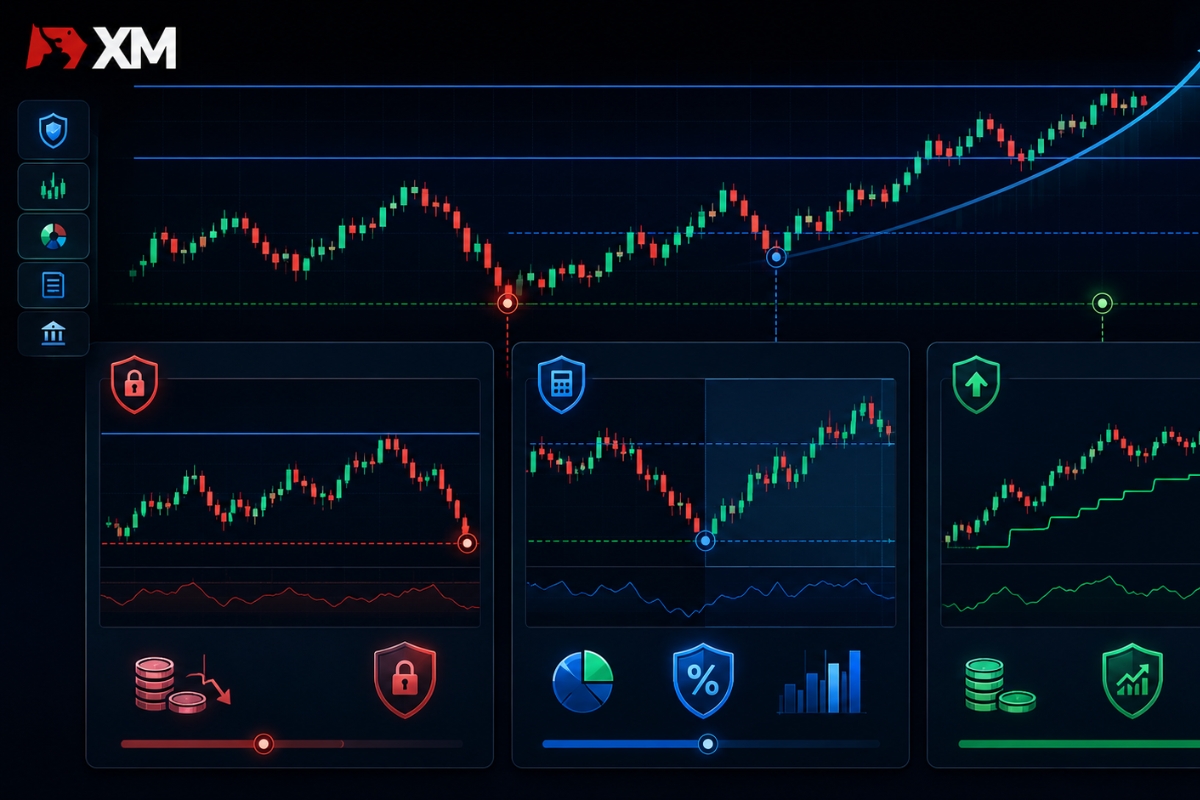
Traditional hard stops remain completely stationary at a fixed price node until triggered or modified, providing an absolute guarantee on your maximum financial risk. On the other hand, dynamic types adjust automatically as the market moves in your favor, allowing you to lock in active profits without manually intervening in the market.
What are the common types of stop loss in trading?
Professional traders categorize their defensive exit boundaries into three primary functional types:
- The Static Chart Stop: Placed at a fixed horizontal price point based on clear technical criteria, such as right below a major support level or swing low.
- The Equity-Based Stop: Calculated purely by account mathematics, where the stop is placed at an exact distance representing a fixed dollar amount (e.g., exactly $100 or 1% of capital).
- The Trailing Stop: A dynamic order that moves automatically behind the market price at a set distance, acting as both a risk reduction tool and a profit-harvesting mechanism.
To maximize the commercial efficiency of your portfolio, learning when to deploy the dynamic model is essential.
When should you use a trailing stop on XM?
You should use a trailing stop on XM during strong trending markets or immediately following major macroeconomic breakout expansions when an asset is printing clean, aggressive impulses. This order type is exceptionally effective for trend-following strategies because it automatically trails your position by a fixed pip distance, allowing you to ride a massive multi-day macro trend while protecting your downside. It is less suitable for choppy, range-bound environments, where minor counter-trend whipsaws will prematurely trigger your trailing parameters before the primary move completes.
With the core order types clearly categorized, we can transition directly into the exact practical methods required to set these targets with institutional accuracy.
How to set a stop loss effectively on XM?
To set a stop loss effectively on XM, you must calculate the exact price point where your trading thesis is proven structurally invalid, rather than picking a random round number.

A professional placement methodology combines strict price action logic—such as identifying major support and resistance zones or key moving averages—with precise position-sizing math to ensure your risk parameters are perfectly balanced. When your execution is paired with the ultra-low latency routing and transparent market execution championed on the MBroker, your defensive orders are filled with absolute precision and minimal slippage.
Step-by-step guide to setting stop loss for beginners
Implementing a protective boundary on your MetaTrader terminal involves a simple, rule-based workflow:
- Step 1: Identify Structure: Analyze your chart and locate the nearest major support floor (for a buy trade) or resistance ceiling (for a sell trade).
- Step 2: Define Invalidation: Place your stop cursor slightly past that structural zone—typically 5 to 10 pips below support or above resistance—to account for minor market noise.
- Step 3: Calculate Distance: Measure the total pip distance from your planned entry point to your defined invalidation target.
- Step 4: Size Your Position: Use a position calculator to adjust your lot size so that the total pip distance equals exactly 1% of your total account balance.
- Step 5: Execute Order: Open your order entry window, type the exact price into the “Stop Loss” field, and submit your trade to the live interbank network.
While this mechanical checklist is straightforward, avoiding classic retail execution traps requires ongoing tactical discipline.
What mistakes should be avoided when setting stop loss?
Amateur chartists frequently compromise their equity by making major errors when interacting with their defensive parameters. The most destructive mistake is moving your stop-loss wider mid-trade, which is driven by emotional denial and completely breaks your pre-calculated risk-reward math. Another common error is setting a “tight stop” too close to current market prices to force a larger lot size; this ignoring of market ATR (Average True Range) results in getting prematurely stopped out by standard, non-directional market spread widening.
Now that you can place these orders flawlessly, the final phase toward system mastery involves integrating these steps into a macro portfolio management framework.
Applying stop loss XM in risk management strategy
Applying a stop loss within an XM risk management strategy transforms a basic chart pattern into a scalable, long-term commercial business model by stabilizing your mathematical equity curve.

By ensuring that every single market exposure features a hard risk boundary, you guarantee that your average losing trade remains a tiny fraction of your overall capital pool. This strict mathematical control allows a trader to withstand a prolonged string of consecutive losses and remain perfectly positioned to compound wealth during subsequent winning cycles.
How does stop loss impact risk management?
The primary impact of a hard stop-loss on risk management is the establishment of a fixed Risk-to-Reward (R:R) Ratio for every position in your books. By locking in a mandatory stop-loss distance, you can structure your profit targets to ensure a minimum 1:2 or 1:3 ratio, meaning your average winning trade is always double or triple the size of your average loss. Mathematically, maintaining a 1:2 risk ratio means your trading system remains highly profitable even with a modest 40% win rate, entirely removing the impossible pressure of needing to be right on every market move.
Beyond basic ratio mapping, you can actively optimize your parameter placement to match shifting volatility regimes.
How to optimize stop loss for better trading performance?
To optimize your defensive performance, transition away from fixed-pip boundaries and integrate volatility-based stops using the Average True Range (ATR) indicator. By multiplying the current ATR by a factor of 1.5 or 2, your stop-loss automatically expands during highly volatile news events to avoid market spikes, and contracts during quiet sessions to maximize your underlying risk-reward efficiency. Furthermore, checking the advanced technical guides and broker updates on the MBroker allows you to refine your parameters based on real-time spread analytics, keeping your execution fully optimized for long-term compound growth.
In conclusion, mastering your Stop Loss placement on XM is the single most important step toward building a highly professional, sustainable trading career. By understanding the core mechanics of static and trailing orders, executing entries through a disciplined 5-step structural process, and maintaining a strict risk-to-reward ratio, you can safely protect your capital from adverse market exposure.

Thoren Vextal is a specialist in XM trading guides, offering practical insights and real-market experience to help traders improve their strategies and trading performance. Email: [email protected]