

The XM Zero Account is a raw-spread trading account that charges a fixed commission per lot instead of marking up spreads. The XM Zero Account offers spreads starting from 0.0 pips but charges a fixed commission per lot traded, unlike the Standard Account, which has no separate commission but wider spreads. This model targets traders who prioritize transparent pricing and tighter spreads on major instruments over a commission-free structure.
The core difference between XM Zero and XM Standard lies in how trading costs are charged: the Zero Account offers spreads starting from 0.0 pips but charges a fixed commission per lot traded, while the Standard Account has no separate commission but wider spreads that embed the trading cost. This structural difference changes the effective cost per trade depending on volume and holding style.
According to XM’s official account types page, the Zero (Ultra Low) Account is designed for high-volume trading, offering lower spreads along with swap and commission fees that are even lower, with spreads on major currency pairs starting from as low as 0.0 pips combined with a fixed commission charged per standard lot traded. This commission is charged separately from the spread, meaning the total trading cost must be calculated as spread plus commission rather than spread alone.
Opening an XM Zero Account requires completing the standard XM registration and identity verification process, after which the account becomes available on both MT4 and MT5 platforms. Platform compatibility allows traders to choose the interface that matches their strategy without affecting the account’s spread or commission structure.
This guide, compiled by Mbroker as an independent source of information on XM, breaks down each of these points in detail, starting with a clear definition of what the XM Zero Account is.
What Is the XM Zero Account?
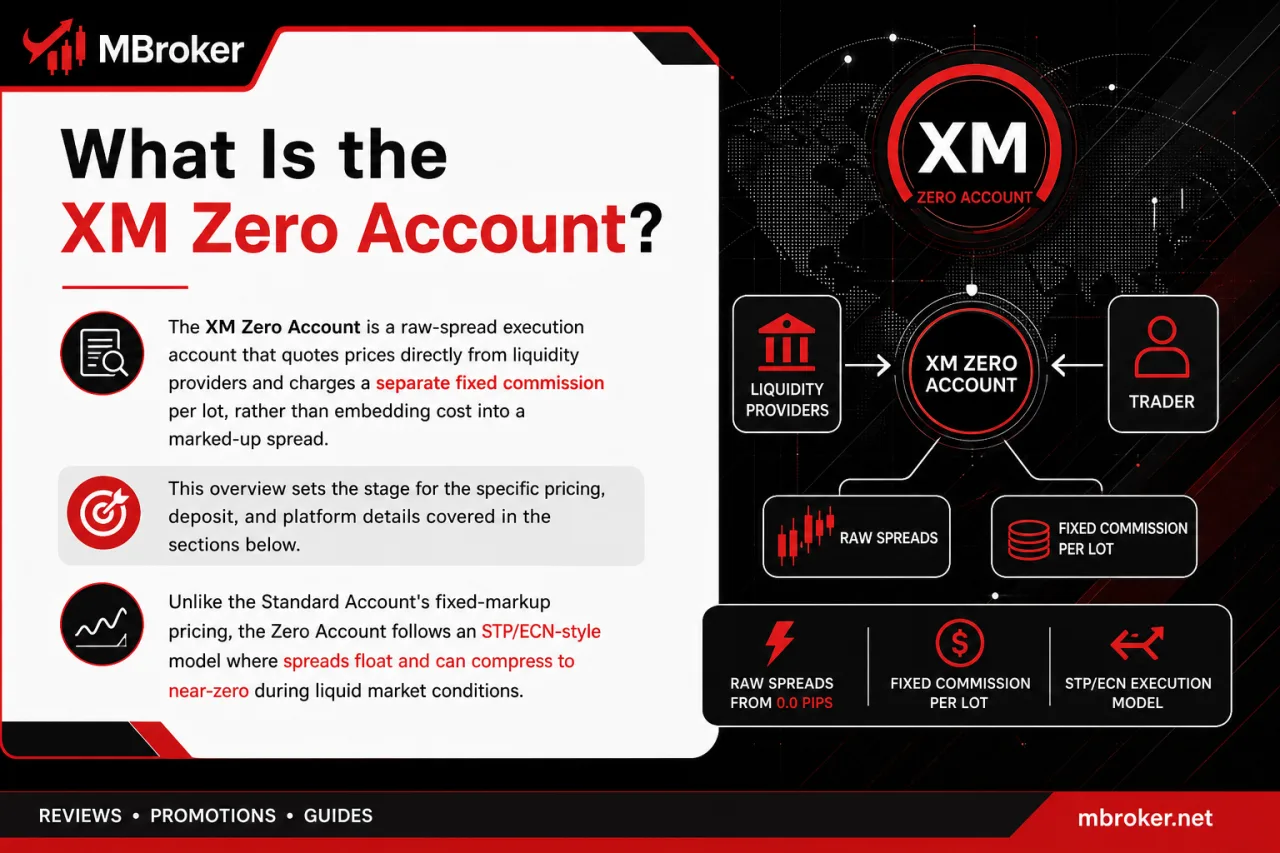
The XM Zero Account is a raw-spread execution account that quotes prices directly from liquidity providers and charges a separate fixed commission per lot, rather than embedding cost into a marked-up spread. This overview sets the stage for the specific pricing, deposit, and platform details covered in the sections below.
Unlike the Standard Account’s fixed-markup pricing, the Zero Account follows an STP/ECN-style model where spreads float and can compress to near-zero during liquid market conditions, with commission acting as the transparent, separately itemized trading cost. This design targets scalpers, algorithmic traders, and cost-sensitive volume traders who track spread and commission as two distinct line items rather than one blended cost.
What Legal Entities and Countries Offer the XM Zero Account?
Multiple XM regulated entities offer the Zero Account, though the exact legal entity a trader is assigned to depends on country of residence and applicable regulatory jurisdiction. This section clarifies which entities provide the account and how eligibility shifts across regions.
XM operates through several regulated entities, and Zero Account availability varies by jurisdiction:
- According to XM’s regulatory disclosure, Trading Point of Financial Instruments Ltd operates as XM Global Limited, regulated by the Financial Services Commission (FSC) of Belize under the Securities Industry Act 2021 (license number 8557558), and offers the Zero Account to eligible international clients outside restricted regions.
- According to the same XM regulatory disclosure, Trading Point of Financial Instruments UK Limited operates under UK financial regulation and offers account terms tailored to UK residents.
- XM entities regulated within the European Union under CySEC provide services to EU residents, subject to EU-specific leverage and protection rules, though the availability of the Zero Account under this specific entity may vary.
According to XM’s regulatory disclosure, XM does not provide its services to citizens of the United States, Canada, Israel, and the Islamic Republic of Iran, among other sanctioned countries, regardless of which entity clients apply through.
Traders confirm which entity applies to their account and whether the Zero Account is listed as an available option during the registration process, since terms differ by legal entity and residency.
Who Is Eligible to Open an XM Zero Account (Retail vs Professional)?
Yes, XM opens the Zero Account to both retail and professional clients, though the two classifications carry different leverage and margin conditions under the relevant entity. This distinction determines how much leverage a trader accesses and how negative balance protection applies to the account.
Client classification affects the Zero Account in three main ways:
- Retail clients receive standardized negative balance protection and leverage caps set by the entity regulating their account, particularly under CySEC or FCA oversight.
- Professional clients qualify for higher leverage ceilings after meeting criteria tied to trading experience, portfolio size, or financial sector employment, but forfeit certain retail-only protections in exchange.
- Non-EU entities such as XM Global Limited generally apply broader leverage ranges to retail clients directly, without requiring professional reclassification.
Professional client status under EU-regulated entities generally requires meeting at least two of several criteria related to trading frequency, portfolio value, and relevant financial industry experience, though the specific classification rules may vary by entity and eligible clients should verify current requirements directly with the broker.
Traders confirm their classification status and applicable margin terms directly through the entity handling their Zero Account registration.
What Are the Key Features and Trading Conditions of the XM Zero Account?
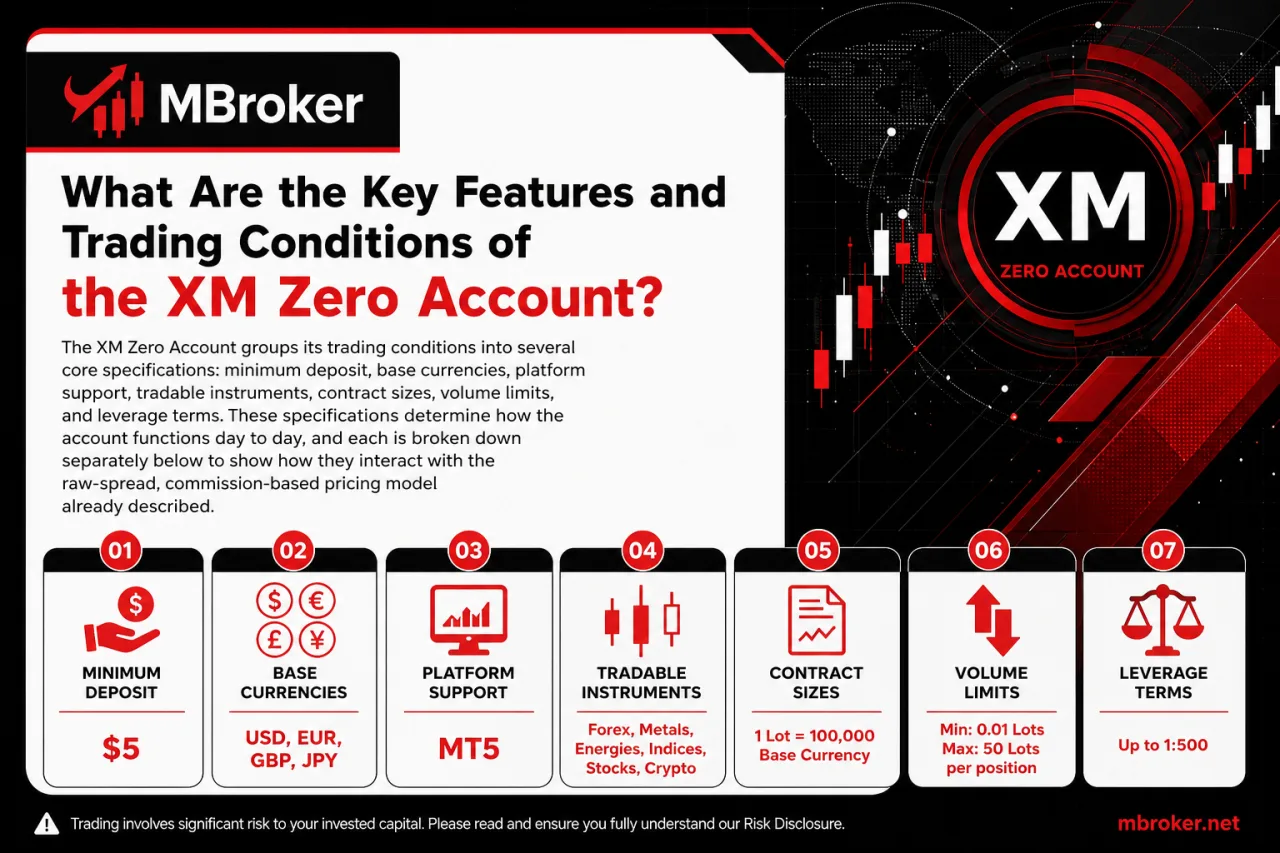
The XM Zero Account groups its trading conditions into several core specifications: minimum deposit, base currencies, platform support, tradable instruments, contract sizes, volume limits, and leverage terms. These specifications determine how the account functions day to day, and each is broken down separately below to show how they interact with the raw-spread, commission-based pricing model already described.
Is the XM Zero Account Compatible with MT4 and MT5?
Yes, the XM Zero Account operates on both MT4 and MT5, with the same raw-spread and commission structure applied across both platforms. This confirms the account’s platform reach before breaking down execution and instrument differences between the two terminals.
Platform choice affects interface and tools rather than pricing:
- MT4 supports the Zero Account with standard order execution, expert advisors, and the four-decimal pricing format familiar to legacy XM users.
- MT5 supports the Zero Account with additional order types, an extended timeframe selection, and a broader instrument list depending on the entity offering the account.
- Both platforms apply the same fixed commission per lot and identical raw spread sourcing, so switching platforms does not change the underlying trading cost model.
Instrument availability may differ slightly between MT4 and MT5 depending on the specific XM entity and account setup, so traders should confirm the exact tradable symbol list within their platform before opening positions. Execution speed and order routing remain consistent with the account’s ECN-style model regardless of terminal.
What Is the Minimum Deposit and Leverage for the XM Zero Account?
The XM Zero Account requires a minimum deposit that varies by regulatory entity, with maximum leverage also set according to the entity and client classification handling the account. This section breaks down the deposit threshold and leverage ceiling, along with how these figures shift across jurisdictions.
Deposit and leverage terms depend on which XM entity processes the registration:
- According to XM’s official account types page, XM Global Limited requires a minimum deposit as low as $5 to open an account, and according to XM’s leverage policy page, leverage for retail clients under this entity can extend up to 1000:1, higher than what EU-regulated entities are permitted to offer.
- According to a CySEC press release, EU-regulated entities under CySEC oversight apply leverage caps mandated for retail clients (as low as 2:1 to 30:1 depending on the instrument), with professional clients accessing higher leverage only after meeting the specific quantitative and qualitative reclassification criteria.
- As a general industry pattern rather than a confirmed figure from XM’s UK-facing materials, UK-regulated entities are understood to apply leverage restrictions for retail traders that are separate from, and typically more conservative than, the leverage terms offered under non-UK/non-EU entities. Traders under a UK-regulated entity confirm the exact cap by referring to the FCA rulebook or the specific terms disclosed on their XM UK account documentation.
Traders confirm the exact minimum deposit and leverage figures applicable to their account by checking the terms displayed during registration under their assigned entity, since these numbers are not uniform across all XM legal entities.
XM Zero Account vs Standard Account: What Are the Differences in Spreads and Commissions?
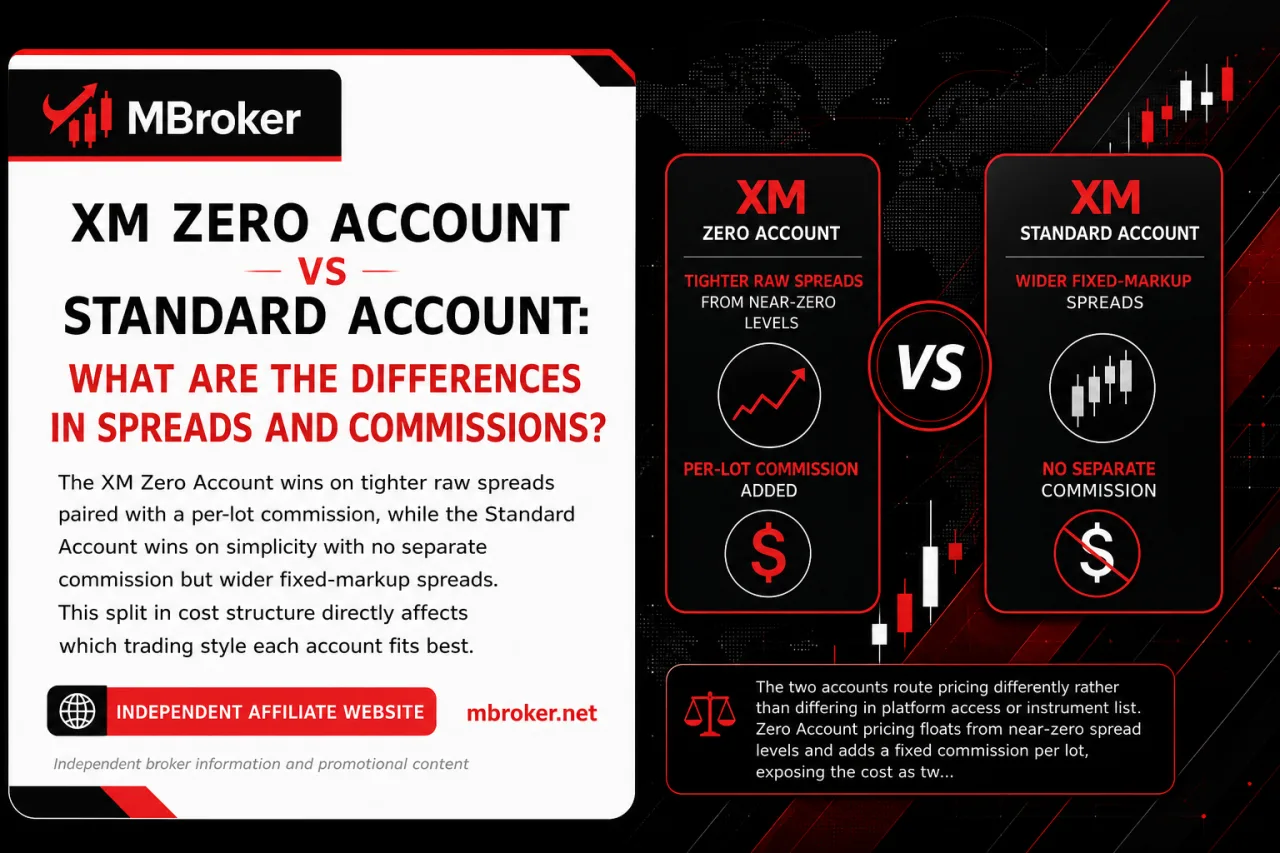
The XM Zero Account wins on tighter raw spreads paired with a per-lot commission, while the Standard Account wins on simplicity with no separate commission but wider fixed-markup spreads. This split in cost structure directly affects which trading style each account fits best.
The two accounts route pricing differently rather than differing in platform access or instrument list. Zero Account pricing floats from near-zero spread levels and adds a fixed commission per lot, exposing the cost as two visible components. Standard Account pricing embeds the entire trading cost into a wider spread, removing the need to track a separate commission line.
| Feature | XM Zero Account | XM Standard Account |
|---|---|---|
| Spread range | From 0.0 pips (floating, raw) | Wider, fixed markup embedded |
| Commission | Fixed fee charged per lot | None charged separately |
| Cost transparency | Spread and commission itemized separately | Single blended cost per trade |
| Typical use case | Scalping, algorithmic and high-volume trading | Casual, discretionary, lower-frequency trading |
Traders running high trade counts or automated strategies generally track the Zero Account’s itemized cost more precisely, while traders placing fewer, longer-term trades find the Standard Account’s all-in spread simpler to monitor without calculating commission separately.
For a closer look at commission-free trading conditions, see our XM Standard Account guide, which explains spreads, minimum deposits, contract sizes, and account features.
How Much Are the Fees, Spreads and Commission Structure on the XM Zero Account?
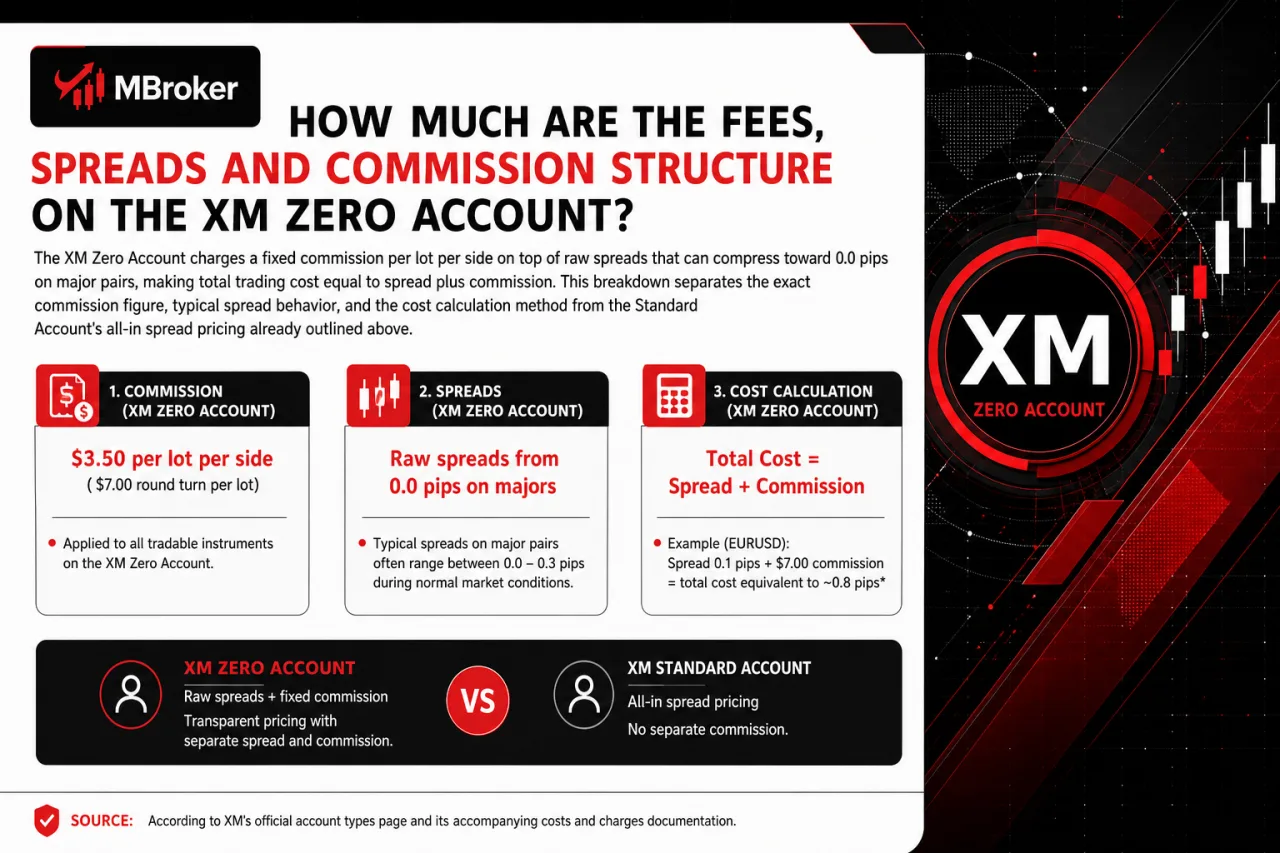
The XM Zero Account charges a fixed commission per lot per side on top of raw spreads that can compress toward 0.0 pips on major pairs, making total trading cost equal to spread plus commission. This breakdown separates the exact commission figure, typical spread behavior, and the cost calculation method from the Standard Account’s all-in spread pricing already outlined above.
According to XM’s official account types page and its accompanying costs and charges disclosure, the Zero Account charges a commission of around USD 3.5 per standard lot (equivalent to USD 7 per USD 100,000 traded), applied per side (opening and closing a position), rather than a single round-turn fee bundled into the spread.
Spreads on major currency pairs on the Zero Account float with market liquidity and start from near-zero levels during high-liquidity sessions, widening during lower-liquidity periods since pricing streams directly from liquidity providers rather than a fixed markup.
Total trading cost on the Zero Account follows a two-part formula: raw spread cost plus the per-lot commission charged on entry and exit. Traders calculate this by adding the current floating spread value to the fixed commission rate, then multiplying by lot size traded, distinguishing it from the Standard Account, where the quoted spread already represents the full trading cost with no additional commission line to add.
Traders comparing lower-spread account options can explore our XM Ultra Low Account guide, which examines variable spreads, commission conditions, and overall trading costs across different account structures.
How to Open and Register an XM Zero Account?
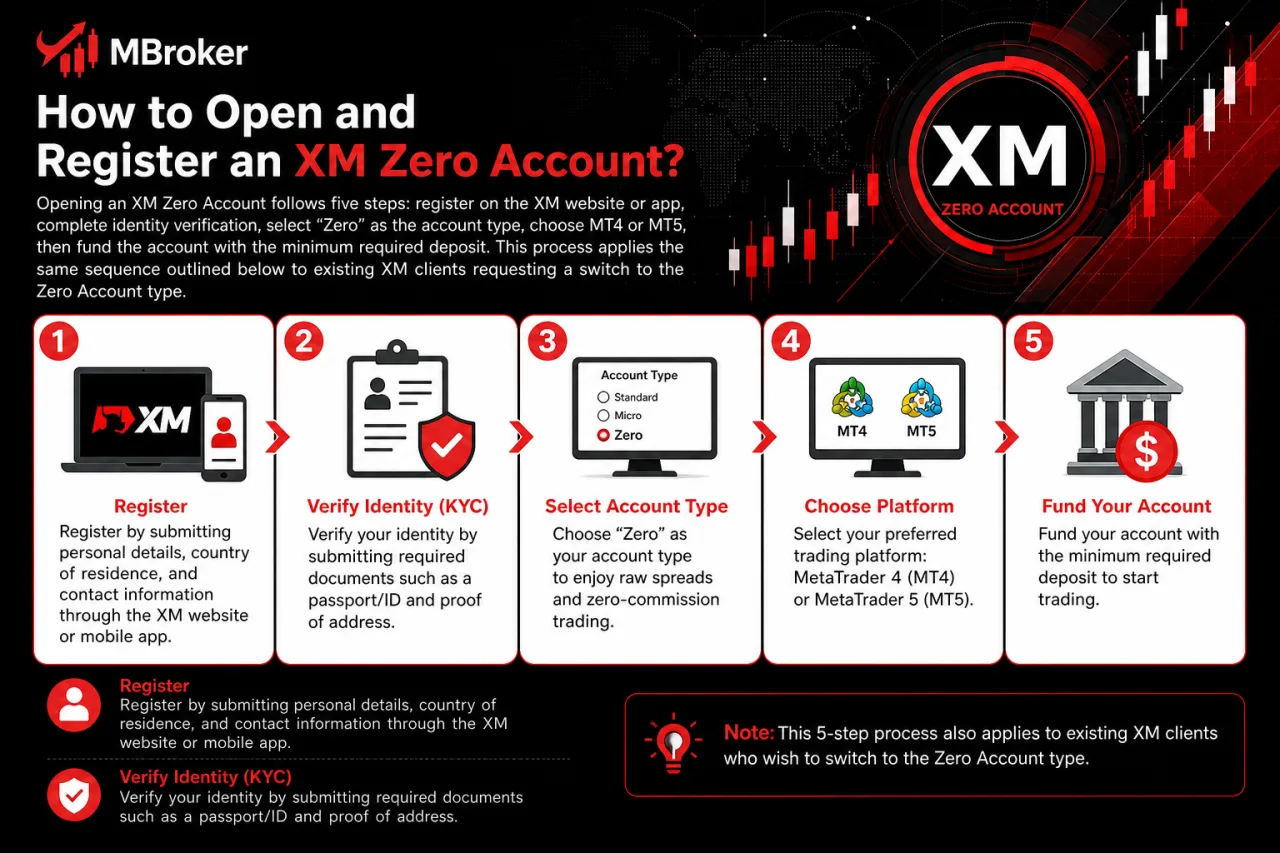
Opening an XM Zero Account follows five main steps, from registration to funding the account with the minimum required deposit. This process applies the same sequence outlined below to existing XM clients requesting a switch to the Zero Account type.
- Register by submitting personal details, country of residence, and contact information through the XM website or mobile app.
- Verify identity (KYC) by uploading a valid ID document and proof of address, a step regulated entities require before granting live trading access.
- Select “Zero” as the account type during the sign-up form, or submit an account-type change request through the Members Area if an existing account already exists under a different type.
- Choose MT4 or MT5 as the trading platform, since the Zero Account’s spread and commission structure applies identically across both terminals.
- Fund the account by transferring the minimum deposit required under the assigned XM entity, after which the Zero Account becomes active for live trading.
Traders switching from an existing Standard Account confirm with XM support whether a new account registration or a simple account-type change request applies to their case, since the process may differ by entity.
Does the XM Zero Account Support Islamic (Swap-Free) and Demo Options?
Yes, the XM Zero Account supports both an Islamic swap-free variant for eligible clients and a demo version for practice trading before funding a live account. This dual availability covers religious trading requirements and risk-free testing, two separate needs addressed by the sections below.
What Restrictions Apply to the Islamic XM Zero Account?
The Islamic XM Zero Account restricts eligibility to clients who self-declare adherence to Sharia trading principles, and it removes swap interest while keeping the standard commission and spread structure intact. This restriction covers the account’s core eligibility rule before the next section addresses instrument limits and administrative fees separately.
Three main limitations apply to the swap-free version of the Zero Account:
- Requiring a self-declaration of religious basis during application, without demanding formal religious documentation from the applicant.
- Restricting swap-free status to specific instrument groups, since some symbols may carry an administrative fee replacing the standard swap charge on positions held overnight. Certain trading instruments may be excluded from swap-free status, with an alternative administrative fee applied instead, though traders should confirm the exact list and fee amount directly within their trading platform.
- Applying a holding-period limit after which XM may impose an administrative fee on positions kept open beyond a set number of days. A holding-period limit applies before an administrative fee is charged, though traders should confirm the exact number of days directly within their trading platform or with XM support.
Traders confirm the exact list of restricted instruments and the holding-period threshold directly through XM’s Islamic account terms page under their assigned entity, since these figures are not disclosed uniformly across all XM legal entities.
For further information about swap-free eligibility, overnight trading conditions, and potential administrative fees, see our XM Islamic Account guide.
Conclusion: Is the XM Zero Account Right for You?
The XM Zero Account may suit active, high-volume or algorithmic traders who prefer tighter variable spreads and are comfortable tracking commission separately. However, it is not automatically the cheapest option; traders should compare the spread, round-turn commission, swaps and other applicable charges with the XM Standard Account.
Before opening an account, verify its availability, minimum deposit, leverage, supported instruments and swap-free conditions under the XM legal entity serving your country. Leveraged trading remains high-risk even when spreads start from 0.0 pips. Readers can learn more about our independent editorial approach, research standards, and XM account resources on the About Mbroker page.

Neria Solven is the XM Accounts, Fees and Promotions Editor at Mbroker, specializing in XM trading accounts, brokerage fees, trading costs, and promotional programs. She focuses on analyzing account conditions, spreads, commissions, and bonus eligibility to provide clear, accurate, and practical information for Forex and CFD traders.