
 Tiếng Việt
XM Energies are CFD instruments that let traders speculate on the price movements of oil and natural gas without owning the physical commodity. These contracts track underlying benchmarks such as crude oil and natural gas, allowing both long and short positions through XM’s trading platforms.
XM offers a range of energy CFD symbols, including crude oil and other high-liquidity energy instruments, allowing traders to speculate on oil and gas price movements. Each instrument carries its own contract specification, quote currency, and underlying benchmark that traders need to check before opening a position.
Trading conditions for XM Energies, including leverage, execution speed, and spreads, vary depending on the account type and whether MT4 or MT5 is used. These conditions directly affect margin requirements and the overall cost of holding energy CFD positions.
Compared with other commodities such as gold or agricultural products, energy prices tend to show higher volatility due to their sensitivity to geopolitical and supply factors. Evaluating these differences helps traders decide whether oil and gas CFDs match their risk tolerance and strategy compared to trading the same instruments with other brokers.
This guide from Mbroker, an independent XM information resource, breaks down how XM Energies work, starting with the fundamentals of the product structure below.
What Are XM Energies and How Do They Work?

XM Energies are CFD contracts that track the price of oil and natural gas benchmarks, letting traders open long or short positions without holding the physical commodity. The following sections break down the contract structure, ownership distinction, and entity-specific availability behind these instruments.
Is XM Energies a CFD Product or a Futures Contract?
XM Energies operate as CFD contracts, typically priced off underlying futures benchmarks rather than as direct futures contracts themselves. This distinction shapes how the product behaves and what traders need to check before opening a position.
A CFD (contract for difference) settles the price difference between opening and closing a trade, without transferring ownership of any underlying futures contract or physical barrel of oil. XM structures its energy CFDs so the quoted price tracks a reference futures market, meaning the CFD price moves in line with that futures curve rather than a fixed spot rate.
Because the underlying reference is futures-based, these CFDs carry expiration and rollover mechanics. As the referenced futures contract approaches its expiry date, XM rolls the CFD price over to the next active contract month, which can introduce a price adjustment on open positions.
This differs from a purely cash-based CFD, which has no expiry and no rollover event. Traders holding energy CFD positions near a rollover date find their contract price adjusted to reflect the new futures reference, so checking XM’s rollover schedule and contract specifications for each energy symbol before holding a position through that period matters.
What Energy CFD Instruments and Symbols Does XM Offer?
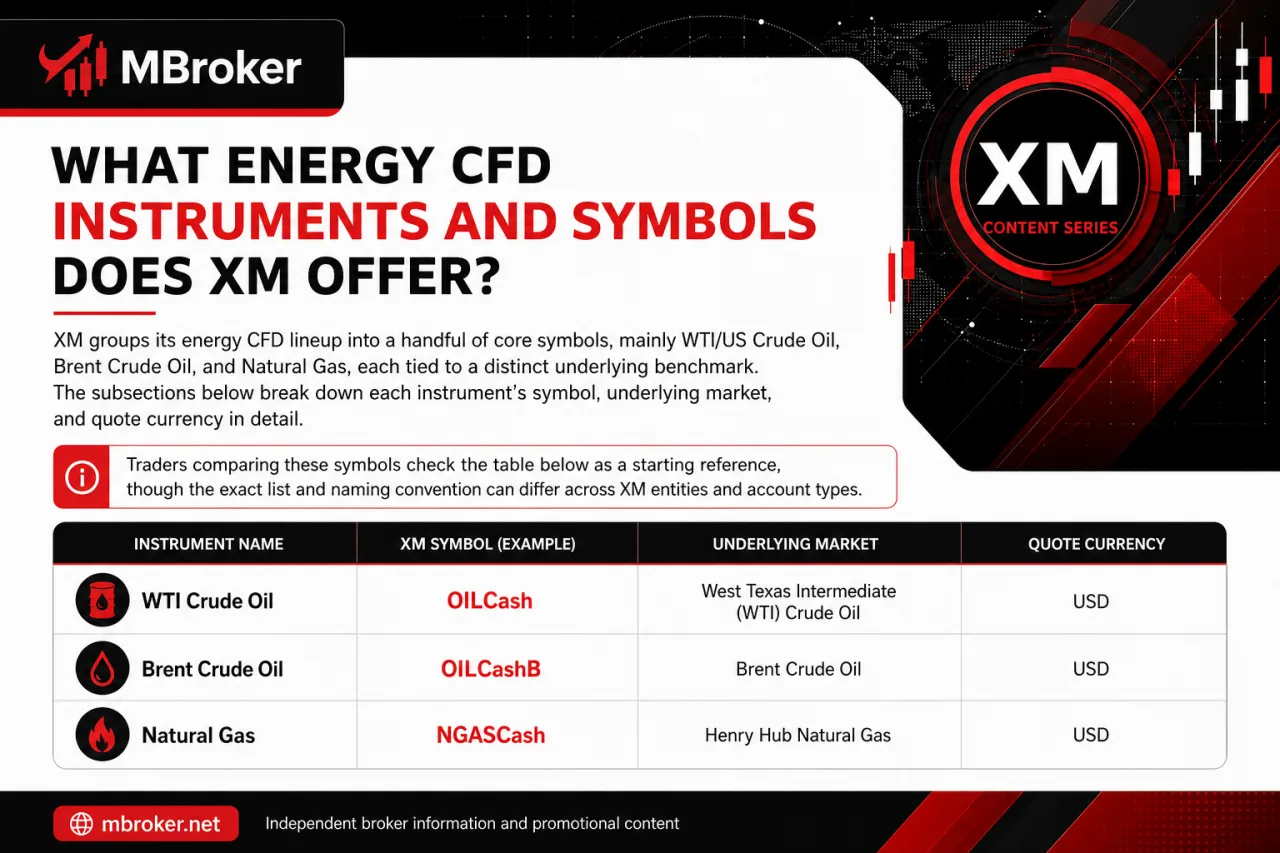
XM groups its energy CFD lineup into a handful of core symbols, mainly WTI/US Crude Oil, Brent Crude Oil, and Natural Gas, each tied to a distinct underlying benchmark. The subsections below break down each instrument’s symbol, underlying market, and quote currency in detail.
Traders comparing these symbols check the table below as a starting reference, though the exact list and naming convention can differ across XM entities and account types.
| Instrument Name | XM Symbol (example) | Underlying Market | Quote Currency |
|---|---|---|---|
| WTI / US Crude Oil | USOIL / OIL.WTIUSD | West Texas Intermediate crude futures | USD |
| Brent Crude Oil | UKOIL / OIL.BRTUSD | Brent crude futures | USD |
| Natural Gas | NATGAS / NGAS | Henry Hub natural gas futures | USD |
Note: the symbols, underlying markets, and quote currencies listed above are subject to change and should be cross-checked against XM’s official contract specifications page at the time of reading.
Exact symbol naming, contract availability, and specifications for energy CFDs vary by XM legal entity, trading platform, and account classification.
Traders verify the current instrument list and specifications on XM’s official contract specifications page before opening any energy CFD position.
How Do Crude Oil (WTI) and Brent Oil CFDs Differ on XM?
WTI and Brent oil CFDs on XM differ mainly in their underlying benchmark, with WTI priced off US crude futures and Brent priced off the North Sea crude futures market. This pricing-source gap drives most of the practical differences traders notice between the two symbols.
Both instruments trade as separate tradable CFD symbols on XM, each with its own contract specification rather than sharing a single quote. WTI, listed under symbols such as USOIL or OIL.WTIUSD, tracks a landlocked US benchmark that historically settles at a different price level than Brent. Brent, listed under UKOIL or OIL.BRTUSD, tracks a seaborne crude benchmark commonly used as a global pricing reference.
Symbol naming, minimum volume, tick size, and rollover scheduling can vary between the two contracts even though both quote in USD. Because each benchmark reflects a distinct regional supply and demand market, WTI and Brent CFD prices do not always move in perfect parallel, and the spread between them can widen or narrow independently of either instrument’s own trend.
Traders check XM’s official contract specification page for each symbol before comparing costs or opening positions, since exact figures depend on account type and platform.
What Is the XM Natural Gas CFD Symbol?
The XM Natural Gas CFD tracks Henry Hub natural gas futures, typically listed under symbols such as NATGAS or NGAS depending on the platform and account type. This instrument gives traders exposure to natural gas price swings without holding any physical gas or a futures contract itself.
Following on from the crude oil symbols covered above, the natural gas CFD carries its own separate contract specification. The instrument quotes in USD, matching the other energy CFDs on XM’s lineup, and its price references the Henry Hub futures curve rather than a spot gas price.
Because natural gas futures expire on a set schedule, the CFD inherits rollover mechanics similar to WTI and Brent, meaning open positions face a price adjustment when XM shifts the reference to the next active contract month. Contract size, minimum volume, and tick value for the natural gas symbol differ from the oil symbols, so traders check XM’s official contract specifications page for the exact figures tied to their account type and platform before opening a position.
Natural gas prices show sharp volatility around supply reports and seasonal demand shifts, a factor traders weigh against their own risk tolerance.
What Are the Trading Conditions for XM Energies on MT4 and MT5?
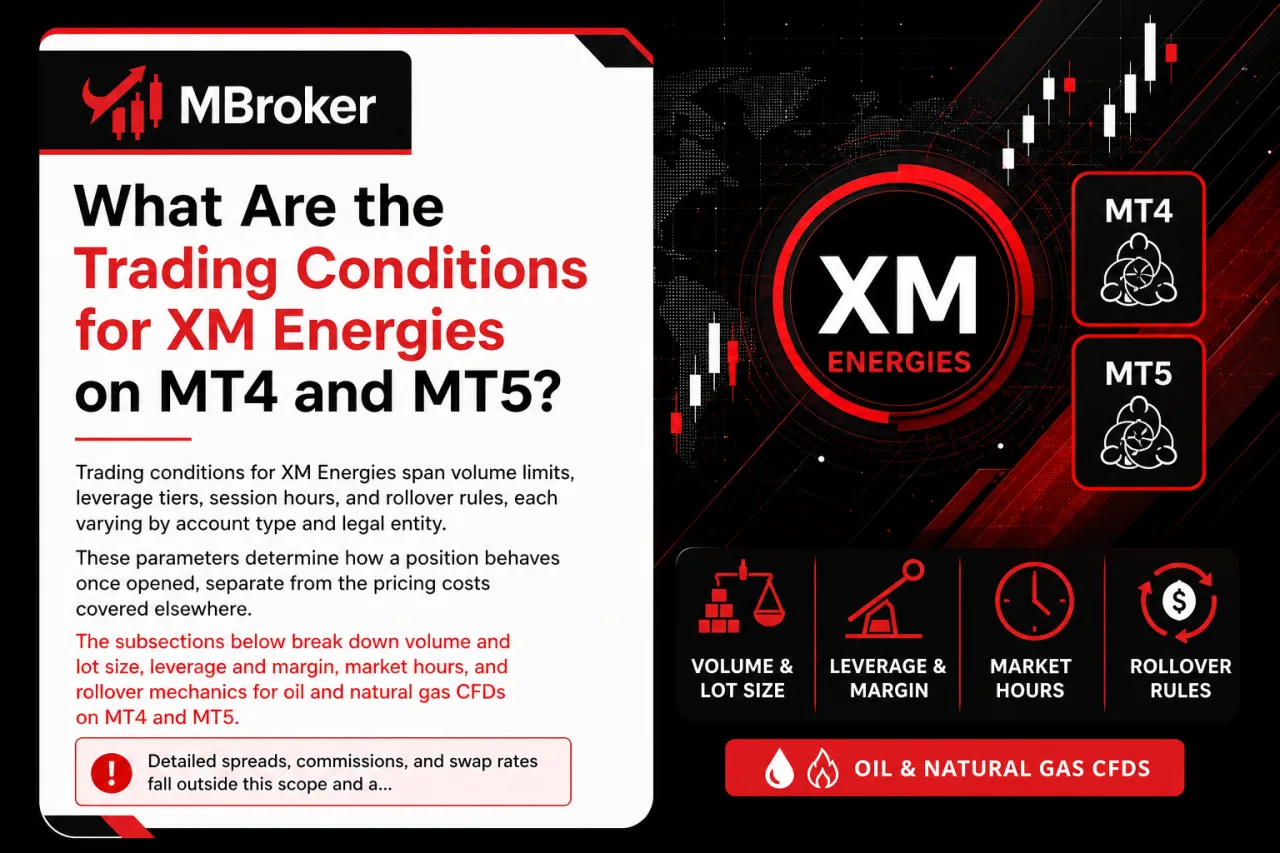
Trading conditions for XM Energies span volume limits, leverage tiers, session hours, and rollover rules, each varying by account type and legal entity. These parameters determine how a position behaves once opened, separate from the pricing costs covered elsewhere. The subsections below break down volume and lot size, leverage and margin, market hours, and rollover mechanics for oil and natural gas CFDs on MT4 and MT5.
Detailed spreads, commissions, and swap rates fall outside this scope and appear in a dedicated XM Fees article. Traders confirm the exact figures applicable to their account and platform on XM’s official contract specifications page before opening any energy CFD position.
How Does Leverage Work for XM Energy CFDs Across Account Types?
Leverage on XM energy CFDs shifts according to account type, client classification, and the specific XM entity a trader falls under, with regulated entities capping leverage lower than international ones. This tiered structure carries directly into how margin gets calculated on oil and natural gas positions.
Several factors determine the leverage available on a given account:
- Client classification: retail clients under a regulated XM entity face leverage caps set by that regulator, while professional clients access higher tiers.
- Entity type: accounts under an international XM entity typically allow higher leverage than those under a regulated one.
- Account type: Micro, Standard, and XM Zero accounts can carry different default leverage settings even under the same entity.
Margin requirements move inversely with leverage. Lower leverage ties up more margin per lot on WTI, Brent, or Natural Gas CFDs, while higher leverage frees up margin but raises exposure per dollar invested. Traders adjust leverage manually within the limits their account and entity allow, subject to XM’s own risk management rules.
Leverage ranges for energy CFDs vary by client residency and regulatory status, so figures can differ between one XM entity and another.
Traders check the leverage table tied to their specific account, verified on XM’s official website, before sizing any energy CFD position.
What Are the Trading Hours and Holiday Schedule for XM Energies?
XM Energies generally follow the trading hours of their underlying futures markets, with WTI, Brent, and Natural Gas CFDs open across most of the trading week but subject to daily session breaks and holiday adjustments. Following on from the leverage and margin structure covered above, session timing and holiday schedules form another variable traders check before opening an oil or gas CFD position.
Oil and natural gas CFDs typically trade across an extended daily session that spans most of the trading week, with a short daily maintenance break separating one trading day from the next. Exact opening and closing times for each energy symbol follow server time and shift with daylight saving changes in different regions.
Market holidays affect this schedule directly. When a public holiday falls on a day the underlying futures exchange closes or shortens its session, XM adjusts trading hours for the corresponding energy CFD accordingly, sometimes closing the instrument entirely or reducing liquidity around that session.
Traders confirm exact opening hours, holiday closures, and any early-close schedule for WTI, Brent, and Natural Gas CFDs on XM’s official market hours and holiday calendar page before planning a position around a holiday period.
Which XM Platforms Support Energy CFD Trading?
XM Energies trade across four main platforms: MT4, MT5, WebTrader, and the XM mobile app, with instrument availability and execution speed varying slightly between them. Following on from the trading hours and rollover mechanics covered above, platform choice forms another practical factor traders check before opening an oil or gas CFD position.
MT4 and MT5 desktop terminals carry the full range of energy CFD symbols, including WTI, Brent, and Natural Gas, with MT5 typically offering additional order types and a deeper market depth view compared to MT4. WebTrader mirrors the desktop MT4/MT5 experience through a browser, requiring no download, though some advanced charting tools available on desktop terminals load with reduced functionality on the web version.
The XM mobile app, available for MT4 and MT5 on iOS and Android, supports opening and closing energy CFD positions along with monitoring rollover events, though chart analysis tools run more limited than on desktop platforms.
Execution speed and symbol naming can differ slightly by platform and broker server, so traders confirm the exact instrument list and platform-specific conditions for energy CFDs on XM’s official website before opening a position.
How Do XM Energies Compare to Other Commodities and Brokers?

XM Energies show higher volatility and expiry-driven pricing compared with gold and other precious metals CFDs available through XM, since oil and gas track futures curves rather than a steadier spot-like reference. Following on from the platform coverage above, this section places oil and gas CFDs against other XM commodity classes and against general industry practice, without ranking specific competing brokers.
Gold and silver CFDs on XM generally trade off a more continuous spot-style reference with fewer scheduled rollover events, while WTI, Brent, and Natural Gas inherit rollover mechanics from their underlying futures benchmarks. Energy prices react sharply to geopolitical developments and supply disruptions, a sensitivity that tends to run higher than typical precious metals price swings.
Product structure also differs: precious metals CFDs on XM commonly carry simpler, non-expiring quote mechanics, whereas energy CFDs require traders to track contract rollover dates.
On a broader industry level, brokers offering commodity CFDs are generally compared on a few concrete points beyond general reputation. Relevant criteria include the number of energy symbols made available (XM lists WTI, Brent, and Natural Gas), the order types supported (market and pending orders across MT4, MT5, WebTrader, and mobile), and whether rollover terms are disclosed clearly for each instrument. Judged against these criteria, XM’s energy offering follows standard practice among CFD brokers offering commodity access, though exact instrument range, platform depth, and specifications vary by broker and by XM entity.
What Are the Key Risks of Trading XM Energy CFDs?
Trading XM Energy CFDs carries risks distinct from other asset classes: sharp volatility from geopolitical and supply-demand events, leverage amplifying losses, and gap risk around rollover and market open. The subsections below break down each risk factor along with balance protection considerations tied to oil and natural gas CFDs.
This overview stays educational and does not constitute investment advice, so traders review XM’s official risk disclosure documents before opening any energy CFD position.
What Happens to XM Energy CFDs During Contract Rollover or Expiration?
When a referenced futures contract nears expiry, XM rolls the energy CFD position to the next active contract month, applying a price adjustment to reflect the new futures reference. This mechanism carries directly on from the rollover behavior already described for WTI, Brent, and Natural Gas CFDs earlier in this guide.
The rollover process itself follows a set sequence. XM identifies the expiring futures contract underlying a given energy symbol, then shifts the CFD’s pricing reference to the next available contract month once the old one nears its expiry date. Because the new contract month can trade at a different price level than the expiring one, open positions may show a visible price gap at the moment of rollover, separate from any actual market movement.
This adjustment affects unrealized profit or loss on open positions, though it reflects a shift in the pricing reference rather than a trading loss caused by market direction. Rollover dates and the size of any adjustment differ across WTI, Brent, and Natural Gas, and can also vary by account type or platform.
Traders check XM’s official rollover schedule and contract specifications page for exact dates before holding an energy CFD position through an expiry period.
Conclusion
XM energy CFDs allow traders to speculate on the price movements of WTI crude oil, Brent crude oil and natural gas without owning or taking delivery of the underlying commodities. Because these instruments generally track futures benchmarks, their symbols, contract sizes, leverage, margin requirements, trading hours and rollover arrangements may differ by instrument, platform, account type and XM legal entity.
Before opening a position, traders should verify the latest contract specifications and rollover schedule directly on the XM platform. Energy prices can move sharply in response to geopolitical events, production decisions, inventory reports, weather conditions and seasonal demand. Since leverage can amplify both gains and losses, traders should use appropriate position sizes, maintain sufficient free margin and consider practising on a demo account before trading with real funds.

Sylas Trenven is a forex strategist who helps traders master risk and timing. His work focuses on behavior-driven market entries and portfolio optimization for XM users looking to trade with precision and discipline. Email: [email protected]