
 Tiếng Việt
XM does not charge a direct deposit fee on most standard funding methods. XM absorbs the transaction cost for common payment channels such as bank cards and select e-wallets, though this policy depends on the client’s assigned legal entity and chosen payment provider, so traders should verify the exact list of supported methods directly on XM’s official deposit page before transferring funds.
Withdrawal fees follow a similar structure but are not automatically guaranteed to be free in every case. XM generally does not deduct a withdrawal fee itself, but the payment method used and the frequency of withdrawals can trigger provider-side charges, so traders should check the specific terms for their chosen payment method directly on XM’s official withdrawal page.
The minimum deposit required to open or fund an XM account is set at a specific threshold that varies by account type. According to XM’s official account types page, the minimum deposit required differs by account tier, with higher-tier accounts requiring a substantially larger funding amount than entry-level accounts, so traders should verify the exact threshold for their chosen account type and payment method directly on XM’s official page. This threshold differs by account tier and legal entity, which directly affects which payment options are available to a trader.
Currency conversion charges can still apply even when XM does not levy its own deposit fee. A conversion cost can arise when the funding currency differs from the account’s base currency, since the applicable exchange rate is typically set by the payment provider or bank rather than by XM itself, so traders should verify the specific rate with their payment provider before depositing.
These distinctions matter because deposit conditions, withdrawal rules, minimum funding levels and currency conversion costs are interconnected parts of the same fee structure. The following sections from Mbroker break down each of these elements in detail, starting with whether XM charges fees on deposits.
Does XM Charge Fees on Deposits?
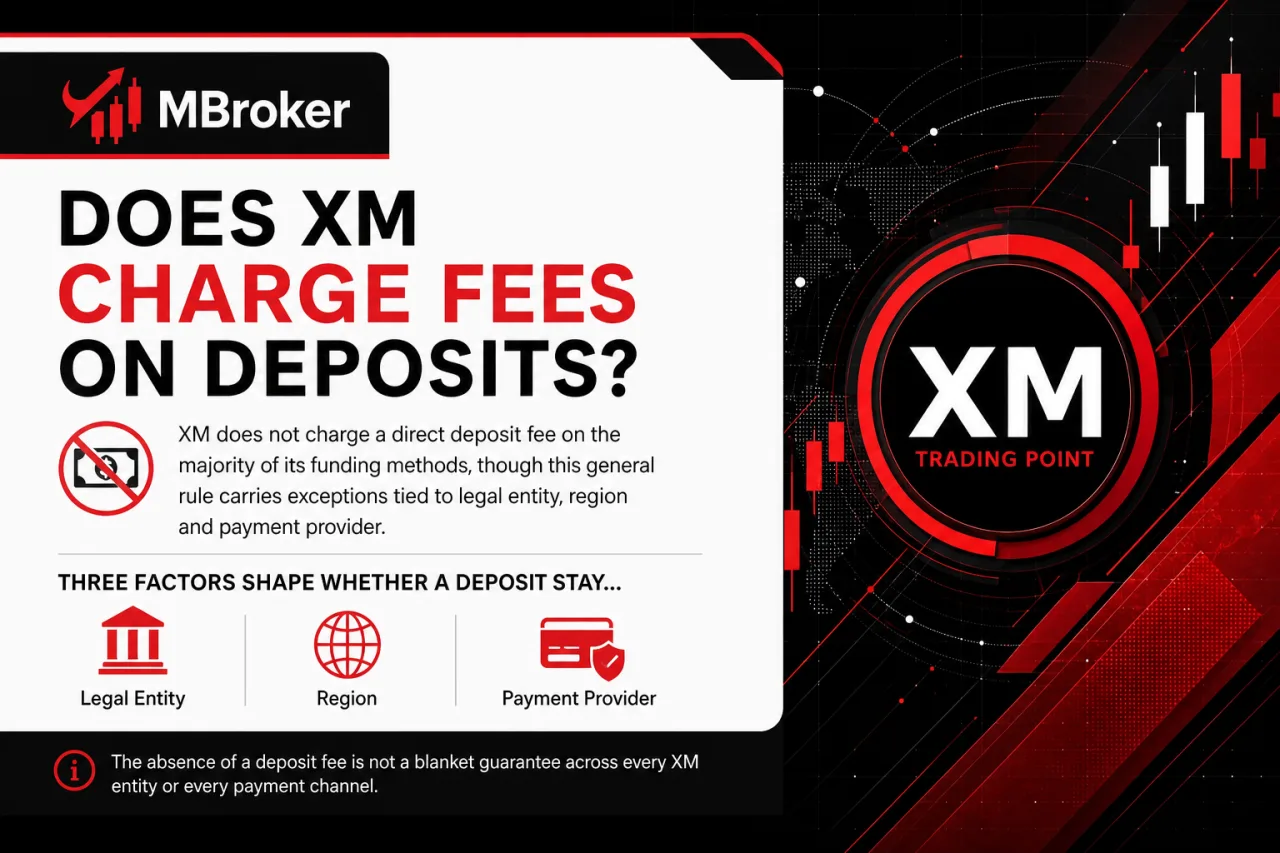
XM does not charge a direct deposit fee on the majority of its funding methods, though this general rule carries exceptions tied to legal entity, region and payment provider. This overview picks up directly on the deposit and withdrawal distinctions outlined above and sets the stage for the entity-specific and method-specific breakdowns that follow.
The absence of a deposit fee is not a blanket guarantee across every XM entity or every payment channel. Three factors shape whether a deposit stays cost-free: the legal entity a client is registered under, the country or region from which the deposit originates, and the payment method selected at the time of funding. Traders operating under different XM entities may encounter different terms for the same payment method, since regulatory requirements and banking partnerships vary by jurisdiction.
Because these conditions change over time and by region, the deposit fee policy described here reflects information available as of the review date and should be cross-checked against the terms published for the client’s specific assigned XM entity before funding an account.
Which Payment Methods Are Free of XM Deposit Charges?
XM groups deposit methods into four broad categories: bank wire transfers, credit and debit cards, e-wallets, and local payment methods, with cards and select e-wallets most commonly free of XM-side charges. This grouping continues the payment method discussion from the previous section and clarifies which channels typically stay cost-free versus which may carry provider fees.
Bank wire transfers sit apart from the other categories because correspondent or intermediary banks can deduct handling charges before funds reach XM, even when XM itself does not add a fee. Cards, including Visa and Mastercard, generally process deposits without an XM-imposed charge, though the issuing bank’s own policies on foreign transactions can still apply.
E-wallets such as Skrill, Neteller, and similar providers are typically fee-free from XM’s side for standard deposits, but each provider may enforce its own terms depending on currency and account status. Local payment methods, including region-specific bank transfers or online banking solutions, vary the most since their availability and fee status depend heavily on the client’s country and assigned XM legal entity.
Traders should confirm the exact list of supported deposit methods and their fee status directly on XM’s official deposit page before funding an account.
Are There Any Conditions That Make a Deposit Non-Free?
Yes, certain conditions still turn a nominally free deposit into a charged one, mainly tied to legal entity, unsupported currency, or bank-side handling. This exception picks up on the payment method breakdown above, since even a category marked as free can carry hidden costs under specific circumstances.
Three scenarios commonly override the general no-fee rule. Clients registered under a regional XM entity with different regulatory or banking arrangements may face a deposit charge that does not apply to clients under another entity. Depositing in a currency not natively supported by the account triggers a conversion step handled by the payment provider or intermediary bank, and that provider sets its own charge independent of XM. Bank wire transfers routed through correspondent banks can also incur handling deductions before the funds arrive, even when XM itself waives its side of the fee.
These situations remain exceptions rather than the standard experience for most deposit methods. Traders should verify the deposit terms tied to their specific assigned XM legal entity and payment currency directly on XM’s official page before transferring funds.
Does XM Charge Withdrawal Fees Too?
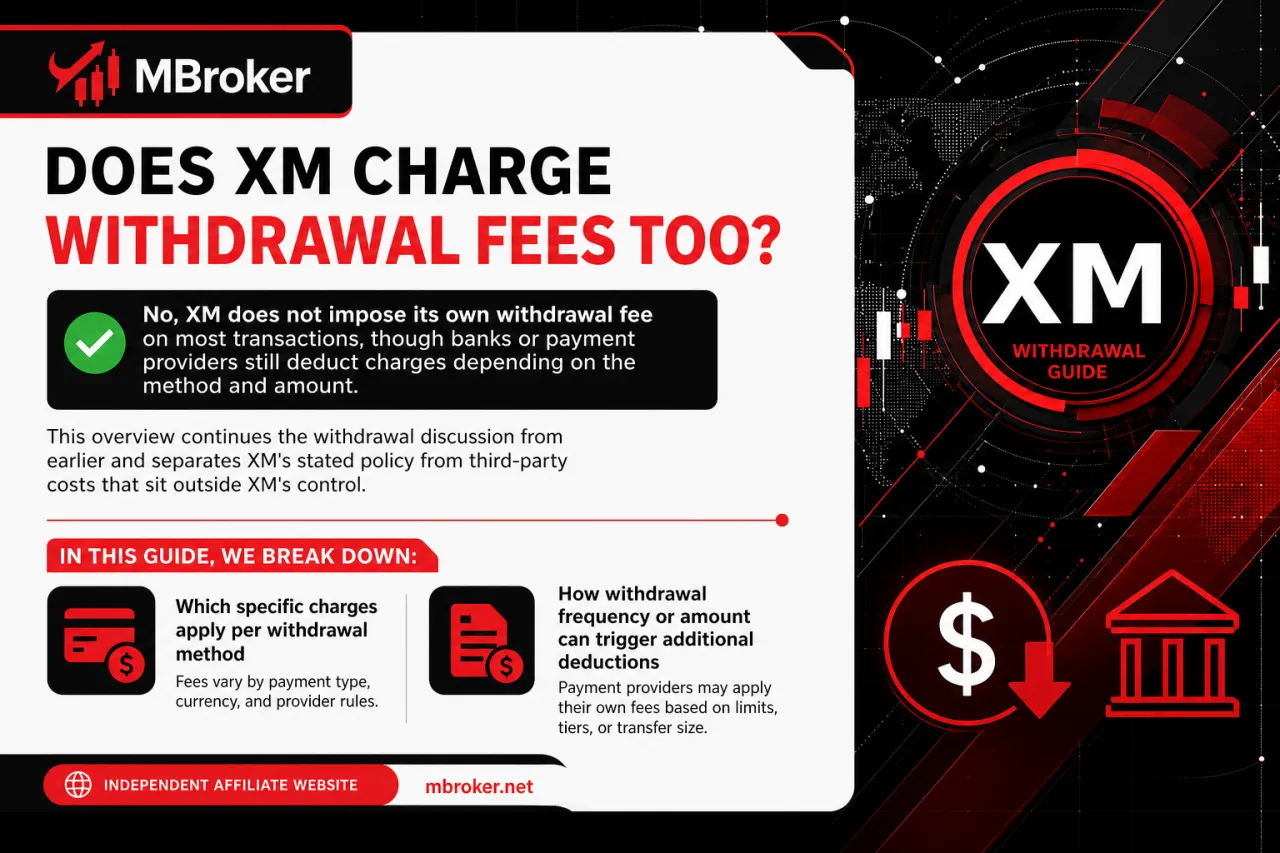
No, XM does not impose its own withdrawal fee on most transactions, though banks or payment providers still deduct charges depending on the method and amount. This overview continues the withdrawal discussion from earlier and separates XM’s stated policy from third-party costs that sit outside XM’s control. Two sub-areas break this down further: which specific charges apply per withdrawal method, and how withdrawal frequency or amount can trigger additional deductions from the payment provider’s side.
How Is a Withdrawal Fee (If Any) Calculated?
Any withdrawal charge follows the fee schedule published by the specific payment provider, since XM itself does not apply a standard flat or percentage-based formula on top of client withdrawals. This calculation question ties directly into the method-by-method breakdown promised above, where bank wires, cards and e-wallets each carry their own provider-side terms rather than a single XM-wide rule.
Where a charge exists, it typically takes one of two forms. Bank wire transfers can involve a flat handling deduction taken by the intermediary or receiving bank, applied per transaction regardless of the withdrawal size. Card and e-wallet withdrawals more commonly involve a percentage-based or currency conversion charge, applied when the payout currency differs from the account’s base currency.
No unified official fee schedule from XM sets a fixed calculation formula for every withdrawal method and currency combination, so the exact amount deducted depends on the provider processing that specific transaction.
Traders should check the fee terms listed for their selected withdrawal method and currency directly on XM’s official withdrawal page before requesting a payout.
What Is the Minimum Withdrawal Amount Allowed?
XM sets a minimum withdrawal amount that varies by payment method and account currency, rather than applying one fixed threshold across all channels. This detail follows directly from the withdrawal fee structure discussed above, since the minimum payout level ties into the same method-specific terms that determine whether a charge applies.
Bank wire withdrawals, card payouts, and e-wallet transfers each carry their own minimum amount, set partly by the payment provider’s own processing rules rather than by XM alone. The account’s base currency also plays a role, since a threshold expressed in one currency converts to a different figure once translated into another currency at the prevailing rate. Clients registered under different XM legal entities may also see different minimum figures applied to the same payment method, consistent with the regional variation already noted for deposits.
Traders should confirm the exact minimum withdrawal amount for their selected payment method and account currency directly on XM’s official withdrawal page before requesting a payout.
What Is the Minimum Deposit Required to Open or Fund an XM Account?
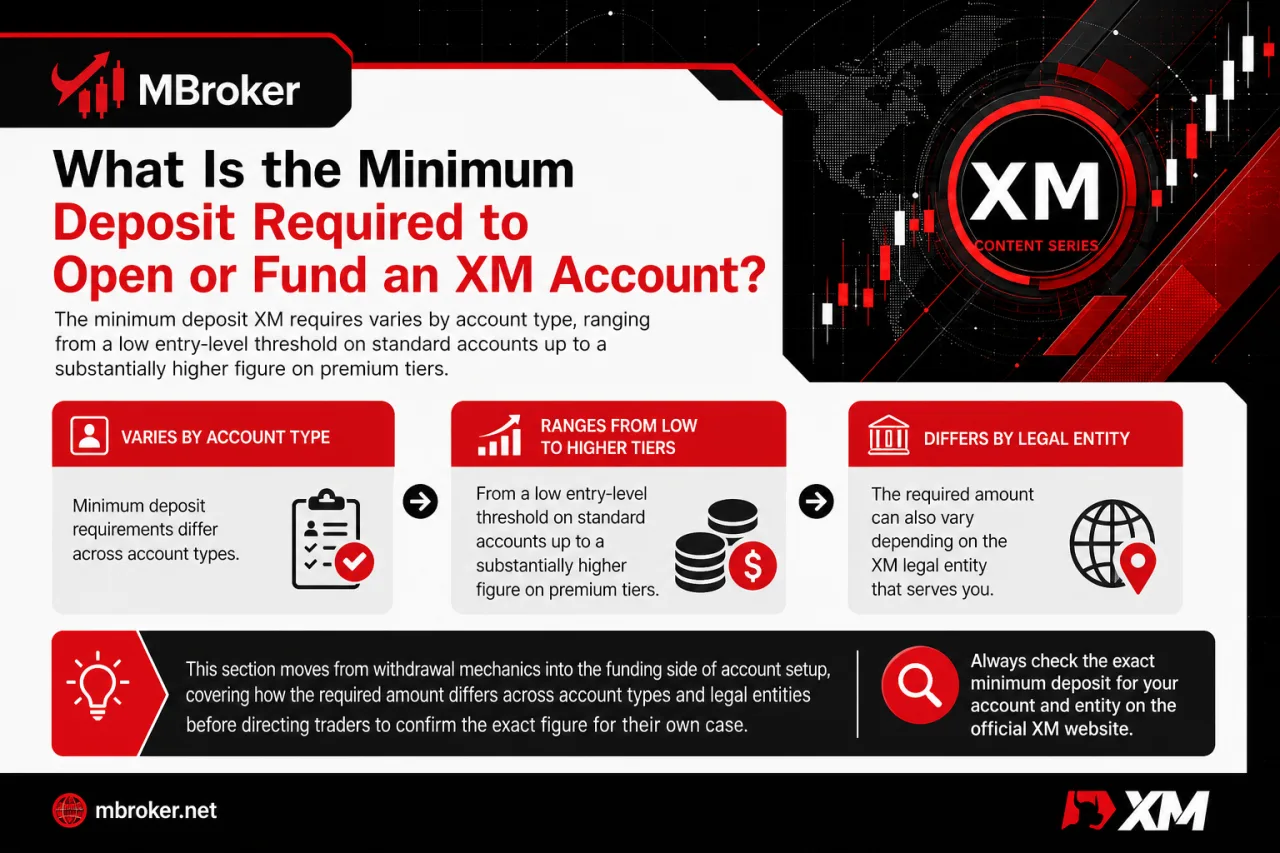
The minimum deposit XM requires varies by account type and legal entity, with the exact threshold differing across the account tiers XM offers. This section moves from withdrawal mechanics into the funding side of account setup, covering how the required amount differs across account types and legal entities before directing traders to confirm the exact figure for their own case.
According to XM’s official account types page, the minimum deposit threshold changes depending on the account type and legal entity selected. Traders must verify the exact figure for their chosen account type directly on XM’s official website.
Which Deposit Methods Does XM Support?
XM supports four main deposit channels: bank wire transfers, debit/credit cards, e-wallets such as Skrill and Neteller, and local bank transfers, grouped by processing speed and regional availability. This grouping builds directly on the payment method categories already outlined for deposit fees, focusing here on which specific channels a trader can actually access.
Bank wire transfers work across nearly all XM legal entities but process slower than digital alternatives, since they route through intermediary banks. Debit and credit cards, including Visa and Mastercard, offer near-instant funding and remain available to most clients regardless of region.
E-wallets like Skrill and Neteller add a further layer of speed and convenience, though their availability depends on whether the client’s country supports that specific provider. Local bank transfers, including region-specific online banking options, appear only under certain XM entities and are not offered uniformly worldwide.
Traders should confirm which of these deposit methods applies to their country and assigned XM legal entity directly on XM’s official deposit page before funding an account.
Are There Currency Conversion or Bank Charges When Depositing?
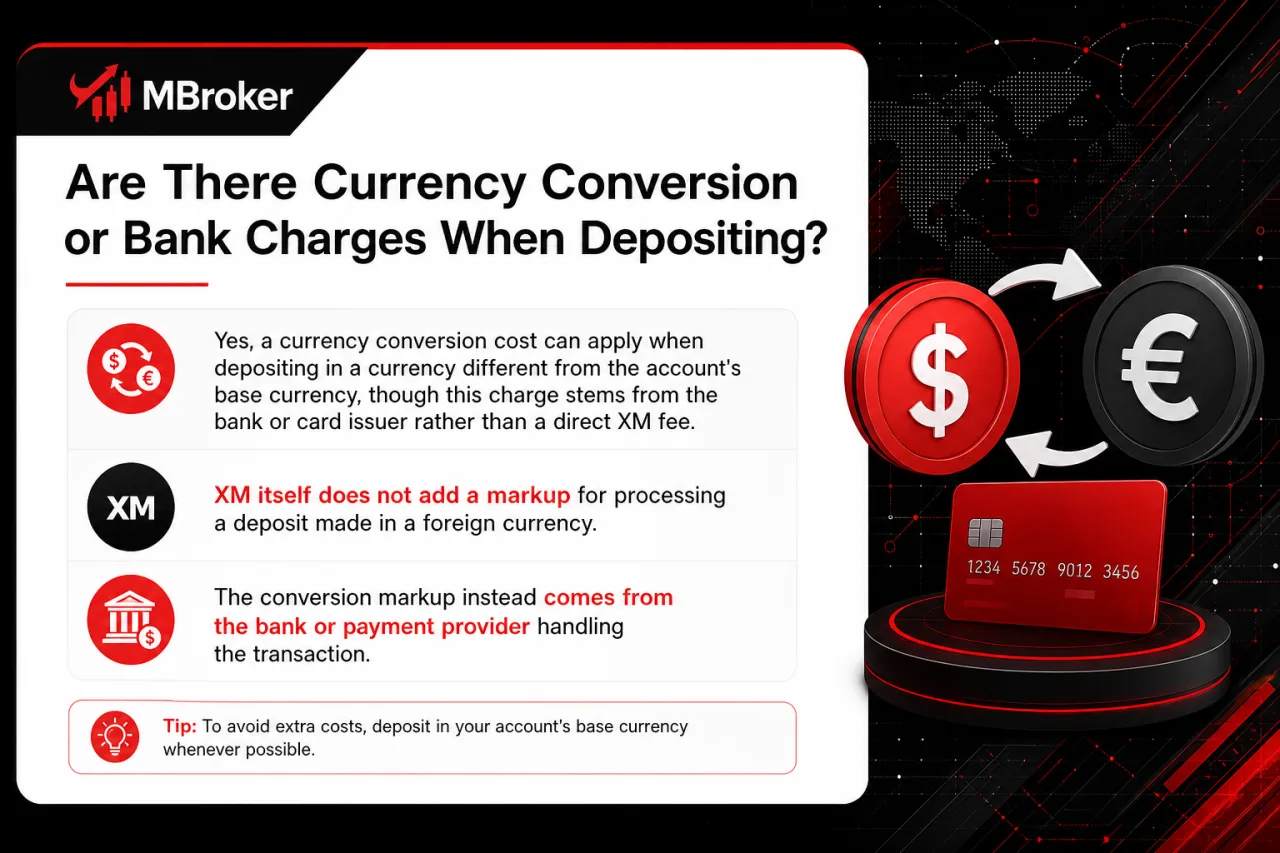
Yes, a currency conversion cost can apply when depositing in a currency different from the account’s base currency, though this charge stems from the bank or card issuer rather than a direct XM fee. This point builds on the currency conversion issue already raised in the introduction. It separates XM’s own policy from third-party conversion practices tied to deposits specifically.
XM itself does not add a markup for processing a deposit made in a foreign currency. The conversion markup instead comes from whichever party handles the currency exchange step. This is typically the card issuer, the sending bank, or the e-wallet provider facilitating the transfer.
Three factors determine whether this conversion cost applies to a given deposit:
- Matching the funding currency to the account’s base currency avoids a conversion step entirely.
- Selecting a card or e-wallet issued in a different currency triggers an exchange rate set by that provider.
- Routing a bank wire through an intermediary bank can add its own conversion spread before funds reach XM.
Traders should confirm the exchange rate and any conversion markup with their card issuer, bank, or e-wallet provider before depositing in a currency other than their account’s base currency.
How Is the Currency Conversion Cost Calculated?
To calculate a currency conversion cost, the payment provider applies its own exchange rate at the time of transaction, adding a markup on top of the interbank rate. This calculation continues directly from the conversion issue raised above, illustrating how the markup applies through a labeled hypothetical scenario rather than a fixed XM formula.
Consider an illustrative example: a trader deposits USD into an XM account denominated in EUR. The card issuer or e-wallet provider converts the USD amount into EUR using its own rate at that moment, which typically sits above the raw interbank exchange rate. A markup in such a scenario could reduce the converted amount credited to the account compared to using the interbank rate, with the exact percentage depending entirely on the specific provider processing that transaction.
This example remains illustrative only and does not represent a guaranteed rate for every deposit. The provider, the currency pair involved, and the timing of the transaction all shift the final markup applied.
Traders should confirm the exact conversion rate and any markup with their card issuer, bank, or e-wallet provider before depositing in a currency different from their account’s base currency.
Can Third-Party or Bank Charges Apply Independently of XM?
Yes, banks, card issuers, and e-wallet providers apply their own charges independently of XM’s fee policy, since these third parties operate outside XM’s direct control. This point extends the currency conversion discussion above, separating what XM itself charges from what a payment intermediary decides to charge on its own terms.
Three types of independent charges commonly appear. Card issuers deduct foreign transaction fees on cross-border payments regardless of what XM lists as its own policy. Correspondent banks handling wire transfers subtract handling charges before funds reach XM or before a withdrawal reaches the client. E-wallet providers apply their own processing fees or currency conversion markups based on internal terms unrelated to XM’s schedule.
These charges depend entirely on the specific provider, the client’s account terms with that provider, and the currency involved in the transaction. XM’s published fee terms cover only what XM itself imposes on a transaction, not what a bank or payment provider adds on their end.
Traders should check directly with their bank, card issuer, or e-wallet provider before depositing or withdrawing funds to confirm any charges those parties may apply.
Information reviewed as of the current publication date; confirm current terms directly with XM and the relevant payment provider for the specific account type, currency, and legal entity involved before transacting.
How Do XM Deposit and Withdrawal Costs Compare to Other Brokers?
Comparing XM’s deposit and withdrawal costs against another broker requires matching the same payment method, transaction size, and account currency for both sides. This comparison extends the withdrawal and conversion topics covered above into a cross-broker context, weighing XM’s fee structure against a competitor’s stated terms rather than relying on a single advertised claim. The following breakdown looks at how this comparison holds up under matching conditions and what factors readers should verify before drawing a conclusion.
A side-by-side comparison places XM and a named competitor under identical conditions, such as the same card deposit method and the same transaction amount, to isolate genuine cost differences. This method follows directly from the comparison principle introduced above, since matching variables prevents one broker’s promotional zero-fee claim from skewing the result.
A fair comparison table pulls figures from each broker’s own current official fee schedule rather than from marketing pages. A direct comparison would require identifying a specific broker and gathering actual deposit and withdrawal fee data from both XM and that broker under the same payment method and transaction amount.
Three elements shape the final conclusion beyond either broker’s headline claim:
- Combining XM’s deposit fee status with any provider-side card or e-wallet charge on both platforms.
- Combining withdrawal minimums and processing charges under the same payment method for both brokers.
- Combining currency conversion markups applied by each broker’s payment partners for the same currency pair.
Readers should verify current deposit and withdrawal terms directly against XM’s official page and the compared broker’s official fee schedule before treating any single zero-fee claim as the full picture.
What Processing Times Should Be Considered Alongside Fees?
Processing time factors into the true cost of a deposit or withdrawal because delayed access to funds carries an opportunity cost separate from any explicit fee. This factor extends the comparison framework above, since two brokers charging identical fees can still differ meaningfully in how quickly a trader can actually use the money.
Cards and e-wallets generally credit deposits faster than bank wire transfers, since wires route through intermediary banks that add processing steps. XM’s processing window for withdrawals typically begins once the request passes internal verification, after which the payment method’s own timeframe applies before funds reach the client, so traders should confirm the exact processing time for their chosen method directly on XM’s official withdrawal page.
Withdrawal requests routed back to the original deposit method, a common anti-fraud requirement, can also extend the wait when that method itself processes slowly.
Traders should confirm the current processing timeframe for their specific deposit or withdrawal method directly on XM’s official page before assuming instant fund availability.
Conclusion: Does XM Charge Deposit Fees?
XM generally does not charge a direct fee on standard deposit methods, but funding an account may not always be completely cost-free. Additional costs can arise from banks, card issuers, e-wallet providers, intermediary banks or currency conversion when the deposit currency differs from the account’s base currency. Deposit options and conditions may also vary by country and XM legal entity. Therefore, traders should review the available methods in their XM account and confirm any third-party charges before transferring funds. Where possible, using the account’s base currency can help reduce avoidable conversion costs.

Neria Solven is Mbroker’s XM Accounts, Fees and Promotions Editor, covering account types, trading costs, payment methods and promotional programmes. Email: [email protected]