
 Tiếng Việt

Yes, according to XM’s official terms and conditions, XM may charge an inactivity fee if a trading account remains dormant for more than 90 days. This charge only applies after a defined period of no trading activity on the account, not immediately after opening it.
The XM inactivity fee, once applied after the dormant period is reached, is deducted from the account on a recurring basis rather than as a one-time charge. The exact figure and currency depend on the account’s base currency and the legal entity handling the account.
According to XM’s official Trading Accounts help center, the fee is triggered after 90 consecutive days without any trading activity on the account. XM’s terms indicate that only trade execution resets the dormancy countdown.
Compared with other brokers that charge similar dormant account fees, XM’s policy follows a common industry pattern rather than an exceptionally high or low rate; for instance, according to BrokerChooser’s XM fees review, XM charges $10 per month after 90 days of inactivity, a rate comparable to what many other brokers charge for dormant accounts. Mbroker breaks down these figures below, starting with whether XM actually applies this charge, how much it costs and how often it is deducted, followed by the specific conditions that trigger it.
Does XM Charge an Inactivity Fee?
Does XM Charge an Inactivity Fee
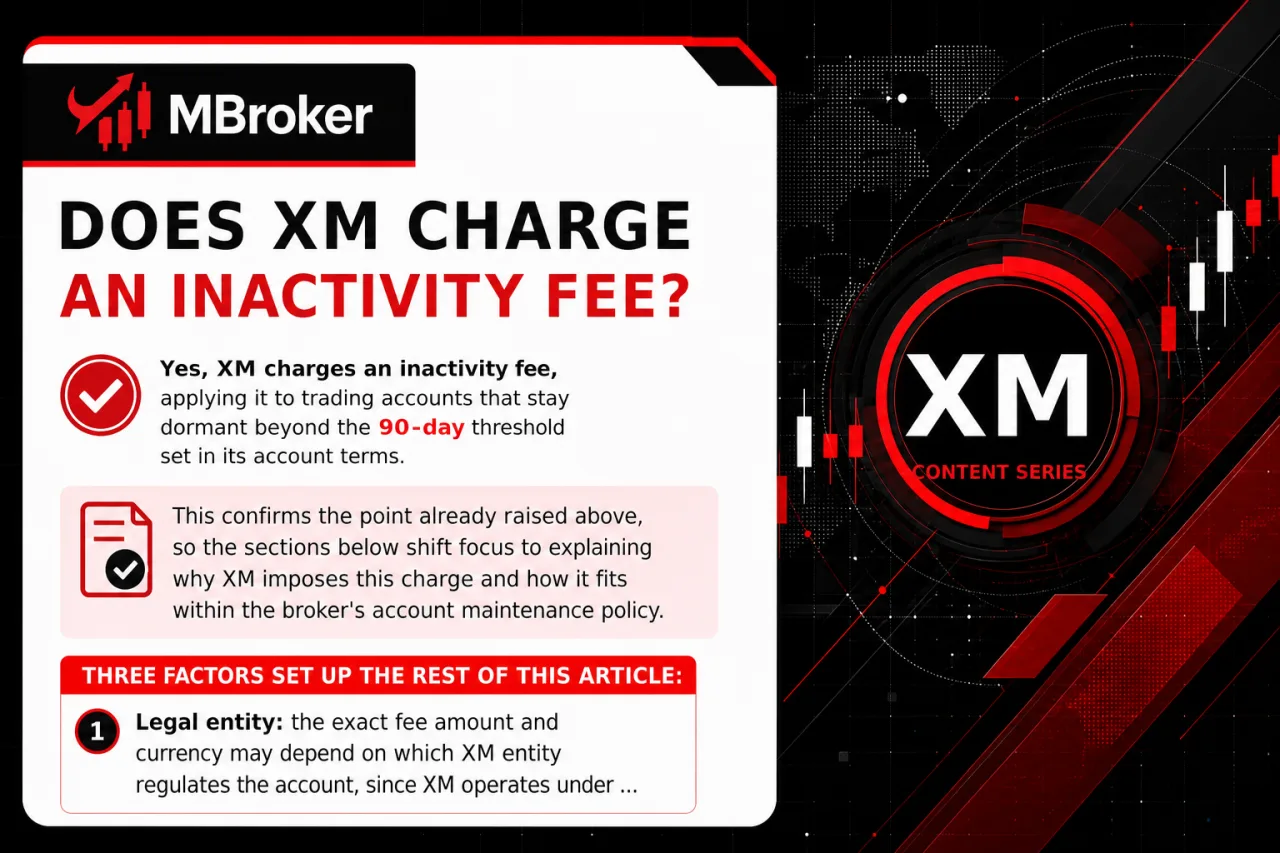
Yes, XM charges an inactivity fee, applying it to trading accounts that stay dormant beyond the 90-day threshold set in its account terms. This confirms the point already raised above, so the sections below shift focus to explaining why XM imposes this charge and how it fits within the broker’s account maintenance policy.
Three factors set up the rest of this article:
- Legal entity: the exact fee amount and currency depends on which XM entity regulates the account, since XM operates under separate regulated entities across different regions.
- Account type: the dormancy rule applies broadly across XM’s standard live trading accounts rather than being limited to one specific account tier.
- Trigger condition: the fee only activates once no trading activity occurs within the defined dormancy window, not from account inactivity in deposits or withdrawals alone.
These distinctions matter because a client’s assigned legal entity and account status determine whether the inactivity fee gets deducted and how much is charged, a topic covered in detail further in this article.
How Much Is the XM Inactivity Fee and How Often Is It Charged?
How Much Is the XM Inactivity Fee and How Often Is It Charged
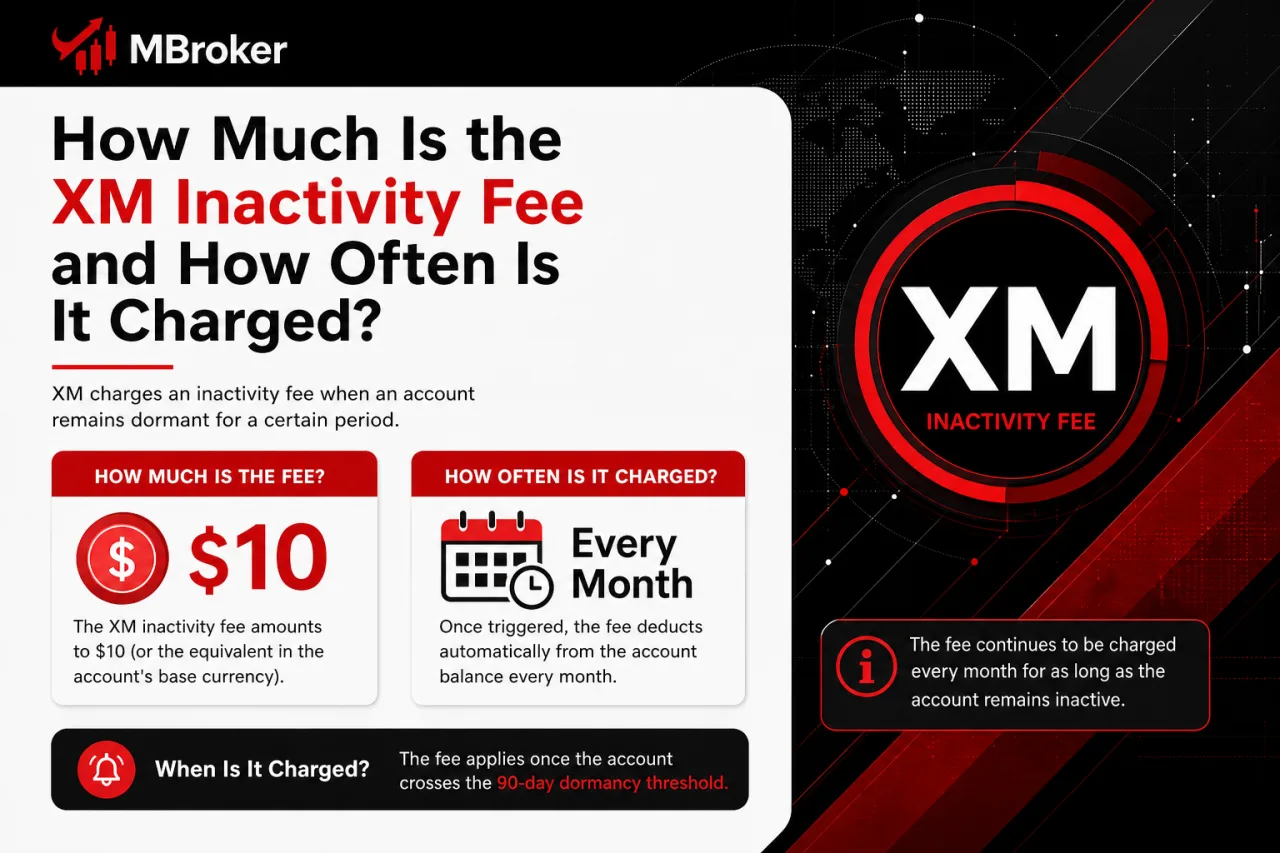
XM’s official fee schedule states that the inactivity fee amounts to $10 (or the equivalent in the account’s base currency) per month once the account crosses the 90-day dormancy threshold.
This section breaks down the exact charge and its billing cycle referenced earlier in the article.
Once triggered, the fee deducts automatically from the account balance every month for as long as the account stays dormant, rather than being billed as a single flat charge. If the client resumes trading before the next monthly cycle, the deduction stops from that point onward, in line with the dormancy terms set out in XM’s Client Agreement.
For accounts with a balance lower than the monthly fee, XM caps the deduction at whatever balance remains rather than pushing the account into a negative figure. Per XM’s official terms, the inactivity fee only deducts the remaining balance rather than pushing the account into negative debt, so an account with, say, $6 remaining would only lose that $6 instead of accruing debt toward XM. This same policy confirms that no client ends up owing XM money simply because their account went dormant.
Clients should confirm the exact fee amount, currency and billing terms under their specific XM legal entity and account type directly on XM’s official fees page or Client Agreement before assuming this figure applies universally.
What Conditions Trigger the XM Inactivity Fee?
What Conditions Trigger the XM Inactivity Fee
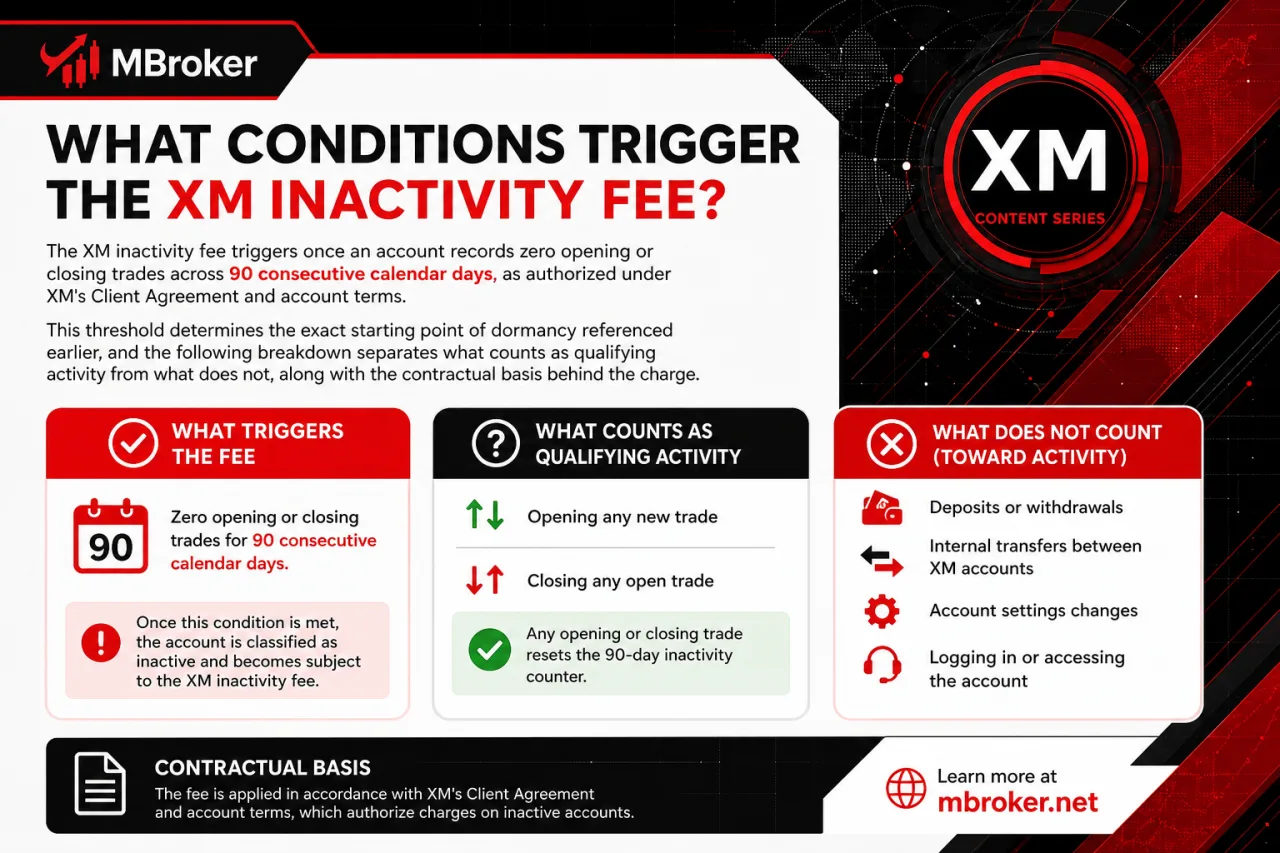
The XM inactivity fee triggers once an account records zero opening or closing trades across 90 consecutive calendar days, as authorized under XM’s Client Agreement and account terms. This threshold determines the exact starting point of dormancy referenced earlier.
The following breakdown separates what counts as qualifying activity from what does not, along with the contractual basis behind the charge.
How Is the 90-Day Inactivity Period Calculated?
To calculate the 90-day inactivity period, XM starts the countdown from the date of the last trade opened or closed on the account, then resets the clock entirely once a new trade executes. This calculation method determines exactly when the dormancy threshold referenced earlier gets reached and when it clears.
The countdown runs on consecutive calendar days rather than trading days, meaning weekends and market holidays still count toward the 90-day total. Once the account crosses this threshold without a qualifying trade, XM classifies it as dormant and begins applying the monthly fee discussed earlier in this article.
If the client places even a single trade before the 90 days elapse, the counter resets to zero and starts fresh from that new trade’s date. This reset applies regardless of trade size or instrument, since XM’s dormancy rule counts trade execution itself rather than trade volume or profitability. According to XM’s official Trading Accounts help center (https://www.xm.com/es/help-center/trading-accounts), non-trading actions such as logging into the account, updating profile details, or making a deposit do not reset the 90-day countdown that determines when the inactivity fee is triggered.
Clients should verify the precise calculation method and any regional variations directly with XM support under their specific legal entity and account type.
Does the Inactivity Fee Apply to All XM Account Types?
No, the inactivity fee does not apply uniformly across all XM account types, since the specific terms depend on the client’s assigned legal entity and account classification. This distinction directly affects the dormancy conditions referenced earlier in this article, so the breakdown below separates the account types and regional entities where variations may occur.
Standard, Micro, Ultra Low and Shares accounts generally follow the same 90-day dormancy rule and monthly deduction structure outlined above, since these fall under the same core trading account category at XM.
Islamic (swap-free) accounts remain subject to the same inactivity fee policy as standard accounts, since the swap-free designation only removes overnight swap charges rather than exempting the account from dormancy fees.
Regional entities may introduce differences worth verifying directly:
- XM Global entities typically follow the standard 90-day and monthly fee structure described earlier.
- XM International entities may apply comparable terms, though currency denomination can shift based on the client’s registered region.
- XM UK or CySEC-regulated entities may carry additional regulatory disclosures tied to local financial conduct rules, since European regulatory frameworks sometimes impose stricter client fund protection requirements.
Clients should confirm the exact inactivity terms applicable to their specific account type and regulated entity directly through XM’s official documentation before assuming uniform treatment across all accounts.
How Does XM’s Inactivity Fee Compare to Other Brokers?
How Does XM’s Inactivity Fee Compare to Other Brokers
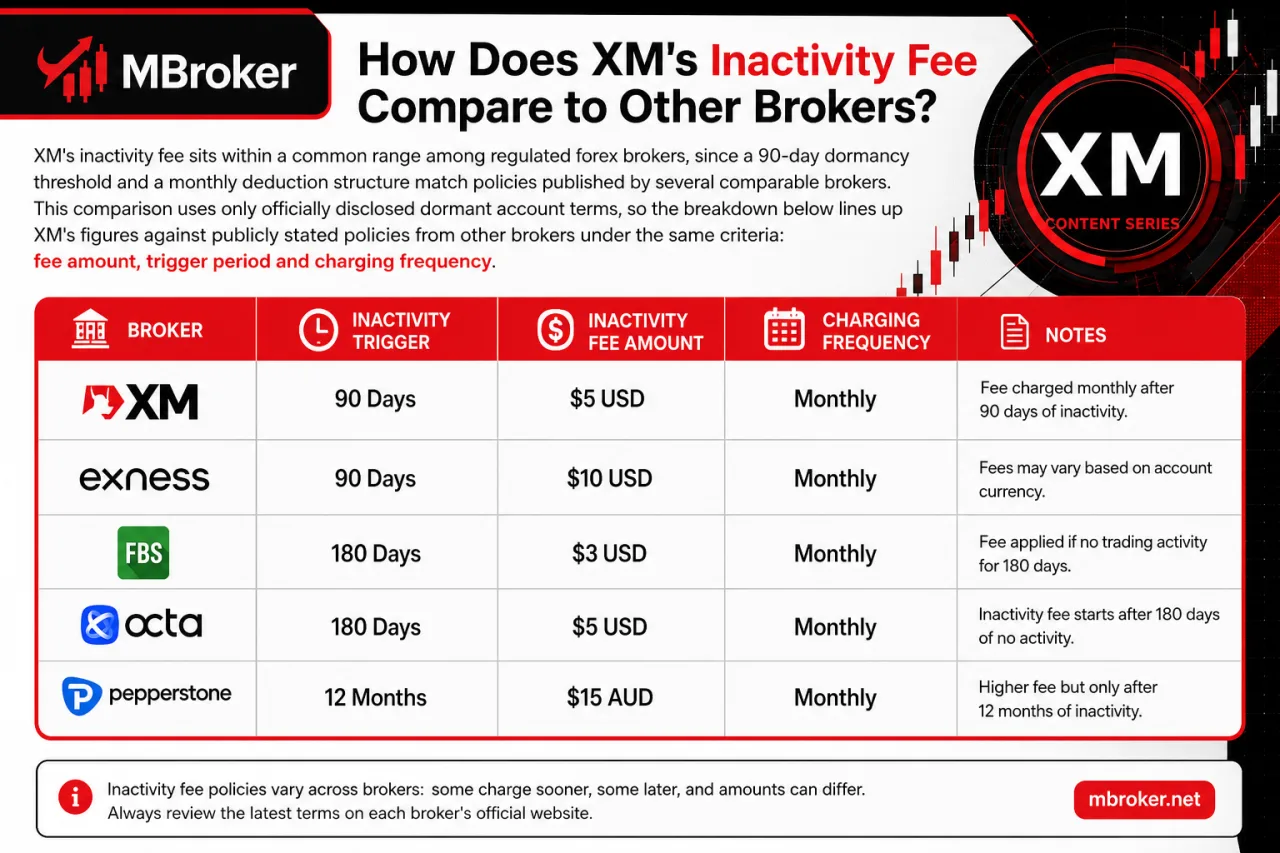
XM’s inactivity fee sits within a common range among regulated forex brokers, since a 90-day dormancy threshold and a monthly deduction structure match policies published by several comparable brokers. This comparison uses only officially disclosed dormant account terms, so the breakdown below lines up XM’s figures against publicly stated policies from other brokers under the same criteria: fee amount, trigger period and charging frequency.
For reference, brokers such as IC Markets, Exness and Pepperstone each publish their own dormant account terms, with figures that vary by entity, region and account type.
Inactivity fee policies vary across brokers: some charge higher monthly dormancy fees or apply shorter inactivity windows before the first deduction, while others set longer grace periods before any charge activates.
A few points shape this comparison:
- Fee amount: XM charges $10 per month once dormancy triggers, an amount consistent with what several other brokers disclose in their published fee schedules, though exact figures vary by broker.
- Trigger period: XM’s 90-day threshold matches the timeframe some brokers use, though others set shorter or longer windows before applying any charge.
- Charging frequency: XM deducts the fee monthly rather than as a single flat charge, a structure shared by several brokers but not universal across the industry.
These comparisons reflect general industry patterns rather than a fixed standard, and dormant fee terms remain subject to change across brokers.
Are There Ways to Avoid or Stop the XM Inactivity Fee?
Yes, placing at least one trade before the 90-day dormancy window closes prevents the XM inactivity fee from ever triggering. This directly follows from the trigger condition explained earlier, so the two approaches below separate prevention from stopping a fee already in progress.
What Happens If the Account Balance Reaches Zero Due to Inactivity?
No, XM does not push the account into a negative balance once inactivity deductions exhaust the funds, since the fee only takes whatever remains and then stops charging further. This clarifies how the zero-balance scenario resolves within the dormancy policy already outlined above.
Once the balance reaches zero, XM typically halts further monthly deductions rather than continuing to bill an account with no funds left. The account itself generally stays open and classified as dormant rather than being automatically closed, though it remains inactive until the client either deposits new funds or resumes trading. Clients should confirm the exact zero-balance handling and any account closure conditions directly through their specific XM legal entity, since this final-stage treatment may differ by region.
Conclusion: Is XM’s Inactivity Fee Avoidable?
XM’s inactivity fee can generally be avoided through timely account management, but traders should not assume that identical terms apply in every region. Under the policy described in this article, the fee begins after 90 consecutive calendar days without a qualifying trade and is deducted monthly only while funds remain, without creating a negative account balance. A new trade may reset the inactivity period, whereas non-trading actions such as logging in or making a deposit may not. Traders who no longer plan to use their account should check the latest Client Agreement for their assigned XM legal entity and consider withdrawing any remaining funds or requesting account closure before the dormancy threshold is reached.

Neria Solven is Mbroker’s XM Accounts, Fees and Promotions Editor, covering account types, trading costs, payment methods and promotional programmes. Email: [email protected]