
 Tiếng Việt
The XM Ultra Low Account is a trading account type designed to offer tighter spreads on major currency pairs compared to XM’s other account types. It requires a minimum deposit of $5, with eligibility open to both new and experienced traders under specific client classification rules. It supports both the MT4 and MT5 platforms, making it accessible across different trading setups.
The XM Ultra Low Account applies a small commission per lot alongside its reduced spreads, while the Standard Account uses wider spreads without separate commission charges. This distinction directly affects the overall trading cost depending on volume and strategy.
The XM Ultra Low Account suits both beginners seeking low entry costs and high-volume traders who benefit from tighter spreads on frequent transactions. Its flexible lot sizing and low deposit threshold accommodate varying trading volumes and experience levels.
The account is divided into Ultra Low Micro and Ultra Low Standard sub-types, each with distinct contract sizes and base currency options. Platform compatibility and available base currencies vary between these sub-types based on XM’s official account terms.
Mbroker breaks down these distinctions in detail below, starting with a clear definition of what the XM Ultra Low Account actually is.
What Is the XM Ultra Low Account?
What Is the XM Ultra Low Account
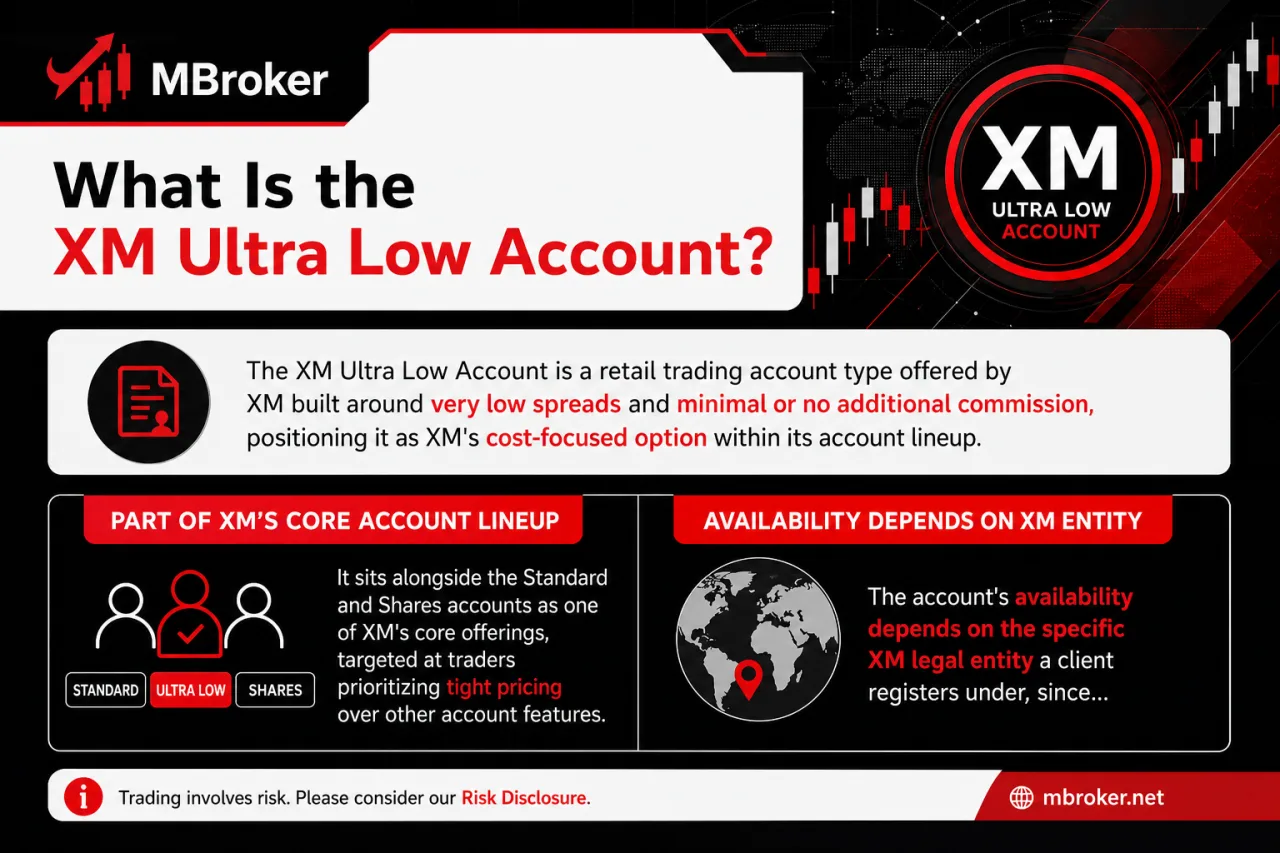
The XM Ultra Low Account is a retail trading account type offered by XM built around very low spreads and minimal or no additional commission, positioning it as XM’s cost-focused option within its account lineup. It sits alongside the Standard and Shares accounts as one of XM’s core offerings, targeted at traders prioritizing tight pricing over other account features.
Building on that definition, the account’s availability depends on the specific XM legal entity a client registers under, since regulatory frameworks differ by jurisdiction. Availability of the XM Ultra Low Account varies by region because XM operates through multiple regulated legal entities, each subject to its own jurisdictional rules.
Within this structure, the account is generally positioned for traders who value transaction cost efficiency over other perks. Key defining traits include:
- Low spread pricing on major instruments
- Minimal or no separate commission charges depending on the sub-type
- Retail client classification under standard eligibility rules
- Placement as a distinct tier within XM’s broader account structure
These characteristics separate the Ultra Low Account from XM’s other account types, which the following sections break down by sub-type, base currency, and platform compatibility.
What Features Does the XM Ultra Low Account Offer?
What Features Does the XM Ultra Low Account Offer
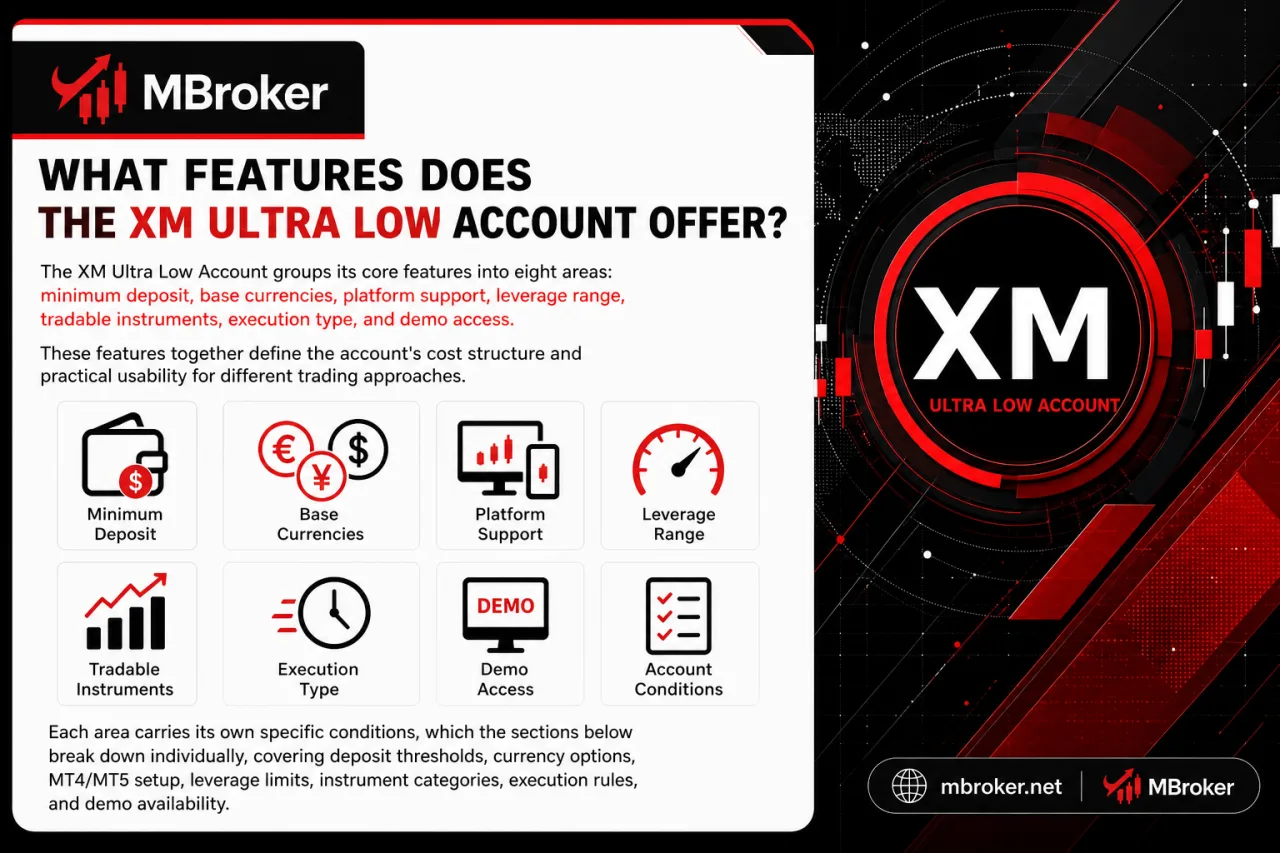
The XM Ultra Low Account groups its core features into seven areas: minimum deposit, base currencies, platform support, leverage range, tradable instruments, execution type, and demo access. These features together define the account’s cost structure and practical usability for different trading approaches.
Each area carries its own specific conditions, which the sections below break down individually, covering deposit thresholds, currency options, MT4/MT5 setup, leverage limits, instrument categories such as forex, commodities, indices, stocks, and metals, order execution model, and whether a risk-free demo version exists.
What Is the Minimum Deposit for the XM Ultra Low Account?
According to XM’s official account types page, the minimum deposit for the XM Ultra Low Account is $5, though the exact figure applies specifically to the legal entity a client registers under, since availability and terms vary across XM’s regulated entities by region.
This deposit threshold ties directly into how accessible the account remains across different trader profiles and regions. XM operates through several regulated legal entities, and deposit requirements, along with accepted payment methods, may differ depending on which entity processes the client’s registration.
Clients should verify the exact figure through their specific XM entity’s account opening page before funding, since regional regulatory rules can adjust minimum thresholds. The $5 minimum keeps the account accessible for beginners testing live trading conditions with limited capital, while still permitting larger initial deposits for traders scaling up position sizes from the start.
Which Base Currencies Are Available for the XM Ultra Low Account?
The XM Ultra Low Account supports multiple base currencies, with the exact options varying depending on the Ultra Low Micro or Ultra Low Standard sub-type and the XM legal entity processing the registration.
This currency selection ties directly into how the account manages deposits, withdrawals, and profit/loss calculations for each trader. Choosing a base currency that matches a trader’s local funding currency avoids extra conversion costs on deposits and withdrawals. XM’s official account types page lists the exact currencies available per sub-type and legal entity, since options differ between Ultra Low Micro and Ultra Low Standard configurations.
Traders opening an Ultra Low Account should verify the specific currency list shown during registration under their applicable XM entity, since this selection typically locks in at account creation and affects margin and swap calculations going forward.
Is the XM Ultra Low Account Compatible with MT4 and MT5?
Yes, the XM Ultra Low Account is compatible with both MT4 and MT5, giving traders the choice of either platform at registration. This platform question ties directly into how the account handles execution and instrument access across setups.
Both platforms run the same Ultra Low pricing structure, though a few practical differences exist:
- MT4 supports standard order types and expert advisors on a four-digit or five-digit pricing model depending on broker configuration.
- MT5 adds extra order types, additional timeframes, and an economic calendar built into the terminal.
- Instrument availability can differ slightly between the two, since MT5 typically lists a broader range of tradable symbols than MT4.
- Execution speed and spread behavior remain consistent between platforms for the same Ultra Low sub-type, as both connect to the same liquidity pricing.
Traders choosing between MT4 and MT5 for the Ultra Low Account base the decision on platform familiarity, automated trading needs, and desired instrument range rather than on cost, since spreads and commission structure stay identical across both terminals for the same sub-type.
What Are the Spreads and Commissions on the XM Ultra Low Account?
What Are the Spreads and Commissions on the XM Ultra Low Account
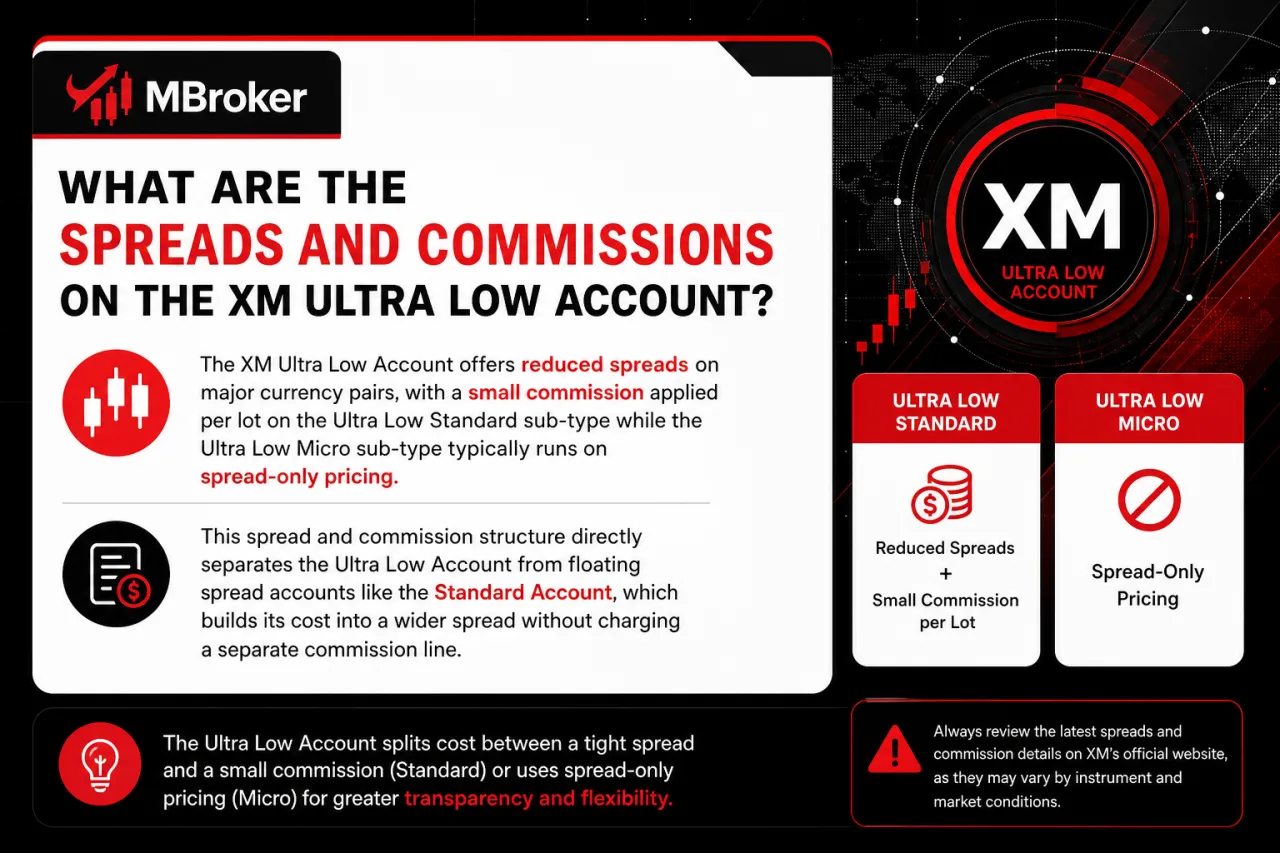
The XM Ultra Low Account offers reduced spreads on major currency pairs, with a small commission applied per lot on the Ultra Low Standard sub-type while the Ultra Low Micro sub-type typically runs on spread-only pricing.
This spread and commission structure directly separates the Ultra Low Account from floating spread accounts like the Standard Account, which builds its cost into a wider spread without charging a separate commission line. Because the Ultra Low Account splits cost between a tight spread and a per-lot fee, total trading cost depends heavily on trade frequency and volume rather than spread width alone.
Contract and lot sizing also differ by sub-type:
- Ultra Low Micro uses smaller contract sizes suited to micro-lot trading.
- Ultra Low Standard uses standard contract sizes aligned with typical forex lot conventions.
- Minimum trading volume per trade starts at the smallest lot increment XM permits for the selected sub-type.
- Maximum trading volume per trade follows XM’s published volume caps for the Ultra Low Account category.
These minimum and maximum volume limits and spread figures are published on XM’s official account types page, and the exact numbers vary by the trader’s legal entity of registration.
XM Ultra Low Account vs Standard Account: What Are the Differences?
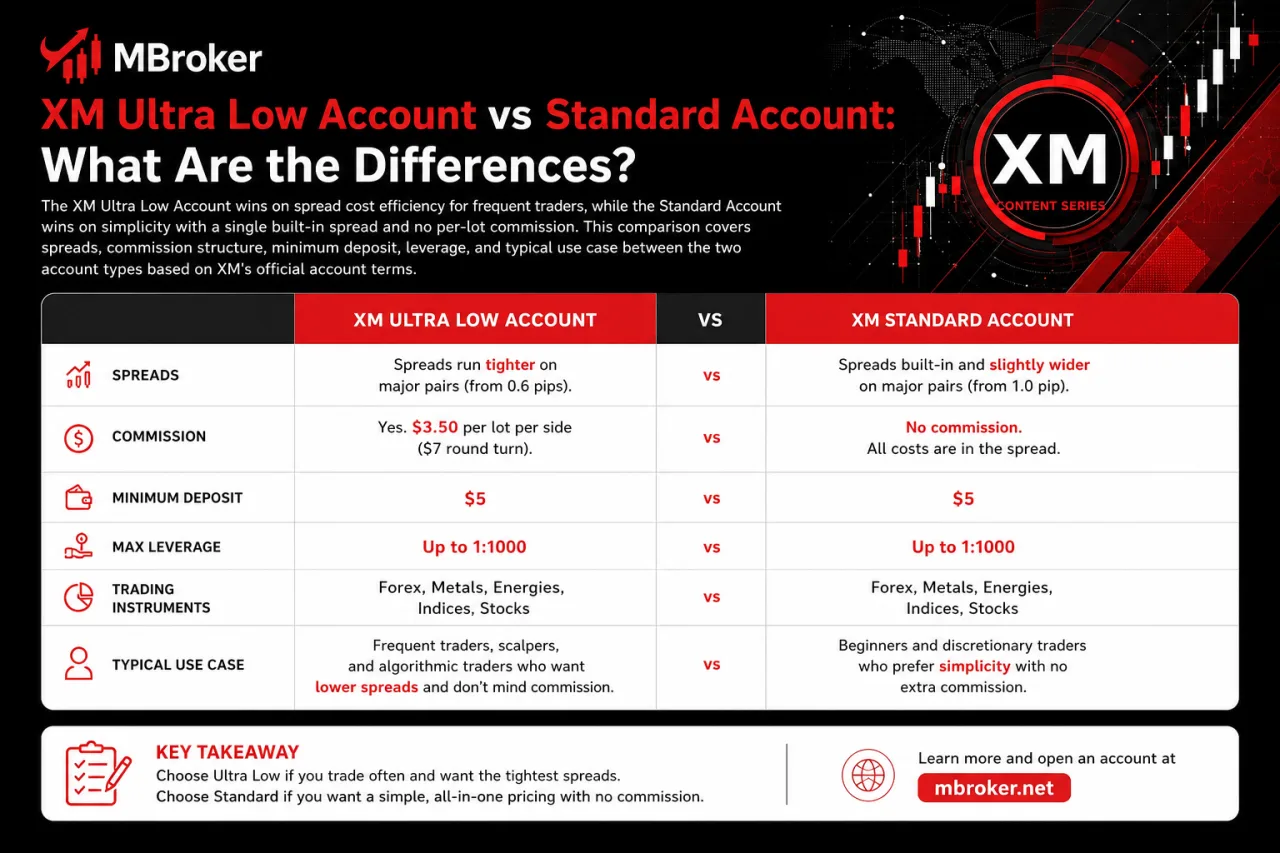
XM Ultra Low Account vs Standard Account: What Are the Differences
The main differences lie in spread width, commission structure, minimum deposit, and leverage between the two account types. This comparison covers spreads, commission structure, minimum deposit, leverage, and typical use case between the two account types based on XM’s official account terms.
The two accounts split trading cost differently rather than one being cheaper across the board. Key differences include:
- Spreads run tighter on the Ultra Low Account compared to the Standard Account’s wider floating spread.
- Commission applies per lot on the Ultra Low Standard sub-type, while the Standard Account charges no separate commission.
- Minimum deposit sits at $5 for the Ultra Low Account, matching the entry threshold already noted for its sub-types.
- Leverage ranges follow the same limits set by the client’s XM legal entity, applying equally to both account types rather than differing by account choice.
- Base currency options and platform support (MT4, MT5) remain available on both accounts, though specific currency lists vary by legal entity.
Typical use case separates the two further: the Ultra Low Account suits high-frequency or volume-based strategies where tight spreads offset the added commission, while the Standard Account suits traders preferring predictable, all-in spread pricing without tracking a separate commission line.
Is the XM Ultra Low Account Suitable for Beginners or High-Volume Traders?
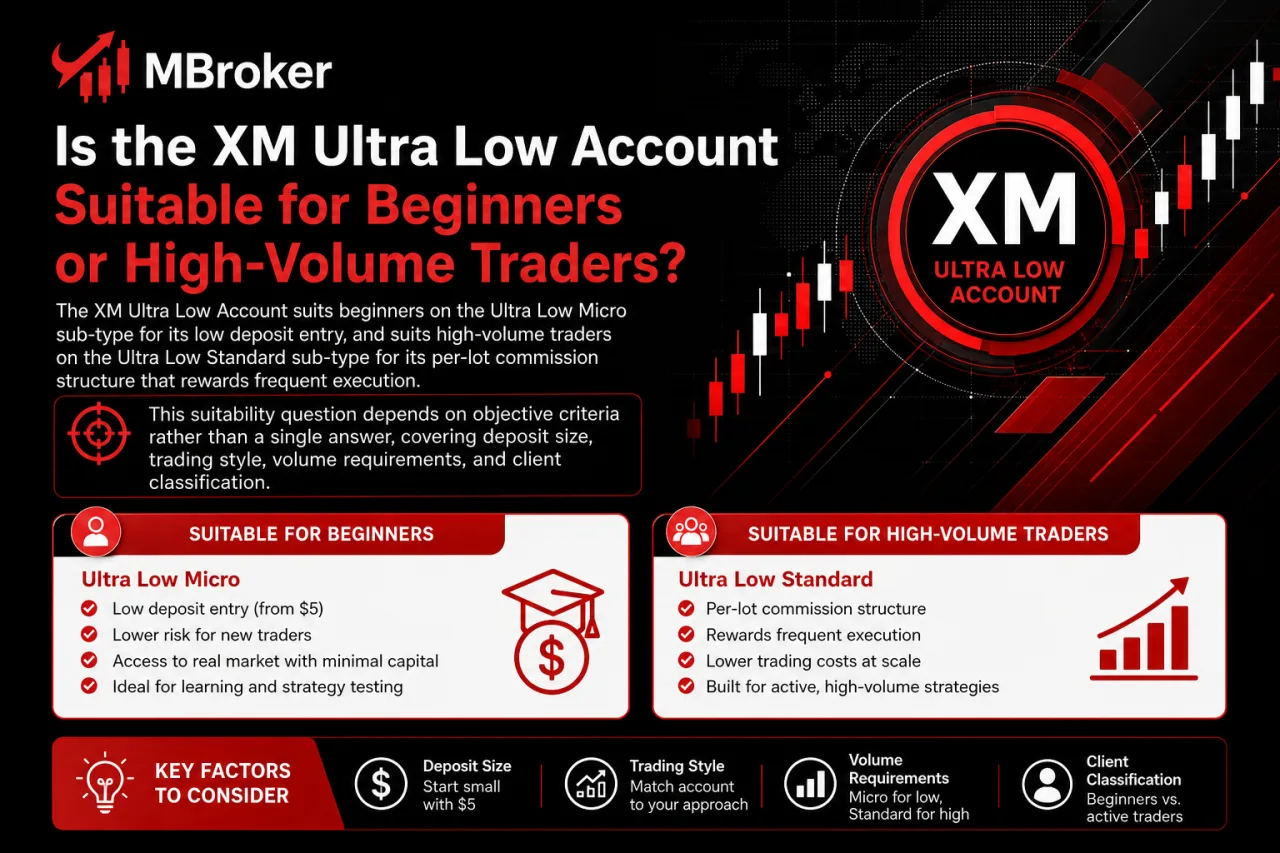
Is the XM Ultra Low Account Suitable for Beginners or High-Volume Traders
The XM Ultra Low Account suits both beginners and high-volume traders, depending on the sub-type chosen. Beginners fit the Ultra Low Micro sub-type for its low deposit entry. High-volume traders fit the Ultra Low Standard sub-type for its per-lot commission structure that rewards frequent execution. Suitability depends on objective criteria covering deposit size, trading style, volume requirements, and client classification.
Deposit size favors beginners at the entry level, since the $5 minimum already noted allows small-scale testing before scaling up. Trading style separates the two profiles further:
- Scalping and high-frequency strategies work with the tighter spreads on Ultra Low Standard, since transaction cost per trade drops as volume rises.
- Long-term or lower-frequency trading suits the Ultra Low Micro sub-type, where smaller contract sizes limit exposure per position.
- Volume-based traders offset the added commission through frequent lot turnover, making cost efficiency scale with activity level.
- New traders test strategies with minimal capital risk before committing to larger position sizes.
Client classification also applies here: retail clients follow standard leverage and margin rules under their XM legal entity, while professional client status, where available, changes leverage limits and negative balance protection terms as defined by that entity’s regulatory framework. Traders confirm their applicable classification and its conditions directly through their XM entity’s account documentation before opening either sub-type.
What Sub-Types Does the XM Ultra Low Account Have?
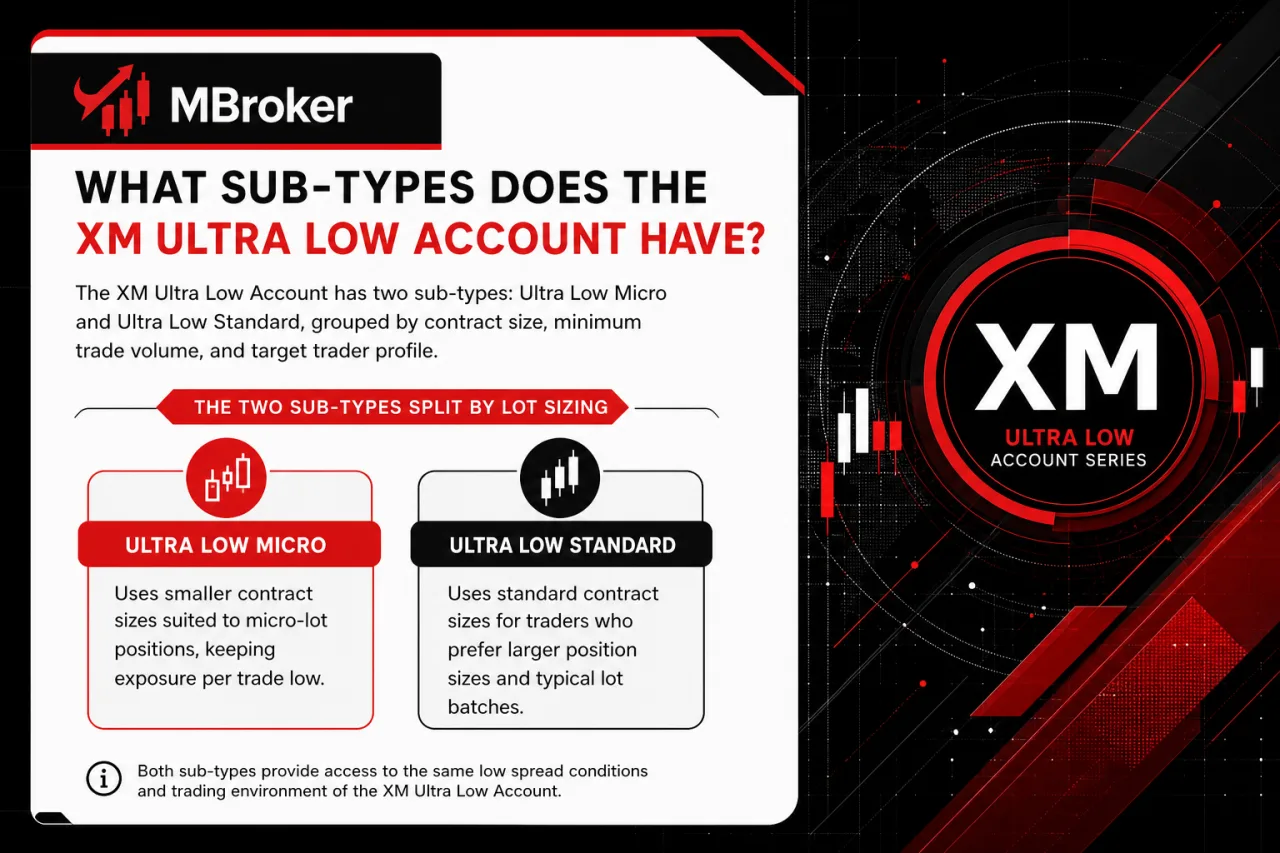
What Sub-Types Does the XM Ultra Low Account Have
XM does not publish an official, universally confirmed breakdown of the Ultra Low account into named sub-types, though trading conditions within this account category vary by lot sizing and contract size. This grouping question ties directly into the account structure already outlined for base currencies and platform support above.
Based on general lot sizing conventions referenced in XM’s materials, variations within the Ultra Low account tend to follow contract size rather than differences in spread or commission logic:
- Some configurations use smaller contract sizes suited to micro-lot positions, keeping exposure per trade low.
- Other configurations use standard forex contract sizes, aligning with conventional lot conventions used by higher-volume traders.
- Minimum trade volume for micro-lot style trading starts at a small lot increment, though XM does not publish an exact figure common across all entities.
- Minimum trade volume for standard-lot style trading sits at a level consistent with conventional standard lot trading, again without a single published figure that applies universally.
Trader profile generally follows this split: smaller lot sizing suits traders testing strategies or managing smaller capital allocations, while standard lot sizing suits traders running larger position sizes who benefit from the per-lot commission structure at higher volume. According to XM’s official account types page, exact contract sizes and volume limits depend on the client’s specific XM legal entity, and traders should verify the current classification directly with XM before opening an account.
Does the XM Ultra Low Account Support Islamic or Swap-Free Trading Conditions?
Yes, the XM Ultra Low Account supports swap-free trading through an Islamic account option, available on eligible legal entities upon client request. This swap-free status ties directly into the account’s suitability question already covered above, adding a religion-based exemption on overnight financing charges rather than a separate account type.
Eligibility and restrictions apply beyond a simple request:
- Availability depends on the specific XM legal entity processing the client’s registration, since not every entity offers this status.
- Approval typically requires the client to confirm eligibility under XM’s Islamic account terms during or after registration.
- Among Islamic account providers generally, swap-free status commonly replaces overnight swap charges with an alternative fee structure on certain instruments held past a set holding period, though the exact mechanism applied to the XM Ultra Low Account depends on the client’s registered entity and its published account terms.
- Both Ultra Low Micro and Ultra Low Standard sub-types remain eligible for swap-free conversion where the underlying legal entity permits it.
Traders confirm current swap-free availability and conditions directly through their applicable XM entity’s account documentation before applying this status to an Ultra Low sub-type. Exact swap-free eligibility criteria and any administrative fees for the XM Ultra Low Account vary by legal entity and account sub-type, so traders should confirm the specific terms that apply to their registered entity before enabling this feature.
Are There Restrictions on Leverage or Margin for Swap-Free Ultra Low Accounts?
No specific leverage cap or margin call/stop-out difference applies to swap-free Ultra Low sub-accounts beyond the standard limits already set for their underlying legal entity, based on XM’s published account terms. This restriction question ties directly into the swap-free eligibility rules already outlined above.
Additional limitations documented by XM instead focus on holding period and fee mechanics rather than leverage or margin:
- Overnight positions held past a set holding period trigger an administrative fee replacing the standard swap charge.
- Certain instruments carry exclusions from swap-free conversion depending on the client’s legal entity.
- Leverage and margin requirements follow the same tiers applied to standard Ultra Low Micro or Ultra Low Standard sub-accounts.
- Margin call and stop-out levels stay identical to non-swap-free equivalents under the same entity.
Traders confirm any entity-specific exceptions directly through their applicable XM legal entity’s account documentation before relying on swap-free status for a given instrument.
In conclusion, the XM Ultra Low Account is a cost-focused option for traders seeking tighter spreads, flexible position sizing, and access through MT4 or MT5. Its low entry threshold may appeal to beginners, while frequent and higher-volume traders can evaluate whether the pricing structure matches their strategies. However, account availability, commissions, base currencies, leverage, and swap-free conditions may vary by XM legal entity, so always verify the latest regional terms before registering or depositing funds.

Neria Solven is Mbroker’s XM Accounts, Fees and Promotions Editor, covering account types, trading costs, payment methods and promotional programmes. Email: [email protected]