
 Tiếng Việt
According to XM’s official account types page, the Standard Account is one of XM’s core trading account types, designed for traders seeking direct market exposure with flexible lot sizing. It supports both MT4 and MT5 platforms and covers a wide range of financial instruments, forming the baseline offering among XM’s account lineup.
According to XM’s official account types page, the Standard, Micro and Ultra Low accounts share the same core protections (negative balance protection, hedging and Islamic account options) but are structured differently, with the Standard Account generally offering a different contract size and minimum trading volume compared to the smaller Micro and Ultra Low lot structures. While Micro accounts use smaller lot sizes suited to beginners, the Standard account follows standard lot conventions used by more experienced traders.
According to XM’s official account types page, the Standard Account requires a minimum deposit of $5, and spreads vary depending on the traded instrument and market conditions. According to XM’s official account types page, the Standard Account does not charge a separate commission, as trading costs are incorporated into the spread itself.
Opening an XM Standard Account generally involves completing an online registration process, submitting identity verification documents, and selecting the account type during sign-up. The sections below present each of these steps in detail before a trader proceeds to fund the account.
The sections below explain what the XM Standard Account is, breaking down its structure and purpose within XM’s broader account offerings.
What Is the XM Standard Account?
What Is the XM Standard Account
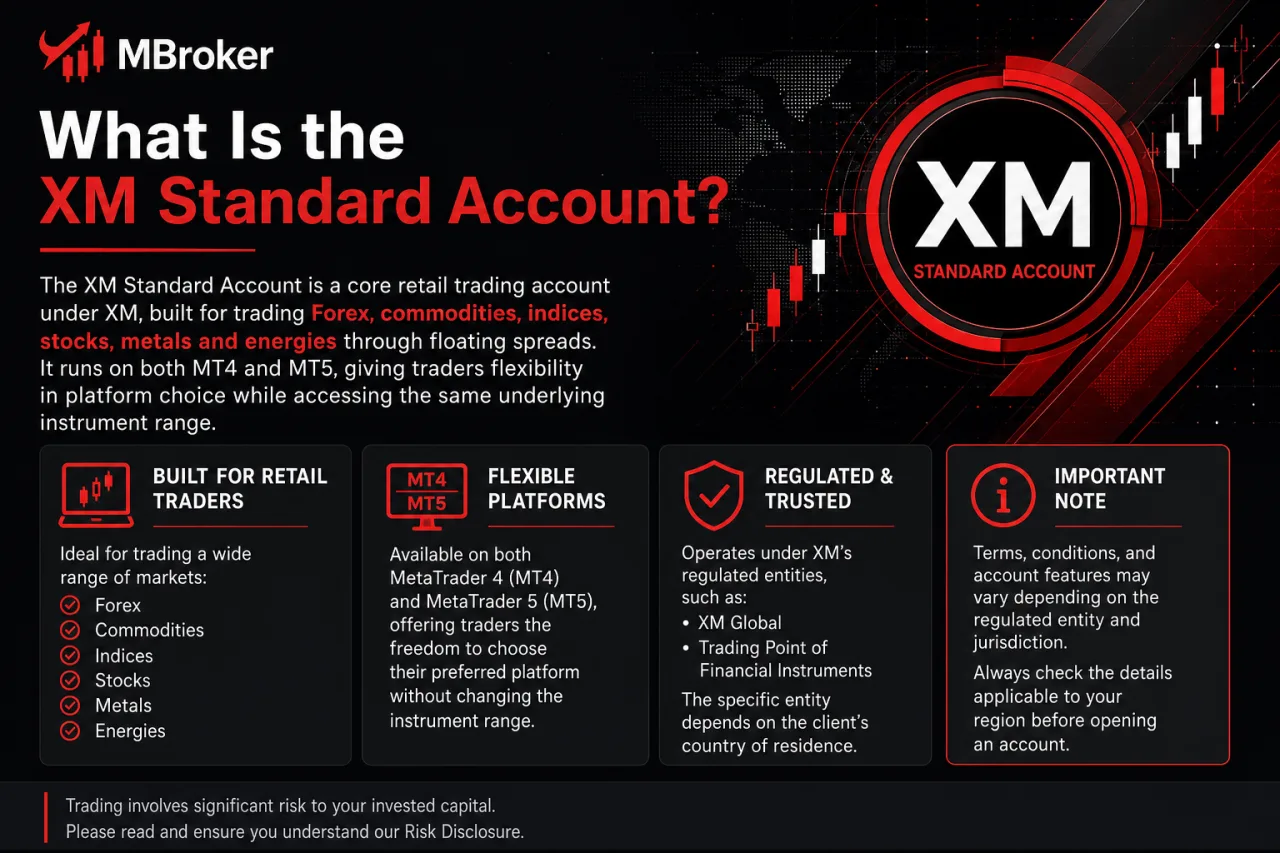
The XM Standard Account is a core retail trading account under XM, built for trading Forex, commodities, indices, stocks, metals and energies through floating spreads. It runs on both MT4 and MT5, giving traders flexibility in platform choice while accessing the same underlying instrument range.
The account operates under XM’s regulated entities, such as XM Global or Trading Point of Financial Instruments, with the specific entity assigned depending on the client’s country of residence. Terms, conditions and available features on the Standard Account vary by legal entity. According to XM’s official regulation page and Trading Point’s regulation page, XM operates under multiple entities. Trading Point MENA Limited is authorised and regulated by the Dubai Financial Services Authority (DFSA, reference no. F003484). XM Global Limited is regulated by the Financial Services Commission (FSC) of Belize (license no. 8557558). This means eligibility, leverage caps and instrument availability differ between clients registered under different XM entities.
The subsections below break down the account’s structure further, covering its position among XM’s retail offerings, supported client classifications, and core purpose within XM’s broader trading conditions.
Which Countries and XM Legal Entities Support the Standard Account?
XM Standard Account availability groups into distinct regional entities: XM Global Limited for offshore and general international clients, Trading Point MENA Limited for Middle East residents, and other Trading Point-affiliated entities covering additional jurisdictions. Each legal entity applies its own regulatory framework, and this shapes which clients access the Standard Account and under what trading conditions.
This grouping matters because leverage limits, negative balance protection and instrument availability on the Standard Account differ by entity rather than applying uniformly worldwide. Traders registered under an entity regulated by a European or stricter regulatory framework generally face lower leverage caps and tighter margin conditions compared to those under offshore entities like XM Global Limited in Belize.
Residents of certain jurisdictions, including the United States, do not qualify for the XM Standard Account at all, as XM does not accept clients from restricted countries. As established with XM’s official regulation page and Trading Point’s regulation page, the specific XM entity assigned to a trader, such as Trading Point MENA Limited or XM Global Limited, depends on their declared country of residence during registration rather than personal preference, which is why eligibility, leverage caps and instrument availability can differ between clients.
Traders verify which entity applies to their account and its corresponding terms directly through XM’s official regulation page before opening a Standard Account, since conditions such as maximum leverage and available instruments are entity-specific rather than universal across XM’s global operations.
Is the XM Standard Account for Retail or Professional Clients?
The XM Standard Account is designed primarily for retail clients, applying standard leverage caps and full negative balance protection rather than the reduced safeguards professional status carries. This retail-first structure ties directly back to client classification eligibility on the Standard Account.
Retail classification remains the default for most applicants opening a Standard Account, since it triggers automatic protections without requiring extra qualification. Professional client classification, where the regulating entity permits it, allows access to different leverage conditions but removes certain retail safeguards, including negative balance protection under some frameworks.
Eligibility for professional classification typically requires meeting criteria tied to trading experience, portfolio size or financial sector employment, and this option is not available under every XM entity.
Traders under stricter regulatory frameworks generally remain restricted to retail terms on the Standard Account, while those under offshore entities like XM Global Limited may find professional options less relevant since leverage caps already run higher by default.
What Are the Key Features and Trading Conditions of the XM Standard Account?
What Are the Key Features and Trading Conditions of the XM Standard Account
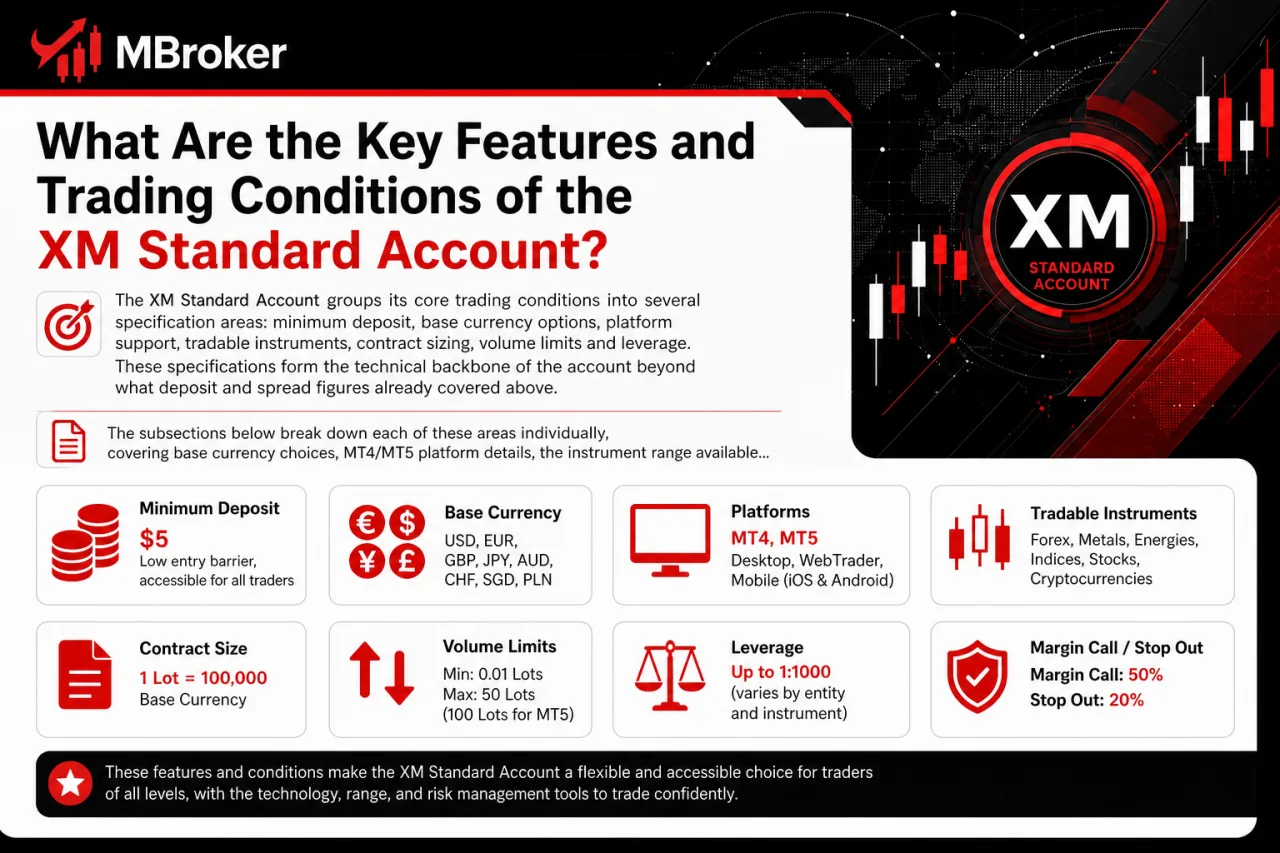
The XM Standard Account groups its core trading conditions into several specification areas: minimum deposit, base currency options, platform support, tradable instruments, contract sizing, volume limits and leverage. These specifications form the technical backbone of the account beyond what deposit and spread figures already covered above.
The subsections below break down each of these areas individually, covering base currency choices, MT4/MT5 platform details, the instrument range available, lot and volume conventions, and margin/leverage structure applied to Standard Account trading.
What Is the Minimum Deposit for the XM Standard Account?
The XM Standard Account requires a minimum deposit of $5, applying consistently across supported base currencies and most funding methods. This figure ties directly back to the funding requirement raised in the account’s overview above, so the following breaks down how the amount holds across entities and payment channels.
The $5 threshold applies as the entry point for opening or funding a Standard Account under XM’s retail entities, though some payment providers impose their own minimum transaction limits above this figure. According to XM’s official account types page, the deposit requirement stays uniform across the Standard Account regardless of the base currency selected, whether USD, EUR or another supported denomination.
Payment method matters mainly for processing speed and provider-imposed limits rather than the account’s own minimum, since bank wires or certain e-wallets sometimes carry higher minimum transfer amounts set by the payment processor itself. Traders confirm the exact figure applicable to their assigned legal entity through the official XM regulation page before funding, since entity-specific terms occasionally introduce variations not reflected on general marketing pages.
Which Base Currencies Are Available for the XM Standard Account?
The XM Standard Account supports multiple base currencies, commonly including USD, EUR, GBP and a few other major denominations, with the exact list depending on the client’s assigned XM entity. This ties back to the deposit structure covered above, where the $5 minimum stays uniform regardless of which currency a trader selects.
Base currency selection happens at the account opening stage and generally cannot be changed afterward, requiring a new account for a different currency. The specific set of base currencies offered on the Standard Account can vary by legal entity, meaning traders registered under Trading Point MENA Limited may see a different currency list than those under XM Global Limited.
Traders confirm the exact currency options available to them during the registration process itself, since the platform displays only the choices permitted under their country’s assigned entity. Matching the base currency to a trader’s local currency or funding source reduces conversion costs tied to deposits and withdrawals, though this remains a practical consideration rather than a fixed rule of the account.
Is the XM Standard Account Compatible with MT4 and MT5?
Yes, the XM Standard Account operates on both MT4 and MT5, with identical instrument access and trading conditions across either platform choice. This directly follows from the platform compatibility mentioned in the account overview above, so the details below clarify how the two versions differ for Standard Account holders.
MT4 remains the more established option, favored by traders relying on custom indicators and Expert Advisors built for that platform’s scripting language. MT5 offers additional order types, an extra timeframe selection and a built-in economic calendar, though the underlying spreads, contract sizes and leverage on the Standard Account stay the same regardless of platform.
Neither version restricts account features exclusive to the other on the Standard Account tier, so the choice comes down to interface preference and tool compatibility rather than trading cost or instrument range. Traders select either platform during account opening, and switching later generally requires opening a separate account under the desired platform.
What Leverage and Margin Conditions Apply to the Standard Account?
Leverage on the XM Standard Account reaches up to 1:1000 for eligible clients, though the actual maximum applied depends on the trader’s assigned XM entity and regulatory framework. This directly extends the entity-based differences already noted for the Standard Account’s eligibility and instrument access.
Entities regulated under stricter frameworks generally impose lower leverage ceilings compared to offshore entities such as XM Global Limited, which typically permit higher leverage tiers. Client classification also shapes the leverage cap, since professional clients under entities that permit this status access different leverage terms than retail clients on the same Standard Account.
Margin conditions on the Standard Account center on two key thresholds, both of which vary by entity:
- Margin call level: a point at which account equity relative to used margin drops low enough to trigger a warning notification.
- Stop-out level: a lower threshold that triggers automatic closure of open positions once account equity falls below it relative to used margin.
Traders confirm the precise leverage tier and margin thresholds applicable to their account through XM’s official regulation page or their live account dashboard.
What Are the Spreads and Commission Structure of the XM Standard Account?
What Are the Spreads and Commission Structure of the XM Standard Account
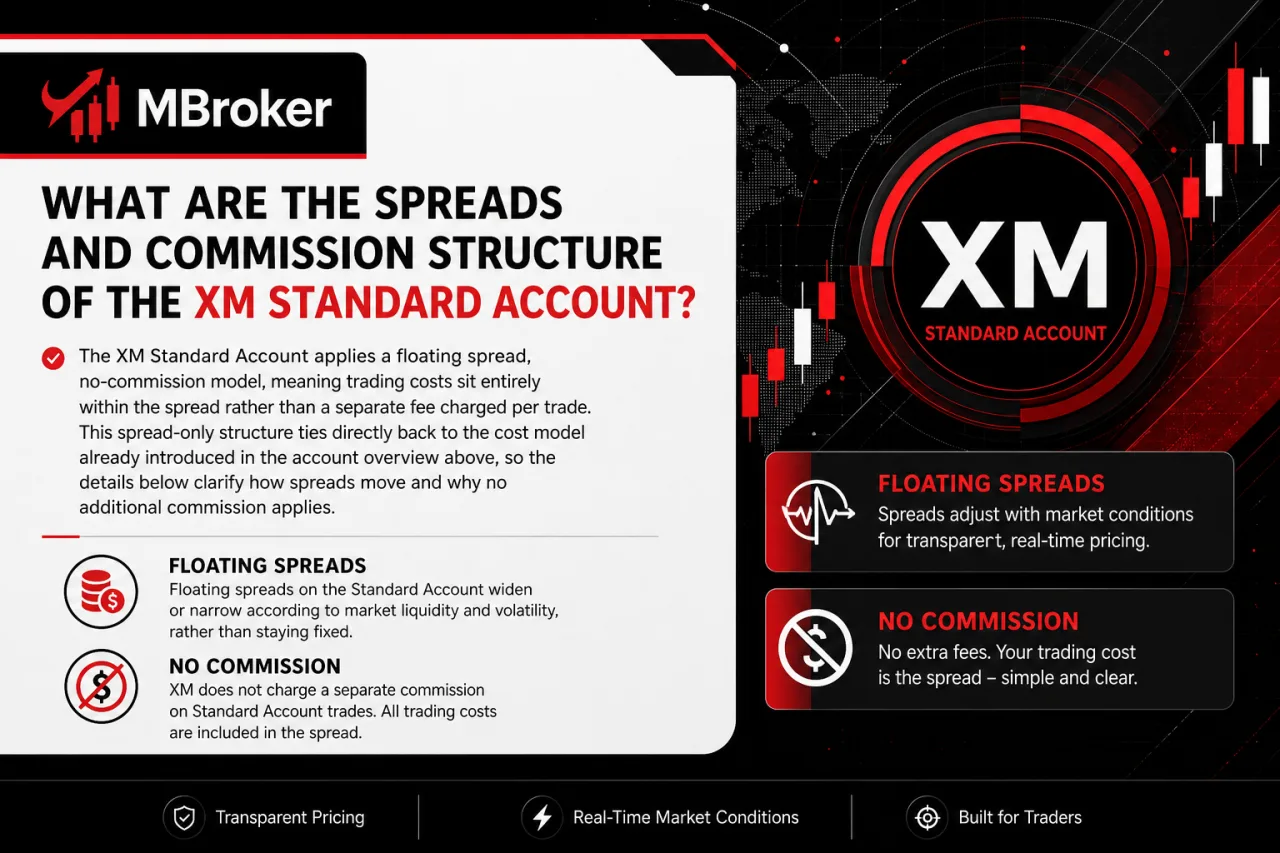
The XM Standard Account applies a floating spread, no-commission model, meaning trading costs sit entirely within the spread rather than a separate fee charged per trade. This spread-only structure ties directly back to the cost model already introduced in the account overview above, so the details below clarify how spreads move and why no additional commission applies.
Floating spreads on the Standard Account widen or narrow according to market liquidity and volatility, rather than staying fixed at a set pip value throughout the trading day. Spreads on the Standard Account are variable and depend on the traded instrument and prevailing market conditions, rather than a fixed starting figure.
This no-commission setup differs from XM’s commission-based account tiers, where trading costs split between a tighter raw spread and a fixed per-lot commission charged separately. On the Standard Account, brokers fold their markup into the spread itself, so traders see one combined cost figure rather than two distinct charges appearing on each transaction.
Spread width also varies by instrument category, with major currency pairs generally carrying tighter spreads than exotic pairs, indices or commodities under normal market conditions. Traders confirm live spread figures through the MT4 or MT5 platform interface directly, since published spread ranges reflect typical conditions rather than guaranteed constant values at every moment of trading.
XM Standard Account vs Other XM Account Types: What Are the Differences?
XM Standard Account vs Other XM Account Types: What Are the Differences
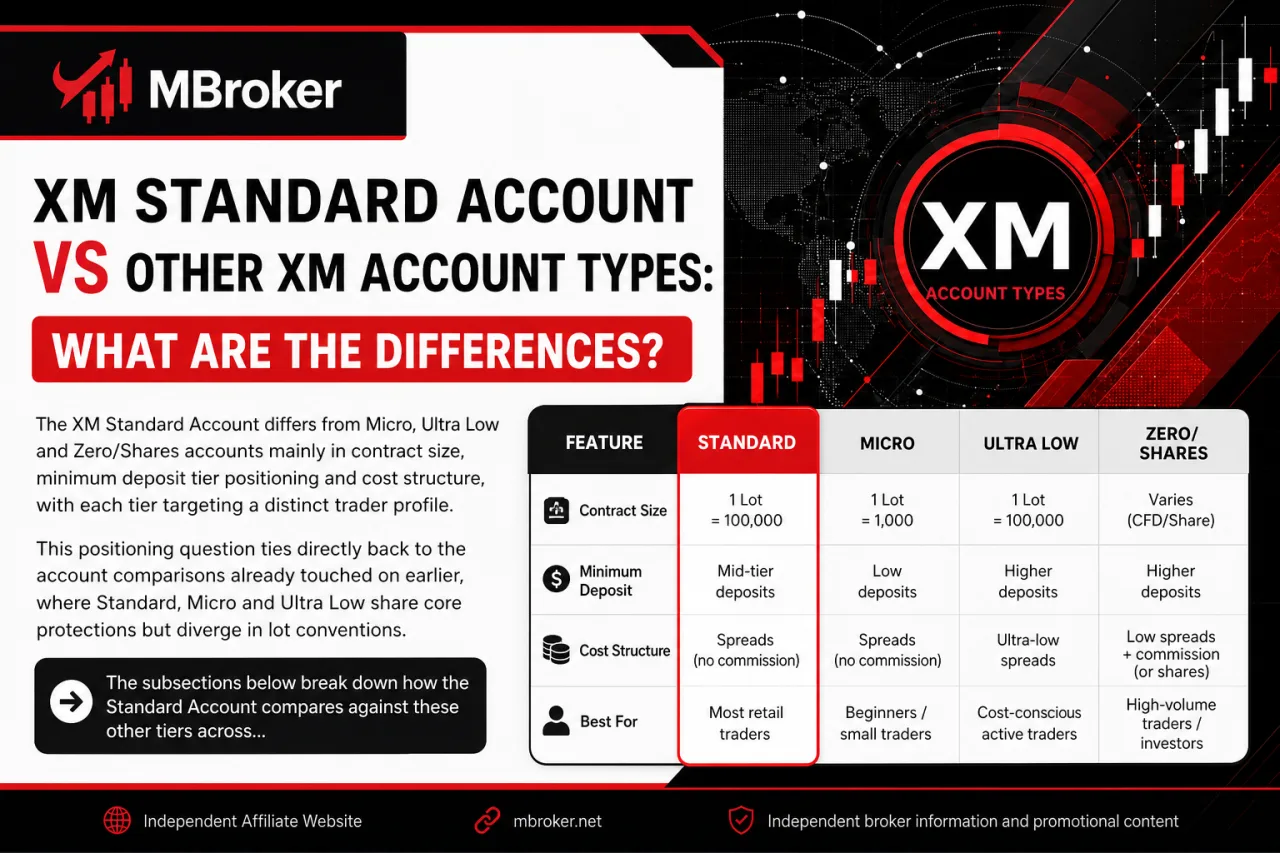
The XM Standard Account differs from Micro, Ultra Low and Zero/Shares accounts mainly in contract size, minimum deposit tier positioning and cost structure, with each tier targeting a distinct trader profile. This positioning question ties directly back to the account comparisons already touched on earlier, where Standard, Micro and Ultra Low share core protections but diverge in lot conventions.
The subsections below break down how the Standard Account compares against these other tiers across minimum deposit, spreads, commission, lot sizing and the type of trader each account suits best.
Standard Account vs Micro Account: What Is the Difference?
The Standard Account differs from the Micro Account mainly in contract size, with 1 lot equal to 100,000 units on the Standard Account versus 1,000 units on the Micro Account. This gap in contract sizing directly shapes which trader profile each account suits and how deposit amounts translate into position exposure.
The larger contract size on the Standard Account means each pip movement carries greater monetary value, positioning it toward traders comfortable managing standard lot exposure. The Micro Account’s smaller 1,000-unit contract size lets beginners trade with reduced monetary risk per pip, making it a common entry point for newer traders testing strategies with limited capital.
Minimum deposit requirements across both accounts stay at the same entry threshold under XM’s retail entities, so the distinction between Standard and Micro comes down to lot structure and risk-per-trade rather than funding access. Traders choosing between the two generally weigh their comfort with position sizing and per-pip risk exposure rather than deposit affordability, since both tiers remain accessible at the same low starting deposit already noted for the Standard Account.
Standard Account vs Ultra Low Account: What Is the Difference?
The Standard Account and Ultra Low Account differ mainly in spread positioning, with the Ultra Low Account generally carrying tighter starting spreads while both retain a no-commission structure. This spread-focused distinction ties directly into the cost comparison already outlined for the Standard Account against other XM tiers.
Neither account charges a separate per-lot commission, so trading costs on both sit entirely within the spread itself rather than splitting between a raw spread and a fixed fee. The Ultra Low Account targets cost-sensitive and high-frequency traders through comparatively lower floating spreads, positioning it closer to scalping and volume-driven strategies. The Standard Account, by comparison, suits traders prioritizing standard lot conventions and broader instrument familiarity over the narrowest possible spread margin.
Contract sizing and minimum trading volume also diverge between the two tiers, following the same entity-dependent variation already noted for lot structures across XM’s account lineup. Traders running frequent trades or scalping strategies generally lean toward the Ultra Low Account for its spread advantage, while those less sensitive to marginal spread differences find the Standard Account’s lot conventions more familiar. Confirming exact spread figures for both tiers happens directly through the MT4 or MT5 platform interface, since published ranges reflect typical rather than guaranteed conditions.
How to Open an XM Standard Account?
How to Open an XM Standard Account
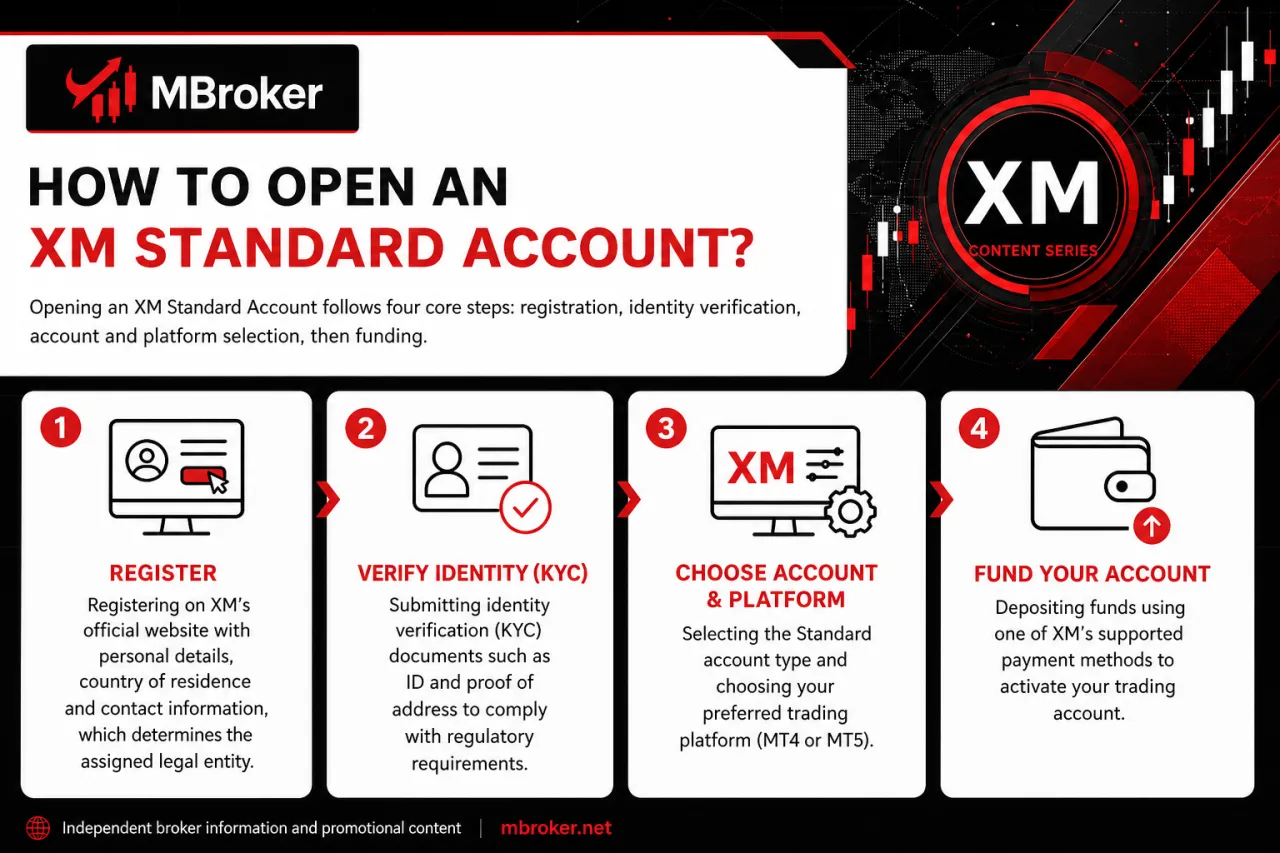
Opening an XM Standard Account follows four core steps: registration, identity verification, account and platform selection, then funding. This process ties directly back to the account opening mention already raised in the article’s introduction, so the breakdown below walks through each step in sequence.
- Registering on XM’s official website with personal details, country of residence and contact information, which determines the assigned legal entity.
- Submitting identity verification (KYC) documents, typically a government-issued ID and a proof of address, to satisfy the regulatory requirements of that assigned entity.
- Selecting the Standard Account type along with either the MT4 or MT5 platform during the account setup stage.
- Funding the account through an available payment method, meeting the minimum deposit threshold already covered earlier in this article.
Exact document requirements and verification steps vary by legal entity, since Trading Point MENA Limited and XM Global Limited each apply their own regulatory checks. Traders confirm the precise steps and required documents applicable to their country through XM’s official registration portal, since the process outlined above reflects the general sequence rather than a fixed procedure identical across every entity.
What Other Account Options Are Available Alongside the XM Standard Account?
Alongside the core trading conditions already covered, the XM Standard Account offers a free demo version, an Islamic swap-free option, and a defined set of account-specific restrictions. These three areas shape whether the account suits practice trading, overnight-holding preferences, or specific trading styles. The subsections below break down each option individually, covering demo access, swap-free eligibility, and restrictions like scalping, hedging and inactivity policies.
Can the XM Standard Account Be Opened as a Demo Account?
Yes, XM offers a free demo version of the Standard Account, mirroring the same instrument range, spreads and leverage conditions for practice trading without risking real capital. This demo option answers the practice-trading question raised for Standard Account holders.
The demo account runs on MT4 or MT5, matching the live Standard Account’s floating spread and no-commission structure so practice trades reflect realistic market conditions. Traders receive virtual funds upon registration, and balances reset or expire after extended inactivity rather than carrying forward indefinitely. The demo account applies a virtual balance and an inactivity-based expiry period, though the exact reset threshold depends on the trader’s assigned XM entity.
No identity verification applies to demo registration, unlike the live Standard Account’s KYC requirement covered earlier. Traders confirm current demo-specific limits directly through XM’s official platform before relying on it for strategy testing.
Is a Swap-Free (Islamic) Version of the Standard Account Available?
Yes, XM offers a swap-free Islamic version of the Standard Account, replacing overnight swap charges with an administrative fee for eligible clients. This swap-free option answers the overnight-holding question raised for Standard Account holders.
Eligibility ties mainly to religious grounds, since the swap-free structure caters to traders following Islamic finance principles that prohibit interest-based charges. Availability also depends on the client’s assigned XM entity and country of residence, meaning not every Standard Account holder qualifies for swap-free status regardless of religious basis. Approved accounts stop accruing standard overnight interest on open positions, with the swap-free arrangement substituting a fixed administrative fee on certain instruments or after a defined holding period instead.
This modification changes only the swap component of trading costs, leaving spreads, leverage and contract sizes on the Standard Account unaffected. Traders confirm current swap-free eligibility, applicable fees and any instrument-specific restrictions directly through XM’s official platform or their assigned entity’s terms before requesting the conversion.
Conclusion: Is the XM Standard Account Right for You?
The XM Standard Account may suit traders who prefer standard lot sizing, floating spreads without a separate commission, and access to both MT4 and MT5. However, its larger contract size requires more careful position management than the Micro Account, while traders prioritising tighter spreads should also compare the Ultra Low Account.
Before opening an account, verify its availability, leverage, instruments, margin rules and swap-free conditions under the XM legal entity serving your country. A low minimum deposit does not eliminate the significant risks associated with leveraged trading.

Neria Solven is Mbroker’s XM Accounts, Fees and Promotions Editor, covering account types, trading costs, payment methods and promotional programmes. Email: [email protected]